

Editor’s note: This article features the chapter “Visions of Deity in the Kirtland Temple” from Karl Ricks Anderson’s book The Savior in Kirtland.
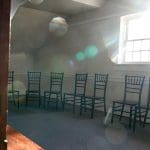
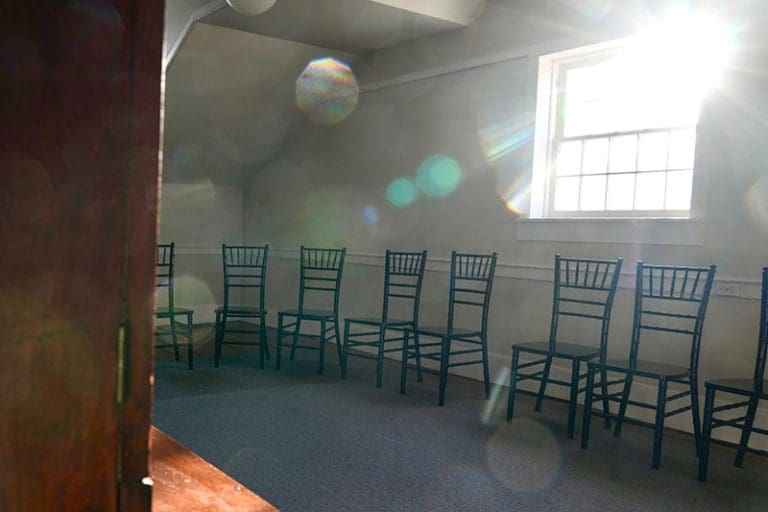
Cover photo: Joseph Smith’s office, west end of the third floor of the Kirtland Temple.
In the Kirtland Temple, visions of Deity and unparalleled spiritual manifestations flowed down upon the Saints. Most visions came during meetings as Joseph Smith conducted recently revealed sacred temple ordinances. When the Saints erected the first house of the Lord in this last dispensation, with humble faith and under direction of their prophet, they fully expected to see or feel the presence of the Savior and experience heavenly manifestations. Joseph taught the new Twelve Apostles, “All who are prepared and are sufficiently pure to abide the presence of the Saviour will see him in the solemn assembly.”1 
Letters from Church leaders indicated that ordinary Church members had been prepared to expect visions and heavenly manifestations. In one letter they wrote: “Within that house God will pour out his spirit in great majesty and glory and encircle his people with fire more gloriously and marvelously than at Pentecost because the work to be performed in the last days is greater than was in that day.”2
Modern-Day Pentecost
Because people of that period knew the Bible, they were familiar with the pentecostal period in the New Testament that surrounded the ascension of Christ and the descent of the Holy Ghost in Jerusalem. Large numbers of Jews witnessed speaking in tongues and seeing “cloven tongues like as of fire.”3 After the outpourings of the Holy Ghost, the Saints of the primitive Church had visions, participated in healings, and beheld wonders and signs. So it was in Kirtland. These modern disciples likewise experienced such spiritual manifestations.
The magnitude, depth, and variety of these manifestations in the Kirtland Temple compelled the Prophet Joseph Smith to record the following:
It was a Pentecost and an endowment indeed, long to be remembered, for the sound shall go forth from this place into all the world, and the occurrences of this day shall be handed down upon the pages of sacred history, to all generations; as the day of Pentecost, so shall this day be numbered and celebrated as a year of jubilee, and time of rejoicing to the Saints of the Most High God.4
The Lord’s inspired prophets of old foresaw and taught of future pentecostal periods such as Kirtland’s. Joel prophesied anciently: “I will pour out my spirit upon all flesh; and your sons and your daughters shall prophesy, your old men shall dream dreams, your young men shall see visions: And also upon the servants and upon the handmaids in those days will I pour out my spirit.”5
During Pentecost, Peter recognized that Joel’s prophecy had descended upon the Saints in Jerusalem. He informed the Jews: “These are not drunken, as ye suppose. . . . But this is that which was spoken by the prophet Joel.”6 The manifestations spoken of by Peter were not the complete fulfillment of Joel’s prophecy, however. As Moroni instructed young Joseph in 1823, he “quoted the second chapter of Joel, from the twenty-eighth verse to the last. He also said that this was not yet fulfilled, but was soon to be.”7
Lorenzo Snow declared that the fulfillment of Joel’s prophecy began for the Latter-day dispensation in the Kirtland Temple. He said:
[The] magnificent [Kirtland] Temple was completed and dedicated to the Lord in the presence of thousands. The day of blessings, and of rejoicings in the history of the Saints, had now arrived. . . . The youth, the middle aged, both men and women, clothed with the spirit of inspiration, would speak, as with the tongue of angels. . . . One would exercise the gift of tongues, another that of interpretation, and some would have the gift of prophecy. One would speak of the blessings of faith, another would testify of knowledge, and some would have the spirit of exhortation. Thus were their gifts exercised, and all edified together, proving they lived in the time of the fulfilment of Joel’s prophecy.8
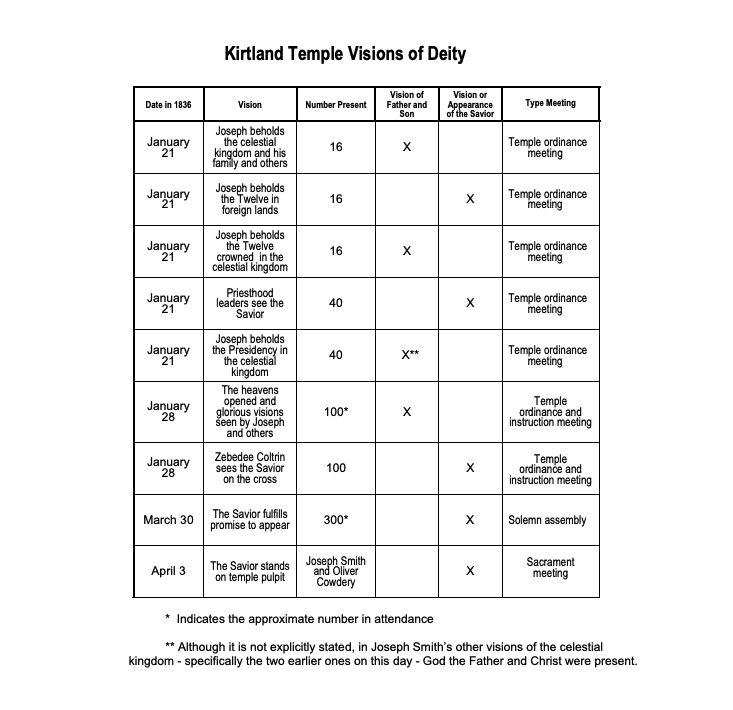
This latter-day pentecostal manifestation indeed fulfilled Joel’s prophecy. Visions and spiritual manifestations flowed down from the heavens as he had prophesied.9 The Savior appeared in the temple in at least eight different visions (see chart, p. 229). The Father and the Son were seen together in four visions. In more than ten meetings, such as the two temple dedications, sacrament services, and priesthood leadership meetings, congregations experienced the presence of heavenly beings. Many Saints saw and heard manifestations such as the gift of tongues, sounds of a mighty wind, a pillar of fire resting upon the temple roof, prophesying, and voices of angels.
Benjamin Brown recorded that this pentecostal period was “even greater than at the day of Penti[cost].” He further elaborated, declaring:
Some have seen the heavens opend& seen the savior[;] others have seen angels on the four corners of the house of the Lord with drawn swords & also stood thick on the ridge Elisha with his chariot of Fire, Peter John & James. . . . Old father Adam was seen B[ea]utiful man his hair stood back & curled most b[ea]utiful even down on his shoulders.10
Following are accounts of visions of Deity in the Kirtland Temple on four different glorious days from January to April 1836.
Visions of Deity, January 21, 1836
The first recorded visions of Deity in the Kirtland Temple occurred January 21, 1836, in Joseph Smith’s office on the temple’s highest level. Joseph gave detailed descriptions of at least two extended visions experienced on that remarkable day. Each vision consisted of distinct parts. The occasion for each vision was the ordinance of anointing the head with oil of the First Presidency, bishoprics, and high councilors.
Vision of the Father and the Son in the Celestial Kingdom
The promised visions began as Joseph Smith was meeting with fifteen other Church leaders.11 As the visions occurred, the Prophet introduced, for the first time in this dispensation, the ordinance of anointing with oil in a temple of the Lord. He described the start of the first vision of the day: “The heavens were opened upon us, and I beheld the celestial kingdom of God, and the glory thereof, whether in the body or out I cannot tell.
I saw the transcendent beauty of the gate through which the heirs of that kingdom will enter, which was like unto circling flames of fire;
Also the blazing throne of God, whereon was seated the Father and the Son.
I saw the beautiful streets of that kingdom, which had the appearance of being paved with gold.
I saw Father Adam and Abraham; and my father and my mother; my brother Alvin, that has long since slept.12
Vision of Christ and the Latter-day Twelve Apostles
In the next part of his visions of this day, Joseph saw the Savior weep over His discouraged band of Apostles. He recorded:
I saw the 12, apostles of the Lamb, who are now upon the earth who hold the keys of this last ministry, in foreign lands, standing together in a circle much fatiegued, with their clothes tattered and feet swolen, with their eyes cast downward, and Jesus <standing> in their midst, and they did not behold him, . . . the Saviour looked upon them and wept.13
Twelve Apostles in the Celestial Kingdom
In the concluding scene of these visions, Joseph apparently watched until the Twelve arrived at the gate to the celestial kingdom and found Father Adam acting as gatekeeper and escort of the faithful to the throne. In recording this part of the vision, Joseph stated simply, “I finally saw the 12, in the celestial Kingdom of God.”14 Nonetheless, Heber C. Kimball remembered further details of Joseph’s vision, undoubtedly told him by the Prophet:
He (Joseph) saw until they [the Twelve] had accomplished their work, and arrived at the gate of the celestial city; there Father Adam stood and opened the gate to them, and as they entered he embraced them one by one and kissed them. He then led them to the throne of God, and then the Savior embraced each one of them and kissed them, and crowned each one of them in the presence of God. He saw that they all had beautiful heads of hair and all looked alike. The impression this vision left on Brother Joseph’s mind was of so acute a nature, that he never could refrain from weeping while rehearsing it.15
Vision of Christ with the High Councils of Kirtland and Zion
Later on January 21, the high councilors of Kirtland and Zion joined the ones already in the meeting, which increased attendance to forty brethren. These brethren also participated in visions of Deity that day. Joseph recorded:
The vision of heaven . . . <was> opened to these also, some of them saw the face of the Saviour, and others were ministered unto by holy angels, and the spirit of propesey and revelation was poured out in mighty power, and loud hosanahs and glory to God in the highest, saluted the heavens for we all communed with the h[e]avenly hosts.16
According to Joseph, “Some of them saw the face of the Savior.” This probably indicates that at least three17 other Church leaders besides Joseph became eyewitnesses to Christ’s existence and leadership of the Church.18
Vision of the Presidency in the Celestial Kingdom
During this final meeting of leaders that now included the high councilors of Kirtland and Zion, Joseph Smith beheld his third vision of the celestial kingdom that day. This time he saw many of those forty brethren, including the presidency, in that celestial setting. He stated: “I saw in my vision all of the presidency in the Celistial Kingdom of God, and, many others who were present.”19 In each of his two other visions of the celestial kingdom that day, the Prophet had seen the Father and the Son and also men who were assisting Joseph in leading the Church, many of whom were present in the meetings. In the first of those visions, Joseph saw God’s throne, the Father and the Son, and others, including his father, who had just anointed him. In the next vision, he saw the Twelve being embraced by the Savior in the presence of the Father. In the third vision, he sees the presidency there with other leaders who are with him in the meeting. Although he didn’t state it directly, it is probable that this final vision also included the Father and Son, because that was the pattern set in the two other visions.
Apparently because of the sacred nature of the visions, Oliver Cowdery, who was present at the meeting, did not record many details. He leaves us wishing for more details, however, with what he did write: “The glorious scene is too great to be described in this book, therefore, I only say, that the heavens were opened to many, and great and marvelous things were shown.”20
God the Father and Christ Seen in Meeting of Quorums, January 28, 1836
Seven days following the incredible visions of January 21, Joseph Smith and his counselors instructed high priests, seventies, and elders assembled in the Kirtland Temple. The leaders introduced to this group the ancient ordinance of anointing with oil. In addition, Joseph Smith conducted the procedure of sealing blessings given them in the anointing. During the proceedings, marvelous visions were distilled upon the priesthood quorums. In this meeting, Zebedee Coltrin saw the Savior. The Prophet recorded this and other visions: “Elder Roger Orton saw a mighty angel riding upon a horse of fire, with a flaming sword in his hand, followed by five others, encircle the house, and protect the Saints, even the Lord’s anointed, from the power of Satan and a host of evil spirits, which were striving to disturb the Saints.
“President William Smith, one of the Twelve, saw the heavens opened, and the Lord’s host protecting the Lord’s anointed.
“President Zebedee Coltrin, one of the seven presidents of the Seventy, saw the Savior extended before him, as upon the cross, and a little after, crowned with glory upon his head above the b[r]ightness of the sun.”21
Harrison Burgess added that Joseph Smith also saw the Savior. In his autobiography, Harrison vividly recalled that in the middle of the meeting, “Joseph exclaimed aloud, ‘I behold the Saviour, the Son of God.’”22 He recorded the following:
The Lord blessed His people abundantly in that Temple with the Spirit of prophecy, the ministering of angels, visions, etc. I will here relate a vision which was shown to me. It was near the close of the endowments. I was in a meeting for instruction in the upper part of the Temple, with about a hundred of the High Priests, Seventies and Elders. The Saints felt to shout “Hosannah!” and the Spirit of God rested upon me in mighty power and I beheld the room lighted up with a peculiar light such as I had never seen before. It was soft and clear and the room looked to me as though it had neither roof nor floor to the building and I beheld the Prophet Joseph and Hyrum Smith and Roger Orton enveloped in the light: Joseph exclaimed aloud, “I behold the Savior, the Son of God.” Hyrum said, “I behold the angels of heaven.” Brother Orton exclaimed, “I behold the chariots of Israel.”23
Two journal accounts lead to a conclusion that both the Father and the Son appeared in vision in this meeting. In an 1879 Sunday meeting, Harrison supplemented his journal account by adding that Joseph Smith also saw God the Father at that time. Charles Lowell Walker, one of the Church’s foremost diary keepers, heard Harrison say that Joseph saw both the Father and the Son. Charles then carefully recorded Harrison’s words in his journal entry:
Br Harrison Burgess spoke of the first Endowments given in the Kirtland Temple and that all the quorums met at one time in the Attic; Joseph and Hyrum met with them. He said that all at once there was a Heavenly and Divine Atmosphere surrounded them, and it seemed as if the rafters and Beams were all gone and Joseph gazing up said, I See the Son of God sitting at the right hand of the Father. Hyrum at the same instant said, I behold the Angels of Heaven, and Roger Orton said, I see the Horses and Chariots of Heaven.24
Although Joseph omitted in his journal account that he saw a vision of Deity, he did record that he saw “a glorious vision.”25 In his journal Harrison concluded that all present experienced the power of God. He wrote, “All who were in the room felt the power of God to that degree that many prophesied, and the power of God was made manifest, . . . the remembrance of which I shall never forget while I live upon the earth.”26
Another account attests to both the Father and the Son appearing, probably on this day. David Patten, a member of the Quorum of the Twelve Apostles, also attended. David visited Abraham Smoot, a recent convert, in Kentucky within weeks of the temple dedication and told him about seeing God the Father and Jesus Christ in vision. Wilford Woodruff recorded his account:
He [Abraham Smoot] had Been with Elder Patten & his wife for several days. Br Smoot related the news to me from Br Patten which was glorious in the first degree. He gave me an account of the endowment at Kirtland Ohio. The heavens Was opened unto them. Angels & Jesus Christ was seen of them sitting at the right hand of the father.27
Joseph Smith described how the impact of the vision stayed with him during the night: “After these quorums were dismissed, I retired to my home, filled with the Spirit, and my soul cried hosanna to God and the Lamb, through the silent watches of the night; and while my eyes were closed in sleep, the visions of the Lord were sweet unto me, and His glory was round about me. Praise the Lord.”28
Divine Presence Felt in Dedicatory Services, March 27, 1836
Many journals testifying of heavenly manifestations on the day the temple was dedicated made reference to a divine presence. In what may have been a reference to Deity, Nancy Tracy recorded that “the heavenly influence rested down upon that house. . . . Heavenly Beings appeared to many. . . . It was heaven on earth.”29
Eliza R. Snow stated that “an abiding holy heavenly influence was realized.”30 In another account she wrote that the whole congregation felt the presence of divinity: “The ceremonies of that dedication may be rehearsed, but no mortal language can describe the heavenly manifestations of that memorable day. Angels appeared to some, while a sense of divine presence was realized by all present, and each heart was filled with ‘joy inexpressible and full of glory.’”31
Other spiritual manifestations were evident. Participants such as Benjamin Brown testified: “There the Spirit of the Lord, as on the day of Pentecost, was profusely poured out. . . .
“We had a most glorious and never-to-be-forgotten time. Angels were seen by numbers present.”32 A heavenly messenger who Joseph Smith said was Peter and who had “come to accept the dedication” was seen entering the temple and sat between Frederick G. Williams and Joseph Smith Sr.33 It seems that on the day of dedication, the Savior sent Peter, the presiding Apostle of the prior dispensation, to visibly accept the dedication. Then, a week later, Christ Himself appeared.
The Pentecost Continues in Priesthood Meeting, March 27, 1836
At a priesthood meeting held in the temple the evening of the temple dedication, additional pentecostal manifestations were given to the Saints. Benjamin Brown recorded:
Sunday Evening . . . Joseph spoke . . . & told them the day of Penticost was continued the . . . Brethren began to
. . . prophesy many prophesied in the name of the Lord then began speaking in tongues and it filled as it were the whole house, perhaps there were forty speaking at once Cloven tongues of fire was seen to sit on many of them an hand was seen laid upon one when he spake in tongues . . . many Visions seen, one saw a [pillar] or cloud rest down upon the house bright as when the sun shines on a cloud like as gold, two others saw three personages hovering in the room with bright keys in their hands, and also a bright chain in their hands. . . .. . . The west end of the House was illuminated by a light from heaven seen on the outside by many. . . .
Father Stephens saw . . . two rows of Angels through the House, at another time the glory of God came down on the Elders from the head down half way.34
Joseph Smith recorded the events of this evening meeting. He made a note about personally beholding a pillar of fire, writing:
All the congregation simultaneously arose, being moved upon by an invisible power; many began to speak in tongues and prophesy; others saw glorious visions; and I beheld the Temple was filled with angels, which fact I declared to the congregation. The people of the neighborhood came running together (hearing an unusual sound within, and seeing a bright light like a pillar of fire resting upon the Temple), and were astonished at what was taking place.35
Oliver Cowdery, present on the evening of the dedication, saw the glory of God descend upon the temple. He recorded:
In the evening I met with the officers of the church in the Lord’s house. The Spirit was poured out—I saw the glory of God, like a great cloud, come down and rest upon the house, and fill the same like a mighty rushing wind. I also saw cloven tongues, like as of fire rest upon many, (for there were 316 present,) while they spake with other tongues and prophesied.36
On the day of dedication, the Lord indeed rewarded His valiant people by opening the heavens.37 These Saints, in addition to building the Kirtland Temple, had sanctified their lives so that “the Son of Man might have a place to manifest himself to his people.”38
The Savior Appears at the Solemn Assembly in the Kirtland Temple, March 30, 1836
Joseph Smith, upon convening the long-awaited solemn assembly, said, “The presidency, the 12, the seventies, the high . . . councils, the Bishops and their entire quorums, the Elders, and all the official members in this stake of Zion amounting to about 300 met in the temple of the Lord.”39 Heber C. Kimball remembered the procedure followed in the solemn assembly:
When the Prophet Joseph had finished the endowments of the First Presidency, the Twelve and the Presiding Bishops, the First Presidency proceeded to lay hands upon each one of them to seal and confirm the anointing; and at the close of each blessing the whole of the quorums responded to it with a loud shout of Hosanna! Hosanna! etc.
While these things were being attended to the beloved disciple John was seen in our midst by the Prophet Joseph, Oliver Cowdery and others. After this all the quorums arose in order, together with the three Presidencies; and the Twelve then presented themselves separately and individually before the First Presidency, with hands uplifted towards heaven, and asked of God whatever they felt to desire; and after each individual petition the whole of the quorums answered aloud Amen! Hosanna! Hosanna! Hosanna! To God and the Lamb, forever and ever, amen and amen.
. . . As a reward for their preparation, the Prophet promised, “All who are prepared, and are sufficiently pure to abide the presence of the Savior, will see Him in the solemn assembly.”40
The reward came to those who were prepared. The Savior appeared to some of the priesthood as described by Joseph:
The brethren continued exhorting, prophesying, and speaking in tongues until five o’clock in the morning. The Savior made His appearance to some, while angels ministered to others, and it was a Pentecost and an endowment indeed, long to be remembered, for the sound shall go forth from this place into all the world, and the occurrences of this day shall be handed down upon the pages of sacred history, to all generations; as the day of Pentecost, so shall this day be numbered and celebrated as a year of jubilee, and time of rejoicing to the Saints of the Most High God.41
Benjamin Brown recorded additional details of these and other spiritual manifestations in a letter to his wife. He mentioned two brethren who saw Christ. Although he wrote without punctuation and in seemingly disjointed thoughts, he provides a more complete account. He wrote: “Many Prop[h]esys [were] given & speaking in tongues . . . two corums continued all night in the House the twelve guarded it the Heavens was opened two saw the savior some saw chariots and other thing[s] one lay about half an hour & saw from Eternity to Eternity many Miracilous Experiences told Many Visions told.”42
Vision of Christ, Moses, Elias, and Elijah, April 3, 1836
The pinnacle of all the holy events transpiring in Kirtland and possibly even in the history of the young latter-day Church was reached with the supernal visions of this day. The Savior Jesus Christ—followed by Moses, Elias, and Elijah—stood before Joseph Smith and Oliver Cowdery to instruct them and to bestow on them long-awaited priesthood keys and authority to carry out the missions of the Church. Joseph’s journal relates that as he and Oliver rose from prayer, Christ stood before them in His full glory. After testifying of Himself and His resurrection, He acknowledged His acceptance of His house, the temple. He then promised to appear again to His faithful servants. Joseph testified:
We saw the Lord standing upon the breastwork of the pulpit, before us. . . . His eyes were as a flame of fire; the hair of his head was white like the pure snow; his countenance shone above the brightness of the sun; and his voice was as the sound of the rushing of great waters, even the voice of Jehovah, saying: I am the first and the last; I am he who liveth, I am he who was slain; I am your advocate with the Father. . . . I have accepted this house. . . . I will appear unto my servants, and speak unto them with mine own voice, if my people will keep my commandments, and do not pollute this holy house.43
Joseph and Oliver related this vision to other early leaders. In turn, William W. Phelps told his wife of the vision, saying, “On Sunday, April 3, the twelve held meeting and administered the sacrament. It was a glorious time. The curtains were dropt in the afternoon. And there was a manifestation of the Lord to Br Joseph and Oliver, [by] which they [learned] thus the great & terrible day of the Lord as mentioned by Mal[a]chi, was near, even at the doors.”44
Lorenzo Snow remembered the testimonies of Joseph and Oliver almost fifty years later. He said, “Those who saw Him testify to this fact.”45 He made particular reference to his association with Joseph and Oliver and to their vision. He said, “There were two persons [Joseph Smith and Oliver Cowdery] with whom I was very well acquainted who saw [Christ] . . . in the Temple in Kirtland, Ohio.”46 Lorenzo was so well acquainted with the vision that he gave these details: “They were sitting side by side, as my brethren are sitting here on this stand, and the Son of God appeared to them.” Lorenzo had obviously heard them relate the vision in 1836. He knew which pulpit Christ stood upon. He later said, “I have preached from that pulpit many times.”47 In relating his feelings in his journal, he tells of the first time he preached from the pulpit:
No language can describe my feelings when, for the first time, I stood up in one of those pulpits to address an audience—a pulpit on the breastwork of which, only a short time before, this holy Personage stood—‘his hair as white as pure snow, his eyes as a flame of fire’—where also Moses, Elias and Elijah came and committed the keys of their dispensations to Joseph Smith.48
The appearance of these divine heavenly visitors was even stamped on the memory of children. Mary Ann Stearnes Winters, a stalwart Utah pioneer, always remembered how, when she was a child, her mother showed her the exact spot where the Savior stood. She said, “Mother took me to the stand and showed me the place on the pulpit where the Savior had stood when He appeared to the Prophet, and where afterwards Moses and Elias came and delivered the keys for the gathering of the Saints (Israel), and the redemption of the dead.”49
Seemingly, the non-LDS community was aware of the Savior’s visit. One week after this vision of Christ, Lucius Parsons, a local resident, wrote of it to his sister: “They report that the Savior appeared personally with angels and endowed the Elders with powers to work Miracles.”50
Orson Pratt, who no doubt was present on April 3, 1836, concluded that this vision of Christ, Moses, Elias, and Elijah in itself rewarded the Saints for all they had endured in building the temple. He said:
Then you see that even this one revelation, which God gave in that Temple, paid the people for the toil they had endured in erecting it. What a satisfaction it was to them to know that angels administered in that Temple! What a satisfaction it was for them to go into that Temple and have the heavens opened to them so that they could gaze on the glory of God! What a satisfaction it was for them to know that the Lord accepted, as His own, the house which they had built according to the pattern which He had given! And what a satisfaction it was for them to know that they loved God by keeping His commandments!51
The Voice of God
Other manifestations experienced by the early Saints in the Kirtland Temple were preserved. For example, Warren Snow testified: “I have seen the power of God manifested. . . . I remember when receiving my endowments in the Temple at Kirtland, I heard the voice of God as plain as I hear my own, and this testimony I have borne for thirty-one years.”52
That We Might Know Jesus Christ
Through visions, appearances, manifestations, and an infusion of glory, the Lord bestowed His divine love upon His new Saints. With His voice from the heavens, He defined the path to be taken for His children to return and dwell with Him forever. When the accounts of the visions are read through spiritual eyes, a sense of overwhelming love seems to draw us closer to the Savior. From the Kirtland Temple, there comes an assurance that the crucified Savior truly did rise from the tomb. As He declared to Joseph and Oliver, He was slain, was resurrected, bears our sins, and truly is our advocate with the Father.53
Footnotes
1. Dean C. Jessee, Mark Ashurst-McGee, and Richard L. Jensen, eds.,Journals, 1832–1839, vol. 1 of the Journals series of The Joseph Smith Papers, edited by Dean C. Jessee, Ronald K. Esplin, and Richard Lyman Bushman (Salt Lake City: Church Historian’s Press, 2008), 99.
2. Sidney Rigdon, Newel K. Whitney, and Oliver Cowdery, May 6, 1834, in Stanley R. Gunn, Oliver Cowdery: Second Elder and Scribe (Salt Lake City: Bookcraft, 1962),101.
3. Acts 2:3.
4. Joseph Smith, History of The Church of Jesus Christ of Latter-day Saints, ed. B. H. Roberts, 7 vols., 2d ed. rev. (Salt Lake City: The Church of Jesus Christ of Latter-day Saints, 1932–51), 2:432–33; Jessee, Ashurst-McGee, and Jensen, Journals, 1:216.
5. Joel 2:28–29.
6. Acts 2:15–16.
7. Joseph Smith–History 1:41.
8. Eliza R. Snow Smith, Biography and Family Record of Lorenzo Snow (Salt Lake City: Deseret News, 1884), 144–45; Joel 2:28–29.
9. Joel’s prophecy was fulfilled in Peter’s day as well as in the Kirtland Temple, but its further fulfillment continues today. President Henry B. Eyring, in speaking to religious educators stated that Joel gave “a promise of an outpouring of the Spirit. It was quoted by Peter and by Moroni. . . . This is not poetry, nor is it allegory; it is description of reality as it will be. Some of it will happen so gradually that you may not notice it. Some has already begun across the Church and we may not have seen the blessing developing. . . .
“That scripture does not say that your sons and your daughters may claim the gift of prophecy by the Spirit. It says that they will. It doesn’t say that your young men may see visions. It says that they will. And it will come because the Lord will pour out His Spirit upon all flesh. Not only will the youth you love and serve have the Spirit poured out on them, but so will the people around them and those who lead them” (“Raising Expectations,” CES Satellite Training Broadcast, August 2004; in author’s possession).
10. Benjamin Brown, in Steven C. Harper, “‘A Pentecost and Endowment Indeed’: Six Eyewitness Accounts of the Kirtland Temple Experience,” in Opening the Heavens: Accounts of Divine Manifestations, 1820–1844, ed. John W. Welch and Erick B. Carlson (Provo, Utah: Brigham Young University Press; Salt Lake City: Deseret Book, 2005), 335; paragraphing altered. The events described here seem to describe happenings in the solemn assembly held March 30, 1836. However, this part of Brown’s record is disjointed; therefore, it is not possible to link it to one particular meeting with certainty.
11. These men were his five counselors and the presidents of the Church in Missouri, his scribe, and the bishoprics of the Church in Ohio and Missouri.
12. Doctrine & Covenants 137:1–5.
13. Jessee, Ashurst-McGee, and Jensen, Journals, 1:168.
14. Jessee, Ashurst-McGee, and Jensen, Journals, 1:168.
15. Heber C. Kimball, in Orson F. Whitney, Life of Heber C. Kimball (Salt Lake City: Bookcraft, 1945), 93–94. It is assumed that this account relates to the January 21 visions for the following reasons: (1) Accounts of both Joseph and Heber refer to the gate through which the faithful enter the celestial kingdom. (2) This vision is the final scene of Joseph’s extended vision. In Heber’s account he said this scene was preceded by Joseph seeing the Twelve “in a far distant land . . . their clothes all ragged, and their knees and feet sore. They formed into a circle, and all stood with their eyes fixed upon the ground. The Savior appeared and stood in their midst and wept over them” (Heber C. Kimball, in Whitney, Life of Heber C. Kimball, 93). (3) Joseph sees the throne of God. (4) Christ is present at the throne. (5) Adam is part of the vision. In recording this vision in his journal, Joseph Smith also recorded seeing Michael (Personal Writings of Joseph Smith, comp. Dean C. Jessee, rev. ed. [Salt Lake City: Deseret Book, 2002], 175). Doctrine & Covenants 137 follows the current edition of the History of the Church (2:380), which simplifies Joseph Smith’s journal by eliminating “and Michael” after Abraham. Perhaps this was done because the editors knew that Michael was another name for Adam. Heber C. Kimball’s account gives Adam, or Michael, the double roles of gatekeeper and the one who escorts the faithful to the throne. This double role may account for his double mention in the Prophet’s report of the vision.
16. Jessee, Ashurst-McGee, and Jensen, Journals, 1:170; Doctrine & Covenants 137.
17. Although it is not known how many leaders saw the Savior, Joseph’s use of the word some would probably indicate more than two.
18. Newel Knight, a member of the high council in Zion, may have been one who saw the Savior in this meeting. He is a witness of Christ because he saw both the Father and the Son in a vision in June 1830 in Fayette, New York (History of the Church, 1:85). He is not listed as a witness in this book, however, because no record exists of his bearing witness of this vision in Kirtland.
19. Jessee, Ashurst-McGee, and Jensen, Journals, 1:170. In recording these visions, Joseph was characteristically succinct, leaving others to fill in details such as Heber C. Kimball provided for the second vision of the day. For this third vision no additional details have surfaced.
20. Leonard J. Arrington,“Oliver Cowdery’s Kirtland, Ohio, ‘Sketch Book,’” BYU Studies 12, no. 4 (1972): 419.
21. History of the Church, 2:386–87; Ashurst-McGee, and Jensen, Journals, 1:174–75.
22. Harrison Burgess, Autobiography, in Windows: A Mormon Family, comp. and ed. Kenneth Glyn Hales (Tucson, Ariz.: Skyline Printing, 1985), 102–3. The account Harrison recorded does not specify a date for the meeting he described; however, a careful comparison of the events correlates with the January 28 meeting. No other meeting during this period comes close. Both Joseph Smith (History of the Church, 2:386) and Harrison identify the meeting location as the attic of the temple. Both indicate that Roger Orton saw a vision of heavenly horses in the meeting. Both say Hyrum Smith was present. Both indicate that the Melchizedek Priesthood quorums were present. Both refer to endowments or anointings given in the meeting. Both describe a heavenly atmosphere that surrounded them. Both specifically mention that instruction was received in the meeting.
23. Harrison Burgess, “Sketch of a Well-Spent Life,” in Labors in the Vineyard in Classic Experiences and Adventures (Salt Lake City: Bookcraft, 1969), 67; History of the Church, 2:387.
24. Diary of Charles Lowell Walker, ed. A. Karl Larson and Katharine Miles Larson, 2 vols. (Logan: Utah State University Press, 1980), 2:483. Harrison Burgess does not give the date of this meeting, but because its details correlate with Joseph Smith’s account of the January 28meeting, we can conclude that Harrison’s recollection was from the same meeting (see 234n22).
25. History of the Church, 2:387; Jessee, Ashurst-McGee, and Jensen, Journals, 1:175.
26. Burgess, Windows, 102–3.
27. Wilford Woodruff, Wilford Woodruff’s Journal, 1833–1898, ed. Scott G. Kenney, typescript, 9 vols. (Midvale, Utah: Signature Books, 1983–85), 1:67. David Patten does not specify the date of the vision; however, the account seems to correlate more closely with January 28 than with any other meeting because David and the others of the Twelve were not present on January 21, when Joseph saw both the Father and the Son, but David and other members of the Twelve were present on January 28. Therefore, if we assume that the word “them” includes David Patten, this vision probably occurred January 28. The word also implies that more witnesses saw the Father and the Son in the vision.
28. History of the Church, 2:387; Jessee, Ashurst-McGee, and Jensen, Journals, 1:175.
29. Nancy Naomi Alexander Tracy, Autobiography, typescript, 9–10, L. Tom Perry Special Collections, Harold B. Lee Library, Brigham Young University, Provo, Utah; hereafter cited as BYU Special Collections.
30. Eliza R. Snow, an Immortal: Selected Writings of Eliza R. Snow, ed. Nicholas G. Morgan Sr. (Salt Lake City: Nicholas G. Morgan Sr. Foundation, 1957), 63.
31. Edward W. Tullidge, The Women of Mormondom (New York: Tullidge& Crandall, 1877; repr., Salt Lake City: n.p., 1975), 95.
32. Benjamin Brown, Testimonies for the Truth: A Record of Manifestations of the Power of God, Miraculous and Providential, Witnessed in the Travels and Experience of Benjamin Brown, High Priest in the Church of Jesus Christ of Latter-day Saints, Pastor of the London, Reading, Kent, and Essex Conferences (Liverpool: S. W. Richards, 1853), 6.
33. Carter, “Truman Angell Autobiography,” 10:198; Truman O. Angell, Journal 5, typescript, BYU Special Collections; Heber C. Kimball 1801–1868, Journal Excerpts (1833–1837), Church History Library; Heber C. Kimball, in Whitney, Life of Heber C. Kimball, 91.
35. History of the Church, 2:428.
36. Arrington,“Oliver Cowdery’s ‘Sketch Book,’” 426.
37. Accounts for the two meetings on dedication day indicate that the Savior might have been present, although unseen, as indicated in chapter 9 regarding a meeting with the Smith family attended by Mary Elizabeth Lightner in 1831 (see pp. 172–73 herein). In that meeting, Joseph Smith announced, “The Savior has been in your midst. . . . [But] there is a veil over your eyes for you could not endure to look upon Him” (Mary Elizabeth Rollins Lightner, typescript, April 14, 1905, 1, BYU Special Collections). That could account for the outward manifestations and sense of the divine reported on dedication day.
38. Doctrine & Covenants 109:5.
39. Jessee, Ashurst-McGee, and Jensen, Journals, 1:213.
40. History of the Church, 2:310; Karen Lynn Davidson, David J. Whittaker, Mark Ashurst-McGee, and Richard L. Jensen, eds.,Histories, 1832–1844, vol. 1 of the Histories series of The Joseph Smith Papers, edited by Dean C. Jessee, Ronald K. Esplin, and Richard Lyman Bushman (Salt Lake City: Church Historian’s Press, 2012), 1:123.
41. History of the Church, 2:432–33; Jessee, Ashurst-McGee, and Jensen, Journals, 1:215–16.
42. Benjamin Brown, Harper, in Opening the Heavens, 337. Benjamin Brown attributes these events to a meeting on March 29, 1836, but the events he describes seem more compatible with a March 30, 1836, meeting. Some problems exist in his account, however. Benjamin says the Twelve guarded the temple, but the Twelve were not present on March 29 to guard the temple. He first dates the meeting on April 29 and then changes it to March 29. If he confused the month, he could have confused the day, especially in light of the fact that his letter is somewhat disjointed at the end. Benjamin would not have been in attendance on March 29. The March 30 meeting is more in line with Joseph’s account because he makes reference to greater spiritual manifestations and pentecostal events on March 30 than he does on March 29 (History of the Church, 2:428–33). Because the March 29 meeting continued all night, Benjamin could have begun his entry with the March 29 meeting and then continued it into the March 30 meeting. Therefore, it is likely these events took place March 30, not March 29.
43. Doctrine & Covenants110:2–4, 7–8.
44. William W. Phelps, Journal, April 1836 (letter 27), 3, William Wines Phelps (1792–1872) Papers, Vault MSS 810, BYU Special Collections.
45. Lorenzo Snow, in Journal of Discourses, 23:342.
46. Snow, in Journal of Discourses, 23:291.
47. Lorenzo Snow, discourse at the Brigham City Tabernacle, March 6, 1887, reported by John Burroughs, in Collected Discourses: Delivered by Wilford Woodruff, His Two Counselors, the Twelve Apostles, and Others, comp. and ed. Brian H. Stuy, 5 vols. (Burbank, Calif.: B. H. S. Publishing, 1987–92), 1:28.
48. Snow Smith, Biography and Family Record, 11–12.
49. Relief Society Magazine 3, no. 8 (August 1916), 432.
50. Lucius Pomeroy Parsons to Pamelia Parsons, April 10, 1836, Church History Library, in Harper, in Opening the Heavens, 329. Parson’s letter does not identify in which meeting the Savior appeared. He wrote in the letter that the manifestation occurred “behind the curtains.” He dated the time for the meeting as being “of late” and around the time of the solemn assembly (March 30, 1836). It is concluded that it was the April 3 meeting because this was the only vision of Christ in the Kirtland Temple that occurred behind the dropped curtains with angels (likely a reference to Moses, Elias, and Elijah).
51. Orson Pratt, in Journal of Discourses, 13:359.
52. Millennial Star 26 (January 23, 1864): 51.
53. Doctrine & Covenants 110:4–5.