




In three parts, here are highlights from the presentation by John W. (“Jack”) and Jeannie S. Welch at the FAIRMormon Conference in Provo on August 8, 2019. The following is part three. CLICK HERE for part two. CLICK HERE for part one.
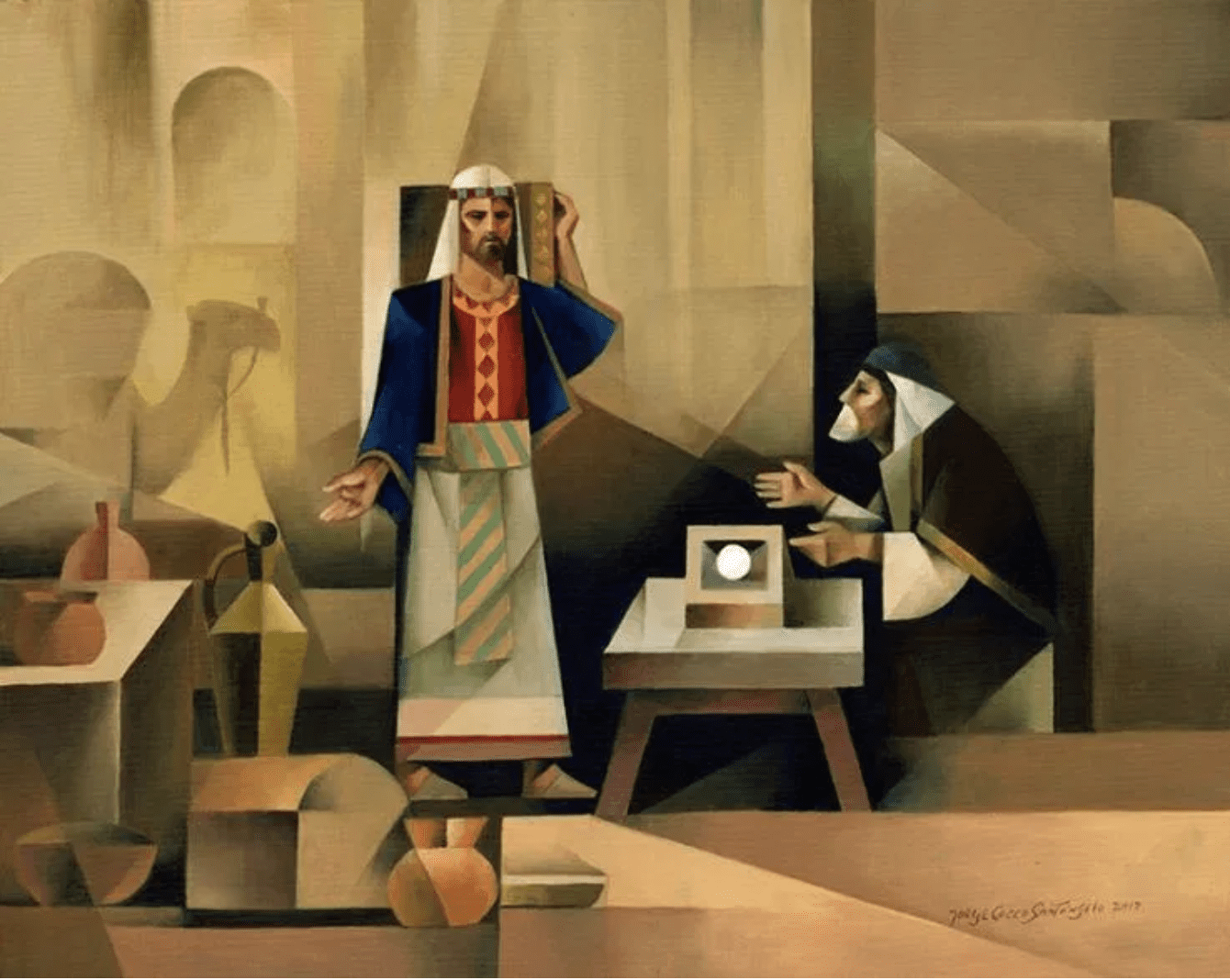
Cover image: “Pearl of great price” by Jorge Cocco.

Jeannie: Several of Jesus’s parables focus on what we might call “last things.” In the parable of the Importuning Widow, Jesus taught that we must endure to the end by persisting in imploring the Lord to answer our prayers and petitions. Cocco’s style, which he calls “sacro-cubism” with its moderate geometric abstraction, portrays only the most obviously recognizable elements of this parable and of Jesus’s other stories. This artistic achievement pairs very well with the literary essence of any parable, which offers a complete story but tells it with only the most essential details. This universalist approach allows all viewers to understand the narrative as seen in their own particular contexts. Thus Cocco’s renditions are both timeless and without geographic specificity, just as are our Savior’s enduring parables.
Another parable about last things conveys a sobering warning: To obtain the true ultimate reward, we must be prepared to strive and to pay a heavy price. In the parable of the Pearl of Great Price, Jesus situates us, just like a merchant, who finds a pearl of great price for sale, and willingly sells all that he or she has to buy and treasure it. In Matthew 13, the need for consecration is the next to the last step in the series before its final parable of judgment.
Jack: In no case does Jesus write himself more unmistakably into his parables than in the case of the Wicked Tenants, which teaches most plainly the mystery of the death of Jesus. Those wicked tenants beat and abuse the absentee landowner’s servants, and in the end even kill his son. Even the chief priests, to whom Jesus addressed this parable, understood the point of this parable: that Jesus spoke of them, and of himself. Of this drawing, our book states: “The dying or dead householder’s son is not shown racked with pain and suffering, as is often the case with artistic portrayals of the agony and passion of Jesus. Here he is stretched out with both arms extended out above his head, his final forsaken gesture. His face is in the dust, returning as it were and atoning for the fall of Adam, who was of the dust. The stylized thorn bush, faintly looming in the right foreground corner, is a portent of the crown that will be placed upon His head by mockers prior to His crucifixion. His Atonement is a free gift to all His children.”
When we asked Cocco if he planned to do this sketch in oil, he said, “No, I can’t do any more with this one. It’s too painful.”
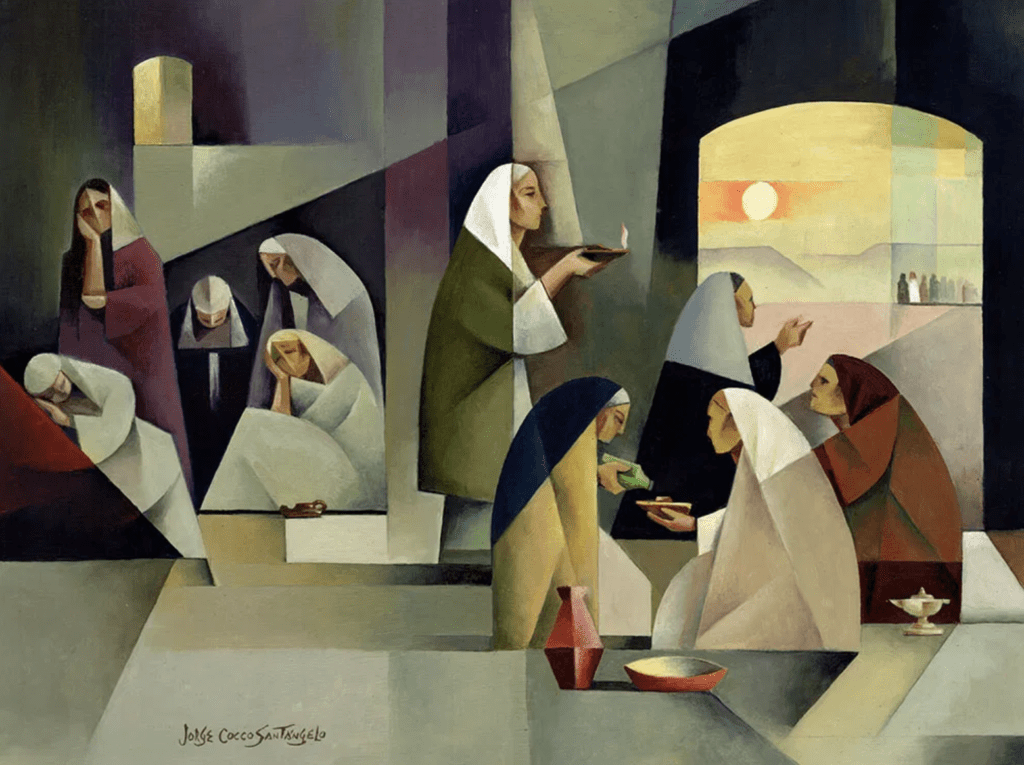
Jeannie: Of course, just as there are many ways to appreciate art, there are many ways to read the parables. Some offer multiple levels of meaning: cultural, ethical, or symbolic, as seen, for example, in the parable of the Ten Virgins, or Bridesmaids.
- Reading this parable culturally, it helps if the reader understands the details of the Jewish wedding customs at the time of Jesus. For example, the bridegroom was delayed as he was negotiating the terms of the marriage with the bride’s father.
- Reading ethically, one sees more clearly that each bridesmaid needed to come prepared with the oil that her own lamp would require. As President Kimball explained to us, those who brought extra oil were not able to share their light of faith or the cumulative effect of a life of righteousness.
- Symbolically, this reminds us that certain things, like personal testimonies, cannot be shared. We cannot live on borrowed light or borrowed oil.
- Christologically, this parable unforgettably illustrates the plan of salvation’s promise that that the Lord Jesus Christ eventually will return for his marriage and messianic reign.
Jack: Just as the days of judgment will follow the millennial reign, several parables next describe various phases of God’s judgment, which will separate, purge, select, preserve, honor covenantal promises, and reward.
First, a stage of separation and purging is depicted by the time of harvest in the parable of the Wheat and the Tares.
Second, a process of selection and preservation is taught in the parable of the Fisher’s great net. Just as these parables speak and apply to all people, Cocco’s art, as in I Will Make Thee Fishers of Men, is universally accessible and applicable as well. We find that our grandchildren, to whom this book is dedicated, are particularly drawn into these portrayals.

Jeannie: And third, in the final judgment parable, that of the Talents, we have the story of three certain investment managers who are entrusted with large amounts of gold or silver to manage for their master. Here especially, but also in all of Jesus’s parables, listeners are invited to ask themselves, who am I in this story? Am I the one neglecting my possibilities, or am I more like the ones who are working to develop the vast resources that belong to the Lord but which are entrusted to us as His stewards? Significantly, the reward given in the parable of the talents is not that the servant gets to keep the profits generated, but is allowed to hear, “Well done, thou good and faithful servant: enter thou into the joy of the Lord,” who will make you “ruler over many things.”
Jack: As all parables aim to inspire and demand action, Cocco’s portrayals likewise typically show action, movement, growth, and development, helping us to progress in becoming true disciples of Jesus Christ. And thus we see how Jesus teaches the plan of salvation, in his parables. And due to the plain and precious truths restored by the Book of Mormon, Latter-day Saint readers and commentators have so much the advantage in unveiling the mystery of the kingdom of heaven that Jesus revealed and taught to those who were ready to receive.
These canvases act as a guide, drawing us in, and helping to direct our personal introspection and development. The parables of Jesus help us ask, “What lack I yet? Lord, what would you have me do?” As Jesus said to the rich young ruler, put the Lord first and “come, follow me” and “thou shalt have treasure in heaven” (Matthew 19:22). And as the Father has said, “This is my work and my glory, to bring to pass [step by step] the immortality and eternal life of man.” While His parables were presented in no particular order, but instead as circumstances or questions arose, in the end, they all together teach the way of the life of righteousness as a full and coherent whole.
Jeannie: People may also wonder, why did Jesus tell so many parables? The answer may be precisely because there are many doctrines in the Father’s great plan. All of these doctrines are needed, and all of them need each other.
As Elder Maxwell has said: “If focused upon singly and exclusively, [the] doctrines [of Christ] are so powerful we can spin off and go wild. Orthodoxy, therefore, rather than being repressive, is a great adventure in handling powerful doctrines that bring great happiness when ‘fitly framed’ and woven together but which can bring misery if we spin them off separately. The doctrines of the Church need each other as much as the people of the Church need each other. We dare not break the doctrines apart or specialize within them, because we need them all to achieve spiritual symmetry, an outcome that requires connections and corrections.” (Neal A. Maxwell, Whom the Lord Loveth: The Journey of Discipleship [2003], 159-60).
It is our hope that Cocco’s paintings and our writings will “fitly frame” all the sacred principles of the Gospel of Jesus Christ taught in the parables of Jesus, jointly, collectively, and covenantally, that we may all, as the members of the body of Christ, achieve together our eternal goals and our divinely appointed and talented roles.