











Editor’s Note: The following is the second in a four-part series. To read the previous installment, entitled The Revolutionary Takes a Bride, click here.
Bride Price
Many of us grew up on Johnny Lingo. I was in my early teen years when I saw it. It was a change from the regular church films, and I loved it. We all knew Johnny, the shrewd businessman who bargained for his bride, the girl known (in frequently repeated imitations) as “Mahana you ugly!” But Johnny refused to pay the low price Mahana’s father suggested, and insisted on paying eight cows for his bride, an act which gave her new confidence. Because he treasured her, she became a treasure.
Of course, there are many problems with that paradigm—that a woman’s worth can be defined by how much her husband is willing to pay for her. We see it today in advertisements for engagement rings, where well-intentioned salesmen persuade couples to buy a stupendous—though perhaps not affordable—engagement ring which any girl would envy. We are not immune to the mind set which measures a woman’s value by material standards.
The problem and resultant consequences are even more visible in countries which still have a bride price. In some African countries, the price can be impossibly high. The consequence is that many couples live together without marriage because they can’t afford the bride price. The sum of money or things representing the bride’s worth is decided by the entire extended family. It can be excused, but rarely is. In the Congo and surrounding countries, the bride price is called the Dote. It is referred to as the Lobola in other African countries.
Elder Dallin Oaks gave salient counsel on this cultural tradition and its problems:
Many African traditions are consistent with the gospel culture and help our members keep the commandments of God. The strong African family culture is superior to that of many Western countries, where family values are disintegrating. We hope the examples of love and loyalty among members of African families will help us teach others these essential traditions in the gospel culture. Modesty is another African strength. We plead with youth elsewhere to be as modest as most of the young people we see in Africa.
In contrast, some cultural traditions in parts of Africa are negative when measured against gospel culture and values. [One] negative cultural tradition is the practice of lobola, or bride price, which seriously interferes with young men and women keeping the commandments of the restored gospel of Jesus Christ. When a young returned missionary must purchase his bride from her father by a payment so large that it takes many years to accumulate, he is unable to marry or cannot do so until he is middle-aged. This conflicts with the gospel plan for sexual purity outside marriage, for marriage, and for child rearing. Priesthood leaders should teach parents to discontinue this practice, and young people should follow the Lord’s pattern of marriage in the holy temple without waiting for the payment of a bride price (Oaks, “Culture of the Gospel” Ensign March 2012).
The custom is changing among many African Latter-day Saints, but it will likely be the next generation which completes the transition to the understanding that the bride, as Shakespeare phrased it in King Lear, “is herself a dowry”.
As we film Heart of Africa, we will depict a bride price ceremony, and so we were glad to see the real thing in Kinshasa, DR-Congo during August, 2014.

The ceremony was full of dancing, good food (fish, chicken, manioc, rice, and bread), whistles, music, laughter, and joy. The bride, Steffy, was stunning. Her sister did her glue-on nails fashionably, and she wore traditional clothing with sparkling rhinestones n her hair. Hired DJs played a mix of American and Lingala songs as we awaited the groom’s arrival. The bride price had been paid the day before. This was merely the celebration.
We waited for several hours for Aime, the groom, to arrive. During this time, we spoke with the family members gathered. I chatted with Steffy’s sister, a returned missionary who had been married in the temple to another returned missionary. She said tearfully, “I always wanted to be a good example to my sister. I am so grateful that she will be going to the temple.” (The temple trip was a week away, following various rituals.) Among others, I met two Congolese returned missionaries whom I had written to during the time they served with the young men we had known in the MTC. I had brought them Gladys Knight CDs. One of them was married and had a child. He was employed by the Church. The other was still making his way in the world, an aspiring musician.

Dusk comes quickly in the Congo, and gives way to night abruptly. It was long past nightfall when Aime came down the path with his mother and brothers. The crowd burst into joyful noise. (For a sample of the “joyful noise,” see the Heart of Africa Film facebook page.)
Aime was seated on a couch, and Steffy and her sisters came out, dancing to the American song “All of Me.” Steffy approached Aime and kissed his cheek. As he moved to kiss her, she stopped him with a firm hand, held like a crossing guard’s stopping traffic. She then kissed him again, a little closer to the mouth. This time, he would not be stopped. He picked up his bride and swung her around. There would be no more games.
Finally, Steffy’s father announced that the bride price had been paid, and he accepted the match. The crowd cheered, and the feast began.
Aime returned home alone, however, for the marriage festivals were not yet complete.
The Civil Ceremony
In fact, this was the first of five marriage ceremonies. The next, two days later, was the civil ceremony. The government hosts these ceremonies only three days a week, so each session is full of brides and grooms. Each bride is dressed beautifully, with the most common veil a netted hat piece. The grooms are in their best suits. Some of the brides, like Steffy, wear stylish suits.

Each couple stands when called upon. The bride and groom recite vows to each other in French, and then come forward so that all can see their wedding bands. They sign a register and exchange a kiss.
This completes the state’s requirements for marriage. The religious choices of the bride and groom follow. They may have a religious ceremony should they choose, but it is not required. Aime and Steffy chose a religious ceremony. Steffy wore her wedding gown for this.
Church Ceremony
It had been my pleasure to purchase a gown for Steffy at a huge discount from Lauren James bridal in Orem, which specializes in temple-ready gowns. I had sent her photos of possible gowns. She selected the one I subsequently purchased, and I was deeply grateful to the owner of Lauren James for giving me such a discount.
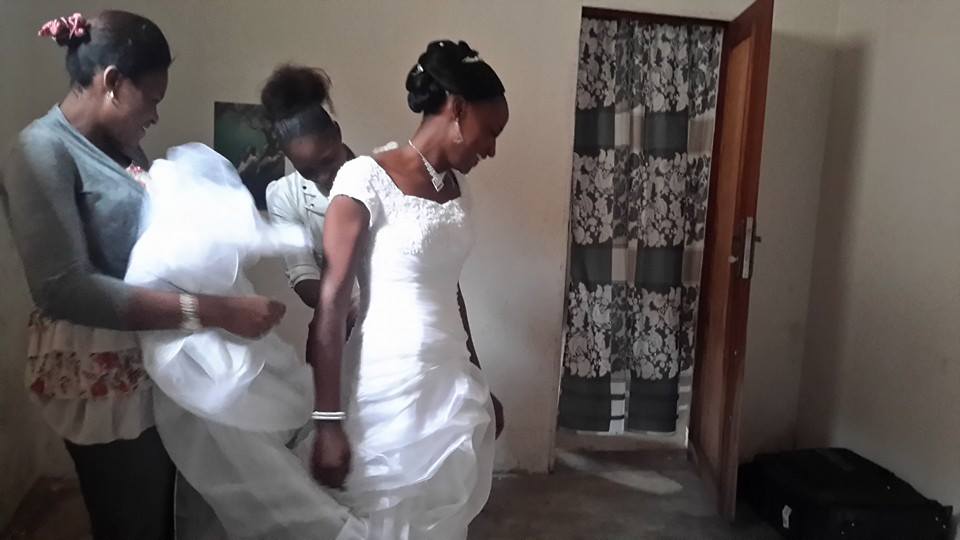
Here are photos of Steffy seeing her gown and then trying it on. We dressed her in Aime’s apartment. Note the picture of Adam and Eve on his wall. It is not common to see art in Congolese homes, but every LDS home I saw had some religious art.


At last, we were ready to go to the church for the Mormon ceremony. An enthusiastic choir began singing as the bride and groom entered—“Love at Home” and “How Firm a Foundation”—both in French. After an opening prayer, the bishop performed the traditional LDS wedding ceremony as written in the handbook. (A brief video of the bride and groom entering the church can be found on the Heart of Africa film facebook page. It was filmed by a little boy—who was thrilled to use a tablet.)

The next ceremony was a private one, but we were allowed to film it. Steffy, still in her bridal gown, was seated next to Aime in his apartment. Aime’s mother, grandmother, and sister brought dinner to the couple and sang a song welcoming Steffy into the family.
The final ceremony would be in the temple. We had planned to go with the newlyweds to the nearest temple, in Johannesburg, South Africa. However, after three attempts, the couple had not been granted a visa. It was clear that South Africa would not be an option.
I told Aime to see if he could get a visa to Ghana.
Yes, he could. Miracles and marvelous things awaited us there.
(End of Part 2)







Aime Junior MbuyiAugust 28, 2015
The idea is to remove the fact that the dot or lobola is an obstacle to marriage. Was dot a symbol, it would not be a bad thing. Was it as simple as buying a piece of bread at the market, it would be a fun thing.
Amèria PhillippsFebruary 10, 2015
Cultural traditions do not change immediately upon receipt of the gospel. The article acknowledges that it may not happen until the next generation. When the gospel is received by any culture it takes time for its people to change years and years of conditioning and tradition. It is usually the elders who are most resistant and the children coming through who accept more readily 'new things'. Line upon line, precept upon precept.