


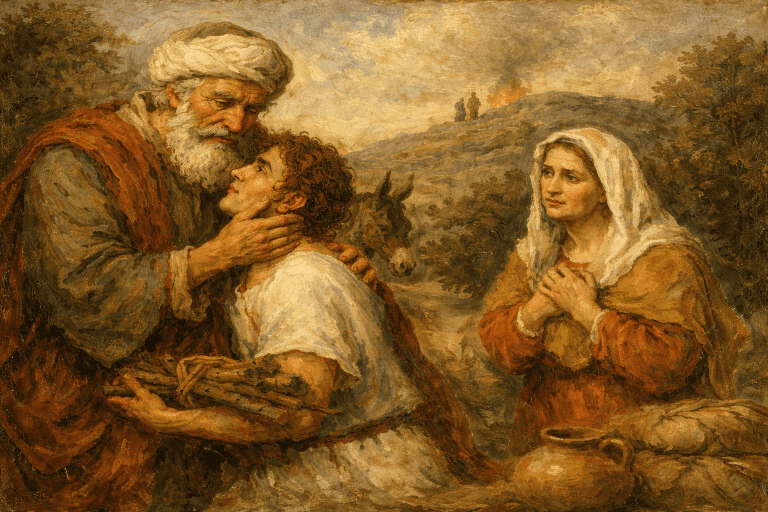


Latter-day Saints (LDS) are more aware of the significance of Abraham and the Abrahamic covenant than any other people in the world. Yet consistently we fail to appreciate the importance of that covenant as made by the Lord with Abraham. Those covenantal blessings are foundational to the Gospel of Jesus Christ, and they continue to echo through the millennia within the ceremonies of all LDS Temples. Within those sacred walls faithful Saints are promised to have all the blessings of Abraham, Isaac, and Jacob as rightful heirs.
President Russell M. Nelson has expressed “The fulfillment of the ancient Abrahamic covenant is only feasible because of the Lord Jesus Christ.”1 What were the promises made to Abraham? Again, from President Nelson:2
- Jesus the Christ would be born through Abraham’s lineage.
- Abraham’s posterity would be numerous, entitled to an eternal increase, and also entitled to bear the priesthood.
- Abraham would become a father of many nations. (Genesis 17; Galatians 3; Abraham 2)
- Certain lands would be inherited by his posterity. (Genesis 17; Galatians 3; Abraham 2)
- All nations of the earth would be blessed by his seed. (Genesis 17:7; Acts 3:25; 1 Nephi 15:18; 22:9; 3 Nephi 20:25, 27)
- And that covenant would be everlasting—even through “a thousand generations.” (Deut. 7:9; 1 Chron. 16:15; Psalm 105:8)
Using The Joseph Smith Translation, Red-Letter Editions, Old Testament,3 and other prophetic utterances we will endeavor to discover more about Abraham and our personal relationship with the covenantal promises he received from God.
Let us first observe the promises made to Abraham as recorded in The Joseph Smith Translation.
Genesis, Chapter 18 Genesis, Chapter 17
1 And when Abram was ninety years and nine years old,
and nine, the Lord appeared to Abram, Andandsaid unto him, I,amthe Almighty God, give unto thee a commandment that thou shalt walk uprightlywalkbefore me, And beand be thouperfect.2 And I will make my covenant between me and thee, and will multiply thee exceedingly.
3 And Abram fell on his face, and called upon the name of the Lord; And and God talked with him, saying, my people have gone astray from my precepts, and have not kept mine ordinances, which I gave unto their fathers; And they have not observed mine anointing, and the burial or baptism wherewith I commanded them; but have turned from the commandment, And taken unto themselves the washing of children, and the blood of sprinkling, And have said that the blood of the righteous Able was shed for sins, and have not known wherein they are accountable before me.
4 But as for thee,
As for me, behold, I will make my Covenantmy covenant iswith thee, and thou shalt be a father of many Nations.nations. And this covenant I make, that thy children may be known among all Nations.
These verses are a marvelous example of the Prophet Joseph Smith exercising his role as a Seer, a Revelator, and a Translator. We learn in these initial verses that a renewal and reinstitution of God’s covenantal blessings was necessary at Abraham’s time because of the wickedness of the people. Abraham was one of the few righteous persons of his day and being faithful to God, and of the direct lineage of Adam, he had the right to the Priesthood and all its attendant blessings.
Because of his faithfulness, God chose Abraham and made a covenant with him resulting in a new dispensation and a restoration of the Gospel with him becoming the “father of many Nations.” God continued speaking to Abraham saying:
5 Neither shall thy name any more be called Abram, but thy name shall be Abraham; for a Father
fatherof many Nations nations have I made thee.6 And I will make thee exceeding fruitful, And
andI will make Nationsnationsof thee; Andandkings shall come upoutof thee, and of thy seed.7 And I will establish a
mycovenant of circumcision with thee, And it shall be my covenant between me and thee and thy seed after thee, in their generations that thou mayest know forever, that children are not accountable before me, until they are eight years old And thou shalt observe to keep all my covenants wherein I covenanted with thy Fathers; and thou shalt keep the commandments which I have given thee with mine own mouth, And I will be a God unto thee and thy seed after thee;for an everlasting covenant, to be a God unto thee, and to thy seed after thee.8 And I will give unto thee and to thy seed after thee, a
theland wherein thou art a stranger; Allallthe land of Canaan, for an everlasting possession; and I will be their God.
While circumcision at 8 days old became the token of the covenant between God and His chosen people at that time, there is a related piece of knowledge found in verse 7 when God said to Abraham “children are not accountable before me, until they are eight years old.” This was recorded by the Prophet Joseph around February-March 1831. In all of scripture, the age of accountability appears only here and in D&C 68:27, which is dated 1 November 1831.
Once again, we see the probable influence of the JST on the Doctrine & Covenants. While The Book of Mormon informs us that children are to be baptized, it never states the age when that is to be done.
God then promises Abraham that the land of Canaan will belong to him and his posterity as “an everlasting possession; and I will be their God.” The land of Canaan includes the present-day boundaries of the country of Israel, and more. It might also be interesting to the reader at this point to note that the Hebrew language has its roots in the language of Canaan as it was spoken at the time of Abraham, but that is another story.
God goes further and informs Abraham in verses 15-17, that he and Sarah would be blessed with a child, Isaac, and through his posterity Abraham’s blessings would be fulfilled. Abraham is 99 at this time and Sarah is 90. Abraham and Hagar’s son Ishmael was 13 (Genesis 17:25). By the time Isaac was born Abraham had turned 100.
15 And God said unto Abraham, as
Asfor Sarai thy wife, thou shalt not call her name Sarai, but Sarah thou shalt callshallher name.be.16 And I will bless her, and I will give thee a Son
son alsoof her; yea, I will bless her, and she shall be blessed; the Mother of Nations;a mother of nations;Kings andkings ofpeople shall be of her.17 Then Abraham fell on
uponhis face, And rejoiced,and laughed, and said in his heart, there shallShalla child be born unto him that is an hundred years old. Andand shallSarah, that is Ninety ninety years shallold,bear.
God later reiterated His blessing to Abraham and his posterity after trying his faith when He asked him to sacrifice his son Isaac, then a young man, symbolic of God’s own sacrifice of His son Jesus the Christ. The angel of the Lord said to Abraham:
Genesis, Chapter 23 Genesis, Chapter 22
15 And the Angel angel of the Lord called unto Abraham out of Heaven heaven the second time,
16 And said, thus saith the Lord, I have sworn by myself, that By myself have I sworn, saith the LORD, for because thou hast done this thing, and hast not withheld thy son, thine only Isaac, from me; son;
17 That in blessings blessing I will bless thee; and in multiplying I will multiply thy seed as the stars of Heaven, the heaven, and as the sand which is upon the sea shore; and thy seed shall possess the gate of his enemies;
18 And in thy Seed seed shall all the Nations nations of the Earth earth be blessed; because thou hast obeyed my voice.
From the biblical record we learn that lineage has always played a key part in God’s plan for spreading His gospel to the known world of all dispensations. I have often contemplated the Lord’s frequent references to a lineage of “chosen people.” The Bible, The Book of Mormon, other Latter-day scriptures, and countless references by leading authorities in the Church are rife with the concept of a select or chosen people upon whom God will pour out His greatest blessings.
Those blessings always come with the caveat that all who receive them must undergo select ordinances and make and keep certain sacred covenants as determined by Him. They become responsible to share their knowledge of Him and those covenants and blessings with those both inside and outside the lineage of Abraham. This universal sharing of Abrahamic covenants and blessings have become increasingly important in these latter-days because of the prophetic mandate given to gather all of Israel, on both sides of the grave, in preparation for the Lord’s return.
So, who are Abraham’s lineage today? As modern-day covenant Israel, Latter-day Saints are literally of the lineage of Abraham or adopted into the house of Israel, as reflected in their patriarchal blessings. To date, most LDS are from Joseph through his sons Ephraim or Manasseh. If you have deceased LDS ancestors who received Patriarchal Blessings, you can access those blessings through your personal Church website, and you will find a varied declaration of lineage among them.
My own LDS ancestors have declarations of lineage including Joseph, Ephraim, Manasseh, and Levi. Sister Wendy Nelson,4 wife of President Nelson, once spoke of finding all the tribes of Israel but Levi, represented in Russia as declared in their patriarchal blessings. When she and President Nelson went on to Armenia, they found a young missionary from Chandler, Arizona who was of the tribe of Levi.
Children in some families have declarations of lineage that are not the same. I am aware of a family with three daughters and one son, where three of the siblings were through Ephraim while one daughter was through Judah. While the preferred lineage for an individual is the Lord’s decision and is revealed through his patriarchs, why the determination of that declaration is given for a specific individual is not known.
However, the effect of scattered Israel upon the people of the world through the millennia is a direct fulfillment of the blessings given to Abraham. Whether persons are literal descendants of Israel or adopted into the house of Israel has no bearing on their receiving equally all the blessings of Abraham, Isaac, and Jacob.
President Russell M. Nelson has taught:
“Some of us are the literal seed of Abraham; others are gathered into his family by adoption. The Lord makes no distinction. Together we receive these promised blessings—if we seek the Lord and obey His commandments. But if we don’t, we lose the blessings of the covenant. To assist us, His Church provides patriarchal blessings to give each recipient a vision for his or her future as well as a connection with the past, even a declaration of lineage back to Abraham, Isaac, and Jacob.”
President Nelson also taught:5
“Now do you see the importance of your patriarchal blessing? I hope each one of you has obtained one. It is precious. It is personal scripture to you. It declares your special lineage. It reminds you of your linkage with the past. And it will help you realize your future potential. Literally, you can lay claim upon the Lord for fulfillment of those blessings through your faithfulness.
Are you Hebrew? Yes, as scriptures define the term. You are related to Abraham, who was the great “Eber” from which the term Hebrew was derived (see Genesis 10:21, 14:13; see also 2 Corinthians 11:22).
Are you Jewish? That precious lineage may be claimed if your ancestors are from the loins of Judah. But most of us are of the lineage of Joseph through Ephraim or Manasseh. That was the lineage selected to pioneer the gathering of Israel, the seed to lead throughout the world in blessing all the nations of the earth.
Can you trace your lineage to Egypt? If your patriarchal blessing indicates that you are of the lineage of Joseph, Ephraim, Manasseh, or other descendants of Israel, yes, you may claim Egyptian ancestry.
Now you can better understand this revelation given through the Prophet Joseph Smith. It applies to each one of us. He said:
‘Thus saith the Lord unto you, with whom the priesthood hath continued through the lineage of your fathers—
For ye are lawful heirs, according to the flesh, and have been hid from the world with Christ in God—
Therefore your life and the priesthood have remained, and must needs remain through you and your lineage until the restoration of all things spoken by the mouths of all the holy prophets since the world began.
Therefore, blessed are ye if ye continue in my goodness, a light unto the Gentiles, and through this priesthood, a savior unto my people Israel.’ [D&C 86:8–11]
‘And as I said unto Abraham concerning the kindreds of the earth, even so I say unto my servant Joseph [Smith]: In thee and in thy seed shall the kindred of the earth be blessed.’ [D&C 124:58; see also D&C 110:12]
‘Wherefore, our father hath not spoken of our seed alone, but also of all the house of Israel, pointing to the covenant which should be fulfilled in the latter days; which covenant the Lord made to our father Abraham, saying: In thy seed shall all the kindreds of the earth be blessed.’ [1 Nephi 15:18]”
The Gospel Study Guide – Patriarchal Blessings,7 found on the LDS Church website declares:
Every patriarchal blessing contains a declaration of lineage. When God’s children are baptized and become members of The Church of Jesus Christ of Latter-day Saints, they inherit the promises God made to Abraham and his posterity if they remain righteous (see Abraham 2:9–11). While a person may descend through more than one family line from the house of Israel, one specific tribe is normally identified, confirming that the individual has a family connection to Abraham.
Whether this declaration means that a person is a literal descendant by blood or through spiritual adoption is not important (see Abraham 2:10). This declaration of lineage shows a family line through which the individual can inherit the promised blessings of Abraham. It also reminds a faithful person of the spiritual responsibilities he or she has as a descendant of Abraham (see Abraham 2:11).
Israel is an interesting and unique moniker for a chosen people. Covenant Israel today are the people who have been chosen by the Lord to take His restored Gospel to all the world. Today when we use the term Israel, we usually think of the Jews who inhabit the land of Israel. However, the Jews are only one of the 12 tribes of Israel. After Jacob, Isaac’s son, wrestled with the Lord, the Lord changed his name to Israel.
It is important to note that it was after Jacob made the covenant (the Abrahamic covenant) with the Lord that his name was changed. This subtle name change is frequently reflected in the prophetic voices of biblical prophets such as Isaiah, Jeremiah, Ezekial, and others. In those biblical passages a reference to Jacob often refers to those of the 12 tribes who were yet to make the new covenant, particularly the Jews. Today the house of Israel are those who have accepted the restored Gospel and entered into the restored, Abrahamic covenant. It is perfectly proper for Latter-day Saints to be called Israel because of their lineage and the restored Abrahamic covenant which they have taken upon themselves.
While scriptural records focus on an ancient people referred to as Israel, all who willingly accept and keep those covenants are brought under the umbrella of those blessings and become part of His chosen people, the house of Israel. They become chosen through their exercise of faith by accepting the Lord and his Gospel, then entering into his Kingdom through baptism by one having authority. They go on, striving to keep all those covenants given them.
One reason direct lineage plays into this concept of a chosen people is that beginning with Adam and his posterity, they were the only people who, through Priesthood authority, were taught the truth and given the ordinances and covenants essential to exaltation. All who accepted the truth and entered into the Lord’s Kingdom on earth were subsequently commanded to share it with all the known world.
From Adam to Enoch, Enoch to Noah, Noah to Abraham, Abraham to Moses, Moses to Jesus Christ, and finally from Jesus Christ to Joseph Smith those covenants had to be reinstituted and revitalized each time because of the follies and wickedness of people, but they remained essentially the same. The lineage of Abraham has always been given a divine mandate through the Lord’s prophets to share the knowledge of God, His ordinances and covenants, with all who would listen and accept them.
Elder David A. Bednar has taught:8
How do these promises and blessings relate to us today? Either by literal lineage or adoption, every man and boy within the sound of my voice tonight is a rightful heir to the promises made by God to Abraham. We are the seed of Abraham. One of the primary reasons we receive a patriarchal blessing is to help us more fully understand who we are as the posterity of Abraham and to recognize the responsibility that rests upon us.
We conclude our observations of our relationship with the Abrahamic Covenant with the simple declaration that all who make and keep their covenants including baptism and those administered in the Holy Temple, will receive as heirs all the blessings of Abraham, Isaac, and Jacob as taught by Joseph Smith, the Prophet, Seer, Revelator, and Translator.