




Wilford Woodruff: Determined to Go on His Mission at all Hazards
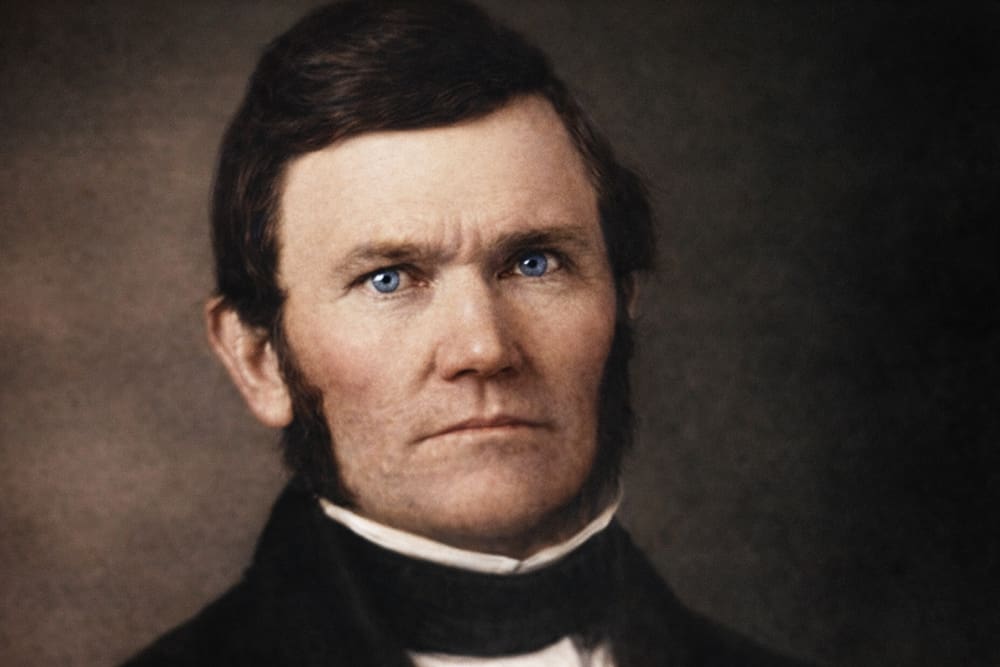
About six weeks after the death of the Prophet Joseph Smith and his brother Hyrum, eight members of the Quorum of the Twelve Apostles met to conduct some much-needed business in Nauvoo. According to Wilford Woodruff’s journal entry on that day, August 12, 1844, the first item was to call Amasa Lyman as a new member of the Quorum. After some discussion, Wilford recorded: “Moved by H[eber] C. Kimball that Elder W. Woodruff take a mission to England and Preside over the Church and Printing establishment in England, Ireland, Scotland & the adjacent Islands and continent.”
Wilford had only recently returned from a mission to the Eastern United States, and now he had to prepare for his second mission to England, this time as the presiding authority of the Church in Europe. He had much to do and many decisions to make before his imminent departure, not the least of which was how to care for his growing family while he was away.
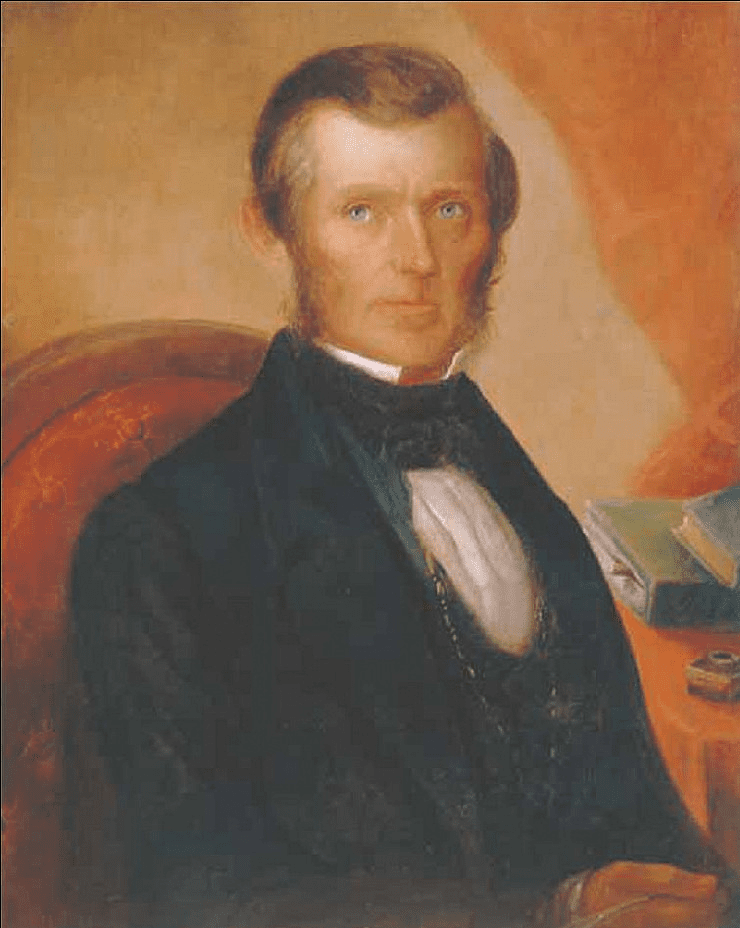
Painting of Wilford Woodruff during his first mission to England, January 20, 1841
Wilford Woodruff the Missionary
By the time Wilford Woodruff and Phebe Carter married in April 1837, Wilford had already served in Zion’s Camp and as a missionary to the Southern United States. A month after their wedding, Wilford took Phebe along with him on a sort of honeymoon mission to Maine, where Phebe’s family lived. Phebe spent some time with her family and worked alongside her husband as his mission companion until she returned to her parents’ home to give birth to their first baby. It was while Wilford was serving in Maine that the Prophet Joseph received what we now know as Doctrine and Covenants 118, a revelation calling Wilford as a new member of the Quorum of the Twelve Apostles, and calling the apostles to preach the gospel “over the great waters.”
Historian Edward Tullidge explained, “Before the age of railroads and steamships had fairly come, going to Great Britain on a mission was very like embarking for another world; and the apostolic proposition to gather a people from foreign lands and many nations to form a latter-day Israel, and with these disciples to build up a Zion on this continent, was in seeming the maddest undertaking possible in human events.”
The Woodruffs finally made it back to Nauvoo from Maine in the spring of 1839. When Wilford left for England in August, Phebe and their baby Sarah Emma were living in an unfinished home and were ill, along with most of the community of Saints. Wilford recorded, “The enemy is striving to bind us down that we shall not go into the vineyard.” Although Phebe and Sarah Emma were soon taken in by friends, Sarah Emma became seriously ill the following summer and died on July 17, 1840.
Preparing for His Second Mission to England
As Wilford prepared for his second mission to England a few years later, he understood the sacrifices that would be required of him and of his family. Yet he was never one to scare off easily—or, really, at all. In Luke 12:32, the Savior assures his disciples, “Fear not, little flock; for it is your Father’s good pleasure to give you the kingdom.” Elder Woodruff was ready to do all he could to build the Lord’s kingdom on earth. Of his missionary service, Wilford boldly stated, “I say, if it cost me my life, let it go: I want to be among the number; I am ready to follow the example of those who have gone before me—when my work is done, I am ready to be offered, if necessary.”
He trusted the Lord and wanted the Lord to trust him, and he was going to take the Lord at His word, believing the promise made in Malachi 3:10–12:
Prove me now herewith, saith the Lord of hosts, if I will not open you the windows of heaven, and pour you out a blessing, that there shall not be room enough to receive it.
And I will rebuke the devourer for your sakes, and he shall not destroy the fruits of your ground; neither shall your vine cast her fruit before the time in the field, saith the Lord of hosts.
And all nations shall call you blessed: for ye shall be a delightsome land, saith the Lord of hosts.

A page of the Book of Malachi from Wilford Woodruff’s personal Bible
Wilford was going to prove the Lord and he expected the windows of heaven to open. He was on the Lord’s errand and his task was clear, as explained by Brigham Young in a letter to the Saints in Europe at the end of August 1844:
To all the Elders and Saints in Europe greeting.
We send our beloved brother Wilford Woodruff to England to take charge of all the business transactions pertaining to the Church of Jesus Christ of Latter Day Saints both spiritual and temporal. We wish you to give diligent heed to his council in all things and as we have not the opportunity of Informing you of what has transpired this season by letter, our beloved brother will make known unto you all things. . . . For he is qualified to teach the Saints in the things pertaining to the Church and kingdom of God established in these last days.
Caring for the Woodruff Children
That same week, as all the business of the Church was on his mind—organizing temple construction; making visits to Emma Smith, Lucy Mack Smith, and Mary Fielding Smith; and still so deep in mourning following the deaths of Hyrum and Joseph Smith only two months earlier—Wilford also had to decide how to provide for his family during his mission. He wrote in his journal on August 27:
I have left my family and friends almost yearly to go on missions in the vineyard of the Lord, for the last ten years of my life, but have never attempted to take my family with me before for the purpose of accompanying me on a mission, but as I am now about to leave my own country to again visit foreign climes to preach the gospel of Jesus Christ & take care of the churches which will probably be a long mission I conclude it best to take my family with me according to the council of the Twelve so this day is spent settling accounts taking inventory of Goods and chattels left, packing up goods, receiving letters, bidding friends farewell blessing the Saints, which continued until midnight.
Although he wrote, “I conclude it best to take my family with me,” he and Phebe would only be taking one of their three children to England with them. Little Wilford, who they called Willie, was now four years old and would stay across the river in Iowa with the Benbows. John and Jane Benbow, converts from Wilford’s first mission in England, were the couple who introduced him to the United Brethren in 1840. They were stalwart and loyal friends of the Woodruffs. Phebe Amelia, age two, was going to leave Nauvoo with the Woodruffs and travel to Phebe’s family in Maine as the Woodruffs made their way east. Only their one-year-old daughter Susan would accompany the Woodruffs to England.
Even after making the decision for their children, and despite their trust in the Lord to look over their own “little flock,” Wilford and Phebe were concerned for their children. On August 28, Brigham Young and Heber C. Kimball gave a blessing to Phebe and also to Susan. Wilford recorded that Phebe was promised, “Your life & health shall be precious in the eyes of the Lord and in the hour of distress & trouble thou shalt be preserved by the power of God. . . . Thy children shall be preserved until thou shall return & meet with them again.”
Leaving Nauvoo, the group traveled with Hiram Clark and Dan Jones and their wives, along with a few others, on the way to Chicago. In mid-September, they made their way across Lake Huron, where Wilford helped put out a fire in the engine room in the middle of the night, in his bare feet and night clothes, while Phebe stayed below and comforted a panicked woman. Wilford recorded that it was over quickly, but “all were sea sick or Lake sick which was equally as bad.” Another fire broke out on board their next ship, on Lake Ontario, just a few days later.
By the end of September, the Woodruffs had reached Wilford’s family in Farmington, Connecticut. Wilford remained with his family a little longer than Phebe and the children, who went on to her parents’ home in Maine. When Wilford joined them, Phebe Amelia was sick and, upon arriving at the Carters, they discovered that members of Phebe’s family were also very ill. Phebe’s sister and niece appeared to be dying of typhus, drawing out the Woodruff’s stay in Maine until they finally felt comfortable leaving their two-year-old daughter with the Carter family. In mid-November, when Wilford was very anxious to be on their way to England, he recorded in his journal: “It is a dark time; I am surrounded with darkness like midnight, the plague or the destroyer is on my right and left hand trying to hedge up my way from filling my mission but I trust the Lord will deliver me in some way.”
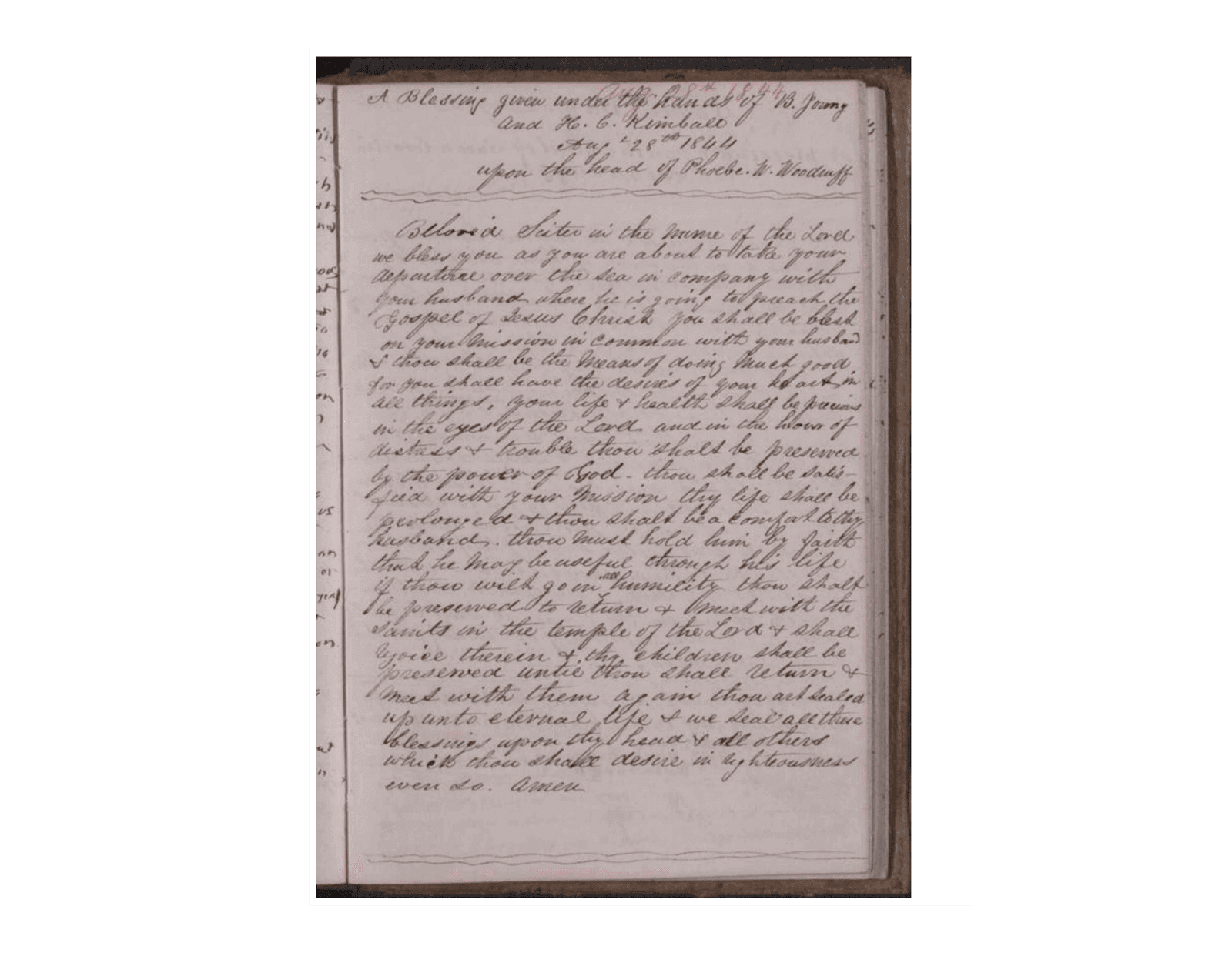
Page from Wilford Woodruff’s journal, August 28, 1844
Leaving Home and Family
Despite their concerns, on November 20th, the Woodruffs—Phebe, Wilford, and baby Susan—said goodbye to Phebe Amelia and left the Carter home for England by way of Boston and New York. Clearly they had stayed longer than Wilford had planned, for on the 21st of that month, he wrote in his journal, “After being blockaded with sickness with my children & friends in Scarboro for near a month & surrounded by great darkness during the time for it seems as though the destroyer was trying to hedge up my way to hinder me on my mission, & where the destroyer is there is darkness & sorrow, yet this I morning I feel like bursting their bands & going my way.”
Finally, by December 8, the little family was on their way out of New York Harbor. There was more talk of rough water, seasickness, and flooding in the cabins, but on December 29, they spotted the Irish coast and realized their journey was almost over. On January 3, 1845, the Woodruffs were in Liverpool.
Building on a Firm Foundation
Leaving Nauvoo at the time Wilford was called to serve a mission required some creative problem solving on the part of the Woodruffs, yet from the records Wilford left behind, not going never seemed to be an option. But why was that, and how did he reconcile the difficulty with the desire? Upon leaving for the first British mission in 1837, his friend Heber C. Kimball expressed the challenge Elder Woodruff would also feel. In his journal, Elder Kimball recorded it this way: “The idea of being appointed to such an important mission was almost more than I could bear up under. I felt my weakness and was nearly ready to sink under it, but the moment I understood the will of my Heavenly Father, I felt a determination to go at all hazards, believing that he would support me by his almighty power . . . I felt that the cause of truth, the gospel of Christ, outweighed every other consideration.”
In a sermon Elder Woodruff gave in Nauvoo in August 1844, immediately before departing, he explained:
Inasmuch as you will be united in heart mind and action in supporting your councillors, the authority of the Church, the priesthood of God, and follow the council given you, as you have endeavored to follow the council of the Prophet while he was living, you will be safe and blessed and will prosper; but if you are divided and reject the counsel of God you will fall, union and faithfulness is your salvation. It is true you have been led by one of the best men that ever has graced humanity, or tabernacled in flesh but he has gone, he has sealed his testimony with his blood. He has loved this people unto death. I would now call upon this people to be united in building upon the foundation which The Prophet Joseph has laid.
Wilford was going to carry on building upon that foundation. The promise in Malachi 3:10—“Prove me now herewith, saith the Lord of hosts, if I will not open you the windows of heaven, and pour you out a blessing, that there shall not be room enough to receive it”—provides some insight into how Wilford Woodruff could trust that the Lord would help him guide, not just the Lord’s “little flock” of those early Saints, but his own “little flock” of Woodruffs. As the Lord promised, their children were protected while they were away. They received updates from the Benbows and the Carters on the health and welfare of their children; and baby Joseph was born safely in Liverpool in the summer of 1845.
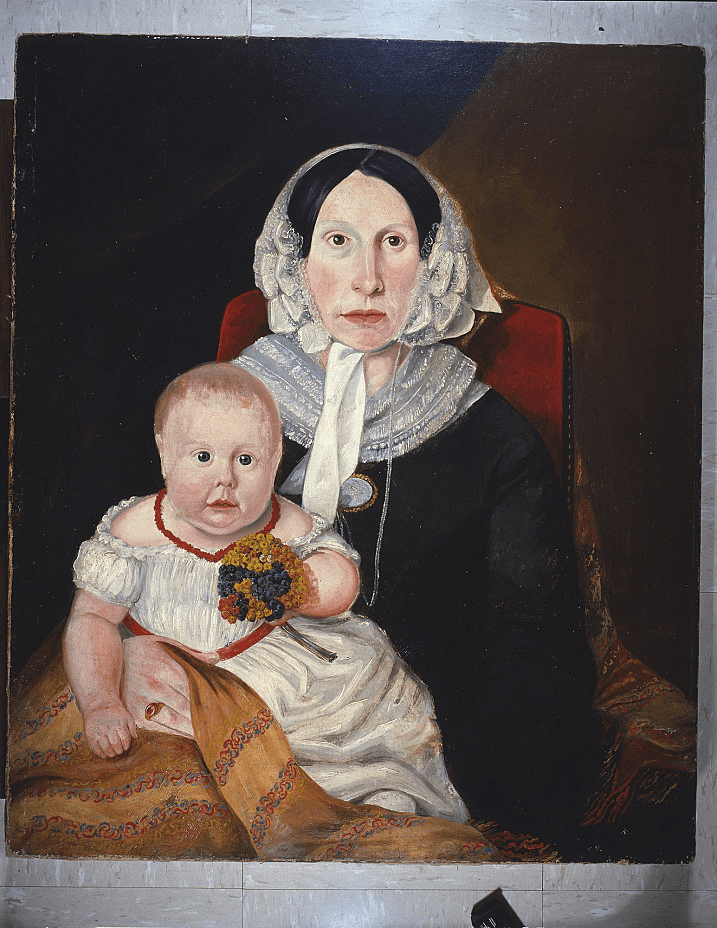
Portrait of Phebe and Joseph Woodruff in England, December 1845
In addition to the blessings for their family, the windows of heaven continued to be opened to bless the missionary work in England. Wilford successfully resolved some fiscal mismanagement and conflicts between mission leadership; he efficiently sorted out the very complicated and threatened publication of the Doctrine and Covenants in England by a former member of the Church who sought to seize the copyright; and he organized several hundred new converts to immigrate to Nauvoo.
Those who made their way west with the Saints from England and farther afield in Europe during the nineteenth century made up about one hundred thousand converts by the turn of century. They were a much-needed addition to the faithful population of the Saints settling in the Intermountain West. Now in 2025, with more than 380 temples in various stages of construction and use, and a worldwide Church population of over seventeen million members, the windows of heaven continue to be opened for the faithful Saints who, like the Woodruffs, trust in the Lord.
 Kristy Wheelwright Taylor serves as the Board Secretary for the Wilford Woodruff Papers Foundation and helps with transcription and writing with the Project. She has loved getting to know Wilford Woodruff better through his own words. Kristy has a master’s degree in Humanities from Brigham Young University and has worked as an English Instructor at Purdue University, copy editor, technical writer, travel writer, and historical researcher and writer, and now spends much of her time volunteering in community and church work. You can find her book, Prepare Me for Thy Use: Lessons from Wilford Woodruff’s Mission Years, at Deseret Book and Amazon.
The Wilford Woodruff Papers Foundation’s mission is to digitally preserve and publish Wilford Woodruff’s eyewitness account of the Restoration of the gospel of Jesus Christ and make his records universally accessible in order to inspire all people, especially the rising generation, to study and to increase their faith in Jesus Christ. For more information, please explore wilfordwoodruffpapers.org.
Footnotes
1 Wilford Woodruff’s Journal, August 12, 1844, p. 309, The Wilford Woodruff Papers,
https://wilfordwoodruffpapers.org/p/mX3.
2 Painting of Wilford Woodruff by Filippo Pistrucci, courtesy of the Church History Library, The Church of
Jesus Christ of Latter-day Saints, ChurchofJesusChrist.org/study/ensign/2006/01/contents?lang=eng.
3 Edward W. Tullidge, The Women of Mormondom, New York: Tullidge and Crandall, 1877.
4 Wilford Woodruff’s Journal, July 25, 1839, p. 105, The Wilford Woodruff Papers,
https://wilfordwoodruffpapers.org/p/vJn.
5 Letter to the Saints, October 11, 1844, p. 2, The Wilford Woodruff Papers,
https://wilfordwoodruffpapers.org/p/Ozvr.
6 Wilford Woodruff’s Bible, p. 410, The Wilford Woodruff Papers,
https://wilfordwoodruffpapers.org/p/EWrm.
7 Wilford Woodruff’s Journal, August 28, 1844, p. 332, The Wilford Woodruff Papers,
https://wilfordwoodruffpapers.org/p/913.
8 Wilford Woodruff’s Journal, August 27, 1844, pp. 327–328, The Wilford Woodruff Papers,
https://wilfordwoodruffpapers.org/p/86o.
9 Baby Joseph would be born in England a year later.
10 Wilford Woodruff’s Journal, August 28, 1844, p. 330, The Wilford Woodruff Papers,
https://wilfordwoodruffpapers.org/p/gL6.
11 Wilford Woodruff’s Journal, September 18, 1844, p. 339, The Wilford Woodruff Papers,
https://wilfordwoodruffpapers.org/p/nxl.
12 Wilford Woodruff’s Journal, November 15, 1844, p. 357, The Wilford Woodruff Papers,
https://wilfordwoodruffpapers.org/p/ELv.
13 Wilford Woodruff’s Journal, August 28, 1844, p. 330, The Wilford Woodruff Papers,
https://wilfordwoodruffpapers.org/p/gL6.
14 Wilford Woodruff’s Journal, November 21, 1844, p. 359, The Wilford Woodruff Papers,
https://wilfordwoodruffpapers.org/p/Jk2.
15 Edward W. Tullidge, The Women of Mormondom, New York: Tullidge and Crandall, 1877.
16 Wilford Woodruff’s Journal, August 25, 1844, p. 325, The Wilford Woodruff Papers,
https://wilfordwoodruffpapers.org/p/6R9.
17 Image of oil on canvas painting of Phebe Carter Woodruff and her son Joseph by Thomas Ward.
Courtesy of the Church History Museum, The Church of Jesus Christ of Latter-day Saints,
history.ChurchofJesusChrist.org/media/portraits-of-childhood-phoebe-woodruff-child?lang=eng#1.
Wilford Woodruff and the Book of Abraham
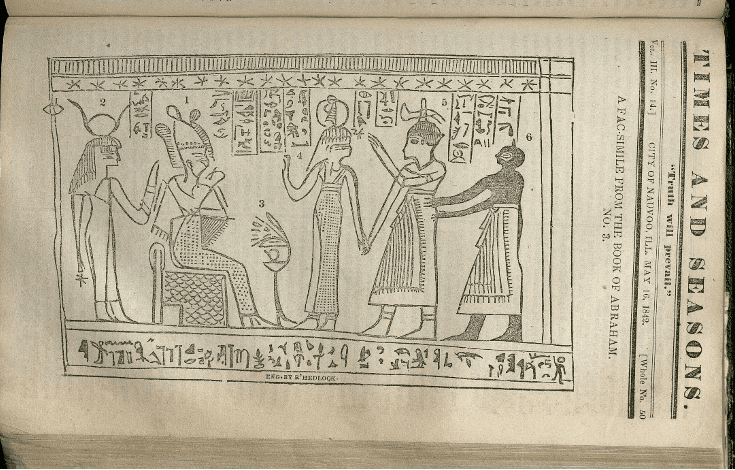
As we begin our study of the Old Testament, including the great Patriarch Abraham, and read from the Book of Abraham, it is worth pausing to consider how blessed we are to have the writings of this fabled man of God. Our gratitude for his writings, and for the prophet Joseph Smith who translated them for us, can be increased as we look at the reaction of those who first received these writings. The example of Wilford Woodruff is particularly inspiring for me.
Michael Chandler was an Ireland native who immigrated to the United States in 1828. At some point in the early 1830s he either acquired or began representing those who had acquired several Egyptian mummies and a smattering of papyri. These artifacts were taken to a number of cities where people paid to see the exhibits.[1] Eventually it was decided to sell the collection, which started to happen piece-meal. Chandler brought the dwindling collection to Ohio to see if he could finish selling it. He arrived in Kirtland in July of 1835, bringing with him four mummies, two papyrus scrolls, and a number of papyrus fragments. Chandler showed these antiquities to Joseph Smith, and the Prophet immediately translated a portion of the papyri. He felt impressed that the Saints needed to acquire these writings, so he purchased the collection from Chandler.

Soon the Prophet announced that the papyri contained the writings of Abraham and Joseph of Egypt, and he began translating the writings of Abraham. He translated much, perhaps all, of the Book of Abraham by the end of 1835. He may have even translated more of Abraham’s writings than we currently have in our Pearl of Great Price. November of 1835 seems to be the high point of translation activity. By December the Prophet began to focus on other things, and he would not return to working on the papyri until 1842.
When Joseph Smith first received the papyri, Woodruff had been a member of the Church for 18 months. Soon after his baptism on December 31, 1833, he had traveled to Kirtland in order to be part of Zion’s Camp. With this group he marched to Missouri, where he remained for some time. In January of 1835, he went on a mission to Arkansas and Tennessee. He was still on that mission when Joseph acquired the papyri and translated from it during the second half of 1835.
Woodruff returned to Kirtland a full year later in November of 1836. He learned of the great many things that had happened in Kirtland during his absence. Among the most significant of these was the translation of the Book of Abraham and the construction and dedication of the Kirtland Temple. He wrote of this in his journal entry for November 25, 1836:
After walking into the Pulpets, erected for the Priesthoods & viewing the curtains all bespeaking that grandure, solemnity & order that nothing Short of wisdom from God could invent, we then visited the upper rooms & there viewed four Egyptian Mumies & also the Book of Abram Written by his own hand & not ownly the hieroglyphicks but also many figures that this precious treasure Contains are Calculated to make a lasting impression upon the mind which is not to be erased.[2]

In Kirtland, one of the things a busy Woodruff became involved in was creating a map of the area around Kirtland. This map was created by drawing the shoreline of Lake Erie and then creating a grid system in which the names of Kirtland and all its surrounding communities. We can surmise that this was done during Woodruff’s stay in Kirtland, which lasted from November of 1836 through late May of 1837.[3] This map has an interesting tie with the Book of Abraham.
Sometime after Woodruff drew the map it was, for unknown reasons, no longer needed. Instead, when Joseph Smith or one of his associates decided to glue some of the papyri fragments to paper in an effort to preserve them, the pieces of papyrus known today as fragments II and IV were glued to Wilford’s map, which was cut into two different pieces in order to accommodate the two fragments.
About a year and a half later, on July 8, 1838, Joseph Smith received a revelation that called the Quorum of the Twelve to serve missions in Britain (see Doctrine & Covenants 118:4-5). They were instructed to leave the next spring from Far West, Missouri. By then, the Saints had fled Far West. Still, desiring to fulfill every part of the revelation, Brigham Young and 24 others, including Elder Woodruff, met in Far West and departed from there for the mission to England. It was there, in Far West, that Wilford Woodruff was ordained an apostle.
John Taylor, Wilford Woodruff, and Theodore Turley arrived in Liverpool in January of 1840.[4] While laboring in places such as Staffordshire and Herefordshire, Elder Woodruff found great success in converting large numbers of people to the Restored Gospel. He also served and found success in London. While he was there, he found experiences that drew him back to Joseph Smith’s papyri and the Book of Abraham.
One experience, at the British Museum. Is recorded in his journal on October 19th, 1840:
Though I felt interested in a visit to evry apartment of this Museum which is considerd the greatest collection in the world & open to the free inspection of the publick, yet I felt the more deeply interested in that Part Called the gallery of Antiquities esspecially the Egyptian. The Antiquities consists mostly of Greek, Roman Jewish & Egyptian, & some british…
Among the Egyptian Antiquities, is a large number of Tombs coffins, mumies, Hieroglyphics & Papyri enough if translated into the English language to make one hundred volums as large as the Bible. I felt more interested in this part than any thing I saw as they were from three to four thousand years of age, & would no doubt if translated have revealed many glorious things Sacred & historical concerning the early ages of the world Abram & the Prophets &c.
Having formed a intimate acquaintance with one of the overseers of the gallery of Antiquities, He explained many things to us concerning those things which were interesting unto us.[5]
It seems likely that the connection Woodruff made between the Egyptian antiquities and Abraham was because of that same connection having been made for him as he viewed the mummies and papyri in the Kirtland Temple. The combination of the Church’s Egyptian antiquities and the things he viewed in the British Museum seems to have sparked a deep interest in the ancient relics of Egypt for Elder Woodruff.
A few weeks later, on November 3rd, he visited the museum again. It appears that while there he communed once again with the Keeper of Egyptian Antiquities at the museum, a Mr. Palmer. We can surmise that Elder Woodruff’s relationship with this keeper had led to Mr. Palmer inviting Woodruff to return for a somewhat private tour. Of this day Elder Woodruff wrote “Elder Smith & myself again visited the British Museum. I having formed a private or intimite acquaintance with Mr W. Palmer the keeper of the Egyptian Antiquities & It being a private day not open to public exibition he accompanied us through the various appartment & spent several hours in explaining to us the most important things relating to the whole collection of Egyptian Jewish Greek & Roman antiquities which were vary interesting.”[6]
Elder Woodruff ended his British mission in April of 1841 and arrived in Nauvoo in October of that year. While Woodruff had developed a great deal of respect for Joseph Smith’s prophetic call and abilities since his conversion to the gospel, it was during the end of 1841 and the beginning of 1842 that he worked closely with the Prophet in a way that allowed him to see and comment on Joseph’s role as a seer in a more intimate way. On one occasion, Elder Woodruff wrote “The Twelve or a part of them spent the day with Joseph the Seer & he unfolded unto them many glorious things of the kingdom of God the privileges & blessings of the priesthood &c. I had the privilege of seeing for the first time in my day the URIM & THUMMIM.”[7]
At the beginning of 1842 Joseph Smith was inspired that he, John Taylor, and Wilford Woodruff should take over management of the Church’s newspaper, The Times and Seasons. It was in connection with this responsibility that Joseph Smith published his translation of the Book of Abraham in that newspaper, beginning work in February of 1842. The Prophet spent time on translating and editing the Book of Abraham during that month, though we cannot tell if the “translation” consisted of working on putting Hebrew phrases into the text, or actually translating new portions of the papyrus.[8]
We do not know the extent of Woodruff’s involvement in preparing the Book of Abraham for publication, but it is clear that he was affected in at least some ways by it. For example, on February 19th, a few days before Joseph’s journal starts to record his Book of Abraham activity, Woodruff recorded:
…The Lord is Blessing Joseph with Power to reveal the mysteries of the kingdom of God; to translate through the urim & Thummim Ancient records & Hyeroglyphics as old as Abraham or Adam, which causes our hearts to burn within us while we behold their glorious truths opened unto us.
Joseph the Seer has presented us some of the Book of Abraham which was written by his own hand but hid from the knowledge of man for the last four thousand years but has now come to light through the mercy of God. Joseph has had these records in his possession for several years but has never presented them before the world in the English language untill now. But he is now about to publish it to the world or parts of it by publishing it in the Times & Seasons, for Joseph the Seer is now the Editor of that paper & Elder Taylor assists him in writing while it has fallen to my lot to take charge of the Business part of the esstablishment.
I have had the privilege this day of assisting in setting the TIPE for printing the first peace of the BOOK OF ABRAHAM that is to be presented to the inhabitants of the EARTH in the LAST DAYS.
My Soul has been much edifyed of late from time to time in hearing Joseph the Seer convers about the mysteries of the Kingdom of God. Truly GOD is with him & is making him mighty in wisdom & knowledge & I am convinced for myself that none of the Prophets Seers or Revelators of the Earth have ever accomplished a greater work than will be accomplished in the Last days through the mercy of God By JOSEPH THE SEER.[9]
Elder Woodruff’s excitement about the Book of Abraham is readily apparent in this journal entry. His involvement in the publication of the Book of Abraham has been often overlooked. If we look to Joseph Smith’s journal to see when the prophet was working on the publication of his translation of Abraham’s writings, we see him mention working on it on February 23rd, March 1st, 4th, 8th and 9th. During this same time period Elder Woodruff mentions working in the printing office on Feb 19th, as mentioned above, and also each day from February 11th-26th. Of this stretch, Woodruff wrote that all of it was spent in the printing office and that “Nothing remarkable transpired with us during the week excepting we prepared A plate for making a cut at the commencement of the Book of Abraham which is to be published in the 9 no. of the 3 Vol of the Times & Seasons which will be interesting to many of the inhabitants of the earth.”[10] Thus it is clear that Woodruff was heavily involved in the publication of the Book of Abraham, in some aspects more than the Prophet himself was.

This continued for some time. Woodruff records that February 28th and March 3-4 were spent in the printing office. The March 1st edition of The Times and Seasons, the date representing when it was likely typeset, although the paper was not finished printing until around the 4th, contained what we now call Abraham 1:1-2:18 and Facsimile One. The successful publication of that portion of the translation was immediately followed by more publication work. March 7th to 10th, the 14th, 16th, 18th, and 19th were all spent by Woodruff working in the printing office.
Of this last day he wrote that “We struck off about 500 No of the 10 No 3 vol of Times & Seasons which contained the portion of the Book of Abraham that gave his account of Kolob, Oliblish, God siting upon his Throne The Earth, other planets & many great & glorious things as revealed to Abraham through the power of the priesthood. The truths of the Book of Abraham are truly edifying great & glorious which are among the rich treasures that are revealed unto us in the last days.”[11] The rest of the current text of the Book of Abraham, and Facsimile Two were published in this edition. It is Woodruff’s journal that lets us know that the actual publication date of the March 15th issue was March 19th.

Nothing more of that book of scripture was published in April or the first May edition of The Times and Seasons. The second May publication of the newspaper contained a printing of Facsimile Three. Woodruff worked consistently in the printing office throughout May, so he would have been a part of publishing that portion of our scripture as well. John Taylor also worked diligently on these publications along with Woodruff, as they were both overseen by Joseph Smith.
Perhaps Elders Taylor’s and Woodruff’s involvement in publishing the Book of Abraham, and the exuberance over it that Woodruff’s journal exhibits, indicates that their involvement in its canonization is not coincidental. A decade after Elder Woodruff’s visit to London, Franklin D. Richards had included transcriptions of The Times and Seasons publications of these writings of Abraham in a booklet he created in Liverpool, England which he titled The Pearl of Great Price. Copies of this booklet made its way across the plains with saints emigrating from England, and soon became known in the Salt Lake Valley. It was not until John Taylor was leading the Church in his capacity as the senior Apostle, with Wilford Woodruff filling the next-most-senior position, that the work on making this booklet into something more began in earnest.
It was on October 10, 1880, that John Taylor was formally made the President of the Church, and Wilford Woodruff was officially made the President of the Quorum of the Twelve. It was that same day that the Pearl of Great Price, including the Book of Abraham, was canonized. One would suppose that as someone who had so enthusiastically witnessed Joseph Smith’s seeric abilities as he worked on the Book of Abraham, that President Wilford Woodruff would have felt just as enthusiastic in raising his hand to support its canonization on that October day.

Kerry Muhlestein received his B.S. from BYU in Psychology with a Hebrew minor. He has taught courses in Hebrew and Religion at BYU, BYU-Hawaii and the UVSC extension center, and courses in History at Cal Poly Pomona and UCLA. He is the director of the BYU Egypt Excavation Project. He has served as the chairman of a national committee for the American Research Center in Egypt and serves on their Research Supporting Member Council. He has also served on a committee for the Society for the Study of Egyptian Antiquities, and currently serves on their Board of Trustees and as a Vice President of the organization. He is involved with the International Association of Egyptologists and has worked with Educational Testing Services on their AP World History exam. He and his wife, Julianne, are the parents of six children.
This article was published in cooperation with the Wilford Woodruff Papers Foundation. For more information on their mission to transcribe and publish all Wilford Woodruff’s writings, please visit wilfordwoodruffpapers.org.
NOTES
[1] “BYU Professor Tracing Path of Book of Abraham Papyri,” Ensign, (June, 1985), 75-76.
[2] “Journal (December 29, 1833 – January 3, 1838),” p. 113-114, The Wilford Woodruff Papers, accessed January 8, 2022, https://wilfordwoodruffpapers.org/documents/b048a7c5-6b6b-438a-bce7-262d5ba297d8/page/ed2cead6-b7f8-45f1-9c7f-5da7ec03faec
[3] Kerry Muhlestein and Alex Baugh, “Preserving the Joseph Smith Papyri Fragments: What Can We Learn from the Paper on Which the Papyri were Mounted?” The Journal of Book of Mormon and Other Restoration Scripture 22/2 (2013): 67-83.
[4] Cynthia Doxey Green, “Wilford Woodruff: Missionary in Herefordshire,” in Alexander L. Baugh and Susan Easton Black, eds., Banner of the Gospel: Wilford Woodruff (Provo and Salt Lake City: Religious Studies Center and Deseret Book Co., 2010), 149-150.
[5] The visit is recorded for the day of October 19, but this part is under his description of returning on December 9th. See “Journal (January 1, 1840 – December 31, 1840),” p. 195-196, The Wilford Woodruff Papers, accessed January 8, 2022, https://wilfordwoodruffpapers.org/documents/a304ab9d-910a-40ea-a121-858616d49cff/page/84edba5c-3797-4a31-abaf-ba4adc5093e5
[6] “Journal (January 1, 1840 – December 31, 1840),” p. 205, The Wilford Woodruff Papers, accessed January 8, 2022, https://wilfordwoodruffpapers.org/documents/a304ab9d-910a-40ea-a121-858616d49cff/page/41065e50-68db-4ded-a06d-2bff990d4a42
[7] “Journal (January 1, 1841 – December 31, 1842),” p. 122, The Wilford Woodruff Papers, accessed January 8, 2022, https://wilfordwoodruffpapers.org/documents/a9d1a2cb-18fe-445d-a5e4-350caaf63442/page/18514a77-9924-4236-8538-7c348353ff09
[8] Kerry Muhlestein and Megan Hansen, “‘The Work of Translating’: the Book of Abraham’s Translation Chronology,” in Spencer Fluhman, Brent L. Top, eds., Let Us Reason Together: Reflections on the Life of Study and Faith, Essays in Honor of Robert L. Millet, (Provo: Religious Studies Center, 2015), 139-162. Since this article, others have commented on what was translated during the Nauvoo period, but have done so without bringing any new information or analysis to the table and while avoiding interacting with the existing work already done on this topic.
[9] “Journal (January 1, 1841 – December 31, 1842),” p. 134, The Wilford Woodruff Papers, accessed January 8, 2022, https://wilfordwoodruffpapers.org/documents/3b738c16-75b7-4cb6-a0ed-1bf682fa554e/page/46a50900-b577-4e5c-9fd9-6b2347845fc1
[10] “Journal (January 1, 1841 – December 31, 1842),” p. 135, The Wilford Woodruff Papers, accessed January 8, 2022, https://wilfordwoodruffpapers.org/documents/a9d1a2cb-18fe-445d-a5e4-350caaf63442/page/2bfcc3ea-da03-47b0-b5c4-3109f47fbc67
[11] “Journal (January 1, 1841 – December 31, 1842),” p. 138, The Wilford Woodruff Papers, accessed January 8, 2022, https://wilfordwoodruffpapers.org/documents/3b738c16-75b7-4cb6-a0ed-1bf682fa554e/page/f81af798-c970-45ec-893a-aa6909c817ab
A Great Question: What DO We Believe? The Articles of Faith and Official Declarations 1 and 2

Scot
We know that the Prophet Joseph Smith wrote the Articles of Faith as part of a larger request from Mr. John Wentworth, editor and proprietor of the Chicago Democrat, a brand-new newspaper in the young, bustling city of Chicago. The Democrat would be published for just seven years, from 1842 to 1849. Mr. Wentworth wanted a concise history of the fledgling Church of Jesus Christ of Latter-day Saints and he wanted it written by its founder, Joseph Smith. The piece was also to be a part of the history of New Hampshire, being compiled by a Mr. George Barstow, a friend of John Wentworth. Joseph agreed to write the piece with this agreement: “As Mr. Barstow has taken the proper steps to obtain correct information, all that I shall ask at his hands is that he publish the account entire, ungarnished, and without misrepresentation.” Joseph carefully compiled the letter but it was never published in the newspaper or any history of New Hampshire. But this letter has become one of the great treasures of Church History.
Maurine
Welcome to Meridian Magazine’s Come Follow Me Podcast. We are Scot and Maurine Proctor and we are delighted to be with you again this week. We’ve entitled this lesson: A Great Question: What DO we believe? and this covers the Articles of Faith and Official Declarations 1 and 2.
One of the ways we support this podcast is through the yearly sale of Come Follow Me calendars. They are simply beautiful and the one for this coming Old Testament year truly sends you back to that ancient world where the Old Testament happens. These feature Scot’s remarkable photography with the Come Follow Me lessons for each week listed so you can help yourself keep track. They are a great gift for all those many people you’d like to give a meaningful gift to, but you don’t know what to do. Order as many as you’d like at flat rate shipping. Now that’s a deal. Go to latterdaysaintmag.com/2026. That’s latterdaysaintmag.com/2026.
Scot
I’ve always loved the Articles of Faith. Haven’t you? Those of you who grew up in the Church, didn’t you memorize all 13 of them in primary? I had the wonderful privilege of having my angel mother, Martha Proctor, teach me these amazing lines of doctrinal teaching. I want us to explore a little background about the Articles of Faith and then talk about some of the doctrines they underline. I remember once, Maurine, when some of my classmates in Rolla, Missouri, during lunch time, questioned what I believed as a Mormon (as we called ourselves in those bygone days). You have to understand that in our little town of 11,320 people, there were fifty-four different religious denominations. Four or five of my evangelical friends asked me what we really believed—but it wasn’t in a “I’d really like to understand you and your religion better” kind of way. It was like, “You are bizarre and freaky and who are you anyway” sort of way—a complete view of ignorance. I said, “Well, first of all, We believe in God the Eternal Father, and in His Son, Jesus Christ, and in the Holy Ghost.” That kind of got their attention. They said, “Yeah, well we believe in them too.” I said, “I know you do and We believe that men will be punished for their own sins, and not for Adam’s transgression.” They started staring at me, a little dumbfounded. I don’t think they really expected me to actually answer the question they had posed. They just wanted to create some contention. I continued, “We believe that through the Atonement of Christ, all mankind may be saved, by obedience to the laws and ordinances of the Gospel.” Okay, they stopped questioning me and made body language like they were done. I caught them in their motions to move and said, “We also believe that the first principles and ordinances of the Gospel are: first, Faith in the Lord Jesus Christ; second, Repentance; third, Baptism by immersion for the remission of sins; fourth, Laying on of hands for the gift of the Holy Ghost.” I wish you could have seen their faces at this point. I understood for the first time what the words confounded and dumbfounded meant. They were speechless and started to leave, I told them I had plenty more to tell them, but they said, “thanks, but we understand now,” and they left. And they never questioned me again. These statements of pure truth and doctrine are powerful.
Maurine
I love that story because these truly are salient, concise, perfect truths combined into powerful sentences and statements that teach our doctrines perfectly. And, if you look carefully at these 13 Articles of Faith, we see that Joseph covered these doctrines and teachings:
- The Godhead
- The Fall
- The Atonement
- The Saving Ordinances
- Priesthood Authority
- The Divine Organization of the Church
- Spiritual Gifts
- The Holy Canon of Scripture
- Continuing Revelation
- The Covenants made with Israel
- Religious Freedom
- Submission to Law
- The Godly Attributes
This is a lot of heavy material to put in just 411 words! And I think it’s interesting to understand that some articles of faith had been worked on and compiled by other leaders of the Church for eight years before Joseph published his. Oliver Cowdery made an attempt in 1834 and published them in the Messenger and Advocate. Oliver was known for his beautiful prose and eloquent language. Listen to Oliver’s approach to the doctrine of the Godhead:
“[1] We believe in God, and his Son Jesus Christ. We believe that God, from the beginning, revealed himself to man; and that whenever he has had a people on earth, he always has revealed himself to them by the Holy Ghost, the ministering of angels, or his own voice.
Of course, all of that is true and beautiful. But when Joseph was asked to give a short history of The Church of Jesus Christ of Latter-day Saints and to talk about its beliefs, he had to be more concise and right to the point in all areas.
Scot
Well, and Maurine, that point is well taken when we read Orson Pratt’s article of faith on the Atonement in 1840. Listen to this and think about Primary children memorizing this one:
“[3] We believe, that through the sufferings, death, and atonement of Jesus Christ, all mankind, without one exception, are to be completely, and fully redeemed, both body and spirit from the endless banishment and curse, to which they were consigned, by Adam’s transgression. … After this full, complete, and universal redemption, restoration, and salvation of the whole of Adam’s race, through the atonement of Jesus Christ, without faith, repentance, baptism, or any other works, then, all and every one of them, will enjoy eternal life and happiness, never more to be banished from the presence of God, if they themselves have committed no sin. …” (Orson Pratt, Interesting Account of Several Remarkable Visions and of the Late Discovery of Ancient American Record, 1840) Try putting that one to primary music! Of course, if Janice Kapp Perry is listening, knowing her, I’m sure she could and it would become a favorite.
I think Elder B.H. Roberts (by the way, B.H. stands for Brigham Henry) summed it up wonderfully when he wrote about the Prophet Joseph’s Wentworth letter, of which the Articles of Faith were the final words: “The letter is one of the choicest documents in our church literature; as also it is the earliest published document by the Prophet personally, making any pretension to consecutive narrative of those events in which the great Latter-day work had its origin. … For combining conciseness of statement with comprehensiveness of treatment of the subject with which it deals, it has few equals among historical documents, and certainly none that excel it in our church literature.” (History of the Church, 4:535–41)
Maurine
Elder Dallin H. Oaks, then of the Quorum of the Twelve, spoke at the Harvard Law School on February 26, 2010, said that “our Articles of Faith,” found at the end of the Wentworth Letter, remain today as “our only formal declaration of belief.”
“The impact of this sacred document lingers today.”
“President Thomas S. Monson wrote in the June 2011 Friend magazine about a man named Sharman Hummel, whom he worked with in the printing business.
“Mr. Hummel learned of the Church when he sat next to a girl on a bus and posed the question “What do you Mormons believe?” The girl recited the Articles of Faith.
“Mr. Hummel got off the bus, looked up the Church, and requested the missionaries come and teach him more. He joined the Church and now claims a large posterity of Latter-day Saints (Monson, Thomas S., “All Because a Child Knew the Articles of Faith,” The Friend, June 2011.)
Elder L. Tom Perry taught in his April 1998 general conference address that if members will use the Articles of Faith as a guide to direct their studies of the Savior’s doctrine, they will find themselves prepared to declare their witness of the restored, true Church of the Lord.
“The Articles of Faith were not the work of a team of scholars but were authored by a single, inspired man who declared comprehensively and concisely the essential doctrines of the gospel of Jesus Christ,” Elder Perry said. “They contain direct and simple statements of the principles of our religion, and they constitute strong evidence of the divine inspiration that rested upon the Prophet Joseph Smith.
“I encourage each of you to study the Articles of Faith and the doctrines they teach. … If you will use them as a guide to direct your studies of the Savior’s doctrine, you will find yourselves prepared to declare your witness of the restored, true church of the Lord. You will be able to declare with conviction: ‘We believe these things’” (Perry, L. Tom, “The Articles of Faith,” General Conference, April 1998).
Scot
I just have to say one other thing about these amazing Articles of Faith. Over the years I interviewed hundreds of BYU kids for their Ecclesiastical Endorsement to be at BYU. The interview had a number of questions and was committing the students to live and act in exacting ways. Of course, I agreed with everything in the BYU Code of Honor. As I very prayerfully considered how I was to interview those precious students I received a wonderful answer. And this is how I did it:
I would first ask a little bit about them and about their background and a little bit about their family if I didn’t yet know them well. And then I said, “Could you please recite for me the 13th Article of Faith?” “The 13th?”, they would ask. “Yes, it starts with ‘We believe…” They would laugh nervously and then would say. “That’s the long one, right? I think I can. Let’s see, “We believe in being honest, true, chaste, benevolent, virtuous, and in doing good to all men;” then they would usually pause here and say, “Uhhh, indeed, we may say that we follow the admonition of Paul—We believe all things, we hope all things, we have endured many things, and hope to be able to endure all things. If there is anything virtuous, lovely, or of good report (and I usually had to prompt them to remember this last thing) or praiseworthy, we seek after these things.” I would say, “Well done! Now, do you believe what you have just recited?” “Yes, I do.” “If you will live your life based on what you have just recited, this amazing 13th Article of Faith, I have no need to ask any more questions.” They would say, “I will.” And that was the interview. And we always felt the Spirit confirming this meeting. And you know, in all the years I did that I only had two students who needed help because they were converts in their late teens and didn’t memorize the Articles of Faith in their primary years. This was so inspiring to me!
Maurine
We could certainly gladly talk about the Articles of Faith all day, but let’s use the 9th Article of Faith as a seg way into the next section of this podcast: “We believe all that God has revealed, all that He does now reveal, and we believe that He will yet reveal many great and important things pertaining to the Kingdom of God.” This is the definition of what President Russell M. Nelson calls “the ongoing Restoration.” Remember what President Nelson said, ““We’re witnesses to a process of restoration. If you think the Church has been fully restored, you’re just seeing the beginning. There is much more to come. … Wait till next year. And then the next year. Eat your vitamin pills. Get your rest. It’s going to be exciting.” I remember standing outside the White House with President Gordon B. Hinckley when he received the Medal of Freedom from then President George W. Bush. He was asked by the press something like, “Is this a great day for the Church, is this a pinnacle of achievement?” And he said, “Oh, we have only just begun to scratch the surface of this great work.”
Scot
Which reminds me of the context of the placement of the Articles of Faith in the Wentworth Letter, by the way. Do you want to know what comes immediately before the Articles of Faith? Listen:
“[T]he Standard of Truth has been erected; no unhallowed hand can stop the work from progressing; persecutions may rage, mobs may combine, armies may assemble, calumny may defame, but the truth of God will go forth boldly, nobly, and independent, till it has penetrated every continent, visited every clime, swept every country, and sounded in every ear; till the purposes of God shall be accomplished, and the Great Jehovah shall say the work is done.” (Wentworth Letter, March 1, 1842, Times and Seasons, Nauvoo) And then the next sentence is:
We believe in God the Eternal Father, and in His Son Jesus Christ, and in the Holy Ghost!
That is so great to see that placement and to think about the ongoing and unfolding Restoration. If you are a little rusty on the Articles of Faith from Primary days, or you have never memorized them, well, take it upon yourself to memorize all 13 of them, a total of 411 words. It will bless your life forever, I promise. I have a personal witness of the power of the Articles of Faith.
Maurine
So, in the process of ongoing revelation let’s go back to the mid 1800’s and explore ever so briefly the growing Church in Utah in those early days and the importance of continuing revelation. Plural marriage was in full bloom. Many of the sisters and brethren in the Church were living “the principle.” One of them that we all know well, and whom Scot and I know especially well, was Parley Parker Pratt. Parley had 11 wives, ten of whom were living. Parley fathered 31 children. Now, all of us take a little Nephite pride in the number of our grandchildren, right? We see it all the time on the Church History tour. It’s kind of a badge of honor or something—at least it feels that way. We are swamped all the time by people who say they have 47 grandchildren and one recently said to us, “My mother had 11 children just like you guys and she had 78 grandchildren.” Sheesh. Well, sit down for a moment, because Parley P. Pratt had 264 grandchildren. And he was martyred before he even got to meet the very first one! That’s a lot of posterity! AND a tremendous loss for him to not get to know his grandchildren on this side of the veil.
Scot
It certainly is! And there were many others, George Q. Cannon had 43 children. Heber C. Kimball had 66 children. Brigham Young had 57. Wilford Woodruff had 34. Joseph F. Smith had 48. John Taylor 34. My own 2nd Great Grandfather, George Facer, had six wives and 29 children (and two of his wives bore no children!). This all makes sense from the Book of Mormon where the Lord said, “For if I will, saith the Lord of Hosts, raise up seed unto me, I will command my people; otherwise they shall hearken unto these things.” (Jacob 2:30) And the antecedent to “these things” is one man with one wife. (See Jacob 2:25-30)
Now, the Saints had been practicing plural marriage for almost 50 years. They were fairly isolated from the rest of the country as they lived in the Great Basin amongst the Rocky Mountains. And remember Deseret or Utah was a territory and had not obtained statehood yet. The Church of Jesus Christ was gaining converts and was growing in numbers and gaining national attention.
Maurine
And in the meantime, laws were being enacted in the United States, including the Edmunds Anti-Polygamy Act of 1882. Signed into law on March 23, 1882 by President Chester A. Arthur, the law declared polygamy a felony in all the federal territories of the United States, which included the Utah Territory. Enforcement of the act started as early as 1882 and in all, more than 1,300 men in Utah were imprisoned, including George Q. Cannon of the First Presidency and apostles Lorenzo Snow and Rudger Clawson. Elected officials in Utah vacated their offices because of their declared belief in polygamy.
In 1887 an amendment was passed, unsigned by the President, to the Edmunds Act to form the Edmunds-Tucker Act, specifically aimed at The Church of Jesus Christ of Latter-day Saints.
Scot
The act:
- Disincorporated The Church of Jesus Christ of Latter-day Saints and the Perpetual Emigrating Fund Company, with assets to be used for public schools in the Territory.
- Required an anti-polygamy oath for prospective voters, jurors and public officials.
- Annulled territorial laws allowing illegitimate children to inherit.
- Required civil marriage licenses (to aid in the prosecution of polygamy).
- Abrogated the common law spousal privilege for polygamists, thus requiring wives to testify against their husbands.
- The act disenfranchised women (who had been enfranchised by the Territorial legislature in 1870), and also a number of other things.
This, of course, caused Church President Wilford Woodruff to be extremely prayerful about what to do. Would the Lord require the dismantling of the Kingdom by continuing to live plural marriage? President Woodruff issued the Official Manifesto in General Conference, read by President Lorenzo Snow, on September 24th, 1890. Polygamy, or plural marriage, by revelation, officially came to an end.
President Woodruff later stated in November 1891:
The question is this: Which is the wisest course for the Latter-day Saints to pursue—to continue to attempt to practice plural marriage, with the laws of the nation against it and the opposition of sixty millions of people, and at the cost of the confiscation and loss of all the Temples, and the stopping of all the ordinances therein, both for the living and the dead, and the imprisonment of the First Presidency and Twelve and the heads of families in the Church, and the confiscation of personal property of the people (all of which of themselves would stop the practice); or, after doing and suffering what we have through our adherence to this principle to cease the practice and submit to the law, and through doing so leave the Prophets, Apostles and fathers at home, so that they can instruct the people and attend to the duties of the Church, and also leave the Temples in the hands of the Saints, so that they can attend to the ordinances of the Gospel, both for the living and the dead?
Maurine
President Woodruff continued:
“The Lord showed me by vision and revelation exactly what would take place if we did not stop this practice. If we had not stopped it, you would have had no use for … any of the men in this temple at Logan; for all ordinances would be stopped throughout the land of Zion. Confusion would reign throughout Israel, and many men would be made prisoners. This trouble would have come upon the whole Church, and we should have been compelled to stop the practice. Now, the question is, whether it should be stopped in this manner, or in the way the Lord has manifested to us, and leave our Prophets and Apostles and fathers free men, and the temples in the hands of the people, so that the dead may be redeemed. A large number has already been delivered from the prison house in the spirit world by this people, and shall the work go on or stop? This is the question I lay before the Latter-day Saints. You have to judge for yourselves. I want you to answer it for yourselves. I shall not answer it; but I say to you that that is exactly the condition we as a people would have been in had we not taken the course we have.
“… I saw exactly what would come to pass if there was not something done. I have had this spirit upon me for a long time. But I want to say this: I should have let all the temples go out of our hands; I should have gone to prison myself, and let every other man go there, had not the God of heaven commanded me to do what I did do; and when the hour came that I was commanded to do that, it was all clear to me. I went before the Lord, and I wrote what the Lord told me to write. …
“I leave this with you, for you to contemplate and consider. The Lord is at work with us. (Cache Stake Conference, Logan, Utah, Sunday, November 1, 1891. Reported in Deseret Weekly, November 14, 1891.)
Scot
And Maurine, this law that had been introduced quietly in Nauvoo in the early 1840’s and then publicly in Utah in 1850, was extremely hard to live, but the people had been living it for 50 years. These were husbands and wives and children who loved each other and were striving to keep the Lord’s commandments. And in those days, because this practice was in place, the Spirit of the Lord would testify to anyone who was asked to live it, that the practice was true and sanctioned by the God of Heaven. But when the Manifesto was issued in that fall General Conference of 1890, many of the Saints openly wept at this change. They loved their families. This would be a hard change for everyone and yet, it was what the Lord now required of His people. This is the Kingdom of God on the earth and there is continual and continuing revelation. The Lord had spoken and His people obeyed.
Maurine
Now, let’s talk about how Official Declaration number 2 came about. This change brought universal joy and happiness in the Church. But it was slow, by our standards, in coming. We want to talk about it in some detail, mainly so you can see the careful process of revelation to the Prophet of God.
If you had already been born and were a member of the Church, June 9, 1978, you remember in vivid detail exactly where you were the minute you heard that President Spencer W. Kimball had received a revelation extending the priesthood to all worthy males.
Elder Marion D. Hanks, an emeritus General Authority who was there said, “Hallelujah. I thank God I lived long enough to see this day.”
Scot
Church historian, Leonard Arrington, said that within five minutes “my son Carl Wayne telephoned from New York City to say he had heard the news. I was in the midst of sobbing with gratitude for this answer to our prayers and could hardly speak with him. I was thrilled and electrified. I felt like the Prophet Joseph Smith said we should feel about the gospel: “A voice of gladness! A voice of mercy from heaven; and a voice of truth out of the earth; glad tidings for the dead; a voice of gladness for the living and the dead; glad tidings of great joy.” (Doctrine and Covenants 128:19)
Rarely has news of an event spread faster than this one, taken the breath away of a people, most of whom had been long pained by the denial of the priesthood to those of African descent.
Maurine
Newspapers delayed their editions to add the announcement. Time and Newsweek stopped their presses on their weekend editions. The New York Times made it a front-page story, and newspapers that had been neutral or hostile to the Church carried laudatory editorials. U.S. President Jimmy Carter commended President Spencer W. Kimball for “compassionate prayerfulness and courage.”
“All of us had the sense of discomfort at the continuing policy that kept good and honorable people from the blessings of their possibilities,” said Elder Hanks. “For 39 years I was a General Authority and had to find ways to respond to what was a troubling reality that there were those worthy and wonderful people who were not yet permitted to hold the priesthood. You can’t respond to questions about this for years, and know that the Lord tells us that he “esteemeth all flesh in one” (1 Nephi 17:35) and not look forward to a change.”
He remembers being on the top of a hill in Vietnam, long before the revelation, talking to a young black member of the Church who had just had his legs blown off, holding his hand and weeping. “All I could say to him is that one day there will be additional information on this subject, and when that happens the Lord will give it to the president of the Church.”
Scot
President Kimball had long been sensitive to this issue. For instance, in March 1976, he was present for the laying of the cornerstone of the Sao Paulo, Brazil temple and met Ruda and Helvecio Martins, devoted black members, converted in 1972. They had donated money and time to the temple, knowing full well that as things stood, they would not be receiving its blessings. The bank account, which they had carefully saved for their son’s mission, went to another young man who would be able to serve. Seeing their devotion–and many others like them–moved and grieved President Kimball.
President Kimball wasn’t the first prophet to ponder and pray over the exclusion policy of the priesthood. Other prophets had made pronouncements to the effect that someday the priesthood would be made available to all worthy male members.
President Kimball had a long record of reaching out to people of many ethnicities. In his early years as an apostle, his assignment had been to the Indian nations, adding to his sensitivity.
Maurine
Beginning in 1976 as the prophet, he began a systematic routine of praying, fasting and supplicating the Lord on this matter.
It was, then, with both keen desire, and awe and reverence for God, that he began his heart-felt petitions, not believing for a moment that the matter was merely in his hands to make a change.
Scot
The spring of 1978 found the First Presidency and the Twelve discussing the subject often in the upper rooms of the temple at their Thursday meetings.
According to Joseph Fielding McConkie, “President Kimball did not act in isolation on the matter. He freely sought the feelings of his counselors and the Quorum of the Twelve. In March of 1978 he invited any of the Twelve who desired to do so to make any expressions they desired to him in writing so that he could carefully consider them. Three members of that Quorum responded to this invitation, Elders Monson, Packer, and McConkie. Elder McConkie’s memo centered on the doctrinal basis for conferring the Melchizedek Priesthood on the Blacks. After the revelation was received, he freely shared with his family the scriptural chain of thought that he had suggested to President Kimball. The power of it was in its simplicity. He simply saw things in passages of scriptures that the rest of us had conditioned ourselves not to see.
Maurine
Joseph McConkie continued: “Dad reasoned that inherent in any passage of scripture that promised that the gospel would go to all mankind was the promise that it–with all its blessings-must go to the Blacks. The Third Article of Faith, for instance, states that we believe that through the atonement of Christ ‘all mankind may be saved, by obedience to the laws and ordinances of the Gospel’ (italics added.) The word saved as used in this text, he said, meant to be exalted or obtain all the blessings of the celestial kingdom. To illustrate this point he quoted D&C 6:13, ‘If thou wilt do good, yea, and hold out faithful to the end, thou shalt be saved in the kingdom of God, which is the greatest of all the gifts of God; for there is no gift greater than the gift of salvation,’ and Joseph Smith’s statement that ‘Salvation consists in the glory, authority, majesty power and dominion which Jehovah possesses and in nothing else.’ (Lectures on Faith, 7:9; Italics added.)
“He also reminded us that all those who accept the gospel become the seed of the family of Abraham and are entitled to all of the blessings of the gospel. Jehovah told Abraham that his seed would take the gospel and the ‘Priesthood unto all nations,’ and that ‘as many as receive this Gospel shall be called after thy name, and shall be accounted thy seed, and shall rise up and bless thee, as their father.’ This, of course, is the matter of being adopted into the house of Israel.
“Jehovah also promised Abraham that when his literal seed took the message of salvation to ‘all nations,’ that then ‘shall all the families of the earth be blessed, even with the blessings of the Gospel, which are the blessings of salvation, even of life eternal.’ (Abraham. 2:9-11.)
“In his funeral address for Elder McConkie, Elder Packer observed that ‘President Kimball has spoken in public of his gratitude to Elder McConkie for some special support he received in the days leading up to the revelation on the Priesthood.’ It would be hard to suppose that that ‘special help’ did not include the assurance of his gospel understanding as found in the doctrinal analysis just reviewed.
Scot
“President Kimball described his own process of seeking revelation this way: “I remember very vividly that day after day I walked to the temple and ascended to the fourth floor where we have our solemn assemblies and where we have our meetings of the Twelve and the First Presidency. After everybody had gone out of the temple, I knelt and prayed. I prayed with much fervency. I knew that something was before us that was extremely important to many of the children of God. I knew that we could receive the revelations of the Lord only by being worthy and ready for them and ready to accept them and put them into place. Day after day I went alone and with great solemnity and seriousness in the upper rooms of the temple, and there I offered my soul and offered my efforts to go forward with the program. I wanted to do what he wanted. I talked about it to him and said, “Lord, I want only what is right. We are not making any plans to be spectacularly moving. We want only the thing that thou dost want, and we want it when you want it and not until.”
President Gordon B. Hinckley said in an October 1988 Ensign, “I was not present when John the Baptist conferred the Aaronic Priesthood. I was not present when Peter, James, and John conferred the Melchizedek Priesthood. But I was present and was a participant and a witness to what occurred on Thursday, June 1, 1978. My memory is clear concerning the events of that day.
“Each first Thursday of the month is a day for fasting and the bearing of testimony by the General Authorities of the Church. So many of the Brethren are absent from home on the first Sunday of the month because of assignments to stake conferences that we hold our monthly testimony meeting in an upper room of the Salt Lake Temple the first Thursday of the month. The Thursday of which I speak was June 1, 1978. We heard testimonies from some of the brethren, and we partook of the sacrament of the Lord’s Supper.
“It was a wonderfully spiritual meeting, as are all such meetings in these holy precincts and under these circumstances. Then the members of the First Quorum of the Seventy and the Presiding Bishopric were excused, while there remained the president of the Church, his two Counselors, and ten members of the Council of the Twelve-two being absent, one in South America and the other in the hospital.
Maurine
President Hinckley continued: “The question of extending the blessings of the priesthood to blacks had been on the minds of many of the Brethren over a period of years. It had repeatedly been brought up by Presidents of the Church. It had become a matter of particular concern to President Spencer W. Kimball.
“Over a considerable period of time he had prayed concerning this serious and difficult question. He had spent many hours in that upper room in the temple by himself in prayer and meditation.
“On this occasion he raised the question before his Brethren—his Counselors and the Apostles. Following this discussion, we joined in prayer in the most sacred of circumstances. President Kimball himself was voice in that prayer. I do not recall the exact words that he spoke. But I do recall my own feelings and the nature of the expressions of my Brethren. There was a hallowed and sanctified atmosphere in the room. For me, it felt as if a conduit opened between the heavenly throne and the kneeling, pleading prophet of God who was joined by his Brethren. The Spirit of God was there. And by the power of the Holy Ghost there came to that prophet an assurance that the thing for which he prayed was right, that the time had come, and that now the wondrous blessings of the priesthood should be extended to worthy men everywhere regardless of lineage.
Scot
“Every man in that circle, by the power of the Holy Ghost, knew the same thing.
“It was a quiet and sublime occasion.
“There was not the sound “as of a rushing mighty wind,” there were not “cloven tongues like as of fire” (Acts 2:2-3) as there had been on the Day of Pentecost. But there was a Pentecostal spirit, for the Holy Ghost was there.
“No voice audible to our physical ears was heard. But the voice of the Spirit whispered with certainty into our minds and our very souls.
“It was for us, at least for me personally, as I imagine it was with Enos, who said concerning his remarkable experience, “And while I was thus struggling in the spirit, behold, the voice of the Lord came into my mind.” (Enos 1:10.)
“So it was on that memorable June 1, 1978. We left that meeting subdued and reverent and joyful. Not one of us who was present on that occasion was ever quite the same after that. Nor has the Church been quite the same.”
Leonard Arrington, who interviewed many of those present said, “At the end of the heavenly manifestation [President] Kimball, weeping for joy, confronted the church members, many of them also sobbing, and asked if they sustained this heavenly instruction. Embracing, all nodded vigorously and jubilantly their sanction. There had been a startling and commanding revelation from God-an ineffable experience.”
Maurine
Those Arrington interviewed said, “the gathering, incredible and without compare, was the greatest singular event of their lives. Those I talked with wept as they spoke of it. All were certain they had witnessed a revelation from God.”
An official announcement of the revelation, dated June 8, 1978, was announced to the press the next day, on June 9. Arrington wrote, “Here was indisputable evidence of God’s presence and direction in these latter days-divine reaffirmation of the faith and values of our church.” It read:
To all general and local priesthood officers of The Church of Jesus Christ of Latter-day Saints throughout the world:
As we have witnessed the expansion of the work of the Lord over the earth, we have been grateful that people of many nations have responded to the message of the restored gospel, and have joined the Church in ever-increasing numbers. This, in turn, has inspired us with a desire to extend to every worthy member of the Church all of the privileges and blessings which the gospel affords.
Aware of the promises made by the prophets and presidents of the Church who have preceded us that at some time, in God’s eternal plan, all of our brethren who are worthy may receive the priesthood, and witnessing the faithfulness of those from whom the priesthood has been withheld, we have pleaded long and earnestly in behalf of these, our faithful brethren, spending many hours in the Upper Room of the Temple supplicating the Lord for divine guidance.
Scot
He has heard our prayers, and by revelation has confirmed that the long-promised day has come when every faithful, worthy man in the Church may receive the holy priesthood, with power to exercise its divine authority, and enjoy with his loved ones every blessing that flows therefrom, including the blessings of the temple. Accordingly, all worthy male members of the Church may be ordained to the priesthood without regard for race or color. Priesthood leaders are instructed to follow the policy of carefully interviewing all candidates for ordination to either the Aaronic or the Melchizedek Priesthood to ensure that they meet the established standards for worthiness.
We declare with soberness that the Lord has now made known his will for the blessing of all his children throughout the earth who will hearken to the voice of his authorized servants, and prepare themselves to receive every blessing of the gospel.
Sincerely yours,
Spencer W. Kimball
N. Eldon Tanner
Marion G. Romney
The First Presidency
Maurine
In an interesting note, Scot, when I interviewed Camilla Kimball for a video on her life, as you know, she explained her experience of the event. She said she had known that Spencer had been troubled and concerned for some time over a matter that absorbed him. She remembered that one day as they were returning from the Salt Lake airport, he had asked to be let off at the temple because he wanted to spend some time in meditation and prayer. She did not know about the revelation on the priesthood until after her daughter, who had heard the announcement on television, called her on the morning of June 9. President Kimball was a man who could keep confidences.
Scot
I love this intimate view of the process of revelation in the Church at the highest level. Now, I remember when we interviewed William (Billy) Johnson in Ghana, a man who heard about the Church in 1964 and had 10 congregations of faithful Ghanaians ready for baptism as soon as they could get missionaries. He told us, “We used to sing Come, Come Ye Saints in our meetings and with tears in our eyes we would cry, “When will our brothers from the West come for us?” They finally did come!
These congregations and others have grown exponentially. Ghana now has 113,470 members in 387 congregations in 31 stakes. Nigeria has 250,341 members in 840 congregations in 80 stakes. The Democratic Republic of the Congo has 102,862 members in 269 congregations in 42 stakes. The list goes on and on—and this is just the growth since the Church officially came into West Africa in late 1978!
Maurine
When I stood next to William (Billy) Johnson going into the Temple dedication in Accra, he told me he had spent all night prostrate upon the floor in a prayer of gratitude to the Lord for bringing the Temple to them. What faith and humility and gratitude! But even more impressive was when I walked out of the Temple with Brother Johnson, one of the most amazing people we have ever met in all the world, he told me that during the singing of The Spirit of God he was given to see a vision of the hosts of the Ghanaian dead. “They were all there, led by their tribal chiefs in all their full royal dress and they had come to have their work done for them!”
This is the faith of a people who had waited so long to have the full blessings of the Gospel and now these blessings are freely extended to all on both sides of the veil.
Scot
That’s all for today. These are marvelous truths and a perfect view of continuing revelation in this, The Church of Jesus Christ. We’ve loved being with you. Next week our lesson will be on: The Family: A Proclamation to the World. We’re grateful to Jenny Oaks Baker for the music and to our daughter, Michaela Proctor Hutchins for producing this show. Have a wonderful, joyous week and see you next time.
“Come, Thou Fount of Every Blessing” Performed by Jenny Oaks Baker. Used with permission © 2003 Shadow Mountain Records
The Keys of Heaven and Apostolic Succession
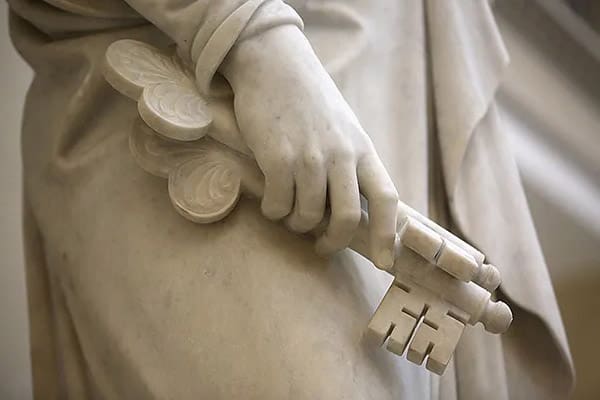
During an address delivered at the April 2008 General Conference of the Church that was entitled, simply, “The Twelve,” President Boyd K. Packer related a story that struck me then and that has stuck with me ever since:
In 1976, an area general conference was held in Copenhagen, Denmark. After the closing session, President Spencer W. Kimball wanted to visit the city’s Vor Frue Church, where Bertel Thorvaldsen’s statues of the “Christus” and of the Twelve Apostles stand, and to take several of the General Authorities there.
The “Christus” stands behind the altar of the church, flanked by the apostles, with Peter to the right and the other apostles in order. Most of President Kimball’s group was back at the rear of the chapel, with the church’s custodian. Elder Packer stood up front before the statue of Peter, with President Kimball, Elder Rex D. Pinegar of the Seventy, and Johan Helge Benthin, who was then serving as the president of the Copenhagen stake.
As he is depicted in Thorvaldsen’s marble, Peter holds a set of heavy keys in his hand. In President Packer’s telling of the story, President Kimball pointed to those keys and explained what they symbolized.
“Then, in an act I shall never forget, he turned to President Benthin and with unaccustomed firmness pointed his finger at him and said, ‘I want you to tell everyone in Denmark that I hold the keys! We hold the real keys, and we use them every day.’”
Continued President Packer, “I will never forget that declaration, that testimony from the prophet. The influence was spiritually powerful; the impression was physical in its impact.
“We walked to the back of the chapel, where the rest of the group was standing. Pointing to the statues, President Kimball said to the kind custodian, ‘These are the dead Apostles.’ Pointing to me, he said, ‘Here we have the living Apostles. Elder Packer is an Apostle. Elder Thomas S. Monson and Elder L. Tom Perry are Apostles, and I am an Apostle. We are the living Apostles.
“‘You read about the Seventies in the New Testament, and here are two of the living Seventies, Elder Rex D. Pinegar and Elder Robert D. Hales.’
“The custodian, who up to that time had shown no emotion, suddenly was in tears.
“I felt I had had an experience of a lifetime.”
Although many do not, Latter-day Saints are far from the only Christians who recognize the vital importance of the “keys” of authority. The question, for such believers, revolves around who holds them.
Many years ago, for example, when I was a graduate student in Cairo, Egypt, my wife and I lived just above an American Lutheran clergyman and his family. He was the pastor of the local expatriate Protestant church, and we became friends. One day, somewhat upset, he told me of an experience that he had just had while meeting with the patriarch of Egypt’s Coptic Orthodox Church, the bishop of Alexandria, who is often also called “pope.” Very quickly, my friend told me, Pope Shenouda had made it clear that, while he recognized Catholic and Greek Orthodox clergy and others as part of the apostolic and episcopal “succession,” from his point of view, Protestant schismatics (such as my friend the pastor) were outside of that line of authority and, thus, mere laymen.
Visitors to St. Peter’s Basilica in Vatican City, a veritable monument in stone to the authority claimed by the popes, will surely have noticed the omnipresence in that vast building of the papal crown atop two crossed keys. And the large inscription that runs around the interior of Michelangelo’s great dome—its blue letters are nearly 6.5 feet high against a gold background—reads as follows: “Tu es Petrus et super hanc petram aedificabo ecclesiam meam et tibi dabo claves regni caelorum” (“Thou art Peter, and upon this rock I will build my church and I will give unto thee the keys of the kingdom of heaven.” Compare Matthew 16:18-19.)
The ancient Catholic and Orthodox communions trace their authority back through what they believe to be an unbroken line of bishops to the original apostles. By contrast, Latter-day Saints believe that the line of authority has been broken. Thus, priesthood authority and priesthood keys had to be restored by heavenly messengers who were sent in the early nineteenth century.
Since the death of President Russell M. Nelson late on Saturday, 27 September 2025, members of the Church of Jesus Christ of Latter-day Saints have been receiving a refresher course on apostolic succession in the presidency of the Church. What has been unfolding was set in place largely by the events that followed the assassination of the Prophet Joseph Smith and his brother Hyrum on 27 June 1844. The 2024 Interpreter Foundation dramatic film “Six Days in August” tells that story, and the Foundation’s forthcoming series of short documentaries (“Becoming Brigham”) will, among other things, expand on those pivotal events.
Immediately upon President Nelson’s passing, Dallin H. Oaks assumed leadership of the Church in his capacity as senior apostle. And, by “immediately,” I mean “instantaneously.” This has been the procedure for many years, as a story related by President N. Eldon Tanner, to an audience at Brigham Young University in 1978, beautifully illustrates.
President Tanner had been serving as first counselor to President Harold B. Lee in the First Presidency of the Church. On 26 December 1973, he was in Phoenix, Arizona, having spent Christmas with his daughter and her family. Suddenly, he received a telephone call from D. Arthur Haycock, President Lee’s secretary, informing him that President Lee was seriously ill. Brother Haycock suggested that President Tanner return home as soon as possible. However, Brother Haycock called again about half an hour later. “The Lord has spoken,” he said. “President Lee has been called home.”
I quote President Tanner’s retelling of what happened next:
“President [Marion G.] Romney, Second Counselor, in my absence, was directing the affairs of the Church, and was at the hospital with Spencer W. Kimball, President of the Council of the Twelve. Immediately upon the death of President Lee, President Romney turned to President Kimball and said, “You are in charge.” Remember, the Prophet Joseph Smith had said that without the President, there was no First Presidency over the Twelve.
“Not one minute passed between the time President Lee died and the Twelve took over as the presiding authority of the Church.”
However, the process wasn’t always so clearly understood. When Joseph Smith and his brother Hyrum were murdered at Carthage Jail, Latter-day Saints were both stunned and confused. Who would assume leadership of the Church? They had no precedent to guide them. Sidney Rigdon, who had served as first counselor to Joseph Smith, claimed the right of succession by virtue of his place in the Church’s First Presidency.
His claim seems, though, to have contradicted what is recorded in Teachings of the Prophet Joseph Smith: “President Smith next proceeded to explain the duty of the Twelve, and their authority, which is next to the present Presidency. … Also the Twelve are not subject to any other than the First Presidency, … ‘and where I am not [meaning the President of the Church], there is no First Presidency over the Twelve’” (105-106).
The Twelve returned to Nauvoo from their mission assignments and, under their president, Brigham Young, also asserted leadership. Over the next months and years, still other claimants would assert their claims, but Sidney Rigdon and the Twelve were the most prominent candidates in mid-1844.
On what basis did the Twelve claim leadership of the Church? They did so on the basis of the keys that they held. But the history of those keys is perhaps more complicated than many realize. In 1835, when the modern Quorum of the Twelve Apostles was organized, its members received the keys of the apostleship as they then existed. However, by 1836, there were keys on the earth that the Twelve had not been given.
How could this be? On 3 April 1836, Moses and Elias, and Elijah appeared to Joseph Smith and Oliver Cowdery in the newly dedicated Kirtland Temple and conferred new keys of authority upon them that had been unavailable when the Twelve were called. For some time thereafter, Joseph and Oliver held those new keys, but no others did.
Unfortunately, Oliver Cowdery was excommunicated in April 1838, slightly more than two years after the new keys had been conferred upon him at Kirtland. Thus, for a time, Joseph Smith was the only man on earth who held the new authority that Oliver had once shared but had forfeited. Had Joseph died during the next two years or so—had he, for example, not emerged from Liberty Jail alive—those keys would have needed to be restored again by heavenly messengers.
This rather precarious situation continued until the great Nauvoo revelation of 19 January 1841, which we now know as Doctrine and Covenants 124. In verses 94 and 95 of that revelation, speaking of Hyrum Smith, the Lord says,
“I appoint unto him that he may be a prophet, and a seer, and a revelator unto my church, as well as my servant Joseph; that he may act in concert also with my servant Joseph; and that he shall receive counsel from my servant Joseph, who shall show unto him the keys whereby he may ask and receive, and be crowned with the same blessing, and glory, and honor, and priesthood, and gifts of the priesthood, that once were put upon him that was my servant Oliver Cowdery.”
Thereupon, within a week, an announcement appeared in the Church newspaper, the “Times and Seasons,” that new officers had been set apart according to the instructions given in the revelation. Hyrum was released as a counselor in the First Presidency and became, instead, what has been called an “associate president,” or a “co-president,” holding all of the keys of priesthood authority with his younger brother.
Importantly, there appears to be no evidence that those keys of authority were ever conferred upon Sidney Rigdon. And it is intriguing to think that, if Hyrum had outlived Joseph, he might have succeeded his brother as the president of the Church. But he didn’t. He was the first of the two to be killed at Carthage; he died a minute or two before Joseph did. So were the keys gone from the earth with the death of both Joseph and Hyrum?
They were not. Apparently sensing that he would not live much longer, Joseph Smith took several important measures in 1843 and early 1844 to ensure that the keys would be shared by others. We don’t know the date on which Brigham Young received the sealing key. Happily, though, we have a witness who testifies that he did. In January 1845, six months after Joseph Smith was killed, Parley Pratt published a proclamation to the Saints in which he recounted many of the steps that Joseph took in preparing the Twelve for his passing. And Elder Pratt specifically says that he was a witness to Brigham Young’s receiving the sealing key, the final key of authority.
In March 1897, in his ninety-first year, President Wilford Woodruff testified, speaking into an early recording device, of an event that is sometimes called the “Last Charge” meeting. It probably occurred on 26 March 1844. To me, it is remarkable to hear the voice of a man who not only knew Joseph Smith but who had served as an apostle during Joseph’s lifetime. But what he chose to say is also remarkable. Here are some of President Woodruff’s words from that recording:
“I bear my testimony that in the early spring of 1844, in Nauvoo, the Prophet Joseph Smith called the Twelve Apostles together and he delivered unto them the ordinances of the church and kingdom of God; and all the keys and powers that God had bestowed upon him, he sealed upon our heads, and he told us that we must round up our shoulders and bear off this kingdom, or we would be damned. I am the only man now living in the flesh who heard that testimony from his mouth, and I know that it was true by the power of God manifest to him. At that meeting he stood on his feet for about three hours and taught us the things of the kingdom. His face was as clear as amber, and he was covered with a power that I had never seen in any man in the flesh before.”
Even so, the apostles seem not to have fully comprehended what Joseph was doing and what it meant for them. Much like the ancient Twelve whom Jesus had warned several times of his pending death, they were nonetheless surprised and confused at the loss of their prophet. Brigham Young himself recalled that, when he first heard of Joseph’s death, he was not only overcome by grief but feared that the keys of the priesthood were gone. Then, he said, “I felt it come like a flash of lightning to my mind, and I said ‘the keys of the kingdom are here.’”
All of this accorded with what had only been hinted at in Doctrine and Covenants 107, which was received in or near April 1835, in connection with the organization of the Twelve:
“Of the Melchizedek Priesthood, three Presiding High Priests, chosen by the body, appointed and ordained to that office, and upheld by the confidence, faith, and prayer of the church, form a quorum of the Presidency of the Church. . . . And again, the duty of the President of the office of the High Priesthood is to preside over the whole church, and to be like unto Moses— . . . yea, to be a seer, a revelator, a translator, and a prophet, having all the gifts of God which he bestows upon the head of the church.”
And again: “The twelve traveling councilors are called to be the Twelve Apostles, or special witnesses of the name of Christ in all the world. …
“And they form a quorum, equal in authority and power to the three presidents” (Doctrine and Covenants 107:22-24, 91-92).
At the death of Joseph Smith, the Twelve became the presiding authority of the Church, with Brigham Young as president of the Twelve, and administered the affairs of the Church for three and a half years. Then Brigham Young was chosen as President of the Church, and he selected and ordained, and set apart his counselors. Then there were three years and two months between his death and the installation of John Taylor as President of the Church. Following John Taylor’s death, it was one year and nine months before Wilford Woodruff was chosen, set apart, and ordained as President of the Church. Since then, just a few days have passed between the death of the President and the setting apart of the next President—and the Twelve continue to preside at the death of each President until—as we have just witnessed—a new First Presidency is organized.
Notes
This article was heavily influenced by Ronald K. Esplin, “‘All the Measures of Joseph’: The Succession of 1844,” in Jeffrey M. Bradshaw, ed., Joseph Smith: A Life Lived in Crescendo (Orem: Interpreter Foundation and Eborn Books, 2024), and by my interview with Dr. Esplin for the forthcoming Becoming Brigham series. Another relevant chapter in that two-volume set is Jeffrey M. Bradshaw, “Dennison Lott Harris’ firsthand accounts of the conspiracy of Nauvoo and the transmission of apostolic keys.”
The full recording of Wilford Woodruff’s 1997 recorded testimony is available at https://www.youtube.com/watch?v=5NjANSFISFY. See also Richard Neitzel Holzapfel and Stephen H. Smoot, “Wilford Woodruff’s 1897 Testimony” (https://rsc.byu.edu/banner-gospel-wilford-woodruff/wilford-woodruffs-1897-testimony).
The two speeches from which I quote are Boyd K. Packer, “The Twelve” https://www.churchofjesuschrist.org/study/general-conference/2008/04/the-twelve?lang=eng, and N. Eldon Tanner, “Administration of the Restored Church” https://speeches.byu.edu/talks/n-eldon-tanner/administration-restored-church/
Wilford Woodruff Discourse: “Whatsoever Leadeth to Good Is of God”
The following is a discourse delivered by Wilford Woodruff in 1894, which was recorded by Arthur Winter. This transcript, its images, and others can be found at https://wilfordwoodruffpapers.org/
The angel Moroni said to the Prophet Joseph Smith, “Whatsoever enticeth and leadeth to good and to do good is of God, and whatsoever doth not is of that wicked one.” That is a true principle. I wish to make some remarks upon this, but before doing so I desire to refer to our meeting this forenoon. There was probably not one half present this morning of those who are here this afternoon, and therefore many may not fully understand what I allude to. This is a Stake Conference, and there was a report made this morning of the fast offerings received from the various wards in the Stake and the amounts disbursed for the support of the poor. I think that the report showed that during the last six months this Stake alone received from the general tithing office $14,000 for the support of the poor. I believe I am sa[f]e in saying that fifty per cent of all the tithing collected throughout the mountains of Israel is returned to the various Stakes for local expenses, among which is the
support of the poor. I think myself that this is wrong. As Latter-day Saints, we should observe our fast meetings and our fast offerings. We should at least make a donation of that which we save by fasting, and give it to the Bishop for the support of the poor. It was remarked this morning that some people said they could not fast because it made their head ache. Well, I can fast, and so can any other man; and if
it makes my head ache by keeping the commandments of God, let it ache. If we did our duty with regard to the poor among us the tithing would not be withheld from the Presiding Bishopric for the support of the poor. In this, brethren and sisters, I certainly think we should improve. There is nothing gained by our attempting to shirk any duty that God requires of us. We should be more diligent in attending our fast meetings. We should fast as the Lord requires. The Lord does not ask anything of any man that he cannot perform. Whenever the Lord
gives a commandment to the children of men, He provides a way for the fulfilment of that commandment. Tithing is a commandment of God to the people, and should be observed. The report of what the Relief Society has done is certainly a great credit to them. The amount of means which they have donated for the support of the poor in this Stake is a large amount, considering the labors that there are upon that Society. I hope we will all reflect upon these things and not forget our duty with regard to the fast offerings and the fast meetings, as well as all other meetings that we are required to attend.
President Angus M. Cannon referred to the officers of the Stake not being present at this Conference. I think if we all felt as we should, if we understood the signs of the times, we would take pleasure in attending meetings as far as possible. The Presidency of the Church and the Twelve Apostles have the conferences of the whole Church to attend, and when they are not here they are performing other duties.
Now, with regard to the statement I made in the beginning, “Whatsoever enticeth and leadeth to good and to do good is of God, and whatsoever doth not is of that wicked one.” While we as a people accord to every denomination the right to enjoy their religion, we claim the same privilege ourselves. I have often referred to this, because perhaps it has appeared sometimes as though we were encroaching upon
others. This, however, is not the case. Let us compare the good with the evil today. Where is there a man, no matter what sect he belongs to, who cannot see a great change in the world today? I remember very well over eighty years of my life, and I certainly have never
seen such a time in my life in the United States as I have during the last year. The spirit of murder, of whoredom, of blasphemy that is going like a flood over the land, and the increase of crime on every hand, is certainly alarming. Is it from God? Does it lead to
good? It does not. There is no God in it. When we look at these things we can see that there is a power manifest in our land and among the nations of the earth that is leading men to do evil. There is one thing very prominently before my mind, and that is the unpopularity of God himself, and of Jesus Christ, and of the Gospel of the Son of God. In the days of the Savior there were a good many religious sects, and they were all at war with the Savior and His Apostles. They fought against everything they did, and labored for their destruction until the Savior and His Apostles were put to death. Were they led by the Spirit of God? They were not. They were not inspired to do right; they were seeking to do wrong. In this dispensation the Prophet Joseph was an unpopular man. He was opposed by the world, and by a great many men who professed to be ministers of the Gospel. They labored against him and to overthrow his doctrines. Now, if Joseph Smith was right, his persecutors were not right. Of course, every man must be his own judge with regard to that. If Jesus Christ and the Apostles were right, then those men who fought against them were not right.
We are informed by the revelation of St. John that in the last days there would be something like six hundred three score and six different religious sects and parties in the earth. Of course, there could be but one of them right; for there is but one right way. There is but one Gospel;
there never was but one and never will be. That Gospel never deviates from one generation to another. So with the Holy Priesthood. The Priesthood is the same in every generation. Whenever God has had a people on the face of the earth, He has had the Priesthood among them. In fact, no man has the right to administer in one of the ordinances of the Gospel of the Son of God only by and through the power of the Holy Priesthood. The ancient apostles and prophets who administered in the ordinances of the Gospel held that Priesthood. Without that authority they would have had no right to administer in these ordinances. So in this day, this principle is the same.
Now, my friends, it does not pay any man to preach false doctrine or ot practice false principles, because there is no salvation in it. It is for salvation that we labor. For that the Lord called Joseph Smith to organize the Church of Jesus Christ once more for the last time on the earth, so that a body of people would be prepared for the coming of the Son of Man. The Gospel of Christ was with Joseph Smith. The Priesthood was given to Joseph Smith by those who held that Priesthood in the days of Jesus. He never pretended to administer in one ordinance until he received the commandment of God to do it. Those of you who have embraced the Gospel and have lived your religion know for yourselves that the power of God has followed this work from the commencement until today. I know it has, and I know it will if we do our duty. All the ancient patriarchs and prophets labored for salvation, for the glory where God and Christ dwell, that after death, in their immortal bodies, they might occupy that position forever. It paid them to do it, and it will pay all men to do the same. We cannot spend our time foolishly in safety. We have a mission to fulfil. Some portion of the Holy Priesthood has been given to almost every man in the land of Zion, and to many of them at a very early age. It has been given to us that we may administer in the ordinances of the Gospel and in the things of the kingdom of God. Then let us try to magnify our callings and to do our duty. We know the principles we are practicing are true. The Lord has given us power to rear these temples unto His holy name, that we may enter in as saviors on mount Zion and redeem our dead, that they who have never heard the Gospel may partake of eternal life. Jesus himself went to preach to the spirits in prison, that they might be judged according to men in the flesh. [1 Peter 4:6]So do the apostles and elders of Israel as they pass away. We labor this side of the veil, and they labor the other side of the veil. These things are true. God has established this Church. He has raised up prophets and apostles, and has planted a work in these mountains of Israel, where this congregation have been gathered by the power of God. We have a labor to perform, and if we do not do it we will be under condemnation. I know this is the work of God. I know the Priesthood is here, and I know the power of God has followed this Priesthood since the Church was organized. Our Elders have traveled at home and abroad. They have been taken from the various
occupations of life and thrust into the vineyard. They have traveled thousands of miles, and that, too, without purse and scrip, preaching without price. I never thought of taking any money with me on my missions. I have traveled in a good many countries, and I always traveled without purse and scrip, and I preached without money and without price. The Lord always raised up friends for me in time of need. I was fed and clothed and had all the necessities of life. That is the way the ancient Apostles preached. It was the way the Elders of Israel have had to preach in the day and generation in which we live.
Brethren and sisters, I hope we will look at the position we occupy here and the work that lies before us, and as far as we can go into these temples. I thank God we have a temple upon this block, where the Latter-day Saints in this region can enter and redeem their
dead—their fathers and mothers and their progenitors who have gone into the spirit world without the Gospel. They never heard the Gospel,
and no man, in time or in eternity, will ever be saved in the celestial kingdom of God without the Gospel of Christ. Therefore, let us look upon these things as they are. Let us try to live our religion, that when we get through we may be satisfied with life. I prayed many an hour when a boy that the Lord would let me live to see a prophet or an apostle, or some man who could teach me that Gospel which I read of in the New Testament. I have lived to see that day, and I thank God for it. I have tried to do what good I could in my weak way. I have tried to go into
these temples and redeem my father’s house. With the assistance of my friends I have been able to do this. When I go to the other side of the veil and meet with them, I think I shall be satisfied, and I think they will. They will find that these principles are true, and so will all denominations when they come in the presence of God. They will learn then, if not before, that this is the work of God. I pray God to bless all who are connected with the Church of Jesus Christ of Latter-day Saints. May we magnify our calling and do our duty, that when we get
through and go into the presence of God and read our history in that great library in heaven, where the acts of all men are recorded, we may be satisfied. God give us wisdom, and lead and guide us in our duty, that we may overcome the world, the flesh and the devil, and inherit eternal life, for Jesus’ sake. Amen.
Come Follow Me Podcast #37: “After Much Tribulation Cometh the Blessings,” Doctrine and Covenants 102-105
Maurine
The material we talk about today gives us specifics about a dramatic, heart-rending series of events from the 19th century, but is also so relevant for our times, as if the story was written just for us. It simply could not be more to the point.
Scot
Hello our dear friends and welcome to Meridian Magazine’s Come Follow Me podcast . We’re Scot and Maurine Proctor and today we are talking about Doctrine and Covenants 102-105 in a lesson called “After Much Tribulation…Cometh the Blessings.”
Before we launch, we want to thank our sponsor Cardio Miracle. It is a powdered drink, taken daily, that signals your body to create nitric oxide, which is essential to blood vessel health, circulation, and cellular signaling. Our bodies slow down making it as we age. In fact, some studies have suggested that by the ages of 50 or 60, our bodies may make half as much nitric oxide as they did in our young adulthood. Healthy blood vessels make a healthy you. Like sending water to the very end of the row in farming, nitric oxide pushes blood flow and oxygen to the ends of your small capillaries. I take this every day and have for seven years and I’ll never quit.
Maurine
Today, as we study Doctrine and Covenants sections 103-105, you may be surprised how these sections work together to address a major problem facing the Saints, as well as became an important pivotal moment in gospel understanding. Yet, these may be hard to connect together and deeply understand without the back story, which, we just so happen to be giving you today. Section 103 instructs Joseph Smith and the leaders of the Church to organize Zion’s Camp. This, of course, calls for money and resources, and with the loss of the property in Missouri and challenges in Kirtland, the Church is struggling in debt. The Lord gives section 104 to address this problem, and finally Section 105 is given when Zion’s Camp is disbanded at Fishing River.
So let’s take our story back to Missouri. In November 1833, the Saints are driven out of Missouri, forced from the property they had purchased and the land the Lord had consecrated to them.
The mobs rejoiced as they saw the Mormons driven north to Clay County out of their midst.
Scot
These were exiles, first huddled along the banks of the Missouri River and later scattered in counties, looking for shelter and work and seeking redress. What should be done about this? In February, 1834, Parley P. Pratt and Lyman Wight arrived in Kirtland with the sad news of the Missouri Saints and a letter from William Phelps saying that the Missouri Governor Dunklin would be willing to help the Saints return to their homes in Jackson County, but he could not maintain a militia to protect them beyond that. The Church would have to raise and arm a force sufficiently big to maintain the safety of the Saints once these displaced returned back home.
Joseph had already been told in Section 101, that the “the strength of mine house” (Doctrine and Covenants 101:55), would be called to go to Zion and redeem the land and aid “the dispossessed Saints in Missouri…This was no vigilante movement. It was Joseph’s clear intention to work within the law and in cooperation with the state of Missouri in returning the Jackson County Saints to their homes,” (H. Dean Garrett, Stephen E. Robinson, Commentary on the Doctrine and Covenants, Vol. 3). The moment had come.
Maurine
Before Zion’s Camp could leave, however, 8 recruiters, including Joseph, were sent out to find 500 volunteers, as the Lord said was necessary, that these companies could “go up unto the land of Zion by tens, or by twenties, or by fifties, or by an hundred, until they have obtained to the number of five hundred of the strength of my house” (Doctrine and Covenants 103:30). This was not an easy task.
Zion will be reclaimed “by power”, we learn in Doctrine and Covenants 103:15, but the Lord does not specify what power. Joseph is compared to Moses as he is called upon to gather an army of Israel, and as the children of Israel were led out of bondage, “so shall the redemption of Zion be” (v. 18). They will leave not knowing if they will face violence and certainly without the promise that they would all come home. The Lord says, “Let no man be afraid to lay down his life for my sake” (vv. 20, 27).
Scot
Heber Kimball said they gathered “with what means they could spare to go up to Zion and render all the assistance that we could to our afflicted brethren. We gathered clothing and other necessaries to carry up to our brethren and sisters who had been plundered; and putting our horses to the wagons and taking our firelocks and ammunition, we started on our journey.”( http://www.boap.org/LDS/Early-Saints/HCKimball.html)
They had hoped for gathering of 500, but they ended up with only a little over 200. They were hardy, and willing, and about to face an Abrahamic test.
Little money was available among them to make this journey, and they all gave it to a general fund. What that really meant was that they could starve together equally, living on poor rations, with aching and sometimes swollen feet in the march from Kirtland to Jackson County.
Maurine
Wilford recorded: ““He [Joseph] said . . . ‘Brethren, don’t be discouraged about our not having means. The Lord will provide, and He will put it into the heart of somebody to send me some money.’ The very next day he received a letter from Sister Vose, containing one hundred and fifty dollars. When he opened the letter and took out the money, he held it up and exclaimed: ‘See here, did I not tell you the Lord would send me some money to help us on our journey? Here it is.’ I felt satisfied that Joseph was a Prophet of God in very deed.”
Joseph spoke to the group before leaving: “I want to say to you before the Lord, that you know no more concerning the destinies of this Church and kingdom than a babe upon its mother’s lap. You don’t comprehend it. It is only a little handful . . . you see here tonight, but this Church will fill North and South America—it will fill the world. It will fill the Rocky Mountains. There will be tens of thousands of Latter-day Saints who will be gathered in the Rocky Mountains.”
The little group departed on their thousand-mile march to western Missouri, calling themselves “Zion’s Camp.” They armed themselves with weapons, many supplies, and great faith.
Scot
The Lord says, “let not your hearts faint, for I say not unto you as I said unto your fathers: Mine angel shall go up before you, but not my presence. But I say unto you: Mine angels shall go before you, and also my presence and in time ye shall possess the goodly land” (vv. 19,20).
Now the question might be legitimately asked, why did the Lord let their enemies prevail against the Saints in Jackson County any way? He answers here that “those who call themselves after my name might be chastened for a little season with sore and grievous chastisement, because they did not hearken altogether unto the precepts and commandments which I gave them.”
Maurine
The Lord also promised that He would “pour out his wrath without measure in mine own time”(v. 2) on the persecutors, but he has “suffered them thus far, that they might fill up the measure of their iniquities, that their cup might be full” (v. 3). In other words, he allows people their agency to act out their evil intent that it might stand in judgment against them.
This reminds me of the moment in the Book of Mormon where Alma and Amulek are forced to watch the believers, who are their own converts, burn by fire. Alma says, that the Lord allowed it “that the people may do this thing unto them, according to the hardness of their hearts, that the judgments which he shall exercise upon them in his wrath may be just, and the blood of the innocent shall stand as a witness against them” (Alma 14:11).
Scot
Twelve hundred homeless Saints were scattered through the counties of Missouri, their dream of a Zion at the center place vanished like smoke on the wind. Elizabeth Haven, who endured many persecutions, recorded in a letter to a friend: “God moves in a mysterious way, his wonders to perform. Many have been sifted out of the Church, while others have been rooted . . . in love and are the salt of the earth. . . . We are to be tried (everyone who inhabits the celestial kingdom) like gold seven times purified.” (in Scot Facer Proctor, Maurine Jensen Proctor, Witness of the Light, Salt Lake City: Deseret Book).
What the Lord must build first, before Zion can come to be, is people.
Maurine
In verses 5-10, the Lord gives them an if-then proposition. If the people will “hearken from this very hour unto the counsel which I, the Lord their God shall give them,” and hearken “to observe all the words which I, the Lord their God shall speak unto them”, they will “begin to prevail against [their] enemies from this very hour” and “shall never cease to prevail.” If not, that promise does not hold.
So often we want a world with no expectations, where nothing is demanded of us. We believe we are entitled to rewards even if we do nothing or follow the lowest or laziest common denominator of our natures. A God of high expectations might even be offensive to us, opting instead for a world where little is expected of us. That’s not the God we have.
Scot
He tells us why here. “Those who want to build and live in Zion were set to be a light unto the world, and to be the saviors of men.”
This is a calling and a privilege. Who can the Lord send to be a light and the saviors of men in this mortal world, if not us. We’re not much, but we are what he’s got.
“And…as they are not the saviors of men, they are as salt that has lost its savor, and is thenceforth good for nothing but to be cast out and trodden under foot of men” (vv. 9-10). His rewards are conditioned upon obedience.
Maurine
This image of being salt that has lost its savor is interesting. You can trace the history of the world through the need to acquire salt. Roman soldiers were often paid in salt instead of money-thus the word salary comes into our language from salt. Not only does salt improve the flavor of food, but foremost, it is a preservative. It is used to preserve meat, fish and vegetables. When you are called to be the salt of the earth, you are called both to have a positive influence in the life of others, but, more importantly, you are called to preserve a world. That need for preservation is even greater when a world is in decline. It’s a remarkable calling and a powerful one.
How does salt lose its savor? Salt doesn’t lose its savor by becoming old. It does not go stale or mold or rot. Salt loses its savor when it becomes corrupted with something else, another element. If salt is not pure, it loses its savor. That’s quite a metaphor for what the Lord expects. If ye are the salt of the earth, ye are the preservers of the earth, and the Lord will sanctify you, even with hardship, to make you pure. It is his gift to you.
Scot
Before Zion’s Camp could leave for Missouri to help the Saints in the spring of 1834, the Prophet Joseph Smith had to solve huge financial challenges for the Church. H.Dean Garrett and Stephen E. Robinson note, “Joseph wrote to Orson Hyde on 7 April, ‘[U]nless we can obtain [financial] help, I myself cannot go to Zion, and if I do not go, it will be impossible to get my brethren in Kirtland, any of them, to go; and if we do not go, it is in vain for our eastern brethren to think of going.’
“Two years earlier, in April 1832, the united order (or united firm) had secured a five-year loan for $15,000, an immense sum at the time, primarily for purchasing goods and property in Missouri. When the Saints were driven out of Jackson County, not only did they suffer staggering financial losses and abject poverty, but the united order also lost its collateral on this loan and its primary means of paying it back. Added to this were other debts incurred by the order on behalf of the Church in Missouri and in Kirtland. The provisioning of Zion’s Camp also would require a great outlay of funds, as did continuing construction on the Kirtland Temple. Further, an apostate named Philastus Hurlbut was trying to acquire property owned by the united order by suing Church leaders, and defending themselves in court was causing escalating legal fees. And, as always, the needs of Kirtland’s poor Saints also had to be met. For all of these reasons, the Church in the spring of 1834 was deeply in debt.” (H. Dean Garrett, Stephen E. Robinson, Commentary on the Doctrine and Covenants, Vol. 3, Salt Lake City: Deseret Book).
Maurine
Garrett and Robinson continue: “At a conference in Avon, New York, on 17 March 1834, Joseph Smith proposed, besides raising volunteers and contributions for Zion’s Camp, also raising two thousand dollars to pay the debts of the Church in Kirtland. On 7 April 1834, Joseph wrote in Kirtland, ‘Bishop Whitney, Elder Frederick G. Williams, Oliver Cowdery, Heber C. Kimball, and myself, met in the council room, and bowed down before the Lord, and prayed that He would furnish the means to deliver the Firm [the united order] from debt, that they might be set at liberty; also, that I might prevail against that wicked man, Hurlburt, and that he might be put to shame.’ Two days later, Hurlbut lost his lawsuit, was put under bond to keep the peace, and was forced to pay court costs.”
What came two weeks later was Section 104, which contains one of the most emphatic sections in all of scripture on consecration, something the Lord calls “an everlasting order” (v. 1). The scripture has much that is practical. Under the threat of lawsuit from Hurlbut, the brethren had considered dissolving the United Firm or what we generally know as the United Order, but in this section instead the united order in Kirtland and the one in Zion are to operate separately. Stewardships are given. Treasuries are established.
Scot
But here is the key, and the first principle of consecration, said with the greatest clarity.
“I, the Lord, stretched out the heavens, and built the earth, my very handiwork; and all things therein are mine” (D&C 104:14). What is His? The air we breathe, the land we stand on, the food we eat, the things we think we own. Our lives, our time, our talents, all are His.
The Lord as the creator of the earth decrees the rules of stewardship and accountability over it. He says, “It is my purpose to provide for my saints, for all things are mine.”
Maurine
“But it must needs be done in mine own way; and behold this is the way that I, the Lord, have decreed to provide for my saints, that the poor shall be exalted, in that the rich are made low.
“For the earth is full, and there is enough and to spare; yea, I prepared all things, and have given unto the children of men to be agents unto themselves” (vv. 15-17).
Scot
If the Saints would not willingly consecrate, Joseph said, “God shall…prevent them from ever obtaining a place of refuge or an inheritance upon the Land of Zion.”
Those who left on Zion’s Camp in May and June 1834, led by Joseph Smith, traveled about 900 miles from Kirtland to Clay County, Missouri. The participants in that group included names we are familiar with: Parley P. Pratt, Orson Hyde, Wilford Woodruff, Heber C. Kimball, and Brigham Young. These were willing to stake their lives and time on the line for the aid of their ailing friends in Missouri.
“As Wilford Woodruff was settling his business affairs and preparing to join Zion’s Camp, his friends and neighbors warned him not to undertake such a hazardous journey. They counseled, ‘Do not go, if you do you will lose your life.” He replied, “If I know that I should have a ball put through my heart the first step I took in the state of Missouri I would go.’”(in David A. Bednar, On the Lord’s Side: Lessons from Zion’s Camp, https://www.churchofjesuschrist.org/study/ensign/2017/07/on-the-lords-side-lessons-from-zions-camp?lang=eng)
Maurine
“Wilford Woodruff later declared while serving as a member of the Quorum of the Twelve Apostles: ‘We gained an experience that we never could have gained in any other way. We had the privilege of … traveling a thousand miles with [the Prophet], and seeing the workings of the Spirit of God with him, and the revelations of Jesus Christ unto him and the fulfilment of those revelations. … Had I not gone up with Zion’s Camp I should not have been here today.’” (See Bednar https://www.churchofjesuschrist.org/study/ensign/2017/07/on-the-lords-side-lessons-from-zions-camp?lang=eng)
“George A. Smith described in his journal the reaction of the Prophet to the daily challenges of the march to Missouri.
“’The Prophet Joseph took a full share of the fatigues of the entire journey. In addition to the care of providing for the Camp and presiding over it, he walked most of the time and had a full proportion of blistered, bloody and sore feet. … But during the entire trip he never uttered a murmur or complaint, while most of the men in the Camp complained to him of sore toes, blistered feet, long drives, scanty supply of provisions, poor quality of bread, bad corn dodger, frouzy butter, strong honey, maggoty bacon and cheese, etc., even a dog could not bark at some men without their murmuring at Joseph. If they had to camp with bad water it would nearly cause rebellion, yet we were the Camp of Zion, and many of us were prayerless, thoughtless, careless, heedless, foolish or devilish, and yet we did not know it. Joseph had to bear with us and tutor us, like children.’”(See Bednar).
Scot
“On one occasion, three prairie rattlesnakes were found in the spot where Joseph had pitched his tent. Some of the brethren were about to kill them, but Joseph said: ‘Let them alone—don’t hurt them! How will the serpent ever lose his venom, while the servants of God possess the same disposition, and continue to make war upon it?’ The brethren took the snakes carefully on sticks and carried them across the creek to safety. Joseph felt that “men must become harmless, before the brute creation; and when men lose their vicious dispositions . . . the lion and the lamb can dwell together, and the sucking child can play with the serpent in safety.”
“‘Notwithstanding our enemies were continually breathing threats of violence,’ wrote Joseph, ‘we did not fear, neither did we hesitate to [take] our journey, for God was with us, and His angels went before us, and the faith of our little band was unwavering.’” (See Proctor, Witness).
Maurine
After walking eight hundred miles in six weeks, Zion’s Camp arrived in Clay County to a threatening environment and disappointing news. Governor Dunklin refused to fulfill his promise to provide a force to assist the Saints to regain their homes in Jackson County. Rumors had spread that about the size and intentions of the camp, and several hundred Missourians had gathered, threatening attack. Five marauders rode wildly through the camp to warn them of their impending doom.
“When the five men entered the camp, not a cloud was to be seen in the whole heavens, but soon a small cloud like a black spot appeared in the northwest and began to unroll itself like a scroll. In a few minutes, the whole heavens were covered with a pall as black as ink. The storm soon broke with wind, rain, thunder, lightning, and hail. Many Saints fled to a nearby Baptist meetinghouse. Wilford Woodruff remembered: ‘As the Prophet Joseph came in shaking the water from his hat and clothing he said, ‘Boys, there is some meaning to this. God is in this storm.’ We sang praises to God, and lay all night on benches under cover while our enemies were in the pelting storm.”
Scot
Wilford Woodruff continued, “Very little hail fell in our camp . . . the lightning flashed incessantly. . . . The earth trembled and quaked, the rain fell in torrents, and, united, it seemed as if the mandate of vengeance had gone forth from the God of battles.” The water in nearby Big Fishing River, which had been only ankle deep the night before, had risen to forty feet deep, drowned some of the mob, and sent the others running for shelter and galloping off to their homes. They declared that if that was the way God fought for the Mormons, they might as well go about their business.
“While their enemies attacked them from without, a deadly enemy attacked the army from within. Cholera broke out, ravaging about sixty-eight of the men and women, fourteen of whom died. The brethren rolled the corpses in blankets and buried them on the bank of Brush Creek. Heber C. Kimball remembered, ‘We felt to sit and weep over our brethren, and so great was our sorrow that we could have washed them with our tears, to realize that they had traveled one thousand miles through so much fatigue to lay down their lives for our brethren.’” (See Proctor, Witness).
Maurine
Joseph and Hyrum related this account to their mother:
“Soon after arriving at the point of destination, the cholera broke out among us, and the brethren were so violently attacked that it seemed impossible to render them any assistance. They immediately sent for us to lay hands on them, but we soon discovered that this also was the judgment of the Almighty, for when we laid our hands upon them in the name of the Lord in order that they might be healed, the disease instantly fastened itself upon us. And in a few minutes we were in awful distress. We made mute signals to each other and left the house for the purpose of going into some secluded place to join in prayer that God would deliver us from this awful influence; but before we could get a sufficient distance to be secure from interruption, we were scarcely able to stand upon our feet and we were greatly alarmed, fearing that we should die in this western wilderness so far from our families, without even the privilege of blessing our children or giving them one word of parting counsel. Hyrum cried out, ‘Joseph, what shall we do? Must we be cut off from the face of the earth by this horrid curse?’
Scot
“‘Let us,’ said Joseph, ‘get down upon our knees and pray to God to remove the cramp and other distress and restore us to health, that we may return to our families.’ We did so but without receiving any benefit, but still grew worse. We concluded, however, to make a second effort, and when we kneeled again, the cramp seized the calves of Joseph’s legs, gathering the cords into bunches, and then the operation extended in like manner all over his system. He cried heartily unto God, but the heavens seemed sealed against us and every power that could render us any assistance shut within its gates. The universe was still. ‘When we arose again,’ said Joseph, ‘I found Hyrum was in the same situation with myself.’
“We soon came to the resolution of appealing again to God for mercy, and not to rise from our knees until one or the other got a testimony that we should be healed, and he who received the first intimation from the Spirit should inform the other of the same. We prayed some time, first one and then the other, and soon perceived that the cramp began to loose its hold. In a short time Hyrum sprang to his feet and exclaimed, ‘Joseph, we shall return, for I have seen an open vision in which I saw Mother on her knees under an apple tree praying for us, and she is even now asking God, in tears, to spare our lives, that she may behold us again in the flesh. The Spirit testifies to me that her prayers and ours shall be heard’-and from that moment we were healed and went on our way rejoicing.” (Lucy Mack Smith, and Scot Facer Proctor, Maurine Jensen Proctor, editors. The Revised and Enhanced History of Joseph Smith by His Mother, Salt Lake City, Deseret Book.)
Maurine
On June 21, the Saints met with county and militia officials hoping to resolve the issue. Joseph assured them that they were anxious for a settlement to the difficulties upon constitutional principles. These meetings went nowhere, and, finally, Joseph, seeing his little band of Zion’s Camp was badly outnumbered, appealed to the Lord and received Section 105 on June 22, 1834. Here he was assured, “For behold, I do not require at their hands to fight the battles of Zion: for, as I said in a former commandment, even so will I fulfil—I will fight your battles” (v. 14). The Lord said, “I have heard their prayers, and will accept their offering.”
The building of Zion must be postponed “for a little season” (v. 9) “that my people may be taught more perfectly, and have experience, and know more perfectly concerning their duty, and the things which I require at their hands.”
We asked earlier, what kind of power would it take to redeem Zion? Now the Lord gives the answer, “This cannot be brought to pass until mine elders are endowed with power from on high” (v. 11) It is not military power, nor any kind of power that man can scramble together. Instead, “I have prepared a great endowment and blessing to be poured out upon them, inasmuch as they are faithful and continue in humility before me” (v. 12). It is the Lord’s power, and the Lord postpones the building of Zion, until the people are ready to receive it. Zion’s Camp is to be disbanded.
Scot
Steven Harper notes, “The revelation which is both pacifistic and militant, marks a turning point in Church history. It is a document of détente. It calls for a proclamation of peace now even as it foreshadows a future role for the army of Israel. It postpones Zion in Jackson County for an ambiguous ‘little season’ (v. 9). It commands Saints in the meantime to receive the anticipated endowment of power to help them gain experience, to learn their duty and doctrine better, and to increase in number and holiness. They are to continue to purchase western Missouri lands but to avoid gathering in numbers perceived as threatening by non-Mormon settlers.
“Doctrine and Covenants 105 gives Joseph and his army orders to retreat. They are instructed to seek redress lawfully. But the war is far from over. These tactics will buy time ‘until the army of Israel becomes very great’ (v. 26) while more land in Jackson and adjoining counties can be legally purchased. Once it is, the revelation says, ‘I will hold the armies of Israel guiltless in taking possession of their own lands, which they have previously purchased with their moneys, and of throwing down the towers of mine enemies that may be upon them’ (v. 30). First, however, ‘let my army become very great, and let it be sanctified before me, that it may become fair as the sun, and clear as the moon, and that her banners may be terrible unto all nations; that the kingdoms of this world may be constrained to acknowledge that the kingdom of Zion is in very deed the kingdom of our God and his Christ; therefore, let us become subject unto her laws’ (vv. 31–32).”
Maurine
Meanwhile, Latter-day Saints are to “sue for peace, not only to the people that have smitten you, but also to all people; and lift up an ensign of peace, and make a proclamation of peace unto the ends of the earth” (vv. 38–39)…
“The brethren were to return to the house of the Lord in Kirtland, to be endowed with power on conditions of humility and faithfulness (v. 12), and then spread out over the globe to gather Israel. Then, when the army became very great both numerically and in”
“obedience to the law of consecration, they would regain Zion.”
“Back in Kirtland [Joseph] urged the Saints to finish the house of the Lord, and he began holding sanctifying training meetings to prepare the brethren for the solemn assembly.” (Steven C. Harper, Making Sense of the Doctrine and Covenants, Salt Lake City: Deseret Book).
Scot
Some who had come on Zion’s Camp were disgruntled when it was disbanded and questioned the prophet, but the Lord revealed this to Joseph in Section 105. “It is expedient in me that they should be brought thus far for a trial of their faith” (v. 19).
Elder David A. Bednar said, “Because of the failure to reestablish the Saints on their lands in Jackson County, Zion’s Camp was considered by some an unsuccessful and unprofitable endeavor. A brother in Kirtland—one who lacked the faith to volunteer to go with the camp—met Brigham Young on his return from Missouri and asked, “‘Well, what did you gain on this useless journey to Missouri with Joseph Smith?’ ‘All we went for,’ promptly replied Brigham Young. ‘I would not exchange the experience I gained in that expedition for all the wealth of Geauga County,’” the county in which Kirtland was then located.”
Maurine
Elder Bednar continued, “In a most literal way, the physical and spiritual challenges of Zion’s Camp constituted a sifting of the wheat from the tares (see Matthew 13:25, 29–30; D&C 101:65), a dividing of the sheep from the goats (see Matthew 25:32–33), a separating of the spiritually strong from the weak. Thus, each man and woman who enlisted in the army of the Lord faced and answered the penetrating question of ‘Who’s on the Lord’s side?’”
“Indeed, ‘the time to show’ for those faithful men and women was the summer of 1834. But the decision to march with the Prophet Joseph to Missouri was not necessarily a one-time, all-inclusive, or immediate response to the question of ‘Who’s on the Lord’s side?’ The time to show for those Saints arose frequently and repeatedly through mental and physical fatigue, through bloody blisters on their feet, through inadequate food and unclean water, through a multitude of disappointments, through dissensions and rebellions within the camp, and through external threats from vicious enemies.”
Scot
Elder Bednar said, “The time to show came in the experiences and privations of every hour, of every day, and of every week. It was the grand combination of the many seemingly small choices and actions in the lives of these devoted Saints that provided the conclusive answer to the question ‘Who’s on the Lord’s side?’
“How did the testing and sifting that occurred in the lives of the Zion’s Camp participants serve as a preparation? Interestingly, eight of the brethren called into the Quorum of the Twelve Apostles in 1835, as well as all of the Seventies called at that same time, were veterans of Zion’s Camp. At a meeting following the call of the Seventies, the Prophet Joseph Smith declared:
“’Brethren, some of you are angry with me, because you did not fight in Missouri; but let me tell you, God did not want you to fight. He could not organize his kingdom with twelve men to open the gospel door to the nations of the earth, and with seventy men under their direction to follow in their tracks, unless he took them from a body of men who had offered their lives, and who had made as great a sacrifice as did Abraham.’
“Now, the Lord has got his Twelve and his Seventy, and there will be other quorums of Seventies called.”(David A. Bednar, On the Lord’s Side: Lessons from Zion/s Camp, https://www.churchofjesuschrist.org/study/ensign/2017/07/on-the-lords-side-lessons-from-zions-camp?lang=eng).
Maurine
The call to join Zion’s Camp was an opportunity for testing, sifting and proving your spiritual mettle. We mentioned at the beginning of this podcast that these sections were particularly relevant for our time—and they are. Surely when the call came from the prophet to join Zion’s Camp, a great number would not make that sacrifice. Surely, when the group was disbanded, after much sacrifice, without achieving an apparent purpose, many felt justified in criticizing the prophet.
I am surprised at how many not only resist our prophet’s counsel, today,but are angered by it. They don’t want to hear things they don’t want to hear. I love what Elder Bednar continued to say as he reflected on Zion’s Camp.
He said, “As a result of my call in 2004 to serve in the Quorum of the Twelve Apostles, I have a decidedly distinctive perspective about what it means to observe, to learn from, and to follow the Brethren. I now see on a daily basis the individual personalities, the various preferences, and the noble characters of the leaders of this Church. Some people find the human limitations and shortcomings of the Brethren troubling and faith diminishing. For me, those weaknesses are faith promoting. The Lord’s revealed pattern of governance in His Church provides for and attenuates the impact of human frailty. It is truly miraculous to me to witness the Lord accomplishing His will through His servants despite the flaws and failings of His chosen leaders. These men never have claimed to be and are not perfect; they certainly are, however, called of God.
Scot
Elder Bednar said, “Since my call as a General Authority, I have tried to observe and learn as some of my Brethren have faced the effects of aging or the relentless demands of physical limitations and constant pain. You cannot and will never know the private and silent suffering some of these men live through as they serve publicly with all of their heart, might, mind, and strength. Serving with and watching President Gordon B. Hinckley (1910–2008), President James E. Faust (1920–2007), Elder Joseph B. Wirthlin (1917–2008), President Boyd K. Packer (1924–2015), Elder L. Tom Perry (1922–2015), Elder Richard G. Scott (1928–2015), and my other apostolic associates empower me to declare clearly and authoritatively that the Brethren with whom I serve are warriors—noble and great spiritual warriors—in the truest and most admirable sense of that word! Their patience, persistence, and courage enable them to “press forward with a steadfastness in Christ” (2 Nephi 31:20) that is worthy of our emulation.” (Bednar, Lessons).
Maurine
That’s all for today. Next week we’ll discuss Doctrine and Covenants Sections 106-108 in a lesson called “To Have the Heavens Opened”. Thanks to Paul Cardall for our music and to Michaela Proctor Hutchins who produces this podcast. See you next week.
Why Did the Saints Move to the Rocky Mountains?
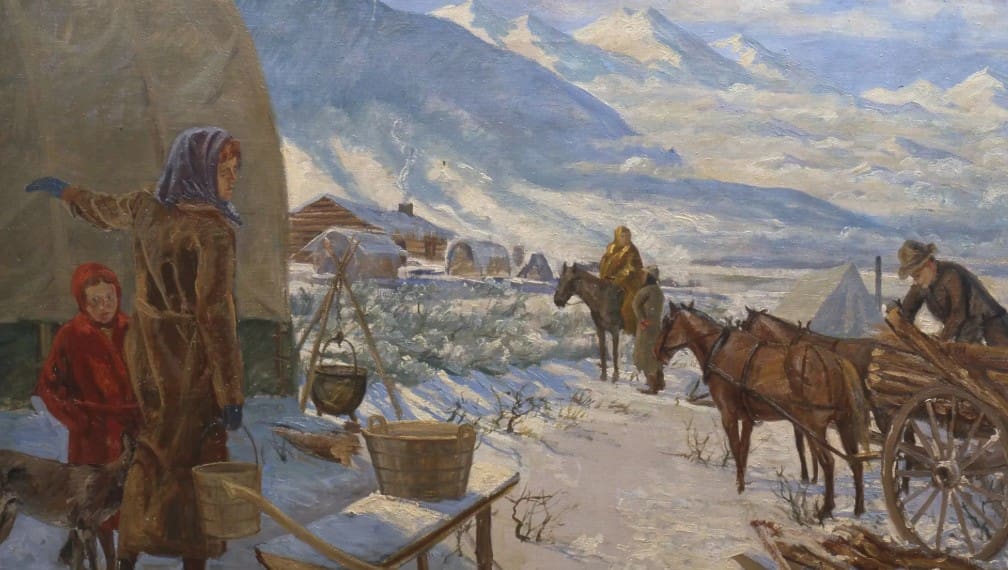
The Know
For Latter-day Saints, Pioneer Day commemorates July 24, 1847, the day when President Brigham Young, who was part of the first pioneer wagon companies, arrived at and looked out over the expansive Great Salt Lake Valley, declaring something like, “This is the right place.”1 While little was known about the desolate Great Basin at that time, early members of the Church knew that Joseph Smith had spoken prophetically to them on several occasions about gathering, principally and crucially, in the Rocky Mountains.2 Going to the Rocky Mountains had become “a settled belief, repeated several times,” beginning earlier in Church history than has usually been recognized.3
As early as February 15, 1831, the US Superintendent of Indian Affairs was informed that some Latter-day Saints in Delaware intended to apply “for permission to go among the Indians; if you refuse, then they will go to the Rocky Mountains,” for where federal permission was not needed because it was then part of Mexico.4 The Saints were already seeking several ways to take the Book of Mormon to the Native Americans, who were understood to be descendants of the Lamanites.
Additionally, on April 11, 1831, Thomas B. Marsh and his wife Eliza wrote to Lewis and Ann Abbott that the Saints were planning to assemble in Ohio:
There our heavenly Father will tell us what we shall next do; perhaps it will be to take our march to the Grand River in the Missouri territory or to the shining mountains which [are] 1500 or 2000 miles west from us. How soon it will be we do not know. In fact, we know nothing of what we are to do until it be revealed to us. But this we know; a City will be built in the promised land, and into it will the descendants of Joseph who was sold into Egypt be gathered.5
Then, on May 7, 1831, Joseph Smith prophesied in Kirtland that “Zion shall flourish upon the hills and rejoice upon the mountains, and shall be assembled together unto the place which I have appointed” (Doctrine and Covenants 49:25). Likewise, on November 3, 1831, Joseph prophesied about gathering the inhabitants of the earth unto Zion, “in the barren deserts” within “the boundaries of the everlasting hills,” where they would be “filled with songs of everlasting joy” (Doctrine and Covenants 133:29, 31, 33).
Wilford Woodruff later reported that in April 1834, Joseph prophesied about “filling the Rocky Mountains with the Saints of God.”6 At the St. George Stake conference on June 12–13, 1892, Woodruff recalled meeting Joseph Smith for the first time in April 1834, when the Prophet said, “This work will fill the Rocky Mountains with tens of thousands of Lamanites who dwell in these mountains, who will receive the Gospel of Christ at the mouth of Elders of Israel, and they will be united with the Church and the kingdom of God, and bring forth much good.” President Woodruff then commented:
I little thought, when I listened to those words, that I should ever live to see the fulfilment of these words of the Prophet. I little thought that I should ever visit the Rocky Mountains, or ever see the Lamanites of whom he then was speaking. . . . But I have lived to see these days. I have lived to see the Lamanites in these mountains. . . . I have preached the Gospel to them, in connection with my brethren, through interpreters. I have spent many interesting days with these Lamanites in the mountains of Israel.7
On January 6, 1836, Lorenzo Dow Young (a brother of Brigham Young) became ill while finishing the exterior of the Kirtland Temple in freezing conditions. Two weeks later, when a doctor had given him little hope for recovery, Joseph Smith sent sixteen elders with specific instructions on how to administer to him. In that blessing, Hyrum Smith promised the faithful Lorenzo that he would “live to go with the Saints into the bosom of the Rocky Mountains to build up a place there,” which miraculously came to pass.8 Many people in Kirtland were aware of these powerful prophetic forecasts.
Sometime before 1844, the Prophet told Lorenzo Snow that he “anticipated moving to the Rocky Mountains with all his family.”9 And as Oliver B. Huntington recalled, Joseph Smith Sr. (who died in 1840) told him in his home in Nauvoo that the Lord had instructed his son, the Prophet, “that we would stay there just 7 years and that when we left there we would go right into the midst of the Indians, in the Rocky Mountains.”10 That seven-year prophecy was, in fact, fulfilled in 1847.
On July 2, 1842, Oliver H. Olney recorded in his journal that some Church members were forming a company “to go as far west as the Rocky mountains and that without delay. . . . They say that they must go where there is no law to baffle them in their doings.” Five days later, Olney added that this move west would be for the protection of religious freedoms so the Church could “raise up a Righeous branch somewhere near the Rocky Mountains in the far west, where no law can touch you or hinder you on the way.”11 Also in 1842, Joseph Smith “stated many things concerning our “going to the mountains. He said we should go and build many cities and we should become a mighty people in the midst of the mountains and should perform a work that will astonish the nations of the earth,” as Anson Call recorded twelve years later.12
Early in 1844, in his presidential campaign literature, Joseph strongly endorsed the westward expansion of the United States:
When the people petitioned to possess the territory of Oregon, or any other contiguous territory, I would lend the influence of a chief magistrate to grant so reasonable a request, that they might extend the mighty efforts and enterprise of a free people from the east to the west sea, and make the wilderness blossom as the rose; and when a neighboring realm petitioned to join the union of the sons of liberty, my voice would be, come: yea come Texas: come Mexico; come Canada; and come all the world—let us be brethren: let us be one great family; and let there be universal peace.13
Then on June 22, 1844, five days before Joseph was murdered, he said in his final goodbye to the Saints in Nauvoo: “You will gather many people into the fastness of the Rocky Mountains as a center for the gathering of the people.”14 Wherever else the Saints were settling—in Missouri, Texas, Iowa, Wisconsin, England, Scotland—a central stake of Zion was to be established in the heart of the Rockies.
On March 3, 1861, Brigham Young affirmed that “hundreds of people in this house are my witnesses, who heard Joseph [Smith] say, when asked whether we should ever have to leave Nauvoo, ‘The Saints will leave Nauvoo. I do not say they will be driven, as they were from Jackson County, Missouri, and from that State; but they will leave here and go to the mountains.’”15
On August 9, 1846, Brigham confided to Wilford Woodruff that “he had not expected to see the Rocky Mountains this year, but when the Lord commanded him to go direct, he intended to go, [even] if he left all and went alone; but [that] he thought the Lord would let him take the people with him and [that] when He found the place for the temple he would work hard until it was built. He said [that] the Lord, revelation, [and] a vision was with him.”16 On January 14, 1847, Brigham Young sent back from Winter Quarters wise instructions based on the will of the Lord, guiding the Saints in successfully moving forward to reach Zion (see Doctrine and Covenants 136).
Lastly, on February 17, 1847, the deceased Prophet Joseph Smith appeared to Brigham Young in a dream as the first pioneer companies were preparing to leave Winter Quarters on the Iowa–Nebraska border and begin moving up the trail into the Rocky Mountains. In the dream, Joseph instructed Brigham,
Tell the people to be humble and faithful, and be sure to keep the Spirit of the Lord, and it will lead them right; . . . it will whisper peace and joy to their souls; it will take malice, hatred, envying, strife, and all evil from their hearts; and their whole desire will be to do good, bring forth righteousness and build up the kingdom of God.17
The Why
In the following years, enthusiastic crowds celebrated Pioneer Day on July 24 each year by gathering at the temple block in Salt Lake City to hear Church leaders speak . Those speakers gave many answers to the question of why the Saints had come to the Rocky Mountains: They had not come for political control, for land grabbing, or for the beautiful scenery. Instead, after they had accomplished the work in Nauvoo that Joseph had charged them to finish, they came to establish a central gathering place for the worldwide Zion.
Already on July 24, 1852, Elder George A. Smith articulated several of those reasons. He said they had come so that “they could lie down to rest in perfect peace—without being disturbed by the cruel hand of persecution.” They came to establish “institutions that insure freedom to all, liberty to every person—the liberty of conscience, as well as every privilege which can be desired by any citizens of this earth.” They came because they “were led by the hand of God, through His servant Brigham.” They came to “stand unflinchingly true by the Constitution of the United States.” They came “for Liberty and Truth, forever!”18
The next year, on July 24, 1853, President Brigham Young spoke at length about establishing the kingdom of God and welcoming all on earth, which he said was the reason the Saints came to gather in the Salt Lake Valley.19 He emphasized that they had come voluntarily. They chose to leave Nauvoo peaceably.
Then in celebrating Pioneer Day on July 24, 1854—the seventh anniversary of the Saints’ arrival to the Salt Lake Valley—two leaders spoke passionately on why the Saints had come. Daniel H. Wells spoke strongly about how they came “seeking a home . . . where they might rest . . . and feel secure from the wrath of [those] . . . who had pursued and hunted them with relentless fury, and driven them from the abodes of civilization.” They came, he said, as “directed by the same God who led Moses and the children of Israel out from the land of Egypt.” They came, following their “beloved President at their head,” believing in “a wise and beneficent God” who has said it was His business and His “purpose to provide for [His] Saints.”20 George A. Smith also spoke about the first company coming “to prepare the way for a safe retreat from tyranny and oppression.”21
Having completed that seventh-year landmark, the Saints continued gathering on Pioneer Day to speak and testify about why they came to the mountains of Utah Territory. They continued to emphasize that they came because they had been commanded by God and led by God to do so and that they gathered out of obedience to their beloved Joseph Smith, who had pointed them toward the Rocky Mountains. They spoke emphatically that they came by the providence of God to find peace and safety and to protect their religious rights.
They also saw their coming as fulfilling biblical prophecy. Writing in 1853, Benjamin Brown explained that “the Bible distinctly depicted a great portion of the work of the last days as being on the mountains,” where an ensign (a clear banner of central solidarity) would be lifted to the nations. There, the Lord’s house would be built and “all nations flow unto it, that they may learn the ways of the God of Jacob, and walk in His paths.” All this ties into the fulfillment of Isaiah 33:16–17 and 35:1, which passages speak of the rocks as symbolizing the defense of the Saints, where they “dwell on high” and where God has caused “the wilderness and the solitary place to be glad for them, and the desert to rejoice and blossom as the rose.”22
For these reasons, the Saints sacrificed all they had to come to the Rocky Mountains and “find the place which God for us prepared, far away, in the west.”23
- 1. Wilford Woodruff, “The Pioneers,” Contributor, August 1880, 252–53. For a brief history on commemorations of this day, see Steven Olsen, “Pioneer Day,” in Utah History Encyclopedia, ed. Allen Kent Powell (University of Utah Press, 1994). At its core, Pioneer Day “was a quest for the sacred.” D. James Cannon, “Pioneer Day,” in Encyclopedia of Mormonism, ed. Daniel H. Ludlow (Macmillan, 1992), 3:1083.
- 2. For a list of such statements by Joseph Smith, see John W. Welch, “Joseph Smith’s Short Trip to Iowa, June 23, 1844, to Secure Lawyers to Go with Him to Carthage,” in Joseph Smith: A Life Lived in Crescendo, ed. Jeffrey M. Bradshaw (Interpreter Foundation; Eborn Books, 2024), 2:671–73.
- 3. Ronald K. Esplin, “‘A Place Prepared’: Joseph, Brigham and the Quest for Promised Refuge in the West,” Journal of Mormon History 9 (1982), 92.
- 4. Richard W. Cummins to General William Clark, February 15, 1831, U. S. Office of Indian Affairs, Central Superintendency Records, St. Louis, Missouri, vol. 6, 113–14, William Clark Papers Collection, Kansas Historical Society; emphasis added throughout this KnoWhy article. Cummins also stated that “they had a new Revelation [the Book of Mormon] with them, as their guide in teaching the Indians, which they say was shewn to one of their sects in a miraculous way.”
- 5. Thomas B. Marsh and Eliza G. Marsh to Lewis and Ann Abbott, circa April 11, 1831, MS 23457, Lewis and Ann Abbott Papers, Abbott Family Collection, 1831–2000, Church History Library, Salt Lake City, UT. Spelling and punctuation standardized.
- 6. Scott G. Kenny, ed., Wilford Woodruff’s Journal (Signature Books, 1985), 8:279.
- 7. “Remarks By President Wilford Woodruff,” The Latter-day Saints’ Millennial Star 54, no. 38 (September 19, 1892): 605–6.
- 8. James Amasa Little, “Biography of Lorenzo Dow Young,” Utah Historical Quarterly 14, nos. 1–4 (1946): 46.
- 9. Eliza R. Snow Smith, Biography and Family Record of Lorenzo Snow (Salt Lake City, 1884), 76.
- 10. Oliver B. Huntington, Journal, February 24, 1883, MSS 162, series 1, item 1, box 1, folder 8, L. Tom Perry Special Collections, Harold B. Lee Library, Brigham Young University, Provo, UT.
- 11. Richard G. Moore, ed., The Writings of Oliver H. Olney: April 1842 to February 1843—Nauvoo, Illinois (Greg Kofford Books, 2020), 78–79, 87; spelling silently modernized. See the entries for July 2 and 7 and August 11, 1842. That exploring party, however, did not materialize.
- 12. Anson Call statement, circa 1854, MS 364, Church History Library, Salt Lake City, UT. For a book-length defense of Anson Call’s reliability concerning this prophecy attributed to Joseph Smith, see Gwen Marler Barney, Anson Call and the Rocky Mountain Prophecy (Call Publishers, 2002). This would be the basis for the prophecy attributed to Joseph Smith in B. H. Roberts, ed., History of the Church of Jesus Christ of Latter-day Saints (The Church of Jesus Christ of Latter-day Saints, 1909), 5:85; and B. H. Roberts, A Comprehensive History of The Church of Jesus Christ of Latter-day Saints (Brigham Young University Press, 1965), 2:181–82.
- 13. “General Smith’s Views of the Powers and Policy of the Government of the United States, circa 26 January–7 Febrary 1844,” pp. 11–12, The Joseph Smith Papers.
- 14. “Autobiography of William Bryan Pace (1832–1847),” Doctrine and Covenants Central.
- 15. Brigham Young, in HYPERLINK “https://journalofdiscourses.com/8/86″Journal of Discourses, 26 vols. (London, 1854–86), 8:356.
- 16. Wilford Woodruff, Journal (January 1, 1845–December 31, 1846), August 9, 1846, Wilford Woodruff Papers.
- 17. “Brigham Young, vision, 1847 February 17, p 1–2,” Church History Catalog, CR 1234, online at catalog.churchofjesuschrist.org; spelling silently modernized.
- 18. George A. Smith, in Journal of Discourses, 1:42–45.
- 19. Brigham Young, in Journal of Discourses, 1:233–45. See also Brigham Young, in Journal of Discourses, 9:137.
- 20. Daniel W. Wells, in Journal of Discourses, 2:25; Doctrine and Covenants 104:15.
- 21. George A. Smith, in Journal of Discourses, 2:22.
- 22. Benjamin Brown, Testimonies for the Truth: A Record of Manifestations of the Power of God, Miraculous and Providential, Witnessed in the Travels and Experience of Benjamin Brown (Liverpool, 1853), 30.
- 23. William Clayton, “Come, Come, Ye Saints,” Hymns, no. 30. These words were written on April 15, 1846, near Locust Creek in Iowa, on the muddy trail 103 miles west of Nauvoo. Hanna Seariac, “The Pioneer Anthem: The Compelling Story Behind ‘Come, Come, Ye Saints,” Deseret News, May 26, 2022.
Six Days in August: Brigham Young as You’ve Never Seen Him Before

When those shots rang out at Carthage, the death of Joseph Smith threw the Latter-day Saints into the deepest, sometimes inconsolable mourning, but it also left the Church with a question. How could the church move forward? What could the Church do without the prophet who had been indispensable to them? What did succession look like?
Could anyone, anyone, possibly stand in Joseph Smith’s place, who had been the head of the dispensation, and whose soul penetrated so far into the heavens and source of all things?
From our future vantage point, it seems obvious that Brigham Young would come to lead the Church, but it wasn’t so clear then. The question of succession would be a showdown, and the drama of the moment is something the new film, Six Days in August, now available in theaters, captures intensely.
It manages to be both riveting and inspiring at the same time, catching us in the drama of the succession question and all that hangs on it, while we are moved by the spiritual manifestations that weave through the story.
Behind the scenes lies another miracle. This film, produced by Daniel C. and Deborah Peterson and written and directed by Mark Goodman, is the product of The Interpreter Foundation, who does so much good in publishing in-depth and academic papers on the scriptures and history, and is now showing, once again, its deft ability to also reach a popular audience. This film grew out of the vision, faith and determination of people who believed the story needed to be told.
It’s a bold thing for a film to take on a spiritual topic. How do you possibly show a spiritual gift or being transformed to look like Joseph in a movie and keep its transcendence and not drift to corniness? Our eyes cannot see spiritual things.

Put this movie on your must-see list.
We have seen movies that put Joseph Smith front and center, but this time our attention is turned to Brigham Young.
Goodman understood that as viewers, we don’t know Brigham quite as well, and so to augment our hope that he becomes the leader of the Church, we are introduced more fully to him. Many of us are used to seeing a 70-year-old Brigham Young with a stoic face, whom we admire as an organizer, colonizer and pioneer leader. He is tough and determined as he builds settlements in the American West and takes the Latter-day Saints out of the United States where they can be protected from their persecutors. He is the American Moses. who led a people who otherwise might have scattered and been lost to history and the gospel.
We know far less of the stalwart, determined younger Brigham whose knees never buckled in following the gospel, no matter how hard that was, and whose considerable leadership Joseph counted on. We are invited in the film to meet Brigham who has his own spiritual gifts and whose oratory would one day thrill the church.
He was the rock to be counted on, always the right man for the job.

As the film opens, the Twelve are away from Nauvoo campaigning for Joseph Smith for president, when several days after the martyrdom, they receive the news of the desolating event. Joseph and Hyrum are gone. They are immediately overcome with sorrow. Wilford Woodruff wrote of the night of July 17, 1844, that he “veiled” his face and “gave vent to my grief and mourning.” He was “bathed in a flood of tears.”
The film moves forward then between flashbacks into Brigham’s life and the urgency of the succession decision at hand. Meeting Brigham Young is delightful, and for many viewers may be surprising. Here is the young Brigham, awkwardly courting his first wife, Miriam Works, and then losing her to death four months after they were baptized. Here is the Brigham who makes his way to Kirtland and first meets Joseph. Their camaraderie is instant (which is true).
Here is a Brigham so sick he shouldn’t be out of bed, struggling to get to his feet to go on a mission to England. Here is Brigham helping Wilford Woodruff baptize at the Benbow Farm and making the expensive, and risky decision to have 5,000 copies of the Book of Mormon printed in England. Here is Brigham speaking in tongues to oxen (and the actor carrying it off with dignity and believability).
John Donovan Wilson is a likeable Brigham Young and plays his part well. Paul Wuthrich, reprises his role as Joseph Smith.

The Question of Succession
Before the Twelve can join together and make their way back to Nauvoo to talk about succession, Sidney Rigdon, who had been living in Pittsburgh and had been somewhat disaffected from Joseph, had a plan. He claimed that he had seen in vision that he was to be the guardian of the church and build it up to Joseph Smith. With his mastery in speaking, he can be very convincing and beyond that, he often in earlier days had given the long talks while Joseph gave the short ones. His claim was not to be taken lightly and was quite convincing to many Latter-day Saints. He wanted the matter settled before the Twelve arrive.
Other ideas were also afloat. Emma hoped that William Marks, the president of the stake in Nauvoo would be the new leader. Lyman Wight wanted to lead a group to Texas.
The key succession events come down to six days in August, six really tense and confusing days, when Sidney was trying to maneuver himself into place before the Twelve arrived from their various destinations. The word came that President Rigdon was going to have a special meeting to choose a guardian, and it looked as if the Twelve might miss this meeting altogether.
What concerned Brigham most was what God wanted in this crucial moment and that those who had specifically been given the priesthood keys by Joseph could continue the work with this authority.
In the spring of 1844, a troubled Joseph had been with the Twelve in the Red Brick Store, and told them that he wanted to ensure that the authority to lead the Church would remain on the earth. “It may be that my enemies will kill me,” Joseph had said, “and in case they should, and the keys and power which rest on me not be imparted to you, they will be lost from the earth.”

Joseph had said, “Upon the shoulders of the Twelve must the responsibility of leading this church henceforth rest until you shall appoint others to succeed you. Thus, can this power and these keys be perpetuated in the earth.”
One of the best attested experiences in Church history is what happened on 8 August, 1844. With his sterling oratory, Sidney Rigdon addressed and nearly convinced the Latter-day Saints that he was to lead the Church, and then Brigham Young addressed the group.
We don’t know the size of the group addressed that day, but by some accounts, thousands were in attendance. It is impossible to verify the number of those who saw the physical transformation of Brigham Young into Joseph Smith. John W. Welch wrote, “Currently known records establish that 129 people gave written testimonies or say that a transformation or other spiritual manifestation occurred. Of these, sixty-eight people created firsthand documents: personal journals, personal narratives told to a scribe, or first-person testimonies published in Church magazine articles. Testimonies from sixty-one people are secondhand: accounts gleaned from biographies written by family members or from historical compilations.”
No matter how you look at it, the number was substantial. Welch wrote, “Of the witnesses to the transformation, a few provided specific details about the traits they recognized as Joseph’s. Homer Duncan not only commented on the voice of Brigham sounding like that of Joseph’s, but also referred to one of Joseph’s mannerisms: ‘The very gestures of his right hand when he was saying anything very positive reminded me of Joseph. My decision was then made as to who should lead the Church of Jesus Christ of Latter-day Saints for surely the mantle of Joseph has fallen upon Brigham’.
“Mosiah Lyman Hancock commented, ‘I saw in him the look of Joseph, and the voice of Joseph; and it seemed to me that he was as tall as Joseph too’. Benjamin F. Johnson also observed Joseph’s ‘tall, straight and portly [robust] form.’ He then added his famous comments about Joseph’s speech and a missing tooth, remarking that he ‘heard the real and perfect voice of the Prophet, even to the whistle, as in years past caused by the loss of a tooth said to have been broken out by a mob at Hyrum [Ohio]’.

“’George Morris also described Joseph’s familiar speech patterns, noting: In the afternoon Presedent Young arose . . . when I was startled by Earing Josephs Voice—he had a way of Clearing his Throat before he began to speak—by a peculier Effort of His own—like Ah-hem— I raised my Head sudinly—and the first thing I saw was Joseph—as plain as I ever saw Him in my life. . . . That was Testemony anough to Convince me where the Proper athoraty rested.’
“George Romney said, ‘I testify to you in all fervor, before God, that the mantle of Joseph Smith fell upon Brigham Young. It was Joseph’s voice; absolutely Joseph’s voice and manner, as Brigham Young addressed the people and told them who should be their leader. Now this is no fiction; this is true as I stand here after so many years, passing from the year 1844 up to the present time.’”
So, how does a film tell a story we already think we know, with surprise and tension? How does it take a complex history, that is rich in color and detail and portray it with just a few deft strokes? It takes skillful filmmakers and a thorough understanding of the larger events to accomplish this. Kudos to all those involved.
Brigham Young and the Twelve, Joseph and Sidney Rigdon all take on a new dimension as we watch them negotiate the unprecedented challenges they faced. Kudos to the filmmakers.
The film is currently playing in 90 theaters and for it to stick around, go early. Or as Dan Peterson says, “Go early and often.”

See:
Welch, John W. Opening the Heavens: Accounts of Divine Manifestations, 1820-1844 . Deseret Book Company. Kindle Edition.
A Site of Faith: Wilford Woodruff’s Farmhouse

In May of 1859, Wilford Woodruff traveled with his son Wilford Jr. and his son-in-law Robert Sholes up Harkers Canyon, searching for lumber to construct a farmhouse on Wilford’s farm located between 1600 and 1500 South in Salt Lake City.[1] Over a period of two days, wading through eight-foot-deep snow and mud, they cut down over three hundred “poles” and eighty “pine house logs” to be used for the new farmhouse. No longer the young man who had helped build Kirtland, Far West, and Nauvoo, at fifty-two years old Wilford noted that the work left him “cold,” “sore and stiff.”[2] But the men’s labor over the next year resulted in a comfortable home on Wilford’s farm that still stands today.
This farmhouse played a significant role in Wilford Woodruff’s life and was a site of harvests, celebrations and tragedies, family gatherings, and revelation. Events that played out within the walls of this home reverberated far beyond the simple frontier life of Wilford and his family and had an impact on the history of the Church.

Wilford Woodruff’s Journal, May 1859
A Place of Work and Independence
Between 1859 and 1862, Wilford continued to cultivate the twenty acres he owned around the farmhouse, primarily focused on producing goods for his family. He grew sugarcane, wheat, and fruit, in addition to raising livestock. His farm enabled him to provide for his family and be unfettered by financial dependence on the outside world. This was a necessity based on their isolated location, as well as a goal shared by many Latter-day Saints and their leaders, such as Wilford, who sought to anchor themselves to each other and to the Church instead. While Wilford and other Saints still sought to build economic relationships with non–Latter-day Saints, particularly those who were friendly towards the Saints, they did not want to become dependent.[3]
This focus on becoming economically independent became more urgent as Church leaders sought to prevent the exploitation of Latter-day Saints at the hands of merchants and businesses that increasingly looked to Utah Territory as a place to gain wealth following the Civil War. Some of these merchants in turn used their resources to push for harsher punishments against the Saints. As the transcontinental railroad neared, Latter-day Saint leaders including Wilford Woodruff encouraged the Saints to participate in home production and the cooperative movement.
A Place of Growth and Trial
Wilford Woodruff championed the value of home production and the co-ops throughout the three decades he called the farmhouse his home. But the farmhouse represented much more than that to him—it was also a place of joy and sorrow, of new life and goodbyes.
Wilford’s daughter Susan Cornelia and her husband, Robert Scholes, were the original occupants of the farmhouse for several years and helped with the farm.[4] In 1866 Wilford moved his seventh wife, Emma Woodruff, to the farmhouse with their children. Emma called this home for the majority of her married life and invested countless days of work to make the arid soil blossom as the rose. Emma and Wilford welcomed five children in the farmhouse, though they lost little Ann Thompson, who only lived seven hours and fifteen minutes after her birth. Wilford did not share details of the child’s death in his journal, though surely the mother and father were exhausted and devastated by the loss.[5]

While raising her children, Emma shared her home for a time with one of Wilford’s other wives, Delight, and her children. In his sixties, Wilford continued to work alongside his children and hired hands in tending to the crops and improving the land. Wilford also spent time with his families at the farm, in spite of the nearly constant stream of both religious and secular assignments.[6] Though not as quick as he had been in his younger years, he continued to be a strong worker, spent a great deal of time at the farm, and made the land around the farmhouse flourish.[7]
However, on September 25, 1873, Wilford’s mortality came clearly into view. When he went out in the fields near the farmhouse after a busy day in Salt Lake City, he had “a strange feeling” come over him and he hurried home. The “feeling” was likely a heart attack or stroke, and led Wilford to write, “I very soon felt as though I was struck with death and could not live. It seemed to be paralysis and death. I felt that I could not live an hour. All my blood, spirit, and life seemed to be leaving my limbs and closing around my heart and vitals and I felt as though I would soon die.”[8]
Wilford sent for his wife Phebe and his friend George Q. Cannon. He also asked for his neighbor William Wagstaff to administer a priesthood blessing to him, after which Wilford declared, “I was liberated instantaneously.”[9] In an era when the medical condition of a heart attack remained unclear, understudied, and untreatable, it was miraculous that Wilford rose from his bed at all.[10]

Wilford Woodruff, 1878, Salt Lake City, Utah
A Place of Faith and Revelation
Many years later, Wilford moved all of his possessions to the farmhouse after the death of his wife Phebe in November 1885.[11] For the next four years until Wilford was called as President of the Church, he made the farmhouse his main residence, though he was often forced to go into hiding as federal officials raided members’ homes, searching for those practicing polygamy. By 1887 he noted to his and Emma’s daughter Clara that he did not “expect to be able to visit the farmhouse much.” He noted, “Prudence would deprive me of this these times. The vigilance of our enemies will now be increased and I shall have to use great caution.”[12]
Yet his fears were soon alleviated when the new federal Marshal, Frank Dyer, informed Wilford that he would “leave him alone.” This was, in part, because Dyer wanted to strike a moderate stance and prosecute only those who contracted new plural marriages. Wilford was free, for the moment, to once again stay at his farm.[13]
Wilford Woodruff Farmhouse, 1880s
It was here that Wilford watched as the federal government intensified its persecution of the Latter-day Saints, forcing more men into hiding or prison and putting stress on countless families. Furthermore, federal officials were preparing to seize Church properties through the Edmunds–Tucker Act.
While at the farmhouse and pondering what to do regarding the federal government and plural marriage, Wilford received a revelation from the Lord counseling him to “pray for the Holy Spirit, which shall be given [the Presidency of my Church] to guide them in their acts.” Wilford likely took comfort knowing that the Lord promised to “hold the courts, with the officers of government, and the nation responsible for their acts towards the inhabitants of Zion.”[14] The Saints were counseled to continue the practice of plural marriage.
Seven months later, Wilford returned to the farmhouse after a long trip and was met with reports of increased hostilities against the Saints due to their continued practice of polygamy. The new federal receiver was determined not to honor the government’s 1888 agreement to exempt the temples from confiscation. On August 16, 1890, with the Territorial Court’s decision on the subject looming, Wilford declared, “We must do something to save our Temples.” The following month, Wilford recorded the following in his journal:
I have arrived at a point in the history of my life as the President of the Church of Jesus Christ of Latter-day Saints where I am under the necessity of acting for the temporal salvation of the Church. The United States government has taken a stand and passed laws to destroy the Latter-day Saints upon the subject of polygamy or patriarchal order of marriage. And after praying to the Lord and feeling inspired by his Spirit I have issued the following Proclamation which is sustained by my counselors and the 12 Apostles.[15]
His proclamation, the Manifesto, directed the ending of all new plural marriages in the Church. Wilford explained to the Saints, “I have had some revelations of late, and very important ones to me, and I will tell you what the Lord has said to me. . . . what would take place if we did not stop the practice.” As difficult as it was to understand, the Lord showed him in a vision that ending polygamy was the only way to ensure “the Prophets and Apostles and fathers [would remain] free men, and the temples [would remain] in the hands of the people, so that the dead may be redeemed.”[16] He must have spent many hours on his knees in the farmhouse seeking guidance from the Lord to understand His will concerning the temples and the future of the Church.
George Q. Cannon, a member of the First Presidency, recorded that Wilford Woodruff “felt strongly impelled to do what he has. . . . He has stated that the Lord had made plain to him that this was his duty, and he felt perfectly clear in his mind that it was the right thing.”[17]

First Presidency, April 6, 1893, Salt Lake City, Utah
For the rest of his life, Wilford Woodruff testified that the Savior had given additional revelation and guidance on the issue. Though he was willing to suffer anything the Lord asked him to pass through in order to continue plural marriage, he knew beyond a doubt that God had revealed the change. Wilford knew that the Lord had accepted the offering of the Saints and that God knew why the change needed to occur. As a result, the temple work for the living and the dead continued unabated as federal persecution of the Saints quieted. Millions on both sides of the veil were impacted as a result of the revelation given.[18]
The farmhouse remains today a historic site available to the public for tours. Though simple in many regards, this home stands as a testament to the faith and dedication of Wilford and his family. It was a place where Wilford spent over forty years of his life working the land and building his family. It was a place of new life, a place of death, a place of miracles and revelation where the Savior Jesus Christ aided His prophet in guiding the Church forward.

Hailing from Bonners Ferry, Idaho, Robert Swanson received his BA in History from Brigham Young University and his MA in History from Rutgers University–Camden, and he is currently a History PhD student at the University of Missouri focusing his work on abolitionism in the Early American Republic while still dabbling in Church history. He is married to his best friend, Bridget Garner Swanson, and they have two little girls who have made life even more of a fantastic adventure than they thought possible.
The Wilford Woodruff Papers Foundation’s mission is to digitally preserve and publish Wilford Woodruff’s eyewitness account of the Restoration of the gospel of Jesus Christ and make his records universally accessible in order to inspire all people, especially the rising generation, to study and to increase their faith in Jesus Christ. For more information, please explore wilfordwoodruffpapers.org.
Notes:
[1] Jennifer Ann Mackley, “Wilford Woodruff’s Homes,” http://www.wilfordwoodruff.info/p/wilford-woodruff-first-arrived-in-salt.html.
[2] Wilford Woodruff’s Journal, May 19–20, 1859, p. 408, The Wilford Woodruff Papers, https://wilfordwoodruffpapers.org/p/GZz7. Spelling and capitalization standardized.
[3] For Latter-day Saint economic history see: Leonard Arrington, Great Basin Kingdom: An Economic History of the Latter-day Saints, 1830–1900 (Lincoln, NE: University of Nebraska Press, 1966). For more on growth of the rest of the West see: Elliot West, Continental Reckoning: The American West in the Age of Expansion (Lincoln, NE: University of Nebraska Press, 2023).
[4] Wilford Woodruff’s Journal, July 26, 1860, p. 60, The Wilford Woodruff Papers, https://wilfordwoodruffpapers.org/p/nZ37.
[5] Thomas G. Alexander, Things in Heaven and Earth: The Life and Times of Wilford Woodruff, a Mormon Prophet (Salt Lake City, UT: Signature Books, 1993), p. 225; Wilford Woodruff’s Journal, April 10–11, 1867, p. 72, The Wilford Woodruff Papers, https://wilfordwoodruffpapers.org/p/DkQx; Jennifer Mackley, “Wilford Woodruff’s Wives: Emma Smith,” http://www.wilfordwoodruff.info/p/wilfords-wives.html. (Later Wilford’s brother Azmon died at the farmhouse as well. See Epistle to the YMMIA from Wilford Woodruff, February 1889, p. 1, The Wilford Woodruff Papers, https://wilfordwoodruffpapers.org/p/OqQr.)
[6] For more on Emma Smith Woodruff see Jennifer Mackley, “Wilford Woodruff’s Wives: Emma Smith,” http://www.wilfordwoodruff.info/p/wilfords-wives.html; Laurel Thatcher Ulrich, A House Full of Females: Plural Marriage and Women’s Rights in Early Mormonism, 1835–1870 (New York: Vintage Books, 2017), pp. 274–279.
[7] In 1874 Wilford put in six miles of fencing. See Wilford Woodruff’s Journal, September 29, 1874, p. 97, The Wilford Woodruff Papers, https://wilfordwoodruffpapers.org/p/2vgM.
[8] Wilford Woodruff’s Journal, September 25, 1873, p. 53, The Wilford Woodruff Papers, https://wilfordwoodruffpapers.org/p/pQ2y.
[9] Wilford Woodruff’s Journal, September 25, 1873, p. 53, The Wilford Woodruff Papers, https://wilfordwoodruffpapers.org/p/pQ2y. Spelling, punctuation, and capitalization standardized.
[10] “History of Heart Attack: Diagnosis and Understanding,” Heart Attack Prevention, University of Minnesota (2012), http://www.epi.umn.edu/cvdepi/essay/history-of-heart-attack-diagnosis-and-understanding/.
[11] Alexander, Things in Heaven, pp. 240–243.
[12] Letter from Wilford Woodruff to Clara Martisha Woodruff Beebee and Ovando Collins Beebe, ca. 1887, p. 1, The Wilford Woodruff Papers, https://wilfordwoodruffpapers.org/p/m63r. Capitalization standardized.
[13] Alexander, Things in Heaven, p. 246.
[14] Wilford Woodruff’s Journal, November 24, 1889, p. 279, The Wilford Woodruff Papers, https://wilfordwoodruffpapers.org/p/79EG.
[15] Wilford Woodruff’s Journal, September 25, 1890, p. 328, The Wilford Woodruff Papers, https://wilfordwoodruffpapers.org/p/Y719. Spelling and capitalization standardized.
[16] Official Declaration 1, Doctrine and Covenants.
[17] George Q. Cannon, Journal, September 24, 1890, The Journal of George Q. Cannon, Church Historian’s Press, https://www.churchhistorianspress.org/george-q-cannon/1890s/1890/09-1890#p84.
[18] “The Manifesto and the End of Plural Marriage,” Gospel Topics Essays, ChurchofJesusChrist.org; Jed Woodworth, “The Messenger and the Manifesto,” in Revelations in Context, ed. Matthew McBride and James Goldberg (Salt Lake City, UT: The Church of Jesus Christ of Latter-day Saints, 2016), https://www.churchofjesuschrist.org/study/manual/revelations-in-context/the-messenger-and-the-manifesto?lang=eng.
Hearing Wilford Woodruff’s Testimony in His Own Voice

Cover image via ChurchofJesusChrist.org.
Bound within the January 1972 issue of the youth magazine of the Church of Jesus Christ of Latter-day Saints, then called “The New Era,” was a flexible plastic record that could be played on a phonograph. It contained a testimony from President Wilford Woodruff, recorded by him roughly a year and a half before his death in 1898 at the age of ninety-one.
I was about to put in my mission papers at the time, and I still remember how thrilling it was to see that little plastic record and to listen to it. I was simply stunned to hear the voice of a man who, as an adult—and, in fact, as an ordained apostle—had known the Prophet Joseph Smith personally and well. I still find that amazing. But I’ve also come to appreciate, much more than I did as a teenager, the actual content of what President Woodruff had to say. It’s remarkable and very important. Here are his words:
“I bear my testimony that in the early spring of 1844, in Nauvoo, the Prophet Joseph Smith called the Twelve Apostles together and he delivered unto them the ordinances of the church and kingdom of God; and all the keys and powers that God had bestowed upon him, he sealed upon our heads, and he told us that we must round up our shoulders and bear off this kingdom, or we would be damned. I am the only man now living in the flesh who heard that testimony from his mouth, and I know that it was true by the power of God manifest to him. At that meeting he stood on his feet for about three hours and taught us the things of the kingdom. His face was as clear as amber, and he was covered with a power that I had never seen in any man in the flesh before.
“I bear testimony that Joseph Smith was the author of the endowments as received by the Latter-day Saints. I received my own endowments under his hands and direction, and I know they are true principles. I not only received my own endowments under his hands, but I bear my testimony that Brigham Young, Heber C. Kimball, Willard Richards, George A. Smith, John Taylor and other brethren received their endowments under the hands and direction of the Prophet Joseph; and also my wife Phoebe, Bathsheba Smith, Leonora Taylor, Mary Smith and others whose names I cannot recall now.
“The Prophet Joseph laid down his life for the word of God and testimony of Jesus Christ, and he will be crowned as a martyr in the presence of God and the Lamb.
In all his testimonies to us the power of God was visibly manifest with the Prophet Joseph.
“This is my testimony, spoken by myself into a talking machine on this the 19th day of March, 1897, in the 91st year of my age.
“Wilford Woodruff.”
Such a testimony, from a man who was closely associated with Joseph Smith in the leadership of the Church, carries a great deal of weight with me.
So do some of the details of what he had to say.
President Woodruff bore testimony of the “endowments” that he and others had received from Joseph Smith. This was enormously important to him. He had, for example, sometimes led ceremonies in the Endowment House in Salt Lake City after it was built in 1855; from 1867 into 1868, he had officiated there every Saturday in both sealings and endowments.
He had presided over the St. George Utah Temple from its dedication in 1877 until 1884. This was not only the first temple to have been dedicated after the migration of the Saints to the Rocky Mountain West but the first in which the ordinances of the endowment were performed for the dead as well as for the living. Under the direction of Brigham Young, he set about to standardize the ceremonies—with the help of John D. T. McAllister, his first counselor and eventually the second president of the temple, he committed the ordinances to writing—and delivered numerous sermons to encourage a broader understanding of temple work. In February 1877, he received a revelation indicating that church members could act as proxies in the temple not only for their own relatives, but for anyone they could identify by name.
In September 1877, President Woodruff indicated that he had been visited by the departed spirits of the signers of the Declaration of Independence and by others of the American Founding Fathers. Accordingly, although proxy baptisms for many of the Founding Fathers had been performed previously in Nauvoo and in the Endowment House, vicarious endowments for these men were done in the St. George Temple.
In 1894, under President Woodruff’s direction, the Genealogical Society of Utah was established. It was the forerunner of the Church’s Family History Department and FamilySearch, the largest genealogical organization in the world. So, it’s not surprising that, given the chance, he testified of the “endowments.”
President Woodruff’s recollection of the pivotal meeting in which Joseph Smith gave his “final charge” to the Twelve is also interesting: The Prophet’s face, he testified, “was as clear as amber, and he was covered with a power that I had never seen in any man in the flesh before.” Many other contemporaries are on record as testifying to the illumination or transparency that would come upon the Prophet while he was receiving revelation. It’s difficult not to think, in this context, of biblical testimony that Moses’s face shone when he descended from Mt. Sinai with the tablets of the Law (Exodus 34:29-35) and that Christ’s face “did shine as the sun” on the Mount of Transfiguration (Matthew 17:2-3; Luke 9:29-31).
But I want to focus here upon President Woodruff’s vitally important testimony that, in Nauvoo in the early spring of 1844, Joseph Smith called the Twelve Apostles together and bestowed upon them the keys of the Kingdom. This fact is of pivotal importance in understanding what happened after Joseph and Hyrum Smith were murdered while imprisoned in the jail at Carthage, Illinois. It is essential for understanding the assumption of Church leadership by the Quorum of the Twelve the following August.
Like the ancient apostles in the time of Jesus, who—so says the New Testament gospels—were repeatedly warned by the Savior that he would soon depart from them, the Twelve in 1844 had been warned of Joseph’s pending departure. But they weren’t ready to be deprived of the leader who had called their quorum into existence and who had transformed their lives. His personality was too vivid; his teachings were essential to them; his absence was unthinkable. And then he was gone.
On 27 June 1844, the day that Joseph and Hyrum were killed, Brigham Young was in Boston. Without knowing why, he felt himself overcome by a deep and dark depression. It wasn’t until 16 July, nearly three weeks later, that he received detailed confirmation of the martyrdom.
“The first thing that I thought of,” he remembered later, “was whether Joseph had taken the keys with him from the earth. Brother Orson Pratt sat at my left; we were both leaning back in our chairs. Bringing my hand down on my knee, I said, ‘the keys of the Kingdom are right here with the Church’” (Comprehensive History of the Church 4:213)
It is because of those keys, bestowed upon Brigham Young and the Twelve in the early spring of 1844 and transmitted from them down to the apostles of our own day, that we are authorized to build genuine temples to the Most High God in which the ordinances of salvation and exaltation can be administered. Without those keys, we could not receive our endowments or be sealed to our loved ones. We could not perform ordinances on behalf of our kindred dead. All those who have died without receiving the fulness of the Gospel, without having received baptism from an authorized officiator, would be in eternal jeopardy.
The medieval Italian Catholic poet Dante Alighieri provides an idea in his Divine Comedy of just what that jeopardy entailed throughout most of Christian history:
Upon entering (fictionally) into the next world, he was astonished by what he saw: “I should never have believed,” he wrote in his Inferno, “that death could have unmade so many souls.”[ Strikingly, despite his obvious admiration for Socrates, Plato, Aristotle, the great Islamic philosophers Avicenna and Averroes, and the chivalrous Muslim military hero Saladin, Dante felt obliged to place them all in Hell. Even his deeply-admired guide, companion and “kindly master,” the Roman poet Virgil, was eternally barred from heaven. Virgil explains the reason to Dante as follows:
“I’d have you know, before you go ahead,
they did not sin; and yet, though they have merits,
that’s not enough, because they lacked baptism,
the portal of the faith that you embrace.
And if they lived before Christianity,
they did not worship God in fitting ways;
and of such spirits I myself am one.
For these defects, and for no other evil,
we now are lost and punished just with this:
we have no hope and yet we live in longing.” (Inferno 4:33-41)
The importance of the keys of priesthood authority cannot be overstated. Especially in this great period of temple-building. It is, therefore, a wonderful thing, and perhaps not coincidental, that we still possess a recording of the voice of Wilford Woodruff testifying to that all-important transmission of authority—“the only man now living in the flesh,” he could say in 1891, who was present when Joseph Smith “called the Twelve Apostles together and . . . delivered unto them the ordinances of the church and kingdom of God; and all the keys and powers that God had bestowed upon him.”
**
Wilford Woodruff will play a prominent role—along with his fellow apostles George A. Smith and Heber C. Kimball—in the forthcoming Interpreter Foundation film Six Days in August (https://witnessesfilm.com). For dramatic purposes, those three will largely represent the other members of their quorum. Brigham Young, of course, will be the central focus.
The Wilford Woodruff Papers Foundation is currently spearheading an effort to make the voluminous surviving records relating to President Woodruff publicly available: https://wilfordwoodruffpapers.org.
The background of the Woodruff recording is given in Richard Neitzel Holzapfel and Stephen H. Smoot, “Wilford Woodruff’s 1897 Testimony,” in Banner of the Gospel: Wilford Woodruff, ed. Alexander L. Baugh and Susan Easton Black (Provo, UT: Religious Studies Center, Brigham Young University; Salt Lake City: Deseret Book, 2010), 327–64.
Ronald K. Esplin’s research on the topic continues, and more is forthcoming, but perhaps the best single treatment thus far, the essential discussion, of Joseph Smith’s conferral of leadership and priesthood keys upon the apostles is Esplin’s article “Joseph, Brigham and the Twelve: A Succession of Continuity,” BYU Studies 21/3 (1981), which is available online at https://scholarsarchive.byu.edu/byusq/vol21/iss3/5/.
Members of the Twelve recounted their reception of the keys of priesthood authority from Joseph Smith on multiple occasions. But Dennison Lott Harris is important as the only independent—that is, the only non-apostolic—witness to the events immediately surrounding Joseph Smith’s “Last Charge” to the Twelve, as the Prophet prepared to “roll the kingdom off [his] shoulders” onto theirs. His story is documented in Jeffrey M. Bradshaw, Emer Harris & Dennison Lott Harris: Owner of the First Copy of the Book of Mormon, Witness of the “Last Charge” of Joseph Smith (Salt Lake City: Eborn Books, 2023).
For some additional thoughts on priesthood authority, see Daniel C. Peterson, “Who Holds the Keys?” Interpreter: A Journal of Latter-day Saint Faith and Scholarship 61 (2024): vii-xx (https://journal.interpreterfoundation.org/who-holds-the-keys/).
FEATURES