






The Seal of Melchizedek: History, Meanings, and Mysteries

This article include excerpts from the book on the symbol: The Seal of Melchizedek: Exploring the Modern Rebirth of an Ancient Symbol written by the author and co-author Alan Rex Mitchell. Ernest and his wife Peggy have also designed jewelry and art to capture the deep, powerful and beautiful meanings of this inspiring symbol which can be found at this website.
This is Part 2 in a two-part series See the first here: “The Seal of Melchizedek and the Design of the San Diego Temple.”
Symbolism
Symbolism is perhaps more an interesting art than a science. Through repeated use and context, certainly strong conclusions can be drawn. Conversely, symbols can mean different things to the same person at a different time, or different things to people from different cultures and eras. Ideally, the messages of symbolism are recognized in holy context and guided by inspiration. A symbol like the Seal of Melchizedek is associated with holy places and temples, making it even more significant:
“Each temple is a house of learning. There we are taught in the Master’s way. His way differs from the modes of others. His way is ancient and rich with symbolism. We can learn much by pondering the reality for which each symbol stands.” Russell M. Nelson, General Conference April 2001
Four layers of symbolism in the Seal of Melchizedek
As we mentioned, the 8-point star symbolism can vary by use in culture and in different periods of time. Although the presentation may vary, the symbolism usually can be recognized. Note these variants from different places, cultures, and times and realize that a differing design doesn’t mean it’s a completely different message. Likely the symbolism came from a common ancient source and its different manifestations can represent the variety of different traditions, yet retain the original core significance of its meanings:

Note: It is interesting that the symbol is often associated with a circle, either inside or outside. The circle, of course, is symbolic of eternity, or heaven. The squares are also often interwoven, which also has some interesting symbolism that we won’t address in this brief article.
In the Judeo-Christian tradition, and sometimes even outside of it, there are 4 layers of symbolism in the Seal of Melchizedek that are very powerful. You will find that they all point to Christ, even the Atonement, and related renewal or purification. Here’s the list and then we will briefly consider each one:
- The Location/Uses of this symbol
- The star shape of the symbol
- The name of the symbol
- The number of points associated with the symbol
The Location/Uses of the Seal of Melchizedek
As we have seen, the Seal of Melchizedek was used extensively in and on the LDS Temples. It was added to the Salt Lake City Temple by President Hinckley. The San Diego Temple has a reported 10,000 instances of the symbol! The symbol can be found on the Washington D.C. Temple (front door), the new Nauvoo Temple (entrance area), and the New Mexico Temple (see picture below), and too many more to name.

Seal of Melchizedek
We’ve seen it depicted in the mosaics shown earlier in this article, where it is associated with the altar, which is in turn symbolic of the sacrifice and atonement of Christ. Interestingly, we also see in those mosaics (dated about 400-500 AD) a veil with the hand of God reaching through or down from heaven, and other representations that are also familiar to the ordinance of endowment: clear associations with temples and Christ.

Catholic church in Quito, Ecuador
Catholics often use the 8-point star in cathedral windows, the light coming through the star is symbolic of light coming from Christ because the symbol is so closely associated with the Lord.

Baptismal Font of St. Joseph’s in Missouri
Even many Catholic baptismal fonts were and continue to be made in the shape of an octagon to retain the symbolism of ‘eight’, which we will discuss later.
 The Free Masons called a common version of the symbol the “Signet of Melchizedek” and in an 1805 text Bromwell further declares it also the “Symbol of the Divine” Omnipotence, Omniscience and Omnipresence, universal infinite and eternal.”

Coptic clothes
Egyptian Copts: In 1920, archeologist Albert Kendrick reported on textiles from Christian Egyptian graves dating from the 2nd to 4th century A.D., excavated at Akhmim. He found several textiles with only the double offset square and others with the circle inside. Some of the cloths were as large as 6’ x 9’ and may have been used as curtains or veils. They resembled very closely the altar cloths in the Ravenna mosaics showing that this specific symbolism carried across several centuries and long distances from the Egyptian origins. It is Coptic tradition that the apostle Mark is the disciple that converted the early Egyptians to Christianity.

Jewish Bible Leningrad Codex
Jewish Tradition: Above is the “carpet page” or cover of the oldest known Jewish scripture. Biblical studies teacher R. Holt Stay blogs about it, “This calligraphic drawing of the magen (or shield) of David set inside an eight-pointed star is from the Leningrad Codex, the oldest complete manuscript of the Hebrew Bible in Hebrew, using the Masoretic text and Tiberian vocalization. It is internally dated AD 1008.” Next to it is a mosaic from an ancient Christian church in Khirbet, near Jerusalem.
Even outside Christianity, the symbol points to God. In Islam, for example, almost every mosque tower has the 8-point star shape or is also octagonal, the mosque not only a holy place but the tower, like a spire, points to heaven. In text it is called the Rub al Hizb, a quarter mark in scripture, yet may also be interpreted as “leader of the people”. Perhaps more interesting it is known in Arabic tradition as Khatim sulaymon, or “the seal of the prophets.”

Christian tile mosaic from Khirbet, Israel
The star shape of the Seal of Melchizedek
Ancient cultures like Greeks and those from the Far East believed that the stars were gods. Therefore, it is interesting to note that when the greatest star ever appeared, it lead wise men from “the East” to the God of all gods, the very Christ child. Every year Christians celebrate the star symbol atop the Christmas tree, a symbol of Christ. Furthermore, Val Brinkerhof notes that Jesus is the “Day Star”, or the Star that rises in the morning chasing all the other stars away. In other words, the Sun. In fact, our star, the Sun, is symbolic of the Son of God: The Sun (Son) is the source of light and life on Earth and without the Sun (Son) there would be no life. The star shape is symbolic of Christ.
The name of the Seal of Melchizedek
“Melchizedek” is Hebrew for “King of Righteousness.” Melchizedek was also Prince of Salem, which translated is “Prince of Peace,” making this name in several ways a type of Christ. In fact so little is known about King Melchizedek, and his name is such a strong type of Christ, that almost all uses of “Melchizedek” in Judeo-Christian tradition do not refer to Melchizedek at all, but indeed indicate Christ. For example, the “Melchizedek Priesthood” is not the priesthood of the ancient king, but in reality is the Priesthood of Christ.
Therefore, the name Seal of Melchizedek really means Seal of Christ. The Free Mason name applied to the 8-point star “Signet of Melchizedek” becomes the Signet of Christ. The Jewish label “Magen(The Shield of) Melchizedek” becomes The Shield of Christ. The name of the symbol very strongly indicates the Christ.
The number associated with the Seal of Melchizedek
Finally, but certainly not least, is the number associated with the symbol. Numbers are perhaps the strongest type of symbolism used in the Bible and in Judeo-Christian tradition. The number of points of this star is of course; eight. Eight is a very strong symbol in and of itself. Let’s explore the scriptures in relation to the number 8 and we can see very quickly why it means to be renewed, or purified in Christ.
The symbolism of “eight” is directly related to the symbolism of “seven.” Starting right at the beginning with Genesis in the Old Testament, we read:
“Thus the heavens and the earth were finished… And on the seventh day, God ended his work which he had made.” (Gen. 2: 1-2, KJV)
Seven, in the Hebrew tradition, means finished, whole, or complete. What then becomes of the 8th day? The eighth day then becomes the first day of a new period. In other words, not the beginning, but a new beginning. And furthermore, it becomes very clearly associated with animal sacrifice and the temple, which both are types of the sacrifice or atonement of Christ!
For example, animal sacrifices stayed with the mother 7 days, and then were sacrificed on the 8th day. Similarly, the priests of Aaron under Moses were to be purified 7 days, and then on the 8th day could enter the tabernacle (temple) and make the atoning (animal) sacrifice. (See Exodus 22:30 and Levitcus 8:35/9:1)
More about the eighth day is found in Ezekiel 43:26 “…it shall be, that upon the eighth day, and so forward, the priests shall make your burnt offerings upon the altar and your peace offerings; and I will accept you, saith the Lord.” (Exekiel 43:26-27 KJV)
And so forth, throughout scripture. The Christian association of baptism with the octagram or the number 8 comes from the time the Lord “baptized” the earth to purge and cleanse it: eight souls were saved on the ark. This symbolism is further reinforced by the Book of Mormon. When Lehi and his sons had wondered in the wilderness for 8 years, they then crossed over the ocean (symbolic of baptism) from the old sinful land of Jerusalem into a new, pristine beginning in the promised land. Similarly, Jared and his group of Jaredites were literally “baptized” in eight vessels as they left a fallen people and sailed to a new, pure beginning in the promised land as well! Finally, the Doctrine and Covenants says a soul should be baptized at age…you know already, 8. (See 1 Ne 17:4, Ether 3:1, D&C 68:27)
Now it becomes even more interesting as Christ appears to the apostles in the New Testament. After the Atonement, the Sabbath is changed from the 7th day to the 8th day, or in other words, the 1st day of the week, or Sunday. So the disciples meet on the “eighth” day every week to partake of the Lord’s Supper, or the sacrament. Again the number 8 is associated with Christ, to remember Him and His Atonement, to be cleansed renewed every week. (St. John 20:19,26 KJV)
Conclusion
And so we can see that this ancient symbol, this 8-point star, often represented as two squares over-laid and offset 45 degrees is a powerful symbol to orient our minds and hearts towards Christ. And really, what better purpose could a symbol serve? It is my prayer that it may indeed provide that most noble purpose for those who will ponder and explore the rich symbolism of the so-called Seal of Melchizedek.
The symbolism points to Christ and His Atonement and related gospel ordinances because it is found on altars, temples, and holy places. It carries the vicarious name of Christ: Melchizedek, the purpose of that name is to directly indicate Christ. The shape of a star also is symbolic of the God of all gods, and the number associated with the 8 points of that star is a powerful foreshadowing and reminder of the atonement of the Son of God.
“To be fluent in the language of the Spirit, one must be fluent in the language of symbolism.” Joseph Fielding McConkie, Gospel Symbolism 1985
“And behold, all things have their likeness, and all things are created and made to bear record of me, both things which are temporal, and things which are spiritual; things which are in the heavens above, and things which are on the earth, and things which are in the earth, and things which are under the earth, both above and beneath: all things bear record of me.” Moses 6:63

Now you may understand why we would decide to help share this inspiring symbolism through a website, a book (available at https://squareup.com/market/seal-of-melchizedek/book-on-the-seal-of-melchizedek-symbol), and making jewelry with this and other familiar symbols of the gospel. If nothing else, we hope to entice a deeper look into the symbolism of God found in the scriptures, the purpose of which is to help us return to Him.
About the Author:
Ernest Lehenbauer: Entrepreneur, Photo-journalist, and Author of The Seal of Melchizedek
Ernest has 3 certificates of graduation from the Utah State University Institute of Religion, as well as a Bachelor of Arts in Political Science from USU. While in school Ernest started several businesses, including one of the original Mobile Mechanic services in Utah.
After moving to San Diego, he went on to become a Field Service Representative and certified Instructor/Mechanic for the largest MRAP armored-vehicle company in the Middle East conflicts, living and working in countries such as Afghanistan, Kuwait, and Iraq for most of the next 10 years. Simultaneously, Ernest blogged as a photo-journalist, sharing views of the Iraq War from an LDS contractor’s perspective.
While living in San Diego, Ernest attended a fireside by an architect of the San Diego Temple on the symbol known as the Seal of Melchizedek. After noticing the ancient symbol in almost every country he visited, he started gathering history and research on the symbol. Now Ernest runs Seal of Melchizedek.com, and with his wife Peggy founded Seal of Melchizedek™ Jewelry & Art to celebrate and share the powerful messages of inspirational symbolism. Ernest is releasing his new book, Seal of Melchizedek: The Modern Rebirth of an Ancient Symbol.
The Seal of Melchizedek and the Design of the San Diego Temple
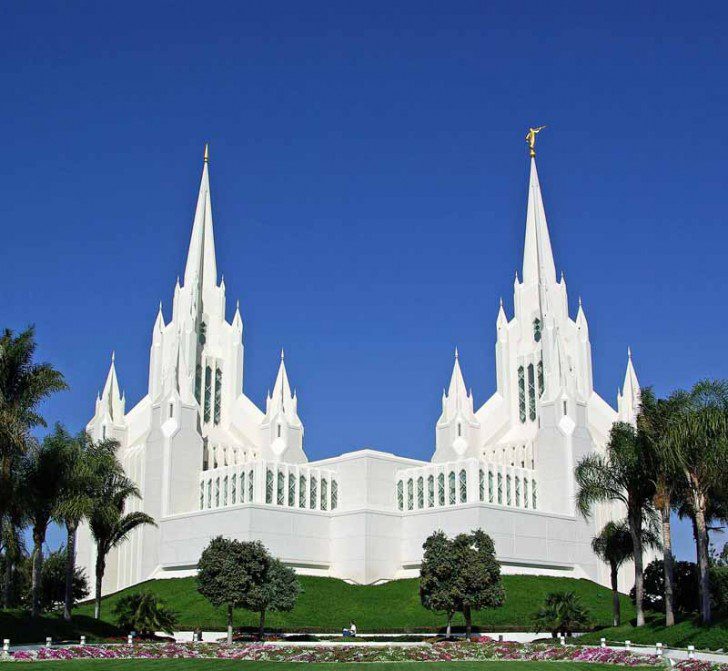
This article submitted by Ernest Lehenbauer includes excerpts from the book on the symbol: The Seal of Melchizedek: Exploring the Modern Rebirth of an Ancient Symbol co-authored by Alan Rex Mitchell. Ernest and his wife Peggy have also designed jewelry and art to capture the deep, powerful and beautiful meanings of this inspiring symbol which can be found at this website.
 This 8-point star, perhaps best known as the Seal of Melchizedek, is a symbol of Christ. President Gordon B. Hinckley was sufficiently impressed with the symbol that he asked it be added to the Salt Lake City Temple.
How, you may ask, did this ancient symbol suddenly capture such modern attention? Seemingly by coincidence, if you believe in that. Our story begins with the design of the San Diego Temple by an architectural team completely unaware of any particular significance of the symbol. Then, we will take a look at the history, meanings, and mysteries of this ancient symbol uncovered by subsequent research.
Design of the San Diego Temple
When the Church of Jesus Christ of Latter-day Saints bought property in San Diego for a temple in La Jolla, the architectural team chosen for the job chaffed quite a bit at the Church’s request to copy the then-standard temple model of the Boise, Idaho Temple. The plan, they said, would not fit into the La Jolla property, either architecturally or aesthetically and they lobbied the Church for a rejection of the Boise model and the chance to start over from the ground up. After listening to their appeal, President Gordon B. Hinckley, 1st counselor in the First Presidency, nixed the earlier directive, saying words to the effect of “Not all temples need to look alike.”
With this new-found freedom, the firm went to work on a design, taking their unusual commission very seriously. William (Bill) S. Lewis, a Church member who worked for the firm, wrestled with a basic design and a motif to use as decoration. He fasted and prayed repeatedly. Finally, whether inspired by a dream or some other prompting, he woke up one morning with squares on his mind. Although the pre-eminent 20th century architect Frank Lloyd Wright had declared, “Destroy the box!” Lewis started with a box… a square… and began playing with it, modifying it, tipping it, twisting and tweaking it.
They settled on a floor plan with two boxes joined at the corners, like a blocky figure 8.

Applying flow analysis, they added more boxes at the junction to create rooms and hallways. They put boxes inside of boxes as the temple rose upward, and put square spires at the corners of boxes. They merged the squares. At the junction of the two taller boxes, or offset squares, they added smaller overlaid, offset boxes as an eight-sided atrium, and put glass around it. The more they used the symbol, the better it worked.
 They kept using the squares as a motif in the detail work, taking the boxes and offsetting them by 45 degrees, using the offset squares in the glass windows, inscribing them in glass doors, and using them in flower beds. They even put the offset square in the white wrought-iron fence that surrounds the grounds. They built a model on a tabletop and tweaked it some more, and then presented it to church headquarters. The church leaders liked it.

Drone view of San Diego temple.

San Diego Temple cornerstone.

San Diego temple windows

San Diego steeple glass.

San Diego entrance doors.

San Diego lobby glass.

San Diego entrance floor.

San Diego entrance ceiling.

San Diego Temple entrance drive.

San Diego Temple garden.

San Diego Temple fence derivative.
Identifying the Symbol
But what of the offset square that became the motif? Was it symbolic? The media touring the temple before the dedication asked the Elder David B. Haight. “Probably just an architectural detail,” he answered. And for years after visitors to the temple, members and non-members alike, were given the same answer.
As fate would have it, Lewis’s friend Stan Smith, who was a representative during the temple project, took numerous pictures of the symbol used at the temple. He decided it just might be something more than just a detail.
He took a trip to Salt Lake City, Utah where he visited the LDS Church Historians Office. They then referred him to Hugh Nibley, emeritus professor of Ancient History at Brigham Young University. Nibley was legendary scholar of ancient history and prolific author on LDS themes.
When Stan Smith showed Nibley the symbol, he replied something to the effect of, “Oh sure, it is the seal of King Melchizedek.” Then Nibley showed Smith one of his latest books, Temple and Cosmos where, in the chapter Sacred Vestments, he had his illustrator Michael Lyon draw a reproduction of a mosaic from a sixth century chapel in Ravenna, Italy.

Ravenna, Italy mosaic.
Above: From Hugh Nibley’s Temple and Cosmos
“Another Ravenna mosaic, c. A.D. 520, show the priest- king Melchizedek in a purple cloak, offering bread and wine at the altar (Genesis 14:18-20). The white altar cloth is decorated with two sets of gammadia, as well as the so-called “seal of Melchizedek.” The mosaic shows Abel and Abraham bringing their sacrifices to the altar—Abel with a lamb representing the Lamb of God; and Abraham with a smaller adult-proportioned son Isaac also representing the sacrifice of The Son. The High Priest Melchizedek, clearly labeled by name overhead and underneath, is seated behind the altar wearing a purple robe of royalty, with loaves of bread and a chalice of wine depicting the holy meal (communion or sacrament.)”
Nibley is not the only scholar to link the symbol with Melchizedek. Constantin Marin, in a Byzantine journal, connected Melchizedek with the star from the Ravenna mosaics altar cloth. According to Constantin “The star on the table cloth of the altar table of the representation ‘Melchizedek’s Sacrifice’ receives, in the context of Holt Test, the power of a symbol expressing the Divine Essence of Melchizedek.”

Another Ravenna mosaic.
Smith reported his findings to Bill Lewis, who was compelled to take the trek to Utah and visit with Nibley himself to have it confirmed. Since Nibley typically spoke quickly and assumed everybody knew as much as he did, it may have been difficult for Lewis or Smith to follow the complete conversation and later report all the connections of the symbol. Because President Hinckley had taken such an interest in the temple design, Lewis wrote him a letter reporting the discovery.
Apparently President Hinckley, who presided over the dedication of the San Diego Temple, was sufficiently impressed. He then requested that the symbol be added to the Salt Lake City Temple. One can also find 8-point star variations all throughout the new Conference Center, the construction of which Hinckley also presided over, and the stars can be found around temple square on lamps and posts as well.

The symbol on the Salt Lake Temple.
After retiring, Bill Lewis served as a sealer in the San Diego Temple he designed. He has given over a hundred firesides about his experience as a temple architect. However popular the symbol may be in local San Diego LDS culture, it remained unknown to the church at large.
The Gathering of Interest and Information about the Symbol
I personally attended one of the firesides by Bill Lewis. As I heard of the way the 8-point star found its way into the design in such a remarkable temple, I was enthralled. I was even more intrigued when I heard the name as presented by Hugh Nibley. Melchizedek is not a name lightly given or used! Indeed I was certain that this story and the fame of the symbol would spread like wildfire through LDS culture, and left off pondering for the time.
Not long after that 9/11 happened and I began contracting for the Department of the Defense to help out in the Middle East conflicts in places such as Iraq and Afghanistan. I began to notice the 8-point star motifs associated with those cultures. Furthermore, traveling through Europe the symbol appeared and I began to suspect the seal of Melchizedek was perhaps a universal symbol, found in the higher forms of worship and also forward and backward through time and civilizations. Suddenly I recalled that fireside a few years earlier and my study of the symbol began in earnest, as it were.
I blogged about seeing the symbol in Iraq and other bloggers also had taken up the discussion, debate, and research. LDS blogger Bryce Haymond at Templestudy.com had also heard stories from San Diego about the symbol in 2008, and contacted Bill Lewis who related his story. Haymond noted that since the dedication of the San Diego Temple, the seal of Melchizedek symbol has been used for the chandelier of the Newport Beach, California Temple, and the new glass doors to the entrance of Salt Lake Temple with a beehive in the center, as noted earlier.
Tim Barker of LDSStudies.blogspot.com also did some excellent research and posted it on his blog. Alonso Gaskill, associate professor of Church History and Doctrine at Brigham Young University added his expertise and observations in a BYU published brief. In 2011 I finally set up a website devoted solely to the research and information I garnered from these resources and others. It can be found at SealofMelchizedek.com
See Part 2, The Seal of Melchizedek: History, Meanings and Mysteries Tomorrow
Now you may understand why we would decide to help share this inspiring symbolism through a website, a book (available at ), and jewelry with this and other familiar symbols of the gospel. If nothing else, we hope to entice a deeper look into the symbolism of God found in the scriptures, the purpose of which is to help us return to Him.
About the Author:
Ernest Lehenbauer: Entrepreneur, Photo-journalist, and Author of The Seal of Melchizedek
Ernest has 3 certificates of graduation from the Utah State University Institute of Religion, as well as a Bachelor of Arts in Political Science from USU. While in school Ernest started several businesses, including one of the original Mobile Mechanic services in Utah.
After moving to San Diego, he went on to become a Field Service Representative and certified Instructor/Mechanic for the largest MRAP armored-vehicle company in the Middle East conflicts, living and working in countries such as Afghanistan, Kuwait, and Iraq for most of the next 10 years. Simultaneously, Ernest blogged as a photo-journalist, sharing views of the Iraq War from an LDS contractor’s perspective.
While living in San Diego, Ernest attended a fireside by an architect of the San Diego Temple on the symbol known as the Seal of Melchizedek. After noticing the ancient symbol in almost every country he visited, he started gathering history and research on the symbol. Now Ernest runs Seal of Melchizedek.com, and with his wife Peggy founded Seal of Melchizedek™ Jewelry & Art to celebrate and share the powerful messages of inspirational symbolism. Ernest is releasing his new book, Seal of Melchizedek: The Modern Rebirth of an Ancient Symbol.