
How the Plagues Defied the False Gods of Egypt – Come Follow Me, Exodus 7-13
Maurine
Hello, we’re Scot and Maurine Proctor, and this is Meridian Magazine’s Come Follow Me podcast, where today we’ll be studying Exodus chapter 7 through 13. Some material that you’ll find very familiar to you. This is, of course, the intriguing story of the children of Israel coming out of captivity because God spared His people, and the type that became for all of the covenant people to this very day.
We have a special guest with us today. Yes, we’re so honored to have Daniel Peterson join us, and if I were to list everything he did, it would take most of the podcast, but here are a few highlights. The theory is that he is a retired professor from BYU in Islamic studies and Arabic, but he never stops working.
He founded the Middle Eastern text initiative. He’s studied and taught in Jerusalem and Cairo, and he is the founder of the Interpreter Foundation. He and his wife have produced feature films including Witnesses and Six Days in August. He has created a wonderful documentary series that will be released weekly for the next year called Becoming Brigham.
Scot
Thank you for being with us today, Dan. We are so excited to talk about these chapters together. And as we open in chapters 7 through 13, we are looking at something that’s very familiar to all of us, in part because many who are listening have seen Cecil B. DeMille’s movie, The Ten Commandments. Our family used to watch it every year, and there is just something about that movie that gives us a visual representation of this time period. But first of all, I just want to have you explain one thing as we begin coming to know Pharaoh a little bit. It sounds like the Lord is hardening his heart every time when he goes to receive counsel from Moses, to let my people go, and the Lord hardens his heart again, but there’s something in the text that’s not right there.
Dan
Yes, the Joseph Smith translation says that pharaoh hardened his heart. You don’t blame it on God. It wouldn’t be very fair of God to set Pharaoh up like that, to put him in his position where he can’t do other than he does, and then punish him for it. So it’s Pharaoh who’s hard in his heart. You know, I don’t know if the original text was wrong, that Joseph is correcting I or if Joseph is restoring the original text, but, it’s a very different view that it’s pharaoh who hardens his heart, not God hardening his heart. And I think that’s important to know that people are responsible for their sins.
Maurine
I think it’s interesting that we are about to see 10 plagues unleashed on Egypt, and I wonder if this big show of power was necessary, both for the Egyptians and the Israelites. Could there have been an easier way to do it? But no, I mean, this absolutely decimates Egypt in the long run. And so you wonder about this show of power. Is this to convince both Israel and Egypt?
Dan
I think it is, and it becomes a pivotal moment in the history of Israel. Jews today, even if they’re not believers, still will very commonly observe the Passover seder. have the ritual Passover meal to remember the days when their ancestors were slaves in Egypt. This is the formative event, and quite often, even subsequent prophets will hearken back to, do you not remember the great works that God did for our fathers?
The great work, the greatest of all those works, is delivering them with a mighty hand out of Egypt. So it becomes the formative event, really, for the people of Israel. before that had been a few ragtag families, the people of Abraham, Isaac, and Jacob. Now it’s a substantial people. And this is the thing that makes them what they are.
I think that’s really important, and it also certainly affects the Egyptians. The pharaoh finally not only allows them to leave, but basically says, Get out, now. As some of them say to him, we’ll all be dead men. If you don’t get out, we’re all going to die. So we want you to go. We’re not reluctant. We want you out. The sooner you go, the better off we’ll be.
Scot
I think it’s interesting when Aaron cast down Moses’ staff in this first miracle, or first sign to the pharaoh, and his staff becomes a serpent, that the sorcerers of Egypt can do the same thing. What’s going on here?
Dan
That’s an interesting question. I don’t think we really know. I mean, it’s possible that they’re doing it as, you know, some sort of imitation. A magic trick, the way modern day magicians can do things that just you can’t imagine how they did it. you know, but you know it’s not real.
He’s not really flying. He looks like he’s flying. He didn’t create a rabbit in the hat. But you don’t know how he did it. Maybe that it’s sleight of hand in some way. Or it may be demonic power.
You know, the term for sorcerer or magicians, as it’s often translated, some people want to translate with a more sort of bland term, religious experts. I think that loses a lot, but it does point to something, which is, these weren’t magicians in our sense. These were Egyptian priests. These were the learned religious class of Egypt, and, presumably, there are things they can do, and I wouldn’t be surprised if some of it was putting on a magic show for the masses, or maybe even for Pharaoh himself, you know, to dazzle him with divine power, where it’s really something they’ve put together, maybe, sincerely, maybe not, but, you know, to sort of fool the masses into thinking, Wow, God is on our side, or God’s really in that temple, or God’s really in this box that we’re carrying through the village.
We just don’t know, but in some cases, I ask myself, but why would they want to duplicate the miracle? Like, he can turn water to blood. Well, we can too, and they do it. Why do you want the water to be blood? Why do you want frogs all over your countryside? Well, we can create frogs too. It’s a little puzzling. But eventually, they reach a point where they say, we can’t do that. And then, eventually, the signs are affecting them. The magicians can hardly stand up because of the blains they’re suffering from. Then eventually, they’re pleading with Pharaoh, let them, let them go. This is the finger of God. My magicians can’t do that. The reason they do it, I think, is to tell him, you know, don’t be overawed by Moses. He can do it, so can we. At least it looks like we’re doing the same thing.
Scot
I think as job security.
Dan
When Pharaoh discovers that you may be a magician or a religious expert, or whatever you want to call them, and you can’t do these things, and Moses can, you’re out of a job. Maybe I’ll hire Moses.
Maurine
Moses is up against a real challenge, because Pharaoh believes he, himself, is God, and so when Moses comes in representing the God of Abraham, Isaac, and Jacob, basically, this God who will protect and deliver the Hebrews, this is a direct affront to pharaoh’s identity. Then, in addition, it seems like each of those plagues is also a direct affront to an Egyptian deity or another.
Dan
Yes, for instance, turning the Nile into blood. The Nile is the most important thing about Egypt. The ancient Greek historian Herodotus, who visited Egypt, famously said that Egypt was the gift of the Nile, and if you look at a map of Egypt, it looks pretty big, but if you look at a map of the populated parts of Egypt, it’s essentially the Nile Valley, with a little leaf off to the west, and the oasis of Fayum, then a little bit along the Mediterranean coast, but it’s basically the Nile Valley. So, to affect the Nile, which was regarded as a god in Egypt-they actually had a god of the river–and to be able to affect that you’re affecting everything in Egypt.
Even today, the Egyptians have let it be known to people who control the sources of the Nile that if they ever try to interfere with Egypt’s water supply, that will be an act of war because Egypt is wholly dependent upon the Nile. To go right for the jugular vein, in a way, in the first plague, and make the water of the Nile undrinkable, and unusable, this is shock and awe. It really has an impact, but still not enough, because pharaoh is so arrogant.
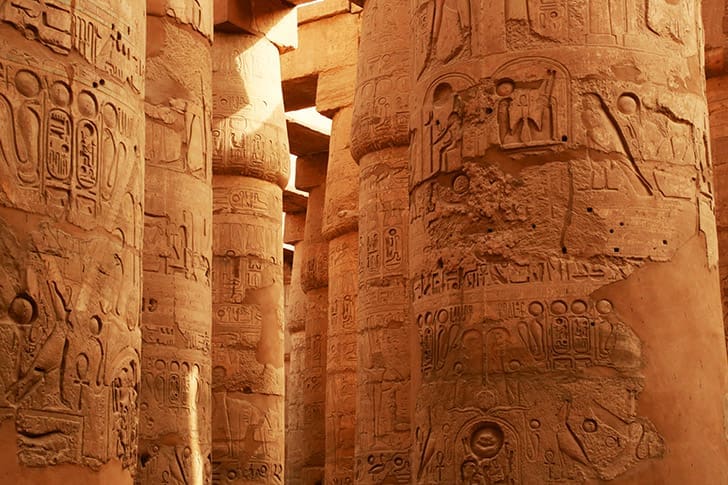
You know, we’ve talked before about the question of who the pharaoh might be. The fact is, we don’t know. Someone suggested that the pharaoh who raised Moses is Seti I, and then his successors, Ramses II. I don’t know if that’s true, but anyone who’s been to Egypt or has read a little bit about Egypt would know that that really fits Ramses to a T. If there was ever a monumental, I mean, literally monumental, egomaniac in world history, it’s Ramses II, who has huge statues of himself all over the country and he even stole other pharaoh’s statues and put his name on them. He has statues of himself with his wife, for example, and she barely comes up to his knees, because it was really important in this relationship. I
I can imagine a person like that, you know, telling Moses, Okay, so you’re representing the God of these Hebrew shepherds, Abraham, you say, and Isaac and Jacob, who are they? I am the son of the god Ra, the emperor of the skies. This is nothing. I care nothing for you.
When you talk about the sun as being a god, and you get this darkness that is tangible, so tangible, you can feel it for three days, there’s another direct assault upon their theology. This miracle blacks out the sun god Ra. He may still be there. They don’t know. They can’t tell, but his light isn’t reaching Egypt, and that’s a direct challenge, and Pharaoh is his son, supposedly. Rameses means child of Ra, the sun god. If that’s the pharoah in the Moses story, then it’s a direct affront to him and to his father, the divine Ra.
Scot
I have to say, on a personal note, every time we go to the Egyptian Museum in Cairo, we always pay that little extra amount to go into the room that’s full of the pharaohs who are still there, and embalmed, and look pretty good, actually, for a dead person of 3,000 plus years ago. We always look at Ramses II, and, (yes, we don’t know if that was the person, but it certainly points to him in the record) and say, you know, things didn’t work out well for you. Here you are, being seen by hundreds of thousands of people all the time in your state, and you really don’t look that powerful?
Dan
I’ve thought similar things when I’ve gone into that room. I’ve thought, here you were, the most important person in the world, as far as you knew, and maybe, truly, the most important single human in the world and now, 3,500 years later, are all these peasants walking by gawking at you, and there’s no splendor, there’s nothing, you know? That’s what human greatness comes down to. A little humility might have been in order. It’s so true.
Maurine
All of these plagues are happening and they’re affecting the Egyptians, but they’re not affecting the Hebrews. Tell us about that, and how that must have felt to the Egyptians, and how it must have felt to the Hebrews.
Dan
We know that at least some of the Hebrews, a sizable chunk of them, are concentrated probably up in the Nile Delta. That is the region of the north of Egypt, where the Nile River fans out, and then enters the Mediterranean Sea. The treasure cities of Python and Ramses, that it says the Israelites are building are up there, we’re pretty certain, on the eastern side of the delta, on the side toward Israel. That area seems to be spared from all of these plagues that the Lord passes by them. Other parts of Egypt are affected but not that part of the delta, which is really interesting.
The King James Bible puts it this way, thus did the Lord God show that he made a difference between the Egyptians and the Hebrews. He makes a difference. The Egyptians are suffering, and the Israelites are doing just fine. Although, they must have been intermixed with the Egyptians a little bit, because later on, we learned that they borrow things from their Egyptian neighbors. They have Egyptian neighbors. They’re not totally separate. Then later, in the last of the plagues, they still have to mark their dwellings, so that the Angel of Death will pass them by, so it’s not just a matter of a blanket, geographical exemption.
Maurine
What I think is so interesting is that as these plagues get worse and worse. This hail that becomes fire, when it lands, blains and boils on your skin. This is really bad. leading up to the worst one. But as they do, I’m so interested to see Pharaoh’s response because he begins to say, “Okay, I will let you go”, and then he changes his mind. As soon as the plague is taken away, he immediately backpedals. In some ways, that reminds me of all of us, as human beings. You know the old story about the man who fell over the cliff, and he was praying with all his heart that he would be saved, and then his coat caught on a branch, and he said, “Never mind, Lord, I don’t need you after all.”
Pharaoh can’t even keep his word. He is so used to not having to make any concessions to anyone of any kind that, no matter what he says, it’s really not trustworthy until, well, I was going to say, until the very end, but even then, his word is not trustworthy.
Dan
You know what, we do the same thing in similar ways, maybe equal in opposite ways. When we’re in real trouble, we pray for divine help, and then when things get better, we sort of slip back into complacency, and don’t pray as much, or as fervently. But, boy, when there’s a real difficulty, then we’re on our knees, urgently pleading with the Lord.
When a plague passes, Pharaoh may think, well, okay, that’s the worst of it. We survived. It’s probably all he’s going to do and then comes another one. Eventually, he realized this isn’t going to end until they’re gone. Even then, though, he doesn’t want to let them go. It’s a great blow to have your slaves successfully rebel. Consider the famous slave revolt of Spartacus against the Romans. What they did to the slaves? They crucified them along the Appian Way. and made a spectacle of them because it just wouldn’t do to have slaves successfully rebelling. If one group does that, others may get ideas. But this time, they got away.
Scot
Back to Cecil B. DeMille–the non-scriptural text–our favorite line, from that movie, by far, is when it’s finally acknowledged, “Moses’ God is God.” That leads us to a question what is it in us as children of our Heavenly Father, that we would ever resist him? I don’t understand why we would ever resist God.
Dan
Yeah, it’s funny because most of us recognize that if we live the rules, if we live the commandments, our lives actually go better. There are all sorts of studies. This is actual science that indicate that people with religious affiliations, who live by certain standards, do better in life. We know that people who donate to charity and serve are happier. We all know it, but we don’t really believe it and we will still say, “Well, yeah, yI grant the idea that being faithful to God, and serving, and giving, and so on would make me happier, but what I really want is a bigger boat. What I really want is a bigger house. I’ve got to get a job that pays me more. Not, you know, understanding with our minds, but not with our hearts, that beyond a certain point, those things don’t actually tend to make you happier. You know, you have to have a roof over your head and food and clothing, but beyond that, devoting your life to a false god of prosperity or power, whatever it is you’re going after, just isn’t going to make you happier, but we just don’t really believe these things.
President Kimball gave a talk once on the false gods we worship, and they’re innumerable false gods that we worship. I think a good way of describing or defining what a person’s God is, is what is it that really is most important to him or to her? If we analyze ourselves, we’ll find that at least at some points in our lives, it hasn’t necessarily been the God of Israel. It’s been something else. that we want, what we really care about.
Maurine
It seems interesting to me, because one of the central questions in the Old Testament, is who is God? Everyone’s claiming, “We have a God”. “Our God is God”. “This God is God.” Here in this story, God is making it very clear who is God. And I think that’s a interesting thing that becomes a part of the heritage of Israel, and maybe a necessary part in Israel, as they will be constantly tempted and challenged and fall to the idea that there is another god.
Dan
It’s amazing to watch the history of even Exodus alone. where the Israelites are constantly falling. This is true throughout much of Israelite history until maybe. It takes a long time.
We believe that for most of us today, idolatry isn’t really an option. I’m not likely to put a little metal statue in the corner of my room and bow down to it much. That’s not in the air today. But I might have another kind of idol, and I have to be constantly watching. Do I have any idols? Do I need to eliminate them from my life?
I really like this definition of scripture or the Bible, I think from Mark Twain or probably Ambrose Bierce, who would find the Bible as a book of scripture admirably suited to the needs of my neighbor. I think we need to be careful when we read this and say, “Oh, look, stupid idolaters, how could they have been such fools?” That’s not the important lesson to draw from this. We should be asking ourselves the question of the Last Supper. “Lord, is it I? Am I doing this? In what way might I be doing this? Can I learn from this?”
The Lord didn’t give us these scriptures so we could laugh at the stupid Israelites that are being led by Moses, or a dumb Laman and Lemuel. He’s giving it to us so we can learn not to be like them. That’s so true.
Scot
I want to talk about this: Pesach or the Passover, because this becomes a critical moment in the children of Israel leaving Egypt, and it’s in their DNA to this day. Pesach is just so important to them. Let’s go through this as far as the symbolism of the atonement goes what were they commanded to do, and and then, you know, how did this become the birth of the nation of Israel?
Dan
I think the Christian symbolism of the Passover is almost embarrassingly obvious. So much so that I’ve led several Passover seders, and I’ve attended a number of others, and I wouldn’t be upset if Latter-day Saints, not as a commandment, but if some of us did this from time to time, I think it’s a good moment to teach children the symbolism of the Passover, as we understand it, not as Jews understand it. Some of the symbolism is pretty obvious.
You have the curse upon the Egyptians, that the first-born male child is going to die, from Pharaoh on down. This is not only in their families, but among their livestock. So the Israelites are commanded to observe the Passover. What do they do? They sacrifice a lamb, but it has to be the firstborn male lamb, unblemished. Now, if that isn’t an obvious reference to Christ, I don’t know what it would be. Christ was the firstborn, he was unblemished. This is a really important part of the atonement, that he is literally without sin. He’s an unblemished lamb and so he is sacrificed.
But then, what would that mean to us if we didn’t apply the blood in a way? It’s not a phrase that we use very often, but it’s really relevant. In the initial Passover, what they’re supposed to do is take the blood and spread it on the doorposts and the lintel, the crossbeam of their doors, in their little individual mud dwellings. This is to tell the Angel of Death, or the Lord himself, to pass by, or to pass over that house, and spare the inhabitants, including the firstborn who’s there. The idea of applying the blood of Christ to ourselves is centrally important to accepting the atonement.
It’s not enough that Christ has atoned for our sins. We have to accept that atonement. If we don’t, it’s as if it didn’t happen for us. So that’s putting the, putting the blood on the, on the door and lintel of your house. telling the Lord, “Yes, I accept the atonement. I accept the sacrifice of your unblemished son.”
Then there are other aspects of the thing that have to do with their rapid removal from Egypt. You have the unleavened bread, the ideas that they don’t have time for bread to rise, right? Their flight is going to be in haste. They’re supposed to eat it in the old days with their walking staff and their shoes on, and this is to indicate they’re ready to go, to bolt at a moment’s notice. There are things like, um, you know, dipping, eating the bitter herbs to remind themselves what they came from, the bitterness of captivity.
But all of this fits, I think, a Christian context really well. We are captive to sin until the atonement frees us from it. We would be the slaves of the devil if the atonement didn’t free us from captivity. It’s by that shed blood of Christ, and the atonement that he makes for our sins, that we are free, because he’s an unblemished lamb. I think the similarities should be pretty obvious to a lot of Latter-day Saints. Something to reflect on.
In a way, too, the sacrament that we do still today is a very abbreviated form, a descendant of the Passover. With the wine, originally, or the water now, and the bread representing the body of Christ, the initial sacrament service was a Passover meal, the Last Supper. This has enormous ramifications, and not just for Jews, but for Latter-day Saints as well.
Maurine
I’ve always thought it was interesting and ironic that when Jesus is put on trial by the Sanhedrin, and then they take him next to the Romans to be tried, that they won’t enter Pilate’s house, because they’re afraid that it will have leaven in it. They are following the Passover law, but they don’t recognize the point of the Passover, which is right with them. They’re taking Christ to be judged and ultimately crucified. What an ironic moment that is, that they have kept Passover all these centuries, and yet they don’t recognize Christ when he is right there with them.
Dan
Jews are sometimes criticized for legalism. The rabbis, the Pharisees, certainly were legalistic. It’s sometimes justified, sometimes maybe not so much, but the idea that you go in to deliver an innocent man to a brutal, violent death, but you’re worried about whether there’s leaven in the house is getting moral priorities just a little bit skewed, I think. I
I’m taken by the fact that in our dispensation, the Lord gives as the last promise in the Word of Wisdom these words, “and I, the Lord, give unto them a promise that the destroying angel shall pass by them as the children of Israel and not slay them.” Here’s this health code that we’re given today, and we’re reminded of our Hebrew roots. that we’re right back to, to this time when the angel of death passed over them. So, you know, this Passover echoes.
In fact, it’s kind of interesting that the founding of America is being in some way connected with this, so much so that Benjamin Franklin proposed as the first seal of the United States the image with the pillar of fire going ahead of the children of Israel. Because he thought that’s what the people of the United States were, people who’d gone out of captivity in Europe to come to freedom in the Promised Land. It wasn’t accepted. This image has been used constantly. Black spirituals in the South were always singing about Moses going down to Egypt way and saying, “Let my people go.” The image of liberation, salvation, earthly liberation, and salvation, is so rich in this story that’s been used in multiple cultures and for understandable reasons.
Scot
I think is so interesting in that last meeting with Pharaoh, that he basically says, as we mentioned earlier, I don’t want to see your face again, Moses. I mean, Moses has been nothing but trouble to Pharaoh. And Moses says, You won’t.
Dan
I think of it too. There’s a human dimension to this that I think is brought out in Cecil B. DeMille’s movie, but, these are people who are probably raised together. They’d known each other. Moses had grown up at court. Pharaoh wasn’t a stranger to him. So the rift is utter and absolute. “I don’t ever want to see your face again.” “Don’t worry; you won’t. It’s a terrible personal tragedy, in its small way, among all the other things that are going on.
Maurine
I’m fascinated that the children of Israel were directed to go to their neighbors, and to ask for their gold, and their silver, and their precious things, and the Lord softened the hearts of their neighbors, and they gave them away. Then they basically are spoiling Egypt. That’s just a fascinating thing for this group, who have been slaves. They’re all spoiling Egypt now as they leave.
Dan
Last week we talked about the fact that the Egyptians are not going to put this on the records in their temples and all over their murals, because this was pretty embarrassing. This is a major defeat for an arrogant pharaoh, and for a people who didn’t like the idea of slaves successfully getting away with a revolt. It’s kind of funny here to see the Lord telling his people to essentially steal from the Egyptians, but I think the idea would be, they’ve exploited you for the better part of half a millennium, and so you’re not going to go out as slaves with nothing. You should take something from them, because a lot of that is the product of your labor. Their economy is strong because you are working for it and so, it’s only fair that you take a little bit of that. So they do.
Maurine
So, it’s so interesting as they leave, the Lord will be obviously and visibly with them, because there’ll be a pillar by night and a shadow by day, as we sing in the song, “How Firm a Foundation. But that is really obvious. And I think it’s interesting that a shadow by day as you’re crossing the Sinai desert would be so important. Scot and I have spent a lot of time even camping in the desert and when that sun comes up, it’s like an enemy. It’s so terribly terribly hot, and you can hardly bear the heat. So if you have sort of a shadow by day, that’s the indication that you were being watched over. And, of course, the pillar by night is the same thing, protecting you from all the things that could be in the wilderness. So I love it, because, again, it seems like part of the covenant promise. It is the same kind of thing that the Lord said to Jacob. I will go with you. The Lord says, “I will be your God and you will be my people.”
Dan
This is seen again in their posterity. They had this very clear indication that God is with them. One of the names that’s given to Jesus in scripture is Emmanuel, which means God with us. God is with us. That’s one of the great promises made to the covenant people is that God is with you. You may not always see him as clearly as a pillar of fire, or of smoke, but he is with you and so you can depend on him, and he’s trying to teach that to the Israelites. In the future of Israel, he won’t be there so obviously. But if they remember this story, they’ll know that he is with them, that there was a time when he was obviously with them in a visible unmistakable way and that will reinforce the lesson that they’ll remember forever.
Maurine
We don’t have a pillar by night and a shadow by day. But he is with us just the same, and sometimes it seems like it would be a lot easier if we could see this visible thing that reminds us that God is with us. There’s a lot more required when you have to rely on your memory and your experiences, and the good feelings that you have when you do certain things. But the Lord is with us just as clearly as he was with those covenant children as they crossed that great wilderness to the Promised Land.
Dan
Yeah, yeah. That’s, I think, one of the most important lessons to learn in the gospel is that God is with us, and that, in the end, everything will be okay. It may not be in the short term, sometimes, but in the long term, everything will be okay.
Scot
This is Scot and Maurine Proctor. We’ve been here with our guest, Dr. Daniel Peterson. We’re so grateful for your time with us. Next week, we’ll be studying Exodus chapters 14 through 17, called “Stand Still, and See the Salvation of the Lord”. Thanks to Jenny Oaks Baker for the music, which accompanies this podcast, and as always, we’re grateful to Michaela, Proctor Hutchins, for producing this show. Have a great week, and see you next time.
“Come, Thou Fount of Every Blessing” Performed by Jenny Oaks Baker. Used with permission © 2003 Shadow Mountain Records
A Miracle, a Plot, and a King’s Triumphal Entry: Taking You to Palm Sunday
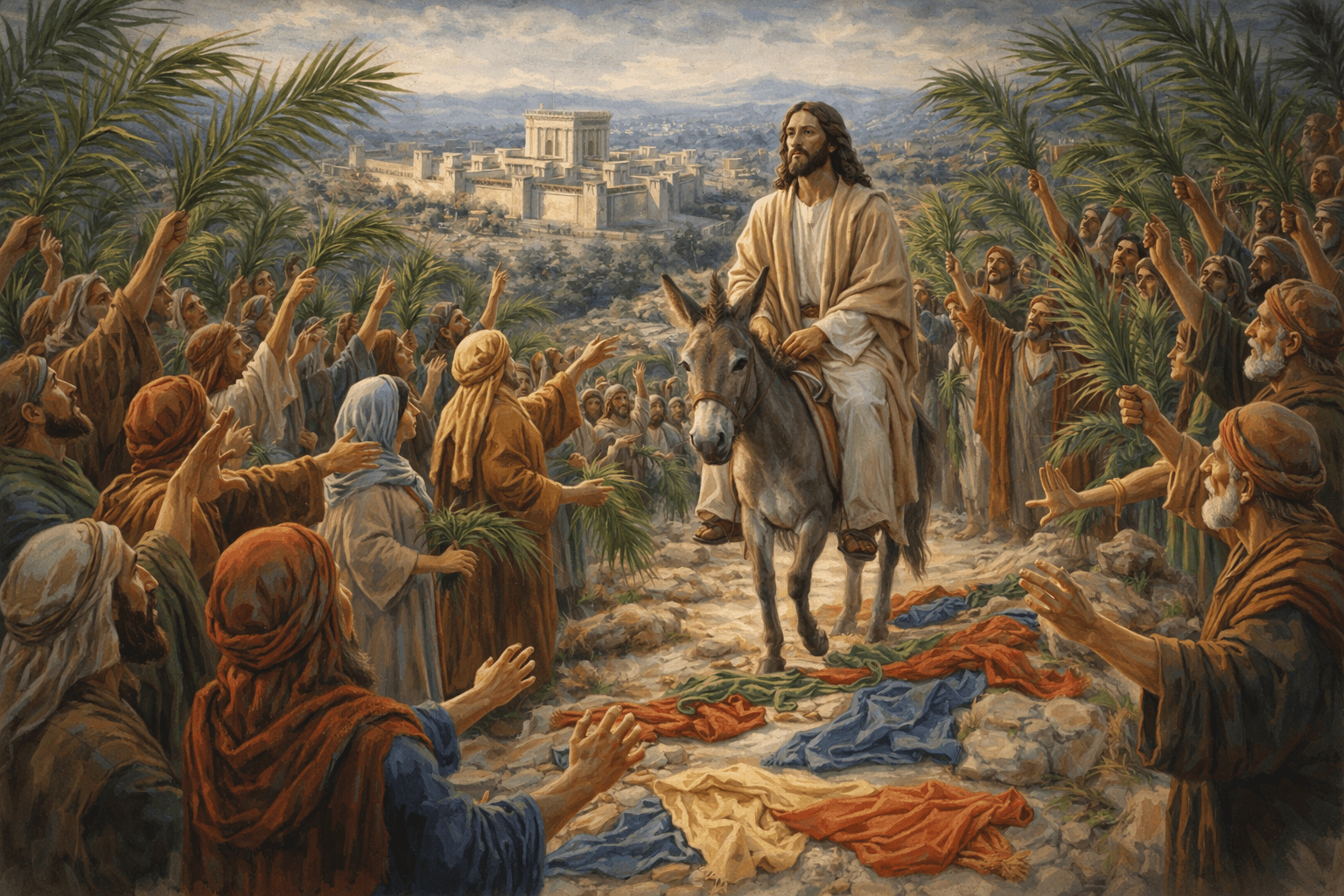
What did Jesus do that finally tipped the Pharisees into conspiring to crucify him? What act was so heinous, so threatening, so terrible to them that they could no longer stand is presence in their nation?
Ironically, it was a miracle that they couldn’t stand. The light and power that awakened Lazarus from the tomb made them convinced that they had to put Jesus into one.
Raising someone from the tomb who had obviously been there four days was their breaking point. “If we let him thus alone, all men will believe on him,” they said. Raising the dead, healing the blind, lifting the broken heart, these were the offenses that kindled their anger and threatened their position.
So let’s go to that scene of Lazarus.
Raised from a Tomb
Mary and Martha sent an urgent message about their brother to Perea where Jesus was teaching: “Lord, behold, he whom thou lovest is sick.” When Jesus heard of Lazarus’ sickness, He said, “This sickness is not unto death, but for the glory of God,” and He turned and continued His work two more days at Perea with the calm assurance of divinity, knowing that He would arrive in proper time.
After two days, He told the disciples that Lazarus was dead, but He said, “Let us go into Judaea again.” This was a dangerous suggestion, prompting Thomas to say, “Let us also go, that we may die with him,” for “they feared lest the Jews should take Jesus and put him to death, for as yet they did not understand the power of God.”
As Jesus traveled on the road near Bethany, the news came that Lazarus had already lain in the grave four days, and heartbroken Martha, hearing that Jesus was coming, went out sorrowing to meet Him. “Lord,” she exclaimed, “if thou hadst been here, my brother had not died.” How often during that heavy four days since Lazarus’ death Mary and Martha must have discussed this very thing. “If only Jesus had come, if only He had been here.” Still, she had no complaining word for Jesus, no murmuring; she just affirmed, “But I know, that even now, whatsoever thou wilt ask of God, God will give it thee.”
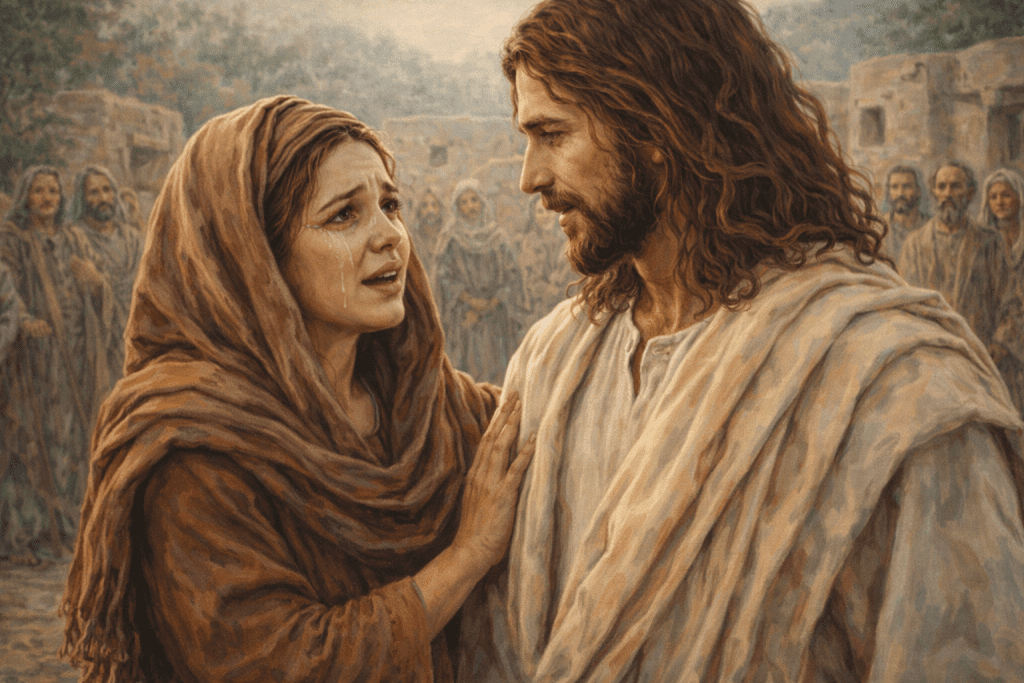
Jesus answered, “Thy brother shall rise again,” which Martha misunderstood, saying, “I know that he shall rise again in the resurrection, at the last day.” Jesus explained further, “I am the resurrection, and the life: he that believeth in me, though he were dead, yet shall he live: . . . Believest thou this?” Then Martha affirmed with loving faith, “Yea, Lord: I believe that thou art the Christ, the Son of God, which should come into the world.”
Next, Martha went quickly to her sister with words every believer would long to hear: “The Master is come, and calleth for thee.” Oh, He had come!
As Mary left the home, perhaps with couches and chairs tossed over in the Jewish form of mourning, the mourners followed her, thinking she went to the grave to weep. Instead, she came to the Lord and fell at His feet.
Jesus asked, “Where have ye laid him?” to which they answered, “Lord, come and see.” Then, “Jesus wept,” not apparently because Lazarus had died, for He knew that in moments His friend would rise. He wept, instead, for love and compassion, for the grief that tore the heart of His friends, for the bruises and scars of mortality, for all that hurts.
At the place of burial, Jesus asked the people to roll away the stone from the cave entrance where Lazarus lay. Martha demurred: “Lord, by this time he stinketh: for he hath been dead four days.” Jewish belief was that a body began its corruption on the fourth day.
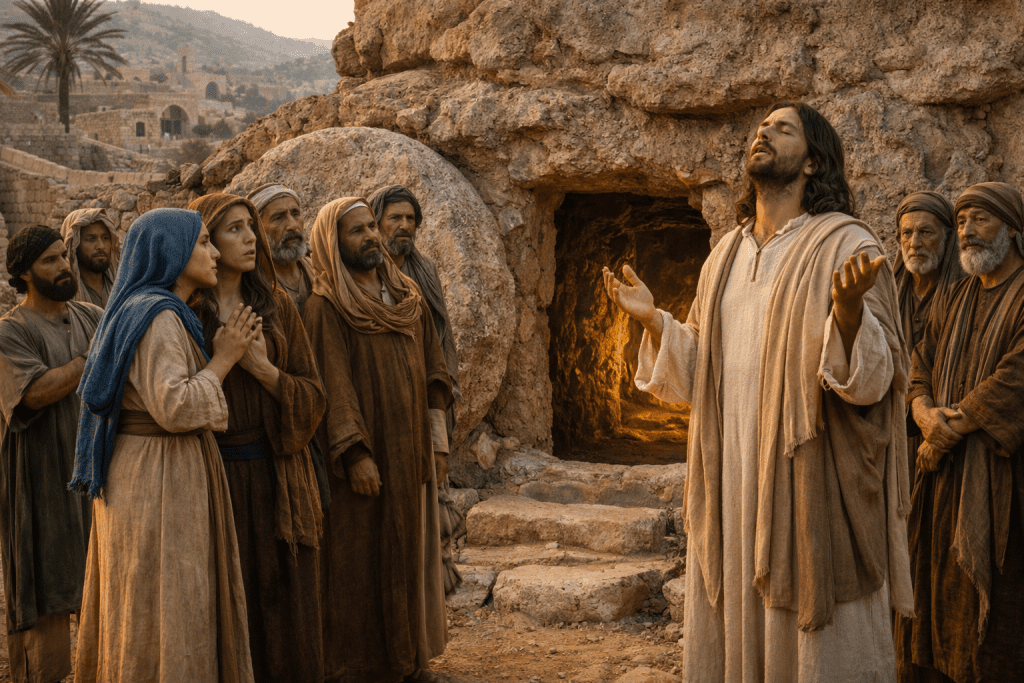
“Then they took away the stone from the place where the dead was laid. And Jesus lifted up his eyes, and said, Father, I thank thee that thou hast heard me.
And I knew that thou hearest me always.”
Those last words rings in our ears, “I knew that thou hearest me always.” We might talk ourselves into believing that God is distant in some far away place, deaf to our yearnings and pleas, but if we could follow Christ’s example, as believers, we would have to acknowledge, “thou hearest me always.” It is an affirmation of assurance and faith, knowledge and joy.
Then in a loud voice that must have shaken the listeners to the marrow, He cried, “Lazarus come forth.” And “he that was dead came forth, bound hand and foot with graveclothes.” “Then from that day forth [the Pharisees] took counsel together for to put [Christ] to death.”
Mine Hour Hast Come
Jesus had told his mother Mary when she had asked her for help at the wedding at Cana, “Woman, what wilt thou have me to do for thee? that will I do; for mine hour is not yet come.”
Now His hour had come. Behind Him were the green hills of Galilee, the great crowds gathering on the grass to hear His word, the lap of waves on a blue sea. Ahead lay Jerusalem, the arrogant city on a hill, tense in its self-conceit, where already in their supreme blindness in the name of religious piety, plotters were scheming to kill the Lord Himself.
Offended by His healing touch, by His words that cut to the heart of their hypocrisy, the Roman and Jewish rulers gathered in the high halls of the chief priest and conspired against Him. Raising Lazarus from the dead so that all the countryside was full of the talk of it was Jesus’ final offense that had challenged their dominion. “If we let him thus alone, all men will believe on him,” they said. Raising the dead, healing the blind, lifting the broken heart, these were the offenses that kindled their anger and threatened their position.
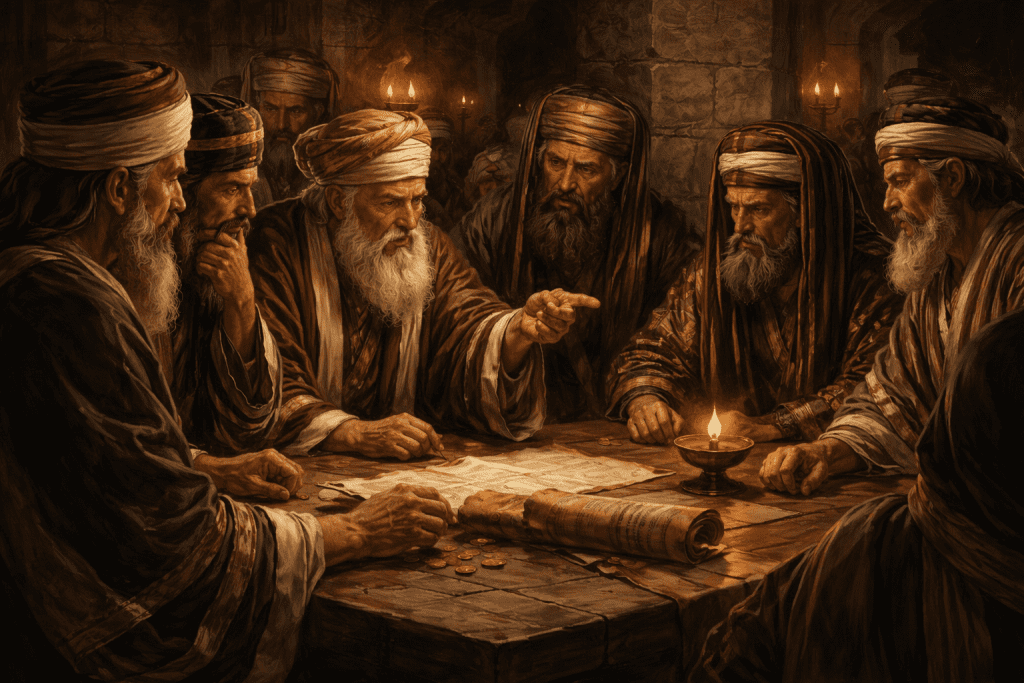
Still, their fanatical hatred did not stop Jesus from coming to Jerusalem for Passover with the certain knowledge of what He would face. Bitter contempt, insult, and death waited for Him along the shadowed roads of Jerusalem, often from the very people who claimed they represented God. What superb irony!
Jesus said, “What shall I say? Father save me from this hour: but for this cause came I unto this hour.”
In Bethany, just over the hill from Jerusalem, Mary, sister of Martha, anointed His feet with a precious oil that she had saved “against the day of [his] burying,” and He patiently told apostles who could not understand that He would submit Himself to be mocked, scourged, and spat upon. He would overcome the world, but not before it appeared to all those who loved Him that the world had overcome Him. They must face His humiliation before they saw His triumph.
He would suffer that others would not have to suffer, face agonies beyond description to do His Father’s will: “For I have not spoken of myself; but the Father which sent me, he gave me a commandment, what I should say, and what I should speak.”
Waving Palm Leaves
On that Sunday in spring, as Jesus and His band of followers went from Bethany to Jerusalem for the Passover celebration, He instructed two of His disciples to go into a village, where they would find a young colt. On this meek animal He would ride for His triumphal entry into Jerusalem, coming not as a proud king with conquests of war but rather in the rule of peace.
His riding a donkey had great symbolic meaning for the Jews. In this way, Jesus was saying to them that he was the legitimate king. God had made a covenant with David that his throne would be established forever and that a future king (the Messiah) would reign in righteousness. In Zechariah 9:9 it reads, “Behold, thy King cometh unto thee…lowly, and riding upon an ass.” War kings rode horses, which were symbols of conquest. Peaceful rulers rode donkeys or mules. Tellingly, when Solomon was declared king, he rode David’s own mule.
At Passover, the population of Jerusalem swelled with people coming to celebrate. Word of Jesus’ coming had spread among the festive pilgrims gathered in the city, especially among His own Galileans, who had heard of His miracles, and as the fire spread from heart to heart, they rushed out to meet Him, making a rough carpet by unloosing their cloaks and throwing them in His path.
Bethany is not far from Jerusalem, just over the Mount of Olives from the great city. As Jesus rode on that steep and winding road down the Mount of Olives, directly across from the eastern wall of Jerusalem, this is where the people gathered palm leaves to wave them in triumph and love for the Messiah.
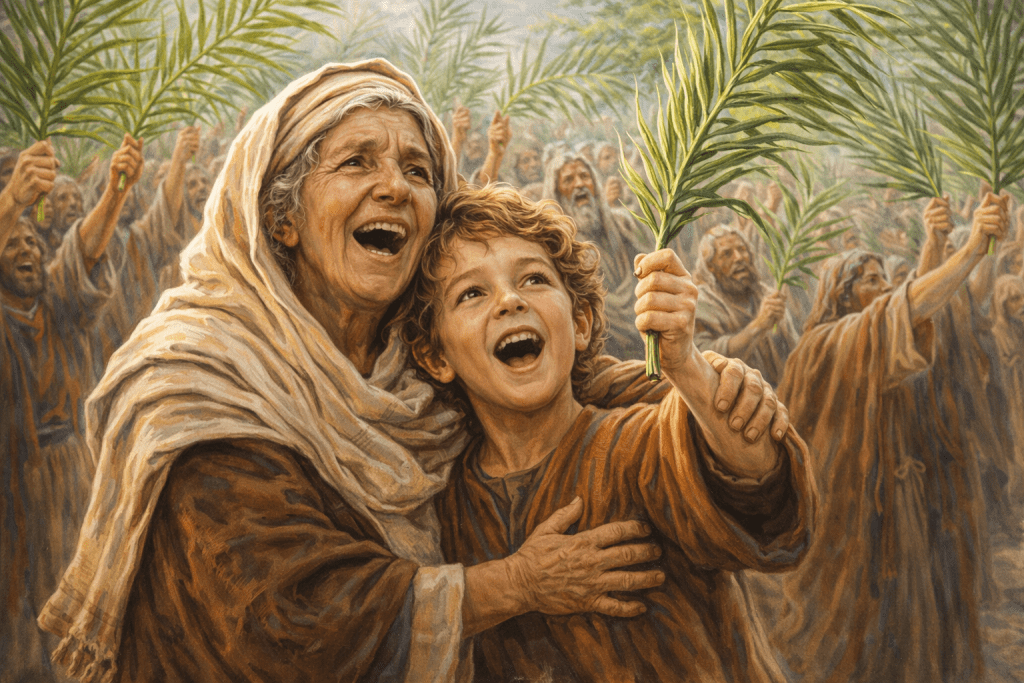
Here was the promised Son of David, and now surely the kingdom was at hand! Waving palm leaves, they shouted hosannas: “Blessed be the King that cometh in the name of the Lord.”
The word hosanna, writes Elder Bruce R. McConkie, is “a word of Hebrew origin, meaning literally, save now, or save we pray, or save we beseech thee – is both a chant of praise and glory to God and an entreaty for his blessings.”_
Elder McConkie explains that the word, hosanna, hearkens to Psalm 118: “Save now, I beseech thee, O Lord: O Lord, I beseech thee, send now prosperity. Blessed be he that cometh in the name of the Lord: we have blessed you out of the house of the Lord.”_
Taylor Halverson further explained, “Hosanna is a beautiful Hebrew word that is formed from two other Hebrew words. The hosa portion of the word means “to save” and is actually in the command form meaning “save!” Na means “please!” So the express meaning of hosanna is “please save!” or “please save us!”
“What I love about this word is that the Hebrew name hosa is the foundational word for these names:
- Joshua
- Josh
- Hosea
- Hoshea
- Elisha
- Elishua
- Isaiah
“And, most significantly, JESUS!
“So when in joy we shout hosanna we are actually shouting ‘Jesus please!’ or ‘Jesus please save us!’”
Whole-Souled Praise
Larry Barkdull added, “Anciently, during the Feast of the Tabernacles, when the Jews were commanded to gather to the temple, a priest would daily recite this psalm during a processional around the altar. The covenant people had been commanded to ‘rejoice before the Lord,’_ and on the seventh and last day of the feast, which was called the Great Hosanna, they would stand before the temple with trumpets sounding, wave palm branches and shout hosanna over and over.
“Essentially, the Hosanna Shout is simultaneously ‘whole-souled’ praise ‘given to the full limit of one’s strength’ and a cry for the Lord to come and save us now. We stand in the holy sanctuary that we have erected to his name, praise him, and plead for him to come and rescue us. By doing so, we fulfill ‘the instruction to bless the name of the Lord with loud voices and ‘with a sound of rejoicing,’ with ‘hosanna to him that sitteth upon the throne forever.’”
Disgruntled Pharisees
Disgruntled and knowing full well that the people were proclaiming Jesus the Messiah, the Pharisees made a desperate appeal to Him to stop the commotion. He answered that if the people held their peace, the very stones would cry out.
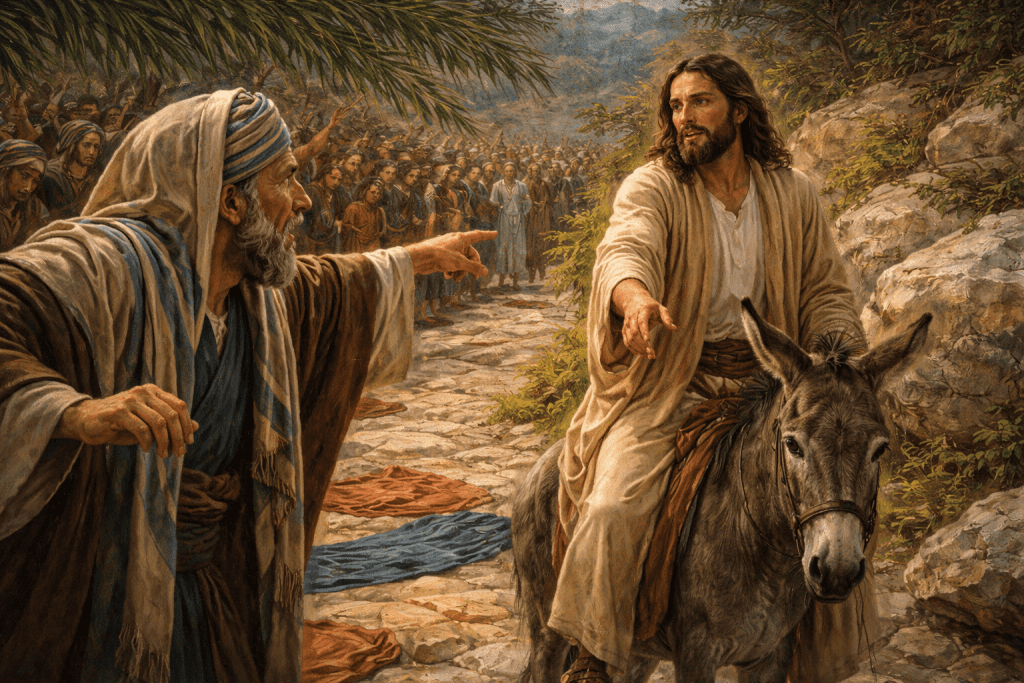
As Jesus first caught sight of Jerusalem, that city of palaces and ivory towers, of terraces and magnificent gardens, He wept. Though the multitude cheered as He began His descent down the Mount of Olives, He moaned in deep lamentation.
“The contrast was, indeed, terrible between the Jerusalem that rose before Him in all its beauty, glory, and security, and the Jerusalem which He saw in vision . . . with the camp of the enemy around about it on every side.” For with God’s view, He saw that in A.D. 68, but a few years hence, the Romans would besiege the city until the temple would be left without one stone upon another, until the city would be tumbled to the ground, its former beauty in ashes.
Scene after scene must have arisen before His eyes, the gory bodies of Jerusalem’s children among her ruins, the famine that drove mothers to snatch food from their infants, the thousands crucified outside the city walls. He said that in those days the daughters of Jerusalem would say, “Blessed are the barren, and the wombs that never bare.” “Then shall they . . . say to the mountains, Fall on us; and to the hills, Cover us” — all of this because they had rejected their God.
Where Were Those Who Had Shouted Hosanna?
From this distance of centuries, the question lingers. Where were all those people waving palm leaves and shouting hosanna just five or six days later when Pilate asked the crowd which prisoner he should release from a certain death warrant Jesus or Barabbas? What did the crowd cry out? “Barabbas.” They cried out for the release of a violent rebel who had murder and bloodshed on his hands instead of the Messiah they had recognized so clearly on that Palm Sunday.
What happened? The conjectures are many. Perhaps it was the swell of Galileans, the rural people of the north who had supported Jesus, not the citizens of Jerusalem. Perhaps, as we have seen so often today, crowds were assembled by pay. They shouted for Jesus to be crucified for a “mess of pottage.” Or maybe it was just enough to stir up rumors and fears about this meek and powerful Messiah.
All we can know for sure is that in our time, we can wave our palm leaves at his triumph and make every prayer a hosanna as we plead with whole-soul devotion, “Lord, save me.”
Barabbas and the Grace of an Open Door
Over a lifetime, we come to understand our every choice leaves a mark. Some bring peace; others linger as regret. No matter how carefully we justify ourselves, there are moments of honest clarity when we recognize how much we need mercy — moments when excuses fall away and we see ourselves as we truly are. The gospel of Jesus Christ speaks directly to those moments. It does not pretend we are without fault — instead it offers us redemption for our faults.
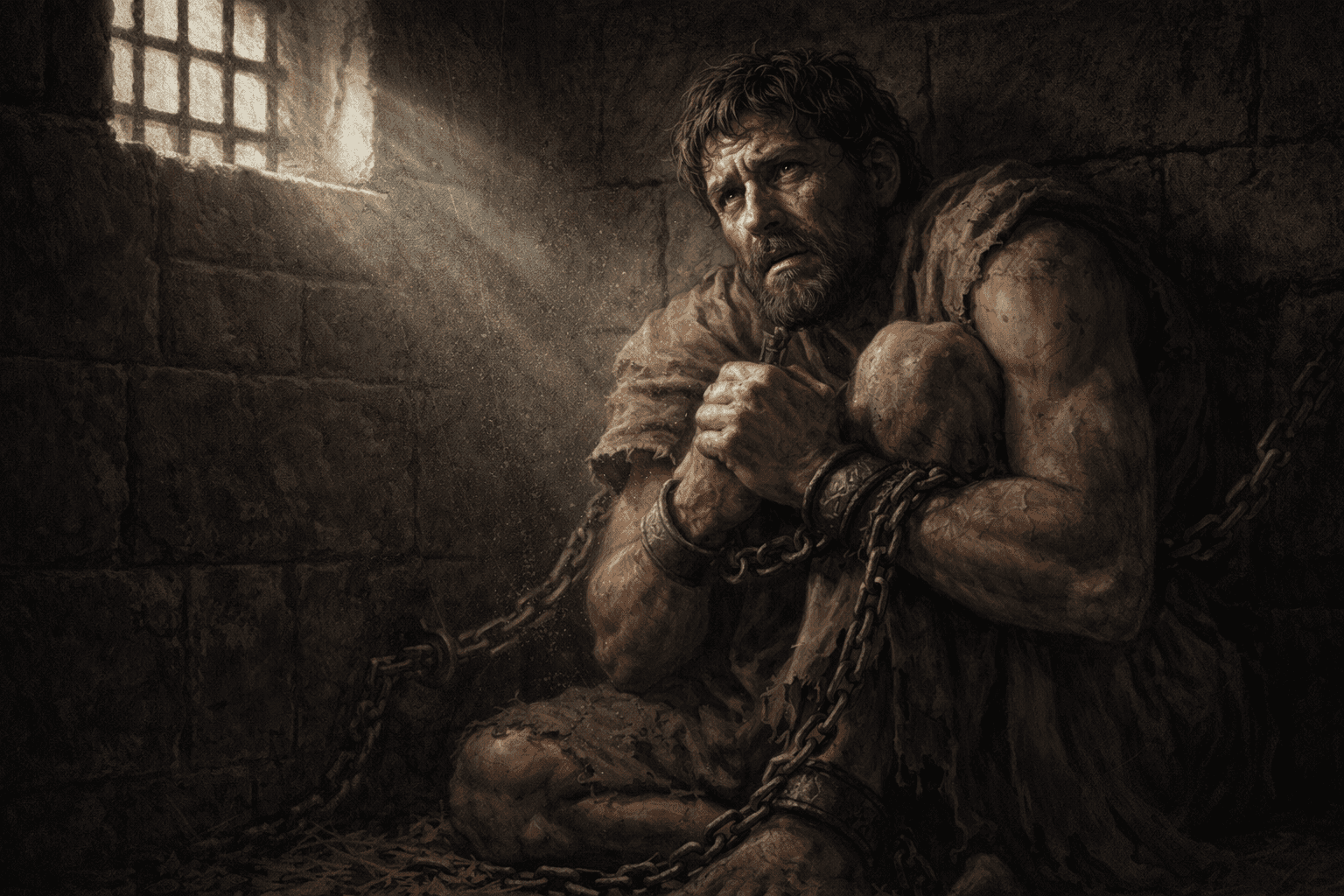
Scripture often teaches through sermons and miracles, but sometimes it teaches through a single human exchange, brief and unsettling, revealing eternal truth more plainly than words alone. On the morning of the Crucifixion, while crowds argued and a governor hesitated, one man waited in a Roman cell expecting justice in its harshest form. Instead, he was given mercy he had done nothing to deserve.
His name was Barabbas.
Barabbas, a notorious prisoner guilty of rebellion, robbery, and murder, may have spent his last hours in a kind of numb dread, the sort that comes when you have run out of options and the consequences you earned are finally here. A man facing Roman execution would have heard the sounds of the city above him, the shuffle of guards, the heavy finality in the air. Maybe he tried to rehearse bravado, telling himself he could meet death like a fighter, yet the body betrays the soul when the end feels close. His mind might have swung between rage at Rome, regret he would never admit out loud, and the sinking realization that his choices had brought him to a cell where tomorrow had been taken away.
Then the impossible happened. Footsteps, keys, his name spoken, not to be dragged out to die, but to be released. Confusion would have hit first, then a rush of disbelief, the heart pounding as if the body could not decide whether this was deliverance or another trick. And when he learned that Jesus of Nazareth was the one being handed over instead, the shock might have turned to something heavier than gratitude, something that landed in the chest like a stone. He knew what he had done. He knew he belonged on that cross. To walk out into daylight because an innocent man was taking his place would have felt like being handed a life that did not fit him, like wearing a clean robe over filthy skin.
What do you do with a gift you did not earn, purchased by a goodness you did not possess?
Perhaps he avoided looking back as he left, or perhaps he could not stop looking back, haunted by the thought that his freedom had a name and a face. If Barabbas had any honesty left in him, he may have sensed that he had just become a living witness of mercy, and that the rest of his life would now ask a question he could not ignore. What do you do with a gift you did not earn, purchased by a goodness you did not possess?
Barabbas steps into the story of Jesus Christ for only a few brief verses, yet his presence is unforgettable. He is the prisoner whose chains are removed while the Savior is led away. He is the guilty man released while the Innocent One is condemned. As Latter-day Saints, Barabbas matters because his experience puts a living face on substitution, mercy, and the unsettling generosity of grace. His story also presses a personal question — what do we do with freedom we did not earn?
All four Gospels record Barabbas as being freed instead of Jesus during the Roman practice of releasing a prisoner at the feast. Matthew calls him a notable prisoner. Mark explains he had taken part in an uprising and had committed murder. Luke describes him as someone imprisoned for rebellion and murder. John calls him a robber. Put together, the picture is not flattering or vague. Barabbas was not in prison for a minor mistake. He was known for violence and unrest, and the authorities saw him as dangerous.
Even his name adds a striking layer. Barabbas is commonly understood to mean “son of the father.” In fact, many biblical scholars believe Barabbas’s first name was also Jesus, making him Jesus Barabbas, which means Jesus, son of the father, creating a powerful ironic contrast with Jesus of Nazareth, the true Son of God, whom the crowd chose to crucify instead. While most manuscripts simply say Barabbas, some ancient copies of Matthew’s Gospel include the name Jesus for him, a detail often noted in footnotes of modern Bibles.
In that crowded moment outside Pilate’s judgment seat, the people rejected the true Son of the Father and chose a man whose life represented the turmoil and brokenness they hoped to escape. They demanded the release of someone who fit their expectations of power and resistance, and they rejected the Messiah whose kingdom would be built through meekness, purity, and truth.
Barabbas is important because he acts out one of the central truths of the gospel in plain sight. Jesus Christ stands in the place of sinners. In a very literal way, Barabbas lived because Jesus died. Barabbas did not argue his way out of prison. He did not repay what he owed. There is no record of him proving his goodness or making promises to change before or after his release. He was simply freed because someone else was chosen to suffer the penalty.
This is the miracle of the Atonement. It does not merely assist the innocent. It rescues the guilty.
As members of the Church of Jesus Christ of Latter-day Saints, this moment teaches something about every one of us. In a sense, we are all like Barabbas. We have all sinned and fallen short. We all carry stains we cannot scrub out by ourselves. We all face consequences we cannot undo by our own strength. Yet through the mercy of Jesus Christ, a door opens which we did not have the power to open ourselves. We walk into light we did not earn. We are given a future we did not deserve. This is the miracle of the Atonement. It does not merely assist the innocent. It rescues the guilty.
The setting makes the lesson even sharper. The exchange takes place at Passover, a feast tied to deliverance through sacrifice. Ancient Israel had been spared through the sign of a lamb, and the memory of freedom was bound to blood and covenant. Here, at the very season celebrating redemption, the Redeemer is condemned and a condemned man is released. The Lamb of God is led to the cross, and a murderer is handed life. The timing is not accidental. It underscores the price of salvation and the seriousness of what Christ offers.
Barabbas also exposes something uncomfortable about human nature. The Gospels show religious leaders stirred the crowd, and the crowd chose the man they wanted instead of the Savior they needed. Pilate offered them a choice, and they chose anger over holiness, force over faith, spectacle over sanctification. It is easy to judge the crowd, but the story is not preserved so we can feel superior. It is preserved so we can recognize temptation in ourselves. The world still offers substitutes for Christ, voices promising quick relief or the thrill of power or the satisfaction of revenge. Those substitutes may look bold and decisive, but they do not heal the soul. They only trade one prison for another.
Then comes the question many people ask: what happened to Barabbas after he gained his freedom? The honest answer is the scriptures do not tell us. The biblical record closes his story at the very moment his life opens up. Later traditions and legends have tried to fill in the silence, but nothing about his later life can be confirmed from the scriptural accounts. He walks out of prison and out of the narrative.
Mercy is not permission to stay the same. Mercy is power to change.
This missing ending is not a flaw. It is part of the message. Barabbas disappears so the reader can step into his place. His freedom is the kind of gift demanding a response. It is one thing to be released from chains. It is another thing to become a new person. Mercy is not permission to stay the same. Mercy is power to change.
Barabbas was freed from Roman punishment, but every soul still needs to be freed from something deeper. Sin binds the heart. Pride locks the mind. Bitterness turns the spirit into stone. Shame convinces people they are beyond hope. Christ does not merely open a cell door and wave us onward. He offers cleansing, healing, and a new life. He offers grace that not only pardons but transforms. This is why repentance is not a punishment. It is a pathway to peace. It is the process of letting the Savior remake what we cannot fix alone.
So Barabbas stands as more than a historical footnote. He is a living parable in flesh and blood. A man who deserved death walked away while the sinless Son of God was crucified. The story stops before we can see whether Barabbas fell back into darkness or turned toward the light. That silence invites each disciple to write the rest with their own choices.
We have all been offered mercy through Jesus Christ. We have all been spared in ways we do not fully understand. We have all been given another day, another chance, another invitation to come unto Him. The question is what we will do with that freedom. Will we run back to the old life, chasing the same appetites and resentments that made us prisoners? Or will we turn toward the Redeemer who took our place and learn to live as true sons and daughters of the Father?
Barabbas leaves the page, but the invitation stays. Christ bore the cross, and we are free to follow Him.
Why Would Some Latter-day Saints Celebrate Passover?

In a world when we’re seeing an increase in both antisemitism and anti-“Latter-day Saint” rhetoric, perhaps it will be of interest to explore the special bond that exists — and the future that is prophesied — between two of the “tribes” of the House of Israel, and why some Latter-day Saints are beginning to celebrate each year what has long been considered a strictly Jewish holiday.
What and When Is Passover?
Passover is seven-day holiday that commemorates a time in history when Israelites were slaves in Egypt, approximately 3,000 B.C. (or as some say, BCE “Before the Common Era). It begins at nightfall on the fourteenth day after a full moon in the month of Nissan in the Hebrew calendar, and lasts for seven days. The lunar reckoning means that the dates in our modern calendar vary from year to year. This year “Pesach” (Passover) begins before sundown on Wednesday April 1, and ends after nightfall on April 9, 2026.
As we’ve studied in the Old Testament book of Exodus, (one of the five books in the Jewish Torah) the prophet Moses was commanded to warn the Pharaoh of Egypt that a number of plagues would visit his kingdom if he would not release his Israelite slaves and let them go out into the desert to worship their god (JWH) Jehovah.
As portrayed in filmmaker Cecil B. DeMille’s epic 1956 movie “The Ten Commandments,” the last plague finally did the trick and forced the Pharaoh to do as Moses said and “let my people go”. The Angel of Death (represented in the movie by a creeping green fog) killed the firstborn child of every Egyptian family. But Moses had instructed the Israelites to place the blood of a sacrificial lamb on the doorposts of their houses. Those who obeyed the prophet found that their homes were “passed over” by the plague, sparing their firstborn children.
Every year afterwards, the Israelites have remembered the event by celebrating Passover, taking wine and bread in anticipation of an even greater deliverance in the future when their Messiah will come. In like manner, many Christians today partake of the emblems of the Sacrament (or “Communion”) weekly; however, the order is reversed as they eat and drink bread and wine (or water), in remembrance of the broken body and spilt blood of Christ that saves us from death and hell.
Who Celebrates Passover?
Who were/are the Israelites (AKA “Children of Israel”), and how did they become slaves? And what are the differences between Jews, Israelites, and Hebrews? Aren’t they all the same? Many people today use those terms interchangeably. But scripturally and historically, each of them has a different meaning. “Hebrews” generally refers to the all birthright descendants of Abraham, Isaac and Jacob. “Israelites” refers to descendants of Jacob, whose name was changed by God to “Israel.” He had twelve sons, who fathered the twelve houses or “tribes” of Israel. The term “Jews” technically refers to descendants of one son (Judah), but it has colloquially come to include other Israelites. Jewish people are known for celebrating Passover, but what is the bigger picture?
Why Would Latter-day Saints Celebrate a Jewish Holiday?
When Jacob/Israel’s son Joseph was sold into Egypt as a slave, his family later joined him as a famine raged throughout the land. Ultimately they all became slaves of the Pharaoh, and remained so for 400 years. So when Moses brought God’s plagues upon Egypt, it was ALL the twelve tribes of Israel who were “passed over” by the angel of death. Every Latter-day Saint is either born into or adopted into one of the tribes of Israel, a lineage that is declared in their patriarchal blessing. Thus the Passover is just as much part of our family history as it is for our Jewish “cousins.”

How Is Passover Observed?
The first night of the seven-day Passover begins at nightfall with a “seder” or family supper. Key elements of this ceremonial meal included the use of unleavened bread and other special foods, and there is a dialogue that takes place as family members remembers how God blessed the Israelites during their exodus from Egypt. The details of the ceremony follow a “script” of sorts, called a “Haggadah.” Many different-but-similar versions of this script can be found on the internet, along with menus and instructions for preparation of the Passover foods.
Judah and Joseph: A Special Kinship
Two of the twelve houses or tribes of Israel (Judah and Joseph) are given special mention in the scriptures. Joseph is sometimes represented by his two sons, Ephraim and Manasseh. When Jacob’s oldest son Ruben (and his tribe) lost his birthright through unrighteousness, Joseph’s two sons took their place in the twelve. But if it were not for Judah, there would be no descendants of Joseph. When his other brothers became jealous and wanted to kill him, it was Judah who suggested that they sell him into slavery in Egypt instead.
Judah and Joseph in Prophesy
Although throughout history there has been conflict and even wars among the twelve tribes of Israel, we’re told in prophesy of a special relationship in the latter days between the peoples of Judah and Joseph.
Thus saith the Lord GOD; Behold, I will take the stick of Joseph, which is in the hand of Ephraim, and the tribes of Israel his fellows, and will put them with him, even with the stick of Judah, and make them one stick, and they shall be one in mine hand. Ezekiel 37:19
Ephraim shall not envy Judah, and Judah shall not vex Ephraim Isaiah 11:13
Passover Seders at BYU: Starting a New Tradition
Beginning in the 1960’s, students at BYU from Pasadena, California formed an Israeli dance group called the Yovail Dancers, and one of their activities was to hold a Passover Seder annually in the Wilkinson Center on campus. Through this and other examples, some Latter-day Saints have begun a new tradition of celebrating this “Jewish” holiday by some of Israel’s other “tribes.”
The B’nai Shalom Fellowship
In 1967 some Latter-day Saints who are of Jewish family heritage and their friends began gathering semi-annually at General Conference time to celebrate not only Passover, but their ethnic identity and interests. They called their fellowship B’nai Shalom, The Children of Peace. The gatherings of this group have continued to the present in Utah, and other gatherings are now held in the states of Washington and Arizona. https://www.mormonsandjews.org/
A Growing Kinship Between Judah and Joseph
Over the years there have been numerous occasions when Latter-day Saint and Jewish congregations have shared positive experiences and created growing bonds of kinship. Brigham Young donated land in the Salt Lake Valley for the first Jewish synagogue. In California, stake centers have been used by nearby Jewish temples for overflow needs on their high holy days. When one stake center was being renovated, a synagogue in the neighborhood offered Sunday use of their building until the construction was completed.
In 2016, the Jewish former New York Attorney General Bob Abrams suggested to a Latter-day Saint friend (who was a General Authority) that the Church might want to celebrate the 175th anniversary of Orson Hyde’s prayer given on the Mount of Olives in Jerusalem, dedicating that land for the return of the Jews. He helped make the necessary arrangements for that to happen. In 2020 he also organized an online dialog between Jewish and Latter-day Saint leaders. It was sponsored by the America-Israel Friendship League and it was called “Climbing God’s Mountains: Building Bonds Between Israel, the Jewish People, and The Church of Jesus Christ of Latter-day Saints.” https://www.youtube.com/watch?v=X-SfEir9ofM
The Church has hosted delegations of Jewish leaders at temple dedications, and other interfaith activities have fostered a growing sense of “kinship” between the peoples of Judah and Joseph.
One video production company is preparing a television documentary for broadcast about the many parallels and the unique bond between the Jews and the Latter-day Saints. It will also highlight the gifts given to humanity by members of these two “tribes,” such as television, stereo, streaming video, hearing aids, cell phones, eradication of polio, synthetic diamonds, and many other blessings.
In these last days when both of these groups are experiencing foretold persecutions, it’s nice to also see the prophecy of kinship being fulfilled.
Robert Starling has been a writer and producer for the NBC Television Network and has worked at Schick Sunn Classic Pictures, Osmond Productions, and the media production department of The Church of Jesus Christ of Latter-day Saints. He has served in various producing capacities on feature films such as: “Jack Weyland’s Charly,” “In Search of Historic Jesus,” “Tears of a King,” “Scout Camp: The Movie,” and “Abandoned Mine.” His recent book “A Case for Latter-day Christianity” is available in many bookstores, on Barnes and Noble, and on Amazon.com in printed and e-book versions. He lives in Riverton, Utah with his wife Sharon. They have four adult children and eleven grandchildren.
Third Blood Moon of Tetrad


Saturday, April 4, 2015, a total lunar eclipse will happen that aligns with the Hebrew calendar holy day of Passover. The eclipse will be visible over most of the United States, but not in Jerusalem.
The eclipsed moon will also not be visible because of daytime from the Atlantic Ocean to Iraq and western Russia. It will be visible as a partial eclipse with only a few minutes of totality in the predawn sky in mountain west America.[i]

Details from NASA of the April 4, 2015 Lunar Eclipse.[ii]
The eclipse is the third total eclipse of a tetrad of four eclipses that began last year and ends this fall.[iii] The lack of visibility of this eclipse is one of many reasons why I would assert that the tetrad of four eclipses during 2014 and 2015 does not rise to a “gold standard” as far as being a key last days’ sign and wonder. However, taken individually, this particular eclipse has several interesting features.
Book of Mormon Gold Standard for Signs and Wonders
The fulfillment of the prophesies of Samuel the Lamanite of the signs of Christ’s birth and His death and resurrection constitute in my opinion instances of a true gold standard of signs and wonders from God. The angel told Samuel that these magnificent signs would be sent “to the intent that [the people] might believe that these signs and these wonders should come to pass upon all the face of this land, to the intent that there should be no cause for unbelief among the children of men …” (Heleman 14:28)[iv]

Exact Calendar Holy Day Alignments
The signs of Christ’s birth, crucifixion and resurrection were exactly aligned with the Hebrew and other sacred calendars within a quarter-day.
Christ’s birth occurred on Passover on the Hebrew calendar the evening before April 6, 1 BC. Astronomer John Pratt’s research has detailed the many holy day alignments that occurred on that date with sacred calendars all the way from the Sacred Round on the Native American calendars to the Mercury calendar.[v]
The Crucifixion day, Friday, April 1, 33 AD, was aligned with the sacrifice of the Passover lambs in Judea, with their holy day of the Passover feast celebrated that evening.
The Resurrection day, in the early morning on April 3, 33 AD, likewise was exactly aligned with the Hebrew and other sacred calendars. This date has even more alignments with sacred calendar holy days than the birth day of Christ.
Calculable Celestial Events
These signs included celestial events that are calculable. A lunar eclipse, turning the moon red occurred on the Lord’s crucifixion day, April 1, 33 AD. As Christ’s body was being placed in the tomb, the rising moon was eclipsed by the earth’s shadow making it appear blood red.

Eclipsed full moon rising just hours after the Crucifixion.
In the year before His birth, Christ’s conception was accompanied by the closest conjunction of Venus and Jupiter in history during June of 2 BC. Like the lunar eclipse, these alignments of the planets can be calculated and many were predicted, observed and recorded in ancient times.[vi]
Unpredictable But Scientifically Understood Signs
This next level of sign and wonder characteristics is where a sign happens that cannot be easily predicted but is generally understood scientifically. An example of this would be a volcanic eruption, earthquake or tsunami such as the 2010 eruption of the Eyjafjallajokull volcano in Iceland or the 2011 Pacific Ocean earthquake and tsunami in Japan.[vii] The signs of Christ’s birth and crucifixion in America are above and beyond this scientifically understood but hard to predict level.

European and world air travel was disrupted for weeks when this minor volcano in Iceland, Eyjafjallajökull, erupted putting deadly ash into the upper atmosphere that clogs jet engines. The severity of this eruption was classified as one on the seven levels of the Volcanic Explosivity Index (VEI) scale.[viii]
Surprise Miraculous Signs
Along with calendar alignments and planetary alignments, what is especially impressive about the signs prophesied by Samuel and witnessed by the population throughout the Nephite and Lamanite countries is the “above and beyond” additional signs for which we have no clear scientific explanations.
The Star of Bethlehem appeared in the sky at the birthday of Jesus, the Babe of Bethelem. It was impressive enough to become the guide for the wise men to find the Savior in Bethlehem. In America, the night of Christ’s birth was a night with “great lights in heaven” (Helaman 14:3) so that “it shall appear unto man as if it was day.” No convincing natural scientific explanation of either miracle is available.
The Crucifixion day before Christ’s Resurrection included the three hours of darkness over all of the earth while Jesus was upon the cross. In America, earthquakes, storms and destructions prevailed for three hours followed by three days of thick darkness over the entire area. Cities were burned, sunk into the sea or buried by mountains. Earthquakes lasting three hours instead of a few minutes are beyond current scientific knowledge.
During the hours of darkness, Christ’s voice enumerated the destructions of many cities “that their wickedness and abominations might be hid from before my face, that the blood of the prophets and the saints whom I sent among them might not cry unto me from the ground against them.” (3 Nephi 9:11)
He then invited those remaining to come unto Him. “O all ye that are spared because ye were more righteous than they, will ye not now return unto me, and repent of your sins, and be converted, that I may heal you?” (3 Nephi 9:13)

Caption: When Jesus Christ visited the Nephites in Bountiful, the whole face of the land had been changed by the signs of the Crucifixion of the Savior.[ix]
Calendar alignments, calculable celestial signs, plus amazingly timed planetary and astronomical miracles: All these characteristics happened with the signs and wonders witnessed in America during the Birth, Crucifixion and Resurrection of Jesus Christ.
Blood Moon Tetrad: Is It Really a “Gold Standard” Sign?
Here is a table from my April 2014 article showing key facts about the four blood moons of 2014 and 2015.[x] Particularly, after having looked at the amazing list of characteristics of the signs of the Lord’s first coming as manifested in America and in the Holy Land, this tetrad certainly would not be in the same class with them and is not a “gold standard” level of last days’ sign.
Date UTC time Hebrew date Visible in Jerusalem?
Tue 15 Apr 2014 7:48 am 15 Nisan No. 9:48 am (local) daytime
Wed 8 Oct 2014 10:52 am 14 Tishri No. 12:52 pm daytime
Sat 4 Apr 2015 12:03 pm 15 Nisan No. 2:03 pm daytime
Mon 28 Sep 2015 2:47 am 15 Tishri Yes. 4:47 am before sunrise
If the tetrad is to have prophetic import for the state of Israel as publications have claimed, the three times that it cannot even be seen in Jerusalem ought to lower its evaluation score as an applicable sign. Only the fourth eclipse will be visible in Jerusalem. The second of the four eclipses does not align on the feast of Tabernacles. The fact that all four eclipses are visible in America might increase the probability of their being signs that apply in the new world rather than the old world.
And, with all these problems, these eclipses perhaps should be evaluated individually instead of asserting that all four eclipses must be considered as a single great sign.
Equinox Solar Eclipse
A recent email from John Pratt commented on the alignment of the total solar eclipse two weeks ago with the spring equinox.
“Today, [March 20, 2015], there is a total solar eclipse over the arctic on the very day of the spring equinox. One article says that hasn’t happened since 1662.
That may be more important that any connection it might have to the much-hyped blood moon tetrad.”[xi]

March 20, 2015 total solar eclipse as viewed in the Faroe Islands.[xii]
Current Lunar Eclipse Visible in Utah
John Pratt’s comments on this third lunar eclipse of the tetrad are also very interesting.
“I have tried to avoid all of the hype about the four Blood Moons because to me much of the focus has been misdirected, implying that it is a sign for Israel. Three of the four lunar eclipses (including the one this Saturday) are not even visible in Israel, which to me indicates that whatever meaning it may have is not associated with that part of the world. Those three eclipses, however, are all visible in the United States.
“This upcoming third ‘Blood Moon’ is a very interesting lunar eclipse. After about an hour and a half of partial eclipse, it will be full for only about five minutes centering on 6:00 a.m. MDT this Saturday, 4 Apr 2015. It will then go into a partial phase again until sunrise.
“On the sacred calendars Saturday is Passover on the Hebrew Calendar and Sunday is Easter (Wave Offering). Moreover, Sunday is Easter on our Gregorian Calendar and on the Enoch Calendar. A more rare coincidence is that it is also Easter on the Priest calendar (1 Jachin), the same day as that of Christ’s resurrection. Saturday is the holy day 7 Eagle on the Sacred Round. So it is a sacred weekend for reasons other than the eclipse.
“The Passover meal (Seder) is eaten on Friday night, at which time President Obama will be in Utah for the first time.
“And of course it is LDS General Conference that weekend.
“I can’t tell you what it all means, but thought you’d like to know what is going on at that time and where there is a lot of activity,”[xiii]

The first lunar eclipse of the 2014-2015 tetrad from April 15, 2014 photographed by Logan Millett in Mesa, Arizona.
The Book of Mormon Standard: Superlative Signs and Wonders Fulfilling Prophecy
After the voice of the Savior detailed the destructions in America caused by the signs of His death, Mormon makes this comment:
“And thus far were the scriptures fulfilled which had been spoken by the prophets.
And it was the more righteous part of the people who were saved, and it was they who received the prophets and stoned them not; and it was they who had not shed the blood of the saints, who were spared—
“And they were spared and were not sunk and buried up in the earth; and they were not drowned in the depths of the sea; and they were not burned by fire, neither were they fallen upon and crushed to death; and they were not carried away in the whirlwind; neither were they overpowered by the vapor of smoke and of darkness.
“And now, whoso readeth, let him understand; he that hath the scriptures, let him search them, and see and behold if all these deaths and destructions by fire, and by smoke, and by tempests, and by whirlwinds, and by the opening of the earth to receive them, and all these things are not unto the fulfilling of the prophecies of many of the holy prophets.” (3 Nephi 10:11-14)
As we look forward to the signs of His coming in our day, why not use the Book of Mormon as our guide as we weigh the significance of the many signs and wonders that are and will yet come to pass, also in fulfillment of prophesies of the holy prophets?
[i] “April 4, 2015 – Total Lunar Eclipse,” timeanddate.com, Retrieved 4/1/2015.
[https://www.timeanddate.com/eclipse/lunar/2015-april-4]
“This Total Lunar Eclipse or “Blood Moon”, is on April 4, 2015 and will be visible in most of North America, South America, Asia and parts of Australia. The Moon will be totally eclipsed (totality) for about 5 minutes. From beginning to end, it will last for 3 hours and 29 mins. This is the third eclipse in the 2014–2015 tetrad.”
“Total Lunar Eclipse on April 4, 2015 (United States),” www.vercalendario.info, Retrieved 4/1/2015.
Information on Salt Lake City: Penumbral, Partial, Total (there is a brief total eclipse phase).
[https://www.vercalendario.info/en/moon/united_states-4-april-2015.html]
SLC: Penumbral eclipse begins 03:01
Partial eclipse begins 04:16
Umbral eclipse begins 05:58
Max eclipse begins 06:00 <<< brief total eclipse
Umbral eclipse ends 06:03
Partial eclipse ends 07:43
Penumbral eclipse ends 08:59
Lead illustration: Wikipedia commons, Retrieved 4/1/2015.
[https://upload.wikimedia.org/wikipedia/commons/thumb/1/15/Lunar_Eclipse.jpg/240px-Lunar_Eclipse.jpg]
[ii] “NASA Lunar Eclipse Catalog,” April 4, 2015 eclipse.
[https://eclipse.gsfc.nasa.gov/LEcat5/LE2001-2100.html]
[https://eclipse.gsfc.nasa.gov/5MCLEmap/2001-2100/LE2015-04-04T.gif]
[iii] Ronald P. Millett, “Are the Four Blood Moons a Significant Last-days Sign?” Meridian Magazine, April 9, 2014.
[https://meridianmag.wpengine.com/article-1-14199/]
“On April 15, 2014, a total lunar eclipse will occur on the same day as the Jewish Passover on the Hebrew Calendar. Three other lunar eclipses will also closely align during the next two years with the Passover and Tabernacles sacred feast days. Various publications such as Minister John Hagee’s book (“Four Blood Moons: Something is about to Change”) have trumpeted this rare set of four events as a significant sign of the fulfillment of latter-day prophesy. This article will analyze these coming events double checking the claimed alignments and examining the visibility of the eclipses in Jerusalem.”
Ronald P. Millett, “Viewing Total Lunar Eclipse and More Evidence against a Prophetic Omen,” Meridian Magazine, April 15, 2015.
[https://meridianmag.wpengine.com/article-1-14222/]
“[Examining further the prophetic claims of several key tetrads deemed related to the 2014-2015 tetrad,] the example tetrads of 1492, 1948 and 1967 seem to come after the events they predict. This is backwards from the prediction of key future events [as coming] after the four blood moons of 2014-2015.
Ronald P. Millett, “Second Blood Moon of Tetrad Lands on Holy Day,” Meridian Magazine, October 10, 2014.
[https://meridianmag.wpengine.com/article-1-14976/]
“A widely visible total lunar eclipse will occur on October 8, 2014. This is the second of a tetrad of four total eclipses of the moon in a row, which is a fairly rare event. These four eclipses have been promoted by some Christians as a very significant latter-day sign relating to the state of Israel and the coming arrival of the Lord Jesus Christ at His Second Coming.
“Six months ago as the first eclipse of the tetrad occurred that aligned with the Passover holy day, I wrote an article entitled ‘Are the Four Blood Moons a Significant Last-days Sign?’. Although the individual eclipses might have some significance, I concluded that the alignments and visibility of the 2014-2015 eclipses have enough inconsistencies that together they are probably not a key sign of imminent last-days catastrophic events.
“This coming eclipse is an example of some of these anomalies. It has been promoted as occurring on the feast of tabernacles holy day on the Hebrew calendar. In fact, it misses that key feast by one day and will not even be visible at Jerusalem.”
[iv] “Samuel the Lamanite,” LDS Media Library, Retrieved 4/1/2015.
[https://www.lds.org/media-library/images/gospel-art/book-of-mormon?lang=eng]
Arnold Friberg, “Classic Scenes from the Book of Mormon,” “Samuel the Lamanite,” Retrieved 4/1/2015.
[https://bookofmormonclassics.com/]
[v] John P. Pratt, “Ten Sacred Calendars Testify of Christ, Meridian Magazine, August 19, 2015.
[https://johnpratt.com/items/docs/lds/meridian/2014/ten_calendars.html]
“Key religious events often occur on sacred calendar holy days, allowing precise dates to be deduced afterward. The life of Jesus Christ provides a compelling example.”
[vi] John P. Pratt, “The Star of Bethlehem’s Forerunner,” Meridian Magazine, November 28, 2000.
[https://www.johnpratt.com/items/docs/lds/meridian/2000/xmas_star.html]
“While the exact nature of the Star of Bethlehem still eludes astronomers, the sign in the heavens of the conception of the Savior has now apparently been discovered.”
[vii] Bryan Walsh, “Why Iceland’s Volcano Is a Hazard for Air Travel,” time.com, April 15, 2010.
[https://content.time.com/time/health/article/0,8599,1982328,00.html]
“What passengers couldn’t see was the eruption of the Eyjafjallajokull volcano in Iceland — more than 621 miles (1,000 km) from Britain — which had spewed a toxic plume of ash high in the air on Tuesday night. Prevailing winds had pushed the ash over much of Europe by Wednesday, and while it was too high (up to 36,000 feet) and dispersed to be easily visible, it still posed a serious hazard to air travel. Volcanic ash, which is made up of sulfur dioxide, carbon dioxide and hydrogen fluoride, along with fine silica particles, may not block pilots’ sight lines, but its chemicals can wreck sensitive aircraft engines. It can also clog an aircraft’s ventilation holes, causing engines to stall.”
“2010 eruptions of Eyjafjallajökull,” wikipedia.com, Retrieved 4/1/2015.
[https://en.wikipedia.org/wiki/2010_eruptions_of_Eyjafjallaj%C3%B6kull]
“The 2010 eruptions of Eyjafjallajökull were volcanic events at Eyjafjallajökull in Iceland which, although relatively small for volcanic eruptions, caused enormous disruption to air travel across western and northern Europe over an initial period of six days in April 2010. Additional localized disruption continued into May 2010.”
Jeanna Bryner, “Tsunami Hits Japan after Massive 8.9 Earthquake,” livescience.com, March 11, 2011.
[https://www.livescience.com/13175-japan-8-9-earthquake-tsunami.html]
[viii] Eyjafjallajokull Eruption,” geotalk.info, Retrieved 4/1/2015.
[https://www.geotalk.info/#!eyjafjallajkull-case-study/c1qwm]
“Volcanic Explosivity Index,” Wikipedia.org, Retrieved 4/1/2015.
[https://en.wikipedia.org/wiki/Volcanic_explosivity_index]
This chart shows the seven level VEI and the amount of material ejected by each level. Notice how tiny the VEI #1 Iceland volcano is on this scale. Yet, the ash is so deadly to aircraft engines that very serious disruptions happened to air travel and air freight.

[ix] “Christ Teaching Nephites,” LDS Media Library, Retrieved 4/1/2015.
[x] Ronald P. Millett, “Are the Four Blood Moons a Significant Last-days Sign?” Meridian Magazine, April 9, 2014.
[https://meridianmag.wpengine.com/article-1-14199/
[xi] Justin Grieser, “Vernal Equinox 2015: Solar eclipse, supermoon kick off spring in the Northern Hemisphere,” The Washington Post, March 20, 2015.
John P. Pratt, email to author, March 20, 2015.
[xii] “See it! Best photos of March 20 solar eclipse,” EarthSky.com, March 20, 2015.
Photo: Haida Mohammed taken in the Faroe Islands.
[https://earthsky.org/space/best-photos-solar-eclipse-march-20-2015]
[xiii] Dennis Romboy, “President Obama to make first trip to Utah this week as president,” Deseret News, March 30, 2015.
John P. Pratt, email to author, March 31, 2015.
Thanking the Jews: A Passover Tribute

But thus saith the Lord God: O fools, they shall have a Bible; and it shall proceed forth from the Jews, mine ancient covenant people. And what thank they the Jews for the Bible which they receive from them? Yea, what do the Gentiles mean? Do they remember the travails, and the labors, and the pains of the Jews, and their diligence unto me, in bringing forth salvation unto the Gentiles? (2 Ne. 29:4)
This Friday millions of Jews around the world will gather in large groups and in small to celebrate Passover. They will dip greens in salt water, spread horseradish on unleavened bread, and drink wine. They will sing songs, ask four questions, set a place for Elijah, and eat a sumptuous meal, all to commemorate how God delivered their ancestors from slavery and oppression.
It is also a time for them to reflect upon their own lives and to thank God for helping them during their own difficulties, often not so directly but through other people. Consistent with this tradition, this Passover I want to thank the Jews, in general as well as those I have known, for giving me hope in myself when I had little, for bolstering my faith in others and in my own spiritual tradition, and for helping me fall in love with the Scriptures, especially the Book of Mormon. To me, they truly have been messengers of God, bringing for salvation unto this Gentile.
Hope
My first contact with Jews and with Judaism occurred, as far as I can recall, when I was eleven. My family had recently moved from Cincinnati to Dayton, Ohio. It was a difficult time for me. There were no other LDS families in the neighborhood, and although religious differences were not high on my list of concerns at this point in my young life, my Mormonism only accentuated my preadolescent self-consciousness. I felt extremely awkward and incompetent, too clumsy physically and socially to ever fit in much less excel.
I hesitated to go outside and join with the neighborhood kids when they played army or formed impromptu baseball or football games. Instead, I remained inside, by myself, building model ships, arranging model tanks in battle scenes, and suspending model airplanes in silent dogfights above my bed. It was not so much that I liked war or was fascinated by killing as I felt small and alone, ill-equipped to deal with this new world that surrounded me, and it was somehow comforting to know that I had allies, even if they were only plastic.
One day, I was flipping through the magazines in my school classroom, and I came across an article on the Six Day War. Instantly, I became obsessed with all things Israeli. I searched the other magazines for additional articles on Israeli politics and Israeli military operations. I scoured the encyclopedia for more information on Israeli history and learned a great deal about the place Jerusalem has in Jewish culture as well as the horrible persecution that prompted Jews to immigrate there. I studied maps of the Middle East. I made maps of the Middle East—illustrating with red, blue, and green magic markers the location of Egyptian military emplacements, the Israeli air strikes that took them out, as well as the dramatic progress the Israeli army made as it rolled across the Sinai, marched up the Golan Heights, and captured the sacred city of Jerusalem.
It seemed like a miracle to me that such a tiny country could triumph so quickly and so completely against so many nations that looked so large and so menacing on my 22” by 28” poster board. Obviously, I was too young and too inexperienced to know what war meant in general, much less what this war meant in particular. However, for a time, Moshe Dayan, Yitzak Rabin, and Golda Meir were my heroes. These Jews gave this Mormon hope that although I was similarly small, outnumbered, and seemingly alone, I did not have to be defeated by my circumstances but could in fact prevail and yet do surprising things.
Faith
Six years later, my family was back in Cincinnati, and I was older, wiser, more mature, and more accomplished. I had put away my models and my interest in war and had become a skilled athlete as well as a more than passible student. I had also acquired several friends and was welcome at most pick-up games, parties, and social events. And yet, I still felt alone. By then, religious differences had begun to matter to me, very much, and I could not help feeling irredeemably odd, out of it, even oppressed somehow.
It was not that I was persecuted or that people made fun of me for being a Mormon. In fact, most of my friends did not even know I was a Mormon. They never asked, and I never told. But that was the problem. Deep inside me I was certain that my friends could not understand my Mormonism, and therefore I became adept at hiding my religious activities and preferences. I had absolutely no faith that I could explain Mormonism to anyone, perhaps even to myself. Having grown up on a part-member family with only sporadic contact with the Church, I knew little about what it meant to be a Mormon. I only knew that I was one and that I had to keep that part of myself locked inside myself forever.
Then my second significant encounter with Jews and Judaism occurred. Somehow, somewhere I picked up a copy of The Chosen by Chaim Potok, and again, as with my discovery of the Six-Day War, I was instantly captivated. In this novel, I got to know young, intelligent, thoughtful, sports-playing religious people doing their best to find their way as a tiny minority in a larger, largely non-religious society.
Danny and Reuven did not look like me or dress like me or talk like me, but immediately I felt a kinship to them and wanted to know them better. I quickly finished The Chosen and moved on to The Promise, My Name is Asher Lev, and later In the Beginning. As a result Danny and Reuven and Asher and David became my best friends, buddies I understood and who seemed to understand me. And they inspired me to be more open about my faith with my flesh and blood friends and to explore that faith as intelligently and thoughtfully as they did theirs.
And so I did, not only reading the Book of Mormon for the first time on my own, but attending Sunday School classes regularly, enrolling in Seminary, and praying—really praying, on my knees, at night, by my bed, by myself but never alone. I don’t recall any of Potok’s characters praying the way Mormons pray. Nevertheless, the way they spoke to each other—openly presenting their points of view, listening carefully to the response, pondering that response, taking it seriously, and continuing the conversation with revised thoughts and improved ideas encouraged me to approach Heavenly Father similarly and in so doing strengthened my confidence in communicating with divinity as well as with humanity. In many ways, I learned to pray by listening to Jews talk.
Love
And this improved communication continued through my senior year in high school, into my freshman year at BYU and onto a mission, as did my study of Jews and Judaism. Like Danny and Reuven, I took Hebrew in college. This impressed my mission president, and from the outset of my mission he challenged me to find ways to connect with the Jewish people. Consequently, I dragged many a bewildered companion to Jewish restaurants, Jewish book stores, Jewish student centers, and especially to Jewish worship services. Initially, I was afraid that our presence in a synagogue would be unwelcome, even insulting somehow. However, no offence was ever taken. Instead in all cases we were greeted warmly by rabbis and treated as honored guests by synagogue members.
Before services, they would shake our hands, explain the service to us, and make sure we were seated properly. Afterwards, they would ask us about ourselves, inquire as to what we thought of the sermon or the readings, and then pepper us with questions on some religious or scriptural topic. These questions were not combative or mean spirited. They did not seem deliberately designed to embarrass us or to expose our ignorance—although they often did. They seemed instead to reflect an almost insatiable curiosity, a deep need to know and understand everything—even Mormonism.
Visiting synagogues often left me feeling invigorated. Certainly, I had had a chance to spread the word a bit about the Church, but I had also learned something myself and felt inspired to learn more. On one occasion, a Jewish man, upon learning about the Book of Mormon and hearing me explain its basic structure, asked, “So why do you Mormons need the Book of Mormon if you have the Bible?” It was fairly usual question and I gave him a fairly usual answer.
Nevertheless, the way the man had asked the question caused me to wonder if I really knew why we had the Book of Mormon, and I resolved to explore this question more deeply. And so, I searched the resources I had at hand—the Scriptures themselves as well as statements Joseph Smith and others had made—and came upon six specific areas the Book of Mormon was supposed to provide more information on. I then read the Book of Mormon slowly, carefully, as a Jew would, recording in a notebook additional information it provided on those topics. The project took several months but in the end left me overwhelmed with the Book of Mormon and incurably in love with it.
After my mission, I continued to study the Book of Mormon, taking classes on it, reading books about it, and learning under the personal guidance of Richard D. Rust how to approach it literarily, as one would a poem or a novel, paying close attention its presentation as well as the ideas it presents. Nonetheless, whenever and however I read the Book of Mormon I always did so with my Jewish friends figuratively sitting beside me, asking me questions, responding to my answers, always encouraging me to look more closely at the text and to dig deeper into it—an approach that has not only provided me with a rich scriptural experience but led directly to my book Beholding the Tree of Life: A Rabbinic Approach to the Book of Mormon.
This Friday when I join my Jewish friends in a Passover Seder, I will raise my glass of grape juice and publically bless God for creating the fruit of the vine, but I will also privately thank Him for preserving the Jews and for blessing me through them.
FEATURES