







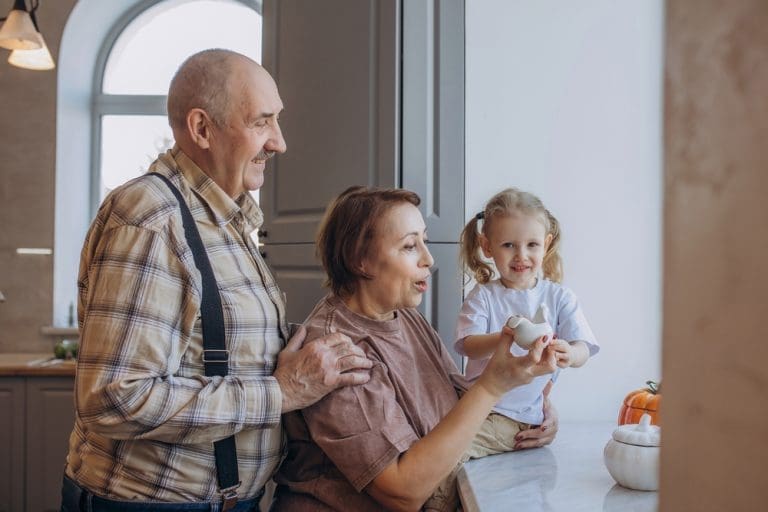


“Speak to your children as if they were the wisest, kindest, most beautiful, and magical humans on earth, for what they believe is what they will become.” — Brooke Hampton
My grandbaby Clara is in her crib for what she believes is an unjust nap. Far removed from the energetic chaos of vacationing families, she is not pleased. From the kitchen, we hear her wailing from below. I glance at Katie, my daughter, and ask, “Can I go sing her to sleep?” She hesitates, reluctant to offer Clara any false hope of escape from her crib. Then, after a pause, she furrows her brow, and to my delight, changes her mind. “Okay,” she says.
I head downstairs, eager to see my grand little one. Clara spots me. Her cries momentarily stilled. She looks at me, wide-eyed, her face a question mark. “What are you doing here, Nana?”
“I’m here, Miss Clara,” I say, raising my eyebrows, “to sing, soothe, and send you off with love to the land of ‘Wynken, Blynken, and Nod.’” She wails again. I sing.
Slowly, over a few songs, her cries begin to quiet. She nestles into the warmth of her crib blankets, surrendering to sleep. My singing, her settling…there is something going on here that is deeper than the simple act of comforting. Through this process, we’ve become closer friends. Sure, there is more than half a century between us. No problem. We have bonded. We will bond again. As Brene Brown has said, “We are wired for connection.” Yes.
This isn’t just about feelings. It’s science, too. Quantum physics tells us that everything in the universe is interconnected, vibrating, in constant communication with everything else. In this vast system, time and distance are irrelevant. All things move together in a continuous dance—there is no real separation between any of us. Bonding is simply an elevation of these natural connections.
Research from Emory University reveals something even more fascinating about the specific bond between grandmothers and grandchildren. When grandmothers look at pictures of their grandkids, their brains light up in areas linked to emotional empathy. Their responses show that when their grandchild is happy, they feel it, and when their grandchild is distressed, they feel it too.
As James Rilling, professor of anthropology, states,
“What really jumps out in the data is the activation in areas of the brain associated with emotional empathy. This suggests that grandmothers are geared toward feeling what their grandchildren are feeling.”
Your grandchildren need you — maybe more than you know.
Grandchildren may feel small in a vast, overwhelming world. Grandparents can be key in helping them see themselves as significant, valuable, and deserving of love.
There’s something inherently royal about being a grandparent — there’s a weight to that role, a gravitas. With this in mind, we’re able to lead with gentle authority. There is no need to raise our voices.
A raised eyebrow can be far more impactful than any verbal reprimand.
We never want to shame children. Feeling guilt is one thing. It’s a signal that we’ve done something wrong. But shame goes deeper; it’s the toxic belief that we are something wrong.
As Brené Brown explains, “Guilt is adaptive and helpful — it’s holding something we’ve done, or failed to do, up against our values, and feeling psychological discomfort. Shame, on the other hand, is the intensely painful feeling of believing that we are flawed, and thereby unworthy of love and belonging.”
We can be firm and clear, while setting boundaries that don’t cause shame. Sometimes, it’s about finding ways to avoid contention altogether. (For more on the critical but rarely discussed underpinnings of contention, see my first book, The Pursuit of Happi-Nest at Amazon and Cedarfort.com)
When contention is absent and grandchildren can feel the warmth and peace of their grandmother’s love, they can be freer to be their complete, honest, quirky, even awkward selves. What freedom is it to be who we are, without fear of judgment? As Fredrick Buechner has said, “What we hunger for is to be known in our full humanness, and that is often just what we fear more than anything else.”
Another simple way to foster connection is to simply kneel down to a young child’s level. Remember all of those photos of Kate Middleton and Prince William, moving down to speak to their children at eye level? It seems like such a small act, but it creates a feeling of safety, and of being seen. It’s one of the easiest, most powerful ways to show grandchildren you’re really there with them.
But even Kate and William could take a few notes from one of my best friends, Lori. She’s a master at connection. For decades, I’ve watched Lori connect with people in ways that leave me in awe. She does it with what I call the SMART LORI method — an acronym that unlocks hearts:
S—See people deeply. Lori has an incredible gift of steady eye contact, demonstrating the wise words of David Brooks, who said, “Respect is a gift you offer with your eyes.” There is a story about a little boy trying to get his mom’s attention: “Listen, Mommy,” he said. “I am listening,” she replied. “No,” he said. “Listen with your eyes.” He was too young to express it any other way, but what he was asking for was so simple: “Please look into my eyes while I speak. Let’s really connect.” Deep eye contact says it all — I love you. I’m here. I understand. Life’s tough sometimes, but it’s going to be okay.
M—Make people feel important. Without even realizing it, Lori has embraced something from Mrs. Fields — yes, the cookie lady who was popular so many calories ago. Her mantra was, “Everyone wears an invisible sign on their foreheads that says, ‘Make me feel important.” Lori sees the sign. She’s looking for the sign. Children never forget the people who make them feel important. Moments with these people often become part of their core memories.
A—Ask, and answer lots of questions. Lori is the queen of asking questions. It’s a habit I’ve noticed in the happiest people — they ask, and ask, and ask. Ever notice how the unhappiest people rarely ask questions? It’s a pattern. Asking questions draws attention outward and helps build both the asker and the receiver.
And kids? They ask so many questions. It’s their way of learning about the world. As Harvard child psychologist Paul Harris explains, “The average child asks about 40,000 questions between the ages of two and five.” Their brains are working over time to form connections, and those questions fuel that growth. Sometimes the answer is “I have no idea.” I don’t know if clouds can sing to each other, or if living on Jupiter will ever happen, but I love the questions.
R—Reach out physically. Lori, with her gentle touch, can calm and connect in ways words can’t. Just a simple tap on the arm or a hug lowers cortisol and boosts oxytocin. This is emotional glue between grands and grandparents.
T—Track the speaker. Lori listens intently, nodding, mirroring expressions and postures. It’s a quiet but powerful way of showing, I hear you, I understand you, and I’m right here with you.
L—Listen with your whole heart. Lori is a firm believer in Stephen R. Covey’s belief that “listening provides emotional oxygen.” And, as Monica Guzman puts it, “The experience of being listened to all the way on something, until your meaning is obvious to another human being, is extremely rare.” Lori gives that rare gift. It takes time, love, and focus, and she has all of those in abundance. Grandchildren are such great beneficiaries of this.
O—Offer “oohs” and “ahhs!” Lori matches a child’s excitement and amplifies it. When they’re excited about something, she meets them there, lifting the energy even higher.
R—Repeat back the last parts of sentences. Kids don’t always speak clearly, so Lori has a wonderful way of repeating parts of what they say to show she’s listening and to keep the conversation going. “A thousand dinosaurs? You chased them?”
I—Ignore surrounding noise. The world is full of distractions, but Lori can block it out and focus entirely on the child in front of her. When she does that, it’s like that child becomes the only person in the room.
According to David Brooks, the world is divided into those who illuminate, and those who diminish. Diminishers tend to be mostly focused on themselves. Illuminators, like Lori, are mostly interested in others.
It’s not always easy to listen deeply, ask questions, and be really present. But is it worth it? Absolutely.
Grandparents can be illuminators extraordinaire. And they can have so much fun along the way. Precious grandchildren are one of God’s greatest gifts. We can choose to ever grow in our tender powers of connection with them.







Ed RehderMay 18, 2026
Well done Sister Bell