







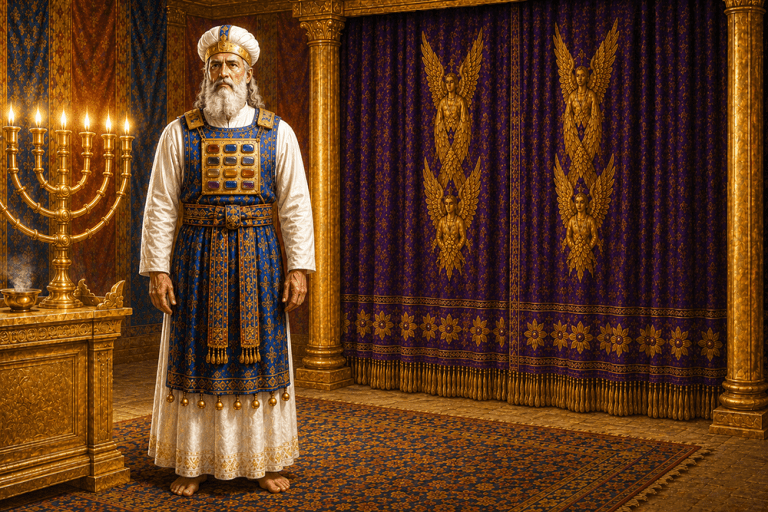


On the tenth day of the seventh month, Israel stopped. The plow waited in the field, the oven cooled, the market fell silent. Not Rome’s world, or Babylon’s, or the merchant routes winding down through the Levant. This was Israel’s world, the world shaped by covenant and sacrifice and the long thunder of Sinai. On Yom Kippur, the Day of Atonement, Israel watched her high priest do something stranger than putting on glory. He took it off.
He laid aside the ephod threaded with gold, the breastplate blazing with twelve stones, the mitre with its plate of pure gold engraved Holiness to the Lord. He bathed. He dressed in plain white linen. And in that linen, alone among living men, he passed through the great embroidered veil into the Holy of Holies, carrying the one thing no sinner could afford to spill and no sinner could live without.1
Hold both pictures in mind: the gold and the linen, the splendor and the plainness. The whole rite turns on the moment one becomes the other. So does the gospel. Heaven’s door swings on the hinge of humility.
Names on His Shoulders
Begin with the gold, since Israel did. The garments described in Exodus 28 are not a tailor’s catalogue. They are theology in cloth and stone. Aaron’s ephod bore on its two shoulder-pieces the names of the twelve tribes, six and six on two onyx stones, “for stones of memorial unto the children of Israel: and Aaron shall bear their names before the Lord upon his two shoulders for a memorial” (Exodus 28:12). The breastplate doubled the freight. Twelve stones, twelve names, one for each tribe, arranged in four rows and pressed over his heart. Inside that breastplate lay the Urim and Thummim, “lights and perfections,” by which the divine will could be sought and declared.2 He was no clerk of holy things. He carried a nation on his shoulders, judgment over his heart, revelation near his hand. Israel did not send him to God with paperwork. Israel sent him with names. Above his forehead the gold plate read Holiness to the Lord, “that Aaron may bear the iniquity of the holy things, which the children of Israel shall hallow in all their holy gifts” (Exodus 28:38). Even Israel’s finest gifts arrived with dust on them. The lamb was clean, the flour was sifted, the oil was bright; still the hands that brought them needed mercy. Someone had to stand at the threshold bearing what the worshipers could not wash out of themselves.
The Gold Comes Off
Then, on this one day in the year, the gold came off.
This is the part the eye keeps sliding past. The high priest entered the innermost place, the Holy of Holies, not in his glory but in the white of a slave or a corpse-washer. Aloneness was sewn into the linen itself. No attendant followed him. No second priest stood at his elbow. No music covered the silence. The rubric of Leviticus 16 is severe on this point. “There shall be no man in the tabernacle of the congregation when he goeth in to make an atonement in the holy place” (Leviticus 16:17). One man, one veil, one bowl of blood, and behind him the breath of a nation held still.
He went in alone because the logic of the rite required it. Only one who can stand where holiness burns and sin crushes. A mortal man can hold that place for a moment at most, like a candle carried into a storm. So the rite was repeated, year after year, generation after generation, always provisionally, always pointing forward.
A Lamp Leaning Toward Christ
Jacob, son of Lehi, makes this observation:
For, for this intent have we written these things, that they may know that we knew of Christ, and we had a hope of his glory many hundred years before his coming; and not only we ourselves had a hope of his glory, but also all the holy prophets which were before us.
Behold, they believed in Christ and worshiped the Father in his name, and also we worship the Father in his name. And for this intent we keep the law of Moses, it pointing our souls to him; and for this cause it is sanctified unto us for righteousness, even as it was accounted unto Abraham in the wilderness to be obedient unto the commands of God in offering up his son Isaac, which is a similitude of God and his Only Begotten Son (Jacob 4:4-5).
This is not accident read backward as design. It is design read forward as hope. The law of Moses was not a puzzle Christians later solved by candlelight. It was a lamp given to Israel, and its flame leaned toward Christ from the beginning.
A Priesthood That Cannot Die
Hebrews names the reason without flinching. The Aaronic order was mortal in two senses at once. The priests could not outlive death, and the sacrifices could not outlast sin. “They truly were many priests, because they were not suffered to continue by reason of death” (Hebrews 7:23). An atonement performed by a man who will himself one day need atoning is a promissory note, never the payment.
This is why the calendar kept turning back to the tenth of Tishri. The gold was put on and taken off. The linen was donned. The veil was crossed. The blood was sprinkled. The priest came out; in time, he lay down in his grave. Then another son of Aaron took up the bowl. The argument the rite could not finish, Hebrews finishes. Christ’s priesthood is not a renewed instance of the same office. It is a different kind of office altogether, “not after the law of a carnal commandment, but after the power of an endless life” (Hebrews 7:16). He “ever liveth to make intercession” (Hebrews 7:25). He “needeth not daily, as those high priests, to offer up sacrifice, first for his own sins, and then for the people’s: for this he did once, when he offered up himself” (Hebrews 7:27). Once was enough because the one who offered it cannot die again. The category is changed at the root. The author of Hebrews therefore reads the older sanctuary as a thing speaking of its own incompleteness: “the Holy Ghost this signifying, that the way into the holiest of all was not yet made manifest, while as the first tabernacle was yet standing” (Hebrews 9:8).3 The veil was not merely a curtain. It was an announcement. Not yet. Not yet.
One Enters, the Other Departs
Two goats stood waiting outside. This too belongs to the aloneness, though at first it looks like company. Lots were cast over them. One goat, “the Lord’s goat,” was slain, its blood carried alone behind the veil and sprinkled upon the mercy seat. The other, the goat “for Azazel,” was not killed. Aaron laid both hands upon its head, confessed over it “all the iniquities of the children of Israel, and all their transgressions in all their sins, putting them upon the head of the goat,” and a fit man led it into the wilderness, out of the camp, away from the dwelling of God and the dwelling of Israel both (Leviticus 16:21).
One goat goes inward, behind the veil, toward mercy. The other goes outward, beyond the camp, toward desolation. One enters the place no sinner could enter; the other bears sin to the place no covenant people could call home. Unus intrat, alter exit: one enters, the other departs. Between them, the whole drama of redemption is staged in a single morning. Jeffrey M. Bradshaw, drawing on the Apocalypse of Abraham and the older temple traditions standing behind it, has proposed that the scapegoat is best understood not as a second figure of Christ but as the formal expulsion of evil to its source.4 In that pseudepigraphal text, Azazel is no innocent creature. He is a fallen power, an adversary, the one to whom sin is sent back because sin began with him. The two-handed laying-on, on this reading, is a ritual of return: guilt restored to its origin, the camp swept clean for the priest’s ascent. The Lord’s goat carries Israel inward toward mercy. The scapegoat carries corruption outward: the long undoing of Eden’s exile, evil driven into the wilderness where it has always belonged. The Day of Atonement, taken whole, opens heaven and silences the accuser in the same hour. Between the goat that enters and the goat that departs stands the high priest in linen, the lone man at the hinge of mercy and judgment.
Here the ancient picture nearly cracks under what it is trying to hold. The goat that walks into the wilderness in Leviticus walks there forever. The chapter does not bring it back. But the figure to which the goat pointed did come back. Christ went out of the camp, “suffered without the gate” (Hebrews 13:12), and cried from the cross the cry of one driven into the far country: Eloi, Eloi, lama sabachthani (Mark 15:34). He went into the wilderness of death itself, the lone and dreary world made absolute. He was the slain goat whose blood entered the holiest place. He was the sin-bearer whose exile reached the bottom of exile. The accuser was not appeased. The accuser was answered. The footsteps of Adam and Eve out of Eden were walked back by One strong enough to come home, dragging the keys of death and hell behind Him. The scapegoat’s long walk ended, at last, not in desolation but in resurrection.
Shadow by Design
For Latter-day Saint readers, Alma 13 widens the picture and guards against a common mistake: provisional does not mean failed. Alma speaks of ancient priests not as men who happened, in retrospect, to resemble Christ, but as men “ordained after the order of his Son, in a manner that thereby the people might know in what manner to look forward to his Son for redemption” (Alma 13:2).5 The priesthood order was a signpost by design, not by accident. These priests were “called and prepared from the foundation of the world” (Alma 13:3), the shadow planned before the body arrived to cast it. This is what distinguishes typology from literary cleverness: the connection between Israel’s ceremonies and Christ’s person was not a ribbon tied on later by pious readers. It was woven into the cloth from the first. Israel’s worship was holy worship, given of God, meaningful in its own season, and aimed from the beginning at the Messiah who would bring it to its proper end. Fulfillment is reverence completed, not reverence dismissed. To say that these rites were fulfilled in Christ is not to say they were empty before Him. The veil was torn in honor of what it had so long protected.
Rituals are not lectures. They are truths with hands and feet. They teach by making the body remember what the mind has not yet learned how to say. Every Yom Kippur, Israel watched a man dress in white, take up blood, vanish behind the veil, and emerge again alive. For centuries they rehearsed the grammar of atonement: blood, veil, linen, return. So when the final Word was spoken, faithful Israel would recognize the voice.
At the crucifixion, the veil of the temple was torn in two, from the top downward (Matthew 27:51).6 Not from below, where human hands could clutch and tug, but from above, where only God could lay hold of it. Curtains torn by men tear upward. This one tore as the sky tears. The Holy of Holies stood open. The great High Priest, having offered not the blood of bulls and goats but “his own blood,” had “entered in once into the holy place, having obtained eternal redemption for us” (Hebrews 9:12). And He carried more than twelve names. He carried every name ever whispered over a cradle, carved on a stone, forgotten by the world, or remembered with tears.
The Uniform of the Work
This is where the linen comes back. On Yom Kippur, Aaron laid aside the gold to enter the place of blood and mercy. He divested himself of visible glory to do the inmost work. Read the Incarnation here. Glory did not cease to be glory when it became humble. “Being in the form of God,” Christ “thought it not robbery to be equal with God: but made himself of no reputation, and took upon him the form of a servant, and was made in the likeness of men” (Philippians 2:6–7). He laid aside glory. He clothed Himself in the linen of our humanity: hunger, weariness, skin that could bruise, blood that could be shed. Then He walked through the veil we could not cross. The plain white was never a demotion. It was the uniform of the work.
He went in alone.
The ancient high priest could go where Israel could not, but he could not remain where Israel needed him, nor bring Israel where he had gone. He came out as he had gone in, a mortal man whose own atonement would be needed again next year. Christ has gone where none of us could go and has opened what none of us could open. We do not climb into God’s presence by standing on our own offerings. Our gifts cannot wash the hands that bring them. The veil is no thinner for our trying. We come because He has gone before us. We repent because His atonement is real. We pray in His name because He lives to intercede. We approach the Father not as intruders but as those invited in by the Son.
What Aaron rehearsed in shadow, year after year, Christ performed in substance, once and forever. The old ceremony, in all its solemn beauty, pointed beyond itself to the true High Priest entering the heavenly holy place with His own blood, dressed in the linen of our flesh, alone.
And because He entered alone, we do not remain alone.
Footnotes
1. On Yom Kippur as described in Leviticus 16, see Gordon Wenham, The Book of Leviticus, New International Commentary on the Old Testament (Grand Rapids: Eerdmans, 1979), 228–235.
2. On the Urim and Thummim, see Victor P. Hamilton, Exodus: An Exegetical Commentary (Grand Rapids: Baker Academic, 2011), 484–486. Their exact form and function remain disputed. The description here follows the dominant reconstruction.
3. F.F. Bruce, The Epistle to the Hebrews, New International Commentary on the New Testament (Grand Rapids: Eerdmans, 1990), 112.
4. See Jeffrey M. Bradshaw, “The Ezekiel Mural at Dura Europos: A Tangible Witness of Philo’s Jewish Mysteries?,” BYU Studies Quarterly 49, no. 1 (2010), and Bradshaw’s discussion of the Apocalypse of Abraham and Azazel in Temple Themes in the Book of Moses (Salt Lake City: Eborn, 2014).
5. On Alma 13 as a typological chapter and its relationship to Hebrews, see John W. Welch, “The Melchizedek Material in Alma 13:13–19,” in By Study and Also by Faith, ed. John M. Lundquist and Stephen D. Ricks (Salt Lake City: Deseret Book, 1990), 2:238–272.
6. On the tearing of the temple veil, see Raymond E. Brown, The Death of the Messiah (New York: Doubleday, 1994), 2:1098–1102. Brown reviews the evidence for the veil as the inner curtain before the Holy of Holies.







KathleenMay 16, 2026
Thank you - so clear and methodically expressed.