







How the Seven-Fold Pattern of Exodus Reveals the Covenant Path of Every Soul
From the Dust of History to the Mountain of God
The modern scholar approaches the Bible as one might approach a filing cabinet in a condemned building, careful not to get dust on his cuffs, and quite certain there is nothing alive inside the drawers. He pulls out a drawer, notes the rust, catalogs the contents, and never once asks whether the building was a temple.
Our reading of the Exodus has suffered worst from this habit of careful, sterile handling. Three generations of commentators have busied themselves with the salinity of the Red Sea and the caloric content of manna, while the Voice that thundered from Sinai goes unanswered. To the disenchanted eye, the Burning Bush is a botanical curiosity. To the Saint, it is the tearing of a veil between two worlds, and the ground beneath it is holy. When we read the Exodus as a sequence of ancient happenings rather than as a living pattern still unfolding in us, we have already committed Pharaoh’s fundamental error: we have decided that human beings are things to be explained rather than souls in the long labor of becoming.
If we mean to recover the wonder of our own deliverance, we must stop reading the Exodus as a travelogue and begin reading it as a temple text, a sacred narrative carrying within it the whole weight of what the Lord intends to do with a human being, the way a seed carries an oak, or the way a wedding ring carries a marriage. Hugh Nibley called the temple a “scale model of the universe.” In the Restored Gospel, we do not merely study history. We enact it. The word for that enactment is liturgy: the ordered service of our covenants, the passage from the chaos of the fallen world into the order of our Father’s presence.
Consider what the Lord showed Moses before He ever sent him to Egypt. In Moses 1:27–39, the Lord unveiled the whole of creation and then declared: “This is my work and my glory—to bring to pass the immortality and eternal life of man.” Moses had to see the architecture before he could walk through it. The Exodus was never a political accident. It was a premortal covenant being fulfilled in time (see Abraham 3:22–26). As the Lord organized the physical elements of the earth out of raw, chaotic matter, so He seeks to organize the raw, chaotic matter of the human heart. We climb “grace for grace,” rung by rung (Doctrine and Covenants 93:13). And the blueprint for that ascent is written in two remarkable passages in the book of Exodus.
The Seven-Fold Awakening (Exodus 3:7–9)
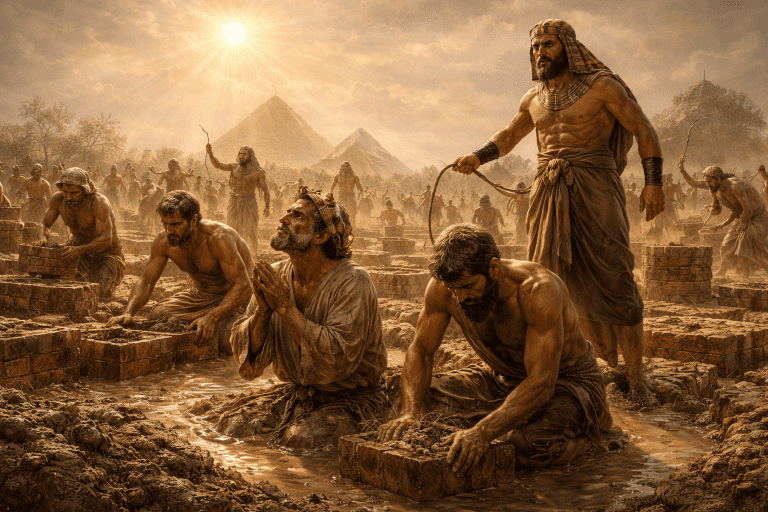
Egypt is not merely a place on a map. It is a condition of the soul: the place where Pharaoh’s economy of fear tells you that you are nothing more than the bricks you produce. Pharaoh does not need chains when he has convinced you that you are the kind of thing that cannot move. A man who believes he is a brick will stack himself.
In Exodus 3:7–9, the Lord issues a seven-fold declaration to Moses from the Burning Bush. These seven statements mirror the seven days of creation and the seven stages of a soul waking to its own deliverance:
1. “I have surely seen the affliction of my people.”
Here ends the lonely isolation of suffering. Jehovah sees for Himself. Lehi pleaded: “Awake, my sons; put on the armor of righteousness. Shake off the chains with which ye are bound, and come forth out of obscurity, and arise from the dust” (2 Nephi 1:23). The first act of creation, and of deliverance, is light. You are seen.
2. “I have heard their cry.”
The cosmos is not a deaf machine. When Joseph Smith cried from Liberty Jail, “O God, where art thou?” (Doctrine and Covenants 121:1), the heavens were listening. When the people of Alma cried in bondage, “the Lord did strengthen them that they could bear up their burdens with ease” (Mosiah 24:14). Hearing precedes deliverance. It always has.
3. “I know their sorrows.”
In Hebrew, yada is intimate, relational; it is the same word used for the deepest human bonds. The Lord does not have data about us. He has a lived understanding of us, bone-deep and particular, the way a mother knows which cough in the night belongs to which child. This is the engine of the Atonement: Christ “will take upon him the pains and the sicknesses of his people… that he may know according to the flesh how to succor his people” (Alma 7:11–12). He is no theorist of suffering. He is a participant in it.
4. “I am come down to deliver them.”
In the ancient Near East, gods did not come down. Jehovah’s personal descent overturns the entire hierarchy of divine distance. When Nephi beheld the condescension of God, he saw the Son of God “going forth amongst the children of men” (1 Nephi 11:24). The Savior does not shout directions from the summit. He walks down into the valley where we are, and the dust of the road clings to His feet, as it does to any man who has actually walked somewhere.
5. “To deliver them out of the hand of the Egyptians.”
The first separation. As the Lord divided light from darkness on the first morning of the world, He divides the true story of who we are from the false one Pharaoh has told us. We are “free to choose liberty and eternal life, through the great Mediator of all men, or to choose captivity and death” (2 Nephi 2:27). Freedom is the recovery of truth.
6. “To bring them up out of that land.”
The great pivot from the down-road to the up-road. We move from objects acted upon to agents invited to act. “Because that they are redeemed from the fall they have become free forever, knowing good from evil; to act for themselves and not to be acted upon” (2 Nephi 2:26). We are not bricks. We are not our diagnoses. We are beings in the long labor of becoming.
7. “Unto a good land and a large.”
The promise of rest. But the “good land” was never merely Canaan. The Lord revealed that Israel “hardened their hearts and could not endure his presence; therefore, the Lord in his wrath… swore that they should not enter into his rest while in the wilderness, which rest is the fulness of his glory” (Doctrine and Covenants 84:24). The Promised Land is the Holy of Holies. It always was.
The Law of Seasons: Moving Grace for Grace
Why does the Lord not carry Israel from Goshen to Canaan in a single night? Because even Jesus Christ “received not of the fulness at the first, but continued from grace to grace, until he received a fulness” (Doctrine and Covenants 93:13). If the Son of God Himself matured through a process of becoming, we are fools to expect our deliverance to arrive like a telegram slipped under the door before breakfast.
The manna could not be hoarded. It had to be gathered fresh each morning (Exodus 16:4, 19–20). Yesterday’s grace does not exempt us from today’s obedience. When Israel murmured for the “leeks and onions” of Egypt (Numbers 11:5), we should pause to appreciate the full theological weight of that complaint: a people who had witnessed the parting of a sea were prepared to trade their freedom for a salad. They were not simply nostalgic. They were building a case, constructing a story in which the wilderness was unbearable, Moses was incompetent, and the Lord had failed them. The murmuring was an accusation: a people invited to become something new chose instead to remain objects acted upon by circumstance. “Yea, and we may see at the very time when he doth prosper his people… then is the time that they do harden their hearts, and do forget the Lord their God” (Helaman 12:2).
The wilderness is not a detour. It is the curriculum. And the Lord is patient. Not late.
The Architecture of the Heart: The Seven “I Wills” (Exodus 6:6–8)
If the awakening in Exodus 3 is the first gray streak before dawn, the promises in Exodus 6:6–8 are the endowment of power, the blueprint by which the Lord organizes our internal chaos into a house of order:
1. “I will bring you out from under the burdens of the Egyptians.”
The burial of the old life. Alma invited: “As ye are desirous to come into the fold of God, and to be called his people, and are willing to bear one another’s burdens, that they may be light” (Mosiah 18:8). We are buried in baptism so that “like as Christ was raised up from the dead, even so we also should walk in newness of life” (Romans 6:4).
2. “I will rid you out of their bondage.”
It is one thing to leave Egypt. It is another to let Egypt leave us. Pharaoh is remarkably portable. This is the work of the Holy Ghost: to change not merely behavior but the story we are living from the inside out. “The Spirit of the Lord Omnipotent… has wrought a mighty change in us, or in our hearts, that we have no more disposition to do evil, but to do good continually” (Mosiah 5:2). “A new heart also will I give you, and a new spirit will I put within you” (Ezekiel 36:26).
3. “I will redeem you with a stretched out arm, and with great judgments.”
Redemption is an embrace. “The Lord hath redeemed my soul from hell; I have beheld his glory, and I am encircled about eternally in the arms of his love” (2 Nephi 1:15). He does not redeem us from a distance. He reaches.
4. “I will take you to me for a people.”
In the ancient Near East, a sovereign “taking” a people was a covenant formula, a legal adoption carrying the full weight of protection and obligation. In plain terms: a Father saying these are mine. “Because of the covenant which ye have made ye shall be called the children of Christ, his sons, and his daughters; for behold, this day he hath spiritually begotten you” (Mosiah 5:7). We are no longer tools of a tyrant but initiates in the mysteries of godliness.
5. “I will be to you a God.”
The resurrected Christ commanded: “I would that ye should be perfect even as I, or your Father who is in heaven is perfect” (3 Nephi 12:48). Notice what He adds. Before the crucifixion, the command was “even as your Father.” Now He includes Himself. He has walked the path. He is the proof that it can be walked.
6. “I will bring you in unto the land, concerning the which I did swear to give it.”
The “rest of the Lord” is not a hammock strung between two convenient trees. It is His presence. Alma testified that “there were many, exceedingly great many, who were made pure and entered into the rest of the Lord their God” (Alma 13:12). “No unclean thing can enter into his kingdom… nothing entereth into his rest save it be those who have washed their garments in my blood” (3 Nephi 27:19–20).
7. “I will give it you for an heritage: I am the Lord.”
The heritage is not a plot of land. It is everything the Father has. “He that receiveth my Father receiveth my Father’s kingdom; therefore all that my Father hath shall be given unto him” (Doctrine and Covenants 84:38). We become “joint-heirs with Christ” (Romans 8:17). And “I am the Lord” is the divine seal, the signature on a covenant that cannot fail.
But the pattern is a lens, not the country it reveals. You cannot live in a pair of spectacles. Jacob warned that the ancient Jews “looked beyond the mark” (Jacob 4:14). The mark is Christ. If the pattern does not lead us to Him, we have missed the point entirely. “We talk of Christ, we rejoice in Christ, we preach of Christ, we prophesy of Christ… that our children may know to what source they may look for a remission of your sins” (2 Nephi 25:26).
The Sanctuary of Surrender
The universe is God’s temple, but your soul is the Holy of Holies He desires to fill. Not with furniture. With fire. “The elements are the tabernacle of God; yea, man is the tabernacle of God, even temples” (Doctrine and Covenants 93:35).
The great and terrible truth at the center of the Exodus is this: the one thing in all the cosmos that God will not force to organize is the human heart. And the heart, left to its own devices, will organize itself around itself, like a man endlessly rearranging the furniture in a room he refuses to leave. Pharaoh’s world insists you are an object: a brick, a number, a cog in a wheel you did not build and cannot see. But the covenant does not simply promote you from object to subject. It invites you to become something more radical still: an agent whose agency is spent in the service of something larger than the self.
The Promised Land belongs to those who have learned, through forty years of wilderness, to stop building their identity around their own suffering, their own virtue, their own spiritual progress, and to look, simply and entirely, to Him. Self-improvement never unlocked that gate. Surrender did. “For whosoever will save his life shall lose it; but whosoever shall lose his life for my sake and the gospel’s, the same shall save it” (Mark 8:35). The soul that arrives at the Holy of Holies has stopped thinking about itself altogether, lost in the work, lost in the love, lost in the One who descended to find it.
The Burning Bush burned and was not consumed.
That is the promise. You will pass through the fire of the wilderness, and you will not be consumed, because the fire is not destruction. It is the presence of God.
He is asking you, as He asked Moses, to take off your shoes. The ground you are standing on is holy.
“Come unto Christ, and be perfected in him, and deny yourselves of all ungodliness… then is his grace sufficient for you, that by his grace ye may be perfect in Christ… then are ye sanctified in Christ by the grace of God, through the shedding of the blood of Christ, which is in the covenant of the Father unto the remission of your sins, that ye become holy, without spot” (Moroni 10:32–33).







Marie BarnhurstApril 8, 2026
Thank you for your insights. Temple language is what we must search for and find in all scripture! This is a beautiful article.
Haze K.March 31, 2026
This is one of your articles that I have enjoyed the most. So well organized and easily understood. Filled with ideas that have not crossed my mind before today. Pointing out each of the seven awakenings and the seven "I will" is so helpful. "The universe is God’s temple, but your soul is the Holy of Holies He desires to fill... With fire... the fire is not destruction. It is the presence of God." Knowing all of my weaknesses and flaws I've never considered a comparison of myself to a temple filled with His presence. Thank you especially for this article