




Bishnu Adhikari: Here’s What You Can Do to Help a Different Kind of Refugee
Wondering how to help refugees? We have been. Here’s one big idea. For every dollar that Meridian readers donate to help in the cause described below, DoTERRA will match dollar for dollar.
Click here to see what you can do.
There are political refugees, driven from their homes by tyrants. Then there are other kinds of refugees, driven from their homes by physical disaster as walls topple in and roofs collapse. Neither can survive well unless someone steps into help as our leaders have noted in the most recent General Conference.
Meridian Cares in partnership with doTERRA and CHOICE Humanitarian are offering you one of those opportunities.
We’ve just passed the year anniversary of the furious 7.8 magnitude earthquake that struck Nepal, killing 30,000 people and leaving hundreds of thousands homeless. That was followed by hundreds of aftershocks including a major temblor on May 12, 2015 along the same fault line. Avalanches barreled down Everest making it the deadliest disaster ever on the mountain. Kathmandu’s treasures were demolished.
 Any hope of recovery before the June monsoons pelted the land was impossible. People were huddled, homeless, against the weather extremes.
This would be a difficult recovery in a developed nation, but for a place like Nepal, recovery seems almost impossible. To make it worse, in a fit of political gamesmanship, India placed an embargo on all the fuel they send to Nepal, so transportation came to a halt in the country for five months, including the air transport of humanitarian groups. With the border closed to India, everything was blockaded including medicine.
So, a year later, with the attention of the world turned away, life in Nepal is still very tough and the government has made almost no progress in providing relief.
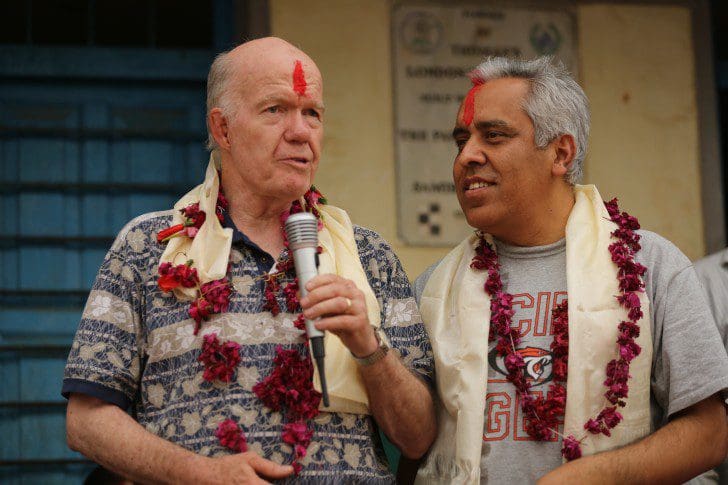
Bishnu Adhikari, who was featured in Meet the Mormons, said, “It is to unfortunate that nothing concrete has been done by the government. Except for what CHOICE and a few other NGOs have been able to do, I hear of no houses or schools being built.
 “The government promised 200,000 rupees to all those who lost their homes, but nothing has been distributed. A year later the people are still under tents and tarps, and in another month the monsoon will come again.”
Some people are going back to live in homes that are tagged as “Not Safe” because they believe they have no recourse. People huddle in badly cracked, unstable buildings. Though they have been told that they will be moved to a newer, safer area, tent cities abound.
 In contrast, CHOICE, with Meridian readers’ generous help, provided tents or tarps for 20,000 families, provided 73,000 meals, built 50 private, earthquake-resistant homes for the widowed and single mothers, and now have finished two schools.

This is the first school completed in Nepal since the earthquake and it was built by CHOICE Humanitarian. This is the day of the Archelani School Inauguration–truly something to be celebrated. This just happened last week.
One of these schools was just dedicated where 400 students will attend.
This is a triumph, but so much more needs to be done.
Click here to jump right in and help now.
Bishnu said, “People are losing faith that something will happen and they will be helped. The sanitation is terrible. The water is polluted. People are dying of diseases. When the monsoon comes again this June, the rivers will swell and the conditions will be worse.”
Why is it that a major disaster like this struck one of the poorest countries on earth? How do the victims get help after the dramatic event has left the news headlines across the world, the rest of us have gone on and forgotten, and they are left unsheltered with a broken country?
We, from the comfort of our secure homes, say, “Too bad that happened” and then go on without much more thought.
The Devastation Can’t Be Calculated
The disruption of an earthquake leaves more devastation in its wake than can be calculated. In the days immediately following the earthquake, buses rolled into the demolished mountain villages, with men promising to take the children away to other schools that had not been wrecked by the earthquake. In fact, these buses were instigated by traffickers, who took the children to exploit them in brothels or as forced labor and other forms of servitude, never to see their families again.
 According to the International Labor Organization 12,000 women and children are trafficked to the Middle East and India every year—and this number only balloons after a disaster. It is hard to imagine a ten-year-old girl whisked away to a brothel under a devious pretense, but that happened.
I want to help in this effort. Click here.
What Can Be Done?
So many schools were destroyed in the earthquake that 1.2 million children were displaced. This could become a whole generation without education. Children today are attending school in tents, which are, according to Bishnu, “a miserable situation. There is no floor. Without walls, the noise travels from one class to another, making a chaos of noise. Noise vibrates and accelerates. When the rain beats on the tent roof, there is no way the children can hear.”

He said, “I followed a girl home from one of our new schools recently. She has three siblings who all go to the same school. When the earthquake struck, their house collapsed, their father was killed and they moved to the only intact structure available—a cow shed, where the child lives today with her mother and two siblings.”
“They need help. They need schools. They need homes—and there is urgency with the monsoons nearly upon us.”
The Widow’s Sacrifice
One 79-year-old woman, Prem Kumari Prajuli, was so worried about the destruction of her village school and the setback for the children’s learning, she made a breathtaking sacrifice. She had spent a lifetime yearning for an education. She had struggled just to decipher letters to read and write, but she always thought if she had been able to go to school, things would have been different for her.
She had been married at age 11 to a 12-year-old and the next year her husband died. For 67 years she has been a widow, knowing that life would have been much different if she had lived in a world where child marriage had been outlawed and she could have gone to school.

This humble widow, Prem Kumari Prajuli, gave all that she had to assure a new generation an opportunity for what she never was able to have–an education.
To help the children, she sold her inherited agricultural land for $2,500 dollars to donate for the construction of a school. For someone who has spent all of her life in someone else’s home, to sell her only land was a profound sacrifice, made in the hope that other children won’t experience what she has known.
She was asked to lay the cornerstone for the Sharada Secondary School, knowing the girls who attend school there will have a very different life than she has had.
Join widow Prem Kumari Prajuli by donating here.
CHOICE Already at Work before the Earthquake Struck
The reason CHOICE was able to respond with such power to the earthquake devastation in Nepal was because the organization, with Meridian as a contributing partner, was already working in the country on a program called Nepal Life. We were already working on a three-year poverty elimination program when the earth shook.
The goal of this program is to eliminate poverty in the entire Lamjung region of Nepal. Nepal is one of the poorest nations on earth, but extreme poverty is its own level of misery.
 Poverty means, that a person is living on less than $1.50 a day, they don’t have adequate health care or shelter, their kitchen is filled with smoke from an open fire so they die young, their children can’t go to school, and they awaken each morning not knowing where they will find food so they often go hungry.
To eliminate poverty—rather than just cope with it—involves the leadership training of the entire community. It means people have been taught to be involved civically to vote for people they trust. It means village government is at work and loan co-ops are in place so that villagers can borrow money without becoming slaves to usurers. It means people are taught how to arise and solve their own problems—which they can and do.
Of the more than 2700 families identified as extremely poor in the 20 villages in the Lamjung region where CHOICE works, more than 850 families have been lifted out of extreme poverty since this program began two years ago.
Poverty is difficult to overcome—even when money is thrown at it with the best of intentions. The Nepal Life program is based on the soundest principles of poverty elimination formulated by Dr. James Mayfield after 50 years of work in the field.
He has developed the philosophy and method to completely change people’s lives.
A Litmus Test
We were immersed in that work when the temblor came with its demanding voice and turned our attention to immediate relief in the region a year ago. It was CHOICE’s chance to evaluate if there was a marked difference between the villages.
Would those villages with Nepal Life workers and training be able to help themselves through an earthquake in a markedly different way than those villages where CHOICE had not been working?

The answer, according to Bishnu, is a resounding yes. “Where we have worked the people know how to mobilize their resources for permanent solutions to their problems.
“The 1400 leaders we have trained in these villages bring new ideas to cope with the disaster they have found themselves in. Three things stand out,” he said.
1) Know how to work together to solve their problems (which were bad and became greater with the earthquake.)
2) They have a planning mentality and know how to handle situations.
3) They look beyond themselves, beyond their own problems to support those around them.
What a mark of success that where there has been CHOICE training and work on poverty elimination, the people have been able to cope so much more successfully with the earthquake disaster.
You Can Help
For two years now, Meridian readers have played a key role in funding Nepal Life. Last year our focus shifted to the earthquake relief, using the same sound principles. Helping people is important, but how you help them may be even more important.
What CHOICE is doing works—even when people’s lives have been devastated in an earthquake. This is not just short-term help, but lifelong change.
Click here to be one who changes lives.
If you helped before, help again. It must feel great to know that you sent tents to the homeless, provided meals, and built schools.
If you’ve never helped before, this is a great time to begin. Your dollars really matter. Small donations and big ones change the lives of people.
Last year for the earthquake Team Meridian raised more than $60,000.


Now, this year, doTERRA, the people who make essential oils, will match us dollar for dollar in the cause up to $100,000! That is like empowering your dollars and doubling their strength. It’s like supercharging your dollars.
Click here to make a difference.
You can chart how Meridian readers are doing on our fund-raising. Let’s make those dollars grow together. If only 400 people gave $250 each, we could achieve our goal and we would then be matched to create $200,000 of relief money. If 800 readers contributed $125 each we could achieve this. Will you join us? Not one dollar will go to Meridian. Together, we can do it.
*****
Maurine and Scot Proctor will be taking a group to Nepal to work on earthquake relief from November 4-12. We will be doing post-earthquake reconstruction in Lamjung, Nepal (7 hours outside of Kathmandu.) We will be rebuilding and refurbishing one of the 4,400 schools that were decimated in the earthquake. If you’d like to join, click here to learn more about it.
Come to Nepal with Us and Join in the Earthquake Relief
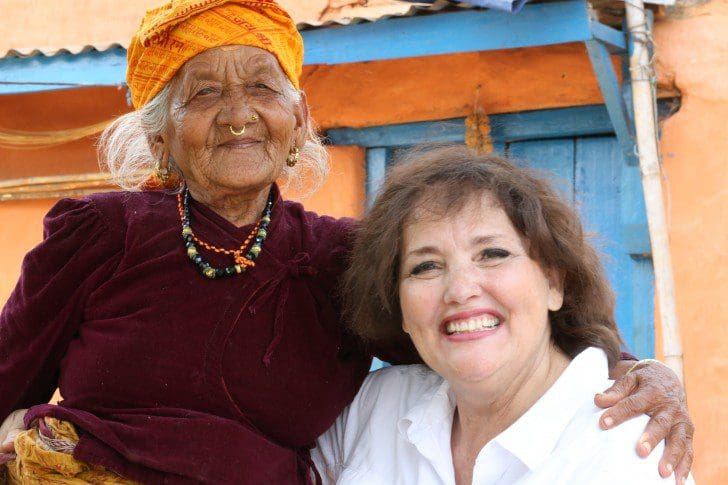
So many of us wish we could help those who really need help. Now you can. You are invited.
Come with Maurine and Scot Proctor on a CHOICE Humanitarian expedition to Nepal, Nov. 4 – 12. This includes stops in Kathmandu, Kurintar, and Lamjung. The trip will be directly involved in the post-earthquake reconstruction in Lamjung, Nepal (7 hours from Kathmandu.)
 It’s a sleep in the village, get your hands dirty, work hard and love people who will change your life forever kind of trip.
Nestled between China and India in southern Asia, Nepal boasts the greatest altitude variation on earth. From sea-level lowlands to towering Himalayan peaks, this charming nation attracts world travelers with its majestic landscapes, vibrant traditions, and warm embraces from the natives.
But while the setting is unforgettable, what will stay with you forever is the memory that you helped significantly change someone’s life.
Here is the trip schedule:
Friday, Nov. 4th
 Participants must arrive at Tribhuvan International Airport (KTM) in Kathmandu before 11 p.m. Please do not plan to arrive a day early. Reserve personal travel for after the expedition if possible.
Airport pick-up and transportation to Shambala Hotel will be provided for overnight accommodations.
Saturday, Nov. 5th
Official expedition activities begin with breakfast and the option to attend local LDS services or explore Kathmandu.
After lunch, group transportation will be provided from Kathmandu to Riverside Springs Resort (3-hour distance) for overnight accommodations (shared double rooms). Staff and expedition leaders will provide a group orientation in the evening to discuss trip details. Dinner will be provided.
Sunday, Nov. 6th
Breakfast served at hotel. Group transportation will then be provided to the developing region of Lamjung (6-hour distance). Lunch will be provided. Casual hike might be required before participants arrive to a gracious village to be greeted with a warm welcome celebration. Dinner will be served. Time available to unpack, rest, and interact with local residents. Overnight accommodations provided in the village.
Monday, Nov. 7th – Thursday Nov. 10th
 Breakfast served in village. Construction projects and development initiatives will be scheduled throughout the week as part of the post-earthquake rebuilding efforts. Participants will be working hand-in hand with families on village-driven programs. Lunch will be served in the afternoons with a brief rest provided. Dinner will be served in the evenings. Village activities and in-depth discussions will be provided each night to promote powerful intercultural exchanges between participants and local residents. Overnight accommodations provided in the village.
Friday, Nov. 11th
 Breakfast served in village. Ceremonious village farewell will be scheduled in the morning. Many tears will be shed as we depart—those who have been through this know what we are talking about. Group bus transportation will then be provided back to Kathmandu (6-hour distance.) Lunch will be provided. Arrive to Kathmandu in the late afternoon and check-in to Shambala Hotel for overnight accommodations. Group dinner will be scheduled in the evening to conclude the expedition and discuss overall impressions with fellow participants. Overnight at the hotel.
Saturday, Nov. 12th
Breakfast served at hotel. Possible time at leisure to explore Kathmandu. This bustling capital of Nepal, part of a regions UNESCO World Heritage Site, dates back to ancient times when first settled along the trade route to Tibet. The cosmopolitan culture of Kathmandu radiates a unique spirit of Hindu and Buddhism evident in surrounding temples and mountains. A rich history of wars and dynasties strengthens the mystical charm that allures travelers here. Transportation will be provided to Tribhuvan International Airport for flight departures.
 The price of the trip is $2195 for adults, $1995 for students. These rates include hotel accommodations, certified group leaders, village lodging, village meals and local transportation. A significant portion of each expedition fee is utilized for rural village development project costs, construction materials, leadership building and other elements leading to high-impact sustainable development.
Space will be limited on this trip to just 20 openings. Numerous people have already asked if we are going back to Nepal. This is that opportunity.
 For those interested, there will be an additional option to extend the experience (highly recommended) to explore the sights of Kathmandu, take a flight to see Mt. Everest, and experience Nepal’s Chitwan National Reserve, which is home to tigers, elephants and over 400 sq miles of natural beauty. This extension will take place from November 12-16 2016. Price TBD.
Call Jordan Menzel at CHOICE Humanitarian for all details and to reserve your spot: 801.943.6106
To learn more about the situation and needs in Nepal, CLICK HERE.
An Invitation to Join with Maurine and Scot Proctor in Nepal

The generous readers of Meridian Magazine raised tens of thousands of dollars to aid CHOICE Humanitarian in their relief efforts in Nepal after the recent earthquake in April. We are proud of that contribution and so grateful for your support.
Now you have the chance to personally participate in the ongoing effort to rebuild.
Scot and Maurine will be traveling to Nepal this November and you can join them in the expedition.
You will get the chance to stay in a village and work hand-in-hand with the families there in village-driven projects to rebuild their communities. You will not only be immersed in the culture, but be able to personally witness the way that the money raised by Meridian readers is put to good use. This is truly a once-in-a-lifetime opportunity that you will never forget.
Expedition dates: November 29-December 6
For more information contact Wade Alexander at CHOICE Humantarian.
By phone at 801-474-1937 or by email at [email protected]
A Thank You from Nepal to Meridian Readers

Because of the amazing generosity of the Meridian Magazine family, over $60,000 was collected for the victims of the April 2015 earthquake in Nepal. On behalf of all of us here at CHOICE Humanitarian, I wish to thank all of you for your support. Over the past month, significant progress has been made in spite of the heavy rains of the Monsoon period (June through August). Bishnu, our in-country director, (and celebrated participant in Meet the Mormons) and local staff of nearly 20 full time rural facilitators have engaged in an almost super human endeavor to meet the immediate emergency relief needs of some 50,000 families in the 7.8 rector scale earth quake epicenter area spread across eight rural districts: Lamjung, Gorkha, Dhading, Nuwakot, Kathamdnu, Sindhupalchowk, Ramechhap and Dolakha in Western and Central regions of Nepal.
Many thousands of homes were severely damaged or destroyed, hundreds of local schools, health clinics, business establishments, and water systems were damaged or destroyed. While the damage of this disaster will require two years or more to repair, Bishnu and his team have accomplished an amazing amount of work with donations received from America.

Leveraging these donations with some government funds and other NGOs working in Nepal, a systemic plan of action has been implemented: First, a rough assessment of the damage and immediate needs, second, a quick response in areas with the most damage, with imported food, hygiene kits and water supplies, make shift tents and blankets, and some medical supplies. However, the most amazing work of the last two weeks has come in the form of bamboo and squire metal pipe reinforced homes constructed under the supervision of Bishnu Adhikari, a professional civil engineer by training.
The village development committees have been so impressed with the quality of these semi-permanent homes that NPR 7, 500 budgets have been allocated to help pay a portion of the cost. CHOICE built 200 such homes in Dolakha district, one of the most severely hit districts by the 25 April earthquake. Now CHOICE is working on fabricating classroom furniture for 25 affected schools. Earlier CHOICE helped build temporary learning centers (TLCs) for these schools.
In the rebuilding stage, that starts right after the monsoon rains are over in September, We plan on building one thousand homes for families of 4 to 8 people, costing roughly $5,000 each with donations already received and funds still to be raised. At the same time CHOICE plans to build 10 schools simultaneously.
One powerful story was the many leaders who approached the CHOICE Humanitarian staff with a request that large tents (18 X 24 feet) would be their first priority. When asked why such large tents, the leaders somberly acknowledged that their major concern was the need for a place where their children could continue their education. One leader, spontaneously declared: “Our school has been totally destroyed. Our children must come first, for they are our future, and without tents as classrooms, our children will not be prepared for their exams coming up.”
To address this request, CHOICE procured 500 classroom tents in China, the Nepalese Government exempted all the import taxes amounting USD 48,000; With the money from our many donors, some 500 large tents have been shipped from China, five in each of 100 communities, used as class rooms in the daytime, sleeping quarters for the homeless at night and community planning meeting and temporary health clinics on the weekends.

Perhaps most poignant was the sharp contrast between the several hundred village leaders that CHOICE Humanitarian has trained during the past year (in groups of 20 men and 20 women) and the village leaders in the other rural districts of this epicenter area that had not received training. Bishnu shared with me several anecdotal examples, where the trained leaders, both men and women, were already engaged in emergency relief efforts even before the CHOICE staff arrived. In contrast, while there were some exceptions, too many of the untrained leaders felt powerless, even hopeless, as they agonized over the slowness of the central government to solve their problems.
CHOICE Humanitarian has learned over the past thirty years that sustainable development requires leaders that are trusted and respected. Too often the formal leaders are not respected. What CHOICE has discovered is how often the truly effective leaders are informal leaders (a school teacher, a mid-wife, a generous farmer, women’s club leader), people who get things done, put the needs and desires of the community over their own needs, and adhere to the core values of their communities.
The CHOICE Humanitarian staff are continually looking for such leaders, to provide training and support for them and encouraging them to take responsibility in helping their communities achieve a better quality of life. The true story of this earthquake is not what leaders did before the earthquake, but what they did after the earthquake. Dear members of the Meridian Magazine family, please know how grateful the people of Nepal are for your help, but also how much more still needs to be done in the months to come. We hope you will continue to support their effort.
Sincerely,
James B. Mayfield, PhD
Cofounder of CHOICE and a University Professor Emeritus
7 Things I Learned from an Earthquake in the Third World

Editor’s note: An enormous thank you to the hundreds of Meridian readers who have already stepped forward and contributed so generously to the earthquake relief efforts in Nepal. MERIDIAN CARES for Nepal is a joint partner with CHOICE Humanitarian in raising funds to send relief. Click here to donate.
My heart has been rent with sorrow in the past two weeks as I have contemplated the plight of our brothers and sisters in Nepal. We spent time with so many people there; these are not abstractions to me, but real people with real faces and real homes that were destroyed in the April 25th earthquake. I have learned some very basic things that I wanted to share with you about a natural disaster such as this earthquake.

1. Emergency relief, especially in the Third World, is absolutely necessary.
There are time-proven methods of human development in the Third World. There are ways that truly bless and lift people out of poverty. Human development is an art and a science. It’s all very tricky, but when a natural disaster strikes in the Third World, such as happened in Nepal on April 25, you have to get emergency relief to the people as fast as you can. Thousands of families are truly suffering, even as we speak, because they are sleeping out in the cold without shelter after this earthquake. The official death toll is now 8,413, but the suffering index cannot be calculated. Again, emergency relief is essential.

2. Shelter, after an earthquake, is nearly the number one need—and tents are the most economical temporary solution.
There are a number of things that are great about tents: They are very economical. They are easily obtained in India and China and can be trucked right to the places of greatest needs. If you are in a tent during an aftershock (and we felt many of these after the Haiti earthquake in January 2010), you are safe. If the tent is knocked over, you just put it up again. You can’t be crushed by rip-stop nylon. A tent provides shelter from rain, sun, insects and cold. We need at least 4,000 tents immediately (preferably 8,000) to be purchased for Nepal. The monsoon rains are coming in less than four weeks and we need these tents now.
Please JOIN US in helping to PROVIDE SHELTER for the victims in NEPAL by CLICKING HERE now.

3. Blankets are so extremely needed after an earthquake and are extremely versatile.
Blankets can become a rare commodity after an earthquake when thousands of homes have been reduced to rubble. Blankets are essential for warmth. Blankets are doubled as stretchers to carry the wounded. Blankets are used to help during delivery of babies (yes, babies keep coming, even in the midst of a natural disaster). Blankets can double as makeshift shelters. Blankets protect from the sun. Blankets help the wounded from going into shock. Blankets bring security. We need 10,000 of them immediately in Nepal. We are buying them in India and China for between $4 and $8 (US Dollars), but mostly from the military for $10. Will you help us obtain these 10,000 blankets? We are still short the funds that we need.
CLICK HERE NOW to help DONATE towards the NEEDED 10,000 BLANKETS.

4. Water purifiers are critical to prevent the outbreak of disease.
A great challenge after the earthquake in Haiti in 2010 was getting clean drinking water to all the people. I remember when the trucks would pull up with thousands of water bottles into a crowd of refugees, hundreds of people would swarm around the truck hoping to get at least one bottle. It was heart-rending to watch. One of things we are buying in India and China is water purifiers that are practical for the people in Nepal. We need so many of these.

5. Medical supplies are essential after an earthquake.
Untold thousands of Nepalese were injured during the quake. Many of those injuries remain untreated to this day because the people in the rural areas where we have been working with CHOICE Humanitarian have no medical supplies.
The most basic essentials are needed, such as bandages, slings, wraps, tape, scissors, antiseptics, anti-biotics, etc. All these things are so important to give relief to the thousands who are suffering. Can you imagine having an untreated infection in an injured finger or toe that just continues to get worse until the infection takes over, the digit become gangrenous, and then it has to be removed? Will you help us provide medical supplies (we are buying them mainly in India and trucking them in to the most remote areas of Nepal)?
Please DONATE NOW to help us EXCEED our conservative FINANCIAL GOALS.

6. People are doing their best in these natural disasters, both the refugees and the aid workers.
We have spent so much time in the Third World and we often hear comments from people in the West, like “those people wouldn’t be in such dire need if they were smarter.” Seriously, we get this all the time. We hear things like, “A lot of the problems in the Third World could be solved if those people just worked harder.” I’m here to tell you that the people in Nepal (and numerous other nations) are doing their best and trying their hardest. Poverty is just a lack of opportunity, not a lack of intelligence or even a lack of resources.

7. These natural disasters are our opportunity to serve the least of these.
We who live in the West or in the developed nations are so blessed. It’s as if we won the lottery in heaven even before we came to earth. And truly, unto whom much is given, much is expected. When hundreds of thousands of people are suffering, shouldn’t we lift our hands to help them?

Bishnu Adhikari, the Meet-the-Mormons Humanitarian is working as hard as he can with his CHOICE Humanitarian staff in Nepal to bring relief to his people—but he needs aid from us right now. Generous Meridian readers have already contributed nearly $50,000 at this writing (2:00 AM on Friday, May 8, 2015), but that goal is small compared to the needs.
If you haven’t DONATED to HELP NEPAL yet, could you do so now by CLICKING HERE?
Thank you all so much for your generosity and your humanity.
FEATURES