



All the Things I Don’t Understand — and the One Thing I Do: A Testimony of the Gospel

A Latter-day Saint, Philo T. Farnsworth, was the first to conceptualize the TV. I admire his invention, but in truth I have no idea how televisions work. I know signals comes through the air, but what if a bird flies through the signal? I mean, if bad weather can mess up the signals, why not a flock of geese?
I have a vague idea how a car engine runs and how a microwave oven works. I know electrical cords run through our walls, water pipes connect to water reclamation sites, and cell phones pick up Wi-Fi signals. But I would never in a zillion years try to repair any of these.
I sew, but I still don’t get how zippers work. Or sewing machines! How on earth does that needle pick up the bobbin thread? And I’m pretty sure I’ve opened a refrigerator more times than there are numbers to count it, but I couldn’t build one. Nor could I build a vacuum cleaner, a computer monitor, a robot, or a steam engine.
I have no idea how a toilet works, not really. Ditto quantum computers, AI, the metaverse, and power tools. Ditto Ditto machines. It’s amazing how much I don’t know. Einstein once said, “The more I learn, the more I realize how much I don’t know.” And we can all enjoy a comparison to Einstein, right?
There is so much in our world that we take for granted. Imagine if someone sent me back through time to the frontier days (and no volunteering to do this!). I would, of course, regale the local folks with incredible tales of every one of these inventions. Plus washing machines! Airplanes! TV dinners! Air conditioning!
Eventually they would conclude that I’m crazy, and send me off to the loony bin in a cart (two-horse power).
I imagine people from the future will look back at our era and pity us that we were still taking chemo, using sutures, swallowing pills, driving cars, having crashes, using cell phones, and flying in airplanes. A hundred years from now, all these things could be replaced.
The other night I dreamed there were no more trains, ships, cars, or airplanes. Someone had figured out how to harness the earth’s magnetic field, and people were flying around in clean “bubbles” of currents. Each was made to repel the others so there would be no crashes. It would cost nothing to run them, and they could be large enough for shipping, as well.
Alas. No one knows when such technology will actually be invented. So… we live in a world where there is much yet to learn. And, like Einstein, the more we learn, the more we realize how much we still don’t know.
However, there is one readily accessible area where we can absolutely know, and it happens to be far more important than every one of the inventions I’ve mentioned. It is gaining a testimony of the Restored Gospel of Jesus Christ. Nothing — literally nothing — is of greater importance.
Even if you never learn anything but that, you are ready to meet your maker in good standing. So often we put secular learning ahead of spiritual learning. But first and foremost, we should put in the effort to truly know this Church is true.
How do we do that? The method is simple, but Satan disguises it as being difficult. For some, heartfelt prayer yields a confirmation from the Holy Ghost. It could be an assurance that fills your heart and mind. It could be a quiet knowing you’ve always had. It could be a voice that tells you Joseph Smith was telling the truth. It could come from lengthy study of the Book of Mormon and other church sources.
Many may already have a testimony, but they don’t know they’ve felt the Spirit because they’re expecting trumpets and fireworks. Elder Neal A. Maxwell reminded us that “in the economy of Heaven, God does not send thunder if a still, small voice is enough.”
Your witness could come while you’re watching General Conference, and suddenly, you simply “know.” It could come from reading the testimony of an ancestor. It could come while singing a hymn. President Dieter F. Uchtdorf has reminded us that “Revelation and testimony do not always come with overwhelming force. For many, a testimony comes slowly — a piece at a time.”
Clayton M. Christensen spent an hour each night, reading the Book of Mormon while a student at Oxford. One night, he said that “All of a sudden there came into that room a beautiful, warm, loving Spirit that surrounded me and permeated my soul, enveloping me in a feeling of love that I had not imagined I could feel. I began to cry. As I looked through my tears at the words in the Book of Mormon, I could see truth in those words that I never imagined I could comprehend before.
“I could see the glories of eternity, and I could see what God had in store for me as one of His sons. That Spirit stayed with me the whole hour and every other evening as I prayed and read the Book of Mormon in my room. That same Spirit would always return, and it changed my heart and my life forever.”
President Dallin H. Oaks has said, “A testimony of the gospel is a personal witness borne to our souls by the Holy Ghost,” and President Russel M. Nelson told us to make our testimony our highest priority, then watch for miracles to happen in our lives.
Elder David A. Bednar told us it requires seeking and knocking. Elder Joseph B. Wirthlin told us that we need a sincere, personal relationship with our Heavenly Father and His Beloved Son, Jesus Christ. President Henry B. Eyring tells us, “He requires your faith and then your action to share fearlessly what has become so precious to you and those you love.” And President Dallin H. Oaks reminds us that we can strengthen our testimonies by bearing them.
Knowledge of the world will always exceed the time we have to acquire it. Have you read every book in the Library of Congress? Do you need to? Learning is fun, even exhilarating. But nothing compares to acquiring that certain core inside your heart — that immovable belief that this is indeed the restored Church of Jesus Christ, in the Latter days. And that knowledge trumps everything else.
Perfect for Mother’s Day, Hilton’s LDS novel, Golden, is now an Amazon audiobook and is available in paperback and on Kindle. Hundreds of her YouTube Mom videos can be found at http://www.jonihilton.com/
Come Follow Me Podcast #42: “O God, Where Art Thou?”, Doctrine and Covenants 121-123

Scot
So, here’s a question: In the midst of all the challenges, trials, privations and difficulties the Saints experienced in Missouri, how is it that when the Church really needed the leadership of the Prophet Joseph, God allowed him to be put in an obscure and remote Jail, ironically called Liberty? Why would God do that? This is the Kingdom of God on the earth. Isn’t the God of the Universe watching out for His chosen Prophet? Let’s explore that question today.
Maurine
Hello dear listeners and welcome to Meridian Magazine’s Come Follow Me Podcast. This is Scot and Maurine Proctor and we’re delighted to be with you again. We are going to be talking about Liberty Jail today, and it is a place we go every year, so we know the things that happened here really well. Before we get started, I want to remind you that our Come Follow Me Old Testament calendar is now available, and it is gorgeous. It is the perfect Christmas gift for everybody on your list because it not only helps people keep track of the Come Follow Me lesson assignments, but it is like hanging an Old Testament photograph on your wall that changes with the season. Through this calendar and Scot’s stunning photography, you are invited into the ancient world of the Old Testament. Give them to your friends, your neighbors, your family members. This is an easy and meaningful way to quickly purchase some of the difficult Christmas gifts that you have to give. See the calendar at latterdaysaintmag.com/2026. That’s latterdaysaintmag.com/2026 You’ll be glad you took a look.
Scot
Let’s go back now to the horrific scenes as Joseph and his brethren were being taken from Far West. Intimidated by Alexander Doniphan’s stand, General Samuel Lucas made plans to take the Church leaders 35 miles to the south to Richmond for trial.
Maurine
Joseph and the other leaders were taken to that horrible jail at Richmond for an agonizing preliminary hearing on charges growing out of the armed hostilities. The prisoners submitted a list of defense witnesses, but these were systematically jailed or driven from the county.
Parley Pratt described conditions in the jail as they awaited their trial: “Our ears and hearts had been pained, while we had listened for hours to the obscene jests, the horrid oaths . . . and filthy language of our guards . . . as they recounted to each other their deeds of rapine, murder, robbery, etc., which they had committed among the ‘Mormons’ . . . They even boasted . . . of shooting or dashing out the brains of men, women and children.
Scot
“I had listened till I became so disgusted, shocked, horrified, and so filled with the spirit of indignant justice, that I could scarcely refrain from rising,” when “on a sudden he arose to his feet, and spoke in a voice of thunder, or as the roaring lion, uttering…the following words:
“SILENCE, ye fiends of the infernal pit. In the name of Jesus Christ I rebuke you, and command you to be still; I will not live another minute and bear such language. Cease such talk, or you or I die THIS INSTANT!”
He ceased to speak. He stood erect in terrible majesty. Chained, and without a weapon; calm, unruffled and dignified as an angel, he looked upon the quailing guards, whose weapons were lowered or dropped to the ground; whose knees smote together, and who, shrinking into a corner, or crouching at his feet, begged his pardon, and remained quiet till a change of guards.
Maurine
Parley described Joseph in that moment:
“I have seen the ministers of justice, clothed in magisterial robes, and criminals arraigned before them, while life was suspended on a breath, in the Courts of England; I have witnessed a Congress in solemn session to give laws to nations; I have tried to conceive of kings, of royal courts, of thrones and crowns; and of emperors assembled to decide the fate of kingdoms; but dignity and majesty have I seen but once, as it stood in chains, at midnight, in a dungeon in an obscure village of Missouri.” (Pratt, Parley P. Autobiography of Parley P. Pratt, Revised and Enhanced Edition, Edited by Scot Facer Proctor and Maurine Jensen Proctor, Deseret Book Company, Salt Lake City, 2000, p. 263)
Six leaders of the Church were taken on to Independence, while some, including Parley P. Pratt, Porter Rockwell and others were left in Richmond.
Scot
Joseph and Hyrum Smith, Sidney Rigdon, Alexander McCrae, Caleb Baldwin and Lyman Wight, all falsely accused, were cast into a two-story, twenty-two-foot-square stone dungeon with the ironic name of Liberty. For the next four long winter months, the Prophet and his friends suffered from bitter cold, unfit food, filthy conditions, and smoke inhalation. On the lower level of the jail, they could not stand fully upright. But worst of all for the Prophet was his inability to comfort the Saints and his family, who were barely surviving in Far West and whose faith was being sorely tried. Reports of the Saints from the outside were grim.
The conditions in the Liberty jail were extremely poor. At least once the brethren were given food that was said to be human flesh, or “Mormon beef.” They refused to eat it. While Hyrum was in the jail, his wife, Mary Fielding Smith, gave birth to a son and with the help of Phoebe Ann Morton Angell, who washed and dressed the baby and had attended to Mary in the birth, was allowed to bring him there to be blessed. With tenderness, Hyrum named his son after his prisoner-brother: Joseph Fielding Smith. This little baby, born in affliction and conflict, would become the sixth president of the Church and preside over it for seventeen years.
Maurine
It seemed there was no movement on the outside to get the brethren released from prison.
Elders Neal A. Maxwell, B.H. Roberts and Jeffrey R. Holland as well as Dr. Truman G. Madsen taught that this time in Liberty Jail for the Prophet Joseph was “a prison temple.”
“The “prison temple” involved a time of obscurity, adversity, irony, and testimony,” said Elder Maxwell.
“The ironies in Liberty Jail are many. Though deprived of his constitutional rights, Joseph Smith therein praised the glorious U.S. Constitution. Then, after the misery of Missouri, Joseph declared with inspired anticipation:
“I am willing to be sacrificed . . . maintaining the laws & Constitution of the United States if need be, for the general good of mankind. [Andrew F. Ehat and Lyndon W. Cook, comps. and eds., The Words of Joseph Smith (Provo, Utah: Religious Studies Center, Brigham Young University, 1980), p. 320]
“While being grossly abused by some biased political, judicial, and military leaders who wrongly used their powers Joseph received a glorious revelation. A sizable portion of that revelation, D&C 121, contrastingly sets forth the style and substance the Lord wants from his leaders that diverges so sharply from the ways of the world (see D&C 121:34–46).
Scot
“Though Joseph was jailed nearly five months, more than four of these in Liberty Jail, he was told by the tutoring Lord that these things shall be “but for a small moment” (D&C 122:4; see also D&C 121:7). Though Joseph was suffering, the Lord reminded him that he was not suffering as much as Job had (see D&C 121:7–11). Only the Lord can compare crosses, and on that particular occasion he did (D&C 122:8).”
“The Son of Man hath descended below them all. Art thou greater than he?” (D&C 122:8)”
Maurine
“It was also a particularly cold winter. The constant darkness bothered the prisoners’ eyes. Joseph wrote about how his hand actually trembled as he penned his next-to-last letter to Emma (see Writings, p. 409).
“In the midst of this stark obscurity and incessant difficulty, and with twelve-thousand of Joseph’s followers driven from the state of Missouri, the enemies of the Church probably felt that they had destroyed Joseph’s work. Yet in the midst of all this deprivation, affliction, and obscurity, Joseph received the Lord’s stunning assurance that “the ends of the earth shall inquire after thy name” (D&C 122:1).
“How inspired and audacious a prophecy for any religious leader, let alone one on the obscure nineteenth-century American frontier. Meanwhile, Joseph’s contemporary frontier and religious leaders have since become mere footnotes to history. But not Joseph!” (Maxwell, Neal A. Joseph Smith, A Choice Seer, BYU Speeches, March 30, 1986)
Scot
I’ve spent an adult lifetime pondering about Joseph’s time in the Liberty Jail. What did he think about? What did he and Hyrum talk about? What plans were they making? There was no one on earth who knew the Book of Mormon as well as Joseph and I have no question that the story of Alma and Amulek’s imprisonment at Ammonihah at least passed through their minds. Do you not suppose that it was at least possible that Joseph and Hyrum, in like manner, talked about the use of priesthood power to bring down this frontier jail. The outer walls were two-feet thick of stone, then the inner walls were one-foot of solid oak timbers. There was a one-foot space between those two walls that was then filled with loose rocks. The ceiling was also filled with loose rocks making this jail practically impossible to escape from. But this was no match for priesthood power. And yet, the Lord had great lessons to teach these, His humble sons.
Maurine
Nevertheless, knowing that they were innocent men of all charges, they were constantly trying to figure out ways to escape this jail. We learn from Alexander McRae’s writings of one such attempt to escape:
“On the 7th day of February, 1839, after counseling together on the subject, we concluded to try to go that evening when the jailor came with our supper. But before deciding fully, and to make it more sure, Brother Hyrum asked Brother Joseph to inquire of the Lord as to the propriety of the move.
“He did so, and received answer to this effect—that if we were all agreed, we could go clear that evening; and if we would ask, we should have a testimony for ourselves.
[Now, listen closely to what Alexander recorded] “I immediately asked, and had no more than asked until I received as clear a testimony as ever I did of anything in my life that it was true. Brother Hyrum Smith and Caleb Baldwin bore testimony to the same. But Lyman Wight said we might go if we chose, but he would not. [Remember, Sidney Rigdon had been released from the jail earlier, due to extreme illness]
Scot
“After talking with [Lyman] for some time, he said if we would wait until the next day, he would go with us.
“Without thinking we had no promise of success on any other day than the one above stated, we agreed to wait.
“When night came [that day], the jailor came alone with our supper, threw the door wide open, put our supper on the table, and went to the back part of the room where a pile of books lay, took up a book and went to reading, leaving us between him and the door, thereby giving us every chance to go if we had been ready. As the next day was agreed upon, we made no attempt to go that evening.
“When the next evening came, the case was very different. The jailor brought a double guard with him, and with them six of our brethren, to wit, Erastus Snow, William D. Huntington, Cyrus Daniels, David Holeman, Alanson Ripley and Watson Barlow. I was afterwards informed that they were sent by the Church. The jailor seemed to be badly scared. He had the door locked and everything made secure. It looked like a bad chance to get away, but we were determined to try it. So, when the jailor started out, we started too. Brother Hyrum took hold of the door and the rest followed. But before we were able to render him the assistance he needed, the jailor and guard succeeded in closing the door, shutting the brethren in with us, except Cyrus Daniels, who was on the outside.
Maurine
“The scene that followed defies description. I should judge from the number that all the town and many from the country gathered around the jail, and every mode of torture and death that their imagination could fancy was proposed for us. But they were so divided among themselves that they could not carry out any of their plans.” (Alexander McRae, Letter to the Editor, Deseret News, Salt Lake City, Utah, October 9, 1854)
Truman Madsen wrote: “During those cold winter months in Liberty Jail-December through March-Joseph did not have a blanket. He wrote to Emma and pleaded for one. She had to reply that in his absence William McLellin, formerly one of the original Twelve Apostles and now a vicious antagonist, had stolen all the blankets from his house. Several times the jailers administered poison to the prisoners…There were no sanitary facilities except the slop bucket, and there was very little light.
“Joseph was not alone; his brother Hyrum and four other brethren were with him. In some respects that was an added affliction, as he saw their sufferings too. The reports piled up of cruelties inflicted on the Saints-the whippings, the beatings, the rapes, the plundering of homes and farms, and finally the enforced exodus to Illinois in dead of winter, leaving bloody marks in their footprints on the snow. These weighed heavily on the souls and the hearts of these men in prison for conscience’ sake.” (Madsen, Truman G., Joseph Smith the Prophet, Bookcraft, Salt Lake City, 1978, pp 56-57)
Scot
On March 19, 1839, something happened that overwhelmed the Prophet with emotions, almost more than he could take. Joseph received a series of letters, including one from his younger brother, Don Carlos and one from his precious wife Emma.
Don Carlos wrote, in part:
Brethren Hyrum [Smith] and Joseph,
Having an opportunity to send a line to you, I do not feel disposed to let it slip unnoticed. Father’s family have all arrived in this state, except you two, And could I but see your faces, this side of the Mississippi, and know and realize that you had been delivered from your enemies, it would certainly light up a new gleam of hope in our bosoms; nothing could be more satisfactory, nothing could give us more joy.” (Don Carlos Smith, Letter with postscript by William Smith, Quincy, Adams Co., IL, to JS and Hyrum Smith, Liberty, Clay Co., MO, 6 Mar. 1839. Featured version copied [between 29 May and 30 Oct. 1839] in JS Letterbook 2, pp. 38–39; handwriting of James Mulholland; JS Collection, CHL. For more complete source information, see the source note for JS Letterbook 2.)
Maurine
And Emma wrote in part:
Dear Husband
“Having an opportunity to send by a friend I make an attempt to write, but I shall not attempt to write my feelings altogether, for the situation in which you are, the walls, bars, and bolts, rolling rivers, running streams, rising hills, sinking vallies and spreading prairies that separate us, and the cruel injustice that first cast you into prison and still holds you there, with many other considerations, places my feelings far beyond description…
“Was it not for conscious innocence, and the direct interposition of divine mercy, I am very sure I never should have been able to have endured the scenes of suffering that I have passed through… No one but God, knows the reflections of my mind and the feelings of my heart when I left our house and home, and allmost all of every thing that we possessed excepting our little Children, and took my journey out of the State of Missouri, leaving you shut up in jail that lonesome prison. But the reflection recollection is more than human nature ought to bear, and if God does not record our sufferings and avenge our wrongs on them that are guilty, I shall be sadly mistaken. (Emma Smith, Letter, Quincy, Adams Co., IL, to JS, Liberty, Clay Co., MO, 7 Mar. [1839]. Featured version copied [between 29 May and 30 Oct. 1839] in JS Letterbook 2, p. 37; handwriting of James Mulholland; JS Collection, CHL. For more complete source information, see the source note for JS Letterbook 2.)
These letters touched a deep place in Joseph’s heart and the very next day he dictated long letters to the Church and his family, the excerpts of which have become Sections 121, 122 and 123 of the Doctrine and Covenants.
Scot
Elder Jeffrey R. Holland teaches us three lessons from the Liberty Jail, although there are many more:
“Well, without trying to determine which of these kinds of experiences in our life are ‘mandatory’ and which are ‘optional’ but still good for us, may I suggest just a very few of the lessons learned at Liberty—those experiences that were ‘school teachers’ to Joseph and can be to us, experiences that contribute so much to our education in mortality and our exaltation in eternity…
“Now then, three lessons from Liberty Jail: May I suggest that the first of these is inherent in what I’ve already said—that everyone, including (and perhaps especially) the righteous, will be called upon to face trying times. When that happens we can sometimes fear God has abandoned us, and we might be left, at least for a time, to wonder when our troubles will ever end. As individuals, as families, as communities, and as nations, probably everyone has had or will have an occasion to feel as Joseph Smith felt when he asked why such sorrow had to come and how long its darkness and damage would remain. We identify with him when he cries from the depth and discouragement of his confinement:
“O God, where art thou? . . .
Maurine
“Secondly, we need to realize that just because difficult things happen—sometimes unfair and seemingly unjustified things—it does not mean that we are unrighteous or that we are unworthy of blessings or that God is disappointed in us. Of course sinfulness does bring suffering, and the only answer to that behavior is repentance. But sometimes suffering comes to the righteous, too. You will recall that from the depths of Liberty Jail when Joseph was reminded that he had indeed been “cast . . . into trouble,” had passed through tribulation and been falsely accused, had been torn away from his family and cast into a pit, into the hands of murderers, nevertheless, he was to remember that the same thing had happened to the Savior of the world, and because He was triumphant, so shall we be (see D&C 122:4–7). In giving us this sober reminder of what the Savior went through, the revelation from Liberty Jail records: “The Son of Man hath descended below them all. Art thou greater than he?” (D&C 122:8).
“No. Joseph was not greater than the Savior, and neither are we. And when we promise to follow the Savior, to walk in His footsteps and be His disciples, we are promising to go where that divine path leads us. And the path of salvation has always led one way or another through Gethsemane.
Scot
“Thirdly…may I remind us all that in the midst of these difficult feelings when one could justifiably be angry or reactionary or vengeful, wanting to return an eye for an eye and a tooth for a tooth, the Lord reminds us from the Liberty Jail prison-temple that
“the rights of the priesthood are inseparably connected with the powers of heaven, and that the powers of heaven cannot be controlled nor handled only [or “except”] upon the principles of righteousness. [D&C 121:36]
“Therefore, even when we face such distressing circumstances in our life and there is something in us that wants to strike out at God or man or friend or foe, we must remember that ‘no power or influence can or ought to be maintained [except] by persuasion, by long-suffering, by gentleness and meekness, and by love unfeigned; . . . without hypocrisy, and without guile’ (D&C 121:41–42; emphasis added).
“It has always been a wonderful testimony to me of the Prophet Joseph’s greatness and the greatness of all of our prophets, including and especially the Savior of the world in His magnificence, that in the midst of such distress and difficulty they could remain calm and patient, charitable, and forgiving—that they could even talk that way, let alone live that way. But they could, and they did. They remembered their covenants, they disciplined themselves, and they knew that we must live the gospel at all times, not just when it is convenient and not just when things are going well. Indeed, they knew that the real test of our faith and our Christian discipleship is when things are not going smoothly. That is when we get to see what we’re made of and how strong our commitment to the gospel really is.” End of Quote from Elder Holland (Holland, Jeffrey R., Lessons from Liberty Jail, CES Fireside, Brigham Young University, September 7, 2008)
Maurine
Now, do we have our Liberty Jails? Do we have times when we come to that place where all we can do is cry out and plead, “Oh God, where art thou?” Of course, we do! We are God’s covenant children and those in the covenant agreed to be tried and tested. Somewhere in our latent memory banks echoes these words, “And we will prove them herewith, to see if they will do all things whatsoever the Lord their God shall command them. (Abraham 3:25)
We have a very dear friend, Bonnie, whose husband, Ron, was in a hiking accident well more than four years ago where he suffered a traumatic brain injury. He seemed to be recovering for a month, and then he had a severe brain bleed that left him in a coma for many months. When he woke up he couldn’t swallow or talk or move his left side or think clearly or take care of himself in any way. The severe trials for our friends were nearly overwhelming. Because of an accident in a split second of time, Ron deteriorated from a bright author and industry and church leader to someone who had to be constantly helped to be able to survive.
Scot
We know that all of us are faced with various life-stretching and mind-boggling trials in our lives, but don’t you think that Bonnie might be tempted to say, “Oh God, where art thou?” We talk to her every day and we see them many times a week. Blessings have been given. Prayers are constantly offered in their behalf. And yet progress is slow.
Still, she says, “I see miracles every day. Each morning when I wake up, I am so exhausted, I just don’t know how I will go on. I don’t know how I will gather the physical strength to do what I need to do. I can’t fathom just getting up to help all day long. And then I do and the Lord gives me strength all day long. He helps me through. He stands beside me. He sends angels from both sides of the veil to help me. If I were to ask where He is, well, He’s everywhere. And I know that every day.”
Maurine
“He is there in finding the right doctor when I need one for a very specific challenge that Ron has. I don’t have to ask where God is. It’s as if He says, “Here am I.”
“He was there in finding just the right specialized vehicle to be able to transport Ron to his numerous appointments and see to his needs. I was paying thousands of dollars a month in transport fees but then this customized vehicle showed up in Missouri and they delivered it to my door. It was as if the Lord was saying, “Here am I.”
Scot
She says, “He was there in having to set up operations that really needed to be done and being delayed only to find out that the delay was the exact perfect timing and led to a much better outcome for Ron. The Lord was saying, “Here am I.”
“He is right here in blessing individually my sons and daughters with increased faith, patience, hope and resilience. And perhaps that’s the most important thing of all. He just says quietly: “Here am I.”
“He is with me every day and I have learned to trust Him absolutely. I even came to the place just the other day where I said in my prayers that I was grateful that He has allowed all this to happen and give me this experience, because it has really shaped and blessed me.”
Maurine
We have been astounded as we have observed Bonnie in this trial and we have been witnesses to the fact that God is really there in every detail, in every turn, in every decision. It has been amazing.
When we are pushed to our limits, when we are at the end of our individual ropes. When we can’t go any further and we, too, as the Prophet Joseph cry out, “Oh God, where art thou?” If we stand still and pay attention and listen, we will hear the still small voice saying gently: Here am I.
Now, we have to end this podcast with a story of faith and super faith, one of our very favorite stories in Church History. We tell it every year in the very spot where it happened and it never ceases to move us to the core of our beings.
Scot
In July 1838, while the Latter-day Saints were still living in Far West, Missouri, Joseph Smith had received a revelation that the Quorum of the Twelve were to be called on a mission to England, and the instructions were very specific:
“Let them take leave of my saints in the city of Far West on the twenty-sixth day of April next” (D&C 118:5). When this revelation was received, the Saints were living happily in Far West and did not know the thunderous storm clouds that lay on the horizon. By April 1839, the blackest, and most hateful Missouri persecutions had intervened. The people at Haun’s Mill had been massacred, while their children were at play; Joseph Smith and other key leaders had been falsely imprisoned in Liberty Jail; and Governor Boggs had issued the Extermination Order, making it legal for anyone to kill a Mormon in Missouri.
The people in Far West had been driven by gunpoint from their homes, their flocks scattered, their crops burned and some of their women ravished in brutal scenes that defy the imagination.
Maurine
By the 20th of April 1839, the last of the Saints had left, fleeing Far West at gunpoint, with the threat of death upon them should they not remove themselves immediately. The Twelve had long since left Missouri and were gathered on the eastern shore of the Mississippi River. What did this mean for the fulfillment of this revelation? It would seem, of course, impossible and irrational to even attempt. It was unusual for a revelation to specify a definite date and a particular place, but this one did.
Joseph Smith and his fellow prisoners, as you know, had spent the winter in the dank Liberty jail, and in Missouri, some were boasting that if the Twelve returned to fulfill this commandment, they would be murdered. Wilford Woodruff said, “It was with the greatest difficulty that many of them, especially the prominent ones, got out of Missouri, for at that time many people of that state acted as though they thought it no more harm to shoot a Mormon than to shoot a mad dog.”
The mobsters boasted that the revelation calling the Twelve to England could never be fulfilled, and thus Joseph was no prophet. On April 5, 21 days before the Twelve were to leave from the corner of the Far West Temple site, eight men, including the county judge, burst into the office of the Committee on Removal, and gave Latter-day Saint Theodore Turley, who had been left behind to settle affairs, the paper containing Joseph Smith’s revelation and asked him to read it. Turley said, “Gentlemen, I am well acquainted with it,” They said, “Then you, as a rational man, will give up Joseph Smith’s being a prophet and an inspired man? He and the Twelve are now scattered all over creation; let them come here if they dare; if they do, they will be murdered. As that revelation cannot be fulfilled, you will now give up your faith.”
Scot
Turley jumped up and said, “In the name of God that revelation will be fulfilled.” Yet, even some members of the Church had doubts about it. They thought, surely the Lord would not expect this, given the dangerous conditions in Missouri. The Lord would surely accept their work no matter what date and what place they left from. Those of the Twelve who were in the vicinity of Quincy, Illinois had the proposition placed before them. Would they be willing to go back to the temple site in Far West as the official starting place of their missions? Brigham Young had no question what their course should be, but some wondered. Surely, they suggested the Lord would take into account the murderous conditions in Missouri and not expect so much. Richard L. Evans called this, “a weak argument for weak men, which phrase is not descriptive of any member of the Twelve.” When the proposition was placed before them, they were in favor, to a man, of fulfilling the revelation and trusting in the Lord to deliver them.
They traveled back across Missouri behind enemy lines, alert for sounds, wary of strangers, putting their lives at risk. Ironically, in a scene I cannot wait to see played back in the next world, Joseph and Hyrum and their companions had escaped the Liberty Jail just days before and it took them nine days to get to Illinois. In the guise of night, they were heading east and in that same cover of darkness, the apostles were heading west. It is possible they passed each other in the night—but neither was aware of the other—although I have my suspicions that Joseph surely knew the Twelve would fulfill the prophecy.
Maurine
While it was yet dark on the morning of April 26, Brigham Young Heber C. Kimball, Orson Pratt, John Taylor and others met at the temple lot in Far West for a short service to begin their missions. Wilford Woodruff and George A. Smith were ordained apostles, making seven, or a majority, present. They prayed in the order of their standing in the Quorum, a song was sung, and a stone was rolled into place at the southeast corner of the Temple. All was done boldly, but quietly.
“As the Saints were passing away from the meeting, Brother Turley said to Elders Page and Woodruff: ‘Stop a bit, while I bid Isaac Russell (who had apostisized) good-bye;’ and knocking at the door, called to Brother Russell. His wife answered: ‘Come in, it is Brother Turley.’ Russell replied: ‘It is not; he left here two weeks ago;’ and appeared quite alarmed; but on finding it was Brother Turley, asked him to sit down; but the latter replied: ‘I cannot, I shall lose my company.’ ‘Who is your company?’ inquired Russell. “The Twelve.’ ‘The Twelve!’ ‘Yes, don’t you know that this is the 26th, and the day the Twelve were to take leave of their friends on the foundation of the Lord’s house, to go to the islands of the sea? The revelation is now fulfilled, and I am going with them.’ Russell was speechless, and Turley bid him farewell.”
The Lord’s word was vindicated. The prophecy was fulfilled.
(References: Evans, Richard L. Century of Mormonism in Great Britain, Salt Lake City: Deseret Book Company, 1937. History of the Church, Vol. III, pp. 339-340. Smith, Lucy Mack. Proctor, Scot Facer and Proctor Maurine Jensen, eds. The Revised and Enhanced History of Joseph Smith by His Mother (Salt Lake City: Bookcraft, 1996).
Scot
Each time we go to that southeast corner of the Far West temple site, I can feel that Spirit that emanated through the apostles to take their lives in their hands and return to fulfill Joseph’s prophecy. This is faith and super faith and the legacy the Twelve left for us is priceless.
That’s all for today. Thanks for being with us. We truly love studying with you. Don’t forget we are offering The Kirtland Diary now for pre-sale, this beautiful diary for thoughts and personal revelation, at latterdaysaintmag.com/Kirtland that’s latterdaysaintmag.com/Kirtland. Next week we will be studying section 124 of the Doctrine and Covenants with a lesson entitled “A House Unto My Name.” Thanks to Jenny Oaks Baker for the beautiful music that accompanies this podcast and for our daughter, Michaela Proctor Hutchins who produces this show. Blessings to you and see you next time.
“Come, Thou Fount of Every Blessing” Performed by Jenny Oaks Baker. Used with permission © 2003 Shadow Mountain Records
The Miracle of Joseph Smith Discovering and Translating an Ancient Record
This article first appeared as part of a series celebrating the bicentennial of the First Vision in 2020. We are reprinting here as part of the Come Follow Me study of the Doctrine and Covenants.
Cover image via Gospel Media Library.
The fact that Joseph Smith actually discovered an ancient record is remarkable. But translating it so quickly was an even greater miracle. Truly the Book of Mormon is, as the Lord described it, “a marvelous work and a wonder.” Even so, the printed text of the book is still its own best evidence of historic, ancient authenticity.
Joseph was told by an angel sent from God, where to find the Book of Mormon plates. In 1838 he stated: “Moroni, who deposited the plates in a hill in Manchester, Ontario county, New York, being dead and raised again therefrom, appeared unto me, and told me where they were, and gave me directions how to obtain them. I obtained them, and the Urim and Thummim with them, by the means of which I translated the plates; and thus came the Book of Mormon” (History of the Church, 3:28).

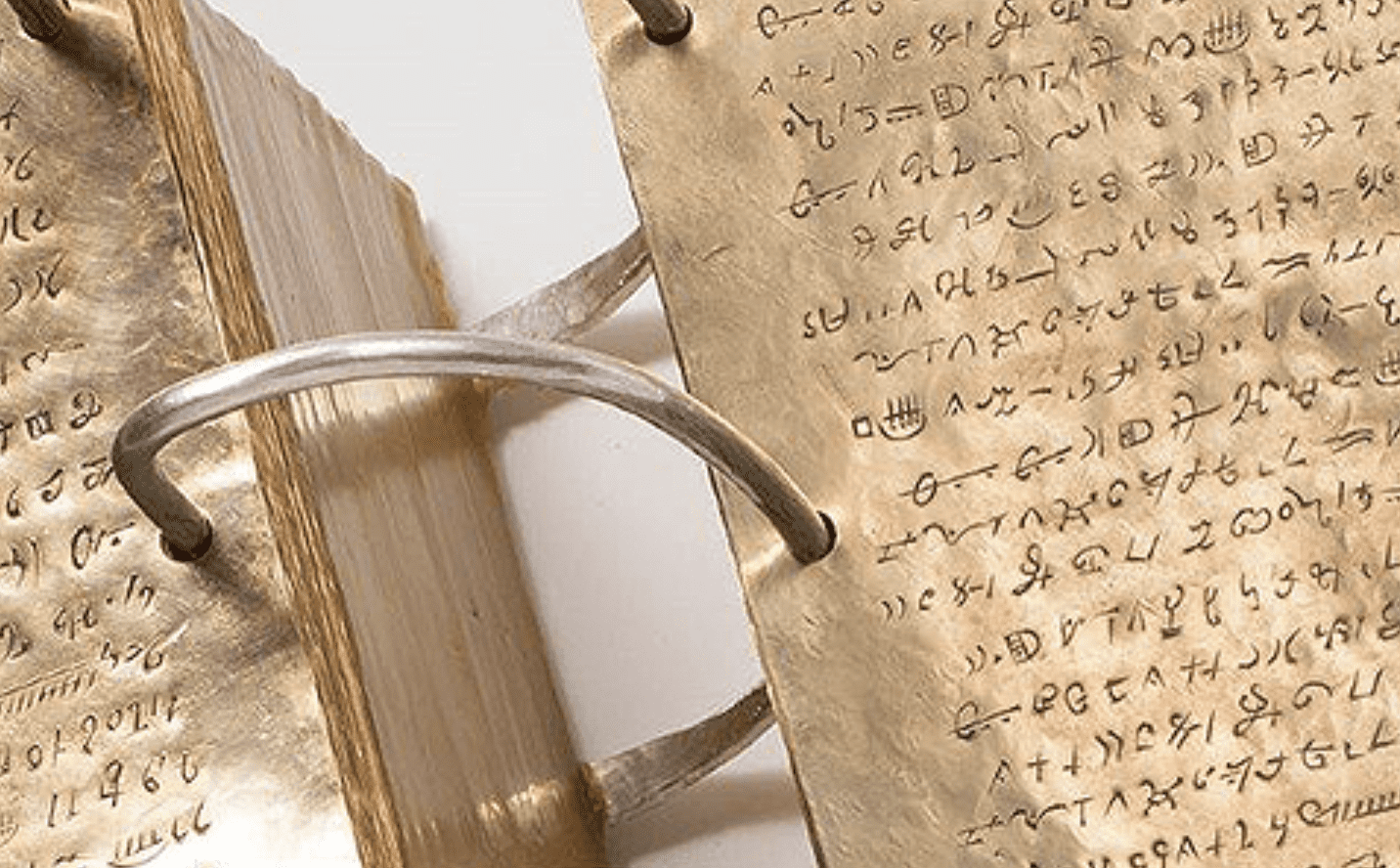
The gold plates, from which Joseph Smith translated the Book of Mormon, were inscribed with ancient characters and revealed a powerful witness of Christ.
The plates are real! Many friends, family members, and other witnesses testified that the Prophet actually located metal plates inscribed with ancient Egyptian characters that they could heft and hold.
In 1842, the Prophet described the plates in amazing detail: “These records were engraven on plates which had the appearance of gold, each plate was six inches wide and eight inches long, and not quite so thick as common tin. They were filled with engravings, in Egyptian characters, and bound together in a volume as the leaves of a book, with three rings running through the whole. The volume was something near six inches in thickness, a part of which was sealed. The characters on the unsealed part were small, and beautifully engraved. The whole book exhibited many marks of antiquity in its construction, and much skill in the art of engraving. With the records was found a curious instrument, which the ancients called ‘Urim and Thummim,’ which consisted of two transparent stones set in the rim of a bow fastened to a breastplate. Through the medium of the Urim and Thummim I translated the record by the gift and power of God” (“The Wentworth Letter,” History of the Church, 4:536-541).
Witnesses also testified that Joseph not only had the plates, but that he translated them by the gift and power of God. Oliver Cowdery said: “I wrote with my own pen, the entire Book of Mormon (save a few pages) as it fell from the lips of the Prophet Joseph Smith, as he translated it by the gift and power of God, by means of the Urim and Thummim, or, as it is called by the book, ‘holy interpreters.’ I beheld with my eyes, and handled with my hands, the gold plates from which it was translated. I also saw with my eyes and handled with my hands the ‘holy interpreters’ (The Contributor, Volume 5, August 1884, no. 11).
Elder Neal A. Maxwell of the Quorum of the Twelve Apostles shared these insights about how the process of translating the Book of Mormon was a miraculous achievement:

Elder Neal A. Maxwell testified of the miraculous nature of the Book of Mormon translation, emphasizing its divine authenticity and rapid completion
“One marvel is the very rapidity with which Joseph was translating—at an estimated average rate of eight of our printed pages per day! The total translation time was about 65 working days. (See “How long did it take Joseph Smith to translate the Book of Mormon?” Ensign, Jan. 1988, 47.) By comparison, one able LDS translator in Japan, surrounded by reference books, language dictionaries, and translator colleagues ready to help if needed, indicated that he considered an output of one careful, final page a day to be productive. And he is retranslating from earlier Japanese to modern Japanese! More than 50 able English scholars labored for seven years, using previous translations, to produce the King James Version of the Bible, averaging about one precious page per day.
“The Prophet Joseph Smith would sometimes produce 10 pages per day! (see the bulletin Insights: An Ancient Window [Provo, Utah: Foundation for Ancient Research and Mormon Studies (F.A.R.M.S.), Feb. 1986], 1).
“A second marvel of the Book of Mormon translation process is that from what we know, rarely would Joseph go back, review, or revise what had already been done. There was a steady flow in the translation. The Prophet’s dictating resulted—just as the compositor, John H. Gilbert, remembered—in no paragraphing.
“Emma Smith said of the inspired process: ‘After meals, or after interruptions, [Joseph] would at once begin where he had left off, without either seeing the manuscript or having any portion of it read to him’ (“Last Testimony of Sister Emma,” Saints’ Herald, 1 Oct. 1879, 290). One who has dictated and been interrupted must usually resume by inquiring, ‘Now, where were we?’ Not so with the Prophet!
“If one were manufacturing a text, he would constantly need to cross-check himself, to edit, and to revise for consistency. Had the Prophet dictated and revised extensively, there would be more evidence of it. But there was no need to revise divinely supplied text. Whatever the details of the translation process, we are discussing a process that was truly astonishing!” (“By the Gift and Power of God,” Ensign, January 1997.)
Dr. Hugh W. Nibley noted that in addition to the miraculous discovery of actual plates, the spectacular translation of the record, and the impressive testimonies left by numerous witnesses, the best evidence of the Book of Mormon’s historicity as an ancient record, is to be found by simply examining the text of the book itself.
He wrote a witty parable, which cuts to the very heart of the matter. The Book of Mormon itself—not what others say or think about it—matters most, when it comes to historical authenticity. Put the gem (the Book of Mormon) to well-known tests for true ancient gems to see if it measures up or not. And does it ever! In the past 200 years of close examination, the Book of Mormon has never come up short in proving itself to be an authentic record of ancient origin. Here’s Dr. Nibley’s parable:
“A young man once long ago claimed he had found a large diamond in his field as he was plowing. He put the stone on display to the public free of charge, and everyone took sides. A psychologist showed, by citing some famous case studies, that the young man was suffering from a well-known form of delusion. An historian showed that other men have also claimed to have found diamonds in fields and been deceived. A geologist proved that there was no diamonds in the area but only quartz. The young man had been fooled by a quartz.
“When asked to inspect the stone itself, the geologist declined with a weary, tolerant smile and a kindly shake of the head. An English professor showed that the young man in describing his stone used the very same language that others had used in describing uncut diamonds: he was, therefore, simply speaking the common language of his time. A sociologist showed that only three out of 177 florists’ assistants in four major cities believed the stone was genuine. A clergyman wrote a book to show that it was not the young man but someone else who had found the stone.
“Finally an indigent jeweler named Snite pointed out that since the stone was still available for examination the answer to the question of whether it was a diamond or not had absolutely nothing to do with who found it, or whether the finder was honest or sane, or who believed him, or whether he would know a diamond from a brick, or whether diamonds had ever been found in fields, or whether people had ever been fooled by quartz or glass, but was to be answered simply and solely by putting the stone to certain well-known tests for diamonds.
“Experts on diamonds were called in. Some of them declared that they could not very well jeopardize their dignity and reputations by appearing to take the thing too seriously. To hide the bad impression thus made, someone came out with the theory that the stone was really a synthetic diamond, very skillfully made, but a fake just the same. The objection to this is that the production of a good synthetic diamond 120 years ago would have been an even more remarkable feat then the finding of a real one” (Lehi in the Desert; The World of the Jaredites; There Were Jaredites, Deseret Book and FARMS, 1988, 121-22).
Many scholars have produced papers, books and presentations analyzing every word and phrase in the Book of Mormon. The more research we do, the more genuine the historical authenticity of the text is revealed. The record is real. The translation is remarkable. And the evidences for the truthfulness of the text just keep coming.
Perfectionism vs. Spiritual Progress: How to Find Peace in Imperfection

Interested in FREE sheet music downloads of sacred and inspirational music? You’ll find them on Lynne Perry Christofferson’s music website: https://www.christoffersonmusic.com/.
There were twenty-six of them: thoughtfully chosen New Year’s resolutions, painstakingly typed on pristine white paper, then meticulously proofread. I taped this impressive list inside the cupboard next to my bed, so I could review it daily. By the end of the year, after having kept each resolution perfectly, I would be a spiritual giant, in remarkable physical condition, the sweetest wife, the most patient mother, and the world’s most dependable visiting teacher. And of course, every nook and cranny of my house would be completely de-junked and organized.
Several days later, with tears on my cheeks, I ripped the list from the cupboard door and tore it into shreds. Why? Because I hadn’t met all twenty-six goals every day since I posted them. Despite similar experiences in previous years, I’d managed to convince myself that this year would be different—if I just worded my goals more precisely, if I just studied them faithfully every day, if I just pushed harder, if I just willed myself to be better. Looking back, I’m troubled to recall how much pressure I put on myself, and how demoralizing it was each time I failed to live up to impossible expectations.
Perfection or Perfectionism
Many years later, after gradually recognizing my toxic perfectionism for what it was, I wrote, “If I added up all of the hours from my past which were consumed by fear, guilt, and worry over my lack of perfection, I have no doubt the sum would equal years—years of my life wasted due to a faulty understanding of the Atonement, including the misconception that Heavenly Father demanded perfection of me immediately. On countless occasions I stressed over the fact that my life could end at any time and I would die without having repented of every speck of sin and certainly without having attained a perfect state.” (1)
I appreciate the following insights of religious educator Allen D. Rau: “… it is… vital to shed light on how a perfectionist paradigm distorts the doctrine of perfection. When doctrine is misunderstood, spiritual and emotional problems can follow… Perfectionism corrupts the doctrine of perfection and creates unnecessary burdens in the lives of those who seek perfection through a perfectionist paradigm.
“The problem with perfectionism is not striving for godliness; it is striving for godliness without “relying wholly upon the merits of him who is mighty to save” (2 Nephi 31:20). Put simply, perfectionism is not what the Lord was asking for when he commanded us to be perfect.” (2)
Perfectionism takes Jesus out of the equation. My most effective tool in fighting toxic perfectionism, is studying earnestly about the Atonement of Jesus Christ. I highly recommend reading “The Infinite Atonement” by Tad R. Callister. (3) Reading Elder Callister’s scripture-centered writings on the Savior’s Atonement had a liberating effect on me. As I increased in understanding of what Jesus Christ has done and what He offers, the more clearly I saw that even my grandest mortal efforts could never save me. What a relief it was to have the burden of my salvation lifted from my feeble shoulders.
Trajectory
I have come to appreciate a simple visual aid I saw in a long-ago Sunday school lesson. First, the instructor drew an arrow horizontally from left to right across the chalkboard. Next, he drew a second arrow that began at the same spot as the first but pointed just a few degrees higher. Though the two lines started at the same point, by the time the second arrow reached the other side of the chalkboard, it was several inches higher than the original line. The instructor emphasized that if those two lines kept going indefinitely, they would continue to grow further and further apart.

“Even a slight adjustment in our spiritual trajectory can lead to profound transformation over time.”
This was a lightbulb moment for me. Two simple lines illustrated how raising our spiritual trajectory by even a small amount can eventually yield significant—even Celestial—results. In my earlier years of perfectionism, I had been aiming my arrow straight up. I wanted immediate perfection, but that’s not how the plan of salvation works. Now, when thoughts of attaining perfection overwhelm me, I focus on the word progression instead.
The Atonement of Jesus Christ altered the trajectory of every woman and man who will ever live on the earth. Even those who choose not to accept Him as their Savior benefit from His victory over death, which gifted all humankind the resurrection from the dead. Through His Atonement, Jesus also offers eternal life to all who are willing to choose a spiritual trajectory that leads back to His holy presence.
Inching Toward God
As Elder Neal A. Maxwell wrote: “Paced progress not only is acceptable to the Lord but also is recommended by Him… Just as divine disclosure usually occurs line upon line, precept upon precept, here a little and there a little, so likewise we will achieve our spiritual progress gradually.” (4)
On a camping trip decades ago, my husband and I took our children hiking. There were towering pines and aspen trees in that beautiful mountain forest, but what captured my attention that day was actually the smallest creature we encountered: a tiny green inchworm, no longer than the tip of my finger. I’m not certain how we even spotted the worm as it made its way up a tree branch. We were fascinated by its movements.

True growth happens gradually—one small step at a time.”
Because inchworms have tiny legs at the front and back of their bodies, but not the middle section, they move by extending their front end, then pulling their rear end forward. As they draw their hind legs up, their body forms a loop. (5) It seems like a terribly inefficient way to travel, but the little worm my family observed persisted until its slow, steady “inching” carried it the length of the long branch.
More times than I can count through the years, the image of a pale green inchworm has come to my mind as I’ve battled a tendency toward perfectionism. Picturing the steady progress of that little creature has been a clear reminder that God plays the long game. He values the line upon line approach.
Elder David A. Bednar has taught the importance of small and simple things: “… if you and I are focused and frequent in receiving consistent drops of spiritual nourishment, then gospel roots can sink deep into our soul, can become firmly established and grounded, and can produce extraordinary and delicious fruit.” (6)
This is why the basic “Sunday school answers” such as praying, pondering, and studying the scriptures are so impactful when done thoughtfully and consistently: they sustain a healthy spiritual trajectory.
I’ve written previously about a pattern observed in nature which symbolizes inching toward God: “Each December, we northern-hemisphere-dwellers experience the shortest day of the year, when the sun takes its lowest path across the sky. But the very next day, a quiet phenomenon occurs while most of us aren’t paying attention: gradually, in tiny increments, the days begin to lengthen. By the spring equinox, our sunsets will be noticeably later, and toward the end of June it will seem that the sun is content to hang in the sky indefinitely.
“As mortals dealing daily with the effects of the Fall… we grapple hourly with our weaknesses and suffer the shame that comes with sinning. But no matter how far gone we think we are, change will begin as we reach out to the Savior for help and grace. Because our initial attempts to improve are so incremental, we will likely not even notice a change at first. But one day, awareness will begin to dawn: the light is changing, increasing. This is the beautiful process of perfection. Change and improvement come slowly, but they will come.” (7)
A stifling burden is lifted from our spirits when we abandon toxic perfectionism and embrace the truth that change and improvement will occur as we trust in the Atonement of Jesus Christ and develop a healthy spiritual trajectory by inching toward God.
Notes:
- Lynne Perry Christofferson, Sisters, Arise! 103, Covenant Communications.
- Allan D. Rau, “Be Ye Therefore Perfect”: Beyond the Perfectionist Paradigm,” Religious Educator 12, no. 3 (2011): 37-57.
- Tad R. Callister, The Infinite Atonement, Deseret Book Co.
- Neal A. Maxwell, Men and Women of Christ, p. 23, Deseret Book Co.
- https://www.google.com/search?q=what+is+an+inchworm https://www.perplexity.ai/search/how-does-an-inchworm-move
- David A. Bednar, “By Small and Simple Things Are Great Things Brought to Pass,” address given Friday, April 29, 2011 at the BYU Women’s Conference. Page 5 of transcript.
- Lynne Perry Christofferson, Sisters, Arise! 109, Covenant Communications.
Come, Follow Me for Sunday School: “That You May Come Off Conqueror”, Doctrine and Covenants 10-11

In this lesson, our objective is to “come off conqueror.”
A conqueror, according to Webster’s 1828 Dictionary, is “one who gains a victory; one who subdues and brings into subjection or possession, by force or by influence.”
What are we supposed to “conquer”? What victory are we seeking? Who or what are we called upon to subdue and bring into subjection?
These questions have two answers. First, “pray always, that you may come off conqueror; yea, that you may conquer Satan, and that you may escape the hands of the servants of Satan that do uphold his work” (10:5).
The second answer is like the first: to conquer Satan, we must conquer ourselves. This means mastering our desires.
The word “desire” appears eight times in Doctrine and Covenants 11. “Verily, verily, I say unto you, even as you desire of me so it shall be done unto you; and, if you desire, you shall be the means of doing much good in this generation” (11:8). Like any tender parent, the Lord is interested in what we are interested in. He wants us to have the desires of our hearts if they are righteous. And in the end, we will be judged as much by what we have desired as by what we have accomplished: “For I, the Lord, will judge all men according to their works, according to the desire of their hearts” (D&C 137:8–9).
I have a friend with a testimony. He served a mission and was married in the temple He is a good man, a hard worker, and a helpful neighbor. We’ve had a lot of good talks over the years. Unfortunately, his church activity is sporadic. He spends his weekends doing sports. His family has disintegrated into unbelief and indifference. He says, “I know I should be active in the church . . . but I just can’t work up the desire.”
Isn’t that the question for us all? As the Savior asked his disciple John, “What desirest thou?” (D&C 71:3). What do we desire? As Alma asked the people at the Waters of Mormon, “What is the desire of your hearts?” What is it in our heart of hearts that we truly desire?
Elder Dallin H. Oaks taught, “Desires dictate our priorities, priorities shape our choices, and choices determine our actions” (“Desire,” General Conference, April 2011). As we study this lesson, we should analyze our desires because what we desire turns into what we choose to spend our finest energies on.
For example, do we desire joy? Do we desire revelation? If so, the Lord promises, “I will impart unto you of my Spirit, which shall enlighten your mind, which shall fill your soul with joy; And then shall ye know, or by this shall you know, all things whatsoever you desire of me, which are pertaining unto things of righteousness” (11:13-14).
Do we desire to bring our families and others to Christ? “If you desire, you shall have my Spirit and my word, yea, the power of God unto the convincing of men” (11:21). “Behold, the field is white already to harvest; therefore, whoso desireth to reap let him thrust in his sickle with his might, and reap while the day lasts, that he may treasure up for his soul everlasting salvation in the kingdom of God” (11:3).
Of course, desire must lead to action: “Behold, I speak unto all who have good desires, and have thrust in their sickle to reap” (11:27). Still, desire comes first. So, the great question is, How do we develop the desire to “thrust in the sickle” and reap while the day lasts? What if our desire falters, as in the case of my friend? What if we “just don’t feel like it”?
What if we feel too tired, too distracted, too burdened with care to acquire “good desires”?
Elder Dallin H. Oaks answers this question by recounting the story of Aron Ralston, a hiker faced with death who had to decide what was most important in his life:
“How do we develop desires? Few will have the kind of crisis that motivated Aron Ralston, but his experience provides a valuable lesson about developing desires. While Ralston was hiking in a remote canyon in southern Utah, an 800-pound (360 kg) rock shifted suddenly and trapped his right arm. For five lonely days he struggled to free himself. When he was about to give up and accept death, he had a vision of a three-year-old boy running toward him and being scooped up with his left arm. Understanding this as a vision of his future son and an assurance that he could still live, Ralston summoned the courage and took drastic action to save his life before his strength ran out. He broke the two bones in his trapped right arm and then used the knife in his multitool to cut off that arm. He then summoned the strength to hike five miles (8 km) for help. What an example of the power of an overwhelming desire! When we have a vision of what we can become, our desire and our power to act increase enormously.” (“Desire,” General Conference, April 2011.)
The vision of his own little child filled Ralston with an intense, hard, clear desire for which he would give anything. Likewise, the vision of my own beloved family fills me with a deep desire to do what I can to ensure their eternal happiness. And I suspect that is true of you, too.
We develop that intensity of desire to follow the Lord when we realize what we have to gain—or lose. Crucially, we must remember that Satan is filled with desire—an insistent desire—to destroy us. He is single-minded. His desire is unquenchable. “Behold, verily, verily, I say unto you, ye must watch and pray always lest ye enter into temptation,” the Lord warns, “for Satan desireth to have you, that he may sift you as wheat” (3 Ne. 18:18). Our desire for eternal life must outweigh Satan’s efforts to deny it to us.
As the Lord indicates, the practical step to attain that level of desire is to pray for it. Elder Neal A. Maxwell taught, “To achieve our eternal destiny, we will desire and work for the qualities required to become an eternal being. For example, eternal beings forgive all who have wronged them. They put the welfare of others ahead of themselves. And they love all of God’s children. If this seems too difficult—and surely it is not easy for any of us—then we should begin with a desire for such qualities and call upon our loving Heavenly Father for help with our feelings. The Book of Mormon teaches us that we should “pray unto the Father with all the energy of heart, that [we] may be filled with this love, which he hath bestowed upon all who are true followers of his Son, Jesus Christ” (Moroni 7:48). (“According to the Desire of Our Hearts,” Ensign, Nov. 1996, 21.)
It is not only appropriate but essential that we “call upon our loving Heavenly Father for help with our feelings.” In this way, we begin to “educate our desires.” Declared President Joseph F. Smith, “The education then of our desires is one of far-reaching importance to our happiness in life” (Gospel Doctrine, 5th ed. [1939], 297). How do we do this?
Educating desires, Elder Neil L. Andersen has said, “is not a once-in-a-lifetime job. It requires not only constant preparation, but also constant nourishing of desires that are noble and eternal, while discarding those that are unrighteous and evil.
“Educating our desires also requires strengthening and fortifying them through scripture study, prayer, obedience, and righteous experiences” (“Educate Your Desires,” Conference of BYU Investment Professionals, September 2011).
If we will do these things, we will “come off conquerors.” And as the Lord says, “Then, behold, according to your desires, yea, even according to your faith shall it be done unto you (11:17).
The Life-Changing Typo

The older I get, the more I realize how little I knew yesterday. It seems I’m often bowled over by how many insights still await. And I think this is a common experience. Instead of feeling smug and smart, most of us are slapping our foreheads and saying, “Wow!” (As an aside, this happens with greater frequency as we increase our temple attendance.)
And, very often, these discoveries are not at all complicated, but quite simple. For example, I recently realized that the entire experience of life on earth can be elevated and enhanced by making one small change in our focus. Think of it as a deliberate mental typo. Instead of wanting what we want, (“My will be done”) we must change our hearts to truly mean it when we say, “Thy will be done.” Changing my to thy in our minds and actions can literally flip an unhappy life into a happy one. But, of course, we have to really mean it.
Several years ago I wrote a book called, The Power of Prayer (Covenant Communications). In it I explained that we start praying like a grownup when we stop thinking of all the things we want, and we focus instead upon what God wants. When we try to advance his goals and purposes, we seem to segue into a better, more joyful dimension. Our problems shrink, our material desires take their proper place on our priority list, and our relationships bloom. By giving him our hearts, we pledge to be his servants, to advance his kingdom. We replace selfishness with selflessness.
That formula also brings a marriage into celestial light. Forgetting ourselves and thinking first of our spouse is as close to a genuine magic trick as you can find. It yields instantaneous results, and heals wounds you thought were hopeless. Other-centeredness is a balm that soothes life’s agonies and injects purpose into the lives of the discouraged. It brings an almost childlike joy into our souls, like a happy laugh welling up from our bellies.
Neal A. Maxwell once said, “Selfishness is really self-destruction in slow motion.” And you can absolutely see it in failing marriages. You can also watch the amazing reconstruction of a relationship when partners set aside their own self-interests and truly put the other one first.
Our relationship with God responds to this same inner change. When we can set aside our list of “stuff we want” and “problems we want God to solve” we become his teammates. By making his priorities our own, we have a virtual guarantee of success, because he will absolutely help us achieve those goals he cares deeply about. Henry B. Eyring said, “I have had prayers answered. Those answers were most clear when what I wanted was silenced by an overpowering need to know what God wanted.” (Write Upon My Heart, Oct. 2000 General Conference)
Before we can make God’s will our own, we must know what it is. And there’s no mystery here; we have been given all the information we need. When we follow the Savior we will be immersed in serving others. By demonstrating a willingness to fully obey God and love our fellowmen, our prayers will actually change. We will find ourselves praying for other people and their problems, we will be praying for help with our missionary and family history work.
Throughout Holy Writ, we are told our prayers will be answered if what we are asking is right, proper, and expedient for us. Here are just three scriptures that underscore this requirement:
“Whatsoever ye ask the Father in my name it shall be given unto you, that is expedient for you.” (D&C 88:64)
“And whatsoever ye shall ask the Father in my name, which is right, believing that ye shall receive, behold it shall be given unto you.” (3 Ne. 18:20)
“Remember that without faith you can do nothing; therefore ask in faith. Trifle not with these things; do not ask for that which you ought not.” (D&C 8:10)
That’s not to say God won’t teach us patience as we wait for something we feel meets the criteria. We can pray for a righteous desire for years, and God’s timing may not match ours. Every ward in the church is filled with people who can testify of the broader view of hindsight, and how they now understand why God delayed their request.
Meanwhile, we find joy and peace through switching from “my will” to “thy will,” as we busy ourselves accomplishing God’s objectives. Other blessings pour forth, inspiration and understanding comes, and lives are blessed for our service. It’s as if we now realize that life is one big journey changing the natural man into a selfless one.
Our beloved Prophet, President Thomas S. Monson, has exemplified this trait his entire life, even saying his birthday wish was for each of us to perform an act of service for someone else. Obviously there are two lessons here: One, be like that. Two, the earlier you overcome selfishness in this life, the happier you’ll be for a longer time. Why struggle all your life grappling with self-interest, when you can make God’s will your focus as a youth, and then have a blessed life for years to come?
Remember what President Dieter F. Uchtdorf said, “In the end, the number of prayers we say may contribute to our happiness, but the number of prayers we answer may be of even greater importance.”
When we sincerely pray “thy will be done,” we must remember that we are instruments in God’s hands, carrying out his purposes and putting words into action. If you’ve had frustrating moments—even for a prolonged time—when you didn’t feel God was hearing your wishes, decide today to listen to His. It might make all the difference.
Hilton’s new LDS novel, Golden, is available in paperback and on Kindle. All her books and YouTubeMom videos can be found on her website. She currently serves in Stake Public Affairs.
Atonement – In Real Time
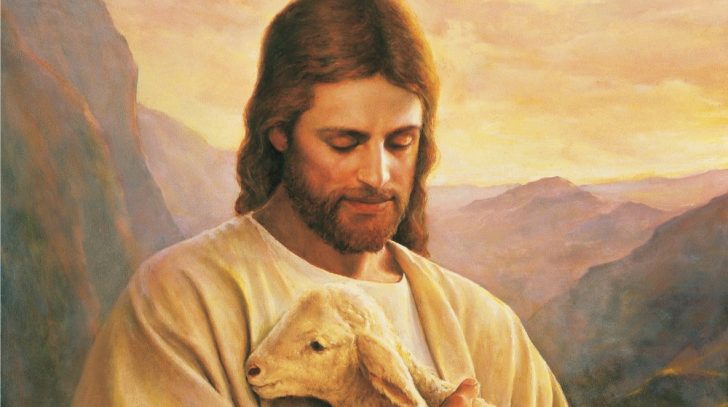
I’ve heard it said that people change and spiritually progress for two main reasons: Either their minds have been opened, or their hearts have been broken. When both happen, just imagine the growth that can take place…
Fallen world forces
We live in a fallen world. Because we live on this telestial planet, we have to abide by telestial law, which thrusts us into realms of CONTRAST. If we experience light, we must experience darkness to become aware of the difference. To truly enjoy health, we must also have a firsthand understanding of sickness. If we want to experience rapture and bliss, we must feel heartbreak and despair. Knowledge and wisdom come from understanding these disparities.
In the dark, joyless realms we can feel so alone and completely cut off from God, but the good news is, a SAVIOR CAN SHIFT THE BALANCE on this telestial rollercoaster. This is why we need a Savior in this existence – in “real time!” Otherwise, evil would triumph with the laws of ENTROPY and OPPOSITION, and mankind would live in perpetual ruin and misery.
Brad Wilcox wrote: “Jesus walked on the water, but mortality was not designed to enable us to walk on water. It was designed so that we would sink. Only then would we reach out and grasp the arm of grace extended to us.” (Changed Through His Grace, p. 133) Christ’s Atonement gives us the opportunity to let grace do its work so we can “fill up” with God.
SURRENDER is a key component in this process. When we experience a “low low”, and completely surrender to the Lord, He will counter that downward thrust and turn our path upwards to ONEness. He can literally transform our emotional and spiritual environments, (sometimes in the blink of an eye). We need the Savior to save us in our extremities. We need at-ONE-ment.
From Crises to Surrender in Tanzania
A friend of mine in Tanzania, Africa experienced a painful “low low” recently when he lost his job, and his landlady gave him the ultimatum to pay up or get out. These were his heartfelt words: “I am going through a financial crisis with no job, and I had already overstayed for three months without having paid my landlady her rent. Recently she issued me 21 days notice to vacate her premises with no further excuse. I remain with 8 days only before the notice expire date and until now I’m confused and I don’t know what to do. I’m just praying for the miracle to happen. Today I surrender my all to Jesus.”
When he wrote that to me, I was so touched. A week later, I wrote him again to see what happened. He said: “Nothing has changed yet, but one thing I know is that my heart is at peace. My spirit was settled the moment I surrendered it all to Jesus, no more worry, no fear no despair.” Even at this extremely uncertain moment in his life, he was buoyed up. Once he OPENED his mind and heart to the point of surrender – the Lord FILLED him with joy and peace completely independent of his circumstance. He became “ONE” with the Lord.
When we’re in that place of ONE-ness, no darkness can penetrate. Christ lifts us out of negativity into light, calm and wisdom. Howard W. Hunter taught: “Peace can come to an individual only by an unconditional surrender – surrender to him who is the Prince of peace who has the power to confer peace.” (Teachings of the Presidents of the Church, 2015)
From Pain to Grace
The following poem showcases the process we all need in order to advance spiritually. It begins with upset or pain:
She fell
She crashed
She broke
She cried
She crawled
She hurt
She surrendered
And then…
She rose again.
(Nausicaa Twila)
Once we surrender to God’s will – not ours – in any given circumstance, we’re lifted up and His whole arsenal is there to heal our hearts and give us peace. Elder Paul V. Johnson said: “No matter how daunting the challenges in our lives or in the world around us, we know we can have peace through the power of the infinite Atonement.”(Elder Paul V. Johnson, April Conference 2013) We can receive this peaceful oneness and live our lives in a more meaningful way.
Capstone Experience
Just a week or two ago, I spoke with a friend who had gone through this process of spiritual surrender over many years. She was given a capstone experience, which she relayed to me. My friend, (I’ll call her Betty), had a friend (Janet), who had betrayed her in a very painful way 16 years earlier. It shook Betty to her core and the tsunami of emotion that resulted was difficult to let go of. The last couple of years, however, Betty had surrendered her experience and all of her emotion to Christ. Little by little she filled up with and applied His atonement until she became enabled to wholeheartedly forgive.
Just the other day, and out of the blue, Janet called her to say that she would be in Betty’s area and asked if she could stay at Betty’s home for the weekend. Somewhat hesitant, Betty agreed. On Sunday, they went to church. Betty sat next to Janet as the sacrament was passed. It seemed like time stood still as she observed herself handing the Sacrament tray to Janet while both partook. At that precious moment Betty realized what the Lord had done for her. She had absolutely no malice, anxiety or anger towards Janet from whom she had received so much grief. How the Lord had changed her! She felt a sense of victory through Christ in passing this tremendous test.
Neal A. Maxwell taught: “Spiritual submissiveness is not accomplished in an instant, but by the incremental improvements and by the successive use of stepping-stones. Stepping-stones are meant to be taken one at a time” (Neal A. Maxwell, Conference, July 2002). In this way, we can access the power to overcome suffering.
Redeemed from Hell
I love it when Nephi said, “…I glory in my Jesus, for he hath redeemed my soul from hell” (2 Ne 33:6). Have you ever experienced hell? I know I have. Whenever we slip into ANY kind of darkness or negativity, we gain entry into the realm of hell. Nephi knew all about this. He even called himself “wretched” during a particularly difficult point in his life. This is a prophet of God talking: “O wretched man that I am! Yea, my heart sorroweth because of my flesh; my soul grieveth because of mine iniquities.” (2 Ne 4:17) He knew what hell on earth meant, but through Christ’s atonement he was able to feel the contrasting emotions (bliss and rapture), when he tells how the Lord “…hath filled me with his love, even unto the consuming of my flesh.” (2 Ne 4:21)
All of humanity experience misery from time to time and need redeeming here and now in mortality. The Lord is the answer. He can liberate us from the hell of personal weakness, lack, addiction, divorce, or many other agonies.
If you find yourself in a difficult or painful circumstance – there IS a way out! It is through learning to be ONE with the Lord in any given situation, (instead of being one with darkness and all that entails) Ask yourself the following questions:
- Is my heart broken?
- Is my mind open?
- Am I ready to trade suffering for peace?
- Am I ready to choose light over dark?
- Am I ready to Surrender my will?
If our heartfelt answer to these questions is yes, we are completely covered from many forces of telestial law as we become ONE with the God of the Universe. He will fill us up with His Atonement, (AS SOON AS WE ARE READY), and we will become entitled to the peace that passes all understanding.
He can give us power to be able to forge ahead in frightening uncharted waters, or give us strength to do what we personally don’t think we can do.
We can apply Christ’s healing, redemptive Atonement NOW, – IN REAL TIME!
You can contact Anne at [email protected]
Why Were Many Nephites So Quick to Disbelieve the Signs of Christ’s Coming?

Visit Book of Mormon Central’s Website
Follow Us on Facebook
And it came to pass that the people began to wax strong in wickedness and abominations; and they did not believe that there should be any more signs or wonders given; and Satan did go about, leading away the hearts of the people, tempting them and causing them that they should do great wickedness in the land
3 Nephi 2:3
The Know
In the first chapter of 3 Nephi, Mormon recorded the fulfillment of prophecy in the form of many signs and wonders from God regarding the coming of Christ into the world (3 Nephi 1:4, 13–15, 19–21). These events caused many to believe in the words of the prophets and to be “converted unto the Lord” (v. 22). However, by the second chapter of 3 Nephi, many had already begun to disbelieve, being led away by the “lyings and deceivings” of Satan (v. 22).
The great sign marking Christ’s birth, the night with no darkness that accompanied the appearance of the new star, was given to the Book of Mormon people in their 91st year of the reign of the judges.[1] By the 95th year, only a few years later, the record relates that “the people began to forget those signs and wonders which they had heard, and began to be less and less astonished at a sign or a wonder from heaven … and began to disbelieve all which they had heard and seen” (3 Nephi 2:1).
They began to rationalize and explain away what they had seen, even to the point of attributing the signs and wonders to the devil. This is exactly the result that Satan had been trying to achieve. Mormon stated, despondently, “and thus did Satan get possession of the hearts of the people again, insomuch that he did blind their eyes and lead them away to believe that the doctrine of Christ was a foolish and a vain thing” (3 Nephi 2:2).
Over the next ten years, the disbelief continued to grow among the people: “Thus, in the space of less than fifteen years from the sign of Christ’s birth, the land went from a state of peace, where “the more part of the people did believe” (3 Nephi 1:22–23), to “a state of many afflictions,” where the people faced destruction because of their iniquity and disbelief (3 Nephi 2:19).
The Why
The Lord’s people have long had mixed experiences with seeking and receiving signs from heaven. The Lord directed Moses to work wonders so that the Egyptians would listen to the words of God’s prophet (Exodus 4:8; 7:8–10). Signs were given to assure the Lord’s people of His promises (Genesis 9:11–17). However, the Lord has also warned people against seeking signs[2] and has instructed that they not trust signs and wonders if they come from misleading sources (Deuteronomy 13:1–5).[3] The Nephites had been taught that Satan could work his own wonders and could even transform “himself nigh unto an angel of light” to confuse people.[4]
For these reasons and others, it is perhaps understandable that some would be wary of the seemingly unexplainable events that they had witnessed. However, those whose hearts were open, who “understood the scriptures,” and believed “the words of the prophecy of all the holy prophets” (3 Nephi 1:24, 26), were able to recognize the true source of those heavenly wonders. Those who allowed Satan to harden their hearts (3 Nephi 1:22), however, could not discern true, divine signs and wonders for what they were.
 One of the reasons so many were deceived was because Satan was particularly active in this period preceding the coming of Christ to the Book of Mormon peoples. BYU Professor John W. Welch commented on the years between the giving of the sign of Christ’s birth to the time of his coming, as recorded in the early chapters of Third Nephi:
These years witnessed gross errors, robbers, secret oaths, anti-establishment rituals, taunting, slaughter, fear, blood, execution, iniquity, murder, conspiracy, and assassination, even to the point of stoning the prophets and casting them out from among them.[5]
The rapid growth of the power and audacity of the Gadianton robbers in this period caused the righteous Nephites and Lamanites to withdraw from the “temple-city” of Zarahemla and gather together for seven years in order to starve out these enemies. The strategy worked, but during this time, the people had no access to the spiritual protection of their temple. Welch explained:
During these extremely vile and temple-less years, Satan was on a rampage. Indeed, the name Satan appears in greater concentration in these chapters than anywhere else in the Book of Mormon. Satan knew that Jesus had been born, and in response he did everything he could to reign with horror and bloodshed upon this world.[6]
The modern day leading up to the second coming of Christ is, similarly, an age in which Satan is on a rampage. Satan likewise tries today to confuse through “lyings and deceivings.” The late Elder Neal A. Maxwell, of the Quorum of the Twelve Apostles, drew a comparison between the two time periods when he warned:
How quickly [Satan] moves in even where people have had special spiritual experiences, seeking to get people who have seen signs ‘to disbelieve all which they had heard and seen.’ (3 Nephi 2:1–2) The adversary has a better chance to persuade us that what we believe is foolish if we worry about looking foolish in front of our fellowmen.[7]
Further Reading
John W. Welch, “Seeing Third Nephi as the Holy of Holies of the Book of Mormon,” Journal of the Book of Mormon and Other Restoration Scripture 19, no. 1 (2010): 36–55.
Victor L. Ludlow, “Secret Covenant Teachings of Men and the Devil in Helaman Through 3 Nephi 8,” in The Book of Mormon: Helaman Through 3 Nephi 8, eds., Monte S. Nyman and Charles D. Tate, Jr. (Provo, UT; Religious Studies Center, 1992), 265-282.
Chauncey C. Riddle, “Days of Wickedness and Vengeance: Analysis of 3 Nephi 6 and 7,” in The Book of Mormon: Helaman Through 3 Nephi 8, eds., Monte S. Nyman and Charles D. Tate, Jr. (Provo, UT; Religious Studies Center, 1992), 191-205.
[1] Which was the 600th year since Lehi left Jerusalem (3 Nephi 1:1). On the sign, see Book of Mormon Central, “Why was there No Darkness After the Sunset? (3 Nephi 1:15),” KnoWhy 188 (September 15, 2016).
[2] For example, when Christ told the Pharisees, “A wicked and adulterous generation seeketh after a sign” (Matthew 12:39; 16:4; Mark 8:12; Luke 11:29; cf. Jacob 7:13–14; Alma 30:44; Alma 32:17).
[3] Cf. 1 John 4:1; Matthew 24:24.
[4] 2 Nephi 9:9. See also Revelation 13:1–15; 2 Corinthians 11:14; 2 Thessalonians 2:9; Matthew 24:24.
[5] John W. Welch, “Seeing Third Nephi as the Holy of Holies of the Book of Mormon,” Journal of the Book of Mormon and Other Restoration Scripture 19, no. 1 (2010): 39.
[6] Welch, “Third Nephi as the Holy of Holies,” 39-40.
[7] Neal A. Maxwell, Things As They Really Are (Salt Lake City, UT: Deseret Book, 1978), 41.
What Sacrifice Do You Place on the Altar?

Like many members, I’m relieved we don’t live in ancient times when we had to kill an animal and burn it. Taking the life of another living creature gives most of us pause, even those of us who eat fish and meat, and know that someone else did exactly that before we purchased it, wrapped in plastic, at the market.
But had we lived in ancient times, we’d have accepted this as God’s commandment, and understood that it symbolized the atonement of Christ. Think of the Paschal Lamb—a clean, innocent, unblemished male with no broken bones. Originally it was the firstborn. And no one was forced to offer a sacrifice; it was voluntary. Even for those whose limited resources meant they had to sacrifice lesser animals such as pigeons, they always chose the finest, most holy that they had. It’s easy to see in these symbols the similitude of the sacrifice of the Only Begotten of the Father.
Not only this, but there was great symbolism in the laying of the offerer’s hands upon the offering, transferring identity, repenting, and praying. Blood was also an important element, symbolizing both the consequences of sin, and the giving of the Savior’s life for man. Atonement means “to cover” in Hebrew, and Christ’s blood covers our sins, making us pure enough to reunite with God. Bruce R. McConkie said, “…those in Israel who were spiritually enlightened knew and understood that their sacrificial ordinances were in similitude of the coming death of Him whose name they used to worship the Father, and that it was not the blood on their altars that brought remission of sins, but the blood that would be shed in Gethsemane and on Calvary.” (McConkie, The Promised Messiah, p.258)
Even the way the animal was then divided gave mankind reminders of the parts of us that must be dedicated to God—the head where our thoughts reside, the legs where we walk and show action, the inner parts which symbolize our feelings and our heart. Together the entire process spells out utter surrender, and total dedication to God, holding nothing back. Exactly as Christ gave his life for us; he reserved nothing.
Participants who understood all this, and approached the altar with the right attitude, found spiritual communion with God in this sacred rite. So how do we demonstrate similar devotion today?
After Christ performed the atonement, he ended animal sacrifice, and said we should now offer “a broken heart and a contrite spirit.” (3 Nephi 9:19-20)
At first glance, that looks like a much easier option. It almost sounds like we dodged a bullet in not having to kill an animal. We just have to keep our pride in check and adopt an attitude of humility, right? But we are so wrong if we think that’s the whole of it.
Today, sacrifice actually involves a willingness to give up, literally, everything. Joseph Smith said, ‘For a man to lay down his all, his character and reputation, his honor, and applause, his good name among men, his houses, his lands, his brothers and sisters, his wife and children, and even his own life—counting all things but filth and dross for the excellency of the knowledge of Jesus Christ—requires more than mere belief or supposition that he is doing the will of God; but actual knowledge, realizing that, when these sufferings are ended, he will enter into eternal rest, and be a partaker of the glory of God…”
And most of us know the quote of his that comes next: “A religion that does not require the sacrifice of all things never has power sufficient to produce the faith necessary to lead unto life and salvation…”
Suddenly our sacrifice looks harder than the ancient one, doesn’t it? And yet they are the same in that they both require our whole heart and soul, our complete dedication to our Heavenly Father.
Joseph Smith also said, “It is vain for persons to fancy to themselves that they are heirs with those…who have offered their all in sacrifice…Men are dependent upon this sacrifice in order to obtain this faith: therefore, they cannot lay hold upon eternal life, because the revelations of God do not guarantee unto them the authority so to do, and without this guarantee faith could not exist.” (Lectures on Faith, pp. 58-60) Our very eternal destiny depends upon our ability to sacrifice and develop the faith that results from it.
We must sacrifice our will, our carnal wants, our stubbornness. We must sacrifice our grudges and the refusal to forgive. We must sacrifice inborn inclinations that are contrary to God’s laws. We must sacrifice our tempers, impatience, unkind judgments, greed, selfishness, envy, sloth. Sometimes we must sacrifice prestige and esteem among men, our hopes for specific blessings in this life, dreams and outcomes we thought we earned. We have to honestly and truly give ourselves over to God. And, even then, we will not be sacrificing as much as did our Lord and Savior.
I think this quote from Neal A. Maxwell in April General Conference of 1995 probably says it best: “Real, personal sacrifice never was placing an animal on the altar. Instead, it is a willingness to put the animal in us upon the altar and letting it be consumed.”
That is the animal we sacrifice today—the natural man. To give this up is not easy, even though we all know it makes us better people. Paradoxically, we all cling to those shortcomings that poison, rather than enrich our lives. It isn’t as if what God wants us to give up is something we need—he only asks us to part with that which isn’t helping us, anyway. How ironic that we find it so very difficult to do.
Again, Elder Maxwell addressed this beautifully in the April Conference of 2004 when he said, “As you submit your wills to God, you are giving him the only thing you can actually give him that is really yours to give.” It’s the one and only thing he wants from us.
Next time we ponder sacrifice, next time we pray, next time we set personal goals, let’s consider the animal we can place on the altar, the personal will we can let go of. And, as Joseph Smith said, find the way to “be a partaker of the glory of God.”
When God Seems Silent

The loneliest times are when that place inside of me where God’s presence usually sits seems vacant. That silence echoes. Some silences can be comforting, when, for instance, a blaring radio is suddenly turned off, or the traffic at the end of the day has stilled and you can no longer hear it out your bedroom window. That silence can wrap around you like a blanket, soothing and secure.
But silence from God takes your breath of life away-especially if you’ve known his whispers thousands of times before. Singer Kenneth Cope wrote these words for one of his songs:
So breathe in me,
I need You now,
I’ve never felt so dead within.
It is a plea most of us have experienced. We know times when we wonder, “Where is the song that God usually sings to me? Where is the answer that is too big for words, the current in my soul that cascades like light inside of me?”
This aching vacancy seems worse when our need is great, when we can’t find the comfort our whole soul yearns for. Then that divine homesickness seems particularly acute. Our souls seem to know that once there was a time when we basked continually in his presence and the current situation may feel bleak indeed without Him. “Answer me, O Lord. Talk to me.”
We know, of course, that sometimes our sense of distance from the Light is our own doing. We have stepped away from Him, and if we are honest with ourselves, we have to admit that it is we who have moved. We may not have even chosen to move, but drifted away unconsciously like a leaf in the wind, distracted by breezes. We believe ourselves too busy to do things that point us in God’s direction when the here and now presses us with such urgencies. Even if we are busy doing good things, we may have forgotten to incline our whole soul toward Him.
Then again, sometimes we have moved because we have a streak of rebellion, fearing that submission to him means giving up too much of ourselves.
But this is not what I speak of today. Instead, I muse about those times when we feel like we have given our all and made every effort to be close to God, and we still feel forgotten. Those are the most difficult times. How can we respond to life’s trials when he doesn’t answer—or at least we don’t hear his answer?
Joseph Smith knew a time like that. The Latter-day Saints who had gathered in Independence, Missouri, in 1831 had come with a burning intent to build Zion, a city to their God. They gathered in groups in groves to speak of the gospel and also the cruel persecutions endured by the disciples of Jesus in former ages, little dreaming that the time was at hand when they, too, would be required to endure like trials “for truth’s sake.”
If irony is the bitter crust on the bread of adversity, the bitterness was made worse because the sweet Zion they hoped to build turned to nightmare of persecution within two years.
In 1833 a mob, made up of some of the most prominent men of the area, drew up a constitution and demanded that the Saints leave. They swore, “We will rid Jackson County of the ‘Mormons; peaceably if we can, forcibly if we must. If they will not go without, we will whip and kill the men; we will destroy their children, and ravish their women!
This demand quickly turned to demolishing the Saint’s printing press, burning their homes, beating Mormons and finally turning them of their homes. They left trails of blood across the snow, in that November of 1833.
Terryl and Fiona Givens write, “As prophet and leader of his people, responsible for the deaths and suffering now unfolding, Joseph certainly felt he had a right as never before to a revelation clarifying the situation and giving him inspired direction. But the heavens were silent. Such answers, he lamented, ‘I cannot learn from any communication by the spirit to me.’ Of the reasons for their continuing plight he added, ‘I am ignorant and the Lord will not show me.’ His prayers went up ‘to God day and night,’ as silence met his anguished appeals.”
This silence from God did not signify his absence. What we can see is that even the best of people have times when they cannot see an answer to their prayers—or at least not an answer that they are equipped to read.
The question remains for us to determine what to make of those times when our words and pleas echo back at us, seemingly without response.
Of one thing we can be certain. If our devotion to God and our dedication to discipleship is dependent on our always feeling and sensing his light, our faith may be challenged in this life. There are days that are tedious and days that drain us of life force. There are times of aching disappointment and loss that we are quite certain God could have spared us. There are times we plead for direction and we feel left on our own to decide.
We cannot be tempted to waste our lives and determine our devotion to God by constantly taking our spiritual temperature. Yesterday I was happy with the Lord because I felt his blessings. Today I feel neglected and forgotten because life is tough. Yesterday I swelled with spiritual radiance because I felt the Spirit. Today, I question my faith and foundation because the heavens seem silent and I am desperate for help.
This is a spiritual roller coaster—and like the amusement park variety—can make us sick. If we are continually questioning the foundation of our faith based on how we feel today, we are on dangerous ground. Today brings us every kind of challenge, often coming like stones pelting us from every side. We may not feel God in the onslaught.
Today may bring challenges to our faith and we forget the truths that we have always known that have comforted us when we’ve needed it.
If our belief is contingent on how we feel spiritually from day to day, it is guaranteed that we will be unstable as water. God will test our mettle. He will feel after us—and unfortunately those may be at the very times when we can’t feel him.
If our faith is based mainly on how we feel or how we think he is blessing us at any given time, we will find it a shaky foundation that may crumble beneath us.
To be in time, as we are in mortality, means to change. Our passions and imaginations are in continual flux. We rise to a spiritual level and then fall back. We experience life as a series of troughs and peaks. We undulate. Convictions that are no more solid than our mood or circumstance of the hour will always be wavering. Convictions and choices cannot be a hostage to how we feel at the moment.
Those who are writers have learned that if they only write when they feel like it, they will never write. Those spurts of inspiration are few and writing is difficult. Authors do not pen their novels by waiting to work until they feel like it. They set a clock every day, start to work and begin clicking on the keyboard. Inspiration usually follows work rather than leads it.
Those who are parents know that if they only nurtured their children when they really felt like it, the world would be riddled with more neglected children. Many times we don’t feel like doing the very things that are most important.
This is true of developing our spirits and our relationship to God. We have to forge forward in our devotion, obedience and discipleship even in those times when we don’t feel like it or when doubt hangs upon us because we cannot see his answers now or when we are just too worn out because “the world is too much with us.”
The Lord repeats three beautiful words in the Book of Mormon. He asks us to be “firm, steadfast and immovable.” Note he does not say “squirm, unsteady and movable” which is the temptation of the natural man.
We are tempted to squirm—instead of be firm–when we constantly re-evaluate our faith in God, when we let old truths that have founded us be knocked by current conditions. Constantly taking your spiritual temperature does not lead to strength.
Our daughter Mariah wrote on Meridian about Maasai thinking. The Maasai are a beautiful African tribe, but the myth about them goes like this:
“They say that a Maasai warrior will die if he is locked up in prison. Close him in a dark room, keep him away from the sunshine and his cattle and he will be unable to imagine an end to this current state. Maasai cannot cling to a sweeter past or the potential for a better future. They live only for the present. Take away his present, and you take away his life.
“Last winter, I was sick with one of those terrible coughs that gets much worse when you try to lay down to rest. So each night at bedtime, I’d lay down, desperate for the respite of sleep and instead accidentally work myself into a coughing fit. In the midst of those fits, while gasping for air I’d think “well, I can’t take singing lessons next semester” or “can you imagine how annoying this is going to be for my husband every time it’s time to sleep?” I can’t be kept from thoughts of the future, but they are suddenly always colored with the assumption that my present circumstances will stretch into forever.”
So it is with those who must take and retake their spiritual temperature to decide how firm they will be in their loyalty to God. If He doesn’t show up on their time frame, this sense of abandonment feels forever and faith is knocked. If a new question arises today, it feels like a permanent condition and old answers are discarded.
Constantly taking your spiritual temperature has at least three pitfalls.
First, we become fair weather friends to the Lord. He cannot count on us to carry out his errands, to be loyal and true. We can be sold off to the highest bidder, change our minds about who He is, abandon the cause when He was counting on us, be worn down with fatigue. This is like Moses could have been if he started up Mt. Sinai and decided to stop when his feet started hurting half-way to the top. God gives us mortal experiences, including times of silence, to teach us to be as firm, steadfast, and immovable as he is.
It is plaintive when many of Christ’s followers were abandoning him, and he said to Peter, “Will ye also go away?” (John 6: 67). Do we want to answer, “I don’t like the menu you’ve served? I don’t like the taste of this bread of life. It is too hard, too demanding. It rips at my heartstrings in ways I can’t bear.
Second, we may count God as silent when he has been talking to us all along. Sometimes it takes spiritual maturity to understand his answers which are sometimes subtle, oblique, or based on a long-term which is currently out of our purview. The Givens quote the poet R.S. Thomas who suggested that God may be speaking “in ways we have yet to recognize as speech.” It may be only in memory that we see He was always whispering to us. It may be in retrospect that we recognize that the prayers that we were offering for clarification may have been more as Kafka said “the icepick to break up the frozen sea within us.”
Sophocles said, “We must wait until the evening to see how splendid the day has been.”
Third, constantly evaluating and re-evaluating our commitment to God becomes entirely self-centered. This frantic and constant taking of our spiritual temperature has real pitfalls. Always worrying about how we feel just now and if things have made us happy enough turns our focus to ourselves. As Elder Neal A. Maxwell said, “We are so busy constantly checking our own temperatures, we fail to notice the burning fevers of others.”
Those times when God appears silent in our lives can be our time of significant opportunity to demonstrate what we are made of. Shakespeare wrote of a kind of love in one of his sonnets that we can think of it as the kind of love that we hope to show to God. He says love is “an ever-fixed mark,/That looks on tempests, and is never shaken.” He adds “love is not love/Which alters when it alteration finds.”
God never alters, but, since we are mortal and fallible, our perception of what he is doing with us may change. We may not understand his silences. We may feel lonely in our solitude. At those times we can trust—trust his purposes, trust his love, trust ourselves—that we have felt before of divine love, we will feel again. If for now we are in a dry season, we know it is just a season and we will not lessen our faith in any way while we endure it.
Elder Maxwell again, “To be cheerful when others are in despair, to keep the faith when others falter, to be true even when we feel forsaken—all of these are deeply desired outcomes during the deliberate, divine tutorials which God gives to us—because He loves us. These learning experiences must not be misread as divine indifference. Instead, such tutorials are a part of the divine unfolding.”
FEATURES