




The Tragedy of Nauvoo: Remembering the Lost City of the Latter-day Saints
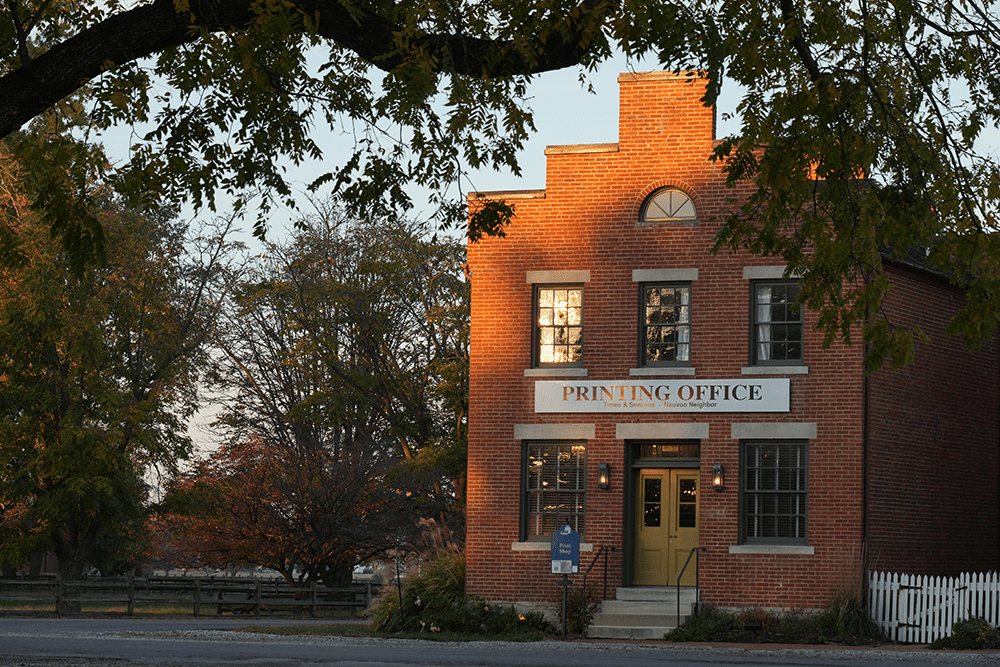
Because of my involvement with the Interpreter Foundation’s new series of mini-documentaries, “Becoming Brigham,” which launched on Monday, 26 January, and which will continue releasing weekly episodes into 2027 (see becomingbrigham.com), I’ve spent several days in and around Nauvoo, Illinois, on each of perhaps five different occasions within roughly the past year. That’s more times than I had visited the town in all of my previous life.
I’ve seen Nauvoo in various seasons, from various angles, spending time in many of its original and reconstructed buildings. I’ve spoken on camera and I’ve reflected silently in Carthage Jail. I’ve stood at the graves of Joseph and Emma and Hyrum Smith.

Perhaps because of this, I’ve come to appreciate more deeply than ever before the tragedy of Nauvoo. I find myself thinking of the lament of the biblical Psalmist, carried away from Jerusalem and its temple into Babylonian captivity:
“By the rivers of Babylon, there we sat down, yea, we wept, when we remembered Zion.
“We hanged our harps upon the willows in the midst thereof.
“For there they that carried us away captive required of us a song; and they that wasted us required of us mirth, saying, Sing us one of the songs of Zion.
“How shall we sing the Lord’s song in a strange land?
“If I forget thee, O Jerusalem, let my right hand forget her cunning.
“If I do not remember thee, let my tongue cleave to the roof of my mouth; if I prefer not Jerusalem above my chief joy.” (Psalm 137:1-6)
Colonel Thomas Kane, a friendly and well-positioned outsider who would become a lifelong friend of the Latter-day Saints, visited the city after the pioneer companies had left. He arrived in September 1846 just after the “Battle of Nauvoo” (10-12 September 1846), when the last remaining sick and destitute members had been driven out. (For many, this wasn’t their first exile.) Later, he wrote an evocative description of what he saw:
“Half encircled by a bend of the river, a beautiful city lay glittering in the fresh morning sun; its bright new dwellings, set in cool green gardens, ranging up around a stately dome-shaped hill, which was crowned by a noble edifice, whose high tapering spire was radiant with white and gold. The city appeared to cover several miles, and beyond it, in the background, there rolled off a fair country, chequered by the careful lines of fruitful husbandry. The un-mistakeable marks of industry, enterprise, and educated wealth everywhere, made the scene one of singular and most striking beauty. It was a natural impulse to visit this inviting region. I procured a skiff, and rowing across the river, landed at the chief wharf of the city. No one met me there. I looked, and saw no one. I could hear no one move, though the quiet everywhere was such that I heard the flies buzz, and the water-ripples break against the shallow of the beach. I walked through the solitary street. The town lay as in a dream, under some deadening spell of loneliness, from which I almost feared to wake it, for plainly it had not slept long. There was no grass growing up in the paved ways; rains had not entirely washed away the prints of dusty footsteps.

“Yet I went about unchecked. I went into empty workshops, rope-walks and smithies. The spinner’s wheel was idle; the carpenter had gone from his work-bench and shavings, his unfinished sash and casing. Fresh bark was in the tanner’s vat, and the fresh-chopped lightwood stood piled against the baker’s oven. The blacksmith’s shop was cold; but his coal heap and lading pool, and crooked water horn were all there, as if he had just gone off for a holiday. No work-people anywhere looked to know my errand.
“If I went into the gardens, clinking the wicket-latch loudly after me, to pull the marigolds, heartsease, and lady-slippers, and draw a drink with the water-sodden well-bucket and its noisy chain; or, knocking off with my stick the tall, heavy-headed dahlias and sunflowers, hunted over the beds for cucumbers and love-apples—no one called out to me from any opened window, or dog sprang forward to bark an alarm.
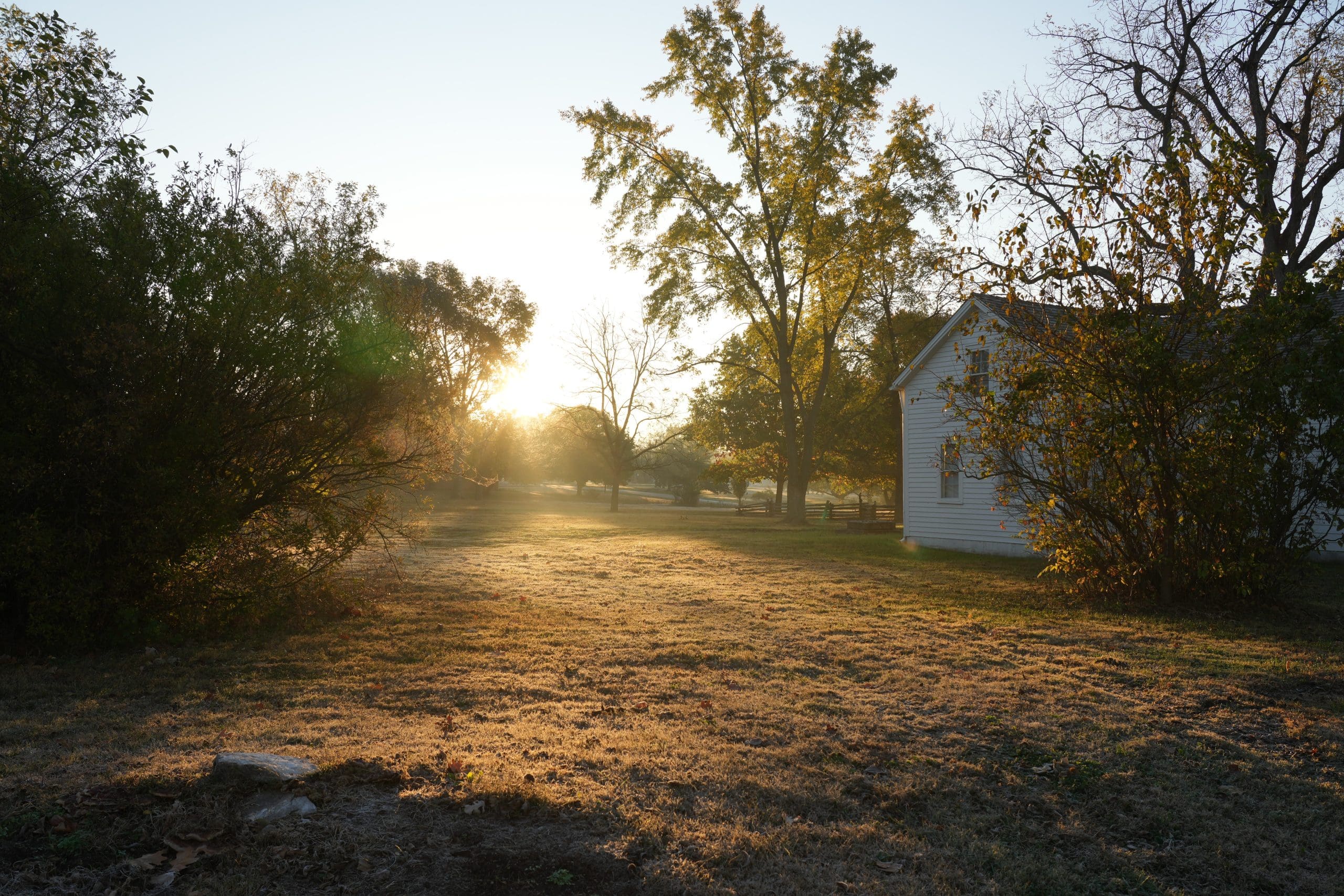
“I could have supposed the people hidden in the houses, but the doors were unfastened; and when at last I timidly entered them, I found dead ashes white upon the hearths, and had to tread a tip-toe, as if walking down the aisle of a country church, to avoid rousing irreverent echoes from the naked floors. On the outskirts of the town was the city graveyard; but there was no record of plague there, nor did it in anywise differ much from other Protestant American cemeteries. Some of the mounds were not long sodded; some of the stones were newly set, their dates recent, and their black inscriptions glossy in the mason’s hardly dried lettering ink. Beyond the graveyard, out in the fields, I saw, in one spot hard by where the fruited boughs of a young orchard had been roughly torn down, the still smouldering remains of a barbecue fire, that had been constructed of rails from the fencing around it. It was the latest sign of life there. Fields upon fields of heavy-headed yellow grain lay rotting un-gathered upon the ground. No one was there to take in their rich harvest.

“As far as the eye could reach they stretched away—they sleeping, too, in the hazy air of autumn. Only two portions of the city seemed to suggest the import of this mysterious solitude. On the southern suburb, the houses looking out upon the country showed, by their splintered wood-work and walls battered to the foundation, that they had lately been the mark of a destructive cannonade. And in and around the splendid Temple, which had been the chief object of my admiration, armed men were barracked, surrounded by their stacks of musketry and pieces of heavy ordnance. These challenged me to render an account of myself, and why I had had the temerity to cross the water without written permit from a leader of their band. . . . Though these men were generally more or less under the influence of ardent spirits.”
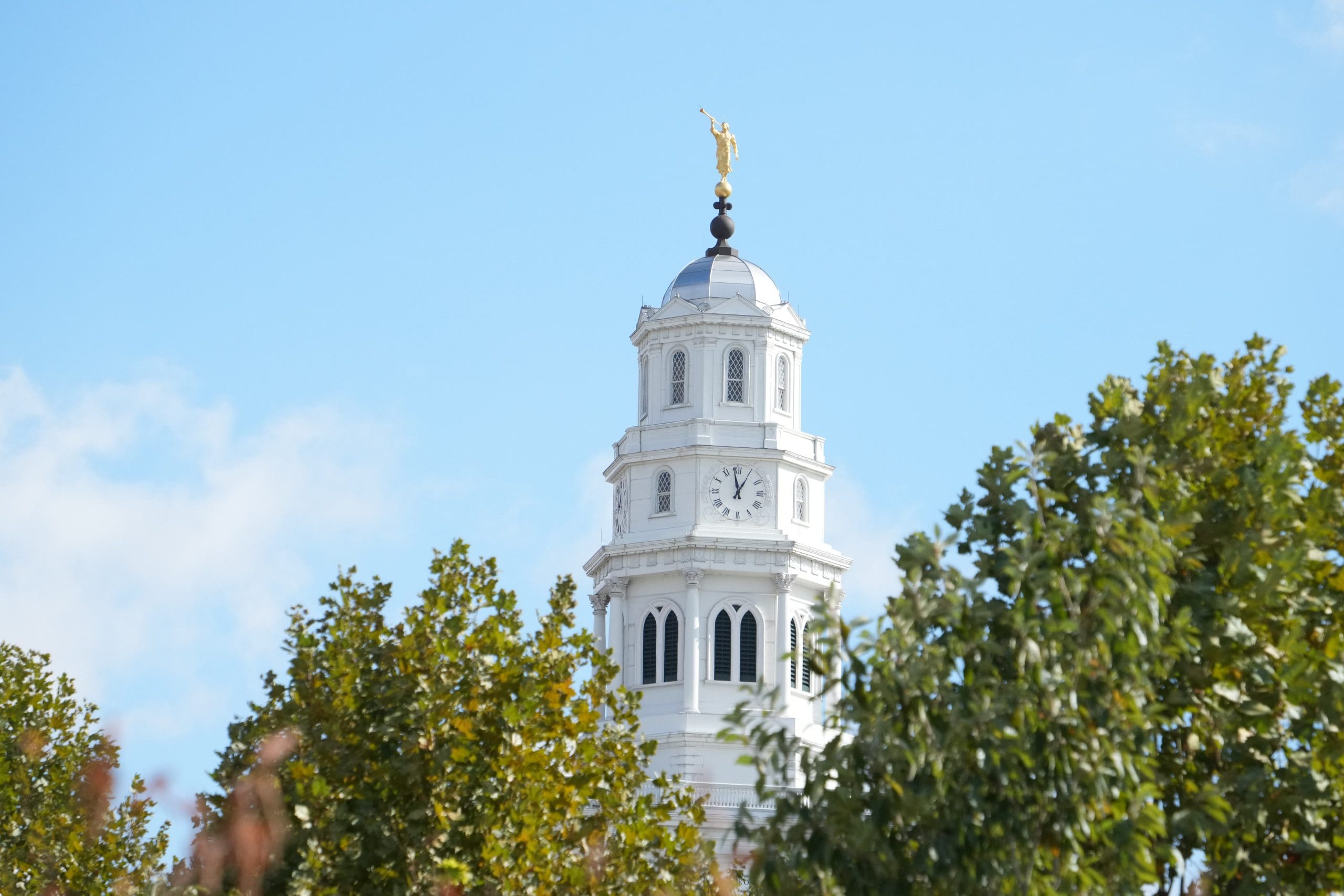
Brigham Young was centrally involved in completing the Nauvoo Temple despite intense persecution and internal turmoil, as well as in directing and administering its ordinances even while the Saints began their exodus westward toward the Great Basin—which also took place under his direction. After the departure of the Saints, the temple was vandalized, desecrated, and defaced. A fire set by an arsonist in 1848 destroyed its interior, leaving only an empty shell standing until, on 27 May 1850, a tornado hit the structure. According to Henry Horner’s 1939 Illinois: A Descriptive and Historical Guide, one source claimed that the storm seemed to “single out the Temple,” destroying “the walls with a roar that was heard miles away.”
Responding to news of the temple’s destruction, Brigham responded, “I would rather it should thus be destroyed than remain in the hands of the wicked.”
But the exiled Israelites who lamented “by the rivers of Babylon” eventually returned and, after a further and still-lengthier exile, many of their descendants live once more in the land of Israel, with Jerusalem as its capital. Indeed, exile and return, gathering and scattering and regathering, are major recurrent themes of the Hebrew Bible, the Old Testament, and of the Gospel in all its ages. The elements will melt with fervent heat and the heavens will be rolled up like a scroll but, in the end, the earth will be restored and receive its paradisiacal glory. We will lie down in death, but we will rise again.
In its humble and, in a certain sense, mundane way—a matter of bricks, boards, and stone—Nauvoo illustrates the Gospel’s promise of rebirth, of victory over death and defeat. Today, scores of senior missionaries serve in the rebuilt Nauvoo Illinois Temple and explain the brief but deeply significant history of the nineteenth-century Latter-day Saint city to visiting Latter-day Saints and curious nonmembers alike.
I myself have been able to serve and to worship in the temple here—something that, in my first several decades, I could never have predicted. I’ve thought of the Saints who went into exile from Nauvoo while taking one last look at it across the Mississippi River and who then learned of its desecration by drunken mobs, the destruction of its interior by arson, and, finally, its leveling by a tornado. I’ve wondered what those refugees would have made of the fact that it now stands again, fully finished this time, and fully dedicated for the first time, on the bluff overlooking the river. At night, it glows with a light that they, in their pre-electric era, could never have imagined.
I’ve seen what was left of the tavern in Warsaw where Thomas Sharp, the fiercely anti-Mormon editor of the Warsaw Signal, and his associates plotted the assassination of Joseph and Hyrum. I’ve seen the house where he lived.
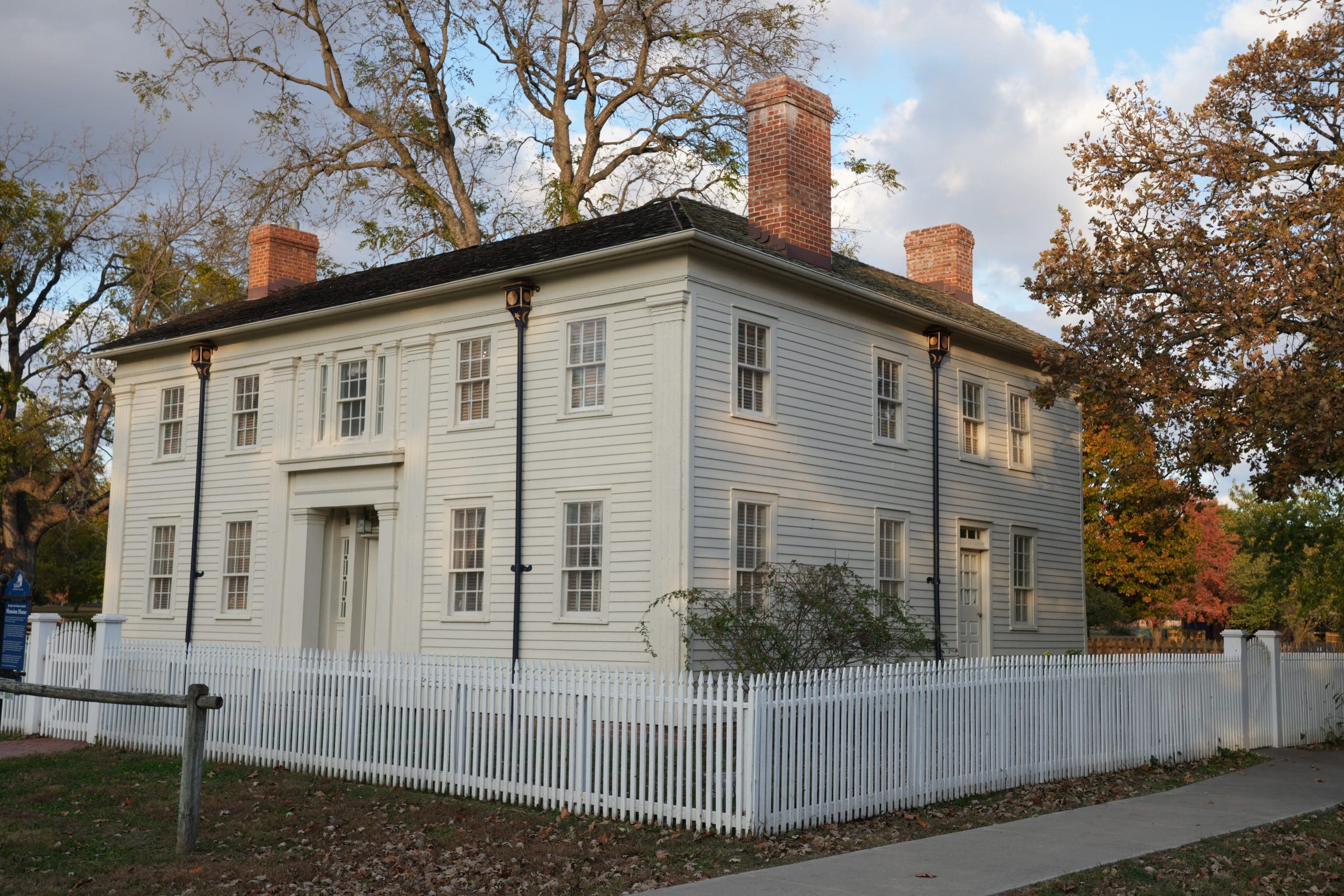
What, I’ve wondered, would Tom Sharp make of that temple on the hill, and of the return of the Latter-day Saints to Nauvoo and surrounding areas? What would he think of the fact that, as I’m told, a Latter-day Saint has restored his home and now occupies it? Would he be surprised to learn that, to the extent that he’s remembered today at all, it’s largely as a footnote to the story of Joseph and Hyrum Smith? Would he and the mobs that he helped to incite be astonished to learn that the Church of Jesus Christ of Latter-day Saints now owns Carthage Jail, in which Joseph and Hyrum were martyred, maintaining it as, in a very real sense, a shrine to their memory? I freely confess that I’m unchristian enough to hope that Sharp and his allies are aware of the return of the Latter-day Saints to Hancock County.
Could early members of the Church have foreseen that the properties that they were forced to abandon would ever be reacquired and restored? That, one day, tens of thousands of their fellow Latter-day Saints would come each year to visit Nauvoo, with reverence but also with smiles? That, to a large extent, it is pilgrims from far away, even from overseas, who patronize the city’s temple? Arriving in vehicles that would have been inconceivable to the wagon trains and handcart companies of the 1840s and 1850s? That, thanks to modern technology, many Saints living thousands of miles away, in places of which those early members could scarcely dream, are able to take “virtual tours” of the homes in which the first Latter-day Saints lived and of the streets that they walked?
“Generations yet unborn,” Joseph Smith prophesied in 1842, “will dwell with peculiar delight upon the scenes that we have passed through, the privations that we have endured; the untiring zeal that we have manifested; the insurmountable difficulties that we have overcome in laying the foundation of a work that brought about the glory and blessings which they will realize.”
And his prophecy has been fulfilled. In all of which, it seems to me, there are obvious lessons to be learned. One of them is that, even in the wreckage of our earthly hopes, when all seems irretrievably lost, there is still hope. The great illustration of this truth, of course, is the resurrection of Jesus Christ, which shows us that not even death is final.
“And God shall wipe away all tears from their eyes; and there shall be no more death, neither sorrow, nor crying, neither shall there be any more pain: for the former things are passed away. (Revelation 21:4)
“Weeping may endure for a night,” says Psalm 30:5, “but joy cometh in the morning.”
“And as for the perils which I am called to pass through,” wrote the Prophet Joseph Smith, from hiding, about a year and a half before his martyrdom, “they seem but a small thing to me, as the envy and wrath of man have been my common lot all the days of my life; and for what cause it seems mysterious, unless I was ordained from before the foundation of the world for some good end, or bad, as you may choose to call it. Judge ye for yourselves. God knoweth all these things, whether it be good or bad. But nevertheless, deep water is what I am wont to swim in. It all has become a second nature to me; and I feel, like Paul, to glory in tribulation; for to this day has the God of my fathers delivered me out of them all, and will deliver me from henceforth; for behold, and lo, I shall triumph over all my enemies, for the Lord God hath spoken it. (Doctrine and Covenants 127:2).
And then he was killed, with his brother. So where was his triumph? Let his mother, Lucy Mack Smith, have the last word here:
“After the [bodies of Joseph and Hyrum] were washed and dressed in their burial clothes, we were allowed to see them. I had for a long time braced every nerve, roused every energy of my soul and called upon God to strengthen me, but when I entered the room … , it was too much; I sank back, crying to the Lord in the agony of my soul, “My God, my God, why hast thou forsaken this family!” A voice replied, “I have taken them to myself, that they might have rest.”
“As I looked upon their peaceful, smiling countenances, I seemed almost to hear them say, “Mother, weep not for us, we have overcome the world by love; we carried to them the gospel, that their souls might be saved; they slew us for our testimony, and thus placed us beyond their power; their ascendancy is for a moment, ours is an eternal triumph.”
**
Watch the episodes of “Becoming Brigham” at becomingbrigham.com. Two quite different settings of Psalm 137 are Don McLean’s round (https://www.youtube.com/watch?v=uTnspbSjKVc) and Linda Ronstadt’s bluegrass version of a reggae tune (https://www.youtube.com/watch?v=u60fXbTsMDg).
Faulty Assumptions about the Book of Abraham
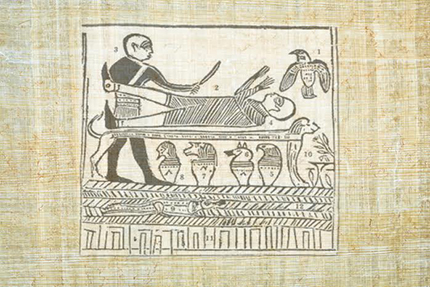
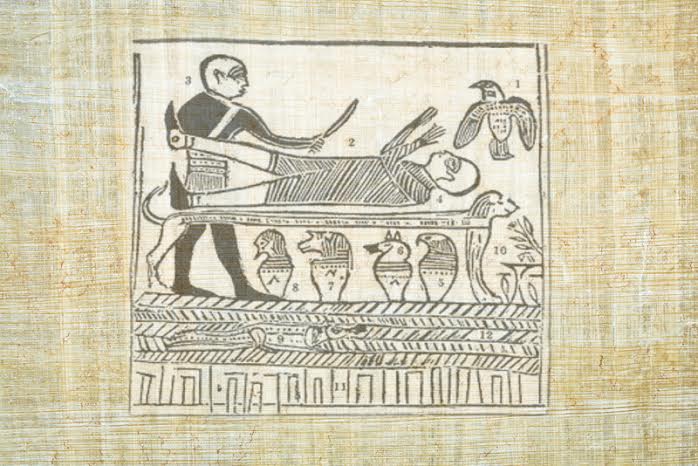

As was mentioned in a previous column (click here to read it), it was almost universally assumed that all of the papyri Joseph Smith had once owned had been destroyed in the Great Chicago Fire of 1871. Thus many were surprised when the papyri surfaced in 1967. One of the papyri fragments contained the drawing which was the original source of Facsimile One. This papyrus drew the most immediate interest.[i]
Part of the reason this fragment drew so much attention was because of the possibilities it suggested. It seemed that perhaps we could now test Joseph Smith’s revelatory abilities. Many members of the Church of Jesus Christ of Latter-day Saints assumed that the text on the papyri which surrounded the original of Facsimile One was the source of the Book of Abraham.
This may give them to chance to demonstrate Joseph Smith’s prophetic abilities. Anti-Mormons also assumed that the text adjacent to that drawing was the source of the Book of Abraham and were excited about the opportunity to disprove Joseph Smith’s prophetic abilities.[ii] Sadly, neither of these groups took the time to carefully and rigorously examine their assumptions. Thus, when the text was translated and we learned that it was a fairly common Egyptian funerary document called the Book of Breathings, many felt that they could now demonstrate that Joseph Smith was not an inspired translator.
This, probably more than anything, has caused confusion regarding the Book of Abraham. Much of this confusion comes because so many don’t even realize that they have made an assumption about the source of the Book of Abraham. For them it is just a given that Joseph Smith translated the text adjacent to Facsimile One when he was dictating the Book of Abraham to his scribe. Failure to realize that an assumption has been made is not only poor scholarship, it makes it impossible to come to any meaningful conclusion. Ironically, not realizing one has made such an assumption causes one to think that he has found solid proof when instead any conclusions reached are fully unreliable.[iii]
The remedy is to be explicit about the assumptions and then test them. If things had been done correctly, instead of writing and speaking about research based on unstated and unnoticed assumptions, all involved should have done their homework.[iv] For instance, it is natural to presume that the text surrounding a picture has something to do with the picture. The problem is not in making this assumption, since research cannot move forward without a hypothesis, but is in failing to take the next necessary step: testing that presumption.
After the logical first step of presumption, the next step should have been to examine whether or not we had evidence that could support or discredit the conjecture. This is the step that almost everyone has failed to take. It is surprising how much stock has been put in the opinions and writings of people who either never realized they were making an assumption or who chose not to investigate that assumption. Almost all of the discussion about the Book of Abraham stems from the assumption that the writing surrounding the drawing of Facsimile One is the source of the Book of Abraham, an assumption that almost everyone swallows without thinking. In this way, people have opened themselves up to an academic hoax. They willingly or unknowingly allow themselves to be deceived by accepting an untested theory as fact. As a result, many have gone through academic and religious confusion because of a faulty method.
So how should we test the assumption? The first step should be to examine the text itself to see if it contains any clues about its relationship with its associated pictures. The second would be to examine similar papyri from the same time period to see if the texts and their vignettes were typically adjacent to each other. The third way to test this assumption would be to examine the accounts of eyewitnesses who saw the papyri and knew from what material Joseph Smith said he was translating. Modern speculations about the extant papyri or the role of the Kirtland Egyptian Papers in the translation of the Book of Abraham must take a backseat to eyewitnesses during Joseph Smith’s day.[v]
Elsewhere I have dealt with the first two methods of testing the assumption, and while they do not demonstrate the assumption to be false, they do show that we are not safe in making the assumption. Both the text itself and contemporary papyri suggest that the text next to the vignette was not necessarily associated with it.[vi]
An extensive article is in process that more fully examines the eyewitness accounts of the papyri during Joseph Smith’s day. Here we can give just a few highlights. Most people who saw the papyri and heard something about the source of the Book of Abraham did not specify whether that source was on the scrolls or the fragments. Here are some examples from the few that did:
One witness wrote that Lucy Mack Smith showed her the papyri and “opened a long roll of manuscript, saying it was the writing of Abraham and Isaac, written in Hebrew and Sanscrit.”[vii] This was after the fragment with Facsimile One was already mounted on paper as a separate piece.[viii]
Another who was shown the papyri by the Prophets mother said “She produced a black looking roll (which she told us was papyrus) found upon the breast of the King, part of which the Prophet had unrolled and read.
“[ix] This was also after Facsimile One and the other fragments with associated text was mounted separately.
Even later than this, another girl who frequently saw the papyri as a child said “in the arms of the Old King lay the roll of papyrus from which our prophet translated the Book of Abraham.”[x]
I have spent six years gathering every eyewitness account I can find. I am sure that there are some out there that I haven’t found, but there can’t be many. Based on the testimony of the eyewitness accounts, it is clear that to the extent that the translations came from the papyri (an idea that is possible, but not sure, and to which we will return in a future column) the long roll was the source of the Book of Abraham. To argue otherwise is to argue against the only historical evidence we have. As we will discuss in future columns, the relationship between the papyri and the Book of Abraham is not clear, and thus we cannot say what the source of the Book of Abraham is. We can say what it is not: it is not the text adjacent to Facsimile One. Anyone who writes differently is ignoring the historical evidence.
___________________________
[i] For more information the reader can listen to a series of lectures by the author, available on CD, entitled “Understanding the Book of Abraham, a Guided Tour,” published by Covenant Communications.
[ii] See Jerald and Sandra Tanner, The Case Against Mormonism (Salt Lake City: Utah Lighthouse Ministry, 1968), 2:159, 3:330. An example of Latter-day Saint ideas is found in Hugh Nibley, “A New Look at the Pearl of Great Price”, Improvement Era, January 1968.
[iii] For more on this, the reader can read or listen to a speech by the author found at https://devotional.byuh.edu/media131112
[iv] Examples of research that pursues unquestioned assumptions are Grant H. Palmer, An Insiders View of Mormon Origins (Salt Lake City: Signature Books, 2002), 16; Wesley P. Walters, “Joseph Smith Among the Egyptians: An Examination of the Source of Joseph Smiths Book of Abraham,” Journal of the Evangelical Theological Society 16 (1973), 25-45, especially 33; and Charles M. Larson, By His Own Hand upon Papyrus: A New Look at the Joseph Smith Papyri, 2nd ed. (Grand Rapids, MI: Institute for Religious Research, 1992), 199226, 151.
[v] On the Kirtland Egyptian Papers see Brian M. Hauglid, A Textual History of the Book of Abraham: Manuscripts and Editions (Provo: Neal A. Maxwell Institute for Religious Scholarship, 2010); also Brian M. Hauglid, “Thoughts on the Book of Abraham,” in No Weapon Shall Prosper, Robert L. Millett, ed. (Salt Lake City: Deseret Book, 2011), 242-253.
[vi] Kerry Muhlestein, “Egyptian Papyri and the Book of Abraham,” in The Religious Educator 11/1 (2010): 90-106; and Kerry Muhlestein, “Egyptian Egyptian Papyri and the Book of Abraham B(?) A Faithful, Egyptological Point of View” in No Weapon Shall Prosper, Robert L. Millett, ed. (Salt Lake City: Deseret Book, 2011), 217-241.
[vii] Charlotte Haven to her mother, 19 February 1843, cited in “A Girls Letters from Nauvoo,” Overland Monthly (December, 1890), 624.
[viii] See Kerry Muhlestein and Alex Baugh, “Preserving the Joseph Smith Papyri Fragments: What Can We Learn from the Paper on Which the Papyri were Mounted?”, Journal of Book of Mormon and other Restoration Scripture 22/2 (2013), 67-83.
[ix] “M”, Friends Weekly Intelligencer; vol. 3, no. 27, October 7th, 1846, 211.
[x] Jerusha W. Blanchard, “Reminiscences of the Granddaughter of Hyrum Smith,” Relief Society Magazine, September 1922, 9.
How we got the Book of Abraham


When Napoleon invaded Egypt he opened it up to a wave of Western exploration that the country had never known. Soon after his defeat there many European countries sent consuls to E gypt with one major goal: bring back amazing antiquities; and that is exactly what they did. The man who oversaw Egypt on behalf of the Ottoman Empire, Mohammed Ali, was eager to seek Western European help in modernizing his country. He, and most Muslims of the time, also viewed the ancient Egyptian monuments as relics of abominable paganism. So, he was happy to trade monuments for modernization, and a flood of artifacts flowed from Egypt into European museums, creating the foundation for some of the greatest museums of the world, such as the British Museum, the Louvre, and the Berlin Museum.[i]
One of the key figures in the excavation game played in Egypt was an Italian who worked for the French government named Antonio Lebolo. Lebolo helped create many important collections, including making major contributions to the Turin Museum and the Louver. He also sold smaller groups of artifacts to private collectors. One such small group, 11 mummies and a handful of papyrus, made its way to the U.S. This was the first large collection of Egyptian antiquities to arrive in the States.
This prize show made its way around the country, setting up in hotel lobbies and advertising in local papers. People flocked from all around to see actual Egyptian mummies. At some point a man named Michael Chandler came to either own the collection or to take care of it on behalf of its owners. For some time he made his living off of traveling with the mummies, but eventually he started to sell them. By the time he had sold all but four of the mummies, one of his friends, a man named Benjamin Bullock, convinced him to take the mummies and papyri to Joseph Smith in Kirtland, Ohio. Bullock had heard from his cousins the Kimballs, who had joined the Mormon church, that Joseph Smith could read Egyptian. He was exceedingly curious as to whether or not his cousins’ prophet could read the papyri, so he prevailed upon Chandler to travel to Kirtland.[ii]
When Bullock and Chandler arrived in Kirtland, in July of 1835, they stayed at the Rigby Inn, not far from the semi-erected temple. Father Rigby had not joined the church, and at that point would not allow his son, John, to do so either. But John believed what Joseph Smith taught, and would eventually both join the church and marry Benjamin Bullock’s daughter. Bullock too would become a believer. But before any of these things would happen, they would both play an important role in the formation of Latter-day Saint scripture because Bullock and Chandler convinced the Rigbys to send young John over to the Prophet and ask him to come see the papyri. The Prophet promised he would do so early the next morning. When he did see the papyri he was immediately interested, and was allowed to take them to his home to study them. Sometime during his study he learned through revelation that the papyri contained the writings of Abraham and Joseph of Egypt. He very much wanted the papyri, but Chandler would not sell them separately from the mummies. So, even in the midst of trying to finance the last stages of building the Kirtland Temple, the prophet found a few followers who supplied enough money for the papyri and mummies to be purchased. Thus one of the most interesting sagas of Mormon scriptural history began.
Many people have questions about the Book of Abraham. It is an interesting, yet complex subject.[iii] In order to help people find answers to these questions, I will write a series of columns, each addressing a separate subject. In these essays I will attempt to be fully forthcoming and transparent, honestly talking about the answers we have, the mistakes we have made, the incorrect assumptions people have long believed, and the answers we don’t have. This first column will only be a history of the papyri. Other subjects, such as the source of the Book of Abraham, the interpretations of the Facsimiles, the Kirtland Egyptian Papers, etc., will follow in future columns. These columns will not be heavily footnoted. They are instead designed to be read quickly by the lay reader, the honest seeker for truth, and to have just enough notes to point people who want more to places where they can read further. Further, a book I have written, Let’s Talk about the Book of Abraham, has just been released that is designed to be very readable yet is more in-depth than we will be able to do here. The story of the Book of Abraham is interesting and complex enough to fill more than one volume of books, but here we give a more condensed version.[iv]
Once Joseph Smith received the papyri, he immediately began translating them. He also seems to have quickly begun to try to make an alphabet and grammar of Egyptian just after doing some translation, a topic more fully discussed in my book. The Prophet and some of his close companions spent time working on the papyri during July. August and September were taken up with other business, such as traveling for conferences. No translation efforts seem to have been made during those months. However, on October 1st efforts were made again. The most consistent period of translation seems to have taken place in late November. For a few weeks Joseph Smith spent time almost every day working with the papyri. As the year ended he took up the study of Hebrew, and seems to have left the study of Egyptian and the papyri behind, almost completely. He would return to it just a little, just a few times during the rest of his life.
This does not mean that he did not always maintain an active interest in translating more and publishing his translations. For the next few years dozens of visitors would come to see the mummies and papyri at his house, at Frederick G. Williams’ house, and at the temple. They may also have briefly been at the John Johnston Inn, but the evidence is inconclusive on this point. As the Church started to experience high degrees of apostasy in Kirtland, some of the disaffected members sought to take the papyri and mummies from the prophet. Various stratagems and hiding places were employed to keep them safe, until they were secreted away to Missouri, after Joseph Smith had moved there.
While the Prophet was in Liberty Jail, most of the Saints moved to Quincy Illinois. We do not know exactly how the mummies and papyri got there, but we do know that Joseph Smith Sr. and Lucy Mack Smith started charging a small fee for people to come and see the mummies in the home they were using in Quincy. These two had gotten to the point where their age made it difficult for them to provide for themselves, yet showing the mummies for a small fee was within their abilities. Lucy would support herself this way for the rest of her life.
Eventually the mummies moved to Nauvoo, where they stayed with the Prophet for the rest of his life. Wherever the mummies were, Lucy Mack Smith showed them to visitors, sometimes taking the lead even when her son was present. After a few years in Nauvoo, the Prophet became the editor of the Church’s semi-monthly newspaper, The Times and Seasons. Almost immediately he used this venue to begin to publish his translation of the Book of Abraham. In the March 1st edition he published Facsimile One, its explanation, and Abraham 1:1-2:18. In the next edition, March 15th, Facsimile Two, its explanation, and the rest of the text of the Book of Abraham was printed. A few editions later, on May 15th, Facsimile Three and its explanation were published. The newspaper promised that more of the book would be printed, but it never was.
When Joseph Smith was killed, his mother maintained possession of the antiquities and showed them to visitors for several years. For a short time she stayed with her daughter, Lucy, but for most of the rest of her life she stayed with Emma and displayed her “curiosities” there. Within two weeks of Mother Smith’s death, Emma and her new husband, Louis Biddamon, sold the mummies and papyri. This was most likely in an effort to try to pay off some of Joseph’s debt that Emma had inherited.
Emma sold the mummies and papyri to a man named Abel Combs. Combs sold most of the collection to a man who put them in the St. Louis museum. At least two mummies and the two long papyri rolls were taken there. We do not know where the other two mummies went. For a long time we thought the entire collection was at the St. Louis Museum. After some time they were sold to a museum in Chicago. That museum was burned in the Great Chicago Fire of 1871. The catalogues of the museum from before the fire list the mummies and papyri as being part of the Museum’s collection. They are not listed as being part of the collection that survived the fire. This is not surprising; both mummies and papyri are very flammable.
It was not until almost 100 years later that any members of the Church learned that not all of the papyri had been sold to the St. Louis Museum. It turns out that Combs had given some of his papyri to his housekeeper, whose daughter inherited them, whose son eventually sold them to the Metropolitan Museum of Art in New York. The people at the Met understood the connection between the papyri and Joseph Smith. While they did not purchase them until the 1940’s, they had been shown them in 1918, along with a receipt signed by Emma Smith that stated they were the papyri that had belonged to her husband, Joseph. Yet the museum was not sure how to approach the Church or what kind of a reaction the papyri would receive publicly. So they waited.
In 1967 an Egyptian scholar at the University of Utah who specialized in the latest phase of the Egyptian language, Coptic, was doing research in the Met. While going through the part of their collection that was not on display, he happened upon the papyri that Joseph Smith owned. He also recognized their connection with Mormons. Because he knew some prominent Mormons he agreed to act as a go-between for the museum. Soon the Met gave the ten fragments they had to the First Presidency as a gift.[v] These were paired with a fragment the Church had long owned but had not recognized, and an intense study of what was became known as the “Joseph Smith Papyri,” began. From that time until now the papyri, their relationship with the Book of Abraham, their ability to say something about Joseph Smith as a prophet and translator, their value as Egyptian artifacts, and their history have been an unceasing point of research and writing. The LDS Church’s statement on the Translation and Historicity of the Book of Abraham is an important part of that research and writing path. We will explore some of the other topics mentioned above in future columns. We cannot yet write the end of the history of the Joseph Smith Papyri, for it still continues.
[i] For more on all of this see Kerry Muhlestein, “European Views of Egyptian Magic and Mystery: a Cultural Context for the Magic Flute,” BYU Studies 43/3 (2004), 137-148; and Kerry Muhlestein “Prelude to the Pearl: Sweeping Events Leading to the Discovery of the Joseph Smith Papyri,” in Prelude to the Restoration: from Apostasy to the Restored Church (Salt Lake City: Deseret Book/BYU Religious Studies Center, 2004), 130—141.
[ii] Clara Fullmer Bullock, Life Story of Benjamin Bullock III (Alberta, 1952), 9, 11-15, 17.
[iii] For some examples of attempts to answer questions about this, see John Gee, A Guide to the Joseph Smith Papyri (Salt Lake City: Deseret Book, 2000);Kerry Muhlestein, “Egyptian Papyri and the Book of Abraham,” in The Religious Educator 11/1 (2010): 90-106; and Kerry Muhlestein, “Egyptian Egyptian Papyri and the Book of Abraham B(?) A Faithful, Egyptological Point of View” in No Weapon Shall Prosper, Robert L. Millett, ed. (Salt Lake City: Deseret Book, 2011), 217-241.
[iv] For more the reader can listen to a series of lectures I did on this, available on cd, entitled “Understanding the Book of Abraham, a Guided Tour,” published by Covenant Communications.
[v] H. Donl Peterson, The Story of the Book of Abraham (Salt Lake City: Deseret Book Company, 1995), 236; John Gee, A Guide to the Joseph Smith Papyri (Provo: Foundation for Ancient Research and Mormon Studies, 2000), 9.
Picture This: Early Morning on the Smith Farm

Some of the beautiful pictures from this article are taken from the new Come Follow Me Wall Calendar for 2025 which can be pre-ordered now by CLICKING HERE.
The only farm in the world I have been to more often than Joseph and Lucy Mack Smith’s farm in Manchester Township, New York is my own boyhood home farm near Rolla, Missouri. The Smith Farm is full of wonder for me and is a place that provides texture, light and beauty for a photographer. My favorite time to film is early in the morning, starting just before sunrise until about 90 minutes after.
There is so much moisture in this area and the temperature changes so much from nighttime to morning, there is often a low-lying fog that settles around the farm. That makes for some really beautiful images. I love this one above. This is looking south at the morning sky. You can see the Smith Frame House there on the right and, of course, the stacked split rail fence leading to the home. The home for two to three generations looked very different than it does now. President Gordon B. Hinckley wanted the home to be taken back to as close to how the Smiths knew it as possible. Renovation experts carefully fine-tooth-combed the house for original interior structure, beams and paper, etc. and made the home very authentic. Most of the home is original to the time when Alvin Smith started to build it and when Hyrum and the others finished it.

This is the interior of the Smith Cabin, located not only at the north end of the original 100-acre purchase of land, but a little bit over the line. Such things often happened in the early 1800’s. At 20 feet x 24 feet, you can see why Lucy called this their “snug little cabin” with nine children living here, plus the parents! Nothing in this reconstruction is original to the Smith family, but the period Bible on the table is open to the Book of James, so one can see James 1:5 and read it in a similar way to how young Joseph would have seen it. We visited the site for many, many years when there was no cabin here. In 1982 the site of the log cabin was located during an archaeological excavation of this north end of the original property. The cabin was erected in 1997-98 and President Hinckley dedicated it on March 27, 1998.

Walking through the Sacred Grove on the Smith Farm, just as the sun is coming up, is a humbling and spiritual experience. The rays of the sun begin to pierce the thick forest and sometimes even send beams of light coming down from the canopy. The trees are tall and beautiful in every season.

Sometimes I like to just point my lens to the top of the canopy and see what I can see. The texture of the sugar maples and the shagbark hickories are especially attractive to me. In this area, during the Smith’s era, they tapped around 1,500 maple trees to produce an average of 1,000 pounds of sugar each season. The amount of work that involved was tremendous and would be a great training ground for all the Smith children.

According to Don Enders, former director of the Historic Sites Division of the Church History Department, this beautiful virgin forest in 1818, “was covered with a magnificent stand of hardwood forest. Many of the trees were from 200 to 350 years old. Maples, beech, hop hornbeam, and wild cherry dominated the landscape, interspersed with ash, oak, hickory, and elm. This forest supported as many as 110 trees per acre…the upper canopy of this forest reached heights of more than 100 feet, with a few enormous elms rising over 125 feet.”[i] William Smith, younger brother of the Prophet Joseph, reported that some of the elms had a diameter of ten to eleven feet. Lucy wrote that they cleared 30 acres of forest in their first year and a half! That is over 3,000 trees and extremely hard and labor-intensive work!

Artist Andrew Wyeth once said, “If one could only catch that true color of nature – the very thought of it drives me mad.” I feel that way on the Smith Farm. There is so much color everywhere you turn. Those reds in the foreground maple branches are so delicious to me, I could stare at them all day long and be filled with joy. Even the textures of the hawthorn bushes, the Queen Anne’s lace mixed with the rail fences just bring delight to the soul here.
Did the Prophet Joseph see all this in his youth? You bet he did—and so much more!
And now, you can picture this.
Some of the beautiful pictures from this article are taken from the new Come Follow Me Wall Calendar for 2025 which can be pre-ordered now by CLICKING HERE.
[i] Enders, Don, The Sacred Grove, 20 February 2019 in history.churchofjesuschrist.org.
Come Join the Proctors for the Ultimate Church History Tour Fall 2018!

UPDATE September 25,2018: THIS TOUR HAS FOUR SPACES AVAILABLE!
(To be placed on a waiting list for 2019 and in case of cancellations, please email our agent, Dani Edmunds, by CLICKING HERE.)
We know you have always wanted to see ALL the significant early Church History sites and now is the time! Many of you have been to Nauvoo or just to Palmyra, or perhaps to Kirtland—but now you will have the opportunity to see all these sacred sites in one sweeping, panoramic view.
We have been leading this ultimate Church History tour for the past twenty-seven years. We know these places and the stories that bring them alive and we love to teach and share this amazing part of our sacred heritage. If you have ever thought about going on a Church History tour, this may very well be your year and we would love to take you with us!
We will be leading this year’s tour from October 8-22, 2018. It’s the perfect time of year for this incredible tour. It will begin the day after General Conference.
Please be aware: This is a life-changing experience!
Below is a thorough look at what we do. Read through the daily itinerary and then consider joining us. Available spaces will sell fast so please decide right away. Pricing and contact information are located at the end of the article or you can call right now for information from our agent: Dani Edmunds, at Morris Murdock Travel: 801-483-6114 or call Wendy at 801-483-5285.
Please note: This tour is selling out so fast; if you would like to go right online and book it yourself, PLEASE CLICK HERE. When you get to that page, scroll down to where it says BOOK NOW and then set up your account and get it done. Half the tour sold out in less than 48 hours. We will create a waiting list for all who desire to come and didn’t get booked in time. Please read the itinerary below.
Day 1- Monday, October 8, 2018
We all fly in from our various homes to Boston today and gather at the Embassy Suites, Boston Logan Airport. (Evening snacks included at the hotel).
Day 2 – Tuesday, October 9, 2018

You’ll love our visit to Old Ironsides.
After breakfast, we’ll enjoy Boston, walk part of the Freedom Trail, and see “Old Ironsides” and the old North Church. A memorable lecture given at Harvard Square in Cambridge will ring in your ears throughout the trip. We’ll get a feeling for the American Revolution and then let you have an enjoyable hour at Quincy Market for dinner where you’ll see the famous Faneuil Hall. Tonight we stay at the Colonial Inn in Concord, one of the oldest Inn’s in American (dates to 1716) and once owned by Henry David Thoreau. (Meals: B,D)
Day 3 – Wednesday, October 10, 2018

You’ll feel the spirit of the Revolution here on Lexington Green.
This morning we will relive the first moments of the Revolutionary War and see the place where the shot was fired that was “heard around the world”. We will travel Battle Road, stopping at various points, and even see where Paul Revere was captured by the British. You will come to know Lexington and Concord, and understand those events which brought about the Independence of this great nation and set the stage for the birthplace of the Gospel of Jesus Christ in the latter days. In the afternoon we will visit Louisa May Alcott’s home and see the Sleepy Hollow Cemetery where Ralph Waldo Emerson, Henry David Thoreau and the Alcott’s are buried. Tonight we will have a meal together at Longfellow’s Wayside Inn in Sudbury—the oldest Inn in America. Here we will see one of New England’s most picturesque sites and perhaps her most famous mill. We will stay again tonight at the Colonial Inn. (Meals: B, D)
Day 4 – Thursday, October 11, 2018

This 38 1/2 foot monument marks the birthplace of Joseph Smith, the Prophet.
Very early this morning we leave for Sharon, Vermont and up Dairy Hill where we will experience strong feelings of the Spirit at the birthplace of the prophet Joseph. We will visit the towns of Sharon, Turnbridge, and, time permitting, Norwich and Lebanon. Here we will get a feel for the first twenty years of marriage of Lucy Mack and Joseph Smith, Sr. This evening we will have dinner and stay in the quaint and charming Best Western Inn & Suites in Rutland, VT.
Day 5 – Friday, October 12, 2018

Here we walk on sacred ground at the grave of Alvin Smith.
Leaving New England the scenery changes as we wind our way south and west to fertile fields and lovely lands of Western New York. We will enjoy stories of early church leaders of the church, where they came from and how they came to know the Gospel of Jesus Christ. Tonight we will stay in the Woodcliff Hotel and Spa in Fairport (near Rochester), New York (right near the old Erie Canal and not too far from Palmyra) and ready ourselves for a spiritual feast tomorrow. Dinner will be at your discretion with a cash stipend at the amazing Wegmans Food Store & Deli (you will love Wegmans). (Meals: B, D)
Day 6 – Saturday, October 13, 2018

You’ll feel the Spirit here at the farm of Joseph and Lucy Smith.
We will arise early and be at the Sacred Grove by 8:00 AM. For many this experience is the highlight of the whole trip. We will have our own, individual quiet time in the Grove. Afterwards, we will enjoy the Smith farm, tour the Smith frame House and the Smith Log Cabin (where the Angel Moroni visited the prophet). We will also visit the Hill Cumorah, Martin Harris Farm, the E.B. Grandin Printing Complex and the downtown village of Palmyra. Our little walk up the hill to the Smith Cemetery will touch you as we gather at the grave of Alvin Smith. This afternoon we will have the opportunity of a session at the Palmyra Temple (be sure you bring your own temple clothes). Dinner will be at “Applebee’s” before we stay again at the Woodcliff Hotel tonight. (Meals: B, D)
Day 7 – Sunday, October 14, 2018

You truly have to experience the newly restored Priesthood Restoration site.
Today is a BIG day! This morning we head to Fayette where the Whitmers lived and the Church was legally organized on Tuesday, April 6, 1830. Twenty revelations for the Doctrine and Covenants were received here or near here. This is also the place where Martin Harris, Oliver Cowdrey and David Whitmer received their special witness of the plates. We will attend sacrament meeting at the beautiful Fayette Ward then head south to Harmony, Pennsylvania to visit the beautiful Priesthood Restoration site. Here we will see the reconstructed homes of Joseph and Emma Smith, Isaac and Elizabeth Hale, and the section of woods where John the Baptist restored the priesthood. A good part of the Book of Mormon was translated here in Joseph and Emma’s Cabin. We will walk along the banks of the Susquehanna River where the first baptisms were performed in this dispensation. Later this evening we check into the Double Tree Inn in Binghamton for dinner and our overnight stay. (Meals: B, D)
Day 8 – Monday, October 15, 2018

Seventeen revelations were given in an upper room of this Newel K. Whitney Store in Kirtland.
Today we travel through some of the western regions of New York and review the missionary labors of Samuel Smith and Parley P. Pratt. The latter headed for Ohio where their labors would change the history of the Church because of the conversion of his very good friend, Sidney Rigdon. About midmorning we will make a stop in Corning, New York at the glass factory en route to Kirkland, Ohio. We reach Kirtland in the late afternoon and tour the Newell K. Whitney home and Store as well as see some of the other Kirkland sites from the bus. Be prepared for a spiritual feast at the Whitney Store. Dinner will be at the “Olive Garden” before checking into the very charming and lovely Best Western Lawnfield Inn & Suites in Mentor, Ohio. (Meals: B, D)
Day 9 – Tuesday, October 16, 2018

The Kirtland Temple stands as a monument to those early saints.
This morning Breakfast is provided at the hotel before we visit the Morley Farm then tour the Kirkland Temple where The Lord Himself appeared as did Moses, Elias, Elijah, and numerous other angels. After lunch we will travel on to the Johnson farm in Hiram, Ohio where the vision of the three degrees of glory was received. Here the Prophet and Sidney Rigdon were mobbed, beaten and the Prophet tarred and feathered. This afternoon we travel to the heart of the Ohio Amish Country for an old-fashioned home style meal at the Dutch Valley Restaurant. (Meals: B, D)
Day 10 – Wednesday, October 17, 2018

These Amish farms are beautiful. Holmes County Ohio boasts the largest population of Amish in the country.
This morning we will have the rare opportunity to spend more time with the Amish, touring their charming villages, seeing some of their local markets and talking to the people. You will love this experience and even have a chance to do some shopping! Later this afternoon we will depart for the Cleveland airport for our flight to Kansas City. Our hotel for the next two nights is the Embassy Suites in Kansas City, MO. (Meals: B, D)
Day 11 – Thursday, October 18, 2018

The Liberty Jail became a temple-prison for the Prophet Joseph.
This morning we will visit Independence, Missouri. Here we will see the original temple lot, tour the Community of Christ (RLDS) temple (time permitting), enjoy the LDS visitor’s center and see the Jackson County Courthouse. We then head north to the Liberty Jail where the Prophet and his companions were imprisoned through the cold months of the winter of 1838/1839. Here we will feel the Spirit as we read the revelations and hear the voices of the past. Time permitting we will make a brief photo stop at the Kansas City Missouri Temple. This evening we will have a wonderful meal at the Cracker Barrel. (Meals: B, D)
Day 12 – Friday, October 19, 2018

For many our visit to Adam-ondi-Ahman is the highlight of our tour.
We head for our morning teaching time and meditational time at a very, very special place: Adam-ondi-Ahman! We then visit the Temple site at Far West before heading east along the approximate path the Saints were driven out of Missouri. We will be staying at the Nauvoo Family Inn and Suites for the remaining nights of our journey. (Meals: B, D)
Day 13 – Saturday, October 20, 2018

How can we forget that breathtaking announcement on April 4, 1999 that the Nauvoo Temple would be rebuilt?
This morning we step back in time and spend a glorious day touring the sites of Old Nauvoo—beginning with our own special early-morning session in the stunning Nauvoo Temple. We’ll hear stories of the past and get a feel for “the City of Joseph”. We will see the moving Relief Society Gardens where thirteen monuments to women will touch your soul. We will tour Brigham Young’s home, the Printing Complex, the Blacksmith Shop, the Seventies Hall, the Browning Gunsmith Shop and Home and as many other places as we can squeeze in. You may receive a Nauvoo brick and a special prairie diamond as authentic souvenirs. Tonight we will dine at the old Nauvoo Hotel with their wonderful all-you-can eat dinner buffet. Don’t miss their amazing sticky buns! (Meals: B, D)
Day 14 – Sunday, October 21, 2018

By the end of two weeks you will feel a deep love for Joseph and Hyrum.
We will attend the early Sacrament Meeting in the Nauvoo Ward, and then tour more of Nauvoo. This afternoon we travel south and east to our final stop, the Carthage Jail. Here you will have one of the highlight experiences of the trip as we review the events of the Carthage Jail, and talk about our feelings for Joseph and Hyrum. We end the tour with a testimony meeting. (Meals: B, L)
Day 15 – Monday, October 22, 2018

We will have a wonderful Mississippi River paddleboat lunch cruise here at Hannibal, Missouri.
As we say our farewells to Nauvoo this morning, we continue on to Mark Twain’s Hannibal on the Mississippi River where we’ll take a special luncheon cruise on a riverboat. Following lunch, we’ll immediately drive to St. Louis for our evening flights home. (B, L)
Tour Cost Per Person includes hotels, deluxe motor coach, flight from Cleveland, Ohio to Kansas City, Missouri, entrance fees, taxes & gratuities, luggage handling, daily breakfast and dinner, and a Mississippi Riverboat cruise.
Credit Card price:
Double Occupancy: $2,850.00 (if you pay with a check, the cost is $2,750!).
Triple Occupancy: $CALL
Quad Occupancy: $CALL
Single Occupancy: $CALL
(As noted above: please subtract $100 if you plan to use a credit card to pay)
Round trip airfare from home cities is not included, but may be booked with the group or secured on an individual basis (you are welcome to use frequent flyer miles).
Please call our agent, Dani Edmunds, at Morris Murdock Travel here direct to her office at: 801-483-6114.
Please note again: This tour is selling out so fast; if you would like to go right online and book it yourself, PLEASE CLICK HERE. When you get to that page, scroll down to where it says BOOK NOW and then set up your account and get it done. Half the tour sold out in less than 48 hours. We will create a waiting list for all who desire to come and didn’t get booked in time.
A deposit of $250.00 per person is necessary to hold space. Payment arrangements can be made with final payment due 60 days prior to the tour. Cancellation insurance is available and is always recommended.
Lucy Mack Smith Gives a Prophecy that is Fulfilled

Sign up for Meridian’s Free Newsletter, please CLICK HERE
To celebrate the study of the Doctrine & Covenants and Church History this year, Meridian is serializing The Revised and Enhanced History of Joseph Smith by His Mother.
To see the previous installment, click here.
To see all the installments, published in order, click here.
Revised and Enhanced History of Joseph Smith by His Mother—
Chapter 40
By Lucy Mack Smith
Lucy recounts her mission with niece Almira Mack, son Hyrum, and others to Detroit and Pontiac, Michigan. Teaching the Book of Mormon aboard ship. Meeting with various relatives (all from the Stephen Mack family). Confrontation with the Reverend Mr. Ruggles of Pontiac. Lucy gives a prophecy to the reverend concerning the missionary work and his congregation. It is all fulfilled. Samuel serves a mission with William McLellin, then an eleven-month mission with newly baptized Orson Hyde.
June 14, 1831 to December 22, 1832
I will now return to the time when the elders set out for Missouri. The reader will recollect that Hyrum Smith, my eldest son, was directed to go by the way of Detroit. I thought it would be a good opportunity to visit the family of my brother Stephen Mack, who had been dead some four or five years, this being 1831, and my brother died in 1826. Hyrum was very anxious to have me accompany him, and as my niece Almira Mack[1] was about returning home, this was another inducement for me to undertake the journey. I accordingly set off in the month of June with Hyrum, Almira, Brother Murdock, Lyman Wight,[2] and Brother Corrill.[3]
When we went on board the boat, we held a consultation to determine whether it was best to say much concerning the gospel. At first, it was concluded that we should be entirely still as to religion, but finally Hyrum said that Mother might say what she was disposed to, and if a difficulty arose, the elders should assist her out of it. We had not been long on board when, as I was sitting one day at the door of the cabin very much engaged reading the Book of Mormon, a lady accosted me thus, “What book have you, madam? You seem very much engaged.”
“The Book of Mormon,” I replied.
“The Book of Mormon,” said she. “What work is that?” I then gave her a brief history of the discovery and translation of the work. This delighted her, and when I mentioned that it was a record of the origin of the Indians of America, she exclaimed, “Is it possible? Why, my husband is a missionary out now among the Indians, and I am going too. How I do wish that I could get a book to carry to him!”
Just then another lady, who was a doctor’s wife, came up very near us with the appearance of wishing to hear our conversation. She paced to and fro before us for some time, carrying herself daintily, I assure you. She was sumptuously dressed, and in seeming absence of mind, she allowed her rich scarf to fall down from one shoulder and thus displayed a neck and bosom so splendidly decorated with jewels as almost to dazzle the eyes. After a while she turned sharply upon me, saying, “Now, I don’t want to hear any more about that stuff or anything more about Joe Smith either. They say he is a Mormon prophet, but it is nothing but deception and lies. There was one Mr. Murdock who believed in Joe Smith’s doctrine; and the Mormons all think that they can cure the sick and can raise the dead. So when Mr. Murdock’s wife was sick, he refused to send for a doctor, although the poor woman wanted him to do so, and so by his neglect, his wife died.”
I told her I thought she must be a little mistaken in regard to that matter, for my son had taken the twins which she left, and I had an idea that I knew something near the truth of the affair.
“I know all about it,” said the lady.
“Well, now, perhaps not,” said I. “Just stop a moment and I will explain a little.”
“No, that I won’t,” she said.
“Then I will introduce you to Mr. Murdock himself and let him tell the story,” I said, turning to Elder Murdock, who stood near. Just before this, however, the chambermaid, who was very friendly, went downstairs and complained to the lady’s husband of his wife’s unbecoming behavior. And before she had heard a dozen words from our brother, her husband came bustling upstairs and said, “Here, they tell me you are abusing this old lady,” and, taking her hand, drew it within his arm and marched her off at an unusually quick pace. But by this time, a large number of the passengers had gathered round, and the subject being introduced, the elders continued it, and they preached most of the time, except while they were sleeping, until we arrived in Detroit.[4] The impression upon the minds of the passengers was very favorable, and we could have disposed of a quantity of books but we had none with us.
When we landed in Detroit, it was dark,[5] and my niece thought it would be advisable for us to put up at a tavern, as her sister, Mrs. Cooper, the only one of my brother’s family who lived in Detroit, was in very ill health with a nervous affection, which she had been under the influence of for several years. The next morning Almira Mack and myself went to her sister’s house. Mrs. Cooper was in her room when we arrived, lying on the bed. Almira went to her, but I remained in the sitting room, as her housekeeper thought that our both going in at once would agitate Mrs. Cooper so much that it might be an injury to her. When the usual salutations had passed between the sisters, Almira told Mrs. Cooper that I had come to Detroit and was waiting to see her. She requested the privilege of inviting me into her room.
“Stop, sister,” said the elder of the two. “I am so nervous I cannot see her, but I am glad she is here, and I will be happy to have her come in as soon as my nerves are settled again.”
“Well, Mrs. Cooper,” said Almira, “there is another thing I want to mention to you. Aunt Lucy has some three or four elders with her, who are yet at the tavern, and she wishes to have them invited here also.”
“Oh dear, no. I am so nervous that I never could endure it in the world. It would kill me. Do not think of it.”
Almira saw that it was in vain to urge the matter, and when Mrs. Cooper’s husband thought that she was composed enough to meet me, she directed Almira to call me to her room, but Almira’s heart was full to overflowing. She knew that Lovisa-that is, Mrs. Cooper-had received as much of my attention when she was a child as either of my own had received, and that my feelings for all my brother’s children were unusually tender. On this account, she felt disagreeable to be the bearer of her sister’s refusal to meet her cousin and my son. But after giving vent to her feelings in a flood of tears, she came to me and gave me to understand the situation.
I went into Lovisa’s room, and she seemed very much pleased to see me. After some light remarks on both sides, I said, “Lovisa, I have four of my brethren with me. One of them is your cousin Hyrum, and I want to have them invited here if I stay.”
“Oh! no, no, no!” she exclaimed. “I never can consent to it! Why, I am so nervous that I am not in a proper situation to see anyone. Company does so agitate me.”
“Now, Lovisa,” I said. “Do you know what it is that ails you? I can tell you exactly. There is a good spirit and an evil one operating upon you, and the bad spirit has almost got possession of you, and when the good spirit is the least agitated, the evil one strives for the entire mastery and sets the good spirit to faltering, just ready to leave you, because it has so slight a foothold. You have been sick a long time, and you may yet live many years. These men who are with me are clothed with the authority of the priesthood, and through their administration, you might receive a blessing; and even should you not be healed, do you not wish to know something about your Savior before you are called to meet him? Furthermore, if you refuse to receive my brethren into your house, I shall leave it and go myself to the tavern.”

South Saginaw Street in Pontiac Michigan, date unknown. Lucy and her party would have seen something like this.
She finally concluded to have a sumptuous dinner prepared and have the brethren all invited to dine with her.[6] The necessary directions being given, I told her that I would like to have her calm her mind as much as possible, and when the elders came have them lay hands on her and pray for her. To this she consented, and it was done after dinner. She went to her room again, being a little fatigued. I asked her if she wished them to pray for her again. She answered very readily that she did, for she had been better since they had administered to her. They complied with her request and, bidding her farewell, left the house.
After they were gone, and she found that they were not to be coming again, she seemed very much distressed that she had not urged them to stay and preach. The next morning I set out in the stage for Pontiac,[7] whither the brethren had gone the day before, and where my brother Stephen’s wife and her son-in-law and daughter, Mr. and Mrs. Whitermore, lived. As soon as I had settled myself at Mr. Whitermore’s, I broached the subject which lay nearest my heart and began to explain to them why the elders visited them and the nature of their mission. Mr. Whitermore paid great attention to what I advanced, as did also my brother’s widow, Sister Mack, until near tea time. Then Sister Mack arose and said, “Sister Lucy, you must excuse me, for I find my nerves are so discomposed that I cannot bear conversation any longer. As the subject is an entirely new one, it confuses my mind.”
“Stop a moment,” I said, and she sat down. I then repeated to her the same, in substance, which I had told her daughter two days before, “but,” I added, “if a company of fashionable people were to come in now and begin to talk about parties, balls, and the latest style of making drapes, do you think that would agitate you?”
She smiled, saying, “I do not know as it would, Sister Lucy. You know, those are very common things.” I told her that I would excuse her freely now to walk where she liked, but requested her to think of what I had said to her. I then concluded to say no more upon the subject of religion, unless she desired me to do so. Finding that she and I were to occupy the same bed, I even determined to desist from my usual habit of praying at my bedside but retired to another place and besought God to soften her heart to the influence of the truth. A short time after we lay down to rest, my sister said, “Everything is still now and I would be glad to hear you talk, if you are not too much fatigued.”
“I should have no objections if you do not think that the subject of religion would make you nervous,” said I.
“Oh, not in the least,” she replied. “There is no other noise now to confuse my mind.” Accordingly we commenced a conversation which lasted till daylight in which she heard and believed the gospel and never after lost her faith.[8]

Lucy’s prophecy concerning Reverend Ruggles and his congregation would come true.
In a few days Mr. Whitermore accompanied me to the house of another niece, named Ruth Stanly, sister to Mrs. Whitermore. Soon after we arrived, Mr. Whitermore introduced me to the Reverend Mr. Ruggles, the pastor of the Presbyterian church to which he belonged. “And you,” said Mr. Ruggles, upon shaking hands with me, “are the mother of that poor, silly, foolish boy, Joe Smith, who pretended to translate the Book of Mormon.”
I looked him steadily in the face and replied, “I am, sir, the mother of Joseph Smith, but why may I ask do you call him a foolish, silly boy?”
“Because,” said his reverence, “that he should imagine he was going to break down all the churches with that simple Mormon book.”
“Did you ever read that book?” I inquired.
“No,” said he, “it is too far beneath me to be worthy of my notice.”
“Then I think, sir,” I said, “you do not abide by that scripture which saith ‘search these things’; and now, sir, let me tell you boldly that the Book of Mormon contains the everlasting gospel, and it was written for the salvation of your soul by the gift and power of the Holy Ghost.”
“Pooh,” said the minister, “nonsense, but I have no fears of any members of my church being led away by such dogmatism, for they have too much intelligence.”
“Now, Mr. Ruggles,” said I, and I spoke earnestly, for the Spirit of God was upon me, “mark my words: as sure as God lives, before three years we will have more than one-third of your church, and sir, whether you believe it or not, we will take the very deacon too.”
This produced a hearty laugh from the company at the expense of the reverend minister.
Not to be tedious, I will say that I remained in this section of the country about three weeks after our brethren left me, making my whole stay four weeks, during which time I labored incessantly for the truth’s sake and gained the hearts of many believers, among whom was David Dort and his wife. These were anxious to have me use my influence to have an elder sent into that region of the country, and they pledged that the man who came should not lack for anything. Just as I embarked for home, Mr. Cooper, my nephew of Detroit, said if we would dress our elders in broadcloth instead of homespun, it would add greatly to their influence. I promised him that the next one who came to preach to them should be more genteel.
I arrived home in a few days in perfect health and safety, finding my family well, and at the first opportunity mentioned the state of things where I had been to Joseph. He seemed pleased that I had succeeded in preparing the way for a minister of the gospel, and sent Brother Jared Carter to labor in that country, but not until we had him fitted out, as I promised Mr. Cooper, with a suit of superfine broadcloth. He went into the midst of Mr. Ruggles’s church and converted seventy of his best members, and as I said he took the very deacon too. For although I did not know anything about the situation of his church, he had a very intelligent deacon by the name of Samuel Bent, who is now a high councilor in Nauvoo, and he told me the last time I saw him, which was not a week since, that he had never forgotten my prophecy upon his head.[9]
In less than a month after my arrival, Samuel returned home from Missouri and remained until the next October, when a revelation was given commanding him and William McLellin to go to the town of Hiram, which was about thirty miles distant, and warn the people in the name of the Lord. He began to make preparations to set out on this mission, but before he was ready to start, he heard a voice in the night which called to him, saying, “Samuel, arise immediately and go forth on the mission which thou wast commanded to take to Hiram.” He arose and took what clothing he had in readiness and set out without eating.
He traveled fifteen miles that day, warning the people by the way, and the next day he arrived at Hiram, where he met William McLellin according to previous appointment, for they had not gone the same route. They held a meeting at noon as they could make arrangements to do so, and being tolerably well received, they continued to preach in Hiram and the surrounding country. They had not been in this place long until they were sent for by a woman who had been sick many months and had prayed much that the Lord would send some of the Mormons into that country, that she might have hands laid on her for the recovery of her health. Samuel went immediately to her and administered to her by the laying on of hands in the name of the Lord, and she was healed and was also baptized.
After finishing this mission, he returned home on December twenty-seventh. However, Samuel was not long permitted to remain at home in quiet; on the first of January he was sent with newly baptized Orson Hyde[10] on a mission into the eastern country. They set out on this mission without delay, calling at public houses as much as possible and warning the people to flee from the wrath to come, until they got to Boston. They preached from city to city, continuing their labors until they were called home by a revelation in which the Lord declared that they should receive the ordinance of the washing of feet, for their skirts were clean of the blood of this generation.[11]
Notes
[1] Almira Mack was the youngest daughter of Stephen and Temperance Bond Mack. Born at Tunbridge, Orange County, Vermont, in 1805 (the same year as her cousin, Joseph the Prophet), Almira was baptized by David Whitmer in 1830. She married William Scobey in 1831, and he died one year later. She married Benjamin Covey in 1836. She followed the Saints through Ohio, Missouri, and Illinois, and crossed the plains to Utah in 1848, dying in Salt Lake City in 1886. (See Papers, p. 498.)
[2] Lyman Wight, son of Levi and Sarah Cardin Wight, was born at Fairfield, Herkimer County, New York, on May 9, 1796. He married Harriet Benton on January 5, 1823, and together they had six children. He joined the Campbellite movement (with Sidney Rigdon) in May 1829, and was among the “common stock” (a “united order” type group of families in the area of Kirtland, Ohio) with Isaac Morley and Titus Billings. He was baptized November 14, 1830. Lyman spent the years 1830 to 1848 associated with the Church. He was a member of Zion’s Camp, was with Joseph in Liberty Jail, was ordained an Apostle on April 8, 1841, and campaigned for Joseph for president of the United States in 1844. He was assigned to try to find a place for the Saints to gather and left for Texas on May 21, 1845. When the Saints followed the Twelve to the Rocky Mountains, he pleaded with them to come to Texas. He never joined with the main body of the Saints and was cut off from the Church December 3, 1848. He died March 31, 1858, at Dexter, Medina County, Texas. (See Cook, Revelations, pp. 82-83.)
[3] The revelation commanding the elders to go to the land of Missouri was given June 7, 1831. Lucy left on Tuesday, June 14, 1831. John Corrill, born September 17, 1794, at Worcester County, Massachusetts, was baptized January 10, 1831. He suffered with the Saints in Missouri, was imprisoned, then driven from Jackson County. He stood by the Brethren through storms and strife and then published a work against the Church in 1839. He was excommunicated March 17, 1839, and died at Quincy, Illinois, in 1843. (See Cook, Revelations, pp. 68-69.)
[4] It was twelve miles from Kirtland to Fairport Harbor, and then another 150 miles across Lake Erie to Detroit.
[5] John Murdock’s journal gives verification of the departure and late arrival: “Agreeable to this revelation [D&C 52] we, Hyrum Smith and Lyman Wight, John Corrill and myself, took our journey from Kirtland June 14th and went on board the steamer Wm. [William] Penn at Fairport and arrived at Detroit Wednesday, 15th, 11 o’clock at night” (John Murdock Journal, Typescript, Brigham Young University Archives, p. 9).
[6] In the Preliminary Manuscript, Lucy added and then crossed out at this point: “Meanwhile, they applied for the Methodist church to preach in, but was refused. A minister came the next morning and said that if he had known it to be the request of General Mack’s sister, they should have preached in his church. I told him there might yet be an opportunity for him to show his goodwill to us.”
[7] Pontiac, Michigan, was twenty-five miles from the dock where their ship landed.
[8] Temperance Mack joined the Church and gathered with the Saints. She wrote a letter in December 1843 from Nauvoo to her Michigan daughters saying: “Aunt Lucy sends her love, tells me that she wishes you to remember that the work is as true as it was when she saw you” (quoted in Richard Lloyd Anderson, “His Mother’s Manuscript: An Intimate View of Joseph Smith,” Brigham Young University Forum, January 27, 1976, Typescript, p. 10).
[9] The Pontiac Congregational Church records verify this event: “February 9 [1833] observed as a day of fasting and prayer on the occasion of the excommunication of Deacon Bent for embracing the Mormon delusion” (quoted in Anderson, “His Mother’s Manuscript,” p. 10). Samuel Bent, son of Joel Bent, was born July 19, 1778, at Barre, Worcester County, Massachusetts. Samuel was baptized by Jared Carter in January 1833, was a member of Zion’s Camp, served in various leadership positions, received temple ordinances at Nauvoo, left with the Saints for the West, and passed away at Garden Grove, Iowa, August 16, 1846. (See Cook, Revelations, p. 254.)
[10] Orson Hyde, born January 8, 1805, in Oxford, New Haven County, Connecticut, the son of Nathan and Sally Thorpe Hyde, was a member of Sidney Rigdon’s Campbellite movement. Sidney Rigdon baptized Orson a member of the Church on October 2, 1831. He served this mission with Samuel H. Smith, leaving January 25, 1832, and returning eleven months later (having together baptized sixty souls). He and his wife, Marinda, had ten children. He was a member of Zion’s Camp, was one of the original Twelve Apostles, and helped open England to the gospel. On April 15, 1840, he left Nauvoo with a mission to dedicate the Holy Land for the return of the Jews, arriving in Jerusalem on October 21, 1841, and dedicating the land on October 24, 1841. He left to go west with the Saints, served another mission to England, presided over the Church at Winter Quarters (1847-1850), and served in the Twelve the rest of his life. He died in Spring City, Utah, November 28, 1878. (See Cook, Revelations, pp. 109-10.)
[11] Orson Hyde’s journal indicates that he served on this mission to the “Eastern Countries” from February 1, 1832, to December 22, 1832, “being absent from Kirtland about 11 months.” It also records that the trip home from Boston to Kirtland took thirteen days.
The Smiths Settle at Kirtland; Joseph and Brothers Head to Missouri for the First Time

To sign up for Meridian’s free executive summary update: Please CLICK HERE.
To celebrate the study of the Doctrine & Covenants and Church History this year, Meridian is serializing The Revised and Enhanced History of Joseph Smith by His Mother.
To see the previous installment, click here.
To see all the installments, published in order, click here.
Revised and Enhanced History of Joseph Smith by His Mother—
Chapter 39
By Lucy Mack Smith
The Smiths settle on a farm in Kirtland. Joseph, Samuel, and Hyrum leave on missions for Missouri. Lucy Mack Smith inserts a number of revelations given at this time concerning the building up of Zion, the keeping of the commandments, and the preaching of the gospel among the congregations of the wicked, including, in part or whole, D&C 52, 58, 59, 60, and 61 of the Doctrine and Covenants.
Mid-May 1831 to August 12, 1831
Mr. Morley gave us the use of a room which we occupied but two weeks, when we moved onto a farm which was purchased by Joseph for the Church. On this farm my family were all established with this arrangement, that we were to cultivate the farm, and from the fruits of our labors we were to support our several families and sustain strangers who were traveling, either members of the Church or others in search of the truth or on a visit to the place.
Immediately after we moved onto the farm, Joseph received a request from the brethren who were in Missouri to send some elders to assist them. Joseph inquired of the Lord and received the following revelation:[1]
Behold, thus saith the Lord unto the elders whom he hath called and chosen in these last days, by the voice of his Spirit-
Saying: I, the Lord, will make known unto you what I will that ye shall do from this time until the next conference,[2] which shall be held in Missouri, upon the land, which I will consecrate unto my people, which are a remnant of Jacob, and those who are heirs according to the covenant.
Wherefore, verily I say unto you, let my servants Joseph Smith, Jun., and Sidney Rigdon take their journey as soon as preparations can be made to leave their homes, and journey to the land of Missouri.
And inasmuch as they are faithful unto me, it shall be made known unto them what they shall do;
And it shall also, inasmuch as they are faithful, be made known unto them the land of your inheritance. . . .
And also [let] my servant John Murdock, and my servant Hyrum Smith, take their journey unto the same place by the way of Detroit.
And let them journey from thence preaching the word by the way, saying none other things than that which the prophets and apostles have written, and that which is taught them by the Comforter through the prayer of faith.
Let them go two by two, and thus let them preach by the way in every congregation, baptizing by water, and the laying on of the hands by the water’s side. . . .
Let my servants Reynolds Cahoon and Samuel H. Smith also take their journey. . . .
And thus, even as I have said, if ye are faithful ye shall assemble yourselves together to rejoice upon the land of Missouri, which is the land of your inheritance, which is now the land of your enemies.
But, behold, I, the Lord, will hasten the city in its time, and will crown the faithful with joy and with rejoicing.
Behold, I am Jesus Christ, the Son of God, and I will lift them up at the last day. Even so. Amen.[3]
It will be observed in this revelation that Samuel H. Smith and Reynolds Cahoon were appointed to go in company together.
On their way to Missouri, they called at a town, and going into a large store, they inquired of the clerk, who was William E. McLellin,[4] if they had any preaching evenings in the place. “Yes,” answered Mr. McLellin, “we do, when any preacher comes along. What denomination do you belong to?”
“We are Latter-day Saints,” said Samuel.
“Can you preach?” said Mr. McLellin. “I would like to hear you, for that is a denomination that I have never heard of, and if you will preach, I will get a house and light it up and call the people together in good season.”
Samuel replied that he would be glad of the opportunity. Mr. McLellin went out, and in a short time he had a large congregation seated in a convenient room, well lit up at his expense. After the meeting was dismissed, Mr. McLellin urged them to stay in the place and preach again, but they refused, as their directions were to go forward without any further delay than to warn the people as they passed.
Soon after they left, which was the next morning, Mr. McLellin grew uneasy, and he afterwards told me the following story:
“When night came I was unable to sleep, for I thought that I ought to have gone with them, as I had an excellent horse, and I could have assisted them much on their journey. This worked upon my mind, so that I determined to set out after them the next morning, cost what it might. I accordingly told my employer what I had concluded to do, and obtaining his consent, I set out in pursuit of my new acquaintances. I did not overtake them, but I pursued my route in the same direction, until I came to Jackson County, Missouri, where I was baptized.”
On their route, Samuel and Brother Cahoon suffered great privations, such as want of rest and food. On this journey, they passed through Quincy. There were only thirty-two houses then in the place, and they preached the first sermon that ever was delivered in that town.[5]
At the time that they started for Missouri, near fifty others also set out for the same place, all taking different routes. When they arrived in Jackson, the elders had mostly got there before them.[6]

Houses built on the original temple lot in Independence, Missouri as props for a pageant. These give a sense of the building of a settlement on the western frontier.
Soon after their arrival Joseph received a revelation, of which the following is an extract:[7]
Hearken, O ye elders of my church, and give ear to my word, and learn of me what I will concerning you, and also concerning this land unto which I have sent you.
For verily I say unto you, blessed is he that keepeth my commandments, whether in life or in death; and he that is faithful in tribulation, the reward of the same is greater in the kingdom of heaven.
Ye cannot behold with your natural eyes, for the present time, the design of your God concerning those things which shall come hereafter, and the glory which shall follow after much tribulation.[8]
For after much tribulation come the blessings. Wherefore the day cometh that ye shall be crowned with much glory; the hour is not yet, but is nigh at hand.
Remember this, which I tell you before, that you may lay it to heart, and receive that which is to follow.
Behold, verily I say unto you, for this cause I have sent you-that you might be obedient, and that your hearts might be prepared to bear testimony of the things which are to come;
And also that you might be honored in laying the foundation, and in bearing record of the land upon which the Zion of God shall stand. . . .
Wherefore, be subject to the powers that be, until he reigns whose right it is to reign, and subdues all enemies under his feet. . . .
And now, verily, I say concerning the residue of the elders of my church, the time has not yet come, for many years, for them to receive their inheritance in this land, except they desire it through the prayer of faith, only as it shall be appointed unto them of the Lord. . . .
For, verily, the sound must go forth from this place into all the world, and unto the uttermost parts of the earth-the gospel must be preached unto every creature, with signs following them that believe.
And behold the Son of Man cometh. Amen.
After the elders had collected in Jackson, they dedicated the spot for the temple,[9] and four days later Joseph received the following revelation:[10]
Behold, blessed, saith the Lord, are they who have come up unto this land with an eye single to my glory, according to my commandments.
For those that live shall inherit the earth, and those that die shall rest from all their labors, and their works shall follow them; and they shall receive a crown in the mansions of my Father, which I have prepared for them.
Yea, blessed are they whose feet stand upon the land of Zion, who have obeyed my gospel; for they shall receive for their reward the good things of the earth, and it shall bring forth in its strength.[11]
And they shall also be crowned with blessings from above, yea, and with commandments not a few, and with revelations in their time-they that are faithful and diligent before me.
Wherefore, I give unto them a commandment, saying thus: Thou shalt love the Lord thy God with all thy heart, with all thy might, mind, and strength; and in the name of Jesus Christ thou shalt serve him.
Following the Missouri conference the elders who had been appointed to return to the East desired to know how they should proceed, and by what route and manner they should travel.[12] In response, on Monday, August 8, 1831, Joseph received the following revelation:[13]
Behold, thus saith the Lord unto the elders of his church, who are to return speedily to the land from whence they came: Behold, it pleaseth me, that you have come up hither;
But with some I am not well pleased, for they will not open their mouths, but they hide the talent which I have given unto them, because of the fear of man. Wo unto such, for mine anger is kindled against them.
And it shall come to pass, if they are not more faithful unto me, it shall be taken away, even that which they have.
For I, the Lord, rule in the heavens above, and among the armies of the earth; and in the day when I shall make up my jewels, all men shall know what it is that bespeaketh the power of God.
But, verily, I will speak unto you concerning your journey unto the land from whence you came. Let there be a craft made, or bought, as seemeth you good, it mattereth not unto me, and take your journey speedily for the place which is called St. Louis.
And from thence let my servants, Sidney Rigdon, Joseph Smith, Jun., and Oliver Cowdery, take their journey for Cincinnati;
And in this place let them lift up their voice and declare my word with loud voices, without wrath or doubting, lifting up holy hands upon them. For I am able to make you holy, and your sins are forgiven you.
And let the residue take their journey from St. Louis, two by two, and preach the word, not in haste, among the congregations of the wicked, until they return to the churches from whence they came.
And all this for the good of the churches; for this intent have I sent them.
And let my servant Edward Partridge impart of the money which I have given him, a portion unto mine elders who are commanded to return;
And he that is able, let him return it by the way of the agent; and he that is not, of him it is not required.
And now I speak of the residue who are to come unto this land.
Behold, they have been sent to preach my gospel among the congregations of the wicked; wherefore, I give unto them a commandment, thus: Thou shalt not idle away thy time, neither shalt thou bury thy talent that it may not be known.
And after thou hast come up unto the land of Zion, and hast proclaimed my word, thou shalt speedily return, proclaiming my word among the congregations of the wicked, not in haste, neither in wrath nor with strife.
And shake off the dust of thy feet against those who receive thee not, not in their presence, lest thou provoke them, but in secret; and wash thy feet, as a testimony against them in the day of judgment.
Behold, this is sufficient for you, and the will of him who hath sent you.
And by the mouth of my servant Joseph Smith, Jun., it shall be made known concerning Sidney Rigdon and Oliver Cowdery. The residue hereafter. Even so. Amen.

The Missouri River, pictured here, became a route of travel to head back east towards St. Louis, Missouri. Near here the brethren experienced the dangers on these waters.
On August 9, 1831, in company with ten elders, Joseph left Independence landing (on the Missouri River) for Kirtland. Nothing very important occurred till the third day, when many of the dangers so common upon the western waters manifested themselves; and after they had encamped upon the bank of the river, Brother William W. Phelps, in open vision by daylight, saw the destroyer in his most horrible power ride upon the face of the waters; others heard the noise, but saw not the vision. The next morning after prayer, Joseph received a revelation,[14] an extract of which follows:
Behold, verily thus saith the Lord unto you, O ye elders of my church, who are assembled upon this spot, whose sins are now forgiven you, for I, the Lord, forgive sins, and am merciful unto those who confess their sins with humble hearts;
But verily I say unto you, that it is not needful for this whole company of mine elders to be moving swiftly upon the waters, whilst the inhabitants on either side are perishing in unbelief.
Nevertheless, I suffered it that ye might bear record; behold, there are many dangers upon the waters, and more especially hereafter. . . .
And now, concerning the residue, let them journey and declare the word among the congregations of the wicked, inasmuch as it is given. . . .
And let them journey together, or two by two, as seemeth them good, only let my servant Reynolds Cahoon, and my servant Samuel H. Smith, with whom I am well pleased, be not separated until they return to their homes, and this for a wise purpose in me.
Here let me say that Samuel was never censured by revelation to my knowledge, for he always performed his missions faithfully and his work was well approved.[15]
Notes
[1] This revelation was given June 7, 1831, and is now known as D&C 52 of the Doctrine and Covenants. Mother Smith gave instructions in the Preliminary Manuscript to include extracts from several revelations at this point in her history. Two paragraphs have been added in this chapter to give a bridge of continuity between them. They have been correspondingly footnoted as they appear.
[2] This first conference in Missouri was held on Thursday, August 4, 1831, in the home of “Brother Joshua Lewis, in Kaw township, in the presence of the Colesville branch of the Church” (History of the Church 1:199). Joshua Lewis, born in 1795, was one of the early settlers of Jackson County and converted to the Church through the efforts of the Lamanite missionaries (Ziba Peterson, Peter Whitmer Jr., Oliver Cowdery, Parley P. Pratt, and Frederick G. Williams) in late fall 1830 (see Papers, pp. 497-98).
[3] Those who had been called on missions to Missouri, as recorded in D&C 52 of the Doctrine and Covenants, were: Lyman Wight, John Corrill, John Murdock, Hyrum Smith, Thomas B. Marsh, Ezra Thayre, Isaac Morley, Ezra Booth, Edward Partridge, Martin Harris, David Whitmer, Harvey Whitlock, Parley P. Pratt, Orson Pratt, Solomon Hancock, Simeon Carter, Edson Fuller, Jacob Scott, Levi Hancock, Zebedee Coltrin, Reynolds Cahoon, Samuel H. Smith, Wheeler Baldwin, William Carter, Newel Knight, and Selah J. Griffin. Joseph Wakefield and Solomon Humphrey were called to the “eastern lands.”
[4] William E. McLellin, son of Charles McLellin, was born January 18, 1806, in Smith County, Tennessee. He was one of the original Twelve Apostles, ordained February 15, 1835. He later publicly opposed Church leadership, was excommunicated in 1838, and never returned to the Church. He spent the last thirteen years of his life trying to convince David Whitmer to start a new church. He died at Independence, Jackson County, Missouri, April 24, 1883. (See Cook, Revelations, pp. 106-7.)
[5] Quincy, Illinois, would, nearly eight years later, be a place of refuge for thousands of the Saints who had been driven from Missouri.
[6] Joseph recorded: “The meeting of our brethren, who had long waited our arrival, was a glorious one and moistened with many tears. It seemed good and pleasant for brethren to meet together in unity. But our reflections were great: coming as we had from a highly cultivated state of society in the east, and standing now upon the confines or western limits of the United States, and looking into the vast wilderness of those that sat in darkness, how natural it was to observe the degradation, leanness of intellect, ferocity and jealousy of a people that were nearly a century behind the times; and to feel for those who roamed about without the benefit of civilization, refinement or religion!-yea, and exclaim in the language of the prophets:-when will the wilderness blossom as the rose; when will Zion be built up in her glory, and where will thy Temple stand unto which all nations shall come in the last days?” (Papers, p. 357.)
[7] Mother Smith instructed in her Preliminary Manuscript that “suitable extracts” be taken from this revelation and be inserted into the history. For a full reading of this revelation, see D&C 58:1-65.
[8] This was a foreshadowing of all that would transpire in Missouri.
[9] The spot for the temple was dedicated on Wednesday, August 3, 1831. The 87th Psalm was read and Joseph recorded: “The scene was solemn and impressive.” (History of the Church 1:199.) This was the humble beginning of laying the foundation for the great Zion, the New Jerusalem that prophets through the ages had seen in vision and hoped and longed for. Here, on that obscure summer day, on a small plot of land in a frontier wilderness, and unknown to the world, the small beginning was laid for the city of God which will someday become the envy of all nations.
[10] This revelation was given on the Sabbath day, August 7, 1831. Mother Smith instructed in her Preliminary Manuscript that “suitable extracts” be taken from this revelation and be inserted into the history. For a full reading of this revelation, see D&C 59:1-24.
[11] These first verses are especially poignant and personal. Polly Knight, stalwart and faithful wife of Joseph Knight Sr., and a member of the Colesville, New York, Branch of the Church, had desired with all of her soul to see Zion, but her health had been failing quite rapidly. The twelve-hundred-mile journey was arduous. Newel Knight recorded: “She would not consent to stop traveling; her only, or her greatest desire was to set her feet upon the land of Zion, and to have her body interred in that land. I went on shore and bought lumber to make a coffin in case she should die before we arrived at our place of destination-so fast did she fail. But the Lord gave her the desire of her heart, and she lived to stand upon that land.” (History of the Church 1:199.) She died on Saturday, August 6, 1831, and was buried the next day. Following the funeral on that day, this revelation was given.
[12] The bridging paragraph here is taken from the headnote to D&C 60 in the 1981 edition of the Doctrine and Covenants.
[13] Mother Smith instructed that the whole revelation, D&C 60 of the Doctrine and Covenants, be inserted in the history. None of the preceding editions have included this.
[14] This paragraph has been inserted from History of the Church 1:202-3 to create a bridge for continuity between the revelations Lucy directed be included in her history. This revelation, D&C 61 of the Doctrine and Covenants, was given on Friday, August 12, 1831.
[15] It must be noted that Samuel Harrison Smith passed away on July 30, 1844, just thirty-three days after his brothers Hyrum and Joseph were killed. Lucy recites with pride, poignance, and in the past tense as she comments about her martyred sons.
Lucy Mack Smith Leads a Group of Saints from New York to Ohio: The Miracle of the Breaking of the Ice at Buffalo

To sign up for Meridian’s free email update: Please CLICK HERE.
To celebrate the study of the Doctrine & Covenants and Church History this year, Meridian is serializing The Revised and Enhanced History of Joseph Smith by His Mother.
To see the previous installment, click here.
To see all the installments, published in order, click here.
Revised and Enhanced History of Joseph Smith by His Mother—
Chapter 38
By Lucy Mack Smith
Lucy Mack Smith leads a group of families from Fayette (Waterloo), New York, to Kirtland, Ohio, the gathering place for the Saints. They sing hymns and preach sermons along the Erie Canal. They arrive at Buffalo and the harbor is closed because of ice. The Saints murmur because of their ill comfort, hunger, and thirst, but Lucy continues to encourage and strengthen them. She calls upon them to exercise their faith and the way will be opened for them. The twenty-foot-thick ice bursts apart like the roar of thunder and they make their passage out of the harbor, then upon Lake Erie to Fairport, Ohio. Joyous meeting with the Prophet Joseph. Safe arrival in Kirtland.
Late April 1831 to mid-May 1831
Soon after my husband and Joseph left for Kirtland, William, being one of the teachers, assisted the Church by calling on every family (as is our custom). He prayed with them and did not leave the house until every member of the family over eight years old had prayed vocally.[1]
When the brethren considered the spring sufficiently open for traveling on the water, a time was set when the Church members were to meet at my house and set off for Kirtland in the same boat. When we were thus collected, we numbered eighty, including the children.

Lucy Mack Smith and her party boarded their packet boat near this point of the Erie Canal by Palmyra.
We went on board a boat which was owned by a Methodist preacher. His wife generally went on the boat with him and did his work, but when she found that he was going to take a company of Mormons, she refused to go and sent a hired girl in her stead. When we were ready to start, the people from all the surrounding country came in droves to bid us farewell, which they did, universally invoking the blessing of heaven upon our heads. Just before we shoved off from shore, an old brother by the name of Humphrey[2] came from Potsdam.[3] He had been brought into the Church by Don Carlos’s preaching at the time that he visited his grandfather in company with my husband. At this time, Brother Humphrey was the oldest elder in the Church and Don Carlos the youngest.
On account of Brother Humphrey’s age, I wished him to take charge of the company, but he refused to do so, saying that everything should be done just as Mother Smith said, and that I, with my sons William and Carlos, should have the entire dictation. “Yes,” the whole company responded together, “we will do just as Mother Smith says.” Just then Esquire Chamberlain came on board and inquired if I had what money I needed to make my family comfortable. I told him that I had an abundance of everything for myself and my children, but it was possible that he might find some who had been unable to provide sufficient means to take them through.[4] “Well,” he said, “here is a little cash,” and handed me seventeen dollars. “You may spend it as you like.” I again told him I did not need it. “You can deal it out to such as do,” he said. I took the money and soon had reason to rejoice that I did.
After bedding him with our own acquaintances and giving our affectionate farewells, the boat was shoved off from shore and we were soon under fine headway.[5] I then began to think how I was to set about the task which was laid upon me. I called the brethren and sisters together and reminded them, “Now, brothers and sisters, we have set out just as father Lehi did to travel, by the commandment of the Lord, to a land that he will show us if we are faithful. I want you all to be solemn and lift your hearts to God in prayer continually, that we may be prospered. And for the present, let the sisters take seats on one side of the boat and the brethren on the other, and we will sing a hymn.” They did as I desired, and when we struck into the second hymn, the captain cried out to his mate, “Do, for God’s sake, come here and take the helm and let me go, for I must hear that singing.” When we finished the hymn, he expressed his surprise and pleasure in the warmest terms and mentioned that his wife had left the boat because he had taken a Mormon company on board, which he regretted, for he thought she would have enjoyed our society very much.
At evening Brother Humphrey and Brother Page[6] asked me if I thought it was best to have prayers twice a day. This pleased me, for it was what I intended before. We seated ourselves and sang a hymn, and the solemn music rose in such sweet melancholy on the clear air and died away so beautifully upon the water, that it melted every heart that heard it. And when we bowed down before the Lord in prayer, our souls burned within us with love, and we felt most sensibly that God indeed bestowed his Spirit upon men, even in these last days as in former days.
When the evening service was ended, I went round among the brethren to ascertain how many of them had prepared themselves with food for the journey, and to my surprise I discerned that there was no less than twenty who had no more than two meals’ victuals on hand. This was unaccountable to me at first, but I afterwards learned that they had converted their substance into clothing. These all, as well as thirty children, I supported entirely by feeding them from meal to meal clear to the end of the journey. They would have been obliged to have turned back or else suffer for the want of proper sustenance, for those who had provided for themselves had done no more, although some of them might have supplied others and themselves. But they did not seem to consider that the revelation that they should help each other was binding upon them.

Map of the area of exodus from New York to Ohio.
I soon discovered among the mothers in our company a carelessness with regard to their children, even when their lives were in danger, which gave me great anxiety. For instance, if children were on deck when the boat passed under a bridge, they could be thrown overboard or bruised in such a manner as was terrible to think of. I called the sisters together and tried to make them realize their children’s danger and their own responsibility. “Sisters,” said I, “God has given you children to be a blessing to you, and it is your duty to take care of them, to keep them out of every possible danger, and especially in such a place as this, to have them always by your side. I warn you now to attend better to your duty in this respect, or your children will by some unforeseen accident be taken from you.”
After this we received news by another boat of the death of a small child that had occurred the day before on the same river. It was killed by being on deck when the boat was passing under a bridge. I thought that this accident and what I had said, taken together, would rouse the sisters to greater attention, but in this I was mistaken, for they took no thought of either, and their excuse for their neglecting their children was that they could not make them mind. I told them that I could make them mind me easily enough, and since they wouldn’t control them, I should.
I then got the children together around me and said, “Now, mark what I say to you. When I come up the stairs and raise my hand, you must every one of you run to me as fast as you can and you must not stop a minute. Will you do so?” They all answered heartily, “Yes, ma’am, we will.” And to their credit I would say that they kept their faith better than some very great folks do in these days-for they never failed to do just as I told, not only in that but everything else, while I was with them.

The Erie Canal was 363 miles long, took nearly nine years to build and was the largest public works project in America to date.
When we got halfway to Buffalo, the canal broke and we were stopped from traveling.[7] This circumstance gave rise to many evil forebodings and much murmuring and discontentment. “Well, here we are,” said they, “the canal is broke and we can go no further, and what’s next? We have left our good homes, and now we have no means of getting a living, and here we must starve.”[8]
“No,” said I, “you will not starve, brethren, nor any such thing. Only do stop murmuring and be patient, for I have no doubt that the hand of the Lord is over us for good. Perhaps it is best for us to be here a short time. After all, it is quite likely that the steamboats cannot leave Buffalo Harbor because it is blockaded with ice, and the town is crowded with families who are waiting for it to break away so that the boats can start. Are we not more comfortable here in a habitation which is paid for, and we have not the expense of renting a house?”
“Well,” said the sisters, “I suppose you know best, but it does seem that we would have done better to have remained at home, for there we might sit in our rocking chairs and take as much comfort as we were a mind to, and here we are tired out and have no place to rest ourselves.” I could not help reflecting upon the contrast between their care, fatigue, and cause for complaint and my own.
While I was talking, a citizen of the place where we had landed came into the boat and inquired what profession we were. I told him that we were Mormons, or Latter-day Saints. “Ah!” said he, “that is a denomination which I never heard of before. Do they ever preach?”
“They do,” I replied.
“Have you any preachers on board,” he said, “that would preach for us while you are stopping here?”
I told him that there were some elders in our company and I would speak to them about the matter. I went immediately to Brothers Humphrey and Page to ask them if they would preach that day. They were glad of an opportunity of addressing the people, and gave an appointment for meeting at one o’clock that afternoon. At the appointed hour, a congregation of one hundred persons collected on a beautiful green bordering the canal. We had a very pleasant meeting, and our fainthearted brethren and sisters were much strengthened. The people were anxious to have the elders preach again, but the canal was repaired by eleven o’clock the next morning, and we proceeded on our journey and arrived at Buffalo on Friday, about an hour and a half before sunset. It was the fifth day after we had set out from Waterloo.[9]
Here we met the brethren from Colesville, who had been detained a week in this place to wait for navigation to open. Since Mr. Smith and Hyrum were directed to be in Kirtland by the first of April, they had gone the remainder of the journey by land. I inquired of the Colesville brethren if they had told the people that they were Mormons. They seemed surprised at the question and replied, “No, by no means-and don’t you do it for the world, for if you do, you will not get a boat nor a house, and here you must stay or go back.”
I told them I would let the people know exactly who I was and what I professed. “If you,” said I, “are ashamed of Christ, you will not be prospered as much as I shall, and we will get to Kirtland before you.”
While we were yet talking with the Colesville brethren, another boat came up which had on board about thirty Mormon brethren, and Brother Thomas Marsh[10] was one of the company. He came to me and, perceiving the drift of our conversation, said, “Now, Mother Smith, if you do sing and have prayers and acknowledge that you are Mormons here in this place, as you have done all along, you will be mobbed before morning.”
“Well, mob it is, then,” said I, “for we shall sing and attend to prayers before sunset, mob or no mob.”
“Then,” said Marsh, considerably irritated, “I shall go into my own boat.”
I then called William and told him to tell Elder Humphrey and Elder Page that I would like to see them. When they came, we counseled together, and concluding that it was best to make what diligence we could to get onto our journey’s end, I requested them to go round among the boats and inquire for Captain Blake, and if they found him to bargain with him to take us to Fairport, for he was the captain of a boat that formerly belonged to General Mack, my brother of Detroit. They soon found the person in question, and he agreed to take us all on board the next morning. He said, however, that he would not be able to furnish us with fresh water, and also he was uncertain about starting, as the ice might not be out in a fortnight from that time. The morning after, we commenced moving our goods on board Captain Blake’s boat and were finished two hours before sunset. The captain of the boat that brought us to Buffalo went with us and said he would stay with us as long as we were there for the sake of religious instruction.
When we were fairly settled, it commenced raining. This rendered our situation very uncomfortable, for we were under the necessity of taking a deck passage, and some of the sisters complained bitterly because we had not hired a house till the boat was ready to start. In fact, their case was rather a trying one, for some of them had sick children.
I told them that I did not believe it would be an easy matter to get a house, for the other brethren had informed me that it was almost impossible, but they could not content themselves. In consequence, I asked Brother Hiram Page to try to get a room for them, but after a tiresome search, he returned and informed them that there was no vacant house to be found in the whole place. At this the women grumbled again and declared that they would have a house, let the consequences be what they might. “Well, well,” I said, “I will go myself and see what I can do for you, and a room you shall have if there is a possibility of getting one, on any terms whatsoever.”
The rain was still falling in torrents, but William went with me and held an umbrella over my head. I went to the nearest tavern and asked the landlord if he could let me have a room for some women to bring their beds into and sleep, that their children were unwell, and they were so much exposed that I was fearful for their health. “Yes,” said he. “I can easily make room for them.” At this, a woman who was ironing in the room turned upon him very sharply and said, “I have put up here myself and I am not going to be encumbered with anybody’s things in my way. I warrant the children have got the whooping cough or measles or some other catchin’ disease, and if they come, I’ll go somewhere else to board.”
“Why madam,” said the landlord, “that is not necessary. You can still have one large room.”
“Well, I don’t care,” said she. “I want them both, and if I can’t have them, I won’t stay.”
“Never mind,” said I, “it’s no matter. I will go somewhere else. I presume I can get some other room just as well.”
“No, you can’t though,” answered the lady, “for we hunted all over the town and couldn’t find one single room until we came here.” This instance of human nature carries its own moral, therefore it needs no remarks.
I left immediately and soon came to a long row of rooms, and as one of them seemed to be almost at liberty, I ventured to call and inquire if I could not rent it a few days. I found the proprietor to be a fine, cheerful old lady, probably near seventy years of age. When I asked her if she had a room which she could spare me at any price, stating the circumstances as I had done to the landlord before, she said, “Well, I don’t know. Where are you going?”
“To Kirtland,” I said.
“What be you?” said she. “Be you Baptists?”
“No,” said I. “We are Mormons.”
“Mormons!” said she in a quick but low and good-natured tone. “Why, I never heard of them before. What be they?”
I told her that we did not acknowledge the name, but the world called us so, and I said so that she might know who we were, but our proper name was Latter-day Saints.
“Latter-day Saints,” said she. “I never heard of them before.”
“I am,” said I, “the mother of the prophet who brought forth the work and translated the Book of Mormon.”
“What!” said she with increased surprise. “A prophet in these days! Why, I never heard the like in my life. Will you come, if I let you have a room?” I told her that I wanted the room for the sisters who were with me, but that I would come with them and stay that day with her.
“You will come in and sit with me and tell me all about it. I don’t know why ’twas, but just as soon as I saw you, I felt as though I wanted you to stay with me and I could not bear to have you go away.”
I returned to the boat, told the sisters what the prospects were, and they made haste to the room, having their beds taken also. The old lady was very prompt in removing the furniture from the room, and as soon as this was done, she came to me and said, “Now come and sit down with me and tell me all about what you was talking about.”
I went in and sat down, and we commenced conversation. I explained to her how the Lord was performing a work which was designed for the salvation of the people, and in order that they might be saved, it is necessary for them to repent of all their sins and be baptized for the remission of their sins, and have hands laid on them that they may receive the Holy Ghost.
“Receive the Holy Ghost,” said she. “What do you mean by that?” I gave her an explanation in full of this and many other matters, and she was so inquisitive and anxious to hear, that she kept me up until two o’clock in the morning. The next day my sisters and I were up betimes, and the old lady was not at all behind us. She offered every assistance possible about our cooking and arrangements, and when breakfast was over and I was about starting back to the boat, she urged me to stay, saying, “I felt as soon as I saw you that there was something more than common, and I would have not let my room go to any person in the world but you.”
When we removed to the boat again, Captain Blake requested the passengers to remain on board, as he wished from that time to be ready to start at a moment’s warning; at the same time he sent out a man to measure the depth of the ice, who, when he returned, reported that it was piled up to the height of twenty feet, and that it was his opinion that we would remain in the harbor at least two weeks longer.
At this, Porter Rockwell started on shore to see his uncle. His mother endeavored to prevent him, but he paid no attention to her, and she then appealed to me, saying, “Mother Smith, do get Porter back, for he won’t mind anybody but you.” I told him that, if he went, we should leave him on the shore, but he could do as he liked. He left the boat, and several others were about following him; but when I spoke to them, they replied, “We will do just as you say, Mother Smith,” and returned immediately.
Just then, William whispered in my ear, “Mother, do see the confusion yonder; won’t you go and put a stop to it!”
I went to that part of the boat where the principal portion of our company were. There I found several of the brethren and sisters engaged in a warm debate, others murmuring and grumbling, and a number of young ladies were flirting, giggling, and laughing with gentlemen passengers who were entire strangers to them, whilst hundreds of people on shore and on other boats were witnessing this scene of clamor and vanity among our brethren with great interest. I stepped into their midst, “Brethren and sisters,” said I, “we call ourselves Saints and profess to have come out from the world for the purpose of serving God at the expense of all earthly things; and will you, at the very onset, subject the cause of Christ to ridicule by your own unwise and improper conduct? You profess to put your trust in God, then how can you feel to murmur and complain as you do? You are even more unreasonable than the children of Israel were; for here are my sisters pining for their rocking chairs, and brethren from whom I expected firmness and energy declare that they positively believe they shall starve to death before they get to the end of their journey. And why is it so? Have any of you lacked? Have I not set food before you every day, and made you who had not provided for yourselves as welcome as my own children? And even if this were not the case, where is your faith? Where is your confidence in God? Do you not know that all things are in his hands, that he made all things and overrules them? If every Saint here would just lift their desires to him in prayer, that the way might be opened before us, how easy it would be for God to cause the ice to break away, and in a moment’s time we could be off on our journey. But how can you expect the Lord to prosper you when you are continually murmuring against him?”

First edition copy of The Book of Mormon.
Just then a man cried out from the shore, “Is the Book of Mormon true?”
“That book,” said I, “was brought forth by the power of God and translated by the same power, and if I could make my voice sound as loud as the trumpet of Michael, the archangel, I would declare the truth from land to land and from sea to sea, and echo it from isle to isle, until everyone of the whole family of man was left without excuse-for all should hear the truth of the gospel of the Son of God. I would sound in every ear that he has again revealed himself to man in these last days, and set his hand to gather his people together upon a goodly land. If they will fear him and walk uprightly before him, it shall be unto them for an inheritance; but if they rebel against his law, his hand will be against them to scatter them abroad and cut them off from the face of the earth.
“God is now going to do a work upon the earth for the salvation of all who will believe it unto the uttermost, even all who call on him, and man cannot hinder it. It will prove unto everyone who stands here this day a savior of life unto life or of death unto death-a savior of life unto life if ye will receive it, but of death unto death if ye reject the counsel of God unto your own condemnation. For every man shall have the desires of his heart. If he desires the truth, the way is open, and he may hear and live. Whereas if he treat the truth with contempt, and trample upon the simplicity of the word of God, he will shut the gate of heaven against himself.”

Buffalo, New York harbor.
Then, turning to our own company, I said, “Now, brethren and sisters, if you will all of you raise your desires to heaven that the ice may be broken before us, and we be set at liberty to go on our way, as sure as the Lord lives, it shall be done.” At that moment a noise was heard like bursting thunder. The captain cried out, “Every man to his post,” and the ice parted, leaving barely a pathway for the boat that was so narrow that, as the boat passed through, the buckets were torn with a crash from the waterwheel. This, with the noise of the ice, the confusion of the spectators, the word of command from the captain, and the hoarse answering of the sailors, was truly dreadful. We had barely passed through the avenue, when the ice closed together again, and the Colesville brethren were left in Buffalo, unable to follow us.
As we were leaving the harbor, I heard one man on shore say, “There goes the Mormon company! That boat is sunk in the water nine inches deeper than it was before, and mark it, she will sink-there is nothing surer.” Our boat and one other had just time enough to get through, and the ice closed again and remained three weeks longer. The Colesville brethren were left in Buffalo, unable to follow us. The bystanders were so sure we would sink that they went straight to the office and had it published that we were sunk, so that when we arrived at Fairport, we read in the papers the news of our own death.[11]
After our miraculous escape from the wharf and passage into the lake, I spoke to Brother Humphrey and requested him to call the brethren and sisters together, that we had seen a great manifestation of the power of God in our behalf, and it was near time for prayers. I thought it would be well to sing a little, and then have a kind of prayer meeting, so that all could pray that felt disposed so to do. We sang and prayed, but we had not got halfway through, when I received a message from the captain requesting me to have the Saints stop praying, for, he said, “We shall all go to hell together. We cannot keep one single hand to his post, even if we should go to the devil, for they are so taken up with the praying of your children.” (He said “my children” because they all called me “Mother.”)
We soon, however, had a formidable difficulty to encounter. We began to feel the effects of the motion of the boat, which brought many of our number down upon their backs with seasickness. There was a cry for water, but the captain had told the cook not to furnish the passengers with water, except where arrangements had been made. Yet, the Saints, especially those who were sick, were in great anxiety. I went to the cook and handed him twenty-five cents, and asked him if he could not let me have some hot water occasionally for the sick folks. He complied very readily with my request, and I was furnished with the means to make them comfortable for a season.
We had not been on board long until the captain found me to be the sister of General Mack. He seemed highly pleased to find in me a relative of his old friend. From that time until I left his boat, I never lacked for anything, and I never was treated with greater respect than on this boat.
A short time before we arrived at Fairport, Brother Humphrey and myself went on shore, and I bought a quantity of bread and some molasses for the little children, for there were thirty on board that I supplied myself. After we went back, Brother Humphrey called me to one side and said, “Mother Smith, you must stop this slavish work or you will kill yourself, and from now on let those women wait upon their own children and do the work for themselves and their husbands. As for myself, I shall not stay on board much longer.” I told him I thought there was no danger of my injuring myself but, thanking him for his kindness, went on as before. They told me afterwards that he left us at the next landing, but I did not observe it at the time.
When we were approaching the landing at Fairport, the passengers, sailors, and even the cooks came round and took me by the hand and wept as they bade me farewell. After landing, with our things put on shore, the company were more disheartened than ever. Several of the men came round me, asking what was to be done. “Here we are,” they said. “We and our goods are without any shelter, and we have no hopes of houses here and no means of conveying ourselves to Kirtland. Even if we could get there, it is not at all probable that we should have a shelter. Now, won’t you set our wives to work and have them sew up some blankets into tents, and we will camp out here by our goods and watch them.”
I looked round at the sisters and found them sitting about, some crying, others pointing, others attending to their business, but the last was the fewest number. I told them I should not set their wives to work; they might do as they liked. “But yonder,” said I, raising my eyes, “sits a man, and I shall inquire of him for information and see what can be done by the way of settling ourselves.”
I came to the man and asked him how far it was to Kirtland. He started up and exclaimed, “Is this Mother Smith?”
“Yes, sir,” I said. “We would like to know whether there is any chance of procuring teams to take our goods to Kirtland.”
“And is it possible that this is Mother Smith?” said he. “I have sat here three days and nights looking for you. Do not give yourself any uneasiness. Brother Joseph is expected here every hour, and in less than twenty-four hours there will be twenty teams on hand to take the goods from here to houses that are waiting to receive them.”
When he mentioned Joseph’s name I started, for I just began to realize that I was so soon to see my husband and three oldest sons. As I turned from the stranger, the first thing that met my eyes was Samuel coming towards me. We met in tears of joy, but before I could speak to him, Joseph came up and caught hold of my other hand. “Mother,” said Samuel. “I was warned of God in a dream to come immediately to this place to meet the company from Waterloo, and I was afraid that some dreadful thing had befallen you. Indeed, I feared that you were dead and that I should only meet your corpse.”
Joseph also seemed overjoyed to find me in so good health and said, “I was myself in great fear for your life, for Brother Humphrey came to Kirtland three days since and told me he thought there was great danger of your wearing yourself out before you got here. He said you had been a perfect servant to the company all the way along, but Mother, I shall now take you away from them and you shall have no more to do with it.”
As soon as this was spoken, the women gathered round me. “Oh, Mother Smith, what shall we do? You must not leave us. Can’t we go with you?” Joseph told them that they could go as far as Painesville and said, “Your husbands and the other brethren will remain until the teams come for the goods, but tomorrow I shall take her away from the whole of you, for she has done enough.”
The other women and I got into the wagons, and we were taken to Brother Partridge’s. When we arrived there we found an excellent dinner prepared for us. After this, Brother Kingsbury came and took me in his carriage so that I could have a good night’s rest, the which I had not taken since I left Waterloo. From here, I set out with my sons for Kirtland in Brother Kingsbury’s handsome and comfortable carriage, which Joseph had provided for the purpose before my arrival. Joseph and the brethren had also engaged houses in Kirtland and Painesville for the rest of the company, so that in a little while they were well situated and ready to commence business for the future support of their families.
The first house that I entered was Brother Morley’s.[12] Here I met with my beloved husband, and great was my joy. Many of my readers know my present situation. These can imagine, perhaps, with what feelings I rehearse these recitals.[13] But no, how can you? No woman lives upon the earth that could tell an experience like mine, and when I retrace my life in scenes like this, I seem again to press the warm hand that I then held within my own, and rest my weary head upon that affectionate breast that supports it now no more. But oh, my God, give me strength and be thou my God and help in every time of need, and support me yet a little longer, until my work is done, and then may the angels waft me to my home in heaven. But enough, I must not indulge my heart, for my tale of woe is to be told hereafter.
The evening after we arrived at Kirtland, we visited Emma. She was very much pleased to see us. She said she had heard of our situation and was afraid that we would be drowned on the lake. This evening she had a pair of twins brought in that was given to her a few days before. These children were taken to supply the place of a pair of twins which she had lost.[14]
Notes
[1] William may have been working in an effort to unite the Saints to follow the commandment to move from New York to Ohio. From John Whitmer’s record it appears that some of the Saints were upset about the move to Ohio. “After the Lord had manifest the above words [D&C 38], through Joseph the Seer, there were some divisions among the congregation, some would not receive the above as the word of the Lord: but that Joseph had invented it himself to deceive the people that in the end he might get gain. Now this was because, their hearts were not right in the sight of the Lord, for they wanted to serve God and man; but our Savior had declared that it was impossible to do so.” (Quoted in Porter, “Origins,” pp. 311-12.)
[2] This was Solomon Humphrey, born September 23, 1775. He was just two months younger than Lucy Smith. He served a mission to the “eastern lands” and baptized George A. Smith, cousin to Joseph the Prophet and future Apostle. Solomon was a member of Zion’s Camp in 1834 and died later that same year in Clay County, Missouri. (See Cook, Revelations, p. 78.)
[3] Potsdam is located just six or seven miles from Stockholm, New York, where the extended Smith family were living.
[4] The Fayette (Waterloo) company was divided into two groups, one under Mother Smith and the other under Thomas B. Marsh. The groups would have likely traveled east on the Cayuga and Seneca Canal (which ran in front of the Smith home in Waterloo), then followed the Seneca River as it proceeded generally east through the village of Seneca Falls, northeast to the north end of Cayuga Lake, then generally north through the Montezuma swamps, and into the Erie Canal. (See Porter, “Origins,” p. 316.)
[5] It appears that this group of eighty Saints left on Monday, May 2, 1831. An editorial in the Wayne Sentinel dated May 27, 1831, gave a report of the exodus of another group of the Saints from the Palmyra area. “Several families, numbering about fifty souls, took up their line of march from this town [Palmyra] this week for the ‘promised land,’ among whom was Martin Harris, one of the original believers in the ‘Book of Mormon.’ Mr. Harris was among the early settlers of this town, and has ever borne the character of an honorable and upright man, and an obliging and benevolent neighbor. He had a respectable fortune-and he has left a large circle of acquaintances and friends to pity his delusion.” (Quoted in Porter, “Origins,” p. 321.) It is worthy to note that there were three main groups making the exodus to Ohio, namely: the Waterloo/Fayette Saints (about eighty in number under the guidance of Mother Smith and Thomas B. Marsh); the Palmyra Saints (about fifty in number under the leadership of Martin Harris); and the Colesville Branch (approximately seventy Saints under the direction of Newel Knight).
[6] This is most likely referring to Hiram Page, one of the Eight Witnesses to the Book of Mormon. Hiram, born in 1800 in Vermont, married Catherine Whitmer (sister to David Whitmer) November 10, 1825. They had nine children (five sons and four daughters). (See Cook, Revelations, p. 40.)
[7] The trip from Waterloo to Buffalo on the canal system was a little over one hundred miles and took this group of Saints about five days to complete, including the waiting time for the “break” in the canal.
[8] In leaving their homes for a new promised land, the Saints, like the children of Israel and Lehi and his family before them, were following the exodus pattern. At this point where the canal is broken, it is worth inserting a correlating verse from Lehi’s journey: “And it came to pass that the daughters of Ishmael did mourn exceedingly, because of the loss of their father, and because of their afflictions in the wilderness; and they did murmur against my father, because he had brought them out of the land of Jerusalem, saying: Our father is dead; yea, and we have wandered much in the wilderness, and we have suffered much affliction, hunger, thirst, and fatigue; and after all these sufferings we must perish in the wilderness with hunger.” (1 Ne. 16:35.)
[9] If this day of the week is correct, then this group arrived at Buffalo on Friday, May 6, 1831. The Colesville Saints had arrived here May 1, 1831. Mother Smith states that they had been detained a week in this place. (See Porter, “Origins,” pp. 317-18.)
[10] Thomas Baldwin Marsh, son of James and Molly Law Marsh, was born in Acton, Middlesex County, Massachusetts, on November 1, 1799 or 1800. He was baptized by David Whitmer on September 3, 1830, and was named by the Lord as a “physician unto the church” (D&C 31:10). Thomas would be called as one of the original Twelve Apostles. He was excommunicated on March 17, 1839, for apostasy, and rebaptized eighteen years later. He died in full fellowship of the Church in January 1866. (See Cook, Revelations, pp. 42-43.)
[11] William Smith stated: “After a long and tedious passage, facing many storms, cold winds and rains, we at length arrived at Fairport, about eleven miles distant from the settlement of the brethren [Kirtland]. I started on foot with Bro. J. [Jenkins] Salisbury [William’s brother-in-law], to find them. We soon discovered their place of residence, and with great joy in our hearts we again conversed with them face to face; while they on their part very gladly received us and bade us welcome.” (Quoted in Porter, “Origins,” p. 320.)
[12] The Morley farm was a gathering place for the Smiths and many of the Saints coming from New York. After Joseph and Emma’s arrival in Kirtland, they first stayed in the home of Newel and Elizabeth Whitney for a few weeks. After this they were invited to live on the Isaac and Lucy Morley farm. Here they made their residence until September 12, 1831, whereupon they moved to Hiram, Portage County, Ohio, to live with the John and Elsa Johnson family.
[13] By the time of the recounting of her life story in 1844-45, Lucy had lost her husband and five of her adult sons. Remembering this past moment of family reunion in Kirtland was very painful for her.
[14] On Saturday, April 30, 1831, Emma had given birth to twins, a boy and a girl, who were named Thaddeus and Louisa. They lived but three hours and died. On that same day, Julia Clapp Murdock, wife of John Murdock, gave birth to twins, a boy and a girl, and she passed away six hours later. Brother Murdock had three other small children, Orrice, John Riggs, and Phebe, and felt that giving the twins to Joseph and Emma (at nine days of age) would allow them to be raised in a place where they could be “taught in the faith and principles of salvation,” and would perhaps assuage the pain of both families. The adopted twins were named Joseph Murdock Smith and Julia Smith. (See Cook, Revelations, p. 80. See also Karl Ricks Anderson, Joseph Smith’s Kirtland: Eyewitness Accounts [Salt Lake City: Deseret Book Co., 1989], p. 32; John Murdock Journal, Typescript, Brigham Young University Archives, p. 9.)
Oliver Cowdery Investigates the Work and Becomes Joseph’s Scribe; The Aaronic Priesthood is Restored

Sign up for Meridian’s Free Newsletter, please CLICK HERE
To celebrate the study of the Doctrine & Covenants and Church History this year, Meridian is serializing The Revised and Enhanced History of Joseph Smith by His Mother.
To see the previous installment, click here.
To see all the installments, published in order, click here.
Revised and Enhanced History of Joseph Smith by His Mother—
Chapter 27
By Lucy Mack Smith
Sickness in the Smith household. Oliver Cowdery is hired to teach school in Manchester. Oliver becomes acquainted with the history of Joseph Smith Jr. and desires to become a scribe for him. Smiths are forced to move to their old cabin. Oliver and Samuel Smith go to Harmony, Pennsylvania, to see Joseph. Oliver acts as scribe for Joseph in the translation of the Book of Mormon. Joseph and Oliver receive the Aaronic Priesthood and the ordinance of baptism.
January 1829 to May 15, 1829
As had always been the case, our season of rejoicing was soon mingled with anxiety and distress. When we arrived at home, we found Sophronia and Samuel lying at the point of death. Hyrum had shut up his own house and quitted business in order to take care of the children during our absence. Sophronia lay very sick for two months, in which time she was dreadfully salivated by the doctor who attended her.[i]

Lake cobble structure on the foundation of the school where Oliver Cowdery was teaching in 1829. The actual school is the right wing of the home in the background.
Soon after we returned, there came a man into our neighborhood by the name of Lyman Cowdery. He went to Hyrum (as he was one of the principal trustees) and applied for the school. A meeting of the trustees was called, and it was settled that Mr. Cowdery should be employed. But the next day, this Mr. Cowdery brought his brother Oliver[ii] to the trustees and requested them to receive him in his place, as business had arisen that would oblige him to disappoint them. But he would warrant the prosperity of the school in Oliver’s hands, if the trustees would accept of his services. All parties were satisfied, and Oliver requested my husband to take him as a boarder, at least for a little while until he should become acquainted with his patrons in the school.
He had not been in the place long until he began to hear about the plates from all quarters and immediately commenced importuning Mr. Smith upon the subject. He did not succeed in eliciting any information from him for a long time. At length, however, he gained my husband’s confidence so far as to get a sketch of the facts which related to the plates.
One day, Oliver came home from school in quite a lively manner. As soon as he had an opportunity of conversing with Mr. Smith, he told him that he (Oliver) had been in a deep study all day, and it had been put into his heart that he would have the privilege of writing for Joseph.[iii] And when the term of school which he was then teaching was closed, he would go and pay Joseph a visit.
The next day was so very stormy as to render it almost impossible to travel the road between the schoolhouse and our place. The rain fell in torrents all the evening, so I supposed that Oliver would certainly stop with some neighbor who lived nearer the schoolhouse than we did. But he was not to be deterred from coming by any common difficulty, for his mind was now fully set upon a subject which he could not converse upon anywhere else.

Oliver Cowdery asked his questions about Joseph here in the Smith frame home.
When he came in, he said, “I have now resolved what I will do-for the thing which I told you about yesterday seems working in my very bones, insomuch that I cannot for a moment get rid of it. My plan is this: My term of school will be out in March, and I want Hyrum, as he is one of the trustees, to manage to have my school money ready for me as soon as the school closes, that I may be able to set off for Pennsylvania immediately upon making the necessary preparations. Samuel, I understand, is going to stay with Joseph through the spring. I will endeavor to be ready to go by the time he recovers his health again. I have made it a subject of prayer, and I firmly believe that if it is the will of the Lord that I should go, and that there is a work for me to do in this thing, I am determined to attend to it.”
We told him that we thought it was his privilege to know whether this was the case and advised him to seek for a testimony for himself. He did so and received the witness spoken of in the book of Doctrine and Covenants, D&C 8.[iv]
From this time Oliver was so entirely absorbed in the subject of the record, that it seemed impossible for him to think or converse about anything else.
As the time for which we had agreed for our place was now drawing to a close, we began to make preparations to remove our family and effects to the log house which was now occupied by Hyrum.[v] When we gave to the new landlord full and entire possession of the last vestige of real estate which we could call our own, we began to feel more seriously than ever before the effects of our lot. Before this, we had the use of our property, although it was not nominally ours. Now the time had come for us to feel the stroke most sensibly.
I thought that it would be impossible in the crowded situation in which we would now have to live for us to make Mr. Cowdery comfortable and mentioned to him the necessity of seeking another boarding place.[vi] I also thought this would be a good occasion to bring to his mind the cause of all our present privations, as well as the misfortune that he himself was liable to if he turned his back upon the world and set out in the service of God.

Everything about this lovely frame home reminded Lucy of her beloved Alvin who had departed more than 5 years earlier.
“Now, Oliver,” said I, “just look upon this thing. See what a comfortable home we have had here and what pains each child that we have has taken to provide for us everything necessary to make our old age comfortable, and long life desirable. Here I have to look upon the handiwork of that dear son whom death has removed from our sight. Everything which meets my eyes reminds me of my beloved Alvin.[vii] Even upon his deathbed, in his last moments, his dying injunction to his brothers was that they should not, by any means, neglect to finish his work of preparing a place of earthly rest for us-that if possible, through the exertions of our children, our last days might be our best days. There is scarcely anything that I see that has not passed through the hands of that faithful boy and, afterwards, been carefully arranged precisely according to his plan by his brothers who survived him. This shows me in every particular their faithful and affectionate remembrance both of their parents and the brother whom they loved.
“All these tender recollections render our present trial doubly severe, for these relics must now pass into the hands of wicked men who fear not God, neither do they regard man. And upon what righteous principle has all this been brought about? They have never raised a hand to earn any part of that of which they are now to reap the benefit. In consequence of these things, Oliver, we cannot make you comfortable any longer and you will be under the necessity of taking boarding somewhere else, for we shall have to crowd ourselves together in a log house where we shall have none of the convenience that we have here.”

This snug 20 x 30 foot cabins would now become the home to 11 people.
“Mother,” exclaimed the young man with much feeling, “only let me stay with you, and I can live in any log hut where you and Father live, but I cannot go away from you, so say no more about convenience.”
“Well,” I continued, “now look around me upon all these things that have been gathered together for my happiness, which has cost the toil of years. You mark. I now give this up for the sake of Christ and salvation, and I pray God to help me do so without a murmur or a tear. In the strength of God I give these up from this time, and I will not cast one longing look upon anything which I leave behind me.”
In April, all Mr. Cowdery’s affairs being arranged according to his mind, he and Samuel set out for Pennsylvania.[viii] The weather, for some time previous, had been very wet and disagreeable-raining, freezing, and thawing alternately, which had made the roads almost impassable, particularly during the middle of the day. But Mr. Cowdery was determined not to be detained by wind or weather and persevered until they arrived at Joseph’s house, although Oliver froze one of his toes and he and Samuel suffered much on the road from fatigue.
When they arrived there, Joseph was not at home.[ix] He had been so hurried with business and writing, etc., that he could not proceed with the work as fast as it was necessary for him to do. There was also another disadvantage under which he had to labor. Emma had so much of her time taken up with the care of her house that she could write but little for him. Accordingly, two or three days before the arrival of Oliver and Samuel,[x] Joseph called upon his Heavenly Father to send him a scribe as the angel had promised, and he was informed that the same should be forthcoming in a few days.

Joseph and Oliver met for the first time in this life here on Sunday, April 5, 1829.
When Oliver was introduced to Joseph, he said, “Mr. Smith, I have come for the purpose of writing for you.” This was not at all unexpected to Joseph, for although he had never seen Mr. Cowdery before, he knew that the Lord was able to perform, and that he had been faithful to fulfill, all his promises.
They then sat down and conversed together until late, and Joseph told Oliver his entire history as far as it was necessary for his information in those things which concerned him. The next morning they commenced the work of translation and were soon deeply engaged. Now the work of writing and translation progressed rapidly.

Somewhere near this spot, Joseph and Oliver were baptized in this Susquehanna River.
One morning, however, they sat down to their usual work, when the first thing that presented itself to Joseph was a commandment from God that he and Oliver should repair to the water and each of them be baptized.[xi] They immediately went down to the Susquehanna River and obeyed the mandate given them through the Urim and Thummim. As they were on their return to the house, they overheard Samuel, in a secluded spot, engaged in secret prayer. They had now received the authority to baptize, and Joseph said that he considered it a sufficient testimony of Samuel’s honesty of heart and zeal for religion that they had found him privately bowing before the Lord in prayer, and that he thought it was an evidence of readiness for baptism. Oliver was of the same opinion, and they spoke to Samuel, who went with them straightway to the water and was baptized.[xii] After this, they again went on with the translation as before.[xiii]
Notes
[i] A common medical practice at this time was to give the patient regular doses of mercury to cause them to salivate a great deal. It was thought that this would bring about the healing of various maladies. Numerous patients died from the mercury poisoning.
[ii] Oliver Cowdery was born October 3, 1806, at Wells, Rutland County, Vermont, the son of William and Rebecca Fuller Cowdery. He married Elizabeth Ann Whitmer (daughter of Peter and Mary Whitmer) on December 18, 1832. Together they had six children (Maria Louise, Elizabeth Ann, Josephine Rebecca, Oliver Peter, Adeline Fuller, and Julia Olive). (See Cook, Revelations, p. 14.) Only one of their children lived to adulthood, Maria Louise, who married but had no children.
[iii] Joseph the Prophet enlightens the reader from his 1832 account: “The Lord appeared unto a young man by the name of Oliver Cowdery and showed unto him the plates in a vision and also the truth of the work and what the Lord was about to do through me, his unworthy servant; therefore, he was desirous to come and write for me” (Papers, p. 10).
[iv] Mother Smith’s edition of the Doctrine and Covenants was printed in Nauvoo in 1844 and the section she is referring to is now D&C 6 in the 1981 edition. She is likely referring specifically to D&C 6:22-24.
[v] This appears to be late winter or early spring, 1829.
[vi] The small twenty-by-thirty-foot cabin at the north end of the one hundred acres would now be home to eleven people: Hyrum and Jerusha Smith (with eighteen-month-old Lovina, and Jerusha pregnant); Joseph Sr. and Lucy Mack Smith; Samuel (age twenty-one); William (eighteen); Catharine (sixteen); Don Carlos (twelve); little Lucy (seven); and Oliver Cowdery.
[vii] Alvin had now been gone for nearly five and a half years.
[viii] Samuel Harrison Smith, age twenty-one, and Oliver Cowdery, age twenty-two, likely set out on their 135-mile journey on Wednesday, April 1, or Thursday, April 2, 1829.
[ix] Oliver recorded: “Near the time of the setting of the sun, Sabbath evening, April 5, 1829, my natural eyes for the first time beheld this brother. . . . On Monday the 6th, I assisted him in arranging some business of a temporal nature, and on Tuesday the 7th commenced to write the Book of Mormon.” (In Papers, p. 29.)
[x] Joseph’s fervent prayer was on April 2 or 3, 1829.
[xi] This was on Friday, May 15, 1829. On this date, Joseph and Oliver were visited by John the Baptist, received the Aaronic Priesthood, and were baptized (see JS-H 1:68-72). Joseph recorded: “Immediately on our coming up out of the water after we had been baptized, we experienced great and glorious blessings from our Heavenly Father. No sooner had I baptized Oliver Cowdery, than the Holy Ghost fell upon him, and he stood up and prophesied many things which should shortly come to pass. And again, so soon as I had been baptized by him, I also had the spirit of prophecy, when, standing up, I prophesied concerning the rise of this Church, and many other things connected with the Church, and this generation of the children of men. We were filled with the Holy Ghost, and rejoiced in the God of our salvation.” (JS-H 1:73.) Oliver Cowdery also recorded: “I shall not attempt to paint to you the feelings of this heart, nor the majestic beauty and glory which surrounded us on this occasion; but you will believe me when I say, that earth, nor men, with the eloquence of time, cannot begin to clothe language in as interesting and sublime a manner as this holy personage [John the Baptist]. No; nor has this earth power to give the joy, to bestow the peace, or comprehend the wisdom which was contained in each sentence as they were delivered by the power of the Holy Spirit!” (Joseph Smith-History 1:71n.)
[xii] In History of the Church these circumstances are recorded a little differently from Mother Smith’s account: “We informed him [Samuel] of what the Lord was about to do for the children of men, and began to reason with him out of the Bible. We also showed him that part of the work which we had translated, and labored to persuade him concerning the Gospel of Jesus Christ, which was now about to be revealed in its fulness. He was not, however, very easily persuaded of these things, but after much inquiry and explanation he retired to the woods, in order that by secret and fervent prayer he might obtain of a merciful God, wisdom to enable him to judge for himself. The result was that he obtained revelation for himself sufficient to convince him of the truth of our assertions to him; and on the twenty-fifth day of that same month in which we had been baptized and ordained, Oliver Cowdery baptized him; and he returned to his father’s house, greatly glorifying and praising God, being filled with the Holy Spirit.” (History of the Church 1:44.)
[xiii] Joseph recorded: “Our minds being now enlightened, we began to have the scriptures laid open to our understandings, and the true meaning and intention of their more mysterious passages revealed unto us in a manner which we never could attain to previously, nor ever before had thought of. In the meantime we were forced to keep secret the circumstances of having received the Priesthood and our having been baptized, owing to a spirit of persecution which had already manifested itself in the neighborhood.” (JS-H 1:74.)
Joseph Smith Repents of the Manuscript Debacle

Sign up for Meridian’s Free Newsletter, please CLICK HERE
To celebrate the study of the Doctrine & Covenants and Church History this year, Meridian is serializing The Revised and Enhanced History of Joseph Smith by His Mother.
To see the previous installment, click here.
To see all the installments, published in order, click here.
Revised and Enhanced History of Joseph Smith by His Mother—
Chapter 26
By Lucy Mack Smith
Joseph Smith Sr. and Lucy go to see Joseph Jr. and Emma in Harmony, Pennsylvania. Joseph relates details of what happened after the manuscript was stolen. Joseph goes through time of repentance and finally obtains forgiveness. Parts of D&C 3 and 10 are quoted. Joseph Sr. and Lucy meet Emma’s parents, Isaac and Elizabeth Hale.
July 1828 to fall 1828
We never heard from our unfortunate son until two months after, when, being uneasy as to the consequences of his distress of mind, Mr. Smith and myself went down to Harmony to make him a visit.[i] When we came within three-quarters of a mile of the house, Joseph started off to meet us, telling his wife that Father and Mother were coming, although he could not see us. He met us with a countenance blazing with delight, and it was very evident that his joy did not arise wholly from seeing us. When I entered, the first thing which attracted my attention was a red morocco trunk lying on Emma’s bureau, which Joseph shortly informed me contained the Urim and Thummim and the plates. He said very little concerning the subject of his earlier trouble until evening. He then related what had taken place since he was in New York with minute precision as follows:

Joseph and Emma’s home in Harmony, Pennsylvania.
“Immediately after I left you, I returned home. After I arrived here, I commenced humbling myself in mighty prayer before the Lord, and as I poured out my soul in supplication to him, that if possible I might obtain mercy at his hands and be forgiven of all that I had done which was contrary to his will, an angel stood before me and answered me, saying, that I had sinned in delivering the manuscript into the hands of a wicked man, and as I had ventured to become responsible for this man’s faithfulness, I would of necessity suffer the consequences of his indiscretion, and I must now give back the Urim and Thummim[ii] into his (the angel’s) hands.
“This I did as I was directed, and as I handed them to him he remarked, ‘If you are very humble and penitent, it may be you will receive them again; if so, it will be on the twenty-second of next September.'”[iii]
Joseph then related a revelation which he received soon after the angel visited him, a part of which is as follows:
Behold, you have been entrusted with these things, but how strict were your commandments; and remember also the promises which were made to you, if you did not transgress them.
And behold, how oft you have transgressed the commandments and the laws of God, and have gone on in the persuasions of men.
For, behold, you should not have feared man more than God. Although men set at naught the counsels of God, and despise his words-
Yet you should have been faithful; and he would have extended his arm and supported you against all the fiery darts of the adversary; and he would have been with you in every time of trouble.
Behold, thou art Joseph, and thou wast chosen to do the work of the Lord, but because of transgression, if thou art not aware thou wilt fall.
But remember, God is merciful; therefore, repent of that which thou hast done which is contrary to the commandment which I gave you, and thou art still chosen, and art again called to the work;
Except thou do this, thou shalt be delivered up and become as other men, and have no more gift.
And when thou deliveredst up that which God had given thee sight and power to translate, thou deliveredst up that which was sacred into the hands of a wicked man,
Who has set at naught the counsels of God, and has broken the most sacred promises which were made before God, and has depended upon his own judgment, and boasted in his own wisdom.
And this is the reason that thou hast lost thy privileges for a season-
For thou hast suffered the counsel of thy director to be trampled upon from the beginning.
Nevertheless, my work shall go forth, for inasmuch as the knowledge of a Savior has come unto the world, through the testimony of the Jews, even so shall the knowledge of a Savior come unto my people-[iv]
And to the Nephites, and the Jacobites, and the Josephites, and the Zoramites, through the testimony of their fathers-
And this testimony shall come to the knowledge of the Lamanites and the Lemuelites, and the Ishmaelites, who dwindled in unbelief because of the iniquity of their fathers, whom the Lord has suffered to destroy their brethren the Nephites, because of their iniquities and their abominations.
And for this very purpose are these plates preserved, which contain these records-that the promises of the Lord might be fulfilled, which he made to his people;
And that the Lamanites might come to the knowledge of their fathers, and that they might know the promises of the Lord, and that they may believe the gospel and rely upon the merits of Jesus Christ, and be glorified through faith in his name, and that through their repentance they might be saved. Amen.
I will now return to Joseph’s recital.
“After the angel left me,” said he, “I continued my supplications to God, without cessation, and on the twenty-second of September, I had the joy and satisfaction of again receiving the Urim and Thummim, with which I have again commenced translating, and Emma writes for me, but the angel said that the Lord would send me a scribe, and I trust that it will be so. The angel was rejoiced when he gave me back the Urim and Thummim, and he told me that the Lord was pleased with my faithfulness and humility, and loved me for my penitence and diligence in prayer, in the which I had performed my duty so well as to receive the Urim and Thummim and was able to enter upon the work of translation again.”

A major portion of The Book of Mormon was translated here in Joseph and Emma’s Harmony home.
A few months after Joseph received them, he inquired of the Lord, and obtained the following revelation:[v]
Now, behold, I say unto you, that because you delivered up those writings which you had power given unto you to translate by the means of the Urim and Thummim, into the hands of a wicked man, you have lost them.
And you also lost your gift at the same time, and your mind became darkened.[vi]
Nevertheless, it is now restored unto you again; therefore see that you are faithful and continue on unto the finishing of the remainder of the work of translation as you have begun.
Do not run faster or labor more than you have strength and means provided to enable you to translate; but be diligent unto the end.
Pray always, that you may come off conqueror; yea, that you may conquer Satan, and that you may escape the hands of the servants of Satan that do uphold his work.
Behold, they have sought to destroy you; yea, even the man in whom you have trusted has sought to destroy you.
And for this cause I said that he is a wicked man, for he has sought to take away the things wherewith you have been entrusted; and he has also sought to destroy your gift.
And because you have delivered the writings into his hands, behold, wicked men have taken them from you.
Therefore, you have delivered them up, yea, that which was sacred, unto wickedness.
And, behold, Satan hath put it into their hearts to alter the words which you have caused to be written, or which you have translated, which have gone out of your hands.
And behold, I say unto you, that because they have altered the words, they read contrary from that which you translated and caused to be written;
And, on this wise, the devil has sought to lay a cunning plan, that he may destroy this work;
For he hath put into their hearts to do this, that by lying they may say they have caught you in the words which you have pretended to translate.
While on this visit, we became acquainted with Emma’s father, whose name was Isaac Hale; also his family, which consisted of his wife, Elizabeth; his sons, Jesse, David, Alva, Isaac Ward, and Reuben; and his daughters, Phebe and Elizabeth.[vii]

This is the home where Emma Hale was born and where her family lived at the time of the translation of the Book of Mormon.
They were a lovely, intelligent, and highly respectable family. They were pleasantly situated, living in fine circumstances in the town of Harmony, on the Susquehannah River, lying a short distance from the foot of a splendid range of mountains. They lived in a large, neatly finished frame home, with every convenient appendage necessary on an extensive and well-cultivated farm.[viii] It was a most delightful situation and did honor to the good taste of the intelligent proprietor.
We spent our time very agreeably and returned home relieved of a burden which had seemed too heavy to be borne. The joy we had over the present prosperity of our son with regard to his spiritual concerns far outweighed anything of the kind which we had before experienced. We now had learned to appreciate the sweet from having drunk deeply of the bitter for a season.
Notes
[i] This was likely in October 1828.
[ii] In the Preliminary Manuscript, Lucy states that Joseph must give back the plates, not the Urim and Thummim.
[iii] Meaning September 22, 1828.
[iv] In the 1853 and later editions of Lucy Mack Smith’s history, the verses from D&C 3 end at this point. In the Preliminary Manuscript, Lucy quotes D&C 3 to its conclusion.
[v] Based on Lucy’s account, this revelation was not given any earlier than September 22, 1828.
[vi] Note here the Lord distinguishes between the “gift” Joseph had been given and the Urim and Thummim.
[vii] The Hale family consisted of nine children (Lucy assumes the reader is aware of Emma, but she omits one other daughter). The children are Jesse (born February 24, 1792); David (March 6, 1794); Alva (November 29, 1795); Phebe (May 1, 1798); Elizabeth (February 14, 1800); Isaac Ward (March 11, 1802); Emma (July 10, 1804); Tryal (November 21, 1806); and Reuben (September 18, 1810). (See Porter, “Origins,” p. 116.)
[viii] It appears that Isaac Hale (and others) had purchased some 623 acres in Harmony Township between 1809 and 1833 (see Porter, “Origins,” pp. 115-16).