




Reflections on “the Meridian of Time”

From the editors: When we formulated the idea of a magazine for Latter-day Saints, we wanted just the right name that would have our purpose in its meaning. We wanted a name that invited excellence and illumination, and so we chose Meridian. We knew that it meant the highest point of light in one sense and a measure of the world in another. Author Jeff Lindsay is on the same wavelength in this article.
Readers of Meridian Magazine may have thought about the meaning of “meridian” in the scriptures. There’s an interesting range of possibilities and a puzzle or two to ponder.
Four times the Book of Moses uses an extremely rare English term, “the meridian of time,” to describe the time when Christ would come:
For they would not hearken unto his voice, nor believe on his Only Begotten Son, even him whom he declared should come in the meridian of time, who was prepared from before the foundation of the world. (Moses 5:57)
Wherefore teach it unto your children, that all men, everywhere, must repent, or they can in nowise inherit the kingdom of God, for no unclean thing can dwell there, or dwell in his presence; for, in the language of Adam, Man of Holiness is his name, and the name of his Only Begotten is the Son of Man, even Jesus Christ, a righteous Judge, who shall come in the meridian of time. (Moses 6:57)
And now, behold, I say unto you: This is the plan of salvation unto all men, through the blood of mine Only Begotten, who shall come in the meridian of time. (Moses 6:62)
And it came to pass that Enoch looked; and from Noah, he beheld all the families of the earth; and he cried unto the Lord, saying: When shall the day of the Lord come? When shall the blood of the Righteous be shed, that all they that mourn may be sanctified and have eternal life?
And the Lord said: It shall be in the meridian of time, in the days of wickedness and vengeance.
And behold, Enoch saw the day of the coming of the Son of Man, even in the flesh; and his soul rejoiced, saying: The Righteous is lifted up, and the Lamb is slain from the foundation of the world; and through faith I am in the bosom of the Father, and behold, Zion is with me. (Moses 7:45–47)
We first consider relevant meanings of “meridian.” Linguist Stanford Carmack kindly sent me some definitions and examples of use from the extensive Oxford English Dictionary, 2nd edition:
2.2 The point at which the sun or a star attains its highest altitude.
c1450 Lydg. Secrees 347 Phebus‥In merydien fervent as the glede.1647 Crashaw Poems 130 Sharp-sighted as the eagle’s eye, that can Outstare the broad-beam’d day’s meridian.a1667 Cowley Ess., Greatness, There is in truth no Rising or Meridian of the Sun, but only in respect to several places.1728 Pope Dunc. iii. 195 note, The device, A Star rising to the Meridian, with this Motto, Ad Summa.1843 James Forest Days viii, The sun had declined about two hours and a half from the meridian.
b.2.b fig. The point or period of highest development or perfection, after which decline sets in; culmination, full splendour.
1613 Shakes. Hen. VIII, iii. ii. 224 And from that full Meridian of my Glory, I haste now to my Setting.1638 Sir T. Herbert Trav. (ed. 2) 93 Yet in the meridian of his hopes [he] is dejected by valiant Rustang.c1645 Howell Lett. (1655) III. ix. 17 Naturall human knowledg is not yet mounted to its Meridian, and highest point of elevation.1673 Temple United Prov. Wks. 1731 I. 67, I am of Opinion, That Trade has, for some Years ago, pass’d its Meridian, and begun sensibly to decay among them. 1700 Dryden Fables Pref. *Bb, Ovid liv’d when the Roman Tongue was in its Meridian; Chaucer, in the Dawning of our Language. a1761 Cawthorn Poems (1771) 61 My merit in its full meridian shone.a1859 Macaulay Hist. Eng. xxiii. (1861) V. 67 This was the moment at which the fortunes of Montague reached the meridian. The decline was close at hand.1893 G. Hill Hist. Eng. Dress II, 268 Dress was in its meridian of ugliness.
c.2.c The middle period of a man’s life, when his powers are at the full.
c1645 Howell Lett. i. vi. lx. (1655) 307 You seem to marvell I do not marry all this while, considering that I am past the Meridian of my age.1703 E. Ward Lond. Spy xvii. (1706) 406 As for her Age, I believe she was near upon the Meridian.1795 Mason Ch. Mus. ii. 133 When Purcel was in the meridian of his short life.1864 H. Ainsworth John Law Prol. iii. (1881) 19 Though long past his meridian, and derided as an antiquated beau by the fops of the day.1873 Hamerton Intell. Life iv. ii. (1875) 143 Any person who has passed the meridian of life.
The origins of the word “meridian” are explained at Etymology Online:
mid-14c., “noon, midday,” from Old French meridien “of the noon time, midday; the meridian; a southerner” (12c.), and directly from Latin meridianus “of midday, of noon, southerly, to the south,” from meridies “noon, south,” from meridie “at noon,” altered by dissimilation from pre-Latin *medi die, locative of medius “mid-” (from PIE root *medhyo- “middle”) + dies “day” (from PIE root *dyeu- “to shine”).
The cartographic sense of “a great circle or half-circle of a sphere passing through the poles” is attested from late 14c., originally astronomical. Figurative uses tend to suggest “point of highest development or fullest power,” implying a subsequent decline. [emphasis added]
“Meridian” is thus related to noon, the high point of time, the time of greatest light, with the figurative sense of fullest light or divine power, after which there would be a decline. While it has sometimes been understood as a chronological midpoint in 7,000 years of sacred history, it may be fruitful to consider more figurative meanings such as a high point, a time of fulness in power and authority, etc.
A Parallel to “the Meridian of Time” in the Book of Mormon?
One of the surprising things about the Book of Moses is that numerous passages in the small book are reflected in the Book of Mormon, sometimes with precisely matching language or language expressing related concepts, often with a common context – without being readily explained by an appeal to the King James Bible.
This possibility was first raised by Noel B. Reynolds in 1990 in “The Brass Plates Version of Genesis” where thirty-three parallels were found, including several that pointed to an unexpected direction of influence from the Book of Moses to the earlier translated Book of Mormon — a surprise that led Reynolds to hypothesize that a text related to our Book of Moses may have been on the brass plates.
In collaboration with Reynolds, that work was expanded in 2021 in “‘Strong Like unto Moses’: The Case for Ancient Roots in the Book of Moses,” bringing the number of proposed parallels up to ninety-six. In 2024, “Further Evidence from the Book of Mormon for a Book of Moses-Like Text on the Brass Plates” raised the number to 133, and then a project looking at statistics and the distribution of parallels further raised the number to 146 in a 2025 two-part publication (see Part 1 and Part 2 at Interpreter: A Journal of Latter-day Saint Faith and Scholarship).
Currently there are 162 proposed parallels. (The list is published at and will continue to be updated as needed at both AriseFromTheDust.com and JeffLindsay.com.) With that many parallels and with many of them occurring in multiple places in the Book of Mormon, 10.2% of the verses of the Book of Mormon (after excluding the chapters from the Bible that are essentially quoted in the Book of Mormon) are involved in one or more parallels with the Book of Moses.
That average of 10.2% comes from a highly non-uniform distribution, with parallels being nearly twice as frequent in the small plates text (15.8%) as in the remainder of the Book of Mormon (8.67%). The non-uniform distribution may in part be due to the high familiarity with the brass plates of early prophets such as Lehi, Nephi, and Jacob. On the other hand, in Mormon’s writings in his book of Mormon, the number is just under 4.0%.
A recently proposed and still tentative parallel, #162, involves the coming of Christ in the “meridian of time.” But how can this be a parallel when the Book of Mormon does not use the term “meridian of time” or even the word “meridian” at all? In this case, the parallel is not based on identical language but on semantically related language.
In light of the dictionary definitions and etymology of “meridian” discussed above, I propose that the “meridian of time” may be tantamount to “the fulness of time” used by Lehi twice in 2 Nephi 2 and by Nephi in 2 Nephi 11:
Wherefore, thy soul shall be blessed, and thou shalt dwell safely with thy brother, Nephi; and thy days shall be spent in the service of thy God. Wherefore, I know that thou art redeemed, because of the righteousness of thy Redeemer; for thou hast beheld that in the fulness of time he cometh to bring salvation unto men. (2 Nephi 2:3)
And the Messiah cometh in the fulness of time, that he may redeem the children of men from the fall. And because that they are redeemed from the fall they have become free forever, knowing good from evil; to act for themselves and not to be acted upon, save it be by the punishment of the law at the great and last day, according to the commandments which God hath given. (2 Nephi 2:26)
For if there be no Christ there be no God; and if there be no God we are not, for there could have been no creation. But there is a God, and he is Christ, and he cometh in the fulness of his own time. (2 Nephi 11:7)
Nephi appears to be reciting Lehi’s words, not just in using a phrase similar to “the fulness of time” but also Lehi’s words: “And if these things are not there is no God. And if there is no God we are not, neither the earth; for there could have been no creation of things” (2 Nephi 2:13).
Lehi’s phrasing may have other connections to the Book of Moses to consider. In 2 Nephi 2:3, Lehi includes the term “salvation” in “in the fulness of time he cometh to bring salvation unto men,” related to “This is the plan of salvation unto all men” in Moses 6:62 (Parallel 13).
Further, 2 Nephi 2:3 also includes “dwell safely,” perhaps influenced by another parallel with the Book of Moses, Parallel 93, “Dwell in safety forever,” involving Moses 7:20 and 2 Nephi 1:9.
Lehi’s words in 2 Nephi 2:26 include “to act for themselves and not to be acted upon,” which involve Parallel 125, “Agents unto themselves” with Moses 4:3 and 6:56, coupled with 2 Nephi 2:26, 10:23; Alma 12:13; and Helaman 14:30.
Connections to the Book of Moses are also evident in the adjacent verses around 2 Nephi 2:26, as shown with inline annotations:
Adam fell that men might be; and men are, that they might have joy [Parallel 144: “Adam fell that men/we might be” with Moses 6:48]. (2 Nephi 2:25)
Wherefore, men are free according to the flesh; and all things are given them which are expedient unto man. And they are free to choose liberty and eternal life [with v. 28, part of Parallel 14, “eternal life” with Moses 1:39] , through the great Mediator of all men, or to choose captivity and death, according to the captivity and power of the devil [with v. 29, part of Parallel 9, “devil-lead-captive-his will” with Moses 4:4]; for he seeketh that all men might be miserable like unto himself [with vv. 5, 11, 13, 18, and 23, part of Parallel 44, “Misery (either for Satan or his followers)”]. (2 Nephi 2:27)
2 Nephi 2 is one of the richest in the Book of Mormon for parallels with the Book of Moses. In terms of parallels per 1,000 words, it is essentially tied with Ether 8 for the most parallel-rich chapter (Ether 8 is rich in parallels pertaining to secret combinations, but lacks the thematic diversity of Lehi’s speech). Thirteen different parallels are found in its 30 verses, involving seventeen verses, seven of which have more than one parallel.
Lehi’s heavy use of Book of Moses-related material (material not easily explained by an appeal to the KJV Bible) in this chapter increases the likelihood that the reference to the time of the coming of the Messiah might have been influenced by the Book of Moses, even though “the meridian of time” was used in the English translation of the Book of Moses instead of “the fulness of time.”
Time(s) and Fulness in the New Testament
The parallel involving Lehi’s “fulness of time” and the Book of Moses is weakened by similar but not identical language in the New Testament that must be considered. While New Testament language would not have been available to influence Nephi or Lehi, it could have influenced Joseph Smith if or when the choice of wording was his, and likewise could have influenced the choice of English given to Joseph Smith in the translation process (e.g., it could have influenced wording choice by a hypothetical angelic agent assisting in the translation, if such were part of the translation process). Galatians 4:4 speaks of “the fulness of the time”:
But when the fulness of the time was come, God sent forth his Son, made of a woman, made under the law, . . .
“Fulness of the time” conveys an important difference relative to Lehi’s phrasing. It points to a specific time, with the concept of fully reaching a specific moment in time rather than an era that is the zenith of time or history. The Greek word chronos is used here for time, referring to a specific time, a chronological event. The New International Version of the Bible (NIV) has “when the set time had fully come,” while the New English Translation (NET) has “when the appropriate time had come.” Without the definite article before “time,” Lehi’s “fulness of time” seems more analogous to “the meridian of time.”
The other New Testament verse to consider is one often heard in Latter-day Saint discourse, Ephesians 1:10:
That in the dispensation of the fulness of times he might gather together in one all things in Christ, both which are in heaven, and which are on earth; even in him:
This is still slightly different from Lehi’s “fulness of time.” This verse is not about the time of Christ’s mortal ministry, nor about a precise time per se, but about a dispensation. The phrase “fulness of times” in this context may point to the completion of history or the culmination of time (or of multiple eras) when everything is finally put under Christ and united. Latter-day Saints generally understand our current era, called the “dispensation of the fulness of times,” to be the culminating era in the “last days” before the Second Coming of the Lord, preparing the world for the great Millennium.
Paul’s use of the term “dispensation” (sometimes translated as “administration”) can refer to the administrative era of the Restoration when authority and apostolic organization have been restored and the work of gathering begins in earnest, preparing mankind for the Millennium.
The era of “dispensation of the fulness of times,” a phrase used several times in the Doctrine and Covenants (see Doctrine & Covenants 27:13, 76:106, 112:30, and 124:41) can be considered to point to the era of the Restoration in the last days leading up to the Millennium. This need not be the same time as “the fulness of times” itself, as we glean from Doctrine and Covenants 76:106, referring to the punishment of the impenitent wicked:
These are they who are cast down to hell and suffer the wrath of Almighty God, until the fulness of times, when Christ shall have subdued all enemies under his feet, and shall have perfected his work.
In summary, “the dispensation of the fulness of times” begins with the Restoration and leads to the Millennium, while the “fulness of times” itself can point to the final completion of mortal time at the end of the Millennium when Christ has conquered all. But this is an entirely different issue than what Lehi refers to with “the fulness of time” when Christ shall come as a mortal to earth.
Neither of the two New Testament passages can adequately serve as the source for concepts and language in the Book of Mormon verses about the coming of Christ in “the fulness of time.” Thus, in spite of the overlapping New Testament language that weakens the parallel, it is still offered tentatively as a possible conceptual parallel for consideration.
More Puzzles: The Rarity of “Meridian of Time” and Its Presence in Doctrine & Covenants
A puzzling aspect of this inquiry into a potential parallel is how rare “meridian of time” is in English. Searching Google Books reveals no instances of this term before 1870 (obviously missing many Latter-day Saint publications). However, there are two instances of use in the Early Modern English Era, which ran from roughly the late 1500s to about 1700. For example, Sir Thomas Browne (1605-1682) wrote Hydriotaphia, urne-buriall, or, a discourse of the sepulchrall urnes lately found in Norfolk, published in 1658, accessible via Early English Books Online, which has this passage:
… even old ambitions had the advantage of ours, in the attempts of their vain-glories, who acting early, and before the probable meridian of time, have by this time found great accomplishment of their ddsignes [designs], whereby the ancient heroes have already out-lasted their monuments, and Mechanicall preservations: but in this latter scene of time we can not expect such mummies unto our memories, when ambition may fear the prophecy of elias that the world may last but fix [six] thousand years…
This does not seem to involve the coming of Christ, but about a future time — relative to more ancient days — of greater development with respect to the topic of burial urns.
Two more finds were shared with me by linguist Stanford Carmack, whose studies identifying Early Modern English influences on the originally dictated language of the Book of Mormon translation have opened significant new vistas of understanding. The first comes from Joseph Cooper in Misthoskopia, A prospect of heavenly glory for the comfort of Sion’s mourners, written no later than 1699 (the year of Cooper’s death) and published in 1700, roughly at the end of the Early Modern English era:
The good things of this Life, they are only calculated for the Meridian of Time, and do only shine with a borrowed light: So that when Death shall seize upon you, and Judgment overtake you, they will then be gone, and like a Shadow disappear for ever.
This seems to refer to the meridian of one’s mortal life, after which comes decline and death.
A second find also kindly provided by Carmack occurs shortly after the Early Modern English era in Benjamin Bennet (1674–1726), The christian oratory: or, the devotion of the closet (London: S. Chandler, 1725):
The RESOLUTION. ND am I immortal? Doth my Spirit at Death return to God, and exist for ever in a separate State? I wou’d henceforth resolve to live for Eternity, to prepare for my Return: In order to which I resolve Lord, help me by thy Grace to have my Eye fixed on the other World; and, in all my Designs, Undertakings and Ations [Actions], to preserve a constant Reference thither. I wou’d esteem every thing as little, as nothing comparatively, that’s calculated only for the Meridian of Time, that ferveth [serveth] only a present State. I resolve to chuse, prefer, pursue things, as they stand related to Eternity, judging of them by this Mark and Property.
This also refers to one’s fleeting mortal life, contrasting it with the eternal afterlife.
At least these finds may suggest that “the meridian of time” was a part, though perhaps a rare part, of Early Modern English, consistent with Stanford Carmack’s find that the dictated language of the Book of Moses reflects a strong Early Modern English component. This is related to his impressive work on examining the language of the originally dictated text of the Book of Mormon and finding a unique signature of Early Modern English influence that cannot be explained by imitating KJV language or by Joseph’s dialect, but points to elements of Early Modern English that sometimes significantly predate the King James Bible. For a collection of important papers on this topic, see Carmack’s list of publications at Interpreter: A Journal of Latter-day Saint Faith and Scholarship. For his work on the Book of Moses, see his 2021 paper, “The Original English of the Book of Moses and What It Indicates About the Book’s Authorship.” Carmack examined 30 different linguistic categories and compared their traits across the Book of Moses, the Book of Mormon, the King James Bible, Joseph’s early writings, and pseudo-archaic texts that sought to imitate archaic biblical syntax. Carmack’s findings are significant:
Joseph Smith’s native usage can explain 30 percent of Book of Moses usage, pseudo-archaism 44 percent, and King James usage 37 percent. The Book of Mormon, however, is able to account for most of the patterns and forms investigated: 86 percent of them, by this count. (It is possible, of course, to include other features, which would change the percentages somewhat.) But the Book of Mormon falls short of being able to explain a few of the linguistic features mentioned in table 2, most notably the past-tense usage. The few usage issues it cannot explain occur in the early modern period. Indeed, broader early modern usage (most of the time not Joseph Smith’s modern usage) accounts for all the linguistic features. Thus the simplest explanation of the Book of Moses’s English usage would be to adopt an early modern perspective—in other words, that a text showing true early modern sensibility in language use was revealed to Joseph Smith in 1830. [pp. 634–35]
The prominent use of the rare and apparently Early Modern English phrase “meridian of time” in the Book of Moses may be one more factor to consider regarding the linguistic influences on the Book of Moses text. As with the Book of Mormon, the existence of non-KJV Early Modern English in either the Book of Mormon or the Book of Moses is something that scholars did not expect. It is not a conclusion driven by any kind of apologetic agenda. It is based on objective data that may require us to reconsider common and sometimes simplistic assumptions about the translation process(es) related to both texts. Why that influence exists is still a matter of debate, though Early Modern English, especially the kind found in both texts, appears to be well suited to simplifying translation in many languages.
Yet another significant puzzle involves the Doctrine and Covenants, where the rare term “meridian of time” occurs twice, both shown here in context:
That as many as would believe and be baptized in his holy name, and endure in faith to the end, should be saved—
Not only those who believed after he came in the meridian of time, in the flesh, but all those from the beginning, even as many as were before he came, who believed in the words of the holy prophets, who spake as they were inspired by the gift of the Holy Ghost, who truly testified of him in all things, should have eternal life…. (Doctrine and Covenants 20:25–26)
Hearken and listen to the voice of him who is from all eternity to all eternity, the Great I Am, even Jesus Christ—
The light and the life of the world; a light which shineth in darkness and the darkness comprehendeth it not;
The same which came in the meridian of time unto mine own, and mine own received me not. (Doctrine and Covenants 39:1–3)
Section 39 was given in January 1831. According to the timeline for Joseph Smith’s work of his translation of the Bible given by Kent P. Jackson in Understanding Joseph Smith’s Translation of the Bible (Provo, UT: Religious Studies Center, Brigham Young University, and Salt Lake City: Deseret Book, 2022), pp. 3–4, the portion of that project that became the Book of Moses was given between June 1830 and December 30, 1830. Thus, it is logical that the 1831 text of Section 39 would employ a colorful and meaningful phrase from the unique Book of Moses.
The problem is that Section 20, which also uses “the meridian of time,” is based on revelation said to have been given in April 1830, although it was not published until 1835. The generally accepted April 1830 date is well before Joseph Smith began work on his translation of the Bible in June 1830. Was the term “meridian of time” something Joseph picked up from the dictation of the Book of Moses, that was later edited into our Section 20 of the Doctrine and Covenants? Was there a revelatory process associated with Section 20 that brought this term to Joseph’s mind for some reason? Or was “meridian of time” a term from the Book of Lehi in the lost 116 pages of the initial Book of Mormon translation?
While we don’t seem to have original manuscripts from 1830 related to Section 20, there are a few manuscripts prior to the 1835 Doctrine and Covenants that help us better understand the timing of the use of “the meridian of time.” One such source is provided in the Joseph Smith Papers website as “Articles and Covenants, circa April 1830, as Recorded in Gilbert, Notebook [D&C 20].” The Gilbert manuscript does not use “meridian” at all. Here is the passage corresponding to the part of Section 20 that has had “the meridian of time” at least since 1835:
[A]nd that he ascendid into heaven to sit down on the right hand of the Father to reign with Almighty power according to the will of the father that as many as would believe and be baptized in his name & endure in faith to the end should be saved, yea even as many as were before he came in the flesh from the beginning which believed in the words of the holy Prophets which were inspired by the gift of the Holy Ghost which truly testified of him in all things as well as they which should come after which should believe in the gifts & callings of God by the Holy Ghost, which beareth record of the Father & of the son, which father and son and the holy Ghost is one God infinite, eternal without end, Amen. [p. 4, emphasis added]
So in 1831, the relevant revelation had “even as many as were before he came in the flesh” instead of “those who believed after he came in the meridian of time, in the flesh” as we now have in Section 20.
A related manuscript on the Joseph Smith Papers website, “Articles and Covenants, circa April 1830, Symonds Rider Copy [D&C 20],” also contains a copy of the material related to Section 20. It was copied by Symonds Rider in May 1831, again without “the meridian of time.”
Surviving copies of the 1833 Book of Commandments, the publication of which was interrupted by a mob destroying the Church’s printing press, also show that “the meridian of time” had not yet entered what is now Section 20. Like the 1831 copies of the “Articles and Covenants,” it has “even as many as were before he came in the flesh, from the beginning,” with no mention of “the meridian of time.”
However, Chapter 41, with its January 1831 revelation related to our Section 39, has “The same which came in the meridian of time unto my own” in v. 2, the same as our Section 39. It seems plausible that in the final edits made for the 1835 publication, that Section 20 was edited to include its current language with the poetic phrase from the Book of Moses.
Conclusion
The “meridian of time” as used in the Book of Moses may be a particularly appropriate figurative and poetic term for describing the time of Christ’s mortal ministry and the spiritual revolution He brought. This was a meridian or a zenith of history in which the Son of God lived with humans on the earth, founded His church, and completed His infinite work. After the rapid growth of the church, there was decline in both the Old World and the New World that required correction by the Restoration in these last days.
When Lehi spoke of the coming of the Messiah that was to be in the “fulness of time,” his language may have been reflecting a concept he encountered in the brass plates having a version of Genesis closely related to our modern Book of Moses. The four passages there about the coming of Christ in “the meridian of time” may be reflected in Lehi’s related statements in 2 Nephi 2 associating the birth of Christ with “the fullness of time,” where “fullness” has connections to figurative meanings of “meridian,” possibly forming a parallel between the Book of Mormon and the Book of Moses, one of many. Given similar language in the New Testament and the conceptual nature of the parallel, this parallel may be one of the weakest among the 162 proposed so far, but may still be worth considering.
The English translation with “the fullness of time” may reflect word choices by Lehi from his speech, by Nephi in his written record, and by the translation process that gave us the English. When faced with the complex relationships between these inspired and miraculously translated texts, we generally cannot say exactly who intended what and why.
Nevertheless, much can be learned by exploring how similar words and concepts are used elsewhere and considering what that might suggest about the intent of authors or translators, or the depth of meaning in the texts. The word choices in the scriptures are often worth pondering.
Readers of Meridian Magazine may wish to reflect upon the meaning of “meridian” and related concepts in the scriptures, as well as the welcome role this publication plays in bringing more light into these troubled times before the Millennium.
From Progenitors to Posterity: A Sacred Shift in Perspective

We often begin family history by looking backward—names, dates, places, and stories of those who came before us. We search for our ancestors with reverence, curiosity, and hope. Yet there comes a sacred moment when the lens quietly turns. We realize that one day we will be the ancestors. Our posterity will look for us, wonder about us, and try to understand who we were and what mattered most.
“And you have to understand: What you do really matters.”1
-Margit Meissner
Before going further, I want to pause and clarify what I mean by posterity. In this article, posterity refers not only to our direct descendants, but to all future generations of people. If you have ever read a life story that captured your heart—even though the person was not related to you in any way—then you already understand this truth: every story matters.
When our stories are preserved, they become a gift for those who come after us. The experiences we record, the choices we describe, the faith we wrestle with, and the lessons we learn may one day speak directly to someone we will never meet. It is entirely possible that something from your life—an insight, a moment of courage, even a quiet act of faith—could hold the answer another soul is searching for.
This shift—from progenitors to posterity—invites a deeper kind of stewardship. It calls us to live and to record our lives with holy intentionality.
Thanking Posterity, Remembering the Holocaust, and Choosing Action
Margit, a dear friend of mine, fled Europe with her mother in 1940. They arrived in the United States as Jewish refugees carrying little more than hope, faith, and the fragile gift of survival. In time, Margit would come to understand herself as what the world now calls a Holocaust survivor—though she wore that title with quiet humility for much of her life.
Later, she served as a docent at the Holocaust Museum in Washington, DC, guiding visitors through one of history’s darkest chapters. Margit passed away in July of 2019, but the quiet power of her story continues to speak.2
For many years, Margit did not intend to write her story. It was her family—children, nieces, and nephews—who lovingly insisted. They knew the story mattered. They understood that memory is a sacred inheritance. Because of their persistence, her memoir, Margit’s Story,3 came to be.
She opens the introduction with these heartfelt words:
“I HAVE TO THANK my children and my nieces and nephews for having urged me, then pleaded with me, to write our family’s story. They nudged me for years about sorting out the boxes with family letters… organizing and annotating the many photographs that cluttered my closet. I am now grateful for their insistence. Though writing this tome has been difficult, completing it has been a satisfying labor of love.”
Her words feel both humble and prophetic. How often do we need the gentle pressure of those who come after us to recognize that what we call clutter is, in truth, consecrated memory?
Margit understood that memory must be tended carefully. In one interview 4, Margit was asked how the story of the Holocaust might change when there are no surviving witnesses left to tell it. Her answer was sobering. She worried that, for younger generations, the Holocaust might one day feel as distant as the Punic Wars. Her hope was simple yet urgent: preserve the stories, make them accessible, and teach them in ways rising generations can truly receive.
History, when untended, grows quiet.
Memory, when unshared, fades at the edges.
We are approaching that moment quickly. History, when untended, grows quiet. Memory, when unshared, fades at the edges.
One moment from Margit’s life especially pierced her heart. After a museum talk, a young boy turned to and asked: “Mrs. Meissner, what do you really regret in your life?”
Margit was taken aback. After a moment’s thought, she answered honestly. One regret, she said, was never fully learning Russian, though she had tried several times throughout her life. So she did something remarkable. Margit began again—at age ninety.
What a holy pattern for the rest of us. A life of courage does not end with survival; it continues with humility, curiosity, and the willingness to begin again.
Stories are meant to steady our courage.
Margit often said one of her deepest hopes was that young people who heard her story would choose not to be bystanders when they witnessed persecution, scapegoating, or discrimination. She understood something eternal: memory is meant to move us. Stories are meant to steady our courage. Even regret—when humbly received—can become a quiet summons to action.
Having Our Say!
Another witness to the sacred power of memory comes from Bessie and Sadie Delany, the beloved Delany sisters, whose joyful declaration still rings: “Some people grieve to remember, but we celebrate!”
Their lives, beautifully preserved in Having Our Say: The Delany Sisters’ First 100 Years 5, offer another gentle but powerful witness.
When writer Amy Hill Hearth6 first approached the sisters, who were 101 and 103 years old, they hesitated. The Delany sisters didn’t know this writer, nor did see themselves as particularly important. Hearth later reflected that she had to persuade them that their experiences mattered—that their lives were part of history itself.
“At first, they weren’t sure they wanted to be interviewed because they didn’t see themselves as important,” Amy Hearth noted. “I had to persuade them that of course they were important, that their life experiences should be told and shared for the sake of history.”
Eventually, the sisters came to see what so many of us must also learn: recording our stories is part of an ancient and sacred tradition—the passing of knowledge and experience from one generation to the next.
As Hearth wrote in the preface, the project became deeply empowering for the sisters. The very title came from Bessie’s delighted refrain during the interviews: “This is fun! We’re having our say!”
The Delany sisters were also clear about something that still feels instructive today: their story was not meant to be boxed into “black history” or “women’s history,” but understood for what it truly is—American history. It belongs to all of us. 7
Actress Ruby Dee captured their impact beautifully when she observed that the sisters gave history a depth and significance beyond any textbook, standing in the long storytelling tradition of the African griot.
“The Delany sisters give our history a depth and significance that exceeds any history lesson…They have glorified the spaces and times in which I and my family lived [and] they are storytellers in the tradition of the African griot.” – Ruby Dee
Margit knew it.
The Delany sisters lived it.
And perhaps our posterity is quietly hoping we will learn it.
What we preserve today becomes courage for tomorrow.
Spiritually Tangible Memories
“We renew our appeal for the keeping of individual histories and accounts of sacred experiences.” – Spencer W. Kimball
As I have reflected on my own family history journey, I have come to understand something deeply personal:
“Through these precious keepsakes and the spiritually tangible memories, I have discovered my progenitors stories and examples of faith, fortitude, and endurance. I have chosen to build upon those tales of triumph and loss as I have captured, collected, and passed down these treasures to my posterity. I have chosen to teach my descendants those things that matter most, such as their true identity and purpose; for they are sons and daughters of God who belong to the House of Israel, which is a heritage filled with glorious, eternal promises and blessings as well as great and wonderful responsibilities.” 8
To know who we are changes how we live. But knowledge alone is not enough.
It must be lived.
It must be preserved.
It must be shared.
“What Do You Do With All That Knowledge?”
My daughter Sam once observed something that has lingered in my heart:
“It wasn’t until I left home that I realized that many people don’t have that knowledge of where they came from. I’ve always known, thanks to my parents for keeping the stories and traditions alive. My question is, what do you do with all that knowledge, and how do you pass it down?”
Her question lingers still.
As I reflect on my mother’s efforts to pass down our heritage and who she was, I use Sam’s words. She noted, “As Mother’s Day approaches, I find myself in quiet awe of my own mother—her strength, her spirituality, her steady foresight in preserving the tangible reminders of who we are, both in this life and in eternity. She showed me how to mother without a handbook. She gave me the priceless gift of example.”
Sam’s question and thoughts converge into one clear answer:
We live the stories forward.
We preserve them.
We teach them.
We embody them.
We make intentional choices so our descendants inherit not only photographs and journals, but faith and identity.
PattieMarch, a reader of Meridian Magazine once commented:
“Everyone’s history is one that needs to be written–our thoughts, our actions, our deeds so we may help future generations understand that our lives matter and so do theirs. We all have a story to tell. Let it be told.” (See PattieMarch 11, 2020 – Meridian Magazine)
Yes. Let it be told.
Lehi’s Story: Living for Posterity
The Book of Mormon prophet Lehi embodies this forward-looking stewardship more fully than most.
He did not journey into the wilderness toward the land of promise for himself. Lehi left Jerusalem knowing destruction loomed. He bore testimony of the greatness of God even when it placed his life in danger. He knew the value of obedience to God’s guidance and commandments, passing it forward by example. Lehi endured the long and uncertain pilgrimage because he saw beyond his own lifetime.
He moved forward for his posterity.
Lehi did not enjoy the land of promise for long; he died shortly after arriving. I believe as Lehi journeyed toward the land of promise he knew his time there would be short, yet he pressed forward in faith because he knew the blessings would flow forward to those who would come after him.
Lehi understood something eternal: sometimes we labor for blessings we may never personally enjoy. The land of promise may be meant for our children—and our eternal place will be to dwell with our family in the eternities.
Writing the Things of God
The pattern of record keeping runs throughout the Book of Mormon.9 From Nephi to Moroni, prophets treated writing as sacred work. Consider what Nephi wrote about his purpose for the small plates of Nephi, and the commandment he gives to his posterity: “I desire the room that I may write of the things of God. For the fulness of mine intent is that I may persuade men to come unto God . . . Wherefore, the things which are pleasing unto the world I do not write, but the things which are pleasing unto God and unto those who are not of the world. . . I shall give commandment unto my seed, that they shall not occupy these plates with things which are not of worth unto the children of men.” (2 Nephi 6:3-6)
Most of the Book of Mormon follows this pattern, yet somewhere between Enos and Amaleki the record wanes a bit and mentions the purpose is “to preserve our genealogy.” Yet, at the end of The Book of Omni, Amaleki gives a brief history of what has taken place and gives a firm testimony of the Savior, the Holy one of Israel.
The lesson is gentle but clear.
Genealogy alone is not enough.
Names matter—but so do testimonies.
Dates matter—but so do divine encounters.
President Spencer W. Kimball renewed the appeal for individuals to keep personal histories and sacred experiences.10 President Gordon B. Hinckley likewise urged the young women of the Church to write and keep journals, promising that such writing would bless generations yet unborn.
As we write, something sacred happens within us.
Our faith clarifies.
Our gratitude deepens.
Our spiritual anchors strengthen—for storms we have not yet seen.
A Sacred Continuum
As we approach the sunset of our lives, the greatest legacy we can leave to our posterity is a life full of example that will stand as a beacon of goodness for generations to come. Unknown
Family history is not only about sealing generations backward. It is about strengthening generations forward.
As Margit searched through preserved boxes, she discovered letters her mother had carefully kept for decades—letters between engaged parents, letters from children scattered by war, letters that stopped abruptly when loved ones were taken to Auschwitz.
These were not merely papers.
They were witnesses.
They were voices.
They were love that outlived tragedy.
They awakened in Margit a deeper devotion to remembering.
We honor our ancestors by remembering them.
We honor our posterity by leaving a record worthy of remembrance.
Looking Back with Gratitude, Looking Forward with Purpose
Nephi taught that the Lord “knoweth all things from the beginning; wherefore, he prepareth a way” (1 Nephi 9:6). Part of that way includes us—our voices, our witness, our willingness to be known.
My own life is now a quiet shaping influence my posterity will one day seek. They will not search for perfection. They will search for meaning. They will want to know:
What did she believe?
What sacrifices did she make?
Did she trust God when it was hard?
May our descendants find in us not flawlessness, but faith.
Not convenience, but covenant.
Not silence, but testimony.
The shift from progenitors to posterity changes everything. It transforms family history from a hobby or genealogy chart into a holy responsibility. It invites us to live intentionally, record faithfully, and testify boldly.
For one day, our names will be the ones searched.
Our journals will be the ones opened.
Our stories will be the ones longed for.
Let them find that God was with us—
and that He will be with them.
1. TransCen, Inc. “Margit Meissner - TransCen, Inc.” TransCen, Inc, Oct. 2019, www.transcen.org/about-us/board/margit-meissner/. Accessed 3 Mar. 2026.
2. Neider, Tanya A. “How this WWII Jewish Refugee Became a Wise Steward of Her Family’s History - Meridian Magazine.” Latterdaysaintmag.com, Meridian Magazine, 10 March 2024, l. Accessed 25 Feb. 2026.
3. Meissner, Margit. Margit’s Story. Rockville, Maryland, Schreiber Publishing, 2003.
4. Hawkins, Joseph. “My Two Cents: Margit’s Story.” Bethesda Magazine, Today Media, 5 Aug. 2014, bethesdamagazine.com/2014/08/05/my-two-cents-margits-story/. Accessed 25 Feb. 2026.
5. Delany, Sarah L, et al. “Having Our Say: The Delany Sisters’ First 100 Years.” IMDb, IMDb.com, Inc., a subsidiary of Amazon.com, 18 Apr. 1999, www.imdb.com/title/tt0196603/.
6. Amy Hill Hearth, Sarah Louise Delany, Annie Elizabeth Delany, et al. Having Our Say : The Delany Sisters’ First 100 Years. 1993. New York, Kodansha America, Inc. , 1993.
7. Hearth, Amy Hill. “Having Our Say: The Delany Sisters’ First 100 Years - the Book, Published in 1993.” Havingoursay.com, Amy Hill Hearth, 2023, www.havingoursay.com/disc.htm. Accessed 26 Feb. 2026.
8. Neider, Tanya A. “The Box of Keepsakes: Bridging the Generations and Understanding Our Identity - Meridian Magazine.” Latterdaysaintmag.com, Meridian Magazine, 8 May 2024, l. Accessed 25 Feb. 2026.
9. Terry L. Szink, "Writing the Things of God." in Living the Book of Mormon: Abiding by Its Precepts, ed. Gaye Strathearn and Charles Swift (Provo, UT: Religious Studies Center, Brigham Young University; Salt Lake City: Deseret Book, 2007), 125–35.
10. Spencer W. Kimball, The Teachings of Spencer W. Kimball, ed. Edward L. Kimball (Salt Lake City: Bookcraft, 1982), 349.
LDS Divorce Group Schedules Annual Retreat for October

Sign up for Meridian’s Free Newsletter, please CLICK HERE
The LDS Divorce Survivors Non-Profit Organization, a Facebook-centered community of more than 2,600 members of The Church of Jesus Christ of Latter-day Saints who are going through or have already completed a divorce process, will conduct its annual retreat in Lehi, Utah, October 27-29, group administrators announced today.
The retreat, coming into its second year, offers speakers and activities intended to instruct and encourage LDS church members as they make this often emotionally shattering transition from marriage to single adulthood once again.
Lisa McDougle, who organized the group in 2011 and serves as chief administrator, said the retreat is a valuable resource for divorced members who so typically feel they no longer fit into a church culture that emphasizes marriage and families.
“Divorce certainly affects a significant number of church members,” McDougle said. “When a marriage splits apart, the individuals involved are often left to flounder on their own. Unlike with illness or death, no one brings them a casserole.”
The LDS Divorce Survivors Retreat, like the Facebook group, provides a forum where divorced members can see they’re not alone and learn good ways to cope with their situation and focus on Jesus Christ.
“Through speakers, workshops, and emotionally rejuvenating activities, participants can learn how to hold themselves and their loved ones together during this stressful time of life,” McDougle explained. “We want them to be instructed but also to exchange experiences and to have fun with others who share their same situation. If they aren’t letting their hair down and outright laughing at some point, I’m going to feel like a failure. There are few groups who need to laugh more than this one.”
Keynote speakers for the conference include Dr. David Christensen, former Director of Seminaries and Institutes of the University of Utah; Kent Merrell, a motivational speaker and neighborhood unit leader in Salt Lake City; Jessie Clark Funk, an inspirational singer, author and executive director of the non-profit Ivy Girl Academy; and Merrilee Boyack, a local attorney, author and life coach.
Seminars taking place in addition to the keynotes will cover topics such as post-divorce financing, self-defense, home and Internet security, safety in dating, methods for natural healing, and the power of the atonement. Other presentations will bring light to temple ordinances post divorce, blended families, red flags of toxic and dangerous relationships, and overcoming trauma and betrayal.
While the focus of the retreat is on spiritual and emotional enrichment, it also includes activities meant for relaxation, McDougle said. These will include a river boat ride at the mouth of Provo River, karaoke based on “Survivor” themed music, catered meals, and a “formal jungle dinner.” Because the retreat goes into Sunday morning, it will include spiritual services that day, as well.
Most of the activities and seminars will take place at the Hillcrest Building, 1120 N. 150 W., in American Fork, starting at 9am, Friday, October 27th.
According to BYU communications professor Robert Wakefield, the LDS church offers several systems for assistance to its members. But even with those systems in place, it is not difficult for divorced members to feel isolated and unsupported.
“As sincere as local church members or leaders may be, it is hard to appreciate the crisis that leads up to and through a divorce unless you have gone through it,” Wakefield said. “Unfortunately, too many end up even leaving the church and walking away from their one true means of support—the Savior, Jesus Christ.”
Wakefield is involved in the group because his own son was divorced five years ago and still deals with custody battles from that breakup. Wakefield recognizes the great need for such a group to exist.
“The LDS Divorce Survivors Facebook group offers a private community of support from those who have been there and have remained in the church. Any church member or former member who is divorced can join, but they are screened first to make sure their intentions are to gain support and not to harrass ex-spouses.”
This past spring, administrators of the group published articles in LDS-centered magazines and then reposted links onto Facebook. Since then, the group has ballooned by more than 2,000 and continues to grow at more than 100 per week.
“We have no doubt that there are many more church members out there who are desperate for help,” McDougle said. “We want to let them know that real support exists online on a daily or even an hourly basis, and at this retreat as well.”
Registration for the entire retreat, including meals, is $75. Additional, cheaper registration options are also available. Interested individuals coming from beyond Utah or Salt Lake counties can stay overnight at the Timpanogos Inn, 195 S. 850 E. in Lehi for a reduced nightly rate (hotel deadline, September 27th).
For additional information and to register, interested participants can go online to www.LDSDivorceSurvivors.com.
Why Did Lehi Quote from a Psalm of Repentance In His Dream?

Sign up for Meridian’s Free Newsletter, please CLICK HERE
View the Article at Book of Mormon Central.
Cover image: Book of Mormon Central composition of the Tree of Life by Krista Maureen Jones and El sueño by Jorge Cocco.
And after I had traveled for the space of many hours in darkness, I began to pray unto the Lord that he would have mercy on me, according to the multitude of his tender mercies.
1 Nephi 8:8
The Know
In 1 Nephi 8, father Lehi told his family about a dream that he had in which he saw the tree of life. Towards the beginning of that dream, he had been following an angel when he suddenly found himself “in a dark and dreary waste” (1 Nephi 8:7). He then noted that he traveled for many hours in this terrible darkness until he finally “began to pray unto the Lord that he would have mercy upon me, according to the multitude of his tender mercies” (v. 8).
Psalm 51:1 from the Old Testament is very similar to this prayer of Lehi. It is, according to tradition, placed in the mouth of King David, who cries: “Have mercy upon me, O God, according to thy lovingkindness: according unto the multitude of thy tender mercies blot out my transgressions.”
There are nine words in common between these phrases in 1 Nephi 8:8 and Psalm 51:1, after excluding the prepositions and pronouns that are slightly different. Although expressions such as “tender mercies” can be found elsewhere in both the Bible and the Book of Mormon, these two passages are the only ones which contain in the same verse both “have mercy upon/on me” and “according unto the multitude of thy/his tender mercies.”
Psalm 51 has several other words and phrases that are reminiscent of Lehi’s dream. 1 Nephi 8:10–12 talks about the fruit of the tree of life using terms such as “happy,” “exceedingly great joy,” “white,” and “to exceed all whiteness.” Psalm 51:7–8 contains words and phrases such as “whiter than snow,” “joy,” “gladness,” and “rejoice.”
The lines in both 1 Nephi 8:8 and Psalm 51:1 are expressed in the form of a prayer. In this basic sense, the contexts of the two are similar. Psalm 51 is known as a penitential psalm, a psalm of repentance, and is traditionally associated with King David’s plea to God for mercy and forgiveness after the Bathsheba incident (see the heading to Psalm 51). Lehi cries out for mercy and relies upon the “tender mercies” of the Lord, but there is no mention of transgression or repentance on Lehi’s part.

However, the fact that Lehi described the place in which he finds himself as “a dark and dreary wilderness” (1 Nephi 8:4) and “a dark and dreary waste” (1 Nephi 8:7) in which he “traveled for the space of many hours in darkness,” suggests that his dream begins in a dark and evil place. Despite the fact that he is accompanied, early on, by a heavenly guide dressed in white, he travels for many hours in darkness and feels the need for God’s deliverance.
This place of darkness and dreariness is set in contrast to the light and joy that are associated with the tree of life. Furthermore, the initial discussion of the dark and dreary wilderness is parallel to Lehi’s mention of his sinful and rebellious sons, Laman and Lemuel. Psalm 51 presents the psalmist’s journey from sin and evil (vv. 3–5) to wisdom, purity and joy (vv. 6–8). When Lehi comes out of the darkness and is blessed to partake of the fruit of the tree, he then desires to share the fruit with his family. In the psalm, David commits to “teach transgressors thy ways” and convert the sinners unto God (v. 13).
There is a very interesting parallel in the comparison between Lehi’s journey to the tree of life and the psalmist being taught “wisdom” in Psalm 51:6. Taking into consideration Proverbs 3, we see that the ancient Israelites saw a relationship between wisdom and the tree of life. Proverbs 3 praises the virtue of finding wisdom: “Happy is the man that findeth wisdom … She is a tree of life to them that lay hold upon her: and happy is every one that retaineth her” (Proverbs 3:13, 18). In Lehi’s dream, the fruit of the tree of life also brought profound happiness (1 Nephi 8:10, 12).
The Why
It seems very likely that either Lehi, in his retelling of his dream, or Nephi, in his abridgment of his father’s record, had Psalm 51 in mind. Lehi repeated, almost verbatim, David’s plea for mercy from this psalm. Thereafter, several key words and themes in 1 Nephi 8 also can be found in Psalm 51. If, indeed, Lehi/Nephi meant to allude to this psalm of repentance, then it should be considered a key (perhaps one of many) to understanding the meaning of Lehi’s dream.

In Psalm 51, the journey from darkness to light, or from sin to righteousness, begins with earnestly seeking the Lord’s grace and mercy in humble prayer. There follows a candid admission of sin against God. There is talk of being cleansed with hyssop, of offering “a broken and a contrite heart” (v. 17), and other imagery that was associated with sacrifice and atonement in the ancient temple rituals.
The psalmist desired to be forgiven of his sins and knew that God could do this by means of the atoning sacrifice. He promised: “Restore unto me the joy of thy salvation … Then will I teach transgressors thy ways; and sinners shall be converted unto thee” (Psalm 51:12–13).
When Lehi prayed for mercy in the dark and dreary wilderness, he was shown the tree “whose fruit was desirable to make one happy” (1 Nephi 8:10). When he ate the fruit, Lehi said that “it filled my soul with exceedingly great joy” (1 Nephi 8:12), which is similar to the “joy and gladness” that the psalmist looked forward to with the forgiveness of his sins (Psalm 51:8).
After Lehi received this great joy for himself, he immediately started looking for his family, including Laman and Lemuel, the most notable “transgressors” among them. He desired to teach them, to share this most desirable fruit with them—“but they would not come unto me and partake of the fruit” (1 Nephi 8:18).
As Nephi later related, the tree of life represented “the love of God, which sheddeth itself abroad in the hearts of the children of men” (1 Nephi 11:22). Nephi further saw that the tree represented the Son of God, who “was lifted up upon the cross and slain for the sins of the world” (1 Nephi 11:33).

Psalm 51, or at least parts of it, was likely well known to Lehi, Nephi, and their family. They would have recognized it as a desperate plea for forgiveness, and the hope of a man who had committed great sins. He desired that the Lord would create in him “a clean heart” and “renew a right spirit” (Psalm 51:10). Certainly, this is also what Lehi wanted for his family, and especially for Laman and Lemuel.
Like Psalm 51, Lehi’s dream teaches that there is hope for those who wander in darkness. They can have faith that they, too, can find forgiveness and joy when they pray unto the Lord “that he would have mercy on [them], according to the multitude of his tender mercies.”
Further Reading
Book of Mormon Central, “What Fruit Is White? (1 Nephi 8:11),” KnoWhy 10 (January 13, 2016).
Mark D. Ogletree, “That My Family Should Partake,” Religious Educator 17, no. 1 (2016): 92–107.
Jeanette W. Miller, “The Tree of Life, a Personification of Christ,” Journal of Book of Mormon Studies 2, no. 1 (1993): 93–106.
Why Did Lehi Divide His People into Seven Tribes?

Sign up for Meridian’s Free Newsletter, please CLICK HERE
View the Article at Book of Mormon Central.
“Now the people which were not Lamanites were Nephites; nevertheless, they were called Nephites, Jacobites, Josephites, Zoramites, Lamanites, Lemuelites, and Ishmaelites.”
Jacob 1:13
The Know
Near the beginning of his record, Jacob clarified that the Nephites and Lamanites were actually divided into seven distinct tribes: “Nephites, Jacobites, Josephites, Zoramites, Lamanites, Lemuelites, and Ishmaelites” (Jacob 1:13).[1] These same tribal affiliations are also reported in 4 Nephi 1:37–38 and again in Mormon 1:8–9, suggesting that they functioned as a “social and legal order that lasted … for almost one thousand years.”[2]
This system of tribal organization likely stemmed from Lehi’s final patriarchal blessings, where he specifically blessed and counseled the patriarchs or posterities of each of the seven tribes (see 2 Nephi 2–4).[3] In several ways, Lehi’s tribe-defining blessings can be meaningfully compared to the patriarchal blessings given by Abraham, Isaac, and Jacob.[4]
Lehi’s posterity repeatedly spoke of him as “our father Lehi” in the same way that Israelites refer to Abraham as “our Father Abraham.”[5] Lehi placed Nephi as a leader over Laman and Lemuel, just as Isaac bypassed Esau and gave the birthright blessing to his younger son Jacob.[6] And like Jacob’s final blessing upon his twelve tribes, Lehi divided his family into groups and blessed them with a land of inheritance.[7] These patriarchal blessings held lasting “religious, military, political, and legal” importance for both posterities.[8]

It’s possible that the twelve tribes of Israel and the seven tribes of Lehi were intentionally counted in such a way as to render their final totals as sacred numbers. In ancient Israelite thought, the number twelve was symbolically linked to government and judgment,[9] whereas seven symbolized perfection or completeness.[10] Especially in the book of Leviticus, the number seven appears some 46 times, in priestly temple contexts.
Jacob’s twelve tribes were increased to thirteen when Joseph’s inheritance and blessing was divided between his two sons, Ephraim and Manasseh.[11] Yet because the priestly tribe of Levi did not inherit a portion of the promised land, they were not counted as one of Israel’s tribes, and thus the total number of tribes was reduced back to twelve (see Numbers 1:47–50).
Corbin Volluz has argued, “It appears the Old Testament modifies the figure of thirteen tribes to twelve in order to maintain this important number, and the Book of Mormon similarly modifies the figure of eight tribes to seven, omitting the tribe of Sam, which the Book of Mormon goes out of its way to draw special attention to by pointing out that Sam’s seed is being numbered with Nephi’s” (see 2 Nephi 4:11).[12]

Like the Israelites who saw the land of Israel as a holy land of promise, Lehi also saw his land of inheritance in the New World as holy land of covenant, making his division of his posterity into seven tribes understandably appropriate within a sacred temple context. The symbolic and sacred significance of the seven tribes may have been an important factor in their preservation and continuity throughout so many years.
It is also notable that the number seven held cosmic significance among ancient peoples in Mesoamerica. Michael Coe described seven as the “mystic number of the earth’s surface,”[13] and according to Diane Wirth, “it represented the seven directions in the universe—four cardinal directions plus the zenith or sky, center, and nadir or underworld.”[14] Moreover, Mesoamerican legends and artwork distinctly and repeatedly depict their various peoples as coming forth from seven caves or lineages.[15] Although no direct evidence for a relationship currently exists, it’s possible that these ancient legends may in some way correspond to the seven founding tribes mentioned in the Book of Mormon.
The Why
The formation of these seven tribes and their importance throughout the Book of Mormon narrative is not the type of thing that most readers consciously notice. Yet once pointed out, this subtle consistency becomes readily apparent and meaningful. Hugh Nibley noted that although these tribes “remain subdued” throughout the text, “[they are] there and they’re the real basis of personal relationships.”[16] He also saw the “retention of tribal identity throughout the Book of Mormon [as] a typically desert trait and a remarkably authentic touch.”[17]

Aside from supporting the Book of Mormon as a consistent and authentically ancient text, Lehi’s seven tribes have immediate relevance for modern readers. In 1829, the Lord Himself identified these exact same tribes, declaring that the “knowledge of a Savior” would come to the “Nephites, and the Jacobites, and the Josephites, and the Zoramites, through the testimony of their fathers—And this testimony shall come to the knowledge of the Lamanites, and the Lemuelites, and the Ishmaelites, who dwindled in unbelief” (Doctrine and Covenants 3:16–18).
Ross Christensen explained, “We don’t know exactly where the seven lineages are now any more than we know where the lost tribes of Israel are located. But the seven lineages do exist somewhere because the Lord promised in 1828 to bring them to a knowledge of the Savior.”[18] Although Lehi’s seven lineages are not declared in blessings given by stake patriarchs in the LDS church,[19] they clearly are analogous to the lasting legacy and importance of the twelve tribes of Israel. In some way or another, it seems that these seven tribes will provide an enduring basis for personal relationships and familial connections for the descendants of Lehi.
Further Reading
Corbin Volluz, “A Study in Seven: Hebrew Numerology in the Book of Mormon,” BYU Studies Quarterly 53, no. 2 (2014): 57–83.
Diane E. Wirth, “Revisiting the Seven Lineages of the Book of Mormon and the Seven Tribes of Mesoamerica,” BYU Studies Quarterly 52, no. 4 (2013): 77–88.
John L. Sorenson, John A. Tvedtnes, and John W. Welch, “Seven Tribes: An Aspect of Lehi’s Legacy,” in Reexploring the Book of Mormon: A Decade of New Research, ed. John W. Welch (Salt Lake City and Provo, UT: Deseret Book and FARMS, 1992), 93–95.
John W. Welch, “Lehi’s Last Will and Testament: A Legal Approach,” in Second Nephi, The Doctrinal Structure, Book of Mormon Symposium Series, Volume 3, ed. Monte S. Nyman and Charles D. Tate Jr. (Provo, UT: Religious Studies Center, Brigham Young University, 1989), esp. 68–70, building on Sorenson, Tvedtnes, and Welch, “Seven Tribes,” 93–95.
[1] See John W. Welch and J. Gregory Welch, Charting the Book of Mormon: Visual Aids for Personal Study and Teaching (Provo, UT: FARMS, 1999), chart 116.
[2] John L. Sorenson, John A. Tvedtnes, and John W. Welch, “Seven Tribes: An Aspect of Lehi’s Legacy,” in Reexploring the Book of Mormon: A Decade of New Research, ed. John W. Welch (Provo, UT: FARMS, 1992), 93.
[3] See Sorenson, Tvedtnes, and Welch, “Seven Tribes,” 93.
[4] See John W. Welch, “Lehi’s Last Will and Testament: A Legal Approach,” in Second Nephi, The Doctrinal Structure, Book of Mormon Symposium Series, Volume 3, ed. Monte S. Nyman and Charles D. Tate Jr. (Provo, UT: Religious Studies Center, Brigham Young University, 1989), 69, 73–74; Sidney B. Sperry, “Types of Literature in the Book of Mormon: Patriarchal Blessings, Symbolic Prophecy, Prophetic Narrative, Prophetic Dialogue,” Journal of Book of Mormon Studies 4, no. 1 (1995): 95–98; Book of Mormon Central, “Should 2 Nephi 1:1–4:12 Be Called the ‘Testament of Lehi’? (2 Nephi 3:3),” KnoWhy 29 (February 9, 2016).
[5] See Sorenson, Tvedtnes, and Welch, “Seven Tribes,” 94.
[6] For the ancient legal implications of Lehi’s blessings upon Nephi, see Welch, “Lehi’s Last Will and Testament,” 74–79. See also, John A. Tvedtnes, “Notes and Communications: ‘My First-Born in the Wilderness,’” Journal of Book of Mormon Studies 3, no. 1 (1994): 207–209.
[7] See Welch, “Lehi’s Last Will and Testament,” 68–71.
[8] See Sorenson, Tvedtnes, and Welch, “Seven Tribes,” 94–95.
[9] See John W. Welch, “Number 24,” in Reexploring the Book of Mormon, 272–274.
[10] Corbin Volluz, “A Study in Seven: Hebrew Numerology in the Book of Mormon,” BYU Studies Quarterly 53, no. 2 (2014): 60–64.
[11] See Genesis 48 and Joshua 17:14–17.
[12] Volluz, “A Study in Seven,” 67. See also, Sorenson, Tvedtnes, and Welch, “Seven Tribes,” 94: “Thus, there are Jacobites and Josephites, but never Samites, in the Book of Mormon.” Welch, “Lehi’s Last Will and Testament,” 78 suggests that just as “Jacob in the patriarchal period had effectively doubled the blessing of Joseph by granting equal blessings to Joseph’s two sons Ephraim and Manasseh (Genesis 48:22), so Lehi effectively doubled Nephi’ s position by granting a share of the land to Sam and then merging it with Nephi’s.”
[13] Michael D. Coe, The Maya, 6th ed. (New York, NY: Thames and Hudson, 1999), 157.
[14] Diane E. Wirth, “Revisiting the Seven Lineages of the Book of Mormon and the Seven Tribes of Mesoamerica,” BYU Studies Quarterly 52, no. 4 (2013): 77.
[15] See Wirth, “Revising the Seven Lineages,” 79–83.
[16] Hugh Nibley, Teachings of the Book of Mormon, 4 vols. (Provo, UT: FARMS, 1993), 4:25.
[17] Hugh Nibley, An Approach to the Book of Mormon, 2nd ed. (Salt Lake City, UT: Deseret Book, 1976), 386 n. 7.
[18] Ross T. Christenen, “The Seven Lineages of Lehi,” New Era, May 1975, online at lds.org.
[19] For the profound spiritual meaning and importance of such blessings, see Thomas S. Monson, “Your Patriarchal Blessing: A Liahona of Light,” Ensign, November 1986, online at lds.org.
Archaeological Dig: Was There a Holy Place of Worship at Nephi’s Bountiful?

Come with us on the adventure of a lifetime as we explore the best candidate for Nephi’s Bountiful in Oman. In the next few days, we will give you the details to take you there with us for an armchair journey to a green beach on the edge of the Arabian Sea where archaeologists are digging. Watch for continuing updates in the days ahead. If you missed the Day 1 report, please click here.
Don’t miss any coverage of the dig in Oman. Sign up for free emails here.
This work is sponsored by the Khor Kharfot Foundation and under the direction of Dr. F. Richard Hauck and his Archaeological Research Institute. (ARI). This entire project in Oman is being done by private contributions. To participate, please click here and click on the DONATE NOW button in the upper right.
On our trips to Khor Kharfot, the best candidate for Bountiful, we used to wonder, did Nephi and his family leave anything behind here, and, of course, the immediate answer was, ‘no.’ How could it, in any way, be likely? They perhaps lived here only three or four years while they built a ship.

Dr. F. Richard Hauck
This place was a way station for them, a bit of relief from the miserable, thirsty 8-year journey they had made.
Small populations of people had obviously inhabited this verdant spot at times in the past and then abandoned it. We could certainly see the remains of their rock shelters, tower and mysterious double lines of rocks.
But these had been accomplished by larger populations of people who lived here for long periods. The Lehites were one small family of somewhere between 30 to 40 people, who came, lived here alone and went.
They already had an enormous building project in making a ship that could sail half way around the world. They wouldn’t have built and left something else, right?
Yet, in that estimation there was something critical we forgot. Worship for Nephi and his family often centered on sacred structures like the temple in Jerusalem. As soon as the family arrive at the Valley of Lemuel, Lehi “built an altar of stones, and made an offering unto the Lord, and gave thanks unto the Lord” (1 Nephi 2:7)
When his sons return from Jerusalem with the plates of brass, Lehi again “did offer sacrifice and burnt offerings unto the Lord”. This was obviously done at an altar (1 Nephi 5: 9).
We are told, too, that when they arrived in the Land of Nephi “I, Nephi, did build a temple; and I did construct it after the manner of the temple of Solomon” (2 Nephi 5:16).
Several things become immediately apparent here. Of course, 1) they were living the law of Moses which required an altar and some kind of sanctuary; 2) Nephi knew how to build a temple; and 3) its construction followed the sacred geometry of the temple of Solomon. These were prophets with sacred knowledge.
Is it reasonable to suppose that they would have skipped having some place of worship at Bountiful? And, if they did have a sanctuary, isn’t it likely that some remnant of that would remain? It would be built after the manner of the Israelites, so it would distinguish itself as something distinct and different in southern Arabia.
Because we didn’t think about this, for years nobody went looking for a sanctuary at Bountiful. You might say that, instead, it found us.
Warren Aston had noticed the unusual structure we now believe to be an Israelite sanctuary years ago in his vigilant combings of the inlet. He had asked his then young teenage son, Chad, to sketch it.

When archaeologist Dr. Ric Hauck saw the sketch and then the site, however, he was stunned. He had deeply studied the Tabernacle in the Wilderness and the Temple of Solomon, he had seen similar configurations twice in Mesoamerica, and the similarities were unmistakable.
It seems that here at Khor Kharfot is a sanctuary site, built according to the pattern of the Temple of Solomon. The western wall of the structure consists of an immense vertical limestone slab, while the other walls are free-standing stone walls that may have stood a meter or more in height.

What is remarkable is that springs, that were here once, dried up, so that no other people have lived in this spot, built over the sanctuary site and distorted it. This site has continuous ocean breezes that alleviates the heat and humidity elsewhere in the inlet and would have been a prized place to live, if the springs had not dried up. It would have been valued for occupation and subsequent habitations would have disrupted the archaeological integrity of the site.
This is a problem archaeologists frequently face when studying a site. It is buried under other layers. Not so here.
It is as if this site has been divinely preserved to be recognizable in our time.
Evaluating a Sanctuary
Before most of us arrived at Khor Kharfot, Chad Aston and Ric Hauck had performed a grueling job. The rock outline of the sanctuary was thick with growth that had to be removed, so we could clearly map, survey and work.
Twisting branches and stubborn trunks had long staked a claim here. Extracting them was careful work done with a machete and hand ax. Archaeology is not for the faint of heart.
Thanks to them we came to a site cleared and ready to photograph and measure more accurately.
We were also ready to dig test pits on the floor of the sanctuary to learn something of its age. This involved marking a meter square in three different locations and then doing careful spadework so as not to damage the layers of earth. What to us looks like a layer of dirt and then a layer of shell, to an archaeologist yields a story.
Below is a photo from the air of Khor Kharfot, divided into ecological and archaeological units. The area on the left, marked Unit 2, is where the sanctuary is located and appears to be the oldest area of habitation on the site.

It will be months before we have a full report on these preliminary findings and years before the work at Khor Kharfot is finished, but to understand why the extraordinary excitement about this sanctuary, it helps to understand a bit about the Temple of Solomon.
The Temple of Solomon
The Temple of Solomon stood in Jerusalem as the center of the Israelite worship and was the temple Nephi and his family knew. It was destroyed by Babylon when they decimated Jerusalem shortly after Lehi led his family away.

This temple was built according to a sacred geometry given by the Lord. (See 1 Kings 6). The entire structure faced due east. In its inner courtyard stood an altar of sacrifice where animals were burned and a brazen sea for the cleansing of the priests. A restricted entrance (sometimes called the first veil) led into the Holy Place.

In the Holy Place was a lampstand or menorah on one side of the sanctuary and a table of showbread on the other. Before the veil (called the second veil) that led into the Holy of Holies was an altar of incense. Here priests burned incense as a symbol of Israel’s prayers wafting to heaven. (This is what Zacharias was doing in Herod’s Temple when Gabriel appeared to him to tell him of the coming of John the Baptist.)
Finally, behind the veil, the Holy of Holies held the Ark of the Covenant and was the place where the presence of God dwelt.
In Solomon’s Temple, the Holy Place was built in a proportion of 1 x 2. It’s width was 10 cubits and its length was 20. The Holy of Holies was built in a proportion of 1 x 1 x 1. It’s proportion was 10 cubits squared

The Sanctuary Site at Khor Kharfot
According to Hauck, the similarities and patterns between the Temple of Solomon and the sanctuary site are significant, even astonishing. We remember again that Nephi built his temple in the Promised Land “after the manner of the temple of Solomon.” It would not be surprising if this family sanctuary at Bountiful followed the same sacred pattern. This was something he had the experience and sacred knowledge to do.
At Khor Kharfot, the sanctuary site is the same size and proportion as the Temple of Solomon. It faces due east, as it should, not varying by a degree. When we put the compass on our phones up to the back wall, the dial pointed directly east.
Its proportions are also like the Temple of Solomon with the sanctuary being on a 1×2 proportion. This is especially clear when it is measured in cubits—the measuring standard of the Temple of Solomon.
A cubit is the length from a person’s elbow to their fingertips, but, of course, this is a varying number depending on who is being measured. Ancient civilizations differed in what they considered the actual length of a cubit.
Archaeologist Asher S. Kaufman who has studied the Temple of Solomon extensively said that the cubit measure for the temple was 42.8 centimeters for the interior of sacred wall of the temple. This is called the sacred cubit. The exterior wall is measured in profane cubits or 43.7 centimeters per cubit.
See this diagram below, measured in these temple cubit measures, to see how it fits the sanctuary at Khor Kharfot in that 1×2 proportion.

Above, you also can see that the architecture is similar to the Temple of Solomon. It includes a walled off compound that Dr. Hauck hypothesizes is the woman’s courtyard, and a separate entry on the left where a cleansing ritual could be performed—all within the sacred dimensions.
Two large boulders on either side within the sanctuary occupy positions opposite each other and equal distance from the rock slab in the back. They are along the northern and southern walls. In the Temple of Solomon on the southern wall the lampstand stood and on the northern wall the table of shewbread in very similar positions.
An accumulation of rock rubble along the rock slab suggests some low platform.
 Outside of the sanctuary and not shown in this diagram is a huge monolith which could have served as an altar of sacrifice.
Dr. Hauck has suggested 14 correlations between this sanctuary site and the Temple of Solomon.
The Rock Slab
Most striking of all, according to Dr. Hauck, is a large rock slab that is in the same position as the veil in the Temple of Solomon. This veil stood before the Holy of Holies where God’s presence dwelt.
This veil before the Holy of Holies is in the same place in Herod’s Temple and was rent at the death of the Lord. (Matt. 27:5). What we sometimes fail to recognize is that this veil stands for the Lord, Himself.

When his flesh was torn in crucifixion and He died, the veil was rent, making the presence of God accessible to us through His atonement.
Paul reminds us very specifically that the veil represents the Lord in this scripture: “Having therefore, brethren, boldness to enter into the holiest by the blood of Jesus, by the new and living way, which he hath consecrated for us, through the veil, that is to say, his flesh” (Hebrews 10: 18-22).
If the rock slab at the sanctuary in Khor Kharfot is playing the same role as the veil in the Temple of Solomon, then, it has to represent the Lord—and it does in a powerful way.
In Nephi’s day, this rock would have had water bursting from it. You can tell this is the case because of the black strip of lichen still visible on its front as well as the deposits of calcium carbonate. This, was, in fact, a weeping rock, a rock where, surprisingly, water ran down its surface. This is surprising because it is a slab not attached to a mountain where waters normally flow, but a free-standing rock.
According to Dr. Hauck, this image of water issuing from solid rock combines several symbolic types all representing the Savior. He is called and calls Himself the fountain of living water. Ezekiel speaks of the water that flows from the temple and heals the Dead Sea. This, is, of course, living water.
 Christ is also the rock. For example, Paul, speaking of the Children of Israel, said they “did eat of the same spiritual meat; and did all drink of the same spiritual drink; for they drank of that spiritual Rock that followed them: and the Rock was Christ” (1 Corinthians 10L1-4).
Nephi and his family would have seen in this rock a powerful image of the Lord, a perfect representation of the veil. Dr. Hauck said, “The people of Lehi would have immediately realized the significance of the ‘weeping’ limestone slab when they first encountered that rock after having spent eight long and terrible years journeying in the waterless wilderness of Arabia.”
 Dr. Hauck continues, “I suspect that this particular ‘type’ evidently became that family’s personal revelation of Moses’ Rock of Horeb, because Nephi uses its symbolism as a teaching tool whenever he compares the journey of his family with that of the Children of Israel—both peoples directed by Jehovah, both people’s seeking their own Promised Land.”
When Nephi is trying to rally Laman and Lemuel’s faith, he said, “Yea, and ye also know that Moses, by his word according to the power of God which was in him, smote the rock, and there came forth water, that the children Of Israel might quench their thirst” (1 Nephi 5:6).
In the final stages of his life, Nephi makes the reference again, saying that Moses was given power, “that he should smite the rock and water should come forth” (2 Nephi 25:20).
Moses journey, and the experience of smiting the rock and receiving water, was a pivotal symbol for Nephi who understood he was on a similar journey.
Dr. Hauck said, “Standing there high above the edge of an unknown sea—a sea that they, like the children of Israel must pass through—Lehi and his people must have received a confirmation from the Spirit that their eight years of tribulation and sacrifice in the desert, their abandonment of homes and wealth in Jerusalem, were not in vain. Such affirmations would have been powerful evidences that they were on the correct earthly and eternal course.
“Knowing Lehi and Nephi’s commitment to the Lord, long before they began felling trees to build a ship for transit across that blue horizon, we can assume that their first act of construction may have been to erect a holy sanctuary as a place to worship Jehovah or Jesus Christ.”
Dr. Hauck’s hypothesis is that this was a primitive synagogue or sanctuary constructed by Lehi’s extended family for private worship during their two to four-year occupation at Khor Kharfot. This is a layout that only could have been available to ancient prophets and seers. Still it is an hypothesis that can be strengthened or weakened by further knowledge.
*****
Special thanks to Mark and Lori Hamilton who made this expedition possible. Donations to this effort in Oman can be made here.
Lesson 6: “Free to Choose Liberty and Eternal Life”

To sign up for Meridian’s Free Newsletter, please CLICK HERE.
Introduction
The first three chapters of 2nd Nephi record Lehi’s last counsel and blessings to his children. In true Near Eastern fashion, Lehi gathered his family together and began to give the blessings of inheritance to his posterity. It is well to look at this scene in some detail.
Lehi’s Family
Lehi’s family was now composed of at least the following individuals: Lehi, (we don’t know if Sariah is still alive–she has likely passed away inasmuch as soon after the death of Lehi, Nephi separates from his brethren and he names everyone in his contingency, Sariah is not among them), possibly Ishmael’s wife, Ishmael’s two sons and their wives and children (if each had four to six children then these children would number 8-12), Laman and his wife and children (total including children is at least four), Laman and his wife and children (at least four), Sam and his wife and children (at least four), Nephi and his wife and children (at least four), Zoram and his wife and children (at least four), and finally young Jacob and Joseph (the youngest children of Lehi and Sariah). The group has grown from the original six who left Jerusalem by commandment to at least 36 people, likely more in the range of 42.
Some question the idea of Nephi’s sisters (see 2 Nephi 5:6), who they were. On May 6, 1882, Apostle Erastus Snow said, “…that Ishmael was of the lineage of Ephraim, and that his sons married into Lehi’s family, and Lehi’s sons married Ishmael’s daughters…” (1) Near Eastern tradition would say that either Ishmael is Lehi’s brother or he is Sariah’s brother. For inheritance reasons children almost always married their first cousins. In this situation, then, the eldest sons of Ishmael had married Lehi’s daughters (Nephi’s older sisters) and it would have been the most natural thing in the world for Lehi and Sariah to be not only concerned about their sons having women to marry, but not to leave their other two children behind in the soon-to-be-destroyed Jerusalem.
Dr. Hugh Nibley wrote: “The interesting thing is that Nephi takes Ishmael (unlike Zoram) completely for granted, never explaining who he is or how he fits into the picture-the act of sending for him seems to be the most natural thing in the world, as does the marriage of his daughters with Lehi’s sons. Since it has ever been the custom among the desert people for a man to marry the daughter of his paternal uncle (bint ‘ammi), it is hard to avoid the impression that Lehi and Ishmael were related.” (2)
Inheritance Comes with Stewardship and Responsibility
In the first chapter of 2nd Nephi, Lehi glories in the obtaining of “this precious land of promise” as the inheritance for his posterity. He sets up what becomes one of the themes of the Book of Mormon, quoting from the Lord: “Inasmuch as ye shall keep my commandments ye shall prosper in the land; but inasmuch as ye will not keep my commandments ye shall be cut off from my presence.” (2 Nephi 1:20)
Lehi said: “we have obtained a land of promise, a land which is choice above all other lands; a land which the Lord God hath covenanted with me should be a land for the inheritance of my seed…And if it so be that they shall serve him according to the commandments which he hath given, it shall be a land of liberty unto them; wherefore, they shall never be brought down into captivity; if so, it shall be because of iniquity…And if it so be that they shall keep his commandments they shall be blessed upon the face of this land, and there shall be none to molest them, nor to take away the land of their inheritance; and they shall dwell safely forever.” (2 Nephi 1:5, 7, 9) The benediction/malediction, blessing/cursing that Lehi left upon this land (the hemisphere of North and South America) continues to this day. And “if the day shall come that they will reject the Holy One of Israel, the true Messiah, their Redeemer and their God, behold, the judgements of him that is just shall rest upon them.” (2 Nephi 1:10)
Whenever the Lord gives blessings to His children there are certain requirements that come with them. “For of him unto whom much is given much is required.” (D&C 82:3) “There is a law, irrevocably decreed in heaven before the foundations of this world, upon which all blessings are predicated-And when we obtain any blessing from God, it is by obedience to that law upon which it is predicated.” (D&C 130:20,21) So it is with the Lord and His covenants with the seed of Joseph, Lehi’s and Ishmael’s posterity, that blessings would come if they were obedient to his words and commandments, and cursings would come if they rejected Him. And forever the children of men would be free to choose.
Free to Choose Liberty or Death
With all the feelings of a tender parent about to part from this world, Lehi pleads with his sons, Laman and Lemuel, to arise to the full stature of the blessings they have received. “O that ye would awake; awake from a deep sleep, yea, even from the sleep of hell, and shake off the awful chains by which ye are bound, which are the chains which bind the children of men, that they are carried away captive down to the eternal gulf of misery and woe.” (2 Nephi 1:13)
Lehi continued: “Awake! and arise from the dust, and hear the words of a trembling parent, whose limbs ye must soon lay down in the cold and silent grave, from whence no traveler can return…Awake my sons; put on the armor of righteousness. Shake off the chains with which ye are bound, and come forth out of obscurity, and arise from the dust.” (2 Nephi 1:14, 23) Here Lehi pleads with his sons to embrace the atonement, to repent of their sins, to come to know the Lord Jesus Christ whom they have so often rejected, to rely “wholly upon the merits of him who is mighty to save.” (See 2 Nephi 31:19)
Lehi later spoke to his young son, Jacob (the same who would become a great prophet of the Lord) and said: “Wherefore, redemption cometh in and through the Holy Messiah; for he is full of grace and truth. Behold he offereth himself a sacrifice for sin, to answer the ends of the law, unto all those who have a broken heart and a contrite spirit; and unto none else can the ends of the law be answered. Wherefore, how great the importance to make these things known unto the inhabitants of the earth, that they may know that there is no flesh that can dwell in the presence of God, save it be through the merits, and mercy, and grace of the Holy Messiah…” (2 Nephi 2:6-8)
In this second chapter of 2nd Neph, Lehi is very clear in his teachings that “the way is prepared from the fall of man, and salvation is free.” (2 Nephi 2:4) He does differentiate that salvation (in this case, the resurrection) is free, but that only those who accept the atonement, repent, and have “a broken heart and a contrite spirit” will be exalted. “And unto none else can the ends of the law be answered.” (2 Nephi 2:7) “Wherefore,” Lehi continues to teach Jacob, “men are free according to the flesh [moral agency]; and all things are given them which are expedient unto man. And they are free to choose liberty and eternal life, through the great Mediator of all men, or to choose the captivity and power of the devil; for he seeketh that all men might be miserable like unto himself.” (2 Nephi 2:27)
Again the theme rings out here and all through the Book of Mormon: Men are free to choose eternal life. Whether it is on the macro scale such as the nations of the Nephites or the Jaredites, or it is on the micro scale such as Alma the Younger, or the four sons of Mosiah, or Amulek, or Enos. The Book of Mormon is replete with the theme that men and women are free to choose eternal life; free to choose the Lord God of Israel; free to choose life and liberty; free to choose good; free to choose to keep the commandments.
Notes
- Journal of Discourses 23:184.
2. Nibley, Hugh. Lehi in the Desert, The Collected Works of Hugh Nibley, Volume 5. Deseret Book Company, Salt Lake City and FARMS, Provo, Utah, 1988, p. 40.
A Powerful Parable: Tripping Over the Liahona
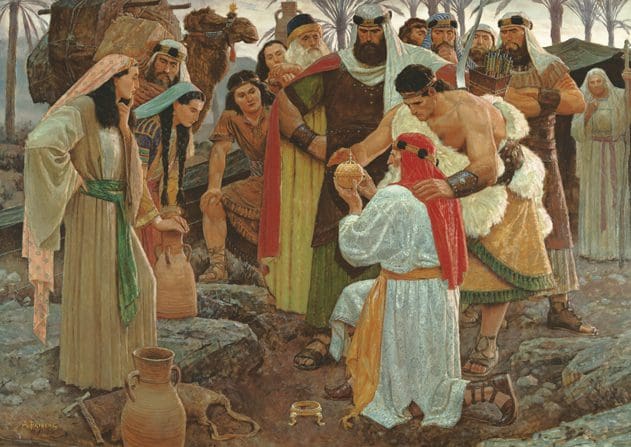
To sign up for Meridian’s Free Newsletter, please CLICK HERE.
For several years we enjoyed a look at classic literary works with Marilyn Green Faulkner in her column “Back to the Best Books.” We are happy to welcome Marilyn back to Meridian, and this time she brings her unique approach to the Book of Mormon. If you’ve ever had trouble connecting the scriptures to your everyday dilemmas, Marilyn has written a study guide just for you.
Marilyn’s new book, The User-friendly Book of Mormon: Timeless Truths for Today’s Challenges, will be available March 8, 2016 from Cedar Fort Publishing, but excerpts will be appearing exclusively in Meridian starting this week. For more lesson helps and excerpts from the book, go to the website, www.userfriendlybookofmormon.com.
(1 Nephi 16)
One day when Lehi looked out of the tent door, there was something new.
He “arose in the morning, and went forth to the tent door, to his great astonishment he beheld upon the ground a round ball of curious workmanship; and it was of fine brass. And within the ball were two spindles; and the one pointed the way whither we should go into the wilderness.” (1 Nephi 16:10)
But this wasn’t just a compass; it was a unique device that only worked under certain conditions: “the pointers which were in the ball… did work according to the faith and diligence and heed which we did give unto them. And there was also written upon them a new writing, which was plain to be read, which did give us understanding concerning the ways of the Lord; and it was written and changed from time to time, according to the faith and diligence which we gave unto it” (1 Nephi 16:28-29). Evan in this world of smart phones and talking watches the Liahona was a marvel.
How Do I Get One of These?
If thousands of people line up to get the latest technological device, imagine what a stir it would make if we could get our hands on a Liahona. Well, it turns out that maybe we can. We have in the Liahona a symbolic source of divine guidance that is close at hand yet requires significant spiritual preparation in order to utilize it.
What in our lives today is like the Liahona? Since it acted as a guide for Lehi and his family, and since it actually contained words from a divine source, the Liahona could symbolize the scriptures. Or, because it was something special and outside of the day-to-day routine, and because it was a little hard to understand but offered words of guidance, it might symbolize the temple. Its needles could represent the words of the living Prophets, since they responded to the everyday needs of the people. In any case, the Liahona represents the guiding spirit of God in the lives of the saints.
You Don’t Even Have to Wait in Line
The Liahona is right there, waiting at the door of your tent (or on your nightstand.) Are you stepping over it every morning rather than taking time to consult it? Taking a few minutes to read the scriptures or conference talks, or to attend a temple session often go unnoticed by others. But these quiet efforts to get in touch with God’s guidance make a significant difference in our lives. They help us to align our lives with the spiritual promptings of the Holy Ghost and with the celestial course laid before us.
Just Slightly Off Course Can be Deadly
Dieter Uchtdorf compares being in tune with spiritual guidance to the navigation of a great airliner. He tells the true story of a large passenger jet with 257 people aboard that flew from New Zealand to Antarctica in 1979. Unbeknownst to the pilots, the flight coordinates had been modified just two degrees, meaning that the plane was 28 miles east of where the pilots assumed it to be. This resulted in the airplane flying into the side of a 12,000 foot volcano, killing everyone on board. Elder Uchtdorf concludes:
“Through years of serving the Lord and in countless interviews, I have learned that the difference between happiness and misery in individuals, in marriages, and families often comes down to an error of only a few degrees. These commandments and covenants of God are like navigational instructions from celestial heights and will lead us safely to our eternal destination. It is one of beauty and glory beyond understanding. It is worth the effort. It is worth making decisive corrections now and then staying on course.”1
The commandments and covenants are the needles on the ball that keep us on a straight course, as the Liahona did the family of Lehi. And thus we see, that “by small means the Lord can bring about great things.” (1 Ne 16:29) Let’s make sure that in our hurry to get on with our day, we aren’t tripping over the very devices that can make our path homeward safe and sure.
Notes
1 Dieter F. Uchtdorf, “A Matter of a Few Degrees.” ttps://www.lds.org/general-conference/2008/04/a-matter-of-a-few-degrees?lang=eng
Why Would Lehi Offer Sacrifices Outside of Jerusalem?

“And it came to pass that we did come down unto the tent of our father. And after I and my brethren and all the house of Ishmael had come down unto the tent of my father, they did give thanks unto the Lord their God; and they did offer sacrifice and burnt offerings unto him.” (1 Nephi 7:22)
The Know
When Lehi and his family fled Jerusalem they “traveled three days in the wilderness” before Lehi “pitched his tent in a valley by the side of a river of water.” Thereupon Lehi “built an altar of stones, and made an offering unto the Lord, and gave thanks unto the Lord our God” (1 Nephi 2:6–7; cf. Exodus 20:25).[i]
Some time later, after Nephi and his brothers had returned from retrieving the brass plates from Laban, Lehi and his family gave “thanks unto the Lord their God; and they did offer sacrifice and burnt offerings unto him” for the safe return (1 Nephi 7:22).
Lehi offering sacrifices outside the confines of the Jerusalem temple seems to be in violation of a commandment given in Deuteronomy 12, which has been interpreted by some as stipulating that sacrifices are only to be offered at the temple (cf. Deuteronomy 12: 5–6, 10–11, 13–14). If this is so, then the Book of Mormon would appear to contradict the biblical record, which might call into question the authenticity of Lehi and his family as being strict in keeping the Law of Moses.
Although this reading is understandable, BYU professor David Rolph Seely challenged this approach through a number of points.[ii]

First, according to Seely, it is possible that “Deuteronomy 12 did not intend to eliminate all sacrifice away from the main sanctuary.” In fact, “altars and sacrifice and even other temples continued at various places” outside of Jerusalem, which is unquestionably verified by archaeology.[iii]
Second, “Melchizedek Priesthood holders were not bound by the centralization of worship as prescribed by Deuteronomy 12,” which would make sense in the case of Lehi, a non-Levite (1 Nephi 5:14). “The fact that the patriarchs of old, officiating with Melchizedek Priesthood authority, built altars and offered sacrifice in various locations,” argued Seely, “suggest that the centralized worship prescribed in Deuteronomy was either misunderstood or was part of the lower law—a temporary law—that was fulfilled with the atonement of Jesus Christ.”[iv]
Third, and finally, “Deuteronomy 12 may have been interpreted anciently as applying only to the land of Israel.”[v]
As Seely noted, one of the texts of the Dead Sea Scrolls, the Temple Scroll (11QT)[vi], specifically noted that sacrifices were not to be offered outside of Jerusalem within a three days’ journey. As such, “the building of an altar and the offering of sacrifice were allowed only outside the radius of a three days’ journey from the temple in Jerusalem. To put the matter differently, sacrifices beyond the three-day limit were acceptable under the law of Moses.”[vii]
Latter-day Saint scholar S. Kent Brown also explored the nature of Lehi’s sacrifices and concluded that Lehi offered both “peace offerings” for the family’s safety and “burnt offerings” for the family’s sins. Concerning the “peace offering,” Brown explained that “in all of its forms this offering was an occasion for rejoicing, a happy state that Nephi highlights for us when recounting the mood of Lehi’s sacrifice after the sons returned with the brass plates: ‘Their joy was full’” (1 Nephi 5:7).
This last observation emphasizes the importance for Lehi of remembering to give thanks to the Lord even out of what must have been, at that point, very precious foodstuffs in his meager provisions[viii] With regard to the “burnt offerings,” Brown concluded,
Lehi was bringing to the altar sacrifices that would atone for sin, sin that would stain the camp and those within it. In each case, one can readily detect sin in the prior behavior of family members whether it took the form of complaining, family jousts, or the taking of human life. Here, Lehi sought to free his extended family from the taint of unworthiness so that he and they would be able to carry out the purposes of the Lord.[ix]
It appears that the Book of Mormon actually responds well the nuances of the ancient Israelite sacrificial ordinances, suggesting that, instead of contradicting the biblical record, the Nephite record actually harmonizes quite well with it.

The Why
Now it becomes clear why Lehi would offer sacrifices as he left the land of Jerusalem. From the research provided by Professor Seely, it would appear that Lehi understood the book of Deuteronomy to allow sacrifices, especially thanksgiving sacrifices, at various locations.
Moreover, the fact that Lehi was three days away from Jerusalem may have placed him, in any event, beyond the regulated sphere of the Temple in Jerusalem, as evidence from the Dead Sea Scrolls arguably confirms. Thus, Lehi set an important example for his family in living the law promptly and conscientiously.
By offering sacrifices, Lehi and his family fulfilled not only the Law of Moses but also a duty that comes from God’s law of gratitude (cf. Psalm 100; D&C 46:32). That Nephi twice made special mention of his father’s sacrifices, even in spite of his perilous and uncertain circumstances, would indicate that both of them were acutely aware of the importance of showing thanks and gratitude to God for his blessings.
All of this shows that for Nephi and Lehi, the law of sacrifice was made for man, and not man for the law of sacrifice (cf. Mark 2:27). For these many reasons, Lehi would not and did not fail to make sacrifices when he arrived safely at his first camp south of Jerusalem.
Further Reading
David Rolph Seely, “Lehi’s Altar and Sacrifice in the Wilderness,” Journal of Book of Mormon Studies 10, no. 1 (2001): 62–69, 80.
- Kent Brown, “What Were Those Sacrifices Offered by Lehi?” in From Jerusalem to Zarahemla: Literary and Historical Studies of the Book of Mormon(Provo, UT: Religious Studies Center, Brigham Young University, 1998), 1–8.
[i] Hugh Nibley has pointed out that this is action by Lehi is consistent with ancient Semitic practice. See Hugh Nibley, An Approach to the Book of Mormon (Provo: Deseret Book and FARMS, 1988), 245–46;
[ii] David Rolph Seely, “Lehi’s Altar and Sacrifice in the Wilderness,” Journal of Book of Mormon Studies 10, no. 1 (2001): 62–69, 80.
[iii] Seely, “Lehi’s Altar and Sacrifice in the Wilderness,” 66; On temples and cult sites outside of Jerusalem, see generally Philip J. King and Lawrence E. Stager, Life in Biblical Israel (Louisville, Kentucky: Westminster John Knox Press, 2001), 330–340.
[iv] Seely, “Lehi’s Altar and Sacrifice in the Wilderness,” 67–68.
[v] Seely, “Lehi’s Altar and Sacrifice in the Wilderness,” 68.
[vi] The relevant passage from 11QT (11Q19 52:13–15) specifically reads, “You shall not slaughter a clean ox or sheep or goat in all your towns, near to my temple (within) a distance of a three-days’ journey; nay, but inside my temple you shall slaughter it, making it a burnt offering or a peace offering.” Donald W. Parry and Emanuel Tov, The Dead Sea Scrolls Reader: Volume I (Leiden/Boston: Brill, 2013), 689—99.
[vii] Seely, “Lehi’s Altar and Sacrifice in the Wilderness,” 69.
[viii] S. Kent Brown, “What Were Those Sacrifices Offered by Lehi?” in From Jerusalem to Zarahemla: Literary and Historical Studies of the Book of Mormon (Provo, UT: Religious Studies Center, Brigham Young University, 1998), 2.
[ix] Brown, “What Were Those Sacrifices Offered by Lehi?” 6.
Why Does Nephi Always Go ‘Down to the Wilderness’, and ‘Up to Jerusalem?’

“Wherefore, the Lord hath commanded me that thou and thy brothers should go unto the house of Laban, and seek the records, and bring them down hither into the wilderness.” (1 Nephi 3:4)
The Know

As Nephi describes movements back and forth between Jerusalem and the wilderness, he consistently describes going up while moving toward Jerusalem and going down while moving away from Jerusalem.
Hugh Nibley was among the first to notice this subtle detail. “The Book of Mormon employs the expressions ‘to go down’ and ‘to go up’ exactly as the Hebrews and Egyptians did with reference to the location of Jerusalem.”[i]
Archaeologist Jeffrey R. Chadwick elaborated on this point:
It is important to remember that in the idiom of Nephi one always went up to come to the Jerusalem region, and one always went down when exiting the Jerusalem region. This is also the Hebrew idiom employed in the Bible, where persons in both the Old and New Testaments typically are said to go down to leave Jerusalem (see, for example, 2 Samuel 5:17; Luke 10:30; and Acts 8:15) and go up to come to Jerusalem (see, for example, 2 Chronicles 2:16 and Matthew 20:18).[ii]
This idiom is the product of the physical surroundings in the region of Jerusalem.
Kelly Ogden, who studied the historical geography of the Bible, explains, “Approaching Jerusalem from any wilderness requires an increase in elevation. All the locative adverbs in the next pages of scripture accurately depict the topography of Judah and the deserts to the south.”[iii]
This reality is made dramatically evident in the contrast in elevation at Jerusalem, which is at approximately 2,500 ft. (754 m.) above sea level, and the Dead Sea, approximately 1,400 ft. ( 429 m.) below sea level, which is nearly a 4,000 ft. (1,200 m.) decline in elevation.
The elevation at the tip of the Gulf of Aqaba, the branch of the Red Sea Lehi likely encamped near (see 1 Nephi 2:5–6) is a mere 20 ft. (6 m.) above sea level. As Lehi’s sons traveled back and forth between their camp and Jerusalem, they were literally trekking up to Jerusalem and then back down into the wilderness.
The Why
In the big picture, this is a minor detail, which is subtle and easy to miss. It is also one that would have been easy to get wrong. It is just the kind of detail that often betrays even the best of forgeries.
The consistency in how up and down are used in the Book of Mormon tells us that the usage was natural to the author (Nephi) and gently hints that he was personally familiar with the topography of Jerusalem and the surrounding region.

There is also a great deal of meaning in this subtle detail. For ancient Israelites, the elevation of Jerusalem was symbolic of ascending toward heaven. As such, it represented holiness and was analogous to Mount Sinai, where Moses ascended to meet the Lord.
LDS biblical scholar David J. Larsen explains, “The directive for the thrice-yearly pilgrimage commanded the Israelites to ‘go up’ (ālâ)” to Jerusalem. As Larsen explains,
The Hebrew word ālâ appears to be used often as a … term in the Hebrew Bible [the Old Testament] for ascending in procession to sacred places, including going up to the promised land of Israel (i.e., from out of Egypt, e.g., Exodus 3:8, 17) and ascending the holy mountain [Sinai] (e.g., Exodus 19:20).[iv]
With this perspective, Nephi’s repeated journeys up to Jerusalem and then back down into the wilderness take on new meaning. Each ascent back to Jerusalem must have served as a somber reminder that the city they now fled had once been a holy city.
The use of “up” and “down” in relation to real world elevation has implications for Book of Mormon geography in the New World. For instance, we can know that the land of Zarahemla was at a lower elevation than the land of Nephi (see Omni 1:13, 27–28; Words of Mormon 1:13; Mosiah 7:1, 4, 13). It may also be important for understanding the story of the Zeniff colony.
After the first Mosiah led the people down to the land of Zarahemla (Omni 1:13), a group returned up to the land of Nephi, because they “were desirous to possess the land of their inheritance” (Omni 1:27). For the Nephites, the land of Nephi, being on higher ground, seemed to be the new holy land, and Zeniff’s people wanted to reclaim it.
This may be reflected in the attitude of King Noah’s priests, who quoted Isaiah 52:7–10 (Mosiah 12:21–24), which praises the feet of those “upon the mountains” who “publisheth peace.” They may have seen themselves as fulfilling this prophecy and establishing Zion in the mountains.
Details matter, even the seemingly small and insignificant details. These features reinforce that the Book of Mormon is what Joseph claimed it to be, an ancient text originally situated in Jerusalem.
Further Reading
David J. Larsen, “Ascending into the Hill of the Lord: What the Psalms Can Tell Us About the Rituals of the First Temple,” in Ancient Temple Worship: Proceedings of the Expound Symposium 14 May 2011, ed. Matthew B. Brown, Jeffrey M. Bradshaw, Stephen D. Ricks, and John S. Thompson (Orem, UT and Salt Lake City, UT: Interpreter Foundation and Eborn Books, 2014), 171–188.
Jeffrey R. Chadwick, “Lehi’s House at Jerusalem and the Land of His Inheritance,” in Glimpses of Lehi’s Jerusalem, ed. John W. Welch, David Rolph Seely, and Jo Ann H. Seely (Provo, UT: FARMS, 2004), 81–130.
[i] Hugh Nibley, Lehi in the Desert/The World of the Jaredites/There Were Jaredites, The Collected Works of Hugh Nibley: Volume 5 (Salt Lake City/Provo, UT: Deseret Book and FARMS, 1988), 7.
[ii] Jeffrey R. Chadwick, “Lehi’s House at Jerusalem and the Land of His Inheritance,” in Glimpses of Lehi’s Jerusalem, ed. John W. Welch, David Rolph Seely, and Jo Ann H. Seely (Provo, UT: FARMS, 2004), 84–85.
[iii] D. Kelly Ogden, “Answering the Lord’s Call (1 Nephi 1-7),” in The Book of Mormon: Part 1—1 Nephi–Alma 29, Studies in Scripture: Volume 7, ed. Kent P. Jackson (Salt Lake City, UT: Deseret Book, 1987), 27.
[iv] David J. Larsen, “Ascending into the Hill of the Lord: What the Psalms Can Tell Us About the Rituals of the First Temple,” in Ancient Temple Worship: Proceedings of the Expound Symposium 14 May 2011, ed. Matthew B. Brown, Jeffrey M. Bradshaw, Stephen D. Ricks, and John S. Thompson (Orem, UT and Salt Lake City, UT: Interpreter Foundation and Eborn Books, 2014), 174–175.

FEATURES