





Former Relief Society General President Bonnie D. Parkin dies at age 84

The following is excerpted from the Church Newsroom. Read the article here.
President Bonnie D. Parkin, 14th Relief Society General President of The Church of Jesus Christ of Latter-day Saints, died Monday, July 28, 2025, at age 84.
Prior to serving as General President from 2002 to 2007, Sister Parkin served on the Relief Society general board under Relief Society General President Elaine L. Jack and as Second Counselor to Young Women General President Janette Hales Beckham.
Read the article here.
Come Follow Me for Sunday School: “There Could Not Be a Happier People”, 3 Nephi 27 – 4 Nephi

Cover image: Christ’s Prayer, by Derek Hegsted.
After two days of rich spiritual experiences, the resurrected Christ appeared once again to his “other sheep. As 3 Nephi 27 opens, we see the Nephite Apostles gathered together in “mighty prayer and fasting.” When Jesus appeared, he asked them, “What will ye that I shall give unto you?”
Imagine being asked that question! Their answer was surprising—“we will that thou wouldst tell us the name by which we shall call this church.” Apparently there had been disputations among the people about this matter. They already knew how the Lord felt about disputations. One of the first things he had told them after introducing himself was—“there shall be no disputations among you.” Why disputations arose among the Nephites concerning the name of the church is not clear.
“How be it my church save it be called in my name?” (3 Nephi 27:8)
There have been many General Conference addresses over the years where prophets have counseled that the correct name of the Church be used.
In April 1948, President George Albert Smith said, “Don’t let the Lord down by calling this the Mormon Church. He didn’t call it the Mormon Church. It is all right for us to believe in the Book of Mormon. He expects us to do that, but he told us what to call this Church.”
In November 1971, President Harold B. Lee said, “When [the Lord] revealed the name by which the Church was to be called, he used some interesting expressions. … He didn’t say Mormon Church; he didn’t say LDS Church, but the clear, firm, unequivocal statement, ‘even The Church of Jesus Christ of Latter-day Saints.’”
Elder Russell M. Nelson said in April 1990, “Note carefully the language of the Lord. He did not say, ‘Thus shall my church be named.’ He said, ‘Thus shall my church be called.’ … Before any other name is considered to be a legitimate substitute, the thoughtful person might reverently consider the feelings of the Heavenly Parent who bestowed that name.”
In an Ensign article in March 1994, Dallin H. Oaks wrote, “The First Presidency has requested that we not refer to ourselves as ‘the Mormon Church’ but by the name the Lord gave his church by revelation: ‘The Church of Jesus Christ of Latter-day Saints’”.
In a “Letter to Members of the Church,” the First Presidency (Gordon B. Hinckley, Thomas S. Monson, and James E. Faust), issued February 23, 2001, this plea is renewed: “The use of the revealed name, The Church of Jesus Christ of Latter-day Saints, is increasingly important in our responsibility to proclaim the name of the Savior throughout all the world. Accordingly, we ask that when we refer to the Church we use its full name wherever possible.”
In the May 2011 Liahona, Boyd K. Packer wrote: “Obedient to revelation, we call ourselves The Church of Jesus Christ of Latter-day Saints rather than the Mormon Church. It is one thing for others to refer to the Church as the Mormon Church or to us as Mormons; it is quite another for us to do so.” M. Russell Ballard, wrote in the same publication three years later in May 2014, “[T]he Lord makes clear that [the full name of the church] is not only a formal title but also the name by which His Church is to be called. Given His clear declaration, we should not refer to the Church by any other name, such as ‘Mormon Church’ or ‘LDS Church.’”
However, the nicknames of the Church still persisted. This all changed in October 2018 General Conference where President Nelson delivered an address titled, “The Correct Name of the Church” where he strongly expressed his desire that the name used by the Church be corrected. This time, the change was going to happen, no matter what the costs might be, financial and otherwise. (I was the mission secretary at the time in California, and the changes we had to make in missionary email addresses, missionary support websites, etc. were massive! I can only imagine what it was like for those who had to make all the world-wide adjustments.)
President Nelson said:
The Lord impressed upon my mind the importance of the name He decreed for His Church, even The Church of Jesus Christ of Latter-day Saints. As you would expect, responses to this statement and to the revised style guide have been mixed. Many members immediately corrected the name of the Church on their blogs and social media pages. Others wondered why, with all that’s going on in the world, it was necessary to emphasize something so “inconsequential.” And some said it couldn’t be done, so why even try? Let me explain why we care so deeply about this issue. But first let me state what this effort is not:
It is not a name change.
It is not rebranding.
It is not cosmetic.
It is not a whim.And it is not inconsequential.
Instead, it is a correction. It is the command of the Lord. Joseph Smith did not name the Church restored through him; neither did Mormon. It was the Savior Himself who said, “For thus shall my church be called in the last days, even The Church of Jesus Christ of Latter-day Saints.”
President Nelson then quoted the verses we have been discussing from 3 Nephi 27:
“Ye shall call the church in my name. …
“And how be it my church save it be called in my name? For if a church be called in Moses’ name then it be Moses’ church; or if it be called in the name of a man then it be the church of a man; but if it be called in my name then it is my church.”
He continued:
Thus, the name of the Church is not negotiable. When the Savior clearly states what the name of His Church should be and even precedes His declaration with, “Thus shall my church be called,” He is serious. And if we allow nicknames to be used or adopt or even sponsor those nicknames ourselves, He is offended.
What’s in a name or, in this case, a nickname? When it comes to nicknames of the Church, such as the “LDS Church,” the “Mormon Church,” or the “Church of the Latter-day Saints,” the most important thing in those names is the absence of the Savior’s name. To remove the Lord’s name from the Lord’s Church is a major victory for Satan. When we discard the Savior’s name, we are subtly disregarding all that Jesus Christ did for us—even His Atonement.
Next, President Nelson ties the name of the Church to the promises we made to Christ at our baptism, and which we renew weekly through the ordinance of the sacrament.
Every Sunday as we worthily partake of the sacrament, we make anew our sacred promise to our Heavenly Father that we are willing to take upon us the name of His Son, Jesus Christ. We promise to follow Him, repent, keep His commandments, and always remember Him.
When we omit His name from His Church, we are inadvertently removing Him as the central focus of our lives.
I love how President Nelson was not dissuaded from this necessary correction by the magnitude of this task in this age of digital technology:
Brothers and sisters, there are many worldly arguments against restoring the correct name of the Church. Because of the digital world in which we live and with search engine optimization that helps all of us find information we need almost instantly—including information about the Lord’s Church—critics say that a correction at this point is unwise. Others feel that because we are known so widely as “Mormons” and as the “Mormon Church,” we should make the best of it.
If this were a discussion about branding a man-made organization, those arguments might prevail. But in this crucial matter, we look to Him whose Church this is and acknowledge that the Lord’s ways are not, and never will be, man’s ways.
Lastly, President Nelson promises that the Lord will bestow unimaginable blessings upon the members of his church if they endeavor to restore the correct name of the Church:
My dear brothers and sisters, I promise you that if we will do our best to restore the correct name of the Lord’s Church, He whose Church this is will pour down His power and blessings upon the heads of the Latter-day Saints, the likes of which we have never seen. We will have the knowledge and power of God to help us take the blessings of the restored gospel of Jesus Christ to every nation, kindred, tongue, and people and to prepare the world for the Second Coming of the Lord.
Christ Defines His “Gospel” – “The Doctrine of Christ”
Although the church being called after Christ’s name is a necessary condition for it to be his church, it is not sufficient. Jesus stated that “if it be called in my name then it is my church, if it so be that they are built upon my gospel” (3 Nephi 27:8; emphasis added).
Robert Millett provided these insights:
Anyone can organize a church. Anyone can name that church The Church of Jesus Christ. And yet, as the Master affirms, it will not be his church unless it is built upon his gospel. We cannot really be built upon Christ’s gospel if we do not believe in the divinity of Jesus Christ. Those who labor tirelessly to lighten burdens or alleviate human suffering but at the same time deny the fact that Jesus Christ is God cannot have the lasting impact on society that they could have through drawing upon those spiritual forces that center in the Lord Omnipotent. (“This Is My Gospel” in The Book of Mormon: 3 Nephi 9–30)
Without of the fulness of the gospel, many worldly ideas and movements seek to occupy center stage. Some in today’s world focus upon Jesus as a loving teacher, guide, and moral leader, but downplay the fact of his divinity. Even those who teach in schools offering doctorates in Theology often lack faith, and emphasize scholarship, and topics such as such as “textual criticism,” rather than spiritual matters.
I love this quote from C. S. Lewis:
I’m ready to accept Jesus as a great moral teacher, but I don’t accept His claim to be God.’ That is the one thing we must not say. A man who was merely a man and said the sort of things Jesus said would not be a great moral teacher. He would either be a lunatic-on a level with the man who says he is a poached egg-or else he would be the Devil of Hell. You must make your choice. Either this man was, and is, the Son of God: or else a madman or something worse. You can shut Him up for a fool, you can spit at Him and kill Him as a demon; or you can fall at His feet and call Him Lord and God. But let us not come with any patronising nonsense about His being a great human teacher. He has not left that open to us. He did not intend to. (Mere Christianity, 55-56)
One of Christ’s most straightforward proclamations regarding the essence of the gospel can be found in 3 Nephi 27, beginning in verse 13: “Behold I have given unto you my gospel, and this is the gospel which I have given unto you—that I came into the world to do the will of my Father, because my Father sent me.” Jesus’s commitment to do whatever the Father asked him is perhaps the ultimate expression of what the gospel is all about. This response of Jesus becomes a pattern for our response to the will of Jesus Christ, that is, being willing to do all he asks of us.
And what was the Father’s will for his son? 3 Nephi 27:14-15:
And my Father sent me that I might be lifted up upon the cross; and after that I had been lifted up upon the cross, that I might draw all men unto me, that as I have been lifted up by men even so should men be lifted up by the Father, to stand before me, to be judged of their works, whether they be good or whether they be evil—
And for this cause have I been lifted up; therefore, according to the power of the Father I will draw all men unto me, that they may be judged according to their works.
I love the image of Christ being lifted up so that by him all men may be lifted up to stand in the presence of the Father. This privilege will be given to all mankind, but how long they are allowed to remain in his presence is according to how well they have lived by the principles of his gospel. In the next few verses, Christ defines exactly what his “gospel” means.
Richard O. Cowan has summarized the gospel plan in the following ten statements: (See “The Church Shall Bear My Name and Be Built upon My Gospel” in The Book of Mormon: 3 Nephi 9–30)
1. All will be judged according to their works. “I [will] draw all men unto me, . . . to be judged of their works (3 Nephi 27:14).
2. No unclean thing can enter God’s presence. “And no unclean thing can enter into his kingdom” (3 Nephi 27:19).
3. God sent Christ to be crucified for the sins of the world. “My Father sent me that I might be lifted up upon the cross” (3 Nephi 27:14; see also John 3:16).
4. Only through Christ’s atoning blood can we become clean. “Therefore nothing entereth into his rest save it be those who have washed their garments in my blood” (3 Nephi 27:19).
5. In the light of point number four, faith in the Savior is the logical and obvious first principle of the gospel. The righteous will be cleansed “because of their faith” (3 Nephi 27:19).
6. We must repent of all our sins. “Repent, all ye ends of the earth” (3 Nephi 27:20).
7. Baptism continues the cleansing process. “Come unto me and be baptized in my name” (3 Nephi 27:20).
8. We are sanctified through receiving the Holy Ghost. We are to be “sanctified by the reception of the Holy Ghost, that [we] may stand spotless before [him] at the last day” (3 Nephi 27:20).
9. We must remain faithful to the end. Salvation comes only to those who continue in “faithfulness unto the end” (3 Nephi 27:19). Note how in this verse the Lord employs both “faith” (referring to our trust in him) and “faithfulness” (referring to our resulting good works).
10. By following the gospel of Jesus Christ, we will be exalted in the celestial kingdom. “Therefore, if ye do these things blessed are ye, for ye shall be lifted up at the last day” (3 Nephi 27:22). Interestingly, the phrase “lifted up” is used not only in reference to the Savior’s crucifixion, but it also refers to our ultimate exaltation (D&C 5:35).
This message is also called the “doctrine of Christ” by Nephi (son of Lehi) in 2 Nephi 31:17, 20:
For the gate by which ye should enter is repentance and baptism by water; and then cometh a remission of your sins by fire and by the Holy Ghost ….Wherefore, if ye shall press forward, feasting upon the word of Christ, and endure to the end, behold, thus saith the Father: Ye shall have eternal life.
Joseph Smith taught:
Baptism is a sign to God, to angels, and to heaven that we do the will of God, and there is no other way beneath the heavens whereby God hath ordained for man to come to Him to be saved, and enter into the Kingdom of God, except faith in Jesus Christ, repentance, and baptism for the remission of sins, and any other course is in vain; then you have the promise of the gift of the Holy Ghost. (TPJS 198)
After baptism, those who take upon them the name of Christ seek to be led by the power of the Holy Ghost. 2 Nephi 32:3 and 5 tell us to “feast upon the words of Christ” because they will “tell you all things what ye should do.” However, the words of Christ are not necessarily written in scripture, for the Holy Ghost “will show unto you all things that ye should do.” Each person who has taken the Holy Ghost as his/her guide is entitled to the personal revelation needed to make good decisions as he/she travels on the strait and narrow path that leads to life eternal.
The Desire of the Three Nephites
The next chapter, 3 Nephi 28, records one of the most intriguing accounts in the Book of Mormon. This is the final day of the Savior’s formal three-day ministry among his “other sheep.” Mormon informs us that he could not even record a “hundredth part of the things” which Jesus taught unto those people (3 Nephi 26:6). We are told that what we have is the “lesser part,” and that “greater things” would be made known to those who believe the things the Lord has given us (see 8–10). In light of what Mormon reveals to us next, I cannot imagine what these “greater things” might be! I have always wondered if those greater things were contained (at least in part) in the sealed portion of the gold plates. It would have been so much easier to carry and hide the smaller portion Joseph actually translated. Was the sealed portion included as a reminder to all of us that there were greater things?
Jesus spoke to each of his disciples, “one by one,” and asked them, “What is it that ye desire of me, after that I am gone unto the Father?” (3 Nephi 28:1). I can only imagine what that must have been like! The possibilities seem overwhelming.
The request of the nine was to come immediately into the kingdom of God upon death, which is the wish of many of the faithful. But the desire of the three to remain on the earth that they “might bring the souls of men unto [Christ], while the world shall stand” is a “greater work” (see 3 Nephi 28:9). Christ told Peter, “Thou desiredst that thou mightest speedily come unto me in my kingdom. I say unto thee, Peter, this was a good desire; but my beloved has desired that he might do more, or a greater work yet among men than what he has before done” (Doctrine and Covenants 7:4-5).
Characteristics of the Three Nephites
Clyde Williams identifies ten major characteristics recorded by Mormon concerning these three individuals. (“The Three Nephites and the Doctrine of Translation” in The Book of Mormon: 3 Nephi 9–30)
- They, like John the Revelator, will “never taste of death” (3 Nephi 28:7). In the words of the Prophet Joseph Smith, “Translated bodies cannot enter into rest until they have undergone a change equivalent to death” (TPJS 191).
- They will “be changed in the twinkling of an eye from mortality to immortality” (3 Nephi 28:8). “This change from mortality to immortality, though almost instantaneous, is both a death and a resurrection” (McConkie, Mortal Messiah 4:390). There is no funeral, no mourning, no grave. For translated beings, their death is more like an ordinance than a time of parting and separation.
- The Three Nephites were told they would experience no pain while they dwelt in the flesh. They are not subject to disease or suffering that commonly afflict man. However, like God, they do experience sorrow “for the sins of the world” (3 Nephi 28:9). Sometime between AD 245 and 300 the wickedness among the Lamanites and Nephites became so widespread that “the disciples began to sorrow for the sins of the world” (4 Nephi 1:44). By AD 326 the wickedness had become so prevalent that the Lord took the Three Nephites away from openly ministering among the people (Mormon 1:13; 8:10).
- For the twelve Nephite disciples, the glorious final day the Savior spent among the Nephites was in effect a Judgment Day. They were given the promise of entering with the Savior into his kingdom. They were promised that they would be even as the Savior is, and like the Father. It was a sure promise to mortal men that they could become gods.
- Translated beings have knowledge and wisdom given unto them that exceed human perspective. The Three Nephites were “caught up into heaven, and saw and heard unspeakable things” (3 Nephi 28:13; see also 13:36). We do not know what wisdom and glory they received, what future visions they beheld, as they were forbidden to speak of what they saw and heard, even being denied the “power that they could utter the things which they saw and heard” (28:14; emphasis added). Perhaps one additional idea is worth our consideration at this point. The Lord entrusted this sacred knowledge with the Three Nephites because he knew they could be trusted. He knew they would keep confidential those things revealed to them. Mormon was careful to let us know that while these three began to minister upon the face of the earth, “they did not minister of the things which they had heard and seen because of the commandment which was given them in heaven” (3 Nephi 28:16).
- As Mormon began writing and editing this portion of the Nephite history, he was uncertain as to the actual condition or state of the Three Nephites. Were they mortal or immortal (3 Nephi 28:15, 17)? Only after inquiring of the Lord did he come to the knowledge that they had experienced a change in their bodies. While they were no longer subject to pain and sickness, “this change was not equal to that which shall take place at the last day [the resurrection]” (vv 38–39).The scriptures are not clear on the exact differences between transfigured beings and translated beings. However, the scriptural use of these terms seems to indicate “that transfiguration is more temporary, as in Matthew 17:1–9 and Moses 1:11, occurring primarily to permit one to behold spiritual things not possible in the mortal condition” (Mark McConkie, Encyclopedia of Mormonism 4:1486). Conversely, “translated beings experience a long-term change” that culminates at the time of their resurrection (Mouritsen in the Encyclopedia of Mormonism 4:1485). It appears that these Nephite disciples were first transfigured and then translated.
- Another blessing enjoyed by translated beings is that wicked or evil men and women have no power over them. Three times they were cast into fiery furnaces and twice into dens of wild beasts their enemies. However, the Lord delivered them each time without harm (see 3 Nephi 28:21–22; 4 Nephi 1:32–33)The scriptures indicate that these three disciples were able to use “the power of the word of God” to destroy the prison walls and to deliver themselves out of the depths of the earth (4 Nephi 1:30). Like Enoch of old and Nephi, the son of Helaman, these translated Nephites had such power that all things were done according to their word (see Hel 10:5–10; Moses 7:13).
- They have the power to show themselves to whomsoever they desire. And the converse is true. They can keep themselves from being seen by anyone they do not want to see them. The only stipulation required for them to show themselves is that they must pray to the Father in the name of Jesus for that power.Mormon declares, “They are as the angels of God” (3 Nephi 28:30). This would seem to mean that travel and distances are of no consequence to them. Mormon prophesied that “great and marvelous works shall be wrought by them, before the great and coming day” of the Lord (v 31).
- One of the most significant characteristics of the Three Nephites is that Satan can “have no power over them” (3 Nephi 28:39). Like some in king Benjamin’s day, they had “no more disposition to do evil, but to do good continually” (Mosiah 5:2). The fact that Satan could no longer tempt these three is further evidence that for them the day of judgment had been moved up.
- Mormon concluded his revealing treatise on the Three Nephites by reminding us that they were to remain in this translated state until the “judgment day of Christ,” or in the words of the Savior until “I shall come in my glory with the powers of heaven” (3 Nephi 28:7, 40).
The Ministry of the Three Nephites
Mormon identifies five major groups these Three Nephites would minister to. First, they would labor among the faithful Nephites and Lamanites who remained after the appearance of Christ on the American continent. Elder Joseph Fielding Smith declared: “While in every instance the Nephite Twelve are spoken of as disciples, the fact remains that they had been endowed with divine authority to be special witnesses for Christ among their own people” (Doctrines of Salvation 3:158; italics in original). We are told that they still continued to minister to Mormon and Moroni from time to time. Moroni revealed, “My father and I have seen them, and they have ministered unto us” (Mormon 8:11; see also 3 Nephi 28:26).
The four other groups that the Three Nephites would minister to are the Gentiles, the Jews, the scattered tribes of Israel, and all nations kindreds, tongues, and people (3 Nephi 28:27–29). We do not know the specifics of their labors among these groups, but we do know that those among whom they labor will not know them (verses 27–28). My own family history has stories where specific miracles that occurred in their lives were attributed to these three men. I can’t wait until all such stories are gathered together and we can watch them in a wonderful Fireside in the sky! I imagine that they brought many souls unto Christ “because of the convincing power of God which is in them” (v 29).
The Pursuit of Happiness, Peace and Rest
What was the result of Christ’s ministry among the Nephites? They lived in peace and happiness for 200 years. 4 Nephi is one of those gems in scripture—in the space of a few short verses we see the fruition of everything that the rest of the Book of Mormon prophets have been trying to instill in their people.
When I think of peace and happiness, I think of Abraham when he was dwelling in the land of the Chaldeans. He says, “I saw that it was needful for me to obtain another place of residence.” This verse makes me laugh, because it seems like the understatement of the year! After all, his father Terah had just allowed him to be offered as a human sacrifice! Something was missing which his soul cried out for. In the first part of Abraham 1:2 we read some interesting things.
And, finding there was greater happiness and peace and rest for me, I sought for the blessings of the fathers, and the right whereunto I should be ordained to administer the same; having been myself a follower of righteousness, desiring also to be one who possessed great knowledge, and to be a greater follower of righteousness, and to possess a greater knowledge, and to be a father of many nations, a prince of peace, and desiring to receive instructions, and to keep the commandments of God, I became a rightful heir, a High Priest, holding the right belonging to the fathers.
What were the things he perceived that he was lacking in his life? Happiness, peace, and rest. What are the things that Abraham perceived would bring him happiness, peace and rest?
Contrast Abraham’s desire with the desire of those who lived just prior to the Savior’]s coming to the Americas. Helaman 13:38 reads, “ye have sought all the days of your lives for that which ye could not obtain; and ye have sought for happiness in doing iniquity, which thing is contrary to the nature of that righteousness which is in our great and Eternal Head.” Notice two things in this verse. How did they seek for happiness? Through doing iniquity. What does Samuel say about that philosophy? That it is contrary to the nature of righteousness. How is “righteousness” qualified? “That righteousness which is in our great and eternal Head.” Who is that? Jesus Christ.
With that in mind, consider again the scripture in Abraham 1:2. What does it mean to be a “follower of righteousness”? Moses 7:47 reads, “Enoch saw the day of the coming of the Son of Man, even in the flesh; and his soul rejoiced, saying: The Righteous is lifted up, and the Lamb is slain from the foundation of the world.” In this verse, how is “The Righteous” being used? As a divine title of the Savior. How does this information affect our understanding of the verse in Abraham 1:2? Abraham, “being a follower of Jesus Christ, desiring also to be one who possessed great knowledge, and to be a greater follower of Jesus Christ, and to possess a greater knowledge.”
Why do you think knowledge was so important that it is mentioned twice in this verse? Leonardo da Vinci once said, “Knowledge of a thing engenders love of it. The more perfect the knowledge, the more fervent the love.” Notice that both times knowledge is mentioned it directly follows the desire to be a “follower of righteousness.” What type of specific knowledge do you think Abraham was referring to? The knowledge of Jesus Christ. This is the happiness, peace and rest that Abraham sought after. Consider how it relates to these verses in Doctrine and Covenants 84:19‑20, 23‑24:
19 And this greater priesthood administereth the gospel and holdeth the key of the mysteries of the kingdom, even the key of the knowledge of God.
20Therefore, in the ordinances thereof, the power of godliness is manifest.
23 Now this Moses plainly taught to the children of Israel in the wilderness, and sought diligently to sanctify his people that they might behold the face of God;
24 But they hardened their hearts and could not endure his presence; therefore, the Lord in his wrath, for his anger was kindled against them, swore that they should not enter into his rest while in the wilderness, which rest is the fulness of his glory.
Abraham sought for happiness, peace and rest, and found it in acquiring greater knowledge of Jesus Christ and using that knowledge to shape the way that he lived his life. The Nephites followed a similar path, and for a short time in their history also found happiness, peace and rest. Although we share these same goals, and are anxiously engaged in this great work, we cannot achieve this if we are too concerned with ourselves. The only way that we can overcome this is to a seek greater knowledge of Jesus Christ and seek to be a greater follower of his righteousness. This state was achieved by those who saw the resurrected Christ in America. They entered into his rest and partook of the fulness of his glory.
Characteristics of a Zion Society
However, just prior to describing the Zion society, Mormon inserted a short but very poignant warning in 3 Nephi 30:1‑2
Hearken, O ye Gentiles, and hear the words of Jesus Christ, the Son of the living God, which he hath commanded me that I should speak concerning you, for, behold he commandeth me that I should write, saying: Turn, all ye Gentiles from your wicked ways; and repentof your evil doings, of your lyings and deceivings, and of your whoredoms, and of your secret abominations, and your idolatries, and of your murders, and your priestcrafts, and your envyings, and your strifes, and from all your wickedness and abominations, and come unto me, and be baptized in my name, that ye may receive a remission of your sins, and be filled with the Holy Ghost, that ye may be numbered with my people who are of the house of Israel.
Why do you think Mormon wanted us to have this warning before reading on? Because he knew that we could also enter into that type of rest if we would heed his warnings. It also anticipates the latter half of 4 Nephi when the people forget to live by the standards which brought them that lifestyle in the first place.
The book of 4 Nephi covers the years 36 AD to 320. The first verse records that the disciples of Christ formed a church, and all who repented were “baptized in the name of Jesus,” and “received the Holy Ghost.” Notice the first principles and ordinances of the gospel are mentioned. Two years later, there were “no contentions” and disputations among them. Both Nephites and Lamanites were converted and dealt justly with one another. Not only that, but they had “all things common among them,” evidently living some form of consecration, and lived it joyfully.
Verse 5 records the “great and marvelous works” performed by the disciples, who performed “all manner of miracles” in the name of Jesus. They multiplied and became a “fair and delightsome people” (v. 10). They built cities, married and were given in marriage, and were “blessed according to the multitude of promises which the Lord had made unto them” (v. 11) They no longer observed the law of Moses, but walked after the Lord’s commandments, “continuing in fasting and prayer,” to “pray and hear the word of the Lord” (v. 12).
After a hundred years had passed away, all the disciples had passed away and there were “other disciples ordained in their stead” (v.14). Evidently, the organization of the twelve disciples in the new world was meant to continue like the twelve apostles in the old world. When a vacancy was created by the death of Judas, the remaining apostles met and prayed and chose Matthias. (See Acts 1:15-26.)
Four times in 4 Nephi (in verses 2, 13, 15, and 18), we are told there was no contention among the people. But in verse 15, we are told why: “because of the love of God which filled their hearts.” Many years have been covered in these few verses, and we might wonder why more details are not reported. The answer is that there was nothing to report because there was no drama. The people kept the commandments, and they “prospered in the land,” just as the Book of Mormon has repeatedly promised. Because of this, “surely there could not be a happier people among all the people who had been created by the hand of God” (v. 16).
There were no “manner of -ites,” in the land, and “the Lord did bless them in all their doings.” Contention is the opposite of unity, and “-ites” are evidence of division among the people. Rather than focusing on whether they were children of Nephi, or Laman, or Lemuel, they were called “children of Christ, and heirs to the kingdom of God” (v. 17).
After Nephi died, his son Amos kept the plates, and there was still peace in the land. That is until verse 20, when a small part of the people revolted from the church and had “taken upon them the name of Lamanites.” The further we go through the Book of Mormon, the more being a “Lamanite” or “Nephite” is a matter of affiliation and belief rather than lineage and birth. Generations had passed away with no “-ites.”, so when this division begins, we notice that it doesn’t say the Lamanites revolted, but that a small part of the people took upon themselves the name of Lamanites. In verse 36, “there arose a people who were called the Nephites.” Verse 38 explains, “those who rejected the gospel were called Lamanites.” So we see that the people were distinguishing themselves more by belief than by their genealogy. This is an important point, because the Lamanites who survived the final battle could have been descendants of Nephi as well as Laman, meaning, modern day Lamanites are as well.
Notice that one of the central characteristics of the Book of Mormon people when they were prosperous is that they cared more about the group as a whole, than they did about their own individual needs. President Spencer W. Kimball once said:
[Bringing about Zion] can only be done through consistent and concerted daily effort by every single member of the Church…. First, we must eliminate the individual tendency to selfishness that snares the soul, shrinks the heart, and darkens the mind…. Second, we must cooperate completely and work in harmony one with another….Third, we must lay on the altar and sacrifice whatever is required by the Lord. We begin by offering a “broken heart and contrite spirit.” We follow this by giving our best effort in our assigned fields of labor and callings. We learn our duty and execute it fully. Finally we consecrate our time, talents, and means as called upon by our file leaders and as prompted by the whisperings of the Spirit. (Spencer W. Kimball, Ensign (May 1978), p. 81.)
In contrast, notice what the characteristics of the society were when it began to deteriorate. Suddenly the individual began to be the most important thing and everything collapsed. There is a great lesson there for all of us. We live in a world where the individual is set upon a pedestal. People are more interested in “what’s in it for me” than they are with how others will be helped.
The peaceful society of 4 Nephi reminds us of the future day ofthe Millennium. During the Millennium, what is it that will bind Satan? 1 Nephi 22:26 tells us that it is “the righteousness of the people.” It follows then that the loosing agent will be the unrighteousness of the people. Was this the case in 4 Nephi? What was the most prominent symptom of their unrighteousness? The exaltation of the individual and the ensuing pride which always follows it. In both the old world and the new, the people weren’t able to maintain their level of righteousness. In 4 Nephi, the people practiced prayer, fasting, and study of the words of the Lord, but then it appears that everything very quickly begins to deteriorate.
The End of the Zion Society
We are told that “there were those who were lifted up in pride, such as the wearing or costly apparel, and all manner of fine pearls…” (v. 24) We see the frightening “P” word appearing after a long absence. And I am not referring to pearls. These have been the happiest of people on the face of the earth! What has changed? CS Lewis stated that “the essential vice, the utmost evil, is Pride. Unchastity, anger, greed, drunkenness . . . are mere flea bites in comparison: it was through Pride that the devil became the devil: Pride leads to every other vice: it is the complete anti-God state of mind.” (Mere Christianity) The Lord has stated that “if ye are not one, ye are not mine” (D&C 38:27, see also 1 Peter 3:8, John 17:11, Mosiah 18:21, Moses 7:18).
In my own scriptures, I have printed off President Ezra Taft Benson’s landmark talk “Beware of Pride” which is divided into verses, like the scriptures. In this talk, given in April 1989, he gave asks a critical question:
The Doctrine and Covenants tells us that the Book of Mormon is the “record of a fallen people.” (D&C 20:9.) Why did they fall? This is one of the major messages of the Book of Mormon. Mormon gives the answer in the closing chapters of the book in these words: “Behold, the pride of this nation, or the people of the Nephites, hath proven their destruction.” (Moro. 8:27.) And then, lest we miss that momentous Book of Mormon message from that fallen people, the Lord warns us in the Doctrine and Covenants, “Beware of pride, lest ye become as the Nephites of old.” (D&C 38:39.)
I earnestly seek an interest in your faith and prayers as I strive to bring forth light on this Book of Mormon message—the sin of pride. This message has been weighing heavily on my soul for some time. I know the Lord wants this message delivered now.
President Benson said that the Book of Mormon was written for our day, and its scriptures are to be likened unto ourselves. His words are still compelling:
Most of us think of pride as self-centeredness, conceit, boastfulness, arrogance, or haughtiness. All of these are elements of the sin, but the heart, or core, is still missing.
The central feature of pride is enmity—enmity toward God and enmity toward our fellowmen. Enmity means “hatred toward, hostility to, or a state of opposition.” It is the power by which Satan wishes to reign over us.
Pride is essentially competitive in nature. We pit our will against God’s. When we direct our pride toward God, it is in the spirit of “my will and not thine be done.”
What is the difference between this community in the new world and Enoch’s city of Zion?
And the Lord called his people Zion, because they were of one heart and one mind, and dwelt in righteousness; and there was no poor among them.
And Enoch continued his preaching in righteousness unto the people of God. And it came to pass in his days, that he built a city that was called the City of Holiness, even Zion. And it came to pass that the Lord showed unto Enoch all the inhabitants of the earth; and he beheld, and lo, Zion, in process of time, was taken up into heaven. And the Lord said unto Enoch: Behold mine abode forever. (Moses 7:18‑19, 21)
Note that Enoch continued in preaching and that it was only in the process of time that the city was taken into heaven. In Doctrine and Covenants 107:48‑49, we learn that Enoch lived in a Zion state for 365 years. How long did the Nephites last in a Zion state?167 years. Does that mean that if that community had continued for another 200 years that they would have been translated? For many years, even those that were not eyewitnesses to the resurrected Christ had made the choice to have faith in their words, and had continued living in peace for decade upon decade. It was only when pride and the loss of unity became a characteristic of the people that the society changed. It appears that the Lord waits until his people have proven that they will always do his will. That they will always make the choice to have faith, even though the possibility of doubt exists. The disciples in the promised land of America, as a whole, failed to prove that they could do that. Instead, they again split into factions.
4 Nephi 1:46‑48:
46 And it came to pass that the robbers of Gadianton did spread over all the face of the land; and there were none that were righteous save it were the disciples of Jesus. And gold and silver did they lay up in store in abundance, and did traffic in all manner of traffic.
47 And it came to pass that after three hundred and five years had passed away, (and the people did still remain in wickedness) Amos died; and his brother, Ammaron, did keep the record in his stead.
48 And it came to pass that when three hundred and twenty years had passed away, Ammaron, being constrained by the Holy Ghost, did hide up the records which were sacred—yea, even all the sacred records which had been handed down from generation to generation, which were sacred—even until the three hundred and twentieth year from the coming of Christ.
The startlingly rapid decline of the Nephites who had so much that was so good can be understood if we realize that their government was a theocracy. If you take that away, the people are left to their own devices to organize society. After having the ideal government, anything less is a slow spiral downhill. We see the people forming something of a tribal or family subculture of the society. Notice that the economy revolved around the trafficking of “gold and silver.” Ammaron was constrained to hide up the sacred records. The society had become focused on materialism, to the point that it could not tolerate the spiritual. And as we will see in the record of Mormon in the next six chapters, the result is the complete destruction of the Nephite society.
God’s Law Governing the Land of Promise
The Book of Mormon begins and ends with the destruction of a people. The first people to be destroyed are those in Jerusalem. At the end of the Book of Mormon, the entire Nephite nation comes to an end.The Book of Ether records the destruction of yet another people—the Jaredites. The Lord tells us that he confirms his word in the mouth of two or three witnesses. These societies are witnesses of the results of his covenants being broken. One of the great messages of the Book of Mormon is this warning. Moroni is especially warning us in the latter days. When you see these things happen, you will know how to fight them.Do we seefactions, disunity, or contention in the promised land of America today?
There is a LAW that governs promised lands – North and South America, Israel. (See Ether 2:8) The law which governs the land of promise is that “whoso should possess the land should serve him, the true and only God, or they should be swept off when the fulness of his wrath should come upon them.” The Lord says, “I hope you got that. I’m going to tell you again. Ether 2:9 reads, “this land, that it is a land of promise; and whatsoever nation shall possess it shall serve God, or they shall be swept off when the fulness of his wrath shall come upon them. And the fulness of his wrath cometh upon them when they are ripened in iniquity.” In case we still didn’t get it, the Lord repeats the message—hopefully the third time’s the charm. Ether 2:10 reads, “For behold, this is a land which is choice above all other lands; wherefore he that doth possess it shall serve God or shall be swept off; for it is the everlasting decree of God.” We make promises to God, and he makes promises to us, and he is bound to live up to them when we are obedient to his commandments. (See Doctrine and Covenants 82:10)
Ether 2:11 makes this personal:
And this cometh unto you, O ye Gentiles, that ye may know the decrees of God—that ye may repent, and not continue in your iniquities until the fulness come, that ye may not bring down the fulness of the wrath of God upon you as the inhabitants of the land have hitherto done.
He put this verse in for our benefit, because the Jaredites were already destroyed and so were the Nephites. What does “continue” suggest in the 11th verse? Iniquity has already started, and if it is allowed to CONTINUE, it will result in the “fulness” of iniquity. This is the FOUNDATION of the law which governs this land.
I wish to include a quote from the Presidential Message on the National Day of Prayer and Return, 2020 issued September 26:
As we continue to combat the challenges ahead of us, we must remember the sage words of President George Washington during his first Presidential Address: “propitious smiles of heaven can never be expected on a nation that disregards the eternal rules of order and right, which Heaven itself has ordained.” As a country and a people, let us renew our commitment to these abiding and timeless principles.
There is an UP SIDE to the promise. You will be a FREE people as long as you serve the God of the land.
Behold, this is a choice land, and whatsoever nation shall possess it shall be free from bondage, and from captivity, and from all other nations under heaven, if they will but serve the God of the land, who is Jesus Christ, who hath been manifested by the things which we have written. (Ether 2:12)
2 Ne. 10:10-14 adds light to this idea:
10 But behold, this land, said God, shall be a land of thine inheritance, and the Gentiles shall be blessed upon the land.
11 And this land shall be a land of liberty unto the Gentiles, and there shall be no kings upon the land, who shall raise up unto the Gentiles.
12 And I will fortify this land against all other nations.
13 And he that fighteth against Zion shall perish, saith God.
14 For he that raiseth up a king against me shall perish, for I, the Lord, the king of heaven, will be their king, and I will be a light unto them forever, that hear my words.
In verse 13, “Zion” is America.
Alma 45:16 is the CURSING part.
And he said: Thus saith the Lord God—Cursed shall be the land, yea, this land, unto every nation, kindred, tongue, and people, unto destruction, which do wickedly, when they are fully ripe; and as I have said so shall it be; for this is the cursing and the blessing of God upon the land, for the Lord cannot look upon sin with the least degree of allowance.
Final Thoughts
4 Nephi 1:43 states, “the people of Nephi began to be proud in their hearts because of their exceeding riches, and become vain like unto their brethren, the Lamanites.” This is a sad situation, where the believers begin to follow the world – a few steps behind, perhaps, but following nevertheless. In 1861, the Millennial Star observed:
If the breach is daily widening between ourselves and the world, as it is between the community of the Saints and the world, then we may be assured that our progress is certain, however slow. On the opposite hand, if our feelings and affections, our appetites and desires, are in unison with the world around us and freely fraternize with them…we should do well to examine ourselves. Individuals in such a condition might possess a nominal position in the Church but would be lacking the life of the work, and, like the foolish virgins who slumbered while the bridegroom tarried, they would be unprepared for His coming when it bursts upon them unexpectedly. (Oct. 5, 1861, Millennial Star 23:645-46)
When the Proclamation on the Family was given in 1995, I remember thinking that it was pretty much business as usual. But today, this document is a source of great controversy. It demonstrates that the gap between the values of the Church and the values of society has grown very wide. I am so grateful for a living prophet who has encouraged us to seek to build God’s kingdom and “Hear Him.”
I close with words from President Ezra Taft Benson:
The antidote for pride is humility—meekness, submissiveness. (See Alma 7:23.) It is the broken heart and contrite spirit. (See 3 Ne. 9:20; 3 Ne. 12:19; D&C 20:37; D&C 59:8; Ps. 34:18; Isa. 57:15; Isa. 66:2.) As Rudyard Kipling put it so well:
The tumult and the shouting dies;
The captains and the kings depart.
Still stands thine ancient sacrifice,
An humble and a contrite heart.
Lord God of Hosts, be with us yet,
Lest we forget, lest we forget.Let us choose to be humble. We can do it. I know we can.
Pride is the great stumbling block to Zion. I repeat: Pride is the great stumbling block to Zion.
We must cleanse the inner vessel by conquering pride.
We must yield “to the enticings of the Holy Spirit,” put off the prideful “natural man,” become “a saint through the atonement of Christ the Lord,” and become “as a child, submissive, meek, humble.” (Mosiah 3:19; see also Alma 13:28.)
Understanding Brigham Young’s Spiritual Depth: A Fresh Perspective

To read more from Daniel, visit his blog: Sic Et Non.
Cover image is a still from the upcoming film Six Days in August.
For many of us, the image of Brigham Young that holds sway in our minds is that of a stern, unsmiling man in his seventies. But that dour image owes more, perhaps, to the techniques and technology of early portrait photography than to the real character of the man. Moreover, he wasn’t always seventy-six. He wasn’t always in poor health and suffering from dental pain.
Brigham Young wasn’t yet thirty-five years of age when he was ordained an apostle, and he was barely forty-four when leadership of The Church of Jesus Christ of Latter-day Saints fell to him as the president and senior member of the Quorum of the Twelve.
By that time, he had established a reputation as a skilled craftsman and valued employee in western New York, where he had married, joined the Restored Church, lovingly tended a wife who was desperately ill with tuberculosis, and then, as a young widower, cared for his motherless children. With his longtime friend Heber C. Kimball—in whose home his twenty-six year-old wife had drawn her last breath—he had led impoverished refugees out of Missouri and presided over the spectacularly successful mission of the Twelve to England. There is no question that Brigham Young was a remarkably able leader and organizer.
But he was much more than that. The late Eugene England, a Stanford-educated student of literature and himself a very fine writer, wrote that “Brigham Young eventually became the most voluminous, wide-ranging, and, in my judgment, the most conceptually powerful orator the Mormon Church has produced, and he is certainly one of the most original, entertaining, and personally expressive of all those who have used the English language.”
Of more fundamental importance, after spending a great deal of time with Brigham Young’s surviving diaries Professor England declared that, “Together with the fairly large number of surviving holograph letters written after 1840, they reveal a man of tenderness, spiritual warmth, and insight, as well as the more commonly known Brigham of great energy and devotion.”
“One of the recurring themes in non-Mormon biographies of President Brigham Young,” wrote the late historian D. Michael Quinn (and, I would add, a common misconception even among Latter-day Saints ), “is the idea that he was not a very “spiritual” man. Such interpretations, however, not only misrepresent his character, they also totally disregard the evidence, both published and unpublished, that refutes such a stereotype.”
The new Interpreter Foundation theatrical film “Six Days in August,” however, will depict a Brigham Young who was a deeply religious seeker even before he encountered Joseph Smith and the Restoration. For instance, although probably few today are aware of it, he spoke in tongues on more than one occasion.
Something that the film will not show, since its story extends only into August 1844, is Brother Brigham’s familiarity with the world beyond the veil. But this is an important facet of his character.
Brent L. Top, now retired as a professor of Church History and Doctrine at Brigham Young University, where he also served as the dean of Religious Education, has written, “I am convinced, as are some other scholars, that Brigham Young had near-death experiences, one of which happened right before the Saints entered the Salt Lake Valley in July of 1847. That may be one of the reasons he talked so much about the spirit world.”
“I can say with regard to parting with our friends, and going ourselves,” Brother Brigham remarked, “that I have been near enough to understand eternity so that I have had to exercise a great deal more faith to desire to live than I ever exercised in my whole life to live. The brightness and glory of the next apartment is inexpressible. It is not encumbered with this clog of dirt we are carrying around here so that when we advance in years we have to be stubbing along and to be careful lest we fall down. . . . But yonder, how different! . . .
“Here, we are continually troubled with ills and ailments of various kinds, . . . but in the spirit world we are free from all this and enjoy life, glory and intelligence.”
On another occasion, he told his audience, “I would like to say to you, my friends and brethren, if we could see things as they are, and as we shall see and understand them, this dark shadow and valley is so trifling that we shall turn round and look about upon it and think, when we have crossed it, why this is the greatest advantage of my whole existence, for I have passed from a state of sorrow, grief, mourning, woe, misery, pain, anguish and disappointment into a state of existence, where I can enjoy life to the fullest extent as far as that can be done without a body.
“My spirit is set free, I thirst no more, I want to sleep no more, I hunger no more, I tire no more, I run, I walk, I labor, I go, I come, I do this, I do that, whatever is required of me, nothing like pain or weariness, I am full of life, full of vigor, and I enjoy the presence of my heavenly Father, by the power of his Spirit. I want to say to my friends, if you will live your religion, live so as to be full of the faith of God, that the light of eternity will shine upon you, you can see and understand these things for yourselves.”
“We have more friends behind the veil,” he taught, “than on this side, and they will hail us more joyfully than you were ever welcomed by your parents and friends in this world; and you will rejoice more when you meet them than you ever rejoiced to see a friend in this life; and then we shall go on from step to step, from rejoicing to rejoicing, and from one intelligence and power to another, our happiness becoming more and more exquisite and sensible as we proceed in the words and powers of life.”
The film “Six Days in August” will also illustrate how the famously successful and “practical” Brigham Young put spiritual things first in his life—things that, to a non-believer, must surely seem transparently impractical distractions from urgent this-worldly needs. For instance, Brigham and his colleagues in the Twelve were deeply committed to Joseph Smith’s emphasis, during the last years of his ministry, on the completion of the Nauvoo Temple. At the same time, in seeming contradiction to that, they were just as committed to planning the removal of the Saints to beyond the Rocky Mountains. (In this, they differed from the priorities of most of those who failed to accept their leadership, including Sidney Rigdon and those who eventually coalesced to form the Reorganized Church of Jesus Christ of Latter Day Saints, now known as the Community of Christ. Most early dissenting groups, to a greater or lesser degree, disapproved of the teachings and practices of Joseph Smith’s Nauvoo.)
A practical man, yes. A highly successful man in terms of this world. But Brigham Young and the apostles devoted many hours, well into the night, at the end of their time in Nauvoo to something with little if any apparent mundane practical value: They performed the ordinances of the temple endowment for hundreds of Latter-day Saints who did not want to leave Nauvoo without them. These Saints yearned to receive those ordinances before their departure for the perilous trek beyond the western frontier and over the Rocky Mountains. Those who watch “Six Days in August” will see this. And, just a few days after the first pioneer company of Latter-day Saints entered the Valley of the Great Salt Lake, President Young struck the ground with his walking stick and proclaimed, “Here we will build the temple of our God.”
“What,” asked Joseph Smith, “was the object of gathering the Jews, or the people of God in any age of the world? . . . The main object was to build unto the Lord a house whereby He could reveal unto his people the ordinances of his house and the glories of his kingdom, and teach the people the way of salvation; for there are certain ordinances and principles that, when they are taught and practiced, must be done in a place or house built for that purpose.”
Brigham Young understood this. LaJean Purcell Carruth, an expert in nineteenth-century shorthand who has devoted innumerable hours to reconstructing the actual words of Brigham Young from surviving documents—words that have sometimes been inaccurately represented—offers an insightful perspective on the second president of the Church. She has, she says, come to see the term “American Moses,” which is often applied Brigham as an honorific and a tribute, as an unfortunate misrepresentation. Moses, she points out, led a single large group of rebellious people to political freedom. But he never entered the promised land, never founded a city, and could not establish the gospel among them. The word “Zion,” she notes, was not in his vocabulary. By contrast, Brigham Young often compared his people to the people of Enoch. In fact, he aspired to be not an American Moses but an American Enoch. It was his goal, insofar as he could, to establish Zion. And he put his entire heart, mind, and will into that effort.
As his descendant and biographer Elder S. Dilworth Young wrote, “It is quite evident that after 1832 Brigham Young was moved by one motive: Determination to obey the will of God as spoken thru the Prophet, and to support that Prophet with all that he possessed of time, talent, and means.[1]
**
The official website of “Six Days in August” is located at https://witnessesfilm.com. Those who are interested can watch the film trailer there, and they can also request that the movie be screened in a theater near them. The film’s Facebook page offers scenes from the movie and interviews with its actors and creators and is frequently refreshed with new material: https://www.facebook.com/people/Six-Days-in-August-Film/100078782109737/.
For Brigham Young’s comments on the spirit world, see “Discourses of Brigham Young,” 379-380 and “Teachings of Brigham Young,” chapter 38.
I’ve enormously enjoyed the admiring portraits of President Young given in Eugene England, “Brother Brigham” (Salt Lake City: Bookcraft, 1980), and Hugh Nibley, “Brother Brigham Challenges the Saints” (Salt Lake City: Deseret Book, 1994). I also like S. Dilworth Young, ““Here is Brigham . . .” Brigham Young . . . the years to 1844” (Salt Lake City: Bookcraft, 1964.
Of very great importance is Ronald K. Esplin, “Joseph, Brigham and the Twelve: A Succession of Continuity,” “BYU Studies” 21/3 (1981): 301-341. Along the same lines, I heartily recommend the remarks given by Prof. Gerrit Dirkmaat at the Interpreter Foundation’s eleventh birthday party in August 2023. A 48-minute video of Prof. Dirkmaat’s remarks is available here: “‘Sweeter Than Honey’: Brigham Young’s Devotion to Joseph Smith’s Teachings After the Martyrdom.”
[1] S. Dilworth Young, “Here is Brigham . . .” Brigham Young . . . the years to 1844 (Salt Lake City: Bookcraft, 1964), Introduction.
The REAL Secret Lives of Mormon Wives

Editor’s Note: We know that our predominantly Latter-day Saint audience is already aware that what is being inferred about the Church by Hulu’s ‘The Secret Lives of Mormon Wives’ is false, but we encourage you to share this article as a way to clarify to your friends and family that may not know just how misleading this show is.
We have a social media culture that rewards making things bite-sized and evocative. The truth is as complex as it has always been, but now it has to fit on a meme. Unfortunately, we have become accustomed to glancing at something that fleeting and taking for granted that it’s true. As such, though I don’t expect Hulu’s The Secret Lives of Mormon Wives to be their next big hit, I have to refute what’s presented in the trailer because those who never end up watching the show will see the trailer or a reel and believe they now know what a “Mormon wife” experience looks like.
It could not be further from the truth.
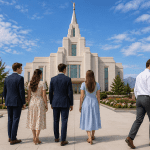
The unfortunate thumbnail already sells the picture of Mormonism as so far from the truth that even those who have left the church have commented in droves that this does not resemble the church they knew. The leads of the series are pictured in heavy, powder blue trench coats holding hands in front of the former Provo Temple (it is currently undergoing a massive renovation). Their outfits stand at some concocted crossroads between the carefully controlled beauty of the Beauxbatons in Harry Potter and the traumatized oppression of the heavily cloaked women in The Handmaids Tale. The fact that all are wearing the identical color and design subtly implies that it was standard issue. I have been in the church all my life and never seen such an outfit.
The image is intentionally cult like, and choosing the backdrop of the temple exploits the fact that many do not know what happens there, implying that the activities inside are frightening and aim to wipe out the autonomy of the individual.
If only those glancing past this odd image knew that what happens in our temples is all about the individual. The promises we make to God there, called ordinances, are often done on behalf of departed loved ones and ancestors. The sorrow of centuries of Christian women who wept when their children died without baptism, believing this beautiful, innocent thing doomed to damnation, are answered by Latter-day Saint doctrine that says that someone can be baptized on another’s behalf when they are gone, and no one need be doomed. Marriages in the temple are not “til death do us part”, they are “for time and all eternity”. And all the work is done for each individual, by name.
Imagine my dismay then in hearing this claim, following that problematic image of the temple: “We’re raised to be these housewives for the men, serving their every desire”. If you show this trailer to a Latter-day Saint woman and see her blood start to boil by 10 seconds in, you’ll know why. Though the Church encourages marriage and family as central to the lives of its members, I have never once felt in all my life that I was being raised to be “serving the every desire” of my future husband. (Just ask him.)
Instead, The Family: A Proclamation to the World, which is a declaration of the Church’s doctrine on family released in October 1995, states that, “Husband and wife have a solemn responsibility to love and care for each other and for their children” and goes on to say that successful marriages and families are established and maintained on principles of “faith, prayer, repentance, forgiveness, respect, love, compassion…in these responsibilities, fathers and mothers are obligated to help one another as equal partners.”
But equal partners working together to get better at treating each other with compassion and forgiveness doesn’t make good fodder for reality TV.
“Have kids by the time you’re 21,” is the next unfounded assertion of what is required of a “Mormon wife”. “Or in my case, at 16,” adds another interviewee, turning up the picture of Latter-day Saint “requirements” from unusual to unfathomable. There is not one Latter-day Saint mother in the United States that dreams her daughter will be pregnant at 16, but this moment of the trailer will be the measure of just how much this show and its subjects aim to exploit the Church in their quest for money and a few more minutes of fame.
In this moment, the trailer is seeking attention based on the shock value of a child bride narrative. But I suspect that when this interview comes up in the actual episode, they will use it as a chance to criticize the Church and its members for shunning a girl because of her teen pregnancy and its sinful implications. To strip-mine this story from both angles will be proof positive of just how little the producers care about truth.
What follows in this trailer is the inference that these individuals created “MomTok”, a group of Mormon moms all dancing for TikTok, as a specific effort to “change the stigma of gender roles in the Mormon culture”. They show footage of the girls goading each other on about just how hard they should be twerking and we’re supposed to believe that it was a calculated ideological crusade. I just don’t believe it. I do, however, believe the one in the group that admits, “my goal was just to be able to provide for my family”.
Many have noted that Latter-day Saint moms dominate the motherhood and lifestyle space on social media. The reasons behind that phenomenon spring from the real dilemmas that arise for “Mormon wives” in their “secret lives”. We want to give our children the best life we can without having to always be away from them to do it. The rise of social media has provided an interesting alternative economy for moms, and “Mormon” moms are particularly well-suited to it.
The Church of Jesus Christ of Latter-day Saints doesn’t have paid positions in their local congregations. As such, we all take turns learning to fill different roles. We learn homemaking skills for youth activities and we begin to learn to speak in front of people and present talks starting at 5 years old. Add to that the pioneer heritage so many of those in Utah have, and you can see why a determination to build something from nothing to take care of our families runs through our very veins.
Millennial moms raised through the 90s and early 2000s also grew up with the world beginning to emphasize that women can do anything and should be out working. Society shifted and began to tell women they’d find more value in worldly accomplishments. Yet, The Church of Jesus Christ of Latter-day Saints is one of the few remaining bastions where the importance and joy of motherhood continues to be heavily emphasized. We believe children have eternal identities that existed before they came here. The stewardship of their care is very serious to us, but the longing to make an impact on the world outside our homes remains. So, what is a well-spoken woman with ambition in her heart and a baby in her arms to do, but take her pursuits to the internet?
But as we all know, the internet renders us all imminently corruptible.
Perhaps MomTok did start out as a fun project among friends, a way to support their families. But the internet is noisy and the sensational is what sells. They wouldn’t be the first content creators to get knocked off course when things “blew up”. What starts as a little side hustle to pay your bills becomes a desperate bid for attention and you begin to be willing to do whatever will get you more of it. Unfortunately, when things “blow up”, they also tend to blow up.
I won’t bother to address what remains of the trailer of The Secret Lives of Mormon Wives. It goes so far off the behavioral deep end that I doubt anyone really believes those choices have anything to do with a “Mormon life”.
But the producers chose that title and the MomTok women traded on the Mormon label originally because the world doesn’t understand why someone would strive to keep high moral standards and live by strict codes of conduct unless there is a puppet master somewhere pulling the strings. To have such standards must just be a facade and people obsessively search for the cracks.
Ironically, the MomTok story is a vivid illustration of exactly why we willingly follow the commandments we obey, and sincerely believe that they are from a loving Heavenly Father who asked these things of us to allow us a life of more freedom and joy, not less.
Rules about chastity before getting married and fidelity afterward may seem, to some, quaint at best and oppressive at worst. (Though statistically, religious women in marriages report sexual satisfaction 50% higher than their secular peers). The MomTok group might well have considered their “soft swinging” departure from those antiquated rules enlightened and modern, or at least spicy for a minute, but that departure ultimately ended in multiple broken homes and displaced children.
You can protect yourself from a cliff with a fence at the top or an ambulance at the bottom, devout Latter-day Saints simply choose the fence.
Yes, the “secret” life of a real Mormon wife is not a story of “good girls gone bad”. It’s a story of good girls trying very, very hard to be good. It’s studying scripture and trying to have more meaningful prayers. It’s crying in the middle of the night with a new baby and not knowing if you’ll ever feel like yourself again. But it’s also getting an unexpected dinner brought to your door because someone just had a feeling you might need it. It’s trying to find time to make cookies for the funeral of someone you don’t even know, but also sitting at the funeral of someone you do know and feeling reassured by the knowledge that you will see them again.
It’s coming in late to a church meeting because you were trying to get all your children dressed in their Sunday best; sorrowing that you missed the chance to take the sacrament. But it’s also knowing that because of that very sacrament, representative of the redeeming power of Jesus, you can always try again to be better next time. It’s deeply believing that your relationship with the Savior means you can overcome any weakness, but also being troubled that you aren’t stronger or more consistent by now. It‘s facing true disappointment and grief, but knowing where to turn for peace.
The struggles in the lives of “Mormon” wives are real, but this show doesn’t explore them. The producers have taken what, in reality, is just a story of a bunch of beautiful people making a hot mess of their lives and brought in the word “Mormon” to try to give their mess relevance. They borrowed something sacred to offer significance to the salacious. They traded on a juxtaposition they knew would sell; the name of a Church with strict rules for a moral life against the images of women who made a whole brand out of throwing that lifestyle away, and they don’t care that they’re spreading sweeping misconceptions in their wake.
Don’t fall for it. Watch the dramas of The Secret Lives of Mormon Wives enfold if you must, but don’t believe that you’ve learned anything accurate about The Church of Jesus Christ of Latter-day Saints in the process.
Celebrating 100 Years of President Nelson’s Life and Leadership

A prophet who not only runs the Church, but also speaks 17 languages, was a pioneer in heart surgery, has blessed people in 130 countries and has 167 great grandchildren–whose special events he tries not to miss–was celebrated at an online birthday tribute September 9. You would think this much activity would have worn him out by this age, but as his great granddaughter Ashlyn Owen said to him, “100 looks good on you.” [If you missed the celebration, you can watch it here anytime]
The event was marked with video segments from around the world of people of all ages wishing President Nelson Happy Birthday. Since, instead of presents, he had asked a 99+1 birthday gift, meaning to reach out to someone in need, video testimonials piled one on top of another, where people gave testimony of the joy they had found finding someone to serve.
Those who admire President Nelson from many faiths shared videos about the impact he’s had on their lives.
Nathan Pacheco, Jenny Oaks Baker and accompanist Jared Pierce performed “We Ever Pray for You, Our Prophet Dear.”

President Nelson said “My dear brothers and sisters, the length of your life is not as important as the kind of life that you live. For each of us, even for a 100-year-old man, life passes quickly. My prayer is that you will let God prevail in your life. Make covenants with Him. Stay on the covenant path. Prepare to return to live with Him again.”
He remarked, “A mortal birthday is not an endpoint. It is a step in our eternal progression.”
President Henry B. Eyring and President Dallin H. Oaks sat together and shared a conversation about what it was like to work with President Nelson. They noted his warmth and love for everyone. When people enter the room, he often stands up to greet them. He gives the sense that he cares.
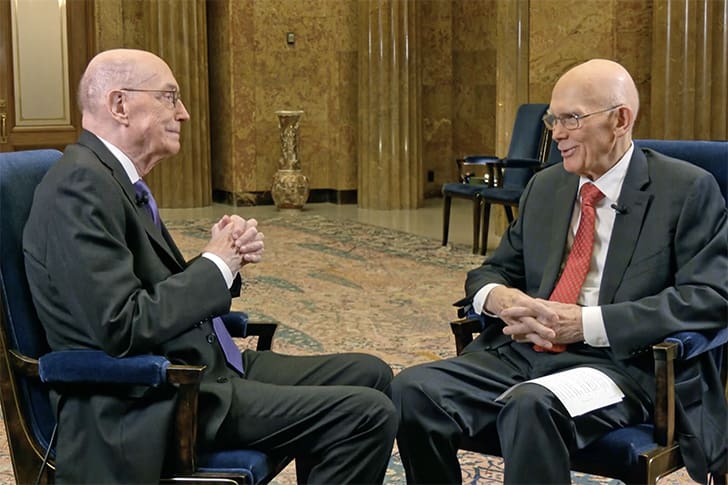
President Oaks noted that to be in a conversation with President Nelson is experiencing what it would be like to be with the Savior. He is the Savior’s representative.
They noted that when he is in a meeting with others, he does not lead off with his opinion, but asks others to say their opinion, giving them a chance to express themselves. He draws out the best of those who report to him. He is decisive. He rarely postpones a decision after all the input has been given him. He’s easy to love.
Both leaders praised President Nelson’s focus on building temples and helping people everywhere come closer to Christ. Since 2018, President Nelson has announced 168 new houses of the Lord.
“[President Nelson has increased temple building] on a spiritual basis of saying, ‘We’ve got to offer the covenants to the people that are far away from temples,’” President Eyring said. “[He’s said] ‘It’s the ordinances that make the difference. Let’s not be extravagant. Let’s make the buildings lovely. But it’s the ordinances that make them available.’”

President Jeffrey R. Holland, shared a personal story. Years ago, his family had traveled with then Elder Nelson to Jerusalem, where his youngest son David was baptized in the Jordan River. President Nelson is a renaissance man, and he took the photos of the baptism. He gave a set of these photos to the Hollands and then prepared a second set for President Holland’s widowed mother, a gift she treasured.
President Holland said that when he became an apostle, “my mother wept and told me I was her second favorite apostle. I don’t need to tell you who the first was. “
“He’s been the Lord’s mouthpiece in receiving and implementing a rush of revelation. He is unfailingly kind and composed, gentle and forgiving. Above all, he has embraced and personified the counsel Paul gave to the Corinthians. ‘Do ye not know that they which minister holy things live the things of the temple.’ In the spirit of the hundreds of temples you have announced, drafted, remodeled, completed or dedicated, we celebrate the sweet, robust, history-making 100 years of your life. We have come to say we love you.”

The Reverend Dr. Amos Brown, of the Third Baptist Church of San Francisco, remembered that in 2019, he was asked to introduce President Nelson to the “great concourse” of delegates at the NAACP convention. “I introduced him as my brother of another mother. I meant that because I felt that kindred spirit immediately when I met him.
A video featuring President Nelson’s extremely large family singing was touching. These beautiful children in each generation filled the screen.
A great-granddaughter, Ashlyn Owens represented the group and remembered President Nelson for his love, personalized nicknames, and personalized blessings.
She noted his steadfastness and emphasized his unwavering support and presence at family events and his focus on individuals.
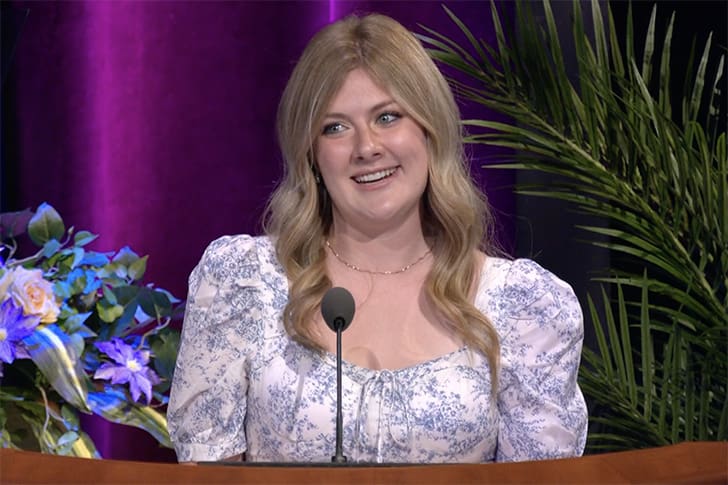
“As a young teenager, I was especially touched by this attention,” Owens said. “I was struggling with many things but was feeling especially shaky about my faith. I was invited to attend general conference, and the minute my grandfather entered the room, his eyes sought me out. I locked eyes on him and felt his undeniable love and support. I don’t think he explicitly knew that I was struggling, but his gentle dependability was grounding for a young, unsure girl. I could tangibly feel a solid wave of encouragement reminding me that he was proud of me and that he loved me even when I was struggling.”
“He helps and lifts us from personal failures.” She said he has a profound respect for women and reminds them, “The heavens are just as open to women as they are to a man.”

Oldest daughter, Marsha Workman, remembered a home where her parents were a terrific team “and all ten of us feel greatly blessed to belong to them.” She said that no harsh words were allowed among them. Above all was love, kindness and a fun sense of humor.
She addressed her father, “Thank you for cherishing us as we cherish you.”
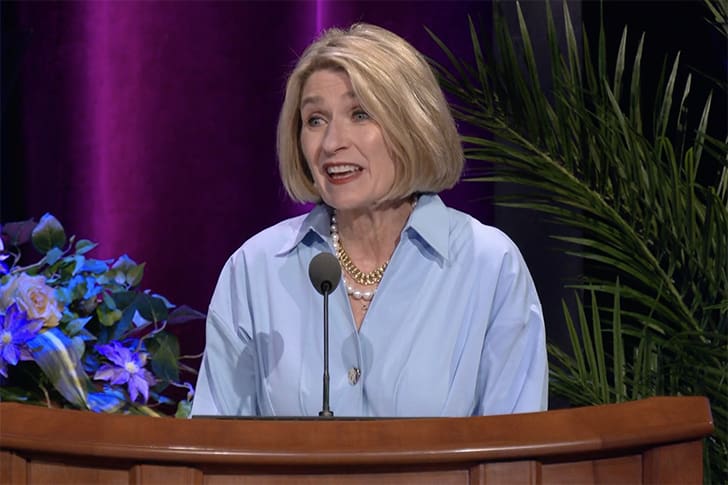
President Camille N. Johnson of the General Relief Society Presidency said, “It was in October 2019, while you were delivering an address that you looked out into the congregation at your dear wife Wendy, your daughters and granddaughters and great daughters and then exclaimed you felt like you would like to claim all of us as part of your family.
“Let me say that I feel claimed and part of your family. What a blessing your kindness, love and respect you have meant to me personally.”
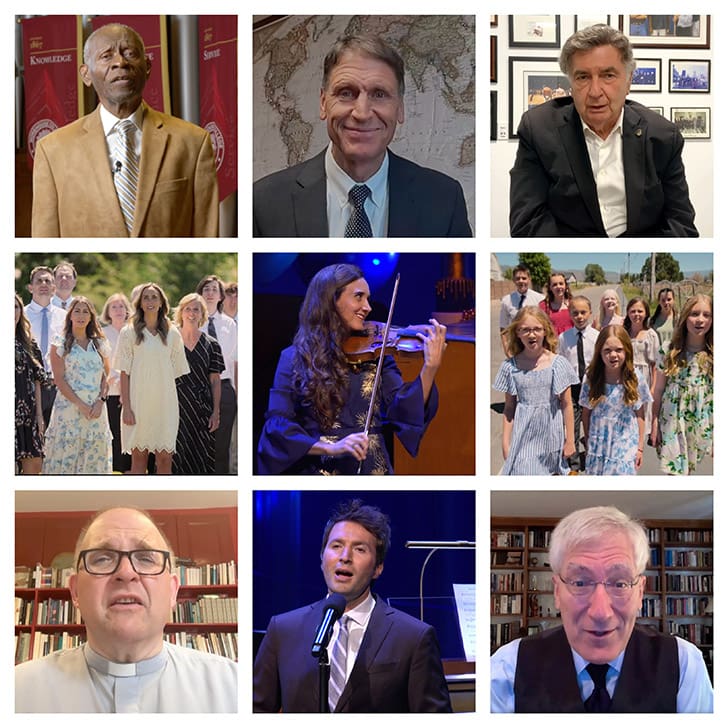
Many others sent video tributes:
The Rev. Dr. Andrew Teal, Anglican Priest and Oxford University Theologian
“President Nelson, from the University of Oxford and as a member of the Church of England, I salute you and give you our hearty congratulations and prayers on your centenary. Thank you for being such an approachable world faith leader. Thank you for leading your people as a true pioneer leader, leaving no one behind. And thank you, also, for touching the hearts of people.”
Robert P. George, Professor at Princeton University
“The foundational principle of all sound morality is that of the profound inherent and equal dignity of each and every member of the human family. And by precept and example, you’ve taught all of us what it means to do justice to that principle, to live up to its demands.”
Rabbi Joseph Potasnik, Executive Vice President of the New York Board of Rabbis
“President Nelson, recently I spoke with Sister Jean Schmidt, 103 years old, who wrote a book entitled ‘What I Learned the First Hundred Years of My Life.’ She says that she attributes her longevity to living life with purpose. You certainly have lived a life of purpose, giving that message of God through your works of goodness throughout the world. Every birthday we often blow out the candles. I suggest [you] keep them burning so we can continue to be the beneficiaries of your light, your love and your loyalty. As we say in New York, mazel tov.”
The Rev. Dr. Lawrence Edward Carter Sr., Dean of the Martin Luther King Jr. International Chapel at Morehouse College
“On the night before Martin Luther King Jr.’s ascension, he said, ‘Like anyone, I would like to live a long life. Longevity has its place.’ I have had the privilege of visiting Salt Lake City and Temple Square four times and observed that the Tabernacle Choir family live a long time. I am convinced that the statement of Dr. King is right — that longevity has its place, and its place is Temple Square. On behalf of the Morehouse College family, our 17,000 living members of the alumni, trustees, administration, faculty, staff and students, we salute you, President Russell M. Nelson Sr., for having reached the centennial, your 100th birthday today.”
Elder McKay Explains Why the Church Purchased the Kirtland Temple

Some may wonder why The Church of Jesus Christ of Latter-day Saints would ever spend significant money on anything other than humanitarian aid. For example, why would the Church spend US$192.5 million to purchase the Kirtland Temple and other properties, documents and artifacts, as it did earlier this year?
To those people, the Church’s Historian and Recorder Elder Kyle S. McKay points to a specific date and place in the past: April 3, 1836, in Kirtland, Ohio. On that day, Jesus Christ gave significant priesthood keys to Joseph Smith.
Speaking to attendees at the annual 2024 Mormon History Association conference held this year near Kirtland on Thursday, June 13, 2024, Elder McKay said it is essential to understand the concepts of priesthood and priesthood keys. If one comprehends these, he said, one can better “appreciate the significance of what was restored” to the earth on that day in 1836.
Elder McKay explained that the priesthood is the power of God delegated to man on earth to act in God’s name for the salvation of God’s children. The keys of the priesthood are the authority to direct how, when and where that power is exercised. The priesthood has all power to do all of God’s work.
“There is little we do in this Church of lasting significance that is not done under the authority of the keys restored on April 3, 1836, in the Kirtland Temple,” Elder McKay said. “Please understand, the Church did not consider itself deficient or incomplete without these historic properties, but these things do provide a magnificent reminder of God’s dealings with His people — sacred evidence of the greatest Restoration ever.”

Hillary Kirkham, a curator with the Church History Department, seconded Elder McKay’s comments.
“We have these buildings, artifacts, documents,” she said. “But, at the end of the day, they can help testify of the gospel and of what God has done for his children. That’s the value. When visitors come, they can be in these buildings and see these artifacts or these documents, and the Spirit can testify to them.”
On March 5, 2024, ownership of the Kirtland Temple and several historic buildings in Nauvoo, Illinois, along with documents and artifacts, were transferred from Community of Christ to the Church of Jesus Christ. Twenty days later, these properties opened for free public tours under the Church’s stewardship.
In an interview with Church Newsroom, Elder McKay said the transition of ownership was “nothing short of miraculous.”
“Bishop [W. Christopher] Waddell was assigned to be the chief spokesman for the Church. He has observed and I have observed in working with him that it has gone so smoothly,” Elder McKay said. “It took time over a year, but it was just so open and so honest and so smooth and so amicable.”

It was a process suitable for sacred space.
“There are very few places on the earth where we can point to and say, ‘The Savior was here,’” said Ben Pykles, director of Church Historic Sites. “We are delighted that we can continue to share this special place, the Kirtland Temple.”
In the Kirtland Temple, Jesus appeared to Joseph Smith and Oliver Cowdery. He told them who He is. He forgave their sins. A vision followed of Moses giving them the keys of the gathering of Israel. Elias then appeared with “the dispensation of the gospel of Abraham.” Last was Elijah, announcing that the time had come to turn the hearts of the fathers to the children and the hearts of the children to the fathers. Having thus spoken, Elijah restored the “keys of this dispensation,” or what the Church today calls the sealing power.
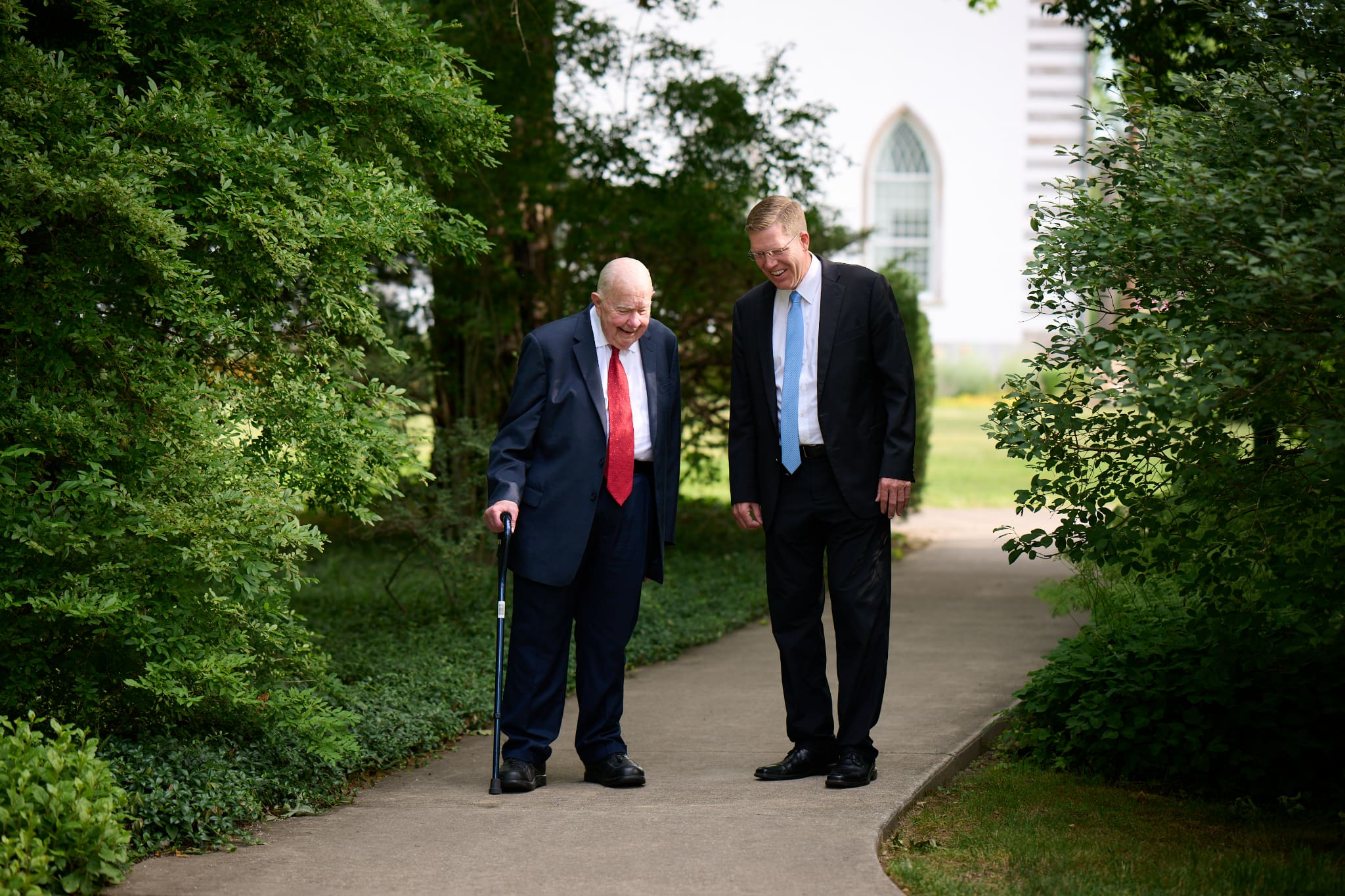
Kirtland Historian Karl Anderson said Joseph Smith called this time the Church’s “Pentecostal period.”
“Kirtland is a place where you feel this spirit that’s here. I’ve not found [it] to that extent anywhere else,” Anderson said. “These are holy places, I believe, wherever deity appears. And you feel that this is holy ground.”
Elder McKay agreed, noting that the power of what happened in Kirtland “affects all of us.”
“The significance of what happened in this temple cannot be overstated,” Elder McKay said. “It is glorious. It is eternal. It is heavenly.”
LDS Church Weighs in on Medical Marijuana Ballot Initiative in Utah

Sign up for Meridian’s Free Newsletter, please CLICK HERE
The Church of Jesus Christ of Latter-day Saints could have a significant impact on the upcoming ballot initiative for medical marijuana in Utah.
The LDS Church, which weighs in on moral and social issues, has spoken out against recreational cannabis ballot initiatives in the past. Asked by FOX 13 about the medical marijuana ballot initiative filed in Utah, a church spokesman responded with a statement:
“Lawmakers across the country have wrestled with whether to legalize the use of marijuana for medicinal purposes. This discussion raises legitimate questions regarding the benefits and risks of legalizing a drug that has not gone through the well-established and rigorous process to prove its effectiveness and safety.
During the 2017 legislative session, a bill was passed that appropriately authorized further research of the potential benefits and risks of using marijuana. The difficulties of attempting to legalize a drug at the state level that is illegal under Federal law cannot be overstated.
Accordingly, we believe that society is best served by requiring marijuana to go through further research and the FDA approval process that all other drugs must go through before they are prescribed to patients.”
To read the full article on Fox 13, click here.
Mormon Artifacts on Display at the Smithsonian

Sign up for Meridian’s Free Newsletter, please CLICK HERE
Artifacts from the early history of The Church of Jesus Christ of Latter-day Saints are on display in a new one-year exhibition at the Smithsonian in Washington, D.C. The “Religion in Early America” exhibit, part of four new The Nation We Build Together exhibitions and interactive experiences, opens to the public on June 28, 2017, in the National Museum of American History.
“Religion in Early America” tells the story of the beliefs and practices of early Americans from 1630 to the 1840s.
“We would like visitors to come away with the understanding of three factors of early American life — religious diversity, religious freedom and religious growth,” said museum curator Peter Manseau. “To stand in the presence of the physical objects transports you to sharing space with those who had lived with them in early American history.”
Visitors to the museum will be able to see an original manuscript of the Book of Mormon, an 1830 first edition of the Book of Mormon, a couple of rare Mormon gold coins and two Kirtland Safety Society notes from 1837. The Latter-day Saint artifacts are on loan from the Church History Library in Salt Lake City, except for the gold coins, which are part of the Smithsonian collection.
“In my opinion, the original manuscript is the most important record in possession of the Church,” said Brandon Metcalf, archivist at the Church History Department. “This is the first time we’ve ever loaned a page of the original manuscript because it is so rare. Many of the pages that did survive are illegible, and so it’s one of our most treasured collections.”

Metcalf said only 28 percent of the manuscript exists because it was stored in less than ideal conditions in the cornerstone of the Nauvoo House in Illinois for more than 40 years.
Also on display are items from the museum’s permanent collection, including George Washington’s christening robe from 1732; Thomas Jefferson’s “The Life and Morals of Jesus of Nazareth,” commonly referred to as the Jefferson Bible; a 1654 Torah scroll; Native American wampum beads; and an 800-pound Revere and Son bronze bell made in Boston in 1802 for a Unitarian church in Maine.
Church founder Joseph Smith began translation of the Book of Mormon more than 188 years ago. The manuscript was dictated by Joseph Smith to Oliver Cowdery and other scribes in Harmony, Pennsylvania, and Fayette, New York, from April to June 1829. (The page on display covers 1 Nephi 4:20–5:14.) The early edition of the Book of Mormon is one of 5,000 copies published by E. B. Grandin in Palmyra, New York, in 1830, right before the Church was organized that same year.

Metcalf said Latter-day Saints in Kirtland, Ohio, established a bank in 1836 called the Kirtland Safety Society and printed notes to create a cash flow. “These two notes that are on loan for the exhibit are two of those notes that were printed in Philadelphia, brought back, and then signed by Joseph Smith and Sidney Rigdon and used in circulation,” he said.
Metcalf said the notes and gold coins were used as currency in the Utah Territory.
“The gold coins were created in a mint here in Salt Lake City shortly after the Saints arrived in the Salt Lake Valley from some of the gold that was actually collected by those that were in California in the gold mines,” said Metcalf.
Millions of visitors are expected to view the Smithsonian exhibition in the nation’s capital over the next year.
“This story could not have been told without the involvement of many religious communities from all over the United States,” said Manseau. “[Visitors] will discover that religion at the founding moment in this country was far more diverse than they ever possibly could’ve known.”

“It’s a privilege for us to be included in this exhibit that documents early religion in America, and you can’t talk about religious movements in America without talking about Mormonism,” explained Metcalf.
“We’re extremely excited to see the reaction to the exhibit and to see many visitors enjoy these documents that they wouldn’t have otherwise seen,” he said.
Long Waits for Visas a Problem for Mormon Missionaries Entering the U.S.

Sign up for Meridian’s Free Newsletter, please CLICK HERE
Cover Image: Sister Chin-Man Hu of Taoyuan, Taiwan, and other Mormon missionaries rake leaves while serving in the LDS Church’s Minnesota Minneapolis Mission.
Every year, nearly 1,000 Mormon missionaries remain on hold in their home countries for as many as 11 months, waiting for a visa to enter the United States.
The delays force some to cancel their missions altogether. Others give up schooling or jobs because they can’t predict when their visa will be approved. Many wind up starting their service in a mission in their home country or a neighboring one. The detour costs them months in their assigned missions.
The problem is a repetitive logjam of paperwork in the visa process for religious workers followed by the State Department since 2008. Staffers annually vet The Church of Jesus Christ of Latter-day Saints nearly a thousand times, once for each missionary, and church staff prepares extensive documentation each time.
Meanwhile, leaders of LDS missions overseas scramble to make room for missionaries assigned to serve in the United States and mission presidents in America struggle to fill assignments and sometimes have to close apartments and suspend mission work in some areas when missionaries don’t arrive.
A bill before Congress would collapse the duplication. The Religious Worker Visa Improvement Act would streamline the process for Mormon missionaries and for those of other established churches, ending the piles of paperwork and shaving months off the time of “visa waiters,” a term that has become part of Mormon missionary jargon.
To read the full article on the Deseret News, click here.
Is it Hard to be Mormon?

Sign up for Meridian’s Free Newsletter, please CLICK HERE
Cover image via LDS.org.
Not long ago I was expressing frustration with a fellow member, because a woman we had fellowshipped for years, and who had finally reactivated, had then fallen away and wouldn’t even return calls.
“Well,” he shrugged, “it’s a hard church to belong to.”
Sometimes I substitute teach high school students, and occasionally I’ll toss a question out to get them thinking. One of these is, “Do rules restrict you or free you?” Invariably I’ll hear their campaigns for driving earlier, drinking, voting, later curfews and the like. To them, laws and rules cramp their style and keep them from having fun.
I ask them to imagine being parents, and their child wants to eat only candy bars. “Well, that’s not good for them,” the kids say. “If they only eat sugar they’ll get sick.”
“Why do I have to stop at a stoplight?” I ask. “That’s slowing me down and keeping me from driving freely.” Soon they see that laws and rules are to protect us, and I point out what would happen if drugs and alcohol were available to all teens, all the time. Nearly everyone knows someone whose life has been ravaged by addiction, and it’s easy to imagine the bedlam we’d have without traffic laws.
“Let’s say your friend decides nobody can tell him what to do and he decides to get drunk, break windows, rob a liquor store, drive 100 miles an hour, gets in a wreck, and goes to jail… how much freedom does he actually have?”
I help them see that these so-called “free choices” always have consequences, and those consequences restrict us. On the other hand, doing the “shoulds” and obeying laws have positive consequences. The child who eats a balanced diet instead of just sugar, will be healthier. The kid who studies gets the better grade, possibly the scholarship, entrance to a better university, a choice of careers, and on and on. There are always consequences of both obedience and disobedience.
So when my friend said this is a hard church to belong to, I was actually speechless for a moment (that’s about my maximum time for speechlessness). In my experience, the more we follow the church’s guidelines, the closer we draw to Christ, the more “active” we are, if you will, the easier life is.
In the 2015 October General Conference President Monson said, “When we keep the commandments our lives will be happier, more fulfilling and less complicated.” How would you like your life to be those very three things?
I thought about two of my other inactive friends. One was breaking the church’s morality laws and this had brought about untold health suffering, shame, remorse and regret. Pulling away from the church had also diminished her ability to feel the Spirit, and be guided by the Holy Ghost. Rules and regulations became slippery in her mind, and soon she was justifying dishonest behavior in business. When she found herself in a crisis, there was no roadmap, no plan she could see to help her repent, find self-respect again, and move forward. Feelings of bitterness filled the spaces where hope might have been.
The other one was completely self-absorbed, missing all the joy of serving others and being useful to her fellowman. Mired in self-pity and focusing only upon the negatives in her life, she joined with others similarly disappointed, and was soon blaming church members for all her problems. That escalated into blaming the church itself and soon her testimony was in shreds. From here she decided to ignore the Word of Wisdom, cut off family members, and criticize the leaders. It was as if she were following the adversary’s playbook. When I last spoke with her, she was more unhappy, less fulfilled, and more tangled in trouble than she had ever been. Exactly the same three things President Monson said are tied to our obedience.
This doesn’t mean that all active members are perfectly obedient. We trip up on a regular basis. And thank goodness we can repent and renew our covenants every week as we take the Sacrament and experience gratitude for the Savior’s love and willingness to suffer for all our sins. None of us are perfect, but as we strive to better follow the commandments, we hope we inch along in the right direction.
We often think that those who can’t understand the consequences of their poor choices simply lack maturity, like the high school students who want freedom from all rules. But we slip into the same thinking every time we have that second slice of pie, knowing we’ll regret it later. We “can’t” resist the momentary enjoyment, even when we know consequences await. We do the same thing when we buy impulsively, lose our tempers, and make a hundred other choices that we know are wrong, even as we’re making them.
And none of us enjoy the results of those bad choices. To my way of thinking, why not minimize the number of hard lessons we have to learn, by simply following President Monson’s counsel? The more loyal we are to what we know is best, the more devoted we are to keeping the commandments, the more joy we’ll have here and now. Yes, the Primary Answers are the key to a peaceful—and peace-filled– life. Prayer, scripture study, attending church, you know the list. When we do them, our life improves. When we don’t, we feel unsettled and lost. As a temple president once said, the commandments are really just tips for happy living.
When someone is thinking about baptism or reactivation and they look at all that’s “required,” why not see it as all that they will now be free from? Why consume addictive drinks that we become dependent upon? Why risk your family’s future by gambling? Why pursue dangerous moral choices? Why resist serving others, when that’s the very formula for joy and personal growth? Why refuse to pay tithing when it brings such immeasurable blessings? Why struggle with marriage issues that have solutions in our teachings? Why have surgery without a Priesthood blessing? Why cling to “friends” who lead you astray? Why deprive yourself and your family of temple blessings? Why cut yourself off from personal revelation? Why wonder if Christ loves you, and if Heavenly Father is really there? This church frees you from all of that.
To me this isn’t a hard church to belong to, it’s an easy one. Happier, more fulfilling, less complicated—sign me up.
Perfect for Mother’s Day– Hilton’s new LDS novel, Golden, is available in paperback and on Kindle. All her books and YouTubeMom videos can be found on her website. She currently serves as a Relief Society President.
FEATURES