



Sing a Joyful Song
Recently, I sat at a young granddaughter’s side in the second row in sacrament meeting, right in the center of the chapel. I held her close with my left arm around her shoulder while I pointed to the lyrics of the opening hymn with my right hand, one word at a time. Neither of us knew the song, but we were determined to sing out, mistakes and all. We are both enthusiastic fans of congregational singing, so we let it rip, undeterred by our certain wrong notes.
Emma is seven years old. She was born with spina bifida and, as a result, she chose early to embrace life with gusto, despite extra challenges and inevitable setbacks. She is perpetually a front-row-center kind of person by decision. Occasional wrong notes on an opening hymn are well within her courageous comfort zone.
The song was #1004, “I Will Walk with Jesus.” The music and lyrics were available for us to follow in a simple black binder that the ward had assembled with new songs and hymns. In that binder, the new songs released so far are numbered 1001-1041, plus Christmas and Easter Hymns numbered 1201-1207. All those songs and hymns will be officially printed and bound in a new Church hymnal entitled “Hymns for Home and Church,” scheduled to be released in 2027.
That Sunday’s opening song was especially poignant for me as I sang with Emma. Gaining confidence and increasing in volume with each verse, she sang with extra gusto on the third verse:
“I will trust in Jesus. I will hear His call
He will never leave me, even when I fall.
Jesus gives me power, lifts and comforts me,
Helping me to live and grow eternally.”
More often than many children her age, Emma does fall. She is currently determined, against the odds, to learn to skip. Her falls are frequent, but she always gets up and tries again. I don’t doubt that Jesus really does help her, even – maybe especially – when she falls.
As she sang about Jesus giving power, lifting, and comforting, I felt sure that she knew personally what she was singing about, and that she really does feel personally empowered, lifted, and comforted by Jesus, who surely smiles on and cheers for His brave young believer.
Her voice was bright with enthusiasm as she sang the chorus louder after each verse:
“As I walk with Jesus, to my home above,
He will bless me with His Spirit and fill me with His love,
Change my heart forever and help me clearly see.
I will walk with Jesus, and He will walk with me.”
As she sang, the importance of those promises and their truthfulness burned in my heart, and I trusted with ever greater assurance that Emma does walk with Jesus, and that her determined steps and entire journey are sure with Him at her side.
Remarkably, again with me pointing to the words, Emma and I also sang the sacrament song together that Sunday – #1008. That one was also new to us both, but it quickly became our own. I was so glad we had three opportunities to sing the chorus. The lyrics made me weep as I heard them sung loudly by my energetic, trusting granddaughter.
“Bread of Life, Living Water, feed my soul, fill my heart.
Lord, give me new life in Thee.
And make me whole, complete and holy, bound to Thee eternally.”
Emma sang with confidence, as if she understood more than what was likely for a seven-year-old, how deeply she, and we all, depend on Him to make us whole, complete, and holy.
New life in Him. Made whole, body and spirit. Complete and holy.
After those poignant personal experiences with the new songs and hymns, I now always check the hymns we are scheduled to sing each Sunday, hoping there will be some numbered in the thousands. Those are the new ones.
I have since learned and, with permission, share that the process of assembling the new Hymns for Home and Church has been ongoing for many years. The resulting volume will include hundreds of songs and hymns of original music submitted by members of the Church from around the world. It will also reflect other decisions made by a conscientious committee of reviewers who have worked deliberately, intentionally, and in as unbiased a way as possible, even as they have maintained a faithful fervor for the enormous task.
Studies have been done to solicit input from members of the Church from around the world who have provided their diverse opinions regarding which of the current hymns they would like to see remain, and which they feel are better retired. Some hymns will be retired simply because they are infrequently or not joyfully sung, or the rights for publication in all languages couldn’t be obtained.
Other hymns, some from other languages and many from other faith traditions, received repeated votes for inclusion in the new volume. “Come, Thou Fount of Every Blessing” received the most votes, and “Amazing Grace” was second.
Other new hymns are new lyrics set to standard, old tunes. At general conference in October this year, we heard the Tabernacle Choir at Temple Square perform five verses of a new hymn entitled, “Thou Gracious God, Whose Mercy Lends.” It ends with a blessedly hopeful fifth verse that reads:
“We thank Thee, Father! Let Thy grace our loving circle still embrace.
Thy mercy shed its heavn’ly store. Thy peace be with us evermore.”
Many of us likely recognized the timeless melody. It is traditionally called “O Waly, Waly” and is a folk tune of British origin that has been used repeatedly as the melody for other lyrics. More recently, Pete Seeger, James Taylor, Eva Cassidy, Sarah McLachlan, and Joan Baez have sung “The Water is Wide” using that melody. It’s beautiful and evocative still and again.
Another hymn that was often requested for addition to the new hymnal was “It Is Well with My Soul,” a hymn written by Horatio G. Spafford in 1876 after he suffered the loss of his four daughters in a shipwreck on their way to Europe. Mr. Spafford had previously lost his young son to pneumonia and much of his wealth in the Great Chicago fire of 1871.
His powerful hymn has served for decades as an anthem for many who have experienced the losses and vicissitudes of life. An acquaintance of ours who suffered severe financial and professional setbacks memorized the lyrics to “It Is Well with My Soul” and sang or rehearsed them daily during his most desperate times to remind himself of the sure promises of the Savior.
“When peace like a river attendeth my way.
When sorrows and sea billows roll-
Whatever my lot, Thou hast taught me to say,
‘It is well, it is well with my soul’”
What could be more encouraging than to know, as the third verse of that hymn aptly proclaims:
“My sin, not in part but in whole,
Is nailed to the cross, and I bear it no more.
Praise the Lord, praise the Lord, O my soul!”
Recently, as I sat listening to a rehearsal in the Tabernacle, the Choir began to sing a song I had never heard before. In spite of its newness, the song felt immediately reassuring and familiar to me. It began:
“An open door, a warm embrace,
Call us to worship and share God’s grace.
All can gather safely here, partake of emblems, feel Jesus near.”
And then the chorus. The first time I heard it, it felt promising. After the second verse, it became encouraging, and by the third verse, it was firm and final in its pronouncement of belonging.
“As weary trav’lers on life’s road, when the world is dark and cold,
Where’er we wander, wher’er we roam,
We’re always welcome, welcome home.”
I felt assured of my home – my home in the Tabernacle, my home in the Church, my home with my family, and especially, my home with my Heavenly Parents.
I had long known what it felt like to be “welcomed home” at church. When I was a young girl, I attended church by myself, but because of the generous and conspicuous welcome of the other parishioners in my ward and the dependable warmth of the Spirit, I felt welcome there with fellow travelers and with God. I felt even welcomed home in a profound and reassuring way in that chapel seated beside others who had also found a home there.
Music is a powerful source of worship, encouragement, and connection to heaven. A worthy song or hymn includes poetry for the mind, melody for the heart, and spirit for the soul. Learn and embrace sacred music. Find your favorites. Hum the melodies. Memorize the lyrics. Sing a joyful song.
MCO’s Messiah in America: Think 3rd Nephi, Produced like Les Mis

Something extraordinary is coming in 21 concerts from the Mississippi River to the Pacific Ocean, beginning March 28 in Orem, Utah. (See dates and locations here. https://www.millennial.org/performances/ ).
Think 3rd Nephi, the story of Christ coming to the Americas, produced like Les Miserables. The Millennial Choir and Orchestra, under the direction of Brett and Brandon Stewart will be presenting the largest and most ambitious project in their history that will also include guest artists, Gentri.
Imagine this story of Christ being presented in the finest concert halls, with original music, a fully costumed cast, remarkable lighting, and music so passionate and spiritual, it penetrates to the depths of your soul.
Imagine 1400 participants in one hall, bringing beauty to you in surround sound, as choirs with singers from age 4 to adult undulate in and off the stage and the highest seats in the theater so you have music on all sides. Imagine being transported from this sometimes tiring world into heaven for a couple of hours by the performance and original music of gifted musicians whose purpose is to convey the love of Christ.
If this sounds like lavish praise, it is because I have been to MCO’s concerts many times before and have left, like so many others, just shaking my head in wonder that their music was so profoundly moving. Come to a concert where everyone is abuzz with excitement and then hear music like you have never heard before.
Brett Stewart, composer of the show said, “In nearly three decades of composing music, we’ve realized that when you take scripture and give it a musical voice, that experience stays with you for a lifetime. The youth of the world need it in their lives, families need this in their lives. We are passionate about rekindling and strengthening the faith and testimonies of this generation.”
The story begins in Jerusalem where Jesus taught, “Other sheep have I which are not of this fold: them I must bring, and they shall hear my voice; and there shall be one fold, and one shepherd” (John 10:16). A melody is played behind these words that becomes a theme throughout the show, reminding the listener again that Christ’s whole point is to gather his sheep into one fold.
This message resonates with the performers who are in the choir, both those who are members of The Church of Jesus Christ of Latter-day Saints, and those who are not. They say that they can feel Jesus’ tender love as they sing of this story. The words of scripture, embedded in music plays through their minds again and again while they learn and perform the songs, having a powerful impact on them. Fix breakfast and the words of 3rd Nephi are humming through your mind, if you are a member of the choir. It is an invitation to a deeper spirituality.
Beethoven said that music is the language of God and Brandon Stewart added that the aim at MCO was to create and perform music that helped listeners connect to a real God and a real Savior.
To create a production as complex as this has put demands on their 35-member staff and 100’s of volunteers. They have created 5,000 costumes, lighting design and an elaborate stage set, whose large Meso-American temples will be trucked from performance to performance across many states.
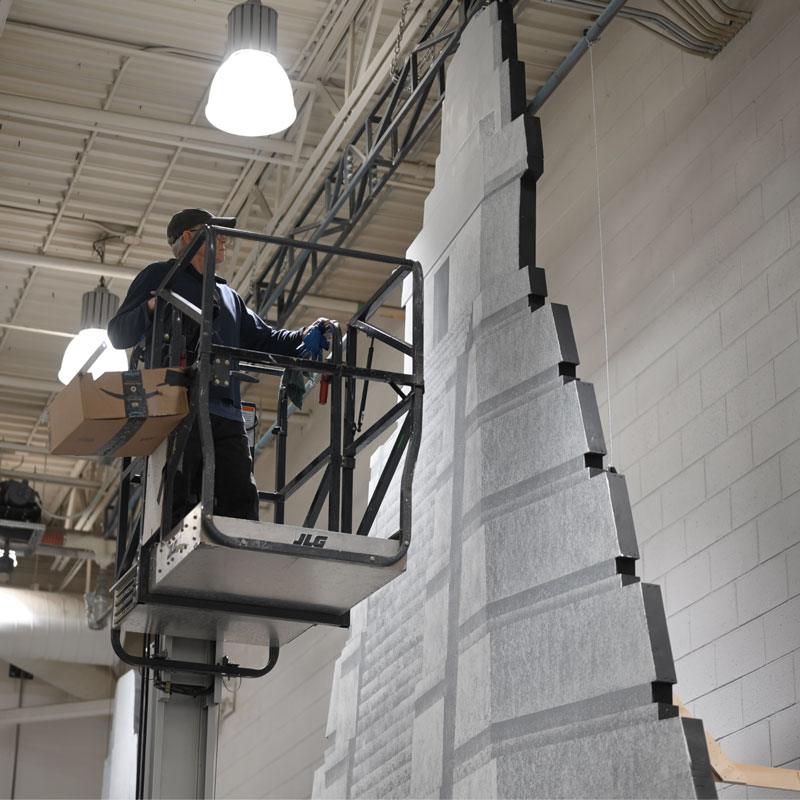
Steve Porter who has designed and created the sets spent 350 hours carving a single Styrofoam stela, which was a copy from the original ancient artist. He has wondered how long that original work, carved in stone, must have taken for the artist who had no power tools.
Kristi Ward, MCO’s artistic director and a sister of the Stewarts, has visited two states each week for the last eight. She has carried much of the heavy load in making this into a stage play. Recently she was with a hundred highschoolers in the choir in a room in Dallas, prepping for one of the most inspiring moments of the show. They were so ready to go home, but as they sang, exhaustion drained away and was replaced by tears of testimony.
“I love the different emotions that you feel as our participants play their roles. They face the despair of having been beaten by the Gadianton warriors, the great storm, the humbling process of repentance through Christ appearing. To see this array of scenes will take an audience on a monumental journey.”

Highly Trained
Brett and Brandon are both highly trained musicians. Brett received a doctorate degree in choral conducting from the University of Cincinnati and Brandon received a masters from Juilliard. Though he was invited to complete a doctorate program and teach at Juilliard, he decided to join his brother in founding MCO.
Why would either of them be willing to take such a risk when life was offering them other tantalizing opportunities? Didn’t they have families to feed? Before Brett called Brandon inviting him to join the founding of MCO, he had checked around and found that every other Latter-day Saint choir, apart from the Church and BYU, had conductors with day jobs.
Starting MCO was not going to be a part time job or a side gig for these talented musicians, but their full focus—and they were not going to start by having their choirs singing at a local church but in a concert hall. The vision that stirred them was great. They made no small plans.
Some people said to Brett, “What you are doing is unbelievable. I don’t know if it is guts or if it is ignorant.” Brett’s answer was, “I just don’t know anything different than to tackle stuff. Once you have decided you just do it.”
The fire that lit them was the product of their noticing a deficit in the music world. Something was lacking. Brandon said, “We noticed a huge need for not just spiritual music, but high-level spiritual music.
“There was high-level music happening, of course, in symphonies and universities across the nation, but the more our world grows away from spirituality, the more we see that spiritual music was performed with an apology. What I love about what we do with with MCO is unapologetic, and we’re proud to praise God through music.”
“The Tabernacle Choir and Orchestra at Temple Square do a wonderful job and the BYU University has just one of the best choirs in the world. These are two organizations who are absolutely nailing it. But it’s a wide world, and there are many people searching for spirituality and they are searching for God and music is one of the fastest way to connect with deity. The organizations who are doing it are doing so well, and we need more of it to feed more people.
“We are living through the greatest faith crisis of our generation. Singing or playing the music is a way of helping them build their faith again and have a faith-affirming experience.” That is a job not to be taken lightly.
The MCO conductors, Brandon and Brett and six others, have the challenge of working with talented, auditioned choirs and orchestras, as well as youth and children as young as four. Their work is so remarkable because they reach beyond the borders of usual expectations.
Book of Mormon Oratorio
When MCO was barely begun, Brandon began working to persuade Brett to write a Book of Mormon oratorio. Brett said, “I didn’t have a desire or a thought to do it, but Brandon asked me out of the blue, and then asked and asked again, and I resisted for months.
“He said, ‘Do you agree that somebody needs to do it?’” Brett agreed that somebody did, and both Stewarts were well aware of Spencer W. Kimball’s famous talk on the Gospel Vision of the Arts where he said, “We are proud of the artistic heritage that the Church has brought to us from its earliest beginnings, but the full story of Mormonism has never yet been written nor painted nor sculpted nor spoken. It remains for inspired hearts and talented fingers yet to reveal themselves.”
For Brett, thinking he could be one of those “inspired hearts and talented fingers” seemed presumptuous, and thus he resisted. Yet finally, Brandon found the question that was the tipping point. “If not you, then who? You have a choir and orchestra. Why not just go for it? You can be one of the first and then it can inspire others.”
“OK, I can go with that,” Brett thought. The ideas for a musical project on the Book of Mormon marinated in his mind with lots of ideas for months and months before he ever put pen to paper. “It just has to sit in your soul and heart and mind,” he said.
Then in the summer, he was in the bow of a boat at a family reunion and ideas began to flow to him about music for the great storm in 3 Nephi. Finally, before the 2010 performance he wrote the entire thing in three months for the MCO in California to perform, and a year later recorded it. It went to the top of the Billboard lists as number one on the classical music chart.
Then years passed without doing much with the oratorio, and finally on a road trip in 2019, Brett pulled out the Book of Mormon oratorio to listen to again. That was a rare thing because a composer rarely listens to his own music, but he had the distinct impression, “This needs to be performed again.”
When Brett and Brandon talk to each other and one says “I feel inspired about this”, they don’t take it lightly, because it is not common. Their plans were to perform it in 2020, and then COVID happened. Everything was canceled.
It sent them back to the drawing board, and they decided to make it a bigger deal, telling the story of Christ in America with all the trappings of a big stage play. Both decided that the oratorio needed to be rewritten to be more accessible to a larger audience.
Why do this? Brandon said, “We live in a different world than we did 25 years ago, and, as incredible as the masterworks in the oratorio style are, people don’t connect as much as they once did to that kind of music. That’s what we realized. This music and the story from the Book of Mormon can reach a wider audience in a more popular way, but still be high quality. We retained some of the melodies and the incredible text, but changed much else.

So, Brett began composing. “There are several ways that music comes to you and faith-based composers say similar things. You could be sleeping in the middle of the night, and wake up in a cold sweat with an idea and run to your office to write this down.”
“Sometimes it is like those old movies where you see someone at a typewriter with a garbage full of crumpled up papers beside them. Sometimes you are on your own and it’s numbing and mindless. Then there are moments when things come to me and they would just be laid out in my mind.”
“The music singing behind the annunciation of Christ in the Americas just came to me in totality with all its melodies and intricate harmonies. There are songs I felt like I painstakingly created. This one just came. It’s as if this has been penned before and I am familiar with it. I think, ‘This one I’ve heard before. I know this one.” Some others in the choir have also come to me and said, ‘I’ve heard this before’.
This is where the people are hearing a voice in the darkness, and the Lord says, “Behold, I am Jesus Christ, whom the prophets testified should come into the world.”
“I don’t know where it came from” Brett said, but “it isn’t me.} It just dropped into my life. I have a very firm belief that we have seen and heard things in the pre-existence that transcends the veil that we carry with us.”
The flip side of that Brett said, “is that when you try to do a good thing, you feel Satan’s power potently. All these participants will say that they don’t remember having this much adversity in their lives. That happened to me when we had five children and my wife broke her ankle. I compose from home and people were in and out of our home all day, while I was trying to cram and get the music done.”
It was too many interruptions to keep the flow of a creative work, and Brett was getting worried.
“You know in the Book of Mormon where it speaks of being compelled to be humble? I was humbled and I fell to my knees. During my prayer, I remember saying out loud to the Adversary, ‘You will not win this battle. I will not be conquered. I will not let you win.’ It felt powerful and spiritual and I was allowed reprieve. I was able to go back to work without anxiety.”
An Early Start
For Brett, as a child and young teenager, composing was the natural expression of his identity. He took piano, and sometimes, tired of the regimen, he would sneak away and find a quiet corner and compose instead. With his first job, he bought manuscript paper at the music store, but hid his compositions under his bed. One day his mother, was making his bed and found the pages of composition, and asked, “What is this?”
He told her, it was a full orchestral score. She looked and saw there was a measure that noted that this was where the horns came in, and she asked, “How do you know when the horns come in?”
Brett answered, “I hear it. I did then, and still do to this day, I don’t know where the music comes from. It’s just there. I came with it.”
Because he has a personal connection to it, Brett was equally as intentional about his love of the Book of Mormon. “It’s the keystone of my testimony. It’s so humbling to me. I remember as a teenager struggling that I had never had an ah-ha answer from the Spirit. It was really concerning to me. I loved this work. I loved the church. I loved seminary. My scriptures were marked until the pages were torn even before I went on my mission.” His fear about receiving no ah-ha moment, no burning of the bosom from the Spirit were calmed when he was told in a blessing that his testimony of the work was etched deep in his soul never to be erased.
It was a moment when he acknowledged that he had always known it.
A Working Relationship
Brett and Brandon, as the duo behind the founding of MCO, and their sister Kristi, who is doing the artistic design that makes Messiah in America possible have a remarkable working relationship. They dream, they talk, they create, and they are honest with each other.
Brett and Brandon will bounce their compositions and arrangements off of each other and they are frank. They say things like, “You are going down a rabbit hole with this part of the composition. It’s just not working.” No matter who is being scrutinized, nobody is offended, because they trust each other’s instincts and knowledge. If this newly-composed section of music doesn’t work for your brother, it won’t create the connection with the audience the Stewarts so highly value. They trust each other’s talent and vision.
What it means is their work is supercharged with faith, and they have been particularly situated to speak of “this sacred story of divine love, unbreakable faith, and the dawn of a new covenant” that marks Christ’s visit to the Americas.
What they hope is that those who see Messiah in America will feel the healing power of Jesus Christ, and that in a world that is so often divided, they will know that the Lord hopes to create one fold with one shepherd.
Grace Notes: First 13 Songs Released for New Hymnbook

The images included here come from the Church Newsroom.
The hymns of The Church of Jesus Christ of Latter-day Saints don’t just reside on a page. They skip across our souls like stones on a still pond, leaving their mark with ripples everywhere. I can hear them somewhere in the ground of my being, pressing through my cells, and capturing my life for as long as I can remember. They swell with pioneer memory from the Tabernacle Choir, open my soul for the sacrament, whisper on my lips when I pray and are attached to my first remembered spiritual experience when I started to cry as a five-year old, because I thought of “his hands pierced and bleeding to pay the debt.”
These songs belong to us, mark us as a community, spill out of our hearts because they have been placed there so often and so much. For more than thirty years, my husband Scot and I have led tours with fellow Latter-day Saints where we discuss the gospel and sing together every day. No matter which group we have taken, when we sing, we naturally take parts, sing with cheer, and sound good—I mean really good. Invariably, the bus driver thinks we are a choir.
Singing well is what Latter-day Saints do. They did it to help themselves across the plains and we do it still.
That’s why the announcement of a new hymnbook, as was made in June 2018, isn’t just another project. It marks a new generation and a new era. I remember the black hymnbook, published in 1950 and its transition to the green one in 1985. If you love the green hymnbook and have memorized the hymn numbers, you might wonder why we would possibly need a new one?
It’s not just to finally include again “Come Thou Fount of Every Blessing”, though that is a necessity. This hymn was in the 1950’s hymnbook and then unceremoniously dropped because it wasn’t popular enough. That, of course, has changed. No, the reason for a new hymnbook is to make it global, and to invite new writers to create new songs that might find their way into a new hymnbook and into our hearts.

This new global hymnbook has begun with the release of 13 new songs, which may be accessed digitally through the Sacred Music and Gospel Library apps in the online Church Music Library at music.churchofjesuschrist.org.
Small batches of new music will continue to be published digitally in preparation for the full hymnbook release, currently expected in print and digital formats by the end of 2026 in English, Spanish, Portuguese and French. The hymnbook is anticipated to be available in 50 languages by the end of 2030.
The hymns now available are:
- Come, Thou Fount of Every Blessing
- When the Savior Comes Again
- It Is Well with My Soul
- I Will Walk with Jesus
- His Eye Is on the Sparrow
- Think a Sacred Song
- As Bread Is Broken
- Bread of Life, Living Water
- Gethsemane
- Hail the Day that Sees Him Rise
- He Is Born, the Divine Christ Child
- What Child Is This?
- Star Bright
Submitters’ Stories
Just as modern covenant Israel is made of the testimony of many voices, so is the new hymnbook. Latter-day Saints from around submitted hymns.
“It would have been a lot simpler to just have specific writers and specific composers contribute specific things,” said Anna Molgard, music project coordinator for the Church’s Priesthood and Family Department. “But in the Lord’s kingdom, He allows us to be a part of this great work, and so it was an opportunity for members of our faith to express their own testimonies in their own way and have an opportunity to perhaps share that with the world.”
Submitters were asked to submit their pieces without their name or any identifying information, so that their work could be evaluated on its own merits. Through an extensive review process, songs were prayerfully considered and chosen for this collection out of 17,000 submissions.
“It was 17,000 testimonies that we were able to look at and read and see people’s desire and their willingness to express their faith in the Lord Jesus Christ in a very specific and unique way was so humbling,” Molgard said. “We were so grateful and humbled by the enormity of that offering.”
The seed of the hymn “As Bread Is Broken” came to creator Stephen Reynolds while sitting in a sacrament meeting in 2017.
“It’s a time where we take bread and water to remember the sacrifice of Jesus Christ,” Reynolds said. “I was thinking about the significance of that and the need for that in my life. And as I thought about that, I had some ideas, some words, very simple words with a very simple tune, come to my mind.”
Reynolds hopes that his hymn will help members to focus more on their covenants and the enabling power they receive through that sacred bond.
“I know that the Church committee has had a lot of work to go through,” Reynolds said. “[They’ve reviewed] thousands and thousands of submissions very carefully. I’m gratified that they would do that because somebody like I am, that doesn’t have a name out there per say, I can still have my work considered.”
“It’s such an exciting day for all of us throughout the Church that we get to receive these wonderful offerings from faithful members of the Church who have shared their testimonies in such a specific way,” added Molgard. “Sacred music is such a gift from the Lord that it allows us to feel the spirit of the Lord in such a unique way.”
“We’ve taken such great care with these very sacred offerings that none of the process could be rushed, none of it could be pushed forward or moved forward any faster. And the Lord’s timing is always right. He allows us to be a part of His work in such beautiful ways that we get to see His hand in His work.”

FEATURES