



Picture This—Hawn’s Mill Massacre Site as You’ve Never Seen It

Today is the anniversary of the Haun’s Mill Massacre, which took place on October 30, 1838.
Maurine and I are currently on our fourth major film shoot for what we are calling the JSD—the Joseph Smith Documentary series. We’re creating upwards of 85 mini-documentaries covering the amazing, remarkable life of the Prophet Joseph. One evening ago, we were racing against the sunset to try to scout our location shoot at Hawn’s Mill. We missed the sunset, but we got something better.
Hawn’s Mill was a small Latter-day Saint settlement of Jacob Hawn and his family and about 75 other families living along the banks of Shoal Creek. It is estimated there were only perhaps a dozen houses, a blacksmith shop, and a mill in this new settlement, so many of the new arrivals were still living out of wagon boxes and makeshift shelters. We’ve been to the site many times, but never so late in the evening and never just after sunset.
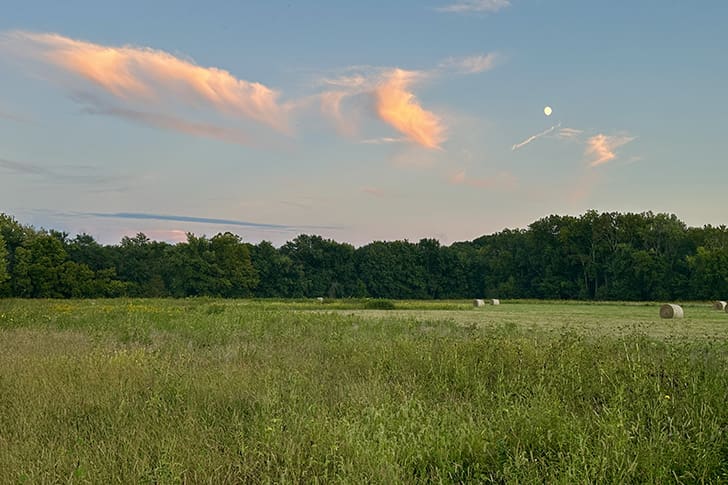
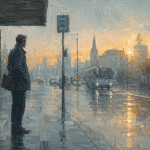
As we were racing down the quiet gravel road to beat the sun, I was attracted to the pink clouds and the moonrise in the east. I pulled over for but a moment to take a few shots. This was the field right next to where we think the settlement was located.
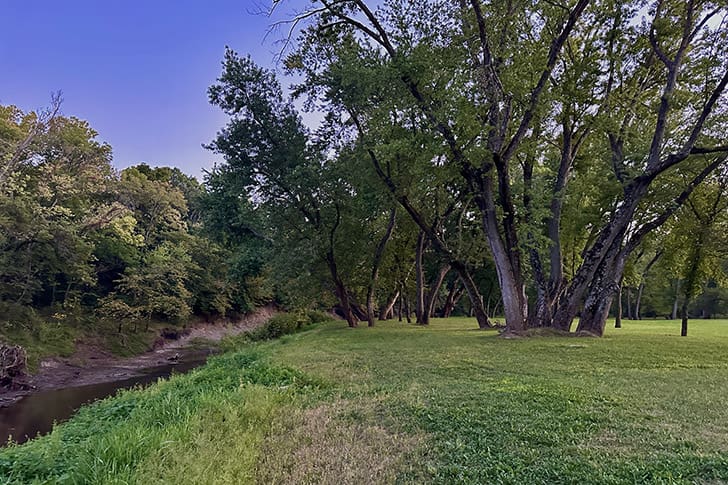
When we got to the parking area of the site, the sun had just barely set two minutes before we arrived. I have to admit I was initially disappointed. I ran along the edge of Shoal Creek, hoping to get the reflection of the sunset in the waters below me. It did not happen. I was somewhat disappointed again.
Then I thought of what happened here that Tuesday afternoon, just after 4:00 PM on October 30, 1838. Approximately 240 men, under the mob mentality of Nehemiah Comstock, captain of the Livingston County militia, and Obadiah Jennings, rode hard into the townsite and began to open fire upon the peaceful Latter-day Saints living there. Within a short time, 1,600 shots were fired and 18 were left massacred. With this on my mind, I came out of the woods and looked to the west and could hardly believe my eyes.
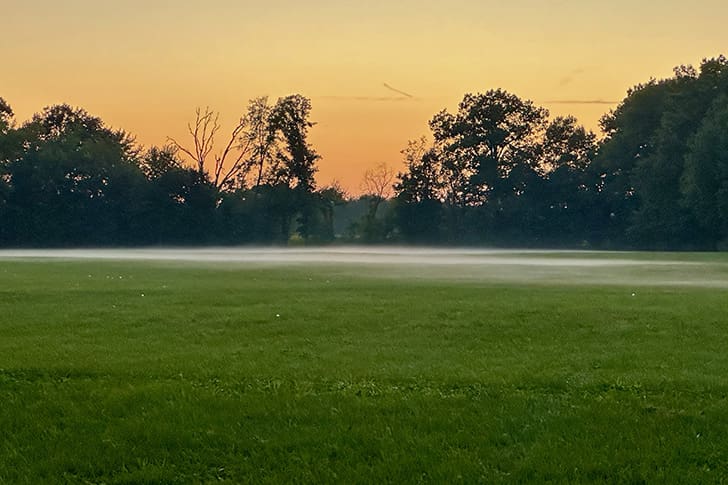
On the far end of the field, a low-lying fog began moving slowly and steadily across the ground towards us. It was not unlike the feeling that Cecille B. DeMille created when the destroying angel came to take the firstborn of the Egyptians. We watched the fog for about half an hour, and it just became more and more unreal.

I ran out into the field and set the camera low to the ground and shot through some dandelions to capture the remaining light with the rolling fog. I shot with my big camera and with my iPhone—these pictures you’re seeing are all just from the iPhone.
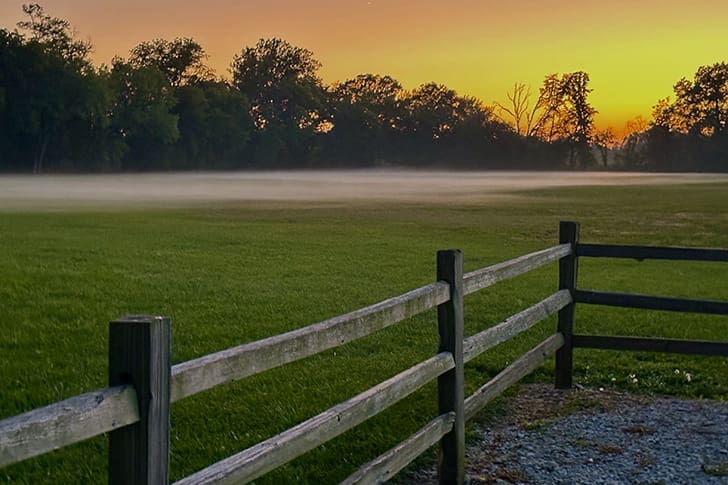
As we got back to the car I looked again and saw the beautiful angle of the fence and even more fog moving in, I started to recall the names of those who had been killed that day: Thomas McBride, Levi Merrick, Charles Merrick (age 9), Elias Benner, Josiah Fuller, Benjamin Lewis, Alexander Campbell, Warren Smith, Sardius Smith (age 10), George Richards (age 15), William Napier, Austin Hammer, Simon Cox, Hiram Abbott, John York, John Byers, Simon Cox, Austin Hammer and John Lee.
We were blessed to have our own experience with nature and reverence the sacred names of the dead.
And now, you can picture this.
Picture This—Hawn’s Mill Massacre Site as You’ve Never Seen It
Maurine and I are currently on our second major film shoot for what we are calling the JSD—the Joseph Smith Documentary series. We’re creating upwards of 70 mini-documentaries covering the amazing, remarkable life of the Prophet Joseph. One evening ago, we were racing against the sunset to try to scout our location shoot at Hawn’s Mill. We missed the sunset, but we got something better.
Hawn’s Mill was a small Latter-day Saint settlement of Jacob Hawn and his family and about 75 other families living along the banks of Shoal Creek. It is estimated there were only perhaps a dozen houses, a blacksmith shop and a mill in this new settlement, so many of the new arrivals were still living out of wagon boxes and makeshift shelters. We’ve been to the site many times, but never so late in the evening and never just after sunset.
As we were racing down the quiet gravel road to beat the sun, I was attracted to the pink clouds and the moonrise in the east. I pulled over for but a moment to take a few shots. This was the field right next to where we think the settlement was located.
When we got to the parking area of the site, the sun had just barely set two minutes before we arrived. I have to admit I was initially disappointed. I ran along the edge of Shoal Creek, hoping to get the reflection of the sunset in the waters below me. It did not happen. I was somewhat disappointed again.
Then I thought of what happened here that Tuesday afternoon, just after 4:00 PM on October 30, 1838. Approximately 240 men, under the mob-mentality of Nehemiah Comstock, captain of the Livingston County militia, and Obadiah Jennings rode hard into the townsite and began to open fire upon the peaceful Latter-day Saints living there. Within a short time, 1,600 shots were fired and 18 were left massacred. With this on my mind, I came out of the woods and looked to the west and could hardly believe my eyes.
On the far end of the field a low-lying fog began moving slowly and steadily across the ground towards us. It was not unlike the feeling that Cecille B. DeMille created when the destroying angel came to take the firstborn of the Egyptians. We watched the fog for about a half-an-hour and it just became more and more unreal.
I ran out into the field and set the camera low to the ground and shot through some dandelions to capture the remaining light with the rolling fog. I shot with my big camera and with my iPhone—these pictures you’re seeing are all just from the iPhone.
As we got back to the car I looked again and saw the beautiful angle of the fence and even more fog moving in, I started to recall the names of those who had been killed that day: Thomas McBride, Levi Merrick, Charles Merrick (age 9), Elias Benner, Josiah Fuller, Benjamin Lewis, Alexander Campbell, Warren Smith, Sardius Smith (age 10), George Richards (age 15), William Napier, Austin Hammer, Simon Cox, Hiram Abbott, John York, John Byers, Simon Cox, Austin Hammer and John Lee.
We were blessed to have our own experience with nature and reverence the sacred names of the dead.
And now, you can picture this.
Proctors on a Mission #15—Some Assignments are a Surprise
When a football team huddles during a game, the quarterback whispers a play to them, and the players, tensed and ready, know just what to do. They have memorized their team’s plays and are ready. But then, when the quarterback is at the line, facing the opposing team, he may realize another call would be better and he calls an audible.
What’s an audible? It means to change plans at the last minute based on newly revealed information. You were certain something was going to be one way, but when you get the whole picture, it turns out to be another.
We received an audible on our mission directly through revelation, as clear and certain as possible. It wasn’t a direction to move us from our mission, because we love being here, but to augment it. Here’s how it came to be.
Once in a while, we hear, with grief, that a friend is leaving the Church, and many times, they say they have learned something about Joseph Smith that has pained and rocked them. We hear these sentiments with sorrow which is then followed by a question for us. Do they really know Joseph Smith or are they responding to some caricature of him that someone has devised? Do they understand the entire context of the event, attribute or moment they take such offense at?
We ask these questions because we love Joseph, have written books about him, witnessed of his prophetic role, and taken people on church history tours for more than thirty years. We are deeply versed in his life and the restoration. What we inevitably hear at the end of our church history tours is this, while someone shakes their head. “I thought I knew, but I never knew Joseph Smith.”
As we discussed this in May, suddenly we received a flow of light, sweet intelligence and a sense of assurance about something we had to do. It was a calling, and we both knew it, with that sense of astonishment one feels when you know you have received revelation.
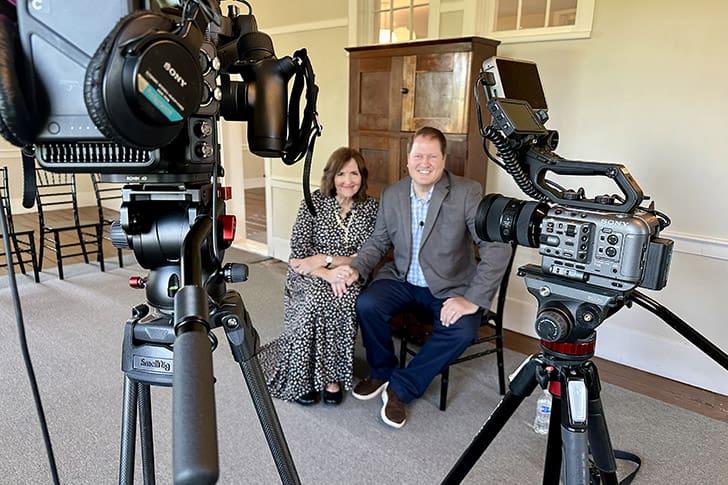
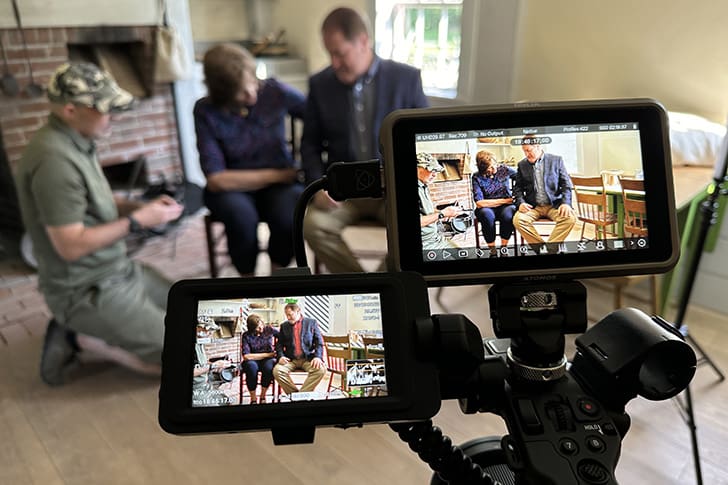
We were to create a series of 60 or more mini-documentaries on the life of Joseph Smith, using the Ken Burns style of film making. Burns takes you to a place and time with images, video footage, and voice actors who help tell the story through the quotes of contemporaries who experienced that time.

As such, they will have a different flavor than other wonderful and moving film and video that have been done on Joseph Smith’s life. They will give more detail, more actual quotes, more deep dive into Joseph’s life. Though they are mini-docs they are many.
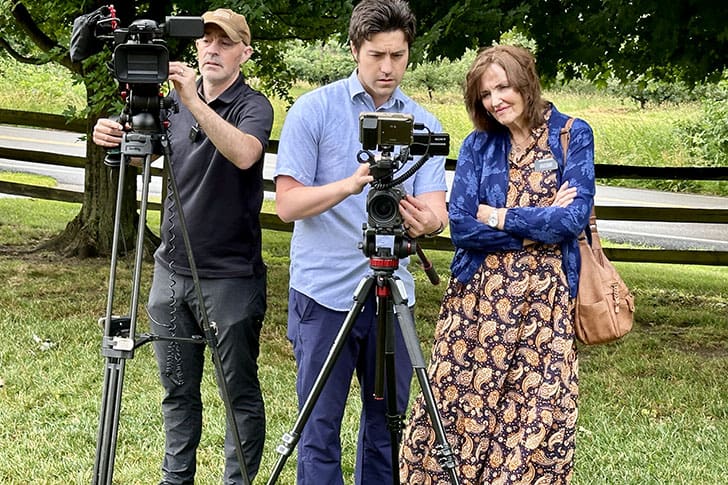
As I described, these documentaries are short and aim to tell the history of Joseph in a way that is textured and rich, faithful and moving, with all the details that demonstrate that this is one of the most compelling dramas to unfold in this time.
What is the world to make of a man who declares that the heavens have burst open and knowledge of God has been given again to humanity? that he has been visited by an angel who has given him an ancient record testifying of Jesus Christ—and then actually produces that record? that he has seen God the Eternal Father and His Son Jesus Christ, who have told him that none of the creeds of the world are correct?
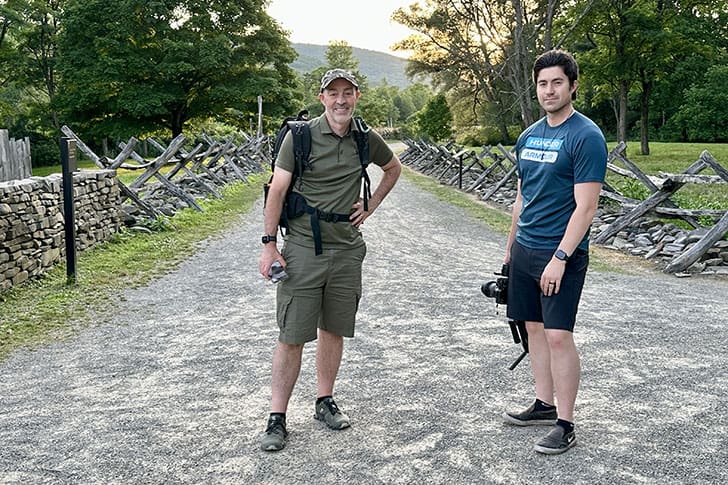
That’s the story. It is a tall project, but as we committed ourselves to it, things started to fall quickly in place. We had to begin shooting in the green of summer, so to shoot Kirtland and the eastern Church history sites meant we would have to leave the mission for 12 days. We had to find the right cinematographers—those who were gifted with a video camera as well as loved the history. Artists with light who knew that movement tells a story. You can so easily tell the difference between a news broadcast and a well-crafted movie scene.
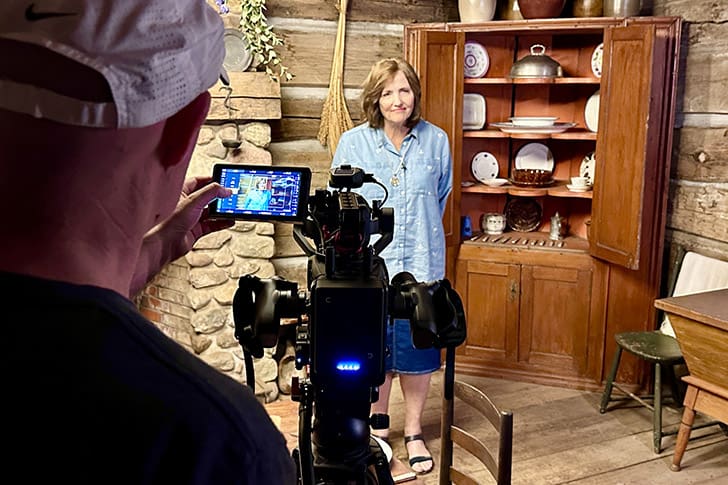
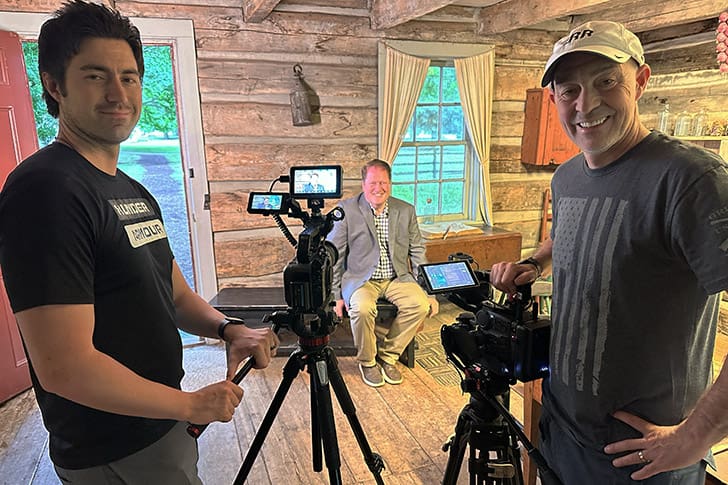
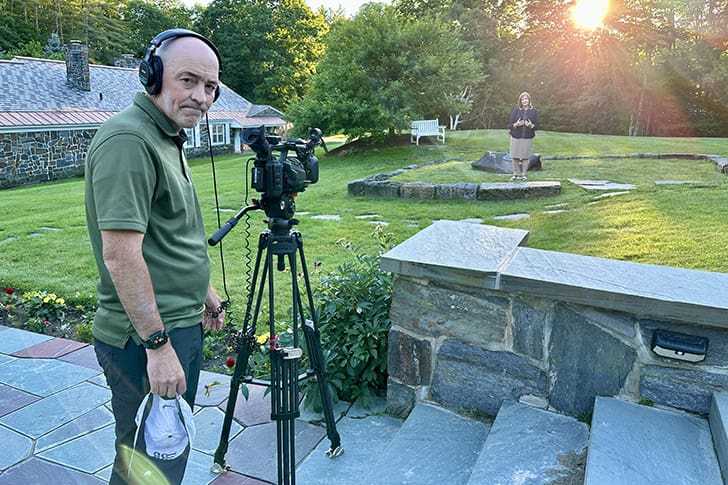
We found these cinematographers in Robin and Geoffrey Saville, a father and son team, who worked seamlessly and endlessly. During those twelve days of work, we had to be at our first spot at 5:30 for sunrise (which usually meant a 4:00 am wake-up call) and often ended back at our hotels as late as 11 p.m. How many nights can you function on four hours sleep? What the body can endure in one night, it balks at the next. Sleep is definitely not over-rated.
We found people who could support the first round of shooting with financial resources. Everywhere we turned was cooperation and friendship from the senior missionaries, arborists and site presidents at each church history location.
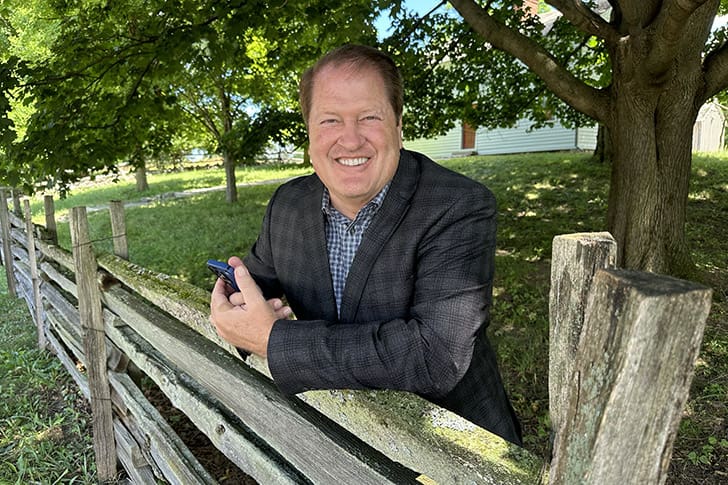
When one says that the weather cooperated, you think of big sunshine and bright blue skies. The weather has to do much more for those who create beautiful images. It has to give surprises, light shows, clouds that move in time for sun bursts.
The morning we were at the Kirtland Temple, we drove there while it was dark and the moon was still up. The moon was large and orange, as if we were looking through a filter, and we arrived at the temple in time to capture that orange moon.
Then, as the sun arose, a low mist lined the hills behind the temple, and were tinged, layer upon layer with pink. No matter how skilled you are at cinematography you cannot do better with an image than what you are given. This exceptional morning was a gift, and, Robin, who is a licensed FAA drone pilot (and undoubtedly the best in the Intermountain West), flew that drone over the temple to create video that was magical. We took it as a divine signature upon the work.
We will give occasional updates of the Joseph Smith Documentary (JSD) as they happen.
Our Love Note to Freddy
In our mission, we are using family history as a major tool to find new friends, who might investigate the Church, as well as help members find names to take to the temple.
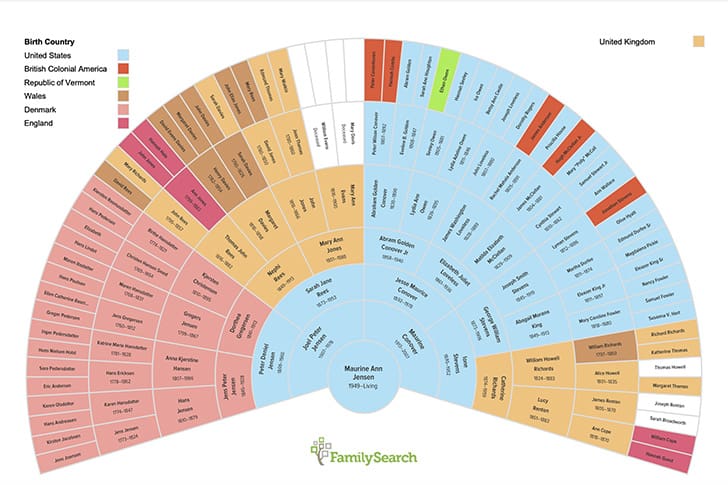
Scot and I have been assembling our finished family history booths for the mission for many months, and the final product looks very professional. It has many pieces and parts, including two large banners, many old family photos, a sample fan chart, and so much more. Since all, but the original banner, which the Church printed for us in Utah, were created in Puerto Rico, we have been in and out of a local Fast Signs shop again and again. They helped us figure out that we needed to print the photos on PVC so they were durable and would last. They walked us through step by step, and we grew confident of their skill.
Screenshot
Then, when we came to pick up the signs (quite a heavy load since we were making 12 booths), the owner, who calls himself Freddy instead of his longer Puerto Rican name, asked Scot between trips to the car, “What’s this?” He was pointing to the fan chart, which was completely full, with the lines colored by origin. Scot showed Freddy how, from the central person, each new circle showed the person’s parents, their grandparents, their great-grandparents and so forth.
Freddy was heartfelt, “I want one of these.” He wanted to see his family, too, laid out and marching back through generations. Then Scot took a load to the car.
Not knowing what Scot had said, I asked Freddy, “Do you know what family history is?” He said, “No.” I showed him the fan chart and gave him the same explanation he had just heard. Then he started to open up to me.
He said, “I have never known who my father is. I wouldn’t know him if he walked into this shop and ordered something. He is anonymous for me. I begged my mother for years and years to tell me, but she adamantly refused.”
Hearing how much this hurt him, I tentatively suggested that maybe she might change her mind? He lamented, “No, she died five years ago.” For him that door was forever closed, but the yearning to know the identity of his father was not extinguished. He longed for this information.
I told him that we were helping people with their family history and he gave us a plaintive look, and tapped his heart, saying how much he wanted to know anything he could find out. He made a prayer gesture with his hands. It was a plea, a groaning from his soul, not just a trivial need. Scot returned, pulled up his phone, and asked Freddy if he knew the name of one of his grandparents who had passed away. (This was, of course, on his mother’s side.)
He knew his grandfather’s name and he thought he knew where he was born. Scot was on FamilySearch, and asked again, “Is your grandmother’s name Catalina?”
“Yes!” Freddy exclaimed. “How did you know?” He pointed to his arms. “I have goose pimples.”
It was a moment of such deep connection between us, with all the formalities of his being a store owner and our being customers cast aside. Here was his heart, right on the line, and we could not get him off of our mind.
The next series of family history training we did with our missionaries, we used a video from President Eyring as the basis. In it he said that we have more than casual curiosity about our families.
Of course! The Lord who has created eternity as a large, unending family unit would place into our souls “more than just a casual curiosity”. It is a longing for our roots, a sense that we cannot know ourselves until we know them, that line of ancestors who gave us breath.
Family History Zone Conference
We flew into Puerto Rico from Boston where we had been shooting the Joseph Smith mini docs at 3:00 am, went home for three hours and slept and then had zone conference that was entirely focused on teaching the gospel, using family history as the bridge between missionary work and the temple. In our mission, we speak often of beginning with the end in mind, which is making covenants in the temple that bind ourselves to God and to our families.
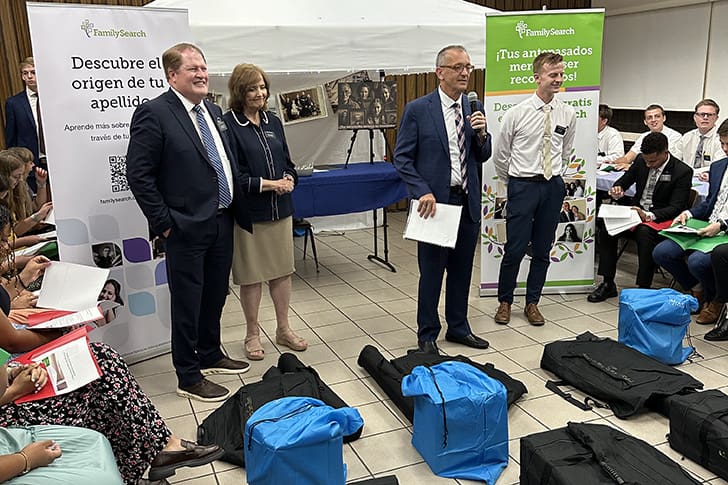
In this conference, every district was given a family history booth, directions on how to assemble each part of it, including how to keep it protected, neat, and ready for the next usage. (These exceptional missionaries, are, after all as young as 18 or 19, and still may not have been keeping their bedroom clean at home.)
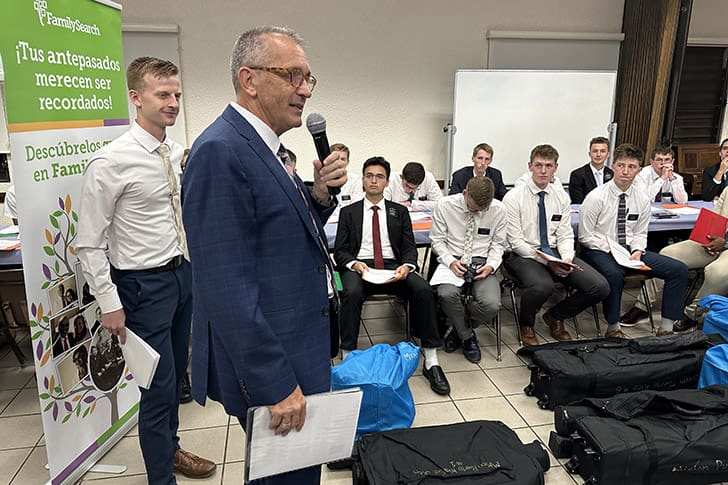
Far more important, our mission president, Paul Horstmeier, called on the words of the prophets to demonstrate this unbreakable link between family history and missionary work.
We currently have three grandsons heading for Spanish-speaking missions and we wish they could use this powerful connection in their mission. I wish we could call each of their mission presidents and share with them the remarkable experiences we are having here in Puerto Rico using family history to find new friends.
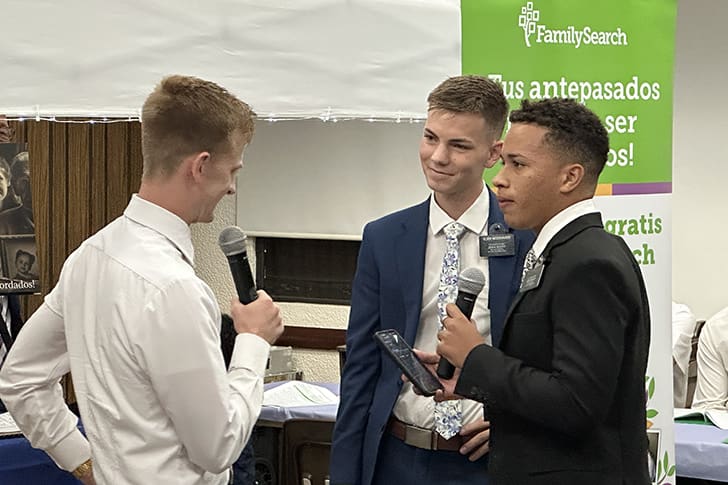
Missionaries must be trained. They must see how to do it. They must understand it soul deep. So, at our zone conference, our mission president called on the prophets to teach us, with their own recorded words.
President Nelson:
“Those who are joining the Church are joining precisely because their ancestors have been praying for one of their posterity to join the Church so that they, the ancestors, can receive their essential ordinances by proxy” (quoting George Q. Cannon).
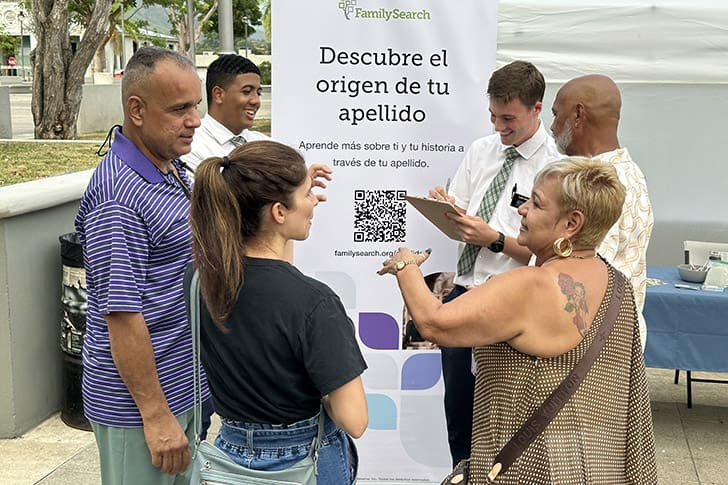
He also suggested some good missionary questions that may be a surprise. They have not been the usual questions our missionaries have asked over the years:
“Tell me about your family heritage.
“Are your parents living?
“What about your grandparents?
“Would you be interested if we could find the names of some or maybe all of your grandparents?”
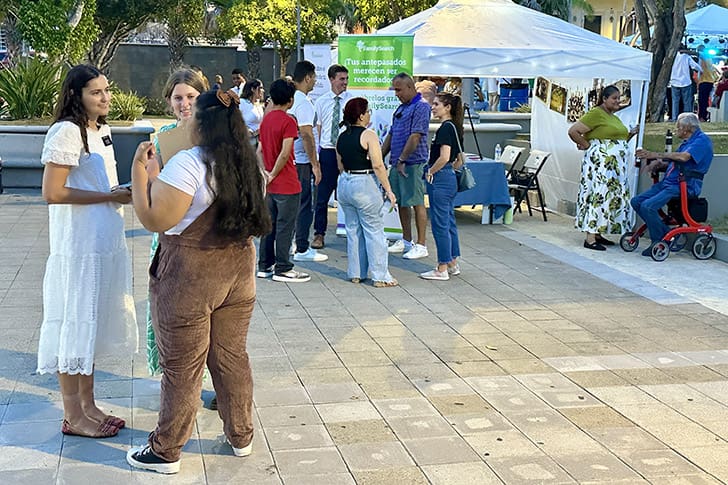
Our missionaries have the goal of setting up a family history booth at least once a month in their districts at festivals, markets and celebrations. That means that every month we will have at least 12 family history booths operating somewhere on the island. It also means we have happy missionaries, because their ability to enter into great conversations grows with people. Those Elijah moments when people feel stirred to turn their hearts to their fathers easily become gospel discussions. Our biggest challenge may soon become keeping up with the people who are interested!