






How a Perfect Storm of Random Forces Inflated the CES Letter beyond Its Merits

When the Church of Jesus Christ was restored to the earth, its young prophet Joseph Smith was told by an angel that in the future, his name “should be both good and evil spoken of among all people” (JSH 1:33).
Book-length fulfillment of this prophecy began a decade later as Eber D. Howe published Mormonism Unveiled, followed by hundreds of antagonistic broadsides, pamphlets, and publications by others containing basically similar messages—across 190-plus years.
Among all these Church-hostile publications, it appears that none experienced a more rapid or broader public distribution and impact than what is now known as The CES Letter, authored by Jeremy Runnells—which soared across the Internet in 2013. Scholars familiar with its content, however, immediately recognized that few, if any, of its accusations were new and most had already been repeatedly refuted. In fact, a large part of the essay, further analysis confirms, reflects a condensed version of writings and concepts that the author borrowed or rephrased from other long-time, prominent anti-Latter-day Saint writers.
So what factors contributed to The CES Letter becoming so widely known? The essay’s style was not polished nor was its author academically recognized.
We observe at least four forces that converged in 2013 to create an ideal atmosphere and opportunity for such an antagonistic 75-page publication to easily fill cyberspace with its anti-Christ, anti-Restoration allegations. This perfect storm resulted from:
- The expanding popularity of the Internet and the establishment of PDF as a document standard—within a society still naive to its full implications.
- The disbanding at Brigham Young University (BYU) of the Foundation of Ancient Research and Mormon Studies (FARMS) in 2010 and the Neal A. Maxwell Institute’s subsequent pivot away from the day-to-day defense of the Church.
- The lack of easily accessible and comprehensive discussions of subjects like those raised in The CES Letter, now available in the Gospel Topic Essays, that thoughtfully explain many complicated and sometimes controversial issues.
- The CES Letter’s clever wrapping of a set of concise arguments against the faith in a personal story—that being a supposed search for truth and subsequent betrayal by the Church—all contained within a compact, easy-to-distribute PDF document. (This fourth dynamic was discovered to be false and documented at length in Michael Peterson and Jacob Hess’s Were These Ever the Sincere Questions of an Earnest Truth Seeker?)
1. The Expanding Popularity of the Internet and the Establishment of PDF as a Document Standard.
The World Wide Web rapidly expanded in popularity and accessibility during the 2000s. By 2013, nearly three-fourths of the inhabitants in developed countries had access.

The number of Internet users per 100 inhabitants in the developed world (x-axis) increased dramatically between 1996 and 2013. (Modified from https://en.wikipedia.org/wiki/Global_Internet_usage.)
The expansion of electronic publishing. During this same period, electronic publishing technology also expanded, thus allowing for the rapid distribution of electronic books and articles in ways previously unimaginable. Critical to this development was a computer program that produced a fixed-page-layout file format that could be opened in a variety of computer operating systems without losing its book-like qualities—including pagination.
In 1993, Adobe Systems led the programming competition with its Portable Document Format (PDF). After guarding it as intellectual property for fifteen years, Adobe displayed shrewd business logic in 2008 by offering the PDF as an open format (PDF 1.7)—allowing software developers worldwide to develop and provide tools for the creation, modification, viewing, and printing of PDF files, if they adhered to Adobe’s original PDF specifications.
Also in 2008, Adobe offered its Reader 2.0 as a free download. This enabled web designers and authors to offer their publications as PDF downloads with an accompanying link to the free PDF viewer. Readers could easily download both the app and the book or article and view the original text as it was designed to be read.
Advanced distribution capability. Soon other free PDF viewers became available, and popular Internet search engines incorporated them into their browsers.
A new world began to emerge, empowering individual authors and content creators to distribute their views instantly, in increasingly persuasive ways, across a mammoth distribution channel: the World Wide Web.
The reality is that before the early 2010’s it would have been difficult to widely distribute any computerized books or extensive articles such as The CES Letter. Documents circulated as Microsoft Word or WordPerfect files would have been susceptible to formatting changes when the files were opened as well as alteration from other readers.
Facebook and Reddit as catalysts. Another online dynamic occurred simultaneously with the PDF expansion: the increasing popularity of Facebook. The year he introduced his CES Letter, Jeremy Runnells expanded his online footprint by creating a “CESLetter” Facebook page. Begun in 2004 by Mark Zuckerberg, the Facebook social networking service had over 1.3 billion users by 2014. It was a natural fit for Runnells since people familiar with Facebook would likely understand how to download a PDF file and viewer. So, he advertised his essay on the platform, with a link to a separate location where a PDF version of the document could be downloaded. He also used Reddit, another forum social network, to provide updates regarding his personal saga with the Church.
The rapid growth of Reddit contributed to the spread of Runnells’ letter. By the 2010’s Reddit was expanding its footprint on the internet—with 46 million users by 2012, and 90 million by 2013—exceeding 174 million users in 2014. Through a Church-hostile Reddit pseudonym —Kolobot—the author attached drafts of his essay, promoted it, attacked critics, crowdsourced material for responses to rebuttals of his essay, and advertised his website.
No printing presses necessary. If any particular PDF became popular, it could also be shared person-to-person via email or through social media sites such as Reddit (typically, as Runnells did, using a Dropbox link)—independent of any homepage download. Such a file could also, of course, be uploaded to a web page. In these early years of internet expansion, it was just a matter of time before a critical voice opposing the gospel of Jesus Christ exploited this new form of rapid communication. Thanks to this emerging technology, no printing presses or mail deliverers were needed to spread a PDF to thousands or even hundreds of thousands in weeks or months. By February 2016, the author of The CES Letter claimed (without documented proof) that his essay had been downloaded an “estimated 600,000 times.”
2. The disbanding at Brigham Young University of The Foundation of Ancient Research and Mormon Studies (FARMS) in 2010 and the Neal A. Maxwell Institute’s subsequent pivot away from the day-to-day defense of the Church.
The second factor catalyzing this perfect storm involved the dissolution of the Foundation for Ancient Research and Mormon Studies (FARMS) at BYU. Organized by Dr. John W. Welch in 1979, FARMS consisted of an informal collaboration of academics devoted to Latter-day Saint historical scholarship.
But this foundation later became more institutional. In 1998, President Gordon B. Hinckley of The Church of Jesus Christ of Latter-day Saints formally invited FARMS to join Brigham Young University—stating: “FARMS represents the efforts of sincere and dedicated scholars. It has grown to provide strong support and defense of the Church on a professional basis.” Yet less than a decade afterward there was a significant change, as the entity was subsumed by the Neal A. Maxwell Institute for Religious Scholarship (NAMI) and effectively disbanded.
“Those guys were warriors.” Prior to this, FARMS’ association with BYU (sponsored and funded by the Church during the 2000s) gave these advocates of the faith much-needed backing and resources that contributed to an ever more effective defense of the gospel of Jesus Christ. “Those guys were warriors,” remarked one prominent Church defender—a common sentiment. It seemed that whenever any new book or conspicuous article appeared on the scene attacking the Church, FARMS was there, with effective and credible scholarship, sourcing, and writings to document and defend the truth.
The effectiveness of this concentrated defense of the Church of Jesus Christ of Latter-day Saints from a strong professional, academic, and faith foundation was powerfully illustrated in the aftermath of Grant Palmer’s 2003 anti-Latter-day Saint book: An Insider’s View of Mormon Origins. This volume was released on the market with great fanfare by Signature Books (known for its longtime publication of works that criticize the core doctrines and principles of the Church, the policies revealed through modern prophets, and the history of the restoration of the gospel of Jesus Christ).
The FARMS Review—a twice-yearly journal comprised of peer-reviewed articles from many faithful scholars defending the Church—took notice.
On June 1, 2004, four separate reviews of Mr. Palmer’s book were simultaneously published in the journal’s “Review of Books.” All of these “heavy hitter” reviewers possessed PhDs, several of them in history. All had significant academic experience and fluency with the subject material and the specific areas of attack Palmer made upon the Church of Jesus Christ, demonstrated by the strength of their reviews:
- Dr. Stephen C. Harper’s Trustworthy History? incisively illustrated the manipulation of data and evidence Mr. Palmer engaged in to support his church-hostile thesis, while highlighting significant scholars, topics, and sources the critic had selectively ignored. In his well-referenced critique, this historian summarized Palmer’s book as “a pitiful failure to write credible history” through a failure to “obey rules of historical methodology,” concluding that the work was “not trustworthy history.”
- Dr. Davis Bitton’s The Charge of a Man with a Broken Lance (But Look What He Doesn’t Tell Us) remarked on Palmer’s claim to be an “insider” in The Church of Jesus Christ of Latter-day Saints. While “wearing the toga of a retired institute director” Palmer had “lived a life of deceit for many years” by remaining affiliated with the Church’s education system while he was a closet doubter. Bitton also revealed that Palmer “presents information as his own that is straight out of previous anti-[Latter-day Saint] works” (including Jerald and Sandra Tanner), “publish[es] them within the covers of a newly minted book,” and thereby “tries to shock the reader”—while ignoring incredible amounts of scholarly work disproving his claims.
- Prying into Palmer by Dr. Louis C. Midgley focused on evidence that “Insider’s View” is actually based on a previous work from Palmer written over a decade earlier under the pseudonym “Paul Pry Jr” and titled New York Mormonism—a work that was not “the product of original research, but instead, a compendium of anti-[Latter-day Saint] arguments…infatuated with…many of the affidavits in E.D. Howe’s notorious Mormonism Unveiled (1834), all of which [Palmer] wove together with opinions drawn from some marginal contemporary critics of the faith.” Midgley’s review then laid waste Palmer’s bizarre theories about the origin of the Book of Mormon.
- A One-sided View of Mormon Origins by Dr. Mark Ashurst-McGee effectively refutes every major section of Palmer’s book and summarizes it as “a piece of disingenuous advertising.” The book, he argues, “intends to present Palmer as a seasoned gospel teacher who will shepherd those who wish to learn more about the origins of their faith,” but then seeks to “discredit the integrity of the foundational claims upon which the faith of the Saints rests.” McGee again reveals that the book “fails to follow the basic standards for historical methodology.”
Six months later, on January 1, 2005, the FARMS Review released a fifth review of Palmer’s book: Asked and Answered: A Response to Grant H. Palmer, by Dr. James B. Allen—focusing on Palmer’s individual criticisms of the Book of Mormon. Allen references several scholarly studies that counter much of the author’s attack while demonstrating the ancient text’s truthfulness. He also effectively takes apart the author’s odd theories surrounding the coming forth of the Book of Mormon.
This barrage of academic artillery in five separate academic reviews effectively illustrated the shallowness of one anti-Latter-day Saint book—leaving it essentially impotent. Over subsequent years, Grant Palmer’s book was generally ineffective in persuading others to leave the faith or remain away from it—except among some of the more uninformed or already hardened detractors of the Church. Its faith-draining influence, over time, became a blip.
What if FARMS had been around when The CES Letter was written? Imagine what likely would have happened with the 75-page CES Letter had the same FARMS weaponry still been in place in the spring of 2013. We can easily see each of the essay’s seven or eight areas of attack upon the faith answered by a separate academic scholar—all released simultaneously. Then each of these potential refutations would likely be followed by its author’s comments or interviews, online discussions, and further dissemination.
The impact of such FARMS activity might have been substantial in reducing the widespread and corrosive effects of Jeremy Runnells’ writings.
In the years following the release of Runnells’ letter, it’s true that several major refutations were eventually published, including: FAIR’s initial online response in 2013, Bamboozled by the CES Letter by Michael R. Ash (2015), A Faithful Reply to the CES Letter by Jim Bennet (2018), and Sarah Allen’s The CES Letter Rebuttal (2021-2022). Allen’s voluminous work not only painstakingly refuted the entire contents of Runnells’ writings, but also exposed the manipulation techniques and background deception of the essay. Yet this series of responses was sporadic and irregular—lacking the concentrated efficiency and cohesion for which FARMS was known.
Different emphasis from scholars. Clearly not every Latter-day Saint scholar has an appetite for raising their voice in a defensive posture concerning the faith—with some scholars feeling little interest in defending the Church generally or at all. Among those who do show such a willingness, there are varying levels of engagement—ranging from those who write things about the faith while mainly leaving it to others to repackage them to be of use to everyday members, to those scholars who identify current, specific claims against the Church from specific authors and refute those particular claims on a day-to-day or real-time basis.
Never shying away from controversial subjects or defending the Church’s official and unofficial positions, scholars at FARMS were consistently among the most actively engaged in the most relevant issues and conflicts.
A vacuum begins. Nevertheless, in the years after disbanding FARMS in 2010, BYU’s Neal A. Maxwell Institute (NAMI) unfortunately also chose to discontinue this level of day-to-day Church defense—even taking the step of removing archived FARMS articles from its website.
When asked in 2013 if the Institute planned to “incorporate apologetic scholarship” into its publications, Spencer Fluhman, director of the Neal A. Maxwell Institute, explained: “We don’t intend to leave apologetics entirely behind.”
Yet among all the podcast notes, titles, and publications of the Maxwell Institute available between 2013 and 2015—right when the popularity of The CES Letter ballooned—we could not identify any addressing the specific issues raised in Runnells’ essay.
Hesitation among some believing academics. The reluctance of any believing scholar to actively defend the Church is perhaps understandable. Religious authors who write for a religious audience can explore ideas in the relative comfort of a mutually accepted paradigm regarding the supernatural. But when religious authors advance narratives that defend the reality of the supernatural before a more pluralistic audience, they risk professional disrespect, ad hominem attacks from activist naturalists, and public notoriety (positive from believers and negative from secularists).
In short, defending the Church’s truth claims positions the scholarly defender against critical voices who for the most part have received broad popularity and society-wide endorsement. Even at Church-owned universities, performing extensive apologetic work may be less advantageous to tenure advancement than publishing articles in respected secular peer-review journals or authoring books printed by prestigious university presses.
More recently, scholars at the Neal A. Maxwell Institute have expanded the definition of “apologetics” to include scholarship that anticipates believers’ questions and responds accordingly. “Good traditional apologetics,” according to this expanded definition “leaves neither the Book of Mormon nor ancient history in the state it found them. It transforms both in the name of faith, seeking insight and understanding.”
While good things are afoot at Maxwell and other faith defense organizations like Scripture Central, and FAIR, this relative vacuum during the early 2010’s may have contributed to some unfortunate effects.
Over subsequent years, youth and young adults oftentimes starkly confronted the claims of The CES Letter, along with other online Church attacks contained in the writings and podcasts of other prominent Church critics—absent the scholarly strength FARMS could have provided. Soon after FARMS was dissolved, the Church of Jesus Christ essentially lost its primary institutionally-supported defense organization—leaving FAIR and other good organizations such as The Interpreter Foundation (begun in 2012) to soldier on to try to make up the difference.
3. The lack of easily accessible and comprehensive discussions of subjects like those raised in The CES Letter, now available in the Gospel Topic Essays, that thoughtfully explain many complicated and sometimes controversial issues.
During the first 170 years of the existence of the Church of Jesus Christ of Latter-day Saints, leaders largely led the Church’s narrative. When most members learned religious teachings and doctrines from official sources like the scriptures, manuals, and books written by believers, critics often struggled to obtain an audience among the Latter-day Saints using the media of the times.
By the 2000s, the rise of the Internet impacted the Church’s communications with its members and conveyance of its message—with critics’ vigorous criticisms and negative evaluations over the web impacting the faith and necessitating an adjustment in educational efforts.
Critics thus advanced an alternate narrative as loudly as believing communications had done for decades. Antagonists’ always-critical view of Church history expanded to a much broader audience, as it became easy to disseminate over the web the same anti-Latter-day Saint materials previously confined to books, periodicals, and other written publications.
General caution and care. There are at least two good reasons for care and caution in how Church history is shared:
- Milk before meat. Even before the Church was organized, the Lord Jesus Christ warned Joseph Smith not to give “meaty” doctrines to those who could only tolerate milk, “lest they perish” (D&C 19:22; see also 1 Cor. 3:2). Due to the fledgling faith of some learners, the revelation emphasized that certain more complicated principles and practices should only be taught under the right conditions. Members’ natural hesitancy on complex and controversial matters was exploited by some online, who accused the faith of a lack of transparency.
- Limited teaching time. A second factor is the limited amount of time and opportunities the Church has to teach the membership the core gospel of Jesus Christ. Within relatively short Sunday meetings, there is an understandable prioritizing of core doctrine that results in a curriculum of scripture, doctrine, and history that builds faith yet naturally makes the controversies and other complex subjects secondary.
Gradual release of additional resources. During this rise of critical voices on the Internet, many documents in the Church’s vast archives had yet to be cataloged, analyzed, and used to clarify various aspects of Church history.
The Joseph Smith Papers project (formalized in 2008 and completed in 2023) provided additional human resources to inventory pertinent archival data, and voluminous numbers of new documents were added to the official catalog. However, for some time such content remained largely unknown to researchers, Church leaders, and members. For example, as independent scholar Don Bradley researched the subject of plural marriage in 2009, Church historians occasionally directed him to recently cataloged manuscripts dealing with that sensitive subject. In several cases, Bradley appeared to be the first external researcher to evaluate their contents. Today the Church’s documentary holdings are freely offered to the public and often as digital downloads. Josephsmithpapers.org is a treasure trove of easily accessible historical information.
Years before The CES Letter was released, leaders of The Church of Jesus Christ of Latter-day Saints recognized the need to expand the Church’s resources to members, specifically to produce “straightforward, in-depth essays” on a number of more complicated topics. So the Church commissioned historians and other scholars to gather accurate information from many different sources and publications and place it in the Gospel Topics section of ChurchofJesusChrist.org. The first of these essays was released in the fall of 2013, just six months after Runnells’ letter was made public. Between 2013 and 2015, thirteen Gospel Topic Essays were added to the Church’s official website. Surely this was an inspired development, coinciding with Runnells’ aggressive marketing of his writings during those same years.
The Gospel Topic Essays effectively covered more sensitive topics such as plural marriage, the Prophet Joseph Smith’s multiple accounts of the First Vision, and the translation and historicity of the Book of Abraham. The essays are inspiring and contain detailed, reliable information. Their help in building faith and inoculating against doubt is evident.
Certainly, an earlier introduction to the Church’s essays may have inoculated members of the Church from the antagonistic “CES Letter”—with adequate time to absorb their contents well before Runnells essay’ first became public. Lacking such prior understanding, it’s easier for a believer to be unsettled by an antagonist’s ‘gotcha’ question—“Did you know X…” “Why do you think Y happened?”—in a way that leads to doubt.
4. The CES Letter’s clever wrapping of a set of concise arguments against the faith in a personal story—a supposed search for truth and subsequent Church betrayal—all contained within a compact, easy-to-distribute PDF document.
As already noted, this fourth dynamic that contributed to the wide dissemination of Runnells’ essay—the false nature of the origin and purpose of his letter—was outlined in detail in Michael Peterson’s analysis with Jacob Hess, “Were These Ever the Sincere Questions of an Earnest Truth Seeker?”
After reviewing the overwhelming evidence documented there, they concluded:
Unmistakably, across thousands of affected readers, it was this shiny wrapper of an “earnest questioner” that gave the so-called letter its broadcastable power, functioning as a compelling personal and online brand. For many, it was simply too hard to resist the allure of Runnells’ professed need to get “faith crisis” questions answered by the Church, followed by the presumed heartbreak of official Church silence in response.
From the scope of the actual online record, it is patently obvious that Jeremy Runnells constructed his so-called “CES Letter” not to get personal “questions” and “concerns” answered—his pretense—but as a device to rocket ship his carefully planned, full-throated public attack upon the faith of those who believe in Jesus Christ and His restored Church.
While intentionally preparing his faith-attacking essay to be disseminated over the web and through email (from its beginning), he was long past any sincere inquiry stage of religious doubt.”
The Improbability of Another Perfect Storm
In the years following the release of The CES Letter, additional copycat letters followed and became available online. These authors may have expected their refined antagonistic offerings to supplant, or at least replicate The CES Letter’s reach. Yet additional technology shifts and more easily available faithful resources caused the perfect storm to lift—The CES Letter’s homemade rocket launch to stratospheric levels, its dominance and widespread notoriety, not only faded but now increasingly looks unlikely to recur.
Moreover, the information technologies employed to defend the Church’s truth claims have dramatically diversified and expanded. For example, the Church’s history is open to anyone to research using literally tens of thousands of pages of full text primary sources available at the Church History Library and Joseph Smith Papers Project websites. How’s that for transparency?
In addition, the Gospel Topics Essays, Saints volumes, the Saints Unscripted YouTube channel, the All KnoWhys video series—as well as many other significant resources—actively inform members regarding more complicated topics and historical issues.
Independent Defenders
There is still more positive change in the air. Although no institutionally sponsored organization has adopted FARMS’s comprehensive everyday efforts to defend the Church regarding specific accusations, several independent 501(c)(3) corporations have appeared or expanded their efforts to fill the gap. Their work not only defends the faith but tends to be devotional and inoculative.
Specifically, at least six organizations have demonstrated a willingness to actively defend the Church’s teachings and doctrines: FAIR, the Interpreter Foundation, the More Good Foundation (including Saints Unscripted and Public Square Magazine), Meridian Magazine, Scripture Central (including Book of Mormon Central and Pearl of Great Price Central), and the B. H. Roberts Foundation (Mormonr). In particular, Saints Unscripted and B. H. Roberts Foundation give youth and young adults interesting and concise material and persuasive advocacy in defense of the Church.
Besides these organizations, increasing numbers of other websites, podcasts, and YouTube channels provide useful dialogue and insights for those encountering The CES Letter and other anti-Latter-day Saint claims, including The Stick of Joseph, Thoughtful Faith, Ward Radio, and Let’s Get Real with Stephen Jones. Within the Church, hundreds, if not thousands, of believers, have taken to heart the instruction, “It becometh every man [and woman] who hath been warned to warn his neighbor” (D&C 88:81). As these members of the Church recognize the deceptions, half-truths, and misrepresentations promoted by critics, they share their own cautions and witness of Jesus Christ with those who will listen.
Other channels and podcasts strengthen faith by profiling inspiring stories of those who have returned to the Church of Jesus Christ of Latter-day Saints after stepping away for a season, such as the Comeback Podcast, Called to Share, and Faith Matters.
These growing collections of independent online groups, YouTube and other channels, podcasts, and websites devoted to documenting and defending the faith are inspiring and effective—although even more are needed.
The good news is this: the days are largely over when the Church of Jesus Christ of Latter-day Saints and defenders of the faith need ever be caught again in a reactive state or behind their quick-footed online adversaries. There is far too much current, easy access to voluminous, reliable sources defending the faith of Christ for that to happen.
Though the claims in Runnells’ essay, as noted, have now been directly and exhaustively refuted many times, with content largely echoing accusations that had been repeatedly addressed in the past by Latter-day Saint scholars. Upon its initial release, however, that alluring doubt bomb just happened to be in the right place at the right time, where random but synergistic forces increased its impact far beyond the significance of its message.
The internet “icon” ultimately faded. By rising in popularity so quickly, The CES Letter morphed into the world of antagonistic iconography, becoming for some detractors a symbol of imagined anti-Latter-day Saint domination. One of the stranger things we witness even today is some who still stubbornly cling to Runnells’ essay and the background storylines behind it, fruitlessly attempting its defense—perhaps partly because upon that shaky foundation they based or reinforced their decision to step away from the faith.
Our observation, in summary, is that the “perfect storm” dynamics that enabled Runnells’ “CES letter” to go viral have changed fundamentally. The Church defense community today is better positioned than ever to truly fulfill the charge given to us all by President Jeffery R. Holland of the Quorum of the Twelve Apostles: “to define, document, and defend the faith.”
Then one day in the future, when the truth of God has indeed “penetrated every continent, visited every clime, swept every country, and sounded in every ear” the world will know that Joseph Smith spoke the truth when despite the ominous possibilities he foresaw (“persecutions may rage, mobs may combine, armies may assemble, calumny may defame”), he nonetheless testified that “no unhallowed hand can stop the work from progressing” and declared that “the truth of God will go forth boldly, nobly, and independent…till the purposes of God shall be accomplished.”
When Attackers Become “Victims”

This article is a response to Jeremy Runnells and a few others who have raised questions about our investigative report on the CES Letter.
It was especially rich to witness a few weeks ago someone whose energy has been poured into a decades-long assault on the faith of members of the Church of Jesus Christ of Latter-day Saints, young and old, claim to be a victim when his own words and actions came under additional scrutiny.
That wasn’t necessarily a surprise, since this is how the author of the CES Letter has reacted to other past critiques. It’s also how Americans these days tend to respond anytime they are uncomfortably challenged about almost anything (including terrible wrongs). There’s tremendous cultural currency right now in being seen as a victim.
But Jeremy Runnells is no victim. He’s an active agent in the faith dissolution of many people in our religious community—especially young adults and teenagers. And his very-public words and actions merit all the public scrutiny they have received—and more.
Our investigative report has received a strong, positive response since it was published. In what follows, we address a handful of critical reactions in the days since its release, responding with clarifications for those who are open to hearing and understanding more.
1. ‘Runnells was up front from the beginning—so what’s the big deal?’
When Runnells’ professed intent behind the CES letter was challenged previously by Sarah Allen and others, he pointed to part of his original 2013 essay’s introduction:
“I’m just going to be straightforward and blunt in sharing my concerns. Obviously I’m a disaffected member who lost his testimony so it’s no secret which side I’m on at the moment.”
Runnells says he is grateful for the director being willing take time to “answer my concerns and questions,” continuing: “You may have new information and/or a new perspective that I may not have heard or considered before. This is why I’m genuinely interested in what your answers and thoughts are to these troubling problems.”
As more and more people are now realizing, the author’s words in this short introduction are directly contradicted by what he did before writing the essay, his actions behind the scenes when he was composing it, the over-the-top aggression of the essay text itself, and a whole set of other actions after sending his letter off to the CES director that continued for years.
Beginning with this introduction, Runnells camouflaged the bigger picture of what he was really up to, through the rhetorical-promotional wrapping he placed around his essay. He wanted readers to think that he was authentic, curious, and interested in answers to his concerns.
But something very different was happening all along, as demonstrated in our report. Still, Runnells has stayed “on message” now for a decade.
So, it’s no surprise that in his August 14th response to our study, he referenced again the above paragraph, while repeating his longtime claim about his prior state of mind and specific purposes:
“I was a distraught and very frustrated member trying to get official answers when I wrote the CES Letter in hopes of restoring my testimony.”
In hopes of restoring his testimony? You mean, after repeatedly attacking the Church in the 6 months prior to writing? And while simultaneously distributing this “letter” to ask “feedback/advice” from Church-hostile social media about its already faith-hostile content?1

Incredibly, this has remained his story for a decade. And even in the face of ten different lines of evidence demonstrating otherwise, it’s still his story today. I was really just looking for answers.
Despite all this, the letter’s original introduction continues to lead some of his sympathizers to say, “hey, Jeremy wasn’t deceiving anyone here. He was honest about who he was from the beginning.”
To view these introductory paragraphs in this way—as somehow demonstrating authenticity and transparency—suggests a superficial reading of the original essay. An English teacher reading the introduction of the original CES Letter would feel compelled to say, “Wow, the rest of your paper doesn’t really match what you say here about being interested in the thoughts of the other person. Can you help me understand that discrepancy?”
In a plain reading of the original text, you can’t escape the jarring clash between Runnells’ introduction and hundreds of subsequent paragraphs tightly organized into 175 faith-hostile “questions” repeatedly attacking the Church, denouncing God the Father, Jesus Christ, and the Holy Ghost and sharply arguing against the truthfulness of the gospel of Jesus Christ. For instance, he writes:
- “To believe in the scriptures, I have to believe in a god who endorsed murder, genocide, infanticide, rape, slavery” (pg. 63).
- “Christ is the crazy God of the Old Testament….Again, I’m asked to believe in not only a part-time racist god…but a part-time psychopathic schizophrenic one as well.” (pg. 64).
- And about the Holy Ghost: “This is the best God could come up with in revealing His truth to His children[?]…How can I trust such an inconsistent and contradictory source?” (pg. 44).
Not exactly how someone talks when they’re “genuinely interested” in additional thoughts and sincerely motivated by “hopes of restoring my testimony.”
At one point, Runnells ironically alleges that Joseph Smith’s actions over several years “are not congruent with honest behavior” (pg. 30). After attempting to use questions to denounce living prophets by name (pg. 32), he also denigrates the character of the three witnesses to the Book of Mormon (pg. 52), while eventually accusing the Church of Jesus Christ of being a cult.
Even then, many thoughtful members sought to respond. Yet when their detailed responses were provided over the years,2 the author would most often minimize, ignore or outright attack them in some way.3 And in the same moment he pretended to be actively pursuing “official” answers from this single director of a Church Education System program, there’s no evidence Runnells ever seriously engaged his own local leaders to seek resolution of these same concerns.4
As you can see, it’s not only the essay’s contents which collides with that introduction, but everything he did before, during, and after sending the letter. Our report documents in great detail how:
- Over the previous nine months before writing his letter, from July 2012 to April 2013, the author was repeatedly bashing the faith online in eleven separate postings5 and at least two documented incidents of attempting to lead some members out of the faith.6
- During this same period when he was composing his essay, Runnells was simultaneously seeking out feedback from a Church-antagonistic subreddit, while encouraging its participants to send his hostile draft to “TBM loved ones” (active members of the Church).7
This took place at the same moment he wrote those lines to the CES Director:8 “You may have new information/or a new perspective that I may not have considered before. This is why I’m genuinely interested in what your answers and thoughts are to these troubling problems.”
Within days of sending the letter, Runnells accelerated its distribution and branded these false storylines about his intent—eventually creating a website and adding significantly to the letter’s contents, and prodigiously promoting it over several years.9
This jarring, duplicitous disconnect between what he was doing and his essay’s introduction is telling:
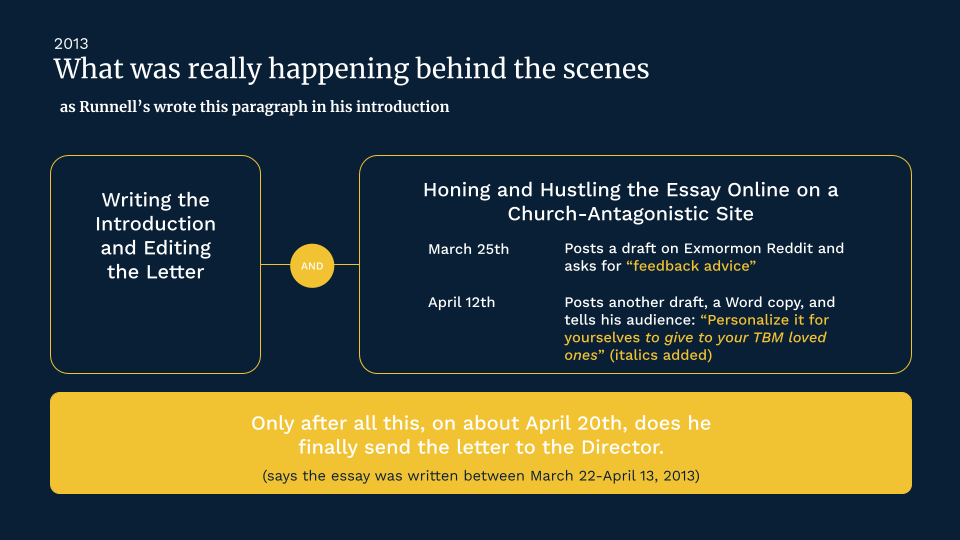
“Here again, we observe two different personas,” we write in our report. “To the general public, a purported seeker of religious answers; to his disaffected comrades in the online world, a clever compiler of an anti-Church hit piece, continuously looking for more ammo.”
From the entirety of this evidence, what actually took place is clear: These introductory paragraphs of Runnells’ original letter were added to disarm readers and provide an appearance of reasonableness—implying a curiosity and openness that never actually existed, but which was valuable to persuade others this truth-seeking was motivating his inquiry.
That pretense was yet another deception—and is no defense at all. Instead, it represents even more evidence of the author’s fraud that damaged so many people’s faith.
2. ‘This is really just an ad hominem hit piece that attacks him personally.’
One especially strange feature of American discourse today is its fragility. Even at universities where open grappling about truth ought to be most welcome, any inquiry or argument that makes someone else feel even slightly uncomfortable about how they choose to act can be cause for a report or sanction.
“I’ve been attacked” the person alleges. That’s the world we live in today.
So it’s truly the least surprising thing imaginable to hear the author characterize our report investigating his own words and actions as really just “personal attacks from Mormon apologists,” “ad hominems,” and “slanders.”
How dare we Latter-day Saints who have watched our brothers and sisters’ faith repeatedly wounded and hollowed out by past libel and slander repackaged as new “honest questions”—how dare we raise our voices to thoroughly investigate the source of this sophisticated smear?
Let’s be clear: The author’s many claims about the background and purposes of the essay were made publicly, heavily promoted, and energetically distributed over many years. That’s why a more direct investigation and public report of his own claims and storylines is vital.
Even so, some Church critics have predictably portrayed our analysis as a “shoot the messenger” effort.
Some of these try to broaden the definition of “ad hominem” beyond its precise, historical meaning as a way of prejudicing the audience against any effort that exposes deceptive speech and actions directly related to the Church and gospel.
Philosopher Douglas N. Walton, a highly respected scholar in the field of argumentation, gives a more complete, accurate definition by pointing out that questions of personal conduct, character, and motives can be very legitimate and relevant in evaluating truth—especially when there are “actions contradicting the subject’s words.”10 It is only when criticism of the person “is completely irrelevant to the argument the person is making” that it’s truly ad hominem, clarifies Dr. Bo Bennett, another expert on critical thinking.
Are the personal and autobiographical details brought up in our analysis relevant to Runnells’ arguments about the Church of Jesus Christ?
Of course they are. They are central. Readers’ initial reactions to Runnells’ essay almost universally focus on its “just-my-honest-questions” storyline and rhetorical packaging—what we’ve called “the shiny wrapper.”
It’s this narrative around the CES Letter that led to its potency in people’s lives—including the author’s professed storyline about the timeline of his original faith crisis, his state of mind when he wrote his essay, his purposes in doing so, the true makeup of his target audience, and his claims about the Church’s supposed silence in response.
Therefore, it’s impossible to do a comprehensive analysis of the essay’s actual impact without examining the author and his story—which are inseparable. As our colleague Carol Rice put it: “He is the story; he is the brand.”
3. ‘They’re being dishonest about Jeremy and not telling the whole story.’
At the same moment the author of the CES letter has accused us of “ad homimens,” in a statement of breathtaking irony he describes the two of us as “dishonest authors” who have “created a false narrative while ignoring key evidences that contradict their false slander and narrative.”
Over the last decade, this has become a go-to rhetorical strategy of some critics of the Church—openly accusing leaders and other members of being simply “dishonest” and outright “lying.” Yet what evidence do they have of this deceit?
Their own words and dark interpretations only. After Jacob wrote an in-depth piece highlighting the many errors in a mainstream article alleging the Church had covered up child abuse, a lawyer in Idaho reached out presumedly with factual concerns about one of the ten elements.
Wanting to see if there was something he had missed, Jacob corresponded with this lawyer and consulted with several other experts to make sure the point was made in a completely accurate way. At the end of their correspondence, this lawyer went online and posted shockingly on Reddit: “Jacob Z. Hess is dishonest.”
This is more or less how you can expect to be represented publicly if you try to defend the full truth about faith today. Never mind engaging the substance. Never mind exploring some of the many meaningful differences in interpretation concerning certain historical details or doctrinal matters. And never mind providing actual evidence of deception (as we have).
So much simpler to just assert, without a shred of genuine evidence, “they’re just lying!”
What you read in this comprehensive report is based on gathering all the evidence we could about what took place—demonstrating in detail the full picture of what actually took place. We’ve also updated the report from new feedback which we took seriously —making a number of adjustments and updates, including two additional pages (28 and 29) that address the author’s introductory paragraphs more in-depth, elaborating on something previously touched on in the footnotes.11
Even then, there was much evidence we didn’t find the space to include in the original report. For instance, there is more to say about Runnells’ online targeting of young adults and teenagers tender in the faith. As posted on Reddit on May 8, 2015:
“The only people I ever consider sharing info with are younger folks who ask questions and they’re young enough to do something about it and enjoy a good part of their lives if they stop believing.”
We also didn’t mention this comment from his second Stake President’s interview on November 9, 2014,12 when he stretched even farther his claim about his frame of mind when he wrote the CES Letter:
“It was not in the spirit of debate or trying to prove him wrong, it was in the spirit of ‘Help me. Help me understand where I’m wrong. Help me, help me fix this…’”
As should be abundantly clear by now, there is nothing in Runnells’ essay or his history that would indicate any such a desire or spirit.
4. ‘They’re really just distracting from—and intentionally avoiding—the questions posed in the letter itself.’
None of the points raised in the CES Letter have been unaddressed, ignored or avoided in the last decade. Every single one of the accusations-masquerading-as-questions has received effective responses, as we list above in footnote 3 and also in our report.
About the letter’s contents, Luke Driscoll summarizes, “Most of these arguments have been debunked for years even before the CES came forth” and “any quote from church leaders are just out of context.”
If these specific contents in the letter are all we focus on—if we become so engrossed in them that we miss the larger picture of what’s happening in the CES Letter—then we’ve taken the bait, and fallen into exactly the “oh-my-goodness-look-at-all-these-troubling-questions-from-a-curious-member-that-no-one-has-been-willing-to-simply-answer” experience the author designed.
Attention to the “wrapper” is the critical awareness that’s too often been missing. And our investigative report illuminates and brings all that into the foreground—revealing the deceptive intentions and designs of the author that should have taken center stage from the beginning.
5. ‘It doesn’t really matter the false approach he took, which is really quite understandable given the circumstances.’
We’ve been surprised by one other comment we’ve heard, which starts by conceding the deception involved, before telling us in essence, “Sure Runnells played a fast one here, but it doesn’t matter if he lied about his story or purposes. The content of his essay is what matters.”
Some of these point to the Church itself, insisting that the level of “deception” and “lying” there is great enough to justify whatever is required to expose it—“gotta fight fire with fire!”
As a professional online marketer—his daytime occupation—Runnells was well suited to do just that, ensuring his letter had a dissemination far beyond what it ever deserved. Runnells’ own deception matters a great deal in this regard, because that foundational storyline persuaded others to grant his essay unique credibility—opening themselves up to “machine-gunned” questions designed to overwhelm people emotionally and resulting in lasting wounds to some people’s faith.
Yet aware that every question has an answer, many others have been unaffected by the attempted barrage. We are among the millions confident in our belief that the prophets and leaders of the Church of Jesus Christ of Latter-day Saints are truthful and good. The fruits of taking their words seriously go on in every direction in our lives that are sweet, abundant and rich.
Needless to say, we do not believe the Church has perpetrated grand deceptions, as hardened critics charge—seeing other valid explanations for some complex matters involving Church history and doctrine. As Jacob wrote several years ago, this idea that leaders of the Church of Jesus Christ have orchestrated elaborate, deliberate lies over the years is the most fabulous lie of all (see, “Have You Heard the Biggest Church Lie?”).
To those who have chosen to trust cynical, dissembling, grievance-driven dissidents with ultimate questions of the soul—happiness, love, life and eternity—instead of being willing to follow the loving, peaceful, truthful and beautiful men and women leading the Church of Jesus Christ, our hearts honestly hurt for you.
Why it all matters
Don’t tell us for a moment this conversation doesn’t matter. “My brothers were deceived by that person,” writes one person in response to our study. “They tried to get me to leave because of these letters.”
There are far too many similar stories directly connected with the letter. “As I personally read the CES letter, I was terrified,” posts another responder on Instagram. “I was bewildered. It was shaking me up. It came at a time when I was vulnerable and already on shaky ground.”
“However, I kept praying to God. I was looking for answers from God. Not my spouse, not the prophet, not my friends, not my siblings, or from strangers on TikTok or podcasters. Only God.”
“In these times we are living, there are voices everywhere clamoring for our time and attention,” this person continues. “The voice I trust most is my Heavenly Father. I’ve seen too many lose faith, and ultimately lose Christ.”
What more awareness could mean
“If more members of the Church understood the facts you so eloquently provide,” Ron Rhodes wrote to us after our investigation was released, “they would be less likely to fall victim to the misleading information in the letter”—with Ralph Hancock noting the “dominant tendency” among believers to assume “the author is sincere and is just speaking from his experience.”
Historian Dr. Steven C. Harper was one of them. “I was one of many, who knows how many thousands, who read the CES letter and wanted to wrap my arms around Jeremy Runnells and say, ‘man that sucks, I wish that stupid CES guy had been better to you.’”
“And that’s just not what happened. That’s not the truth…The author was not an honest truth seeker. As many, many people have done, I took for granted that he was who he said he was.”
“It was never really a letter from an honest truth-seeker asking questions” said Stephen Done, summarizing our own analysis. “Instead, it was an essay specifically designed to attack people’s faith and pull them away from The Church of Jesus Christ of Latter-day Saints.”
“The level of deception Jeremy Runnells engaged in during his promotion of the letter is shocking,” he added.
The evidence couldn’t be more clear. And more and more people are realizing what this letter was from the beginning—including the many precious families who were personally impacted by it.
Every tear from every eye
Despite the overwhelming evidence documented in our report, the author could still choose to continue portraying himself as the victim of a “character attack.” In doing so, Runnells would be attempting to seize control of the narrative—making this about others rather than himself.
But that’s not going to work anymore. Because truth has a way of coming out in the end. It’s also this same search for truth, the refusal to water it down, and the rejection of deception that often leads people back to The Church of Jesus Christ of Latter-day Saints. The growing number of stories of individuals and families returning to the faith include many people once impacted by this letter.13 Even Jeremy himself could surprise us and one day return.
Please pray for the numerous individuals, marriages, and families whose love for and confidence in the gospel of Jesus Christ has been wounded by the CES Letter over the last decade. The God who can wipe every tear from every eye can find ways to heal every single one of these brothers and sisters as they turn back to the Savior and allow Him to heal their battered faith.
We’re rooting for you all and won’t ever stop hoping!
References:
We say a lot more about this introduction to his original essay here: Were These Ever the Sincere Questions of an Earnest Truth Seeker?—pgs. 28-29.
In chronological order: FAIR (2013-2023), Dan Peterson (2014), Michael R. Ash (2015), Brian Hales (2016), Jim Bennett (2018), René Krywult (2019), Scott Gordon (2019), Sarah Allen (2021-2022), GregoryL. Smith (2023), and Mormonr (2023), with collections of videos addressing specific topics raised in the letter organized by Brian Hales, FAIR, and Saints Unscripted.
Were These Ever the Sincere Questions of an Earnest Truth Seeker?—pgs. 13-16, 56-59.
CES Directors have no ecclesiastical authority to give official answers, as we address in the analysis: Were These Ever the Sincere Questions of an Earnest Truth Seeker?—pgs. 15-16.

See Reddit postings from November 11, 2012 and January 21, 2013, displayed on pages 10 and 11 of “Were These Ever the Sincere Questions of an Earnest Truth Seeker?”
Clearly, this is motivated in hopes of damaging their faith. The timeline is important for clarity. On March 25th, 2013, a month before sending his letter to the CES director, the author posted an initial draft of his essay on the Church-antagonistic subreddit, asking for “feedback/advice.” Responders immediately recognized that Runnells’ packaging of his essay as a “letter” to obtain resolution of personal faith issues was a masquerade: “Fan-freaking-tastic” says BigMikeSRT, “I love how this reads as a legit letter.” They applauded him and gave advice on how to better organize and improve his arguments, even sending additional anti-Church information. On April 12th, Runnells posted his final draft, telling the same audience to “personalize it for yourselves to give to your TBM (true blue Mormon) loved ones.” Runnells admitted in April 2014 that this action caused the essay to go “viral a little bit.” He then sent the letter to the director about a week later. Again, he wrote the introduction during this same time period as all this anti-Church activity.
The director is not his actual, intended audience—the evidence of which we reveal on pages 20-22 our report.
See “Were These Ever the Sincere Questions of an Earnest Truth Seeker?,” pgs. 33-36, 52-55.
Douglas N. Walton, Informal Logic: A Pragmatic Approach, Cambridge University Press (2008).
Some other additions and clarifications are noted on page 71 of the investigative report.
A Stake President is a local Church leader. He presides over several congregations, which are called wards.
On pages 64-68 of our report, we discuss the current trend of people returning to the faith after encounters with Runnells and other online antagonists. An increasing number of successful return stories are also documented on the internet and social media sites such as Comeback Podcast, Saints Unscripted, and Faith is Not Blind.
Unveiling the Truth: The Real Story Behind the CES Letter

Editor’s Note: This may be an article you want to save for its valuable links to a new investigative study by Michael Peterson and Jacob Z. Hess on the intentions of the author of the CES Letter (click the link here to access the full report). This article also includes an important link to Sarah Allen’s answers to the questions the CES letter purports to raise.
I have known the grief of having friends, with whom I have once known the joy of sweet, spiritual communion, come to me with an announcement that hits like a bombshell. They are leaving the Church of Jesus Christ. It often seems sudden, and when I press to know why, I have heard an answer that goes somewhat like this. “I learned something…”. They go on to explain that their eyes have been opened because now they have studied deeply, they have found something shocking on the Internet, or a big secret about the Church has suddenly been revealed to them—something that crushed their faith.
I know right away what to ask. “Was it the CES letter?” I jump at this first as the possible source of their disillusionment and discontent, because, by now, I’ve seen it so many times. It has become one of the stumbling blocks that trip up and derail the unwary on their spiritual journey. It has been a source of sorrow and separation for too many Latter-day Saints, who thought they were being earnest, when they were only being misled. So, just what is this infamous CES letter, which has hurt so many people’s faith?
At root, it’s an anti-Latter-day-Saint screed, introduced some eleven years ago on the Internet by Jeremy Runnells, whose purposes are to rob vulnerable readers of their testimonies. It relies on most of the same-old anti-Latter-day Saint arguments that have been used for decades, some of them from the beginning of the Restoration. So why, if the ideas are so old, has this CES letter had any fresh pull and appeal? Why did the CES letter go viral?
As Mark Twain said: “A lie can travel halfway around the world while the truth is still putting on its shoes.” Yet in this case, it was even more than that.
The reason this CES letter was so dangerously potent, was that Runnells carefully framed it as a tale of a confused young man who was honestly seeking some answers to the faith he once loved. This is how he posed it on his website dedicated to the essay’s dissemination. He claimed the letter is “one Latter-day Saint’s honest quest to get official answers from the LDS Church on its troubling origins, history, and practices.”
It was a premise designed to appeal for sympathy and connection, to play upon our natural need to trust and support each other—and many fell for it, not recognizing a wolf in sheep’s clothing. Instead, members exposed to the essay were left with lingering doubts: What were these questions that were impossible to answer, so impossible, in fact, that it was causing others to step away? Is this something I, too, should examine more myself? Have I been duped? What has the Church been keeping from me?
Since the so-called questions asked in the letter attack the very foundational truth claims of the Church, many scholars and apologists stepped forward to soundly address them.
“This includes, in chronological order: FAIR (2013-2023), Dan Peterson (2014), Michael R. Ash (2015), Brian Hales (2016), Jim Bennett (2018), René Krywult (2019), Scott Gordon (2019), David Snell (2019), Sarah Allen (2021-2022), Gregory L. Smith (2023), and Mormonr (2023). There were also collections of videos addressing specific topics raised in the letter organized by Brian Hales, FAIR, and Saints Unscripted.”
In 2021, Sarah Allen gave a particularly comprehensive analysis and refutation of the CES Letter in 70 Weekly Reddit postings (the equivalent of 800 pages) with exhaustive citations and page links. Yet, it was her first posting “The Dishonest Origins of the CES Letter” that particularly caught the eyes of Michael Peterson and Jacob Hess.
More than a year ago, they began an investigation into Jeremy Runnells’ story—what they subsequently began calling “the shiny package” that wrapped and sold the CES Letter. And this week, the report from that investigation is being released, called “Were These Ever the Sincere Questions of an Earnest Truth Seeker?” While others had responded to his arguments with rebuttal, Peterson and Hess asked a unique question that no one but Allen had focused deeply on: Who was Jeremy Runnells? What was his history? Was his claim in the CES Letter to be an earnest seeker instead a masquerade hiding his intention of destroying gospel faith and dividing people from their foundation? Was this premise a deliberate lie?
The authors write: “We were motivated to start this inquiry because of the hurt and heartache we have seen among people we love—influenced directly by the contents of this essay. Our goal has been to find out the full truth surrounding its background story and stated purposes, so we can better support the many impacted by its messaging. Because this rhetorical packaging influenced so many precious brothers and sisters of faith to grant the letter unique credibility—trusting it to influence their own views and feelings—we see this investigation as a necessity.”
In the Book of Mormon, Moroni told us he had seen our day and “know your doing.” (Mormon 8:35) His father Mormon included in the record only those events and trends, witnesses and warnings that would be for us. Their writings would be our road map for an increasingly troubled time.
Then, isn’t it compelling that a particular type shows up in the Book of Mormon over and over again as if we are being warned to sit up and pay attention? It is the Nehors, the Sherems, the Korihors who are smooth talking, persuasive, corrosive and insidiously devoted to testimony destruction, all while looking appealing, intellectual and acting in your best behalf. Alma ll describes his sinful, younger years as going about “seeking to destroy the church of God” (Alma 36:6).
We are warned about slick talkers who don’t have our best interests at heart. They are the thieves of joy. They are the thieves of peace. This new investigation was done to help shine light on deception.
Over and over, Peterson and Hess observed in online comments that people were vulnerable to Runnell’s message because they believed his shiny package of being a young seeker who only wanted answers. Yet that shiny package has been mostly ignored, with all the attention going to the package’s corrosive contents.
“When a veritable mountain of clear, contradictory evidence points beyond the arguments themselves to the larger storyline serving up those arguments to the world, it would seem shortsighted, even unwise, to overlook that evidence. This is especially true in this situation, given the sizable impact of the essay—with some describing it as playing a significant role in their life-altering decision to step away from the Church of Jesus Christ.”
As they dug, the authors learned just how vulnerable people were to the storyline.
“YouTube poster ‘Miss Syrinxie’ is emblematic of so many of the reactions to the essay—with her near-reflexive acceptance of Runnells’ key storylines in 2021:
‘From my understanding, the letter wasn’t intended to be this big exposure of the church; Jeremy Runnells had legitimate questions that he was seeking answers to. Why couldn’t anyone just honestly answer his questions? Obviously, it’s because no one has the answers…’
“Notice how ‘Miss Syrinxie’ focuses on the author’s stated motive for writing his essay,” they relate, “and accepts it without question—which is consistent with so many comments about the CES Letter online. Over and over, we see how readers’ trust in the essay’s contents was directly related to the surrounding storylines and rhetorical packaging they accepted from Runnells as true.”
“Another anonymous commentator on YouTube in 2015 said about the letter: ‘It came from a place of sincere inquiry.’
“Jordan Schaffer similarly said on Quora in 2019: ‘The man who wrote it designed it as a list of questions that were concerning him while he was still a believing member of the Church, when he was hoping a Church Educational System instructor might be able to provide a scholarly clarification.’”
Peterson and Hess note, “Unmistakably, across thousands of affected readers, it was the shiny wrapper of an ‘earnest questioner’ that gave the letter its broadcastable power, functioning as a compelling online brand.”
Following their lengthy investigation, the authors boiled their results down to ten points about Runnells’ deception. We will touch only lightly on six of them here, but recommend you read the actual 68-page report for a thorough look, where all ten points are covered extensively.
- Adversarial Church-bashing long before the letter was written.
Here’s a sample:
“July 2012 (Nine months before writing and publication). Runnells adopts a new, anonymous, church-antagonistic moniker ‘Kolobot’ on ex-mormon Reddit—a site primarily composed of former members of the Church of Jesus Christ hostile to the faith and actively attacking it.
“October 10, 2012. In an ‘Open Letter to Quentin L. Cook,’ of the Quorum of the Twelve Apostles, Runnells (as Kolobot) mocks Elder Cook’s then-recent conference message cautioning about online voices that tear down faith…. ‘I am one of those formerly spiritually lost and ‘apostate’ souls, whose testimony was destroyed by falsehoods I found on the evil internetz,” Kolobot intones. “But on Saturday night, following your advice at General Conference, I repented of my disillusionment, and it totally worked.’
“Continuing his pretense, he says: ‘I used to believe a lot of vicious lies, all of which are found in LDS or LDS-friendly sources I read about on the evil internetz…lies about Joseph Smith, Brigham Young, the First Vision, the Book of Mormon and everything else you can think of about the Lord’s Church.’
On and on the slams are piled, month after month, well before our seeker with a few “honest questions” wrote his letter. He was already practiced at corrosion, a skilled anti-Latter-day Saint dissident.
The authors relate, “After doing her own research, Sarah Allen notes what should be obvious: pre-publication evidence demonstrates that throughout this time, this man was not only far outside of the Church mentally and emotionally but was aggressively attacking it, ‘trying to devise the best way to lead away the rest of his family, and actively helping others push their own family and friends out of the Church as well.’ She frankly adds: ‘Jeremy Runnells has been dishonest about his journey from the beginning.’ The fact that Runnells portrayed an opposite image to the public at the same time he published his essay, in Allen’s words, helps us ‘gauge the truthfulness of the document itself.’”
They add, “All of these attacks were posted before a single word or ‘question’ in the letter was even composed.”
- Disinterest in Available and Established Channels for Member Questions
“Another key part of Runnells’ story is that ‘no response ever came’ to his request for answers—as he solemnly declares in the upper fold of his website’s opening page. He says this is because the Church ‘has no responses’—not any real ones anyway. They were perfectly willing to ‘indoctrinate’ him throughout his youth and young adult years, he insists, but when this 31-year-old man began to seriously question, they went silent…
“There is no evidence, however, that Runnells sought out church authorities for such answers or resolution—much less the General Authorities of the Church…
“No documentation of such sincere-answer-seeking interactions show up in Runnells’ own carefully kept record, which references only occasional mentions of local leaders in dismissive ways, such as his own bishop about whom he says: ‘I’ve made it clear on my positions…he’s mostly left me alone…[he’s] a Tommy Monson bishop more interested in helping the widows.’
“Indeed, even when later participating in lengthy meetings and interviews with his local Stake President… he would use those opportunities not to seek resolution of heartfelt questions and concerns but instead to further attack the church.
“If largely disinterested in local leadership, someone else caught this man’s eye. Runnells’ concerned grandfather, made aware through the family of his disaffection, tried to connect him up with a personal friend who leads a Latter-day Saint religious education program as a Church Educational System (CES) Director…His grandfather forwarded his contact information to this director-friend, who subsequently emailed him to ask about his religious concerns. This is how the CES Director entered the scene in March of 2013—reaching out to Runnells directly (not the other way around)—with Runnells agreeing to send him an email.
The author of the CES Letter insisted that he wanted “official answers” from “official channels” of the Church yet instead focused on a single CES director. Such directors are not “official” in an authoritative or ecclesiastical sense but are college and high school religion class teachers and coordinators—and there are over 150 of them around the world. They teach and inspire, but they do not speak officially for the Church.
“This education system director turns out to be more of an incidental actor, a kind of cipher who happened upon the unfolding central act— namely, Runnells’ advancing online crusade against the faith of Jesus Christ.”
- Textual similarities mirroring other published dissidents
“Were any of us to write a candid letter listing deeply-held concerns and questions we hoped to find some answers to, we’d likely use mostly our own words—referencing quotes only to illustrate our personal wonderings. The content throughout this essay in question, by contrast, includes an overabundance of antagonistic quotes, references and even entire sections of material borrowed, lifted or rephrased from other sources.
“Early on, this wasn’t something Runnells even tried to deny. When asked by John Dehlin about why he decided to put the essay under Creative Commons licensing and attribution, Runnells responded: ‘It’s not my information, and I stand on the shoulders of giants, the Tanners… They’re the real hipsters.’
“’The Tanners?’ Dehlin asked, seemingly for clarification. ‘Yeah,’ Runnells responded, speaking admiringly about these long-time anti-Latter-day Saint antagonists Gerald and Sandra Tanner, whose writings for decades have been dismissed, even by secular observers, for extreme anti-Church bias and outright dishonesty. Yet Runnells went on to insist they were ‘just now being vindicated.’”
- Taking a hostile, disparaging tone in the original essay
“Sincere questions typically involve a sincere tone that invites open engagement. Yet the original version of the essay displays remarkable vitriol aimed at both the restored gospel and Jesus Christ himself, including statements like:
“’To believe in the scriptures, I have to believe in a god who endorsed murder, genocide, infanticide, rape, slavery, selling daughters into sex slavery, polygamy, child abuse, stoning disobedient children, pillage, plunder, sexism, racism, human sacrifice…’
“‘Christ is the crazy god of the Old Testament….Again, I’m asked to believe in not only a part-time racist god and a part-time polygamous god but a part-time psychopathic schizophrenic one as well.’”
“The newest version, in Sarah Allen’s words, was ‘softened and recalibrated to appear more sincere and questioning.’ With those fiery lines removed in a previous 2015 update, he now continues finessing the language, further camouflaging the essay’s intention. Yet the plain aggression of both the original and updated text manifests in more ways than one.”
“The substructure of the letter itself, for instance, reflects what Runnells himself calls ‘machine-gunning’: a tactic of piling many ‘questions’ or ‘concerns’ into one place. This has also been called a ‘Gish gallop,’ which is defined as ‘a rapid series of many specious arguments, half-truths, and misrepresentations in a short space of time,’ which makes the totality seem impossible to refute.
“Widely recognized as an abusive form of rhetorical bullying, this technique has been used frequently in anti-Latter-day Saint campaigns to emotionally overwhelm and provoke spiritual meltdown in people by pummeling them with multiple attacks upon their faith. While potentially harmful to anyone, this is especially so for sensitive teenagers and young adults, whom Runnells has demonstrated are one of his major targets.”
“Compared to a genuine question, which openly anticipates various potential answers and different possible perspectives—Runnells’ questions offer no such context. As such, the format of the rapid-fire letter leaves the impression that there are no answers—one of the implicit messages of the entire essay. “
“Questions become merely strategic tools in a predesigned attempt to stir up doubt—in this case about the gospel of Jesus Christ.”
“Even while acknowledging his older age on occasion, it’s apparent that within his CES letter brand, Runnells wanted readers to regard him as if he were someone younger and inexperienced who had stumbled on unsettling questions (rather than a mature, 31-something adult with long experience in the Church and an immersion in anti-Latter-day Saint material). Upon discovering he had been “lied to,” this sympathetic character is then ushered into a kind of gripping coming of age saga.”
- Immediately promoting and personally disseminating the letter online.
“Had any of us placed the sincere questions of our heart into a private letter, there would likely be a period of weeks that we would await a response. That’s what happens with a genuine question—you anticipate an answer.
“Yet almost simultaneous with the release of his letter, Runnells makes immediate and prodigious efforts to openly promote and disseminate the text on the web. In the April 2014 interview with John Dehlin, he acknowledged posting the letter on another widely read anti-Church website “around that time in late April” when he first emailed it to the CES Director.
“The transformation from private to public letter is lightning quick.
“Sarah Allen summarized Runnells’ personal role in the extensive online distribution of his essay, including advance efforts before its wider public release. For instance, back on March 26th, he told participants on the antagonistic Reddit forum, ‘I will also be including a Word copy so that you and anyone can make the document your own.’ And he did so a few weeks later, on April 12th, encouraging this same large online population to share the letter with others and, again, to make it their own: ‘Personalize it for yourselves to give to your TBM [True Believing Mormons] loved ones. It’s yours.’
“Clearly, several of that disaffected audience did just that. Their responses display a kind of gleeful excitement to send his manufactured story and essay to active members of the Church in their lives: spouses, siblings, extended family, and friends—in the hope of persuading them to join their disbelief. Here was a compact, 77-page PDF doubt bomb wrapped in an interesting personal story that could easily be distributed through email and social media, attacking all the core foundational truths of the restoration of the gospel of Christ. How better could you attempt to decimate the faith of the faithful?”
Runnells lied, “I never promoted it. It just happened.”
- Employing malicious personal attacks upon anyone who dared to disagree
“If you and I were raising honest questions to the world, there would naturally be space to explore different perspectives. As [another] point of evidence, Jeremy Runnells’ behavior over the years demonstrates something far different: an aggressive response to anyone who didn’t agree with the arguments he was making or the flimsy evidence upon which they were based.
“This began soon after the letter’s initial 2013 release as he issued hostile rebuttals to any person or group attempting to respond in depth to his essay’s “questions.” If the author claimed he was just sincerely seeking answers and dialogue to arrive at resolution, why such immediate zeal to attack those offering responses?”
It started with name calling, and then moved on to aggressive attacks upon anyone who dared criticize him. “Yet Runnells reserves his ugliest vitriol for arguably his most compelling critic, a remarkable woman: Sarah Allen. Because she had the courage to boldly and publicly unfold the false origin story of his essay—the foundational deception upon which his entire influence was based—he blasts her on his website, alongside her picture, with name-calling, denigrations, and other personal attacks. Then, after long-time insistence that no one was willing to answer his questions (despite the many who have publicly done so), he tells his audience to ignore Allen’s extensive responses to his essay. Instead, he goes straight for her character.
“Runnells labels her ‘an amateur apologist trying to make a name for herself.’ He repeatedly refers to her as ‘Deceptive Sarah’: ‘I just can’t stand seeing Deceptive Sarah’s face. I’m so repulsed by her.’ In an indirect reference to her gender, he mocks her, addressing her as ‘sweetheart’—talking down to her, decrying what he claims is her ‘fundamental ignorance.’ Then— ironically—he charges her with a ‘Scientology-style cult move here and focusing instead on attacking the person instead of the issues.’
“In this way, Allen’s effective checking of Runnells’ grand deception leads him to accuse her of the very thing that he himself is doing—instead of focusing on the substance of what they are saying, he attacks in insulting language the character and personality of the person best challenging his falsehoods.”
In summary, ten areas of evidence:
Here, now, in order, are the ten findings of the investigation, and in the report, each is thoroughly discussed.
- Adversarial Church-bashing long before the letter was written
- Disinterest in available and established channels for member questions
- Seeking feedback from church antagonists prior to publication
- Public statements revealing a much broader intended audience
- Textual similarities mirroring other published dissidents
- Taking a hostile, disparaging tone in the original essay
- Immediately promoting and personally disseminating the letter online
- Disparaging attitudes and manipulative actions toward local Church leaders
- Extensive and ongoing branding expansion efforts over subsequent years
- Employing malicious personal attacks upon anyone who dared to disagree
Michael Peterson and Jacob V. Hess have done yeomans’ work on their investigative report, which only solidifies what should have been clearer for those who read the infamous CES Letter, with its stack of fabrications, from the beginning. You don’t seek answers to your own personal questions, nor try to extend your knowledge, by reading the work of someone who hates your faith and wants to demoralize your children. You shouldn’t take a testimony and dump it in boiling oil and expect it to remain intact, especially if the one who started the fire did it with the intention of preying upon something that is precious to you—your sense of self and of God.
When someone says, “I am only being honest with you,” maybe we should ask some questions of our own… The “honest” questions of Jeremy Runnells were a deceit from the beginning. He was never being honest with us.