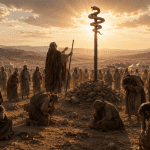




Hidden Things: Are We Looking for the Wrong Kind of Loaves and Fishes from the Lord?

The following is the second in a series of articles giving greater detail from the stories behind the hidden things in our recently released Treasures from the Life of Jesus jigsaw puzzle. If you haven’t gotten yours yet, BUY IT HERE.
If you already have yours, bookmark or print this page so you can hang on to the story to share with your family as you come upon the hidden image when you do the puzzle. Read the first article in the series HERE.

What does the story of the loaves and the fishes mean to us? Most of us are quick to think of times when the Lord has multiplied something that didn’t seem like enough to be sufficient for our needs—whether that was actually enough food at a campout with unexpected attendees or enough energy when you felt you had no more to give, or enough money to pay for your needs when you were coming up short.
I remember as a child joining my friend’s family on a vacation to Lake Powell. The sunsets there were beautiful and following in the footsteps of my dad, I wanted so much to get great pictures of them. One night in particular, the sun turned the sky a deep pink and as I held up my little digital point and shoot to capture the moment, the screen read “battery exhausted” with a descending melody of electronic notes that sounded like failure. The sky would only look like that a little longer and I just wanted to battery to give me another minute or two so badly. I said a quick prayer asking the Lord to give my battery a little more juice and when I pressed the on button once more, the camera sprang to life and gave me the chance at 4-5 more shots.
I don’t remember or have the resulting pictures anymore, but I never forgot the answer the prayer and the Lord’s ability to make my dying battery last just a little bit longer.
But the Lord’s ability to make five barley loaves and two small fishes sufficient to feed a multitude (it says 5000 men, which means with women and children, it was probably more like 20,000) is not the only lesson to be learned from this New Testament miracle.
Add this puzzle to your Easter celebrations.
You may not remember that at the time that this hungry crowd was following Jesus, He had just learned of the gruesome death of John the Baptist. After receiving this news, Jesus departed “into a desert place apart” (Matt. 14:13) ostensibly to process his grief alone. But He wouldn’t get the chance, as the people heard of His whereabouts and followed Him by foot out of the cities.
When Jesus saw the great multitude, He was “moved with compassion toward them, and he healed their sick” (Matt 14:14).
As the day wore on, Christ’s disciples said that it was time to send the multitude away that they might get themselves something to eat. This moment is vividly in my mind because I was one of the extras in the Church’s Bible video of the feeding of the 5000. It was an extremely hot day in the wilderness of Utah and everyone was dressed in layers of the garb of ancient Israel. People began to faint for want of shade and water and though underneath they were just modern people in costumes with paramedics and water bottles standing by, it seemed like we were back in time—a crowd truly in need of saving sustenance in a desert wasteland.
It was Jesus’ chance to finally be alone, but he told his disciples that the crowd need not be sent away, but that they could make do with the food they had—five loaves and two fishes.
Jesus looked up to heaven and gave thanks before blessing and breaking the tiny offering. The pieces were distributed among the crowd and when all had eaten their fill, twelve baskets of the fragments remained (Matthew 14:20).
It was a miracle, clear to everyone there, but it’s what happened after this that I want you to remember.
The next day the people looked again for Jesus—both those that had actually been there and were fed, and those that only heard about it. It was not unlike a time after a large buffet meal that I leaned back in my chair and said, “ugh, I’m so full, I’ll never eat again” and my dad’s swift response was, “I have a friendly wager…you will.”
Of course, I have eaten again and again and likewise, these people that were filled the day before now came back hungry.
“Ye seek me, not because ye saw the miracles,” said Jesus, “but because ye did eat of the loaves, and were filled” (John 6:26).
Elder Jeffrey R. Holland sums up the exchange this way:
During the Savior’s Galilean ministry, He chided those who had heard of Him feeding the 5,000 with only five barley loaves and two fishes, and now flocked to Him expecting a free lunch. That food, important as it was, was incidental to the real nourishment He was trying to give them.
“Your fathers did eat manna in the wilderness, and are dead,” He admonished them. “I am the living bread which came down from heaven: if any man eat of this bread, he shall live for ever.”
But this was not the meal they had come for, and the record says, “From that time many of his disciples went back, and walked no more with him.”[1]
Add this puzzle to your family’s collection now.
Such fair-weather friends it seems, to have witnessed such a miracle and then to turn and walk away when the miracle didn’t continue to take the form they understood; to walk away seeking somewhere else to fill their bellies, ignoring the aching hunger of their spirits.
Elder Holland continues:
In that little story is something of the danger in our day. It is that in our contemporary success and sophistication we too may walk away from the vitally crucial bread of eternal life; we may actually choose to be spiritually malnourished, willfully indulging in a kind of spiritual anorexia. Like those childish Galileans of old, we may turn up our noses when divine sustenance is placed before us. Of course the tragedy then as now is that one day, as the Lord Himself has said, “In an hour when ye think not the summer shall be past, and the harvest ended,” and we will find that our “souls [are] not saved.”
So, what are the loaves and fishes that we are fixating on, while completely missing the bread of life?
Perhaps you look back to certain miracles from the past and feel cheated that you aren’t seeing those same kinds of miracles anymore. Perhaps rather than reflecting in gratitude on past answers to prayer, those earlier versions of yourself mock you because the prayer in your heart now seems to go unanswered and you don’t know why.
Because that child that I was, was given the loaf of a little more battery power to take a sunset picture, I cannot just believe that I need never pack batteries again. Because the Lord isn’t in the business of batteries, He’s in the business of consecrating lives and transforming our souls.
I’m afraid I see a little too much of myself in those disciples that came for the food and walked away when it was going to be strictly spiritual food.
Help your kids learn more about Jesus with this activity for the whole family.
A few years ago, I directed a short film and on the day that we were meant to shoot a particular sequence, it began to rain. Ironically, it was meant to be raining in the scene, but I had planned on rain that I could control and from which I could protect the expensive equipment. So much had gone into finding a day that would work for everyone to shoot this scene and watching the rain pour down from heavily laden clouds just felt like the Lord didn’t care about my project at all. I sat on an overstuffed chair and cried.
It was in the midst of those tears that I realized that perhaps I was believing myself entitled to miracles-on-demand from the Lord. Not looking to Him in gratitude that we’d pulled off so much already or that I’d had so much help from so many talented people. I was looking to be provided with the intercession of heavenly help in temporal matters while being satisfied to go without it in my spiritual life.
But thankfully, my story didn’t have to end there. It wasn’t Jesus that walked away from those disciples, it was them that departed hence from Him. Just like he looked on the original multitude, despite intending to be alone, and had compassion on them and stayed with them, He has compassion on us and will be there when we come to our senses and begin to crave the bread that only He can give; the life that he bought us with his blood.
So, when you find the loaves and fishes in our Treasures from the Life of Jesus jigsaw puzzle, be grateful for the abundance that the Lord is capable of showing forth in our lives, but also remember not to be the disciples that walked away when they couldn’t come back for seconds. Seek the Bread of the Life when the rolls run out, for it is only through Him that we can be filled and never hunger again.
[1] Holland, Jeffrey R., “He Hath Filled the Hungry with Good Things”, October 1997.
Spiral Staircases and Sacred Surprises: Lessons in Elder Clark G. Gilbert’s Ordination

In the last six months, we have lost two truly extraordinary disciples of Jesus Christ, President Russell M. Nelson and Elder Jeffrey R. Holland. The outpourings of love and the specifically personal tributes that have flooded the internet show just how much these men had not just global impact, but quite individual influence in the hearts of Church members (and others).
As you read the narratives of their mortal lives that are always shared upon the passing of an apostle, sometimes it feels like they were extraordinary from their youth, guided at every step, and lived a nearly perfect existence. It’s easy to look at your own life, whose setbacks and pitfalls you know so well and feel like you weren’t set up quite as obviously for success. Or didn’t have such inner strength and commitment from hour one.
It is for this reason that the story from President Holland’s funeral that stood out to me most was his eldest son sharing of his weaknesses in carpentry, even in the simplest tasks. “We acquired the habit, whenever he picked up a hammer, of quoting to him Doctrine and Covenants 24:9: ‘In temporal labors, thou shalt not have strength, for this is not thy calling.’” President Holland received the teasing with good humor. He had often told them of the time in his youth when he decided to build an external spiral staircase and entrance to his parents’ attic, which had previously been very difficult to access.
“It was characteristically noble thought of a loving son and he did his level best,” David Holland shared, “but he was crestfallen when an insurance adjuster, who had come to assess some earlier wind damage elsewhere on the property, urgently called my grandfather to the back of the house, pointed to my father’s recently completed summer project, and said, ‘Mr. Holland, I can’t tell you exactly what’s gone on here, but obviously this was the place of the greatest damage.’”
“Even the best of intentions have to contend with the gravitational forces of a fallen world,” David Holland said as he summed up the story, stating that this was a concept his father understood well.
This is a concept we all come to know well, whether we are willing to peacefully accept it or not. It is always a good reminder to know that even the spiritual exemplars that you admire the most were just building their rickety spiral staircase towards heaven one moment of choosing to trust the Savior at a time, even if in the end of their mortal life, the structure seems to look so glorious.
So, as we welcome Elder Clark G. Gilbert as the newest apostle, who was ordained to the office on Thursday, February 12, we are eager to be blessed by the insight of his unique experience, his apostolic mantle, and his hard-earned testimony. But it is also exciting to hear the ways he freely shares how humbled he is by the call and that life to this point hasn’t just been absolutely certain and easy every step of the way.
“There’s a mix of trepidation and joy,” Elder Gilbert shared with the Church News, “two feelings that don’t usually coincide. So much excitement and joy for what opportunities lie ahead to bear witness of Jesus Christ, and trepidation for the responsibility and the weight of the calling.”
“He’s such a joyful, happy person; so positive and enthusiastic,” his wife Christine Gilbert shared as they sat hand in hand. “Sometimes it’s a whirlwind,” she added, “sometimes we’re not sure we have all our pieces in the right place. It’s chaotic, especially with eight kids. But we’re having a good time. We’re being joyful and we’re doing our best. That’s what we always say, you can’t do it perfectly, but do your best.”
Elder Gilbert met the now Sister Gilbert when they were both attending BYU. They married in the Salt Lake Temple in 1994, which was also the year he received a bachelor’s degree in international relations from the university.
Elder Gilbert would go on to receive a master’s degree in East Asian studies from Stanford and a doctorate in business administration from Harvard, where he would soon after join the faculty.
During his time in Boston, his experiences with inner-city Latter-day Saint youth fundamentally shaped his thinking in his later position as the first president of BYU-Pathway Worldwide, a spiritually based education initiative that has gone on to bring educational opportunity to more than 288,000 students in more than 180 countries.
While those Boston youth were new to the Church and its doctrine, Elder Gilbert said, he learned the key to helping them grow was to focus on their potential.
“In this Church,” he taught, “we believe in the divine potential of all of God’s children and in our ability to become something more in Christ.” While people begin life with differing circumstances, “in the Lord’s timing, it is not where we start but where we are headed that matters most.”
His life’s preparation for this newest, crucial calling also included time as CEO of Deseret Digital Media, president of the Deseret News, and president of BYU-Idaho before he became the inaugural leader of BYU Pathway.
He had been serving as Commissioner of the Church Education System, which involves oversight of all of the Church’s universities, online educational programs, seminaries, and institutes, until this most recent calling.
Elder Gilbert was with President Oaks for the Church Board of Education meeting on Wednesday, February 11, and at the end of the meeting President Oaks said, ‘Elder Gilbert, would you come in for just one item of follow up?’
“I sat down and he extended the calling,” Elder Gilbert shared, “it was immediately sobering and humbling…but beautiful at the same time.”
After receiving the calling, he stepped away privately to call his wife.
“There was a lot of surprise,” Elder Gilbert said of that phone call.
“Surprise was also met with a feeling of sacredness for the trust he was being shown,” the Church News reported, “he and Sister Gilbert stayed up late Wednesday reflecting on what they have learned from each member of the First Presidency and Quorum of the Twelve Apostles.”
I love picturing that scene of receiving such overwhelming, life-changing news and admire so much that they chose to respond to it like Nephi when he first heard of his father’s vision of the Tree of Life. They knew where to turn. They reflected on what the Lord has already taught them in preparation for this moment by the examples of those that have come before in this calling. They invited the spirit by reflecting on the truths that had already been taught to prepare them, even when they didn’t know they were being prepared.
According to the Church Newsroom, Elder Gilbert says he has received over 1,000 text messages since his calling was announced.
“We couldn’t answer every call that was coming in,” Elder Gilbert shared, “but one of them was on [Sister Gilbert’s] phone from one of our inner-city youth. He’s someone we had mentored and loved and watched him grow in the Gospel. But he called her, not me.” Elder Gilbert’s voice filled with emotion as he shared what the message for his wife was: “We know that this wouldn’t have happened without you.”
“And he’s right.” Elder Gilbert said, “and what a tender expression of that…for both of us.”
I do believe that those the Lord calls to lead his Church are prepared for that calling from their earliest days. They are equipped with skills and insights unique to the time they live in. Elder Clark G. Gilbert is no exception. But I believe the Lord prepares us all for the times we live in and the things we are to take from and contribute to them.
Though life can often feel like we live in constant survival mode, the Lord’s hand is orchestrating our opportunities to allow us to accomplish the unique calls and purposes he has for each of us. Perhaps the greatest opportunity we have is to learn to draw close to Him.
“Right now, we live in what the apostle Paul talked about; perilous times.” Elder Gilbert shared, “The world is in commotion and people are struggling. Good is being called evil, and evil being called good. There are anxieties and tumult and polarization. But those are the same things that are creating the most unprecedented opportunities for the Church.”
“It’s much harder, in this climate, to do things without the Lord. But when you involve him, and make him your priority, all of those things calm.”
None of the prophets or apostles that we have loved and lost had the chance to control the events of their lives. But all chose again and again to involve the Lord and it was through Him that they could have such significant impact with the gifts and insights they had.
“He will comfort us in our afflictions, He will strengthen us in our infirmities, and He will succor us when life’s not fair.” Elder Gilbert testified. “I have a testimony that He lives and I am so grateful the opportunity now to share that everywhere I go in the world.”
Some Thoughts on the Character of Joseph Smith
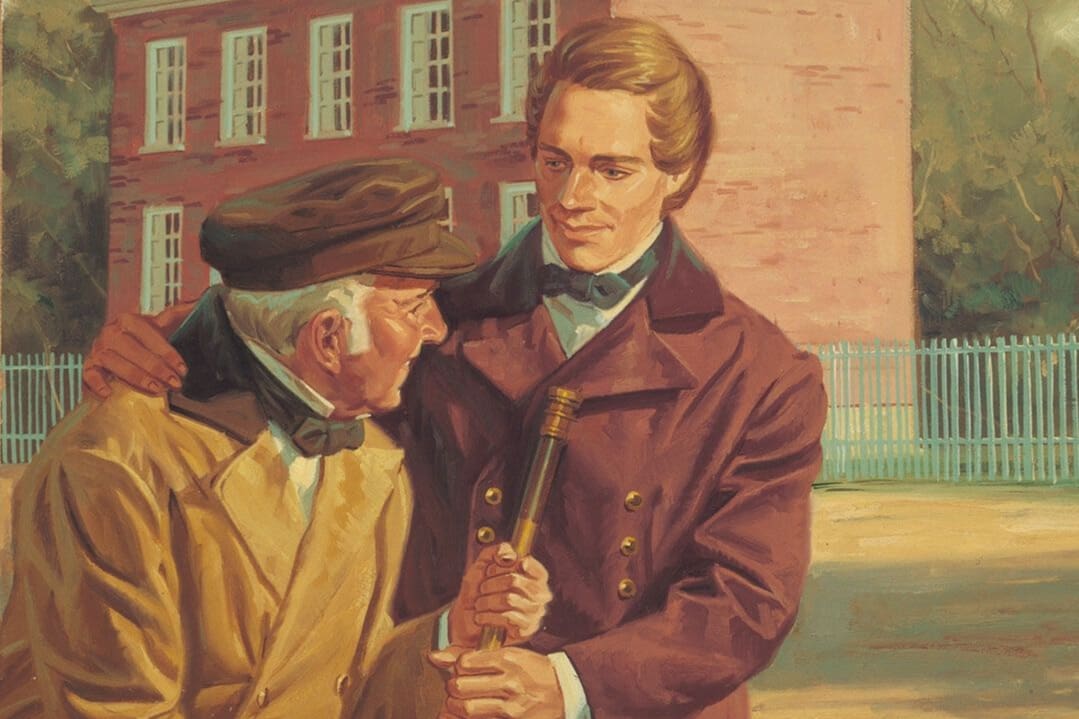

The following comes from Daniel C. Peterson’s blog, “Sic et Non” on Patheos. To visit his blog, CLICK HERE.
The jumping-off point for our Elders Quorum meeting today, taught by our former bishop, was the late Elder Jeffrey R. Holland’s address at the last October general conference, “And Now I See.” As always, it was a memorable talk, and I, along with hundreds of thousands if not millions of others, was moved by his fervent testimony. He used an incident from the ninth chapter of John as the centerpiece for his remarks, and I excerpt some of the verses from that chapter here below. The incident, well known among missionaries of the Church of Jesus Christ of Latter-day Saints for the theological answers that it suggests, involves the Savior’s healing of a man who had been blind since birth, which transpired as follows:
When he had thus spoken, he spat on the ground, and made clay of the spittle, and he anointed the eyes of the blind man with the clay, And said unto him, Go, wash in the pool of Siloam, (which is by interpretation, Sent.) He went his way therefore, and washed, and came seeing. The neighbours therefore, and they which before had seen him that he was blind, said, Is not this he that sat and begged? Some said, This is he: others said, He is like him: but he said, I am he. Therefore said they unto him, How were thine eyes opened? He answered and said, A man that is called Jesus made clay, and anointed mine eyes, and said unto me, Go to the pool of Siloam, and wash: and I went and washed, and I received sight. . . .
They say unto the blind man again, What sayest thou of him, that he hath opened thine eyes? He said, He is a prophet. . . . Then again called they the man that was blind, and said unto him, Give God the praise: we know that this man is a sinner. He answered and said, Whether he be a sinner or no, I know not: one thing I know, that, whereas I was blind, now I see. (John 9:6-11, 17, 24-25)
There is a very great deal that could be profitably said about this passage (including the verses that I’ve omitted here). One thing of note is the humble material means that Jesus used for the miracle: dirt mixed with spit. I’ve been to Siloam, which is located in East Jerusalem, in the modern Arab district of Silwan (سلوان), more times than I can count. The water of the pool is mundane water, the dirt is mundane dirt, and I suppose that the saliva was entirely mundane, as well. There are obvious lessons to be drawn from the story about how the Lord uses ordinary means (and ordinary people) to achieve his purposes.
The brother sitting immediately to my left observed how interesting it is that while his enemies would spit upon him to humiliate him (as at Matthew 26:67-68, Mark 14:65, and Luke 22:63-65) — compare Isaiah 5):6: “I gave my back to the smiters, and my cheeks to them that plucked off the hair: I hid not my face from shame and spitting” — the Savior used spittle as a vehicle for healing.
In thinking about the story told in John 9, I found myself thinking about some exceptionally nasty and insulting characterizations of the Prophet Joseph Smith that I happen to have seen online over the past two or three days. (It seems ridiculous that I need to say it — although, with some disingenuous folks, it’s also probably futile to say it — but I am not equating Joseph Smith with the Savior here.). I’m familiar, of course, with attacks on the Prophet’s character, and have been familiar with them for decades, but I’ve seen an unusual number of them lately, and my response might run somewhat along the lines of that given by the formerly blind man in John 9:
He answered and said, Whether he be a sinner or no, I know not: one thing I know, that, whereas I was blind, now I see.
Immediately next, I thought of an 1856 remark by President Brigham Young:
I recollect a conversation I had with a priest who was an old friend of ours, before I was personally acquainted with the Prophet Joseph. I clipped every argument he advanced, until at last he came out and began to rail against “Joe Smith,” saying, “that he was a mean man, a liar, money digger, gambler, and a whoremaster;” and he charged him with everything bad, that he could find language to utter. I said, hold on, brother Gillmore, here is the doctrine, here is the Bible, the Book of Mormon, and the revelations that have come through Joseph Smith the Prophet. I have never seen him, and do not know his private character. The doctrine he teaches is all I know about the matter, bring anything against that if you can. As to anything else I do not care. If he acts like a devil, he has brought forth a doctrine that will save us, if we will abide it. He may get drunk every day of his life, sleep with his neighbor’s wife every night, run horses and gamble, I do not care anything about that, for I never embrace any man in my faith. But the doctrine he has produced will save you and me, and the whole world; and if you can find fault with that, find it. (Journal of Discourses 4:78)
Now, please note that Brigham Young wasn’t admitting such behavior on the part of Joseph Smith; at the time of the conversation with “brother Gillmore,” Brigham said, he had not even met the Prophet — which puts the conversation very early, probably no later than autumn of 1832. Later, of course, Brigham Young came to know Joseph exceptionally well, and here’s what he had to say about his experience with the Prophet, as reported at Journal of Discourses 9:332:
Who can justly say aught against Joseph Smith? I was as well acquainted with him, as any man. I do not believe that his father and mother knew him any better than I did. I do not think that a man lives on the earth that knew him any better than I did; and I am bold to say that, Jesus Christ, excepted, no better man ever lived or does live upon this earth. I am his witness.
I feel like shouting hallelujah, all the time, when I think that I ever knew Joseph Smith, the Prophet whom the Lord raised up . . . and to whom He gave keys and power to build up the kingdom of God on the earth and sustain it” (Journal of Discourses 3:51)
Dean Jessee, who essentially founded the Joseph Smith Papers project, passed away on the very last day of 2025: “Church historian Dean Jessee — the ‘founding father’ of ‘The Joseph Smith Papers’ project — dies at age 96: Latter-day Saint historian Dean Jessee was a ‘humble, dedicated disciple of Christ,’ his longtime colleague Ronald Esplin says”
Brother Jessee’s work had a specific and around impact on me: I think that his two-volume edition of The Personal Writings of Joseph Smith and, now, the much larger Joseph Smith Papers project, have set out clearly the true character of the Prophet, and I commend these two brief articles, written by the estimable Jacob Hess, to your attention:
This strikes me as quite significant, since the three basic options for explaining Joseph Smith seem to be, using the appropriate technical terminology, as follows:
- He was lying.
- He was nuts.
- He was telling the truth.
But option 1 appears to be incompatible with the historical evidence and option 2 has no real evidence to support it. Now what?
When the Roles Reverse: Adult Children Dealing with Immature Parents

In the traditional parent-child relationship, parents are expected to provide guidance, stability, and maturity while children grow, learn, and eventually step into their own adult responsibilities. But what happens when this expected order is reversed—when adult children find themselves more emotionally mature, more spiritually grounded, and more responsible than their own parents? This is a sensitive and often painful dynamic that some faithful Latter-day Saints quietly navigate.
The restored gospel teaches us about eternal families and the importance of honoring our parents. However, honoring does not mean enabling unhealthy behavior or pretending dysfunction does not exist. It means treating our parents with respect, patience, and love, even when their choices or emotional immaturity create challenges. In addressing this situation, President Dallin H. Oaks wisely taught, Our obligation to honor our parents does not include condoning or participating in unrighteous or destructive behavior. We can honor them through kindness and compassion while still establishing necessary boundaries.
Some parents may struggle with selfishness, emotional volatility, irresponsibility, or even spiritual immaturity. In such cases, adult children may find themselves in the unusual position of providing the steadiness, wisdom, and spiritual perspective that their parents seem to lack. This reversal can be confusing, frustrating, and spiritually taxing.
There are a number of principles you can apply to help navigate these types of relationships. The first is to set loving boundaries. Loving someone does not mean accepting harmful behavior. Adult children can, and often must, establish clear boundaries to protect their emotional and spiritual well-being. This might include limiting certain conversations, declining to engage in family conflicts, or stepping back from enabling poor decisions. If you are caught up in this type of situation, it may help to gain perspective by remembering Elder Jeffrey R. Holland’s counsel—Be kind regarding human frailty—your own as well as that of those who serve with you in a Church calling. Except in the case of His only perfect Begotten Son, imperfect people are all God has ever had to work with.
But also remember, recognizing imperfection is not the same as tolerating harmful patterns. Forgiveness is central to our discipleship in Jesus Christ. However, forgiving immature or selfish parents does not mean pretending their actions have no consequences. We can forgive while still acknowledging reality. The Savior’s example teaches us to offer mercy but also to speak truth. Adult children can pray for their hearts to be softened, while still wisely assessing the situation.
Adult children may feel isolated in this role reversal, but they are not alone. Jesus Christ understands the burdens of family pain. He is the source of lasting peace and guidance. Through prayer, scripture study, and temple worship, adult children can receive personalized revelation on how to balance honoring their parents with protecting their own spiritual health. As taught in Preach My Gospel—Through Jesus Christ, we can be cleansed and healed from the effects of other people’s sins as well as our own.
Sometimes, family dynamics can leave adult children feeling spiritually unsupported. In such moments, the Church community can offer belonging, mentorship, and the steadying influence of gospel-centered friends and leaders. Trusted bishops, Relief Society sisters, and priesthood brethren can offer counsel and a listening ear.
One of the most empowering truths of the restored gospel is that we are children of Heavenly Parents who love us perfectly. Earthly families may struggle, but our divine heritage is secure. Elder Dieter F. Uchtdorf has stated, No matter how insignificant you may feel, like one of billions of humans who have lived on this earth, know that you are not invisible to your Heavenly Father. He loves you. He knows you. When facing the sorrow of emotionally or spiritually immature parents, remembering this eternal identity can also offer perspective and—perhaps more importantly—hope.
Dealing with immature parents as a responsible adult child is a unique and often painful stewardship. It requires courage, spiritual maturity, and deep reliance on the Savior. The path is rarely straightforward, but the gospel offers light, healing, and hope. As adult children seeking to navigate these challenging relationships, we can rest in the assurance that our efforts to act with charity and wisdom are known to God—and that the Savior will walk with us through the complexities of family life.
Come Follow Me Podcast #42: “O God, Where Art Thou?”, Doctrine and Covenants 121-123

Scot
So, here’s a question: In the midst of all the challenges, trials, privations and difficulties the Saints experienced in Missouri, how is it that when the Church really needed the leadership of the Prophet Joseph, God allowed him to be put in an obscure and remote Jail, ironically called Liberty? Why would God do that? This is the Kingdom of God on the earth. Isn’t the God of the Universe watching out for His chosen Prophet? Let’s explore that question today.
Maurine
Hello dear listeners and welcome to Meridian Magazine’s Come Follow Me Podcast. This is Scot and Maurine Proctor and we’re delighted to be with you again. We are going to be talking about Liberty Jail today, and it is a place we go every year, so we know the things that happened here really well. Before we get started, I want to remind you that our Come Follow Me Old Testament calendar is now available, and it is gorgeous. It is the perfect Christmas gift for everybody on your list because it not only helps people keep track of the Come Follow Me lesson assignments, but it is like hanging an Old Testament photograph on your wall that changes with the season. Through this calendar and Scot’s stunning photography, you are invited into the ancient world of the Old Testament. Give them to your friends, your neighbors, your family members. This is an easy and meaningful way to quickly purchase some of the difficult Christmas gifts that you have to give. See the calendar at latterdaysaintmag.com/2026. That’s latterdaysaintmag.com/2026 You’ll be glad you took a look.
Scot
Let’s go back now to the horrific scenes as Joseph and his brethren were being taken from Far West. Intimidated by Alexander Doniphan’s stand, General Samuel Lucas made plans to take the Church leaders 35 miles to the south to Richmond for trial.
Maurine
Joseph and the other leaders were taken to that horrible jail at Richmond for an agonizing preliminary hearing on charges growing out of the armed hostilities. The prisoners submitted a list of defense witnesses, but these were systematically jailed or driven from the county.
Parley Pratt described conditions in the jail as they awaited their trial: “Our ears and hearts had been pained, while we had listened for hours to the obscene jests, the horrid oaths . . . and filthy language of our guards . . . as they recounted to each other their deeds of rapine, murder, robbery, etc., which they had committed among the ‘Mormons’ . . . They even boasted . . . of shooting or dashing out the brains of men, women and children.
Scot
“I had listened till I became so disgusted, shocked, horrified, and so filled with the spirit of indignant justice, that I could scarcely refrain from rising,” when “on a sudden he arose to his feet, and spoke in a voice of thunder, or as the roaring lion, uttering…the following words:
“SILENCE, ye fiends of the infernal pit. In the name of Jesus Christ I rebuke you, and command you to be still; I will not live another minute and bear such language. Cease such talk, or you or I die THIS INSTANT!”
He ceased to speak. He stood erect in terrible majesty. Chained, and without a weapon; calm, unruffled and dignified as an angel, he looked upon the quailing guards, whose weapons were lowered or dropped to the ground; whose knees smote together, and who, shrinking into a corner, or crouching at his feet, begged his pardon, and remained quiet till a change of guards.
Maurine
Parley described Joseph in that moment:
“I have seen the ministers of justice, clothed in magisterial robes, and criminals arraigned before them, while life was suspended on a breath, in the Courts of England; I have witnessed a Congress in solemn session to give laws to nations; I have tried to conceive of kings, of royal courts, of thrones and crowns; and of emperors assembled to decide the fate of kingdoms; but dignity and majesty have I seen but once, as it stood in chains, at midnight, in a dungeon in an obscure village of Missouri.” (Pratt, Parley P. Autobiography of Parley P. Pratt, Revised and Enhanced Edition, Edited by Scot Facer Proctor and Maurine Jensen Proctor, Deseret Book Company, Salt Lake City, 2000, p. 263)
Six leaders of the Church were taken on to Independence, while some, including Parley P. Pratt, Porter Rockwell and others were left in Richmond.
Scot
Joseph and Hyrum Smith, Sidney Rigdon, Alexander McCrae, Caleb Baldwin and Lyman Wight, all falsely accused, were cast into a two-story, twenty-two-foot-square stone dungeon with the ironic name of Liberty. For the next four long winter months, the Prophet and his friends suffered from bitter cold, unfit food, filthy conditions, and smoke inhalation. On the lower level of the jail, they could not stand fully upright. But worst of all for the Prophet was his inability to comfort the Saints and his family, who were barely surviving in Far West and whose faith was being sorely tried. Reports of the Saints from the outside were grim.
The conditions in the Liberty jail were extremely poor. At least once the brethren were given food that was said to be human flesh, or “Mormon beef.” They refused to eat it. While Hyrum was in the jail, his wife, Mary Fielding Smith, gave birth to a son and with the help of Phoebe Ann Morton Angell, who washed and dressed the baby and had attended to Mary in the birth, was allowed to bring him there to be blessed. With tenderness, Hyrum named his son after his prisoner-brother: Joseph Fielding Smith. This little baby, born in affliction and conflict, would become the sixth president of the Church and preside over it for seventeen years.
Maurine
It seemed there was no movement on the outside to get the brethren released from prison.
Elders Neal A. Maxwell, B.H. Roberts and Jeffrey R. Holland as well as Dr. Truman G. Madsen taught that this time in Liberty Jail for the Prophet Joseph was “a prison temple.”
“The “prison temple” involved a time of obscurity, adversity, irony, and testimony,” said Elder Maxwell.
“The ironies in Liberty Jail are many. Though deprived of his constitutional rights, Joseph Smith therein praised the glorious U.S. Constitution. Then, after the misery of Missouri, Joseph declared with inspired anticipation:
“I am willing to be sacrificed . . . maintaining the laws & Constitution of the United States if need be, for the general good of mankind. [Andrew F. Ehat and Lyndon W. Cook, comps. and eds., The Words of Joseph Smith (Provo, Utah: Religious Studies Center, Brigham Young University, 1980), p. 320]
“While being grossly abused by some biased political, judicial, and military leaders who wrongly used their powers Joseph received a glorious revelation. A sizable portion of that revelation, D&C 121, contrastingly sets forth the style and substance the Lord wants from his leaders that diverges so sharply from the ways of the world (see D&C 121:34–46).
Scot
“Though Joseph was jailed nearly five months, more than four of these in Liberty Jail, he was told by the tutoring Lord that these things shall be “but for a small moment” (D&C 122:4; see also D&C 121:7). Though Joseph was suffering, the Lord reminded him that he was not suffering as much as Job had (see D&C 121:7–11). Only the Lord can compare crosses, and on that particular occasion he did (D&C 122:8).”
“The Son of Man hath descended below them all. Art thou greater than he?” (D&C 122:8)”
Maurine
“It was also a particularly cold winter. The constant darkness bothered the prisoners’ eyes. Joseph wrote about how his hand actually trembled as he penned his next-to-last letter to Emma (see Writings, p. 409).
“In the midst of this stark obscurity and incessant difficulty, and with twelve-thousand of Joseph’s followers driven from the state of Missouri, the enemies of the Church probably felt that they had destroyed Joseph’s work. Yet in the midst of all this deprivation, affliction, and obscurity, Joseph received the Lord’s stunning assurance that “the ends of the earth shall inquire after thy name” (D&C 122:1).
“How inspired and audacious a prophecy for any religious leader, let alone one on the obscure nineteenth-century American frontier. Meanwhile, Joseph’s contemporary frontier and religious leaders have since become mere footnotes to history. But not Joseph!” (Maxwell, Neal A. Joseph Smith, A Choice Seer, BYU Speeches, March 30, 1986)
Scot
I’ve spent an adult lifetime pondering about Joseph’s time in the Liberty Jail. What did he think about? What did he and Hyrum talk about? What plans were they making? There was no one on earth who knew the Book of Mormon as well as Joseph and I have no question that the story of Alma and Amulek’s imprisonment at Ammonihah at least passed through their minds. Do you not suppose that it was at least possible that Joseph and Hyrum, in like manner, talked about the use of priesthood power to bring down this frontier jail. The outer walls were two-feet thick of stone, then the inner walls were one-foot of solid oak timbers. There was a one-foot space between those two walls that was then filled with loose rocks. The ceiling was also filled with loose rocks making this jail practically impossible to escape from. But this was no match for priesthood power. And yet, the Lord had great lessons to teach these, His humble sons.
Maurine
Nevertheless, knowing that they were innocent men of all charges, they were constantly trying to figure out ways to escape this jail. We learn from Alexander McRae’s writings of one such attempt to escape:
“On the 7th day of February, 1839, after counseling together on the subject, we concluded to try to go that evening when the jailor came with our supper. But before deciding fully, and to make it more sure, Brother Hyrum asked Brother Joseph to inquire of the Lord as to the propriety of the move.
“He did so, and received answer to this effect—that if we were all agreed, we could go clear that evening; and if we would ask, we should have a testimony for ourselves.
[Now, listen closely to what Alexander recorded] “I immediately asked, and had no more than asked until I received as clear a testimony as ever I did of anything in my life that it was true. Brother Hyrum Smith and Caleb Baldwin bore testimony to the same. But Lyman Wight said we might go if we chose, but he would not. [Remember, Sidney Rigdon had been released from the jail earlier, due to extreme illness]
Scot
“After talking with [Lyman] for some time, he said if we would wait until the next day, he would go with us.
“Without thinking we had no promise of success on any other day than the one above stated, we agreed to wait.
“When night came [that day], the jailor came alone with our supper, threw the door wide open, put our supper on the table, and went to the back part of the room where a pile of books lay, took up a book and went to reading, leaving us between him and the door, thereby giving us every chance to go if we had been ready. As the next day was agreed upon, we made no attempt to go that evening.
“When the next evening came, the case was very different. The jailor brought a double guard with him, and with them six of our brethren, to wit, Erastus Snow, William D. Huntington, Cyrus Daniels, David Holeman, Alanson Ripley and Watson Barlow. I was afterwards informed that they were sent by the Church. The jailor seemed to be badly scared. He had the door locked and everything made secure. It looked like a bad chance to get away, but we were determined to try it. So, when the jailor started out, we started too. Brother Hyrum took hold of the door and the rest followed. But before we were able to render him the assistance he needed, the jailor and guard succeeded in closing the door, shutting the brethren in with us, except Cyrus Daniels, who was on the outside.
Maurine
“The scene that followed defies description. I should judge from the number that all the town and many from the country gathered around the jail, and every mode of torture and death that their imagination could fancy was proposed for us. But they were so divided among themselves that they could not carry out any of their plans.” (Alexander McRae, Letter to the Editor, Deseret News, Salt Lake City, Utah, October 9, 1854)
Truman Madsen wrote: “During those cold winter months in Liberty Jail-December through March-Joseph did not have a blanket. He wrote to Emma and pleaded for one. She had to reply that in his absence William McLellin, formerly one of the original Twelve Apostles and now a vicious antagonist, had stolen all the blankets from his house. Several times the jailers administered poison to the prisoners…There were no sanitary facilities except the slop bucket, and there was very little light.
“Joseph was not alone; his brother Hyrum and four other brethren were with him. In some respects that was an added affliction, as he saw their sufferings too. The reports piled up of cruelties inflicted on the Saints-the whippings, the beatings, the rapes, the plundering of homes and farms, and finally the enforced exodus to Illinois in dead of winter, leaving bloody marks in their footprints on the snow. These weighed heavily on the souls and the hearts of these men in prison for conscience’ sake.” (Madsen, Truman G., Joseph Smith the Prophet, Bookcraft, Salt Lake City, 1978, pp 56-57)
Scot
On March 19, 1839, something happened that overwhelmed the Prophet with emotions, almost more than he could take. Joseph received a series of letters, including one from his younger brother, Don Carlos and one from his precious wife Emma.
Don Carlos wrote, in part:
Brethren Hyrum [Smith] and Joseph,
Having an opportunity to send a line to you, I do not feel disposed to let it slip unnoticed. Father’s family have all arrived in this state, except you two, And could I but see your faces, this side of the Mississippi, and know and realize that you had been delivered from your enemies, it would certainly light up a new gleam of hope in our bosoms; nothing could be more satisfactory, nothing could give us more joy.” (Don Carlos Smith, Letter with postscript by William Smith, Quincy, Adams Co., IL, to JS and Hyrum Smith, Liberty, Clay Co., MO, 6 Mar. 1839. Featured version copied [between 29 May and 30 Oct. 1839] in JS Letterbook 2, pp. 38–39; handwriting of James Mulholland; JS Collection, CHL. For more complete source information, see the source note for JS Letterbook 2.)
Maurine
And Emma wrote in part:
Dear Husband
“Having an opportunity to send by a friend I make an attempt to write, but I shall not attempt to write my feelings altogether, for the situation in which you are, the walls, bars, and bolts, rolling rivers, running streams, rising hills, sinking vallies and spreading prairies that separate us, and the cruel injustice that first cast you into prison and still holds you there, with many other considerations, places my feelings far beyond description…
“Was it not for conscious innocence, and the direct interposition of divine mercy, I am very sure I never should have been able to have endured the scenes of suffering that I have passed through… No one but God, knows the reflections of my mind and the feelings of my heart when I left our house and home, and allmost all of every thing that we possessed excepting our little Children, and took my journey out of the State of Missouri, leaving you shut up in jail that lonesome prison. But the reflection recollection is more than human nature ought to bear, and if God does not record our sufferings and avenge our wrongs on them that are guilty, I shall be sadly mistaken. (Emma Smith, Letter, Quincy, Adams Co., IL, to JS, Liberty, Clay Co., MO, 7 Mar. [1839]. Featured version copied [between 29 May and 30 Oct. 1839] in JS Letterbook 2, p. 37; handwriting of James Mulholland; JS Collection, CHL. For more complete source information, see the source note for JS Letterbook 2.)
These letters touched a deep place in Joseph’s heart and the very next day he dictated long letters to the Church and his family, the excerpts of which have become Sections 121, 122 and 123 of the Doctrine and Covenants.
Scot
Elder Jeffrey R. Holland teaches us three lessons from the Liberty Jail, although there are many more:
“Well, without trying to determine which of these kinds of experiences in our life are ‘mandatory’ and which are ‘optional’ but still good for us, may I suggest just a very few of the lessons learned at Liberty—those experiences that were ‘school teachers’ to Joseph and can be to us, experiences that contribute so much to our education in mortality and our exaltation in eternity…
“Now then, three lessons from Liberty Jail: May I suggest that the first of these is inherent in what I’ve already said—that everyone, including (and perhaps especially) the righteous, will be called upon to face trying times. When that happens we can sometimes fear God has abandoned us, and we might be left, at least for a time, to wonder when our troubles will ever end. As individuals, as families, as communities, and as nations, probably everyone has had or will have an occasion to feel as Joseph Smith felt when he asked why such sorrow had to come and how long its darkness and damage would remain. We identify with him when he cries from the depth and discouragement of his confinement:
“O God, where art thou? . . .
Maurine
“Secondly, we need to realize that just because difficult things happen—sometimes unfair and seemingly unjustified things—it does not mean that we are unrighteous or that we are unworthy of blessings or that God is disappointed in us. Of course sinfulness does bring suffering, and the only answer to that behavior is repentance. But sometimes suffering comes to the righteous, too. You will recall that from the depths of Liberty Jail when Joseph was reminded that he had indeed been “cast . . . into trouble,” had passed through tribulation and been falsely accused, had been torn away from his family and cast into a pit, into the hands of murderers, nevertheless, he was to remember that the same thing had happened to the Savior of the world, and because He was triumphant, so shall we be (see D&C 122:4–7). In giving us this sober reminder of what the Savior went through, the revelation from Liberty Jail records: “The Son of Man hath descended below them all. Art thou greater than he?” (D&C 122:8).
“No. Joseph was not greater than the Savior, and neither are we. And when we promise to follow the Savior, to walk in His footsteps and be His disciples, we are promising to go where that divine path leads us. And the path of salvation has always led one way or another through Gethsemane.
Scot
“Thirdly…may I remind us all that in the midst of these difficult feelings when one could justifiably be angry or reactionary or vengeful, wanting to return an eye for an eye and a tooth for a tooth, the Lord reminds us from the Liberty Jail prison-temple that
“the rights of the priesthood are inseparably connected with the powers of heaven, and that the powers of heaven cannot be controlled nor handled only [or “except”] upon the principles of righteousness. [D&C 121:36]
“Therefore, even when we face such distressing circumstances in our life and there is something in us that wants to strike out at God or man or friend or foe, we must remember that ‘no power or influence can or ought to be maintained [except] by persuasion, by long-suffering, by gentleness and meekness, and by love unfeigned; . . . without hypocrisy, and without guile’ (D&C 121:41–42; emphasis added).
“It has always been a wonderful testimony to me of the Prophet Joseph’s greatness and the greatness of all of our prophets, including and especially the Savior of the world in His magnificence, that in the midst of such distress and difficulty they could remain calm and patient, charitable, and forgiving—that they could even talk that way, let alone live that way. But they could, and they did. They remembered their covenants, they disciplined themselves, and they knew that we must live the gospel at all times, not just when it is convenient and not just when things are going well. Indeed, they knew that the real test of our faith and our Christian discipleship is when things are not going smoothly. That is when we get to see what we’re made of and how strong our commitment to the gospel really is.” End of Quote from Elder Holland (Holland, Jeffrey R., Lessons from Liberty Jail, CES Fireside, Brigham Young University, September 7, 2008)
Maurine
Now, do we have our Liberty Jails? Do we have times when we come to that place where all we can do is cry out and plead, “Oh God, where art thou?” Of course, we do! We are God’s covenant children and those in the covenant agreed to be tried and tested. Somewhere in our latent memory banks echoes these words, “And we will prove them herewith, to see if they will do all things whatsoever the Lord their God shall command them. (Abraham 3:25)
We have a very dear friend, Bonnie, whose husband, Ron, was in a hiking accident well more than four years ago where he suffered a traumatic brain injury. He seemed to be recovering for a month, and then he had a severe brain bleed that left him in a coma for many months. When he woke up he couldn’t swallow or talk or move his left side or think clearly or take care of himself in any way. The severe trials for our friends were nearly overwhelming. Because of an accident in a split second of time, Ron deteriorated from a bright author and industry and church leader to someone who had to be constantly helped to be able to survive.
Scot
We know that all of us are faced with various life-stretching and mind-boggling trials in our lives, but don’t you think that Bonnie might be tempted to say, “Oh God, where art thou?” We talk to her every day and we see them many times a week. Blessings have been given. Prayers are constantly offered in their behalf. And yet progress is slow.
Still, she says, “I see miracles every day. Each morning when I wake up, I am so exhausted, I just don’t know how I will go on. I don’t know how I will gather the physical strength to do what I need to do. I can’t fathom just getting up to help all day long. And then I do and the Lord gives me strength all day long. He helps me through. He stands beside me. He sends angels from both sides of the veil to help me. If I were to ask where He is, well, He’s everywhere. And I know that every day.”
Maurine
“He is there in finding the right doctor when I need one for a very specific challenge that Ron has. I don’t have to ask where God is. It’s as if He says, “Here am I.”
“He was there in finding just the right specialized vehicle to be able to transport Ron to his numerous appointments and see to his needs. I was paying thousands of dollars a month in transport fees but then this customized vehicle showed up in Missouri and they delivered it to my door. It was as if the Lord was saying, “Here am I.”
Scot
She says, “He was there in having to set up operations that really needed to be done and being delayed only to find out that the delay was the exact perfect timing and led to a much better outcome for Ron. The Lord was saying, “Here am I.”
“He is right here in blessing individually my sons and daughters with increased faith, patience, hope and resilience. And perhaps that’s the most important thing of all. He just says quietly: “Here am I.”
“He is with me every day and I have learned to trust Him absolutely. I even came to the place just the other day where I said in my prayers that I was grateful that He has allowed all this to happen and give me this experience, because it has really shaped and blessed me.”
Maurine
We have been astounded as we have observed Bonnie in this trial and we have been witnesses to the fact that God is really there in every detail, in every turn, in every decision. It has been amazing.
When we are pushed to our limits, when we are at the end of our individual ropes. When we can’t go any further and we, too, as the Prophet Joseph cry out, “Oh God, where art thou?” If we stand still and pay attention and listen, we will hear the still small voice saying gently: Here am I.
Now, we have to end this podcast with a story of faith and super faith, one of our very favorite stories in Church History. We tell it every year in the very spot where it happened and it never ceases to move us to the core of our beings.
Scot
In July 1838, while the Latter-day Saints were still living in Far West, Missouri, Joseph Smith had received a revelation that the Quorum of the Twelve were to be called on a mission to England, and the instructions were very specific:
“Let them take leave of my saints in the city of Far West on the twenty-sixth day of April next” (D&C 118:5). When this revelation was received, the Saints were living happily in Far West and did not know the thunderous storm clouds that lay on the horizon. By April 1839, the blackest, and most hateful Missouri persecutions had intervened. The people at Haun’s Mill had been massacred, while their children were at play; Joseph Smith and other key leaders had been falsely imprisoned in Liberty Jail; and Governor Boggs had issued the Extermination Order, making it legal for anyone to kill a Mormon in Missouri.
The people in Far West had been driven by gunpoint from their homes, their flocks scattered, their crops burned and some of their women ravished in brutal scenes that defy the imagination.
Maurine
By the 20th of April 1839, the last of the Saints had left, fleeing Far West at gunpoint, with the threat of death upon them should they not remove themselves immediately. The Twelve had long since left Missouri and were gathered on the eastern shore of the Mississippi River. What did this mean for the fulfillment of this revelation? It would seem, of course, impossible and irrational to even attempt. It was unusual for a revelation to specify a definite date and a particular place, but this one did.
Joseph Smith and his fellow prisoners, as you know, had spent the winter in the dank Liberty jail, and in Missouri, some were boasting that if the Twelve returned to fulfill this commandment, they would be murdered. Wilford Woodruff said, “It was with the greatest difficulty that many of them, especially the prominent ones, got out of Missouri, for at that time many people of that state acted as though they thought it no more harm to shoot a Mormon than to shoot a mad dog.”
The mobsters boasted that the revelation calling the Twelve to England could never be fulfilled, and thus Joseph was no prophet. On April 5, 21 days before the Twelve were to leave from the corner of the Far West Temple site, eight men, including the county judge, burst into the office of the Committee on Removal, and gave Latter-day Saint Theodore Turley, who had been left behind to settle affairs, the paper containing Joseph Smith’s revelation and asked him to read it. Turley said, “Gentlemen, I am well acquainted with it,” They said, “Then you, as a rational man, will give up Joseph Smith’s being a prophet and an inspired man? He and the Twelve are now scattered all over creation; let them come here if they dare; if they do, they will be murdered. As that revelation cannot be fulfilled, you will now give up your faith.”
Scot
Turley jumped up and said, “In the name of God that revelation will be fulfilled.” Yet, even some members of the Church had doubts about it. They thought, surely the Lord would not expect this, given the dangerous conditions in Missouri. The Lord would surely accept their work no matter what date and what place they left from. Those of the Twelve who were in the vicinity of Quincy, Illinois had the proposition placed before them. Would they be willing to go back to the temple site in Far West as the official starting place of their missions? Brigham Young had no question what their course should be, but some wondered. Surely, they suggested the Lord would take into account the murderous conditions in Missouri and not expect so much. Richard L. Evans called this, “a weak argument for weak men, which phrase is not descriptive of any member of the Twelve.” When the proposition was placed before them, they were in favor, to a man, of fulfilling the revelation and trusting in the Lord to deliver them.
They traveled back across Missouri behind enemy lines, alert for sounds, wary of strangers, putting their lives at risk. Ironically, in a scene I cannot wait to see played back in the next world, Joseph and Hyrum and their companions had escaped the Liberty Jail just days before and it took them nine days to get to Illinois. In the guise of night, they were heading east and in that same cover of darkness, the apostles were heading west. It is possible they passed each other in the night—but neither was aware of the other—although I have my suspicions that Joseph surely knew the Twelve would fulfill the prophecy.
Maurine
While it was yet dark on the morning of April 26, Brigham Young Heber C. Kimball, Orson Pratt, John Taylor and others met at the temple lot in Far West for a short service to begin their missions. Wilford Woodruff and George A. Smith were ordained apostles, making seven, or a majority, present. They prayed in the order of their standing in the Quorum, a song was sung, and a stone was rolled into place at the southeast corner of the Temple. All was done boldly, but quietly.
“As the Saints were passing away from the meeting, Brother Turley said to Elders Page and Woodruff: ‘Stop a bit, while I bid Isaac Russell (who had apostisized) good-bye;’ and knocking at the door, called to Brother Russell. His wife answered: ‘Come in, it is Brother Turley.’ Russell replied: ‘It is not; he left here two weeks ago;’ and appeared quite alarmed; but on finding it was Brother Turley, asked him to sit down; but the latter replied: ‘I cannot, I shall lose my company.’ ‘Who is your company?’ inquired Russell. “The Twelve.’ ‘The Twelve!’ ‘Yes, don’t you know that this is the 26th, and the day the Twelve were to take leave of their friends on the foundation of the Lord’s house, to go to the islands of the sea? The revelation is now fulfilled, and I am going with them.’ Russell was speechless, and Turley bid him farewell.”
The Lord’s word was vindicated. The prophecy was fulfilled.
(References: Evans, Richard L. Century of Mormonism in Great Britain, Salt Lake City: Deseret Book Company, 1937. History of the Church, Vol. III, pp. 339-340. Smith, Lucy Mack. Proctor, Scot Facer and Proctor Maurine Jensen, eds. The Revised and Enhanced History of Joseph Smith by His Mother (Salt Lake City: Bookcraft, 1996).
Scot
Each time we go to that southeast corner of the Far West temple site, I can feel that Spirit that emanated through the apostles to take their lives in their hands and return to fulfill Joseph’s prophecy. This is faith and super faith and the legacy the Twelve left for us is priceless.
That’s all for today. Thanks for being with us. We truly love studying with you. Don’t forget we are offering The Kirtland Diary now for pre-sale, this beautiful diary for thoughts and personal revelation, at latterdaysaintmag.com/Kirtland that’s latterdaysaintmag.com/Kirtland. Next week we will be studying section 124 of the Doctrine and Covenants with a lesson entitled “A House Unto My Name.” Thanks to Jenny Oaks Baker for the beautiful music that accompanies this podcast and for our daughter, Michaela Proctor Hutchins who produces this show. Blessings to you and see you next time.
“Come, Thou Fount of Every Blessing” Performed by Jenny Oaks Baker. Used with permission © 2003 Shadow Mountain Records
The Logic of Conversion

As an adult convert to the Church of Jesus Christ of Latter-day Saints, I look back and realize my path was not particularly straightforward. My wife was already an active adult convert when we married in our thirties. For the next fourteen years, I supported her and my young stepson in their church activities. While not a member myself, my involvement placed me in the limbo of being a dry Mormon. I was present, even committed in many ways, but still not ready to enter the waters of baptism.
I’ve had a testimony of Jesus Christ for as long as I can remember. Where it came from, I cannot say—my parents were not churchgoers—but it was real. At the same time, I wrestled with what I perceived as the hypocrisy of organized religion. Like the young Joseph Smith, I had no idea which church, if any, was true. Unlike Joseph, however, I never entered a sacred grove to seek a definitive answer in prayer. I felt Christ’s presence in my life and had experienced the comfort and protection of the Holy Ghost—or at least what I sometimes thought of as a very busy guardian angel. For a long time, it seemed enough.
A couple of years before my marriage, I had even taken the missionary lessons. A friend and patrol partner from the LAPD introduced me to the church, but the lessons didn’t stick. When I married, I had did not feel I had the same quarrel with the Church as I had with other religions, yet I still convinced myself I needed to be logically converted before allowing myself to be spiritually or emotionally converted. In hindsight, I recognize this was, at least in part, a delaying tactic. Yet those years were not wasted. They became a season of preparation and growth.
During that time, I did not avoid the Church—far from it. I attended sacrament meetings faithfully, keeping myself tethered to the Saints. I read the Book of Mormon, studied LDS doctrine with intensity, and had long, earnest conversations with knowledgeable friends—friends who never pushed me to be baptized, trusting I would come to it in my own time. I accepted callings, from Cubmaster to co-chairing the Activities Committee with my wife. I planned ward Christmas parties and even wrote and directed two youth roadshows—remember those?
I paid tithing, insisting on doing so as soon as my wife and I were married. When I asked her to include my contribution, she hesitated, asking Are you sure? Somehow, it never occurred to me not to give, even though I had never done so before. Outwardly, I belonged. Every action, every gesture, bore the mark of commitment. And yet, in the quiet, shadowed corners of my heart, I was still wrestling.
My stepson spent a year at BYU and then left on his mission, which I fully encouraged and supported. My wife and I often had the missionaries over for dinner while he was away, but still, I waited for logic to convince me the Church was true.
I see now the challenge lay in my approach. Many who claim they want to be logically converted read the Book of Mormon or study the Restoration with a closed mind, searching only for reasons to disbelieve. Yet Moroni’s promise is clear: by the power of the Holy Ghost ye may know the truth of all things, and I was well aware the witness of the Spirit does not come to the cynical, but to the sincere seeker who approaches with a sincere heart, with real intent, having faith in Christ (Moroni 10:4).
So I chose the opposite path. I came with an open mind, actively searching for reasons to believe the gospel was true—and those reasons were abundant. I had, and still have, questions. But I came to understand that unanswered questions do not cancel out truths already received. As Elder Jeffrey R. Holland has counseled, when issues arise and answers are not immediately forthcoming, hold fast to what you already know and stand strong until more knowledge comes.
Through study, worship, and fellowship, I found answers which brought peace, assurance, and a deep witness that the Book of Mormon truly is another testament of Jesus Christ. That witness did not erase my questions, but it gave me something far greater—a foundation of faith.
To reconcile what I knew with what I did not, I created an imaginary Big Box o’ Questions. Whenever I faced something puzzling or troubling, I mentally placed it in my Big Box o’ Questions, set it on a high shelf, and moved forward with the testimony I already had. Over time, I would revisit the box. Occasionally, what once confused me had now become clear through study or spiritual growth. More often, I found the questions still unanswered. When that happened, I simply placed them back in my Big Box o’ Questions, put the box back up on its high shelf, and again continued walking in faith.
This practice taught me humility and patience. Not every answer is given immediately, and not every question is essential for salvation. As President Dieter F. Uchtdorf once reminded us, in this Church, we embrace truth wherever we find it. But we don’t claim to know everything. We claim that God does, and that He will reveal truth to us in His own time and way.
The turning point came when I realized the gospel and the doctrines of the Church could be distilled into two simple words—love and service. That understanding quieted the nagging voice of doubt and reminded me of what I was truly seeking. As Paul taught, Charity never faileth (1 Corinthians 13:8), and the Savior declared, By this shall all men know that ye are my disciples, if ye have love one to another (John 13:35).
Logic gave me a thousand reasons to delay baptism, but it also revealed the greatest reason to move forward—the gospel of Jesus Christ is true. After years of wrestling with reason, I finally chose to listen to the still, small voice of the Spirit rather than the noisy arguments of the adversary. Those whispers carried more weight than all my intellectual striving. They told me what I had known all along—it was time to stop being a dry Mormon and step into the waters of baptism.
When I did, I found the peace and joy which had eluded me during those fourteen years of searching. My conversion was not the abandonment of logic, but the recognition logic alone could never deliver what the Spirit freely gives—a witness of truth, the cleansing power of Christ’s atonement, and the assurance of love and service being at the heart of discipleship.
In the end, conversion is both logical and spiritual. Logic can point us toward truth, but only faith allows us to embrace it. My journey taught me that while questions are natural, faith in Jesus Christ is essential. As President Russell M. Nelson declared, Faith in Jesus Christ is the greatest power available to us in this life. All things are possible to them that believe.
When faith and reason work together under the guidance of the Spirit, the result is not just belief, but true conversion—a commitment to follow the Savior with all your heart, might, mind, and strength.
General Conference: The Lord Offers Invitations and the Work Hastens
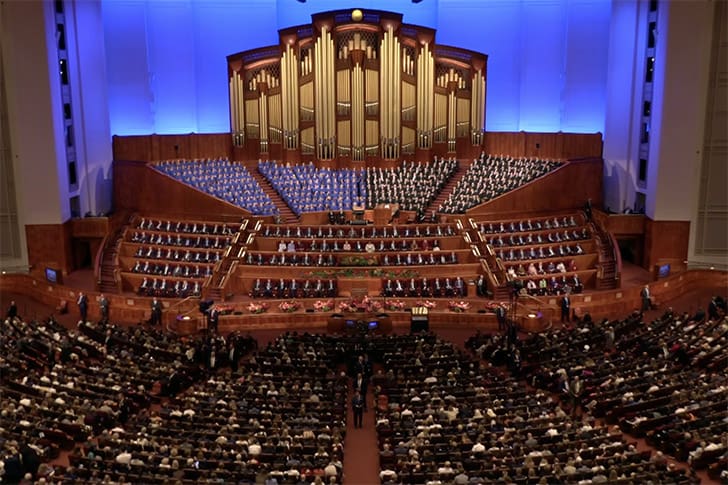
When President Russell M. Nelson died just a few days before, we knew we were in for a rare General Conference, and it was. Seamlessly, gracefully, the Church rolls on in power even when its beloved prophet has passed. The minute the prophet dies, the First Presidency is dissolved, and the Church is under the direction of the Quorum of the Twelve, with its senior apostle, President Dallin H. Oaks, leading and the Spirit of the Lord directing.
The keys and authority are intact.
Arguing, infighting, and jockeying for power is completely foreign in leadership change for The Church of Jesus Christ of Latter-day Saints. President Nelson had already made assignments and given instruction for this conference, and his imprint was still upon it. Yet, it is the profound immersion of the Spirit that will continue to guide.
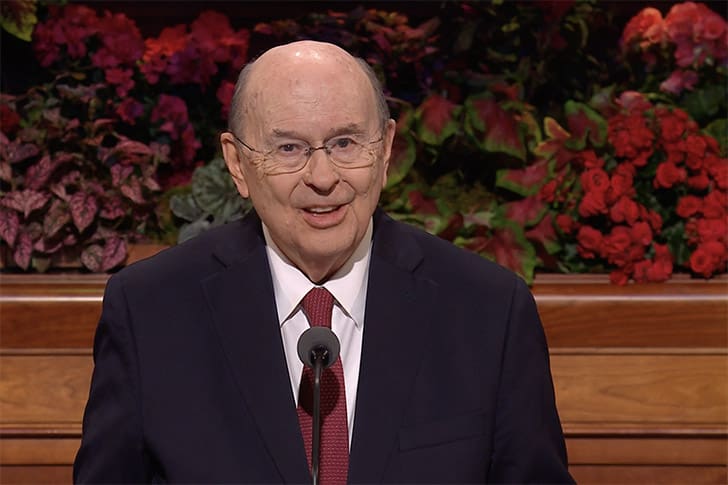
What a time this has been. Elder Quentin L. Cook began his talk by quoting the famous Charles Dickens quote, “It was the best of times; it was the worst of times.” The lethal attack on the Grand Blanc ward in Michigan reminds us quite personally of the unrest, division, and hatred that too often marks our civil dialogue, and we are still weeping for the dead, the wounded, and the traumatized of our fellow Latter-day Saints and all who are terrorized in news that has become all too frequent.
Yet, it is also the best of times. Elder Cook told us just how manifestly the Lord is hastening his work. “In the last 36 months nearly 900,000 converts have joined the Church. These converts constitute approximately 5% of the total church membership…These 900,000 converts in the last 36 months exceed the total membership of the Church at its 110th anniversary in 1940, which was just over 860,000 members.”
Elder Gerrit W. Gong reported that “Every Sabbath, members and friends from 195 birth countries and territories gather in 31,916 Church congregations. We speak 125 languages.”
Seeing the Invitation
This General Conference seemed particularly designed to hasten the work within and throughout the heart and soul of each listener. It was full of invitations to be more and to see more, to come closer to a Lord who was relentlessly pursuing you and offering you your only chance for complete peace. It is as if we could hear the Lord speaking to us, saying, “I am able to make you holy.”
Here are just a few of the invitations:
An Invitation to Fresh Starts
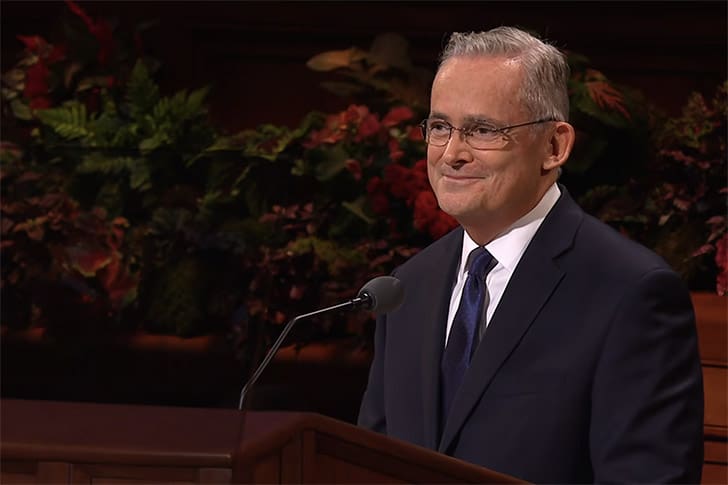
Elder Patrick Kearon said, “Everything He said and did provided a new beginning for each of those He healed, blessed, taught, and relieved of sin. He didn’t withdraw from them, and He certainly won’t withdraw from you. Imagine in this moment, hearing any of these life-giving words from Him:
“’Son, thy sins be forgiven thee’.
“’Damsel, I say unto thee, arise’
“’Be thou clean’.
“’Neither do I condemn thee: go, and sin no more’.
“’Daughter, be of good comfort: thy faith hath made thee whole; go in peace’.
“The Savior’s words to these individuals were brief, but with them He painted vast new horizons of forgiveness, healing, restoration, peace, and eternal life. And the glorious news is, He offers the same new beginning to you and to me. All of us can have a new beginning through and because of Jesus Christ. Even you. New beginnings are at the heart of the Father’s plan for His children. This is the church of new beginnings! This is the church of fresh starts!”
An Invitation to be Unafraid of Being Proved
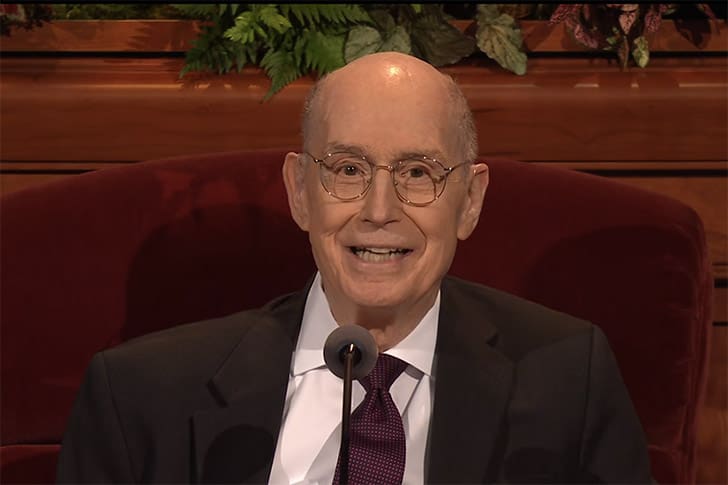
Elder Eyring was struggling as he studied physics and mathematics in college, so much so that learning it seemed beyond him. He said, “I felt weak. As I prayed, I felt the quiet assurance of the Lord. I felt Him say to my mind, “I am proving you, but I am also with you.”
He went on to explain what it meant to be proved. “To prove something is not simply to test it. It is to increase its strength. To prove a piece of steel is to place it under strain. Heat, weight, and pressure are added until its true nature is enhanced and revealed. The steel is not weakened by the proving. In fact, it becomes something that can be trusted, something strong enough to bear greater burdens.
“The Lord proves us in much the same way to strengthen us. That proving does not come in moments of ease or comfort. It comes in moments when we feel stretched beyond what we thought we could bear.”
He continued, I bear witness that these moments are not evidence that the Lord has abandoned you. Rather, they are evidence that He loves you enough to refine and strengthen you. He is making you strong enough to carry the weight of eternal life. If we remain faithful in our service, the Lord will refine us. He will strengthen us. And one day, we will look back and see that those very trials were evidence of His love. We will see that He was shaping us to be able to stand with Him in glory. “
An Invitation to Take Charge of Your Testimony
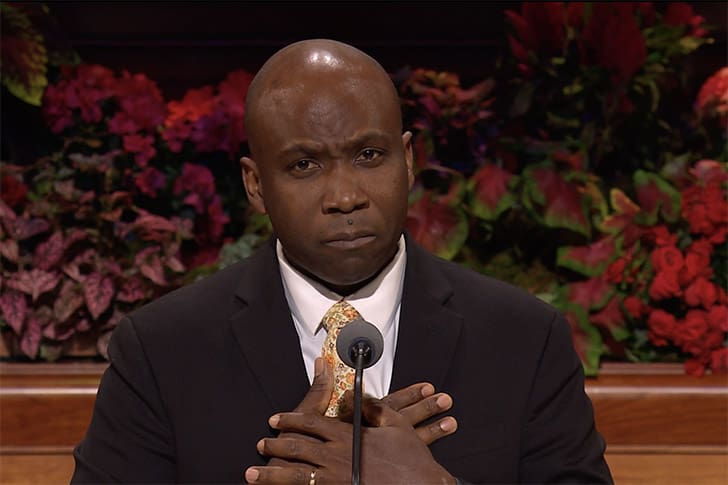
When Elder Kevin G. Brown was baptized, his friends belittled his choice to become a member and asked him, “Why are you wasting your life away?” But he had attained a witness.
He said, “Jamaica is to me like Palmyra was to Joseph Smith. It is my Sacred Grove. I do not know the exact spot where Joseph knelt to pray in the Sacred Grove, but I know exactly where I was when my Sacred Grove became reality. It happened at Four Grove Road, Mandeville, Jamaica, in my bathroom, at 6 a.m. on a Wednesday- three years after my baptism. This sacred experience happened because two weeks earlier, an inspired sister missionary had invited me to read the Book of Mormon. That experience changed me.”
He said, Brothers and sisters, a testimony is not given for temporary use. This gift from our loving Heavenly Father is meant to be eternal because the giver is eternal. A testimony should not have an expiration date. It should not weaken or diminish because something in my life has changed or something in the world has changed. It should get stronger because, like the servant in the parable of the talents, my personal testimony is a gift to be multiplied—not buried.”
“I plead with you to take charge of your testimony. Work for it. Own it. Care for it. Nurture it so that it will grow. Feed it truth.” To me, the words take charge, work, care, own, nurture, and feed sound like an agent given stewardship for something precious and important.
Elder Brown continued, “I invite you to think about your path to a sure witness of Jesus Christ and His gospel. Take charge of your testimony, use your agency wisely, and acknowledge the giver and all His glorious attributes. I bear witness that the power is within you. No one can choose for you. No one can take this gift away. You can choose to believe.
“I promise that as you do this, your testimony will be a ‘well of living water springing up unto everlasting life.’ It will be an anchor and a motivator and it will sustain you through difficult times. It will enable you to develop spiritual gifts. It will help you in your personal ministry and service. It will be a weapon against Satan and your adversaries. Your testimony will be a joy as you see it replicated in your children, grandchildren, and great-grandchildren and in those you love and serve. It will be powerful when you share it and use it to testify. If you know, you know. I know that I know. We need more sure witnesses of Jesus Christ and His gospel. Get there! Seek it! It is urgent! This is the final dispensation—the dispensation of the fullness of times.
He continued, “Brothers and sisters, a testimony of Jesus Christ was never meant to be a temporary gift. Nothing about it is temporary. Not the giver, not the gift itself, not the deliverer of the gift, not who the gift is about.”
An Invitation to Discipline
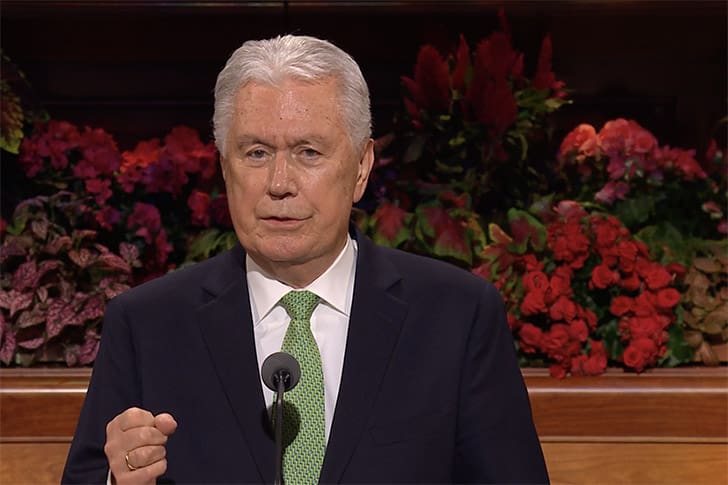
Elder Dieter F. Uchtdorf found himself in a flight simulator at Lufthansa, the company where he was once chief pilot. He wondered if his old skills had become rusty with disuse. Then he taught:
“You might spend years acquiring a skill or developing a talent. You might work so hard that it becomes second nature to you. But if you think that means you can stop practicing and studying, you’ll gradually lose the knowledge and abilities you once acquired at great cost.
“This applies to skills like learning a language, playing a musical instrument, and flying an airliner. It also applies to becoming a disciple of Christ.
“Simply put, discipleship takes self-discipline. It is not a casual endeavor, and it doesn’t happen by accident. Faith in Jesus Christ is a gift, but receiving it is a conscious choice that requires a commitment of all our “might, mind, and strength.” It is a practice of every day. Every hour. It takes constant learning and determined commitment. Our faith, our loyalty to the Savior, becomes stronger as it is tested against the opposition we face here in mortality.
“It is because we keep nourishing it, we keep actively applying it, and we never give up.
“On the other hand, if we fail to use faith and its convincing power, we become less sure of things we once held sacred—less confident of things we once knew were true. Temptations that would never have enticed us begin to look less appalling and more appealing. The fire of yesterday’s testimony can warm us for only so long. It needs constant nourishment to keep burning brightly.”
An Invitation to Look to the Lord in Times of Trouble
Elder D. Todd Christofferson reminded us of the horrible bus accident in Lesotho in June that killed 6 young women, 2 of their leaders, and the branch president and his wife. Others were deeply injured, some with severe burns.
Elder Christofferson said, “There seems to be no end to the different sources people look to for meaning, happiness, and help. Most are “looking beyond the mark.” But we need not be “children, tossed to and fro, and carried about with every wind of doctrine [or fashion]”
“In looking to God, we can find peace in difficulty, and our faith can continue to grow even in times of doubt and spiritual challenge. We can receive strength in the face of opposition and isolation. We can reconcile the ideal with present reality.
“There truly is no other way than what God Himself has ordained, ‘Look unto me, and be ye saved, all the ends of the earth: for I am God, and there is none else.’ Looking to God means that He is not just one of our priorities; it means rather that He is our one highest priority.
I call to mind again that awful crash in Lesotho last June. From her hospital bed, one of the Young Women leaders who survived, who did not believe in God before joining the Church, said that her purpose is now to discover why her life was spared. “Constantly serving God is how I will come to an answer, if I come to an answer,” she stated. “I used to think that I loved God, but now I really, really, really, really love Him. Now He is the number one priority in my life.”
An Invitation to be Peacemakers
Elder Gary E. Stevenson continued the call given to us by President Russell M. Nelson.
“Peacemakers Needed. Disagree without being disagreeable. Replace contention and pride with forgiveness and love. Build bridges of cooperation and understanding, not walls of prejudice or segregation. And the same promise: ‘Blessed are the peacemakers, for they shall be called the children of God.’
“The hearts of today’s rising generation are filled with a testimony of Jesus Christ and a hope for the future. Yet they too ask, ‘Can I truly become a peacemaker when the world is in commotion, my heart is filled with fear, and peace seems so far away?’
“The resounding response is once again yes! We embrace the words of the Savior: ‘Peace I leave with you, my peace I give unto you…Let not your heart be troubled, neither let it be afraid.’ Peacemaking still begins in the most basic place—in our hearts. Then in homes and families. As we practice there, peacemaking will spread into our neighborhoods and communities.
An Invitation to Study the Book of Mormon
Elder Jeffrey R. Holland reminded us that one of Jesus’ miracles was healing a blind man by first requesting him to put a mixture of mud and spit on his eyes. He observed:
A “truth that is evident here are the instruments the Creator of Heaven and Earth used to provide this miracle: spit and a handful of dirt! These very unlikely ingredients declare that God can bless us by whatever method He chooses. Like Naaman resisting the River Jordan or the children of Israel refusing to look at the serpent on the staff, how easy it is for us to dismiss the source of our redemption because the instruments pointing to it seem embarrassingly plain.
But we remember from the Book of Mormon that some things are both plain—and precious—and that prior to Jesus’s birth it would be prophesied that “he [would have] no form nor comeliness; and when we [should] see him, there is no beauty that we should desire him.” How often God has sent His majestic message through a newly called and very anxious Relief Society president, or an unlearned boy on a New York farm, or a baby lying in a manger. So what if the answers to our prayers come in plain or convoluted ways? Are we willing to persevere in trying to live Christ’s gospel no matter how much spit and clay it takes? It may not always be clear to us what is being done or why, and, from time to time, we will all feel a little like the senior sister who said, “Lord, how about a blessing that isn’t in disguise?”
My first sight-giving, life-giving encounter with real evidence of truth did not come with anointing clay or the Pool of Siloam. No, the instrument of truth that brought my healing from the Lord came as pages in a book, yes, the Book of Mormon: Another Testament of Jesus Christ! The claims about this book have been attacked and dismissed by some unbelievers, the anger often matching the vitriol of those who told the healed man he could not possibly have experienced what he knew he had experienced.
It has been hurled at me that the means by which this book came to be were impractical, unbelievable, embarrassing, even unholy. That is harsh language from one who presumes to know the means by which the book came to be, inasmuch as the only description given about those means is that it was translated “by the gift and power of . . . God.”
In any case, the impact in my life of the Book of Mormon is no less miraculous than was the application of spit and dirt placed on the blind man’s eyes. It has been, for me, a rod of safety for my soul, a transcendent and penetrating light of revelation, an illumination on the path when mists of darkness come as surely they have and as surely they will.
An Invitation to Stand by and Live the Proclamation on the Family
The concluding speaker of this conference was President Dallin H. Oaks, acting in his role as President of the Quorum of the Twelve. He spoke with a great deal of tenderness on The Family: A Proclamation to the World, becoming personal and vulnerable when he spoke of losing his Dad.
“I will never forget the promise of my maternal grandfather, when we children were living on his farm near Payson, Utah. He gave me the tragic news that my father had died in faraway Denver, Colorado. I ran into the bedroom and knelt beside the bed, crying my heart out. Grandpa followed me and went to his knees beside me and said, ‘I will be your father.’
Elder Oaks stands with Elder Nelson, who said of the Proclamation, that it is “pivotal to God’s plan . . . . In fact, a purpose of the plan is to exalt the family.”
President Oaks reminds us of all the ways that we are a family-centered church: “We can truly say that the gospel plan was first taught to us in the council of an eternal family, it is implemented through our mortal families, and its intended destiny is to exalt the children of God in eternal families.
“Despite that doctrinal context, there is opposition. In the United States, we are suffering from a deterioration in marriage and childbearing. For nearly a hundred years, the proportion of households headed by married couples has declined, and so has the birthrate. The marriages and birthrates of our Church members are much more positive, but they have also declined significantly. It is vital that Latter-day Saints do not lose their understanding of the purpose of marriage and the value of children. That is the future for which we strive.”
He reminded us. “The national declines in marriage and childbearing are understandable for historic reasons, but Latter-day Saint values and practices should improve—not follow—those trends.”
President Oaks reminded us, “The family circle is the ideal place to demonstrate and learn eternal values such as the importance of marriage and children, the purpose of life, and the true source of joy. It is also the best place to learn other essential lessons of life, such as kindness, forgiveness, self-control, and the value of education and honest work.”
Finding Purpose and Power in The Family Proclamation

Editor’s note: This week, we are celebrating the 30th anniversary of The Family: A Proclamation to the World.
September 23, 2025, marks 30 years since the First Presidency and Council of the Twelve Apostles of The Church of Jesus Christ of Latter-day Saints introduced The Family: A Proclamation to the World.1 In our increasingly complex world, I have chosen to write this article as a letter to our youth and young adults who are navigating exciting opportunities, difficult challenges, and important decisions during this pivotal time of their lives.
Does the Proclamation Apply to Me?
When President Gordon B. Hinckley read The Family Proclamation during a General Relief Society Meeting in September 1995, it came as a bold declaration of restored eternal truth regarding individuals and families to warn the world and call everyone to action. The Proclamation can be seen as an “ensign to the nations” and a beacon on a hill.2 But does its light shine for you? Is it still relevant to you, our youth and young adults who make up the rising generation of the church? This season of your life brings numerous challenges and opportunities. You are discovering who you are, where you fit in the world, and what you can contribute. You are navigating relationships, school, work, and your physical and spiritual health amid rising risks and responsibilities. It’s a lot to manage, and sometimes these pressures can rupture your sense of self and leave you doubting your capacity to handle it all. You may not know much about The Proclamation, or if you do, it might seem out of date, irrelevant, or unreasonable, considering your current realities, but please consider how it might relate to the very questions you are asking God about your life right now. President Nelson recognized how important this stage of life is for you: “You are establishing priorities and patterns that will dramatically affect not just your mortal life but also your eternal life.”3
A Beacon, not a Benchmark
It might be easy to read the Proclamation as a checklist, with benchmarks you must meet to live up to God’s expectations. But your journey is unique and evolving. As you find your way, remember that God’s words are a beacon, not a scorecard for measuring success. The Proclamation lights the way by telling your true story – from creation into eternity. It declares truths that crystallize your divine worth and potential. God’s work and glory is to bring to pass your immortality and eternal life (Moses 1:39). Mortality, however, is the messy middle of God’s plan. When you are in the middle of confusing decisions and difficult relationships, with losses and disappointments piling up around you, you may wonder, How can this be God’s plan? However, the “mess” is the essential material for creating enduring love, beauty, and joy. In the mishmash and mishaps of mortality are your opportunities to build something real and eternal with God. Elder Bednar has taught that your hope for a loving eternal family “begins with you!”4 All your experiences, good and bad, can lead to learning and growth that will benefit your current or future family relationships. The Lord Himself said, “know thou…that all these things shall give thee experience, and shall be for thy good” (D&C 122:7). In this life, you are developing the desires and abilities to become, through Jesus Christ, whole and complete, securely connected in loving family relationships.5 If you desire it, family is your destiny.6
Truth, Agency, and Correct Principles
God established the plan of salvation and exaltation to enable your learning and growth so that you can receive all that He has. The conditions of mortality may seem pointless or cruel to some, but they are necessary for you to realize your divine potential. They include opposition, a Savior, a physical body, moral agency, absolute truth, and temple ordinances and covenants. Don’t doubt God’s plan. Jump in, you’ve got this!
Start by finding and understanding eternal truth. President Nelson unequivocally stated that truth is not relative, “There really is absolute truth-eternal truth.”7 Real, solid, unchanging truth is empowering. And you have the ability (and responsibility) to discern truth from error through the Spirit. Moroni wrote, “by the power of the Holy Ghost ye may know the truth of all things” (Moroni 10:5). You are swimming in a turbulent ocean of information. Chaos and deceit flood every part of life. President Nelson warned, “One of the plagues of our day is that too few people know where to turn for truth.”8 In this confusing environment, you can turn to the restored gospel of Jesus Christ for eternal truth.
Next, you must act on the truth you know. God gave you your agency to choose right from wrong, and the power to act. Your righteous use of moral agency is fundamental to your learning and growth. Elder Bednar taught that “[agency] is the capacity and power of independent action.”9 Moral agency is both a divine gift and a sacred responsibility. Because God is bound to His own laws of agency, His Spirit will not force or compel you. You must choose to act, for we “should be anxiously engaged in a good cause, and do many things of [our] own free will, and bring to pass much righteousness” (D&C 58:26–28). As a free agent, you must seek and receive spiritual knowledge and apply the truths you discover. Your spiritual growth depends on it.
Finally, you need to identify the gospel’s guiding principles and apply them to your specific circumstances. Elder Bednar described principles this way, “[A] gospel principle is a doctrinally based guideline for the righteous exercise of moral agency. Principles derive from broader gospel truths and provide direction.”10 Jesus Christ and His prophets teach with correct principles rather than proliferating a list of specific rules so that you can learn to govern yourselves.11 Rules can break down when circumstances change, but principles adapt and remain relevant and valuable. Apostle Richard G. Scott said that “principles are concentrated truth, packaged for application”, and they add clarity even in “the most confusing and compelling circumstances.”12
When you identify and apply correct principles in your life, you gain spiritual knowledge and wisdom, line upon line (2 Ne. 28:30). Elder Pingree described this process, “Once the Holy Ghost confirms a specific truth to us, our understanding deepens as we put that principle into practice. Over time, as we consistently live the principle, we gain a sure knowledge of that truth.”13 Gaining knowledge and understanding is a gradual process of seeking and applying true principles to see if they bear fruit. This takes time and effort, but I think your generation is primed and ready for truth. “The youth of the Church are hungry for things of the Spirit; they are eager to learn the gospel, and they want it straight, undiluted. They are not doubters, but inquirers, seekers after truth. [They] sense the hollowness of teachings that would make the gospel plan a mere system of ethics.”14 It is your great opportunity to learn truth by faith and apply true principles of the gospel in your life. You will learn wisdom and receive the vital blessings of spiritual strength, direction, and protection.15
Additionally, Elder Uchtdorf observed that principles “don’t make decisions for you.”16 Rules might, but principles never do. Principles provide the reasons for making a righteous choice or decision. It has been my experience working with youth that you care deeply about the reasoning behind things. A humble, curious disciple wants to know “why?” That question can be so valuable to your spiritual learning. Understanding the rationale for an action or behavior fosters your desire, your internal motivation, to do it. “Because I said so” doesn’t cut it, whether it’s coming from your parents or Church leaders. Reasons motivate better than checklists—and they are far more powerful. The Lord wants you to ask questions and search for truth. Dive into the scriptures and the writings of the prophets and ask your questions in humble prayer. He will guide you.
You can lean on The Proclamation to teach you righteous principles, derived from eternal truths, that will guide your choices about earthly and eternal families. However, you are in charge of understanding those principles and making your own decisions. Elder Renlund makes this important distinction, “Our Heavenly Father’s goal in parenting is not to have His children do what is right; it is to have His children choose to do what is right and ultimately become like Him. If He simply wanted us to be obedient, He would use immediate rewards and punishments to influence our behaviors. But God is not interested in His children just becoming trained and obedient ‘pets’… No, God wants His children to grow up spiritually and join Him in the family business.”17 The teachings and principles of Jesus Christ are always most impactful when you choose to follow Him with all your might, mind, and strength (Moroni 10:32).

How Do I Apply the Principles of the Proclamation?
The Proclamation amplifies these simple, profound truths: as a child of Heavenly Parents, you are sacred, family is sacred, and new life is sacred. Knowing your divine origin and worth changes how you see yourself and others. Family becomes a sacred laboratory where love and faith can begin to grow and flourish. The eternal perspective of who you are and who you can become will motivate you to live the Proclamation’s principles as best you can, even when things are hard. You may not quickly reach the ultimate goals you set for yourself, but you can keep moving in the right direction. If the duties and responsibilities in the Proclamation feel overwhelming, remember you do not need to do them all at once. Listen for what the Spirit is prompting you to learn about yourself, your family, and your divine destiny, and focus on that.
I invite you to engage with the language of the Proclamation and seek revelation from the Spirit to understand and live the principles it teaches. As you do, you will discover the wonderful things God has prepared for your beautifully unique, eternal journey.
The Family Proclamation: Distilling Principles
As you explore the Proclamation, it can help to group the principles by theme. Below, I selected specific sections from the Proclamation that I found useful to study and supplemented them with recent prophetic teachings to enhance my understanding. This is just one way to view the Proclamation. Let’s explore the Proclamation’s truths and principles through the lens of our fundamental relationships – our individual relationship with God, the marriage relationship, and parent-child relationships.
Individual – Woman and man are the beloved son or daughter of heavenly parents created in the image of God—male and female—with a divine nature and destiny. Men, women, and children receive priesthood power and blessings by faithfully living ordinances and covenants, including the promise of an eternal family. Man and woman are equal in God’s eyes.18
Marriage – Husband and wife enter the holy order of matrimony and together receive priesthood power and blessings for themselves and their family, including eternal life.
- Being united in marriage requires a full and equal partnership, sharing responsibilities.19
- Their decisions should be made in unity and love, with full participation of both.20
- The government in the family follows the patriarchal pattern, which entails that wives and husbands are accountable directly to God for fulfillment of their sacred responsibilities in the family. These special responsibilities do not imply hierarchy and exclude any abuse or improper use of authority. There is no president and vice president in the family.21
- The teachings of Jesus Christ lead to happiness and success in family life.
Parental – Mother and father are commanded to create life but only within the bonds of marriage. Husbands and wives have the solemn responsibility to love and care for each other and their children. Parents have a sacred duty to rear their children in love and righteousness, to provide for their physical and spiritual needs, and to teach them to love and serve one another, observe the commandments of God, and be law-abiding citizens.
- Fathers are to preside over their families in love and righteousness and are responsible to provide the necessities of life and protection for their families. Parents work in unity to fulfill these responsibilities.22
- Mothers are primarily responsible for the nurture of their children. In unity with her husband, a mother helps her family. Together, they foster an environment of love in the family.23
- In these sacred responsibilities, fathers and mothers are obligated to help one another as equal partners. They should prayerfully counsel together and with the Lord.24
- Circumstances may necessitate individual adaptation, and extended families should lend support when needed.
After studying the truths and principles that guide our individual, marriage, and parental relationships, do you understand them better? What did you discover about how these principles can apply to you? When you connect the responsibilities directly to the eternal truths, you can begin to see how these principles are meant to guide your decisions rather than enumerate rules to follow. This type of study can give you a fuller picture of why families are so important and how to apply the principles to benefit your life.
How Do I Make Marriage and Family a Full and Equal Partnership?
The ordinances and covenants you make in the temple, both the endowment and the marriage sealing, are vertically and horizontally integrated, uniting you to God and to your spouse in love and godly power. Because of this covenant relationship, husband and wife lead and guide the family together in full and equal partnership with each other and with the Lord.25 As part of this commitment, Christ invites spouses and parents to sacrifice and consecrate themselves to a shared family stewardship.
What can we learn from the Proclamation about the responsibilities specifically assigned to fathers and mothers? Elder Soares explains that mothers and fathers should view their responsibilities as “opportunities, not exclusive limitations,” and recognize that nurturing and presiding are “interrelated and overlapping responsibilities.”26 In a family, loving and caring for each other is never done alone. You are truly better together. Every family is a unique combination of people, personalities, desires, weaknesses, and strengths. Your family benefits from mobilizing your collective resources in the loving care of one another. Mutual support and collaboration nurture growth and connection for everyone involved.
Family is often an “all hands on deck” situation. Help may come from extended family, friends, church members, mentors, schools, and communities. Sometimes, resources are thin and support is scarce, which can be discouraging, but Elder Christofferson reassures you, “Much that is good, much that is essential–even sometimes all that is necessary for now–can be achieved in less than ideal circumstances.”27 In reality, nobody has ideal circumstances or an ideal family. Imperfection is the condition and purpose of mortality. Only through Jesus Christ are we, eventually, made perfect.28
This statement by Elder Holland beautifully describes how our hope in Jesus Christ, however dim, can carry us through the difficulties of family relationships, “So when our backs are to the wall and, as the hymn says, ‘other helpers fail and comforts flee,’ among our most indispensable virtues will be this precious gift of hope linked inextricably to our faith in God and our charity to others.”29
Years ago, my husband and I reached a point in our family when it felt like our backs were to the wall and we had to act in faith to consecrate our efforts, in full and equal partnership, for our family stewardship. We had a young child, a toddler, and a newborn. I wasn’t working, and my husband’s income didn’t cover our expenses, even though he traveled most of the week. The demands of my children overwhelmed me, and everything felt like too much to handle. One night, after a long day for both of us, everything boiled over. Following a heated argument, I broke down in tears, pleading for help. To my surprise, my husband echoed my feelings, saying, “I can’t do this anymore; I need help too.” In that moment, we both realized we had reached our breaking points and felt compassion for each other. We understood we couldn’t give any more than we were already giving, yet we decided to keep going because we believed in our family.
In the days that followed, I spent a lot of time seeking reassurance from the Lord, hoping that our sacrifices would prove worthwhile. We didn’t regret having our three precious children; we simply felt overwhelmed and disappointed by the challenging reality we faced. I worked to make sense of the difficulties and adversities we encountered. Piece by piece, I discovered the beautiful, eternal things God had in store for our struggling family. My worries and challenges persisted, but rays of light and truth began to enlighten my perspective—an understanding of my covenants and hope in the Lord’s promises. My husband and I continued to give our all, doing our best with faith and hope that the Lord would support us and restore our righteous desires for our children and for each other.
Will God Keep His Promises?
Amid the mortal tangle and struggle, you can trust that the Lord will keep His promises to you. As you rely on His words, hope brightens (D&C 50:24). He will guide you as you humbly try to forge loving family relationships. Like Sara, who yearned for a child, you can “judge him faithful who has promised” and come to know that His promises are sure (Hebrews 11:11). When fear and pain surround so many families, the Lord asks you to “exercise a particle of faith” or even just a “desire to believe” in your own divine potential (Alma 32:27). When your efforts feel wasted, Christ promises to restore the lost and mangled pieces of your life to their “proper and perfect frame” (Alma 40:23). Offer your “two mites” of righteous desire and effort, and the Savior will redeem and restore all that He has promised.30 He will give you His peace and make you whole and complete.
You are the loving fulfillment of your Heavenly Parents’ eternal procreative power. Amazingly, you also have the inherent, divine nature “to create a human body…a genetically and spiritually unique being never seen before…and never to be duplicated again…a child, your child–with eyes and ears and fingers and toes and a future of unspeakable grandeur.”31 As you press forward, look to Christ, trusting and hoping that the words He has revealed to you about your eternal family are true. As Elder Holland shared, “We all need to believe that what we desire in righteousness can someday, some way, somehow yet be ours.”32
Here are some questions to help you reflect on the Proclamation’s principles:
- How does knowing you are a child of Heavenly Parents impact your views of family?
- How can the duties and responsibilities be viewed as principles rather than rules? How does that change things?
- How can temple covenants enhance your understanding of a parent’s duties and responsibilities?
- How can the assignments, responsibilities, and obligations of the Proclamation be viewed in light of the priesthood power husbands and wives share?
- How does the principle of full and equal partnership guide your decisions?
- How does counseling together improve the success of a family?
- What can you each contribute to your family? What burdens do you each bear?
- How do the teachings of Jesus Christ improve your family relationships?
- What helpful insights have apostles and general officers provided?
Footnotes
1 The Family: A Proclamation to the World. https://www.churchofjesuschrist.org/study/scriptures/the-family-a-proclamation-to-the-world/the-family-a-proclamation-to-the-world?lang=eng
2 Isaiah 30:17. See also Gordon B. Hinckley, “An Ensign to the Nations, a Light to the World,” Ensign Nov. 2003.
3 Russell M. Nelson, “Choices for Eternity,” Worldwide Devotional for Young Adults, May 15, 2022.
4 David A. Bednar, “A Welding Link,” Worldwide Devotional for Young Adults, Sept. 10, 2017.
5 See Hebrews 11:40, JST. “God having provided some better things for them through their sufferings, for without sufferings they could not be made perfect.”
6 Sharon Eubank, “A Letter to a Single Sister,” Ensign, Oct. 2019.
7 Russell M. Nelson, “Pure Truth, Pure Doctrine, and Pure Revelation,” Liahona, Nov. 2021; see also D&C 123:12.
8 Nelson, Nov. 2021.
9 David A. Bednar, “Seek Learning by Faith,” Ensign, Sept. 2007.
10 David A. Bednar, “The Principles of My Gospel,” Liahona, May 2021.
11 See Teaching of Presidents: Joseph Smith, 2007, 284.
12 Richard G. Scott, “Acquiring Spiritual Knowledge,” Ensign, Nov. 1993.
13 John C. Pingree Jr., “Eternal Truth,” Liahona, Nov. 2023.
14 J. Reuben Clark, “The Charted Course of Church Education,” 1938 address.
15 Bednar, Sept. 2007.
16 Dieter F. Uchtdorf, “Jesus Christ is the Strength of Youth,” Liahona, Nov. 2022.
17 Dale G. Renlund, “Choose You This Day,” Ensign, Nov. 2018.
18 General Handbook 3.5, 3.6, 2.1; Ulisses S. Soares, “In Partnership with the Lord,” Liahona, Nov. 2022.
19 General Handbook 2.1.2.
20 General Handbook 2.1.2.
21 Soares, Nov. 2022.
22 Handbook 2.1.3.
23 Handbook 2.1.3.
24 Handbook 2.1.3.
25 Soares, Nov. 2022.
26 See Soares, Nov. 2022. “One person may have a responsibility for something but may not be the only one doing it. When loving parents well understand these two major responsibilities, they will strive together to protect and care for the physical and emotional well-being of their children.”
27 D. Todd Christofferson, “Why Marriage, Why Family,” Ensign, May 2015. “No one is predestined to receive less than all that the Father has for His children.”
28 Jeffrey R. Holland, “Be Ye Therefore Perfect–Eventually,” Ensign, Nov. 2017.
29 Jeffrey R. Holland, “A Perfect Brightness of Hope,” Ensign, May 2020.
30 See Mark 12:41-44
31 Jeffrey R. Holland “Personal Purity,” Ensign, Nov. 1998, emphasis added.
32 Holland, May 2020.
You Don’t Need to Feel Forgiving to Forgive

This article was originally published by Public Square Magazine by Skyline.
Few moments are more defining than those shaped by deep personal betrayal. When recalling these moments, the body often reacts before the mind—muscles tighten, the stomach turns, and the memory returns with clarity. The pain may be lasting, the consequences irreversible. In such moments, two responses emerge side by side: anger and forgiveness—two gifts, one in each hand, and while both feel justified, only one can be given.
This is the essential tension at the heart of forgiveness: not a passive emotion, but an active, deliberate, sacred decision. Forgiveness is often couched in dramatic moments of intense pain and wrongdoing, but it also needs to find its way into everyday moments, like when a loved one or stranger says a careless word or performs a negligent action. These small moments of hurt, if unforgiven, can lead to a lifetime’s accumulation of tension and resentment. There is great power for both the offender and the offended in the words, I forgive you. While it is often assumed that forgiveness must be earned, Christian theology and research present a different view. Forgiveness is a gift extended not only to the offender, but also to release and heal the one who forgives.
What Forgiveness Is and Isn’t
Forgiveness is often misunderstood in its meaning and execution, carrying a wide range of meanings across individuals and cultures. Some may conclude it is unattainable before ever fully understanding what it entails. This word deserves a thoughtful unpacking before being dismissed. Clarifications of what forgiveness is and is not can be helpful.
Forgiveness is not:
- Trusting the person who caused the wrong.
- Earned by the person who caused hurt.
- Forgetting what happened.
- Pretending the offense didn’t hurt.
- Letting the offender perpetuate the harm.
- Reconciliation, or prolonging a relationship.
Forgiveness is:
- A choice to act compassionately.
- Beginning to feel compassion as you act compassionately.
- Given whether or not the other person shows remorse or change.
- Something you do for you.
- A perpetual choice and not a single event.
Psychologist Everett Worthington––a leading expert on forgiveness whose research has informed much of the thinking in this article––identifies two forms of forgiveness: decisional and emotional.
Decisional forgiveness is consciously choosing to forgive—often for our own well-being rather than for the benefit of the offender.
Emotional forgiveness, by contrast, is when feelings of anger begin to soften into empathy and compassion.
While it is often believed emotions drive actions, research and experience suggest the opposite: choices and behaviors gradually shape feelings. Suggesting that often it may be required to act compassionately, before we feel compassion. Anger’s grip is hard and often shapes our journey with forgiveness. Anger can serve as an emotional strategy to overcome feelings of helplessness. However, as President Nelson taught, “anger never persuades,” and the sensation of control is really an illusion: change is up to the offender just as much as our decision to forgive is up to us.
Forgive For Your Own Sake
Worthington’s research shows forgiveness improves mental and physical health, lowers blood pressure, reduces anxiety, and even boosts the immune system. Forgiveness may not change the offender—but it will change the forgiver.
When we decide to release resentment, we begin to, as one Church leader put it, “rise to a higher level of self-esteem and well-being” characterized by emotional clarity and peace. Choosing to forgive doesn’t deny the pain—it simply refuses to let that pain define our path forward.
Examples of Forgiveness
At one point in early Church history, tensions ran high among members. People were hurting each other, holding grudges, and struggling to move forward. In that setting, the Lord gave a clear, striking command: His followers “ought to forgive one another.” Then He added something sobering. While God alone could decide “whom to forgive,” His disciples were not given that same privilege of discretion. They were “required” to forgive “all.”
It isn’t a suggestion. It isn’t conditional. This is a divine directive for healing and unity. The Lord didn’t ask them to ignore justice—He asked them to make room for His mercy by letting go of their desire to carry the offense any further.
Why would the Lord ask something so hard? Perhaps it is because the Lord knows that holding onto hate keeps our minds dwelling on the past and the offender. Focusing on the offense leaves no room for contemplating and engaging with His healing grace and hope in the present.
Jesus, hanging on the cross, uttered the words while looking at His torturers, “Father, forgive them; for they know not what they do.” In that moment, Christ modeled the highest form of forgiveness: extending compassion without having received any apology, show of remorse, or change. He recognized His abusers’ ignorance toward the depths of His pain and the extent of their own sin. Often, offenses are committed in such a state.
Even when buried by regret—when the weight of wrong choices seems too great, or the damage too deep—there is still hope. Healing doesn’t require perfection, only a willingness to turn toward the Savior. His grace reaches to infinite depths. Elder Jeffrey R. Holland tenderly reminds us, “It is not possible for you to sink lower than the infinite light of Christ’s Atonement shines.” The same is true for those who have caused wrong. They, too, remain within the reach of divine love, and those who forgive become more like Christ when hoping for their healing.
The REACH Method
So what is to be done when someone wants to forgive, but doesn’t know how or where to begin?
Start here. The Skyline Research Institute has published a series of short and playful videos focusing on tools and tactics for Peacemaking. These videos expound principles taught in President Nelson’s address “Peacemakers Needed” by complementing them with academic theories in psychology and conflict management. This current article is one in a series of articles published through Public Square, exploring the theories taught in each video more thoroughly.
The following video teaches principles of forgiveness from the perspective of a cat learning to forgive the dog who hurt them.
As shown in the video, these steps give a simple starting place for applying the divine and well-researched principles of forgiveness:
1. Name the Hurt.
Think of the person who hurt you. Let yourself feel the pain. Ask, “What specifically hurts me about this?” Is it betrayal? Injustice? Abandonment?
2. Imagine Speaking to Them.
What would you say if they were sitting before you? Get it all out—no filters. Write it in a letter (even if you never send it).
3. Switch Seats.
Now imagine being them. What might they say? What wounds might they carry? This doesn’t excuse them—it humanizes them.
4. Picture the Two Gifts.
In front of you are two gifts: your forgiveness and your anger. Which will you give them?
This process may need to be repeated many times—that’s okay. Forgiveness is rarely a one-time event. Like any habit, the choice to act with compassion must be practiced, especially in the face of discomfort. It may feel unnatural or insincere at first, but each time we choose kindness, the action becomes a little more familiar, a little more automatic. In any given situation, forgiveness is a muscle that strengthens with use. It’s a neural pathway that, with repetition, begins to favor hope, action, and healing over the depressing and well-worn track of rumination.
If the choice to act compassionately towards an aggressor feels out of reach, recognizing the need to forgive and its benefits is a good place to start. Even aiming for forgiveness softens your heart. Desire to want to forgive.
Based on his research, Worthington developed the REACH method:
- R – Recall the hurt.
- E – Empathize with the offender.
- A – Altruistic gift of forgiveness.
- C – Commit to forgive.
- H – Hold onto forgiveness when emotions rise again.
As the video showed, REACH is enacted step by step by recalling the hurt, imagining the offender’s pain, and choosing to give the “gift” of forgiveness.
The Choice Is Ours
The reality of pain is undeniable, and its depth is often known only to the individual and God. Life frequently confronts people with shocking and disproportionate suffering, much of it undeserved. Such experiences are not uncommon, though they remain deeply personal and often isolating.
Forgiveness does not erase the past—but it reclaims the future. It is not about denying hurt, but about refusing to let that hurt decide who we become. In a world full of real wounds and imperfect people, forgiveness offers something radical: not control over others, but healing within ourselves. Though anger may offer the illusion of power, only forgiveness frees us from the grip of the past and opens the way to peace.
As both research and revelation affirm, forgiveness is not just a moral ideal—it is a practiced, powerful, and divine pathway toward emotional, physical, and spiritual renewal.
The invitation remains: choose the gift of forgiveness. Give it again and again.
Skyline Research proudly hosts TheFamilyProclamation.org, a website dedicated to advancing the principles of The Family: A Proclamation to the World.
Surrounded and Outnumbered: The Miracle at Gapyeong

They were a group of faithful, clean-cut, young men from southern Utah when their unit of the National Guard was called to fight in the Korean War in 1951. They probably didn’t know much about Korea or why a war was being fought when they left, but they were doing their duty. What happened when their 240 soldiers found themselves caught in a battle, with no backup against an army of 4,000 Korean and Chinese soldiers was a story so miraculous, it became the stuff of legend.
Surrounded and outmanned, they stood bravely, fought valiantly, and won the battle without the loss of a single soldier. It is a modern-day parallel to the Stripling Warriors.
This story is told with power in the following 11-minute video, The Miracle at Gapyeong written by Brad Taylor, a former missionary and mission president in Korea.
Elder Jeffrey R. Holland begins and ends the video, reminding us:
“The lesson that we can take from the ‘Miracle at Gapyeong’ is that when we are true and faithful to the Lord, miracles of all different shapes, sizes, and timing will happen in our lives,” he said in the video. “To our remarkable youth of today, I say, please, please be faithful. Please be courageous and obedient. Please trust in the Lord with all your heart. I promise that He will direct you for good.”
FEATURES