





The Fatherhood of Christ

Handel’s Messiah made several scriptures especially memorable; one of them is Isaiah 9:6 (also 2 Nephi 19:6):
For unto us a child is born, unto us a son is given: and the government shall be upon his shoulder: and his name shall be called Wonderful, Counsellor, The mighty God, The everlasting Father, The Prince of Peace.
It is hard for fans of Handel’s Messiah to read these words without singing them. The part we’ll focus on is “The everlasting Father.” How is Christ the Father? Although Isaiah called Christ “the everlasting Father,” we must turn to restoration scriptures and modern prophets to fully understand what Isaiah meant.1 President Joseph F. Smith and his counselors in the First Presidency (Anthon H. Lund and Charles W. Penrose2) and the Twelve Apostles published a Doctrinal Exposition in 1916 entitled “The Father and the Son.”3 In it, they described three ways that Christ can be called the Father:
Father of Heaven and of Earth
First, in a phrase that I have found is exclusive to the Book of Mormon, Christ is the Father (creator) of heaven and earth (2 Nephi 25:12; Mosiah 3:8; 15:4; Alma 11:39; Helaman 14:12; 16:18; Ether 4:7)4. This is significant but, in this article, we won’t spend many more words on it.
Father of Saints Who Take Upon Themselves His Name
Second, He is the Father of those who repent and take upon them His name through baptism—and they become His spiritual children.5 The Book of Mormon excels the Bible in teaching this truth, although other restoration scriptures are also helpful. (The closest the Bible comes is Ephesians 1:5—“Having predestinated us unto the adoption of children by Jesus Christ to himself, according to the good pleasure of his will.” Let’s look at two of the most explicit:
King Benjamin proclaimed:
And now, because of the covenant which ye have made ye shall be called the children of Christ, his sons, and his daughters; for behold, this day he hath spiritually begotten you… therefore, ye are born of him and have become his sons and his daughters. (Mosiah 5:7)
The premortal Christ told Jared’s brother:
Behold, I am Jesus Christ. I am the Father and the Son. In me shall all mankind have life, and that eternally, even they who shall believe on my name; and they shall become my sons and my daughters. (Ether 3:14) (See also: Mosiah 15:11-12; 27:25*; Alma 5:14*; 3 Nephi 9:17*; Moroni 7:19; D&C 25:1; 34:3; and others, as cited in the Exposition—see the attached endnote. Those with asterisks refer to becoming children of God generally, not of Christ specifically.)6
Mortal fathers provide DNA to their offspring; since mortal matters are but a reflection of heavenly situations, I have proposed that becoming Christ’s sons and daughters involves receiving in our spirits His “spiritual DNA” and that it is delivered to us by the Holy Ghost. This “spiritual DNA” helps us acquire Christ’s characteristics and thus is the means of our sanctification; and this explains the Holy Ghost’s role in our sanctification and why the gift of the Holy Ghost is required for our salvation in the celestial kingdom.7
Christ had to first be God’s Son in the flesh in order to accomplish His atonement, and thus to become our spiritual Father. So, by His atonement, He went from Son to Father; and in the temple, He invites us to do likewise: All of humanity are spirit sons and daughters of Heavenly Parents; at our baptism, we are adopted as sons and daughters of Christ; and in the temple, we take upon Christ’s name more fully,8 and are adopted into God’s celestial family in a higher way than our original relationship with God.9 Finally, we are given the power to become eternal fathers and mothers. So, in the temple, following Christ’s example, we also progress from son/daughter to future eternal father/mother, assuming we keep our covenants.
Father by Divine Investiture of Authority
Finally, the 1916 First Presidency coined the term “divine investiture of authority” to describe that Christ as God has inherited Fatherly qualities and is so one with the Father that we can also call Christ the Father, even though Christ is not the literal father of our spirits. I believe that this phrase is implied in several restoration scriptures. (In addition to those quoted below, see Moses 1:6 in which Christ speaks to Moses as if He were Heavenly Father.)10
The most explicit of these scriptures was given in this dispensation to Joseph Smith:
The Father and I are one—the Father because he gave me of his fulness, and the Son because I was in the world and made flesh my tabernacle, and dwelt among the sons of men. (D&C 93:3-4; italics added.)
So, receiving the Father’s fullness allows Christ to be called the Father. Christ received the Father’s fullness in at least two ways:11 first, through Christ’s firstborn birth, in which He received the birthright and became the “crown prince” among the rest of us, who are also spirit children of God—princes and princesses—but only One could be the “crown prince.” Second, He was the Only Begotten of the Father—the only spirit child of God whose mortal body was sired by God. Thus, He inherited Godly genes. These gifts—coupled with His excruciating atonement—enabled Him to become the second type of Father, the father of covenanting Saints who take His name upon them. And as covenanting Saints, we can inherit through Christ His special blessings, even the ability to be “crown princes” and “crown princesses” who can grow up to be kings and queens, although Christ will always be the “king of kings” (1 Timothy 6:15; Revelation 17:14 and 19:16). This is what it means to be “joint-heirs” with Christ (Romans 8:16-17).
The night before He was born, Christ reassured Nephi3 that He was, in fact, coming:
Behold, I come unto my own, to fulfil all things which I have made known unto the children of men from the foundation of the world, and to do the will, both of the Father and of the Son—of the Father because of me, and of the Son because of my flesh. (3 Nephi 1:14)
“Of the Father because of me.” The Father’s will is the Son’s will. Having become exactly like His Father, Their wills are the same. Speaking of 3 Nephi 1:14, Joseph Fielding McConkie, Robert L. Millet, and Brent L. Top explain that
Of course, we know that they, Jehovah and Jesus, are one and the same being. At the same time, this statement dramatizes the separate and severable roles that would be played by the Master, that of the Holy One of Israel (premortal) and that of Jesus of Nazareth (mortal). There is a sense, then, in which we might speak of the Lord Jehovah, acting always under the direction of Elohim, our Heavenly Father, as the one who sent Jesus Christ into the world.
(Also, notice that only five verses before Ether 4:12, a different Fatherhood was mentioned, Father of heaven and earth [v. 5].) In a similar vein, Christ told Moroni12:
And whatsoever thing persuadeth men to do good is of me; for good cometh of none save it be of me. I am the same that leadeth men to all good; he that will not believe my words will not believe me—that I am; and he that will not believe me will not believe the Father who sent me. For behold, I am the Father, I am the light, and the life, and the truth of the world. (Ether 4:12)
This is striking: The word Father has two meanings in this verse. This is clearly Christ talking; and He refers to the Father who sent Him, and then immediately proclaims that He, Christ, is the Father! No, He did not mean that they are one being. Rather, this is a case of divine investiture of authority; Christ has the same attributes as His Father, and in the same sense as in 3 Nephi 1:14, Christ, as the Father, sent Himself.
Abinadi’s Masterful Teaching
Now let’s look at Abinadi’s remarkable and deep teaching in Mosiah 15, in which he describes all three ways that Christ is the Father. No other chapter in scripture describes all three ways (although all three are found in Ether 3-4).
In verses 1-5 and 7, we see two types of Fatherhood: divine investiture of authority (italics) followed closely by Father of heaven and earth (bold italics). On divine investiture, this scripture is like 3 Nephi 1:14 (above) in that being conceived by God the Father, Christ inherits Godly qualities—but a caution: Christ was tempted (Hebrews 2:18; 4:15) and He still had agency. Being righteous wasn’t any easier for Him than it is for us; in fact, it was harder. He chose successfully, without exception, to be righteous anyway.
I would that ye should understand that God himself shall come down among the children of men, and shall redeem his people. And because he dwelleth in flesh he shall be called the Son of God, and having subjected the flesh to the will of the Father, being the Father and the Son—The Father, because he was conceived by the power of God; and the Son, because of the flesh; thus becoming the Father and Son—And they are one God, yea, the very Eternal Father of heaven and of earth. And thus the flesh becoming subject to the Spirit, or the Son to the Father, being one God, suffereth temptation, and yieldeth not to the temptation, but suffereth himself to be mocked, and scourged, and cast out, and disowned by his people. …Yea, even so he shall be led, crucified, and slain, the flesh becoming subject even unto death, the will of the Son being swallowed up in the will of the Father. (Mosiah 15:1-5, 7; italics added.)
Abinadi’s statements have dual meaning: his statement that the Father and Son “are one God” could refer either to Jesus and Elohim being one with each other, which They are, or to Jesus (the Son) being the same person as Jesus (the Father).13 Abinadi’s statements that the Son was subject to the Father, or that the will of the Son was swallowed up in the will of the Father, could refer either to Jesus submitting to Elohim, or to Jesus submitting His mortal will and His bodily appetites to His own divine will. Similar to 3 Nephi 1:14, in which the Father sent the Son, but the Son, as the Father also sent Himself, the beauty of Abinadi’s statement is that both meanings are correct.
We’ll return to that theme; but let’s get to the third type of Fatherhood Abinadi discusses, still in the same chapter: Christ is the spiritual Father of the faithful, who are called His “seed” (offspring):
Behold I say unto you, that whosoever has heard the words of the prophets, yea, all the holy prophets who have prophesied concerning the coming of the Lord—I say unto you, that all those who have hearkened unto their words, and believed that the Lord would redeem his people, and have looked forward to that day for a remission of their sins, I say unto you, that these are his seed, or they are the heirs of the kingdom of God. For these are they whose sins he has borne; these are they for whom he has died, to redeem them from their transgressions. And now, are they not his seed? (vs. 11-12)
Christ’s Multiple Roles in Animal Sacrifice Symbolize His Multiple Roles in His Atonement
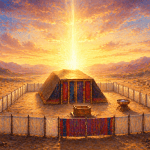
The animal sacrifices of the Law of Moses, especially the burnt offerings, and the animal sacrifices that predated the Law of Moses were made in similitude of Christ’s sacrifice.14 These animal sacrifices were a special function of the priesthood. Four beings were connected with each sacrifice: First, the person who offered his animal to be sacrificed. Second, the priest who had the authority to slay and burn the animal. As with all ordinances, animal sacrifice was only recognized by God if it was performed by proper authority. Third, the animal itself, which symbolically took the sins of the person offering it upon itself. Of course, the animal represented the Savior, and the animal’s death represented the Savior’s death. And Fourth, God, who accepted the sacrifice.
When Jesus Christ made the ultimate sacrifice, to which all the previous animal sacrifices pointed, He obviously played three of these roles. First, He offered the sacrifice. (It may also be properly said that God the Father offered His Son to be sacrificed, but this does not remove the condition of Jesus’ self-offering). Second, He was the Priest. He not only held the priesthood as many of us do, but He held the fulness of it; and He was, under the Father, its source. (It is called The Holy Priesthood After the Order of the Son of God [D&C 107:3]. In reality, Christ didn’t hold Melchizedek’s priesthood; rather, Melchizedek held a portion of Christ’s priesthood.) And third, He was the sacrificial victim. These multiple roles of Jesus are alluded to in the epistle to the Hebrews:
For such an high priest became us, who is holy, harmless, undefiled, separate from sinners, and made higher than the heavens; Who needeth not daily, as those high priests, to offer up sacrifice, first for his own sins, and then for the people’s: for this he did once, when he offered up himself. (Hebrews 7:26-27)
But Christ being come an high priest of good things to come… by his own blood he entered in once into the holy place, having obtained eternal redemption for us…. How much more shall the blood of Christ, who through the eternal Spirit offered himself without spot to God, purge your conscience from dead works to serve the living God? (Hebrews 9:11-14)
But Christ also played the fourth role: the acceptor of the sacrifice. Recall that as the God of the Old Testament, Jesus was the immediate God who accepted the animal sacrifices which prefigured His own atonement. (Certainly, God the Father accepted them as well.) And based on scriptures such as Mosiah 15:1-5,7 and 3 Nephi 3:14 (above), we can see how even though God the Father (Elohim) is the ultimate acceptor of Jesus’ offering, that because Jesus is one with His Father, and has the same will as His Father, that Jesus in His role as Father could also accept the atonement made in His role as Son. Thus, in this limited sense, Jesus was all four beings involved in both animal sacrifices and in His own Great Sacrifice.
Christ is indeed our “elder brother,” but He is also our God. Even premortally, His high status, power, and perfection are difficult to comprehend. Let’s remember, however, that Jesus is and will always be subject to His Father, who is the ultimate object of our worship, the original author of the plan of salvation, and the only literal father of our spirits. Also, despite Jesus’ oneness with the Father in the premortal existence and during His mortal life, Jesus did not receive ultimate, absolute perfection until His resurrection.
References
1 Of course, our Christian friends who don’t accept restoration scriptures or living prophets nevertheless accept Christ as “the everlasting Father,” but most of them believe that Christ and the Father are the same being anyway.
3 “The Father and the Son,” proclamation of the First Presidency and Council of the Twelve Apostles, 30 June 1916; originally published in the Improvement Era, August 1916, pp. 934-942.
https://archive.org/details/improvementera19010unse/page/934/mode/2up but now more easily accessible as an appendix in the Encyclopedia of Mormonism, or as republished in Ensign, April 2002.
https://www.churchofjesuschrist.org/study/ensign/2002/04/the-father-and-the-son?lang=eng
4 The scriptures cited in the Doctrinal Exposition to illustrate Christ as the “Father of heaven and earth” are: Mosiah 15:4; Alma 11:38-39; and Ether 4:7. My list includes all of these, and in addition, 2 Nephi 25:12; Mosiah 3:8; Helaman 14:12, and 16:18. My lists come from books I’ve previously published; I did my own scripture searching for those books, and later compared to the Proclamation’s scriptural citations. See The Heart of the Gospel: Explorations into the Workings of the Atonement (2013) p. 23 note 7; p. 36 note 9; and p. 160 note 12; God’s Organizing Power: Explorations into the Power and Blessings of the Priesthood (2014), p. 21 note 7; and Who is the Holy Ghost? (2024), p. 6 note A. (All published by Eborn Books, Salt Lake City.)
5 The Doctrinal Exposition’s term for this category of fatherhood is “Father of those who abide in His gospel.”
6 The scriptures the Exposition cites to illustrate Christ as our spiritual Father are: Mosiah 15:10-13; D&C 9:1; 25:1; 34:3; 39:1-4; 121:7. It also cites D&C 11:28-30; 35:1-2; 45:7-8, although these refer to “sons of God” and not explicitly to the Fatherhood of Christ. (Note that some of the other D&C scriptures, such as D&C 34:3, listed above, also refer to “sons of God,” but go on to say something like “Wherefore, you are my [Christ’s] son.” So, all the scriptures in the first list are indeed about sons of Christ.
My list, compiled from lists in books I’ve previously published (see list in previous endnote, in the Father of Heaven and Earth section), and for which I did my own scripture searching prior to comparing to the Doctrinal Exposition’s scriptural citations, include Mosiah 15:11-12 (similar to Mosiah 15:10-13 used in the Exposition) as well as D&C 25:1 and D&C 34:3; but my list is heavier on additional Book of Mormon scriptures.
7 See essay #2, “The Holy Ghost’s Roles in the Godhead and in Our Sanctification and Sealing,” in Richard D. Gardner, Who is the Holy Ghost (Salt Lake City, UT: Eborn Books, 2024).
The Exposition quotes D&C 93:21-22 (“And all those who are begotten through me are partakers of the glory of the same, and are the church of the Firstborn”) and then states: “For such figurative use of the term “begotten” in application to those who are born unto God, see Paul’s explanation: ‘For in Christ Jesus I have begotten you through the gospel” (1 Corinthians 4:15). An analogous instance of sonship attained by righteous service is found in the revelation relating to the order and functions of priesthood, given in 1832:
“…They become the sons of Moses and of Aaron and the seed of Abraham, and the church and kingdom, and the elect of God” (D&C 84:33-34 [I’ve only quoted v. 34 here]).
I have speculated in Essay #2 in Who is the Holy Ghost? (referenced above) that this figurative use of “begotten” might not be as figurative as we’ve imagined; perhaps we can receive in our spirits not only Christ’s, but also Moses’ and Aaron’s, and Abraham’s spiritual DNA—which is some actual substance (see D&C 131:7)—as well as that of our ancestors to whom we are sealed.
8 Just as young children have their father’s name but do not yet have his authority or powers, upon our baptism we are “babes in Christ” (1 Peter 2:2; 1 Corinthians 3:1). By taking Christ’s name more fully in the temple, we “grow up” in Him. As I’ve said elsewhere, “Exaltation is more than living in the celestial kingdom. It is even more than justification and sanctification. It is to be like God, full of priesthood power and the ability to procreate eternally. It means to not only be a son or daughter of Christ, but to “grow up” in Christ, because although sons and daughters inherit, a full inheritance comes only for ‘adults in Christ.’” As Paul said, “Now I say, That the heir, as long as he is a child, differeth nothing from a servant, though he be lord of all” (Galatians 4:1). See Richard D. Gardner, Who is the Holy Ghost? (Salt Lake City: Eborn Books, 2024), p. 173.
On this subject, then-Elder Oaks said, “It is significant that when we partake of the sacrament we do not witness that we take upon us the name of Jesus Christ. We witness that we are willing to do so. (See D&C 20:77.) The fact that we only witness to our willingness suggests that something else must happen before we actually take that sacred name upon us in the most important sense. What future event or events could this covenant contemplate? The scriptures suggest two sacred possibilities, one concerning the authority of God, especially as exercised in the temples, and the other‚—closely related‚—concerning exaltation in the celestial kingdom.” Dallin H. Oaks, “Taking Upon Us the Name of Jesus Christ,” Ensign, May 1985. https://www.churchofjesuschrist.org/study/ensign/1985/05/taking-upon-us-the-name-of-jesus-christ?lang=eng
9 Elder Bruce R. McConkie explained: “Those accountable mortals who then believe and obey the gospel are born again…They become members of another family, have new brothers and sisters, and a new Father. They are the sons and daughters of Jesus Christ… Thereafter, through celestial marriage, they are adopted into the family of God the Father, becoming his sons and daughters. In this sense, they are brothers, not sons, of Christ; they become heirs of God; they are joint-heirs with Christ. … Those who are sons of God in this sense are the ones who become gods in the world to come.” Bruce R. McConkie. Doctrinal New Testament Commentary (Salt Lake City, Utah: Bookcraft, 1973) 2: 471-472. (See also p. 474.) See also Bruce R. McConkie. “Sons of God” in Mormon Doctrine (Salt Lake City, Utah: Bookcraft, 1979), p. 745.
10 I used mostly Book of Mormon scriptures (3 Nephi 1:14; Ether 4:12; and Mosiah 15:1-7; as well as D&C 93:3-4) to illustrate divine investiture of authority, as I have done in books previously published (see previous endnote, in the Father of Heaven and Earth section). I don’t know anyone else who used these scriptures to illustrate this concept in particular, although someone might have. I also cited Moses 1:6, which shows Christ speaking to Moses as if Christ were the Father. The main scriptures listed in the Doctrinal Exposition to illustrate divine investiture of authority are those declaring the Father and the Son as one. The scriptures listed are: John 10:30; 17:11,22; 3 Nephi 20:35; 28:10; and D&C 50:43. The Exposition’s authors also note by analogy that the John’s revelation was given to him by an angel (Revelation 1:1) but the angel spoke in Christ’s name: “I am Alpha and Omega, the beginning and the end, the first and the last” (Revelation 22:12-13). Nevertheless, we know it was still the angel speaking, because John, who fell down to worship, was told, “See thou do it not; for I am thy fellow-servant, and of thy brethren the prophets, and of them which keep the sayings of this book: worship God” (Revelation 22:9).
11 Two additional ways that Christ received the Father’s fulness are that 1) The priesthood and gospel were named after Christ, and Christ became the direct source of our priesthood (The Holy Priesthood after the order of the Son of God—D&C 107:3); and 2) Christ inherited Fatherly qualities from His Father, enabling Christ to be our Father in the ways detailed here.
12 Joseph Fielding McConkie, Robert L. Millet, and Brent L. Top, Doctrinal Commentary on the Book of Mormon (Salt Lake City: Bookcraft, 1992), 4:7; italics added.
13 This paragraph is from Richard D. Gardner, The Heart of the Gospel: Explorations into the Workings of the Atonement (Salt Lake City: Eborn Books, 2013), p. 147.
14 These paragraphs comparing Christ’s sacrifice and animal sacrifices are taken from Richard D. Gardner, The Heart of the Gospel: Explorations into the Workings of the Atonement (Salt Lake City: Eborn Books, 2013), p. 142-143.
FEATURES