






Restoring the Lost Likeness of Joseph Smith, Part 1

Cover image: Daguerreotype; Forensic Skull/Death Mask Rendering
Voice from the Dust: A Forensic Witness from the Grave
“For now we see through a glass, darkly; but then face to face”. – 1 Corinthians 13:12
We know those closest to us face to face. For the earliest Latter-day Saints, Joseph Smith’s was a familiar face. Indeed, many of them gained a conviction that Joseph was a prophet when they first saw him, particularly noting his piercing eyes that seemed to gaze right into their hearts. What was the face that so impressed these early Saints? How did the Prophet look? The last person to have seen him in life died over eight decades ago, and no known photograph survived at the time, leaving the Latter-day Saints as a people who had not seen their founding prophet’s face.
In 2020, the Prophet’s great-great-grandson Dan Larsen opened a locket he had inherited through his Smith family line and found within it a striking photograph of a rugged, steely eyed man. The face revealed in that locket, we will argue in this article series, is that of the Prophet Joseph Smith. A popular Latter-day Saint hymn promises: “millions shall know Brother Joseph again”–to which we would now add–“face to face.”
This series seeks to bring readers “face to face” with the Prophet Joseph in four steps. This article will settle a longstanding controversy by identifying the Prophet’s skull, providing evidence of his appearance and enabling us to eventually compare his skull to the daguerreotype discovered by Dan Larsen. The second article will forensically authenticate the daguerreotype itself, giving evidence that it is a genuine photograph of the Prophet’s face. The third article will authenticate the daguerreotype historically, exploring its provenance (history of ownership). And the fourth and final article will use the daguerreotype, in conjunction with the Prophet’s skull and death mask, and other evidence, to present a new artistic image recreating the Prophet’s face as seen by the early Latter-day Saints.
How to Recreate a Lost Face
How do we recreate the Prophet’s appearance? Reconstructing Joseph’s face requires us to carefully use the surviving vestiges of his appearance. Among these are drawings and paintings made during his lifetime, a death mask cast from a plaster mold of his face, his skeleton–which was exhumed and photographed in 1928 along with that of his brother Hyrum, and, as we will argue in our next article, the daguerreotype (an early form of photograph) discovered by Dan Larsen. To reveal the prophet’s face, and to authenticate this photograph of his face, we will use forensic methods to analyze the evidence of his appearance.
Forensics refers to the use of scientific principles and practices to the solving of crimes. Its methods–for instance, the reconstruction of a deceased person’s appearance from their remains–can also be applied to solving historical questions. Forensic methods of reconstructing appearance include facial approximation–predicting soft tissues from the skull, craniofacial superimposition–comparing a skull to a photograph, and 3D facial reconstruction.
Such methods, like those of a skilled historian, can–if applied critically and systematically– extract new discoveries from familiar data. In the hands of an analyst who is grounded in the existing scholarship and rigorous in her or his approach, these methods reveal new discoveries. The following description of progress in history can just as well be applied to forensics: “The enlargement of historical knowledge comes about mainly through finding how to use as evidence this or that kind of perceived fact which historians have hitherto thought useless to them.”[i] From apparently “useless” details in a photograph, artifact, or historical document, the analyst can restore previously lost elements of the past.

Death Masks of Joseph and Hyrum Smith
The Physical Record of the Martyrdom
There are two types of records of the Prophet Joseph’s martyrdom–the textual record and the physical record. The textual record consists of accounts written about the events. The physical record consists of material remnants of those events, including, most crucially, Carthage Jail, the death masks of the martyrs Joseph and Hyrum, and their skeletons.
Both records, interpreted carefully, contribute to our knowledge of Joseph and Hyrum’s martyrdom, particularly when analysis of each record is integrated with the other. And Joseph and Hyrum’s death masks and skeletons can not only reveal how they died, they can also reveal how they appeared in life.
There is, however, a crucial question to be resolved before the skeletons can reveal how Joseph and Hyrum, respectively, looked and how they died: Which skeleton is which? Joseph’s and Hyrum’s skeletons were buried in a secret location in Nauvoo, without grave markers to distinguish them. When Joseph and Hyrum were exhumed in 1928, Joseph’s then-living descendants identified his skeleton–and did so incorrectly.
Joseph’s grandson Frederick M. Smith, then president of the Reorganized Church of Jesus Christ of Latter Day Saints, mistakenly believed his granduncle Hyrum Smith was killed by a bullet to the right side of his face, whereas Hyrum’s death mask shows the bullet wound on the left side.[ii] Because of this error in where he placed the bullet wound, Fred M. Smith mistakenly believed that the skull labeled “Skull #1”–which had bone missing on the right side of the nose–was Hyrum’s skull, and even had a photograph of that skull labeled to mark the presumed course of the bullet.

Several decades after Fred M. Smith identified Skull #1 as Hyrum’s, historians such as Ronald Romig and amateur analysts such as Shannon Tracy argued that this skull could not have been Hyrum’s but was actually Joseph’s. This has continued to be a point of controversy, but we can now definitively identify which skull is Joseph’s and which is Hyrum’s using the methods of forensic science. Forensic methods enable us to use the two-dimensional photographs of Joseph’s and Hyrum’s skulls to construct three-dimensional models of those skulls. These 3D models of the skulls can be digitally overlaid onto the death masks to test which death mask best aligns with each skull.
Why is it important to reconstruct the skulls in three dimensions, rather than comparing the death masks only with two-dimensional photographs? Just as a pair of pants might look like they fit when seen in a two dimensional photo online but not fit at all when tried onto our three dimensional bodies, features that might seem to match between the death masks and skulls in two dimensions may not actually fit when the third dimension is added. While a two-dimensional alignment is an apparent alignment, only a three-dimensional alignment is an actual alignment.
Finding a three-dimensional alignment between Joseph’s death mask and one of the two skulls claimed to be his will thus identify which is his correct skull. And we can then use this skull to reconstruct the appearance of his face by modeling how it would appear with the soft tissues in place, and use it in our next article to assess the probability that the newly discovered daguerreotype is a photograph of Joseph Smith.
How, then, do we begin reconstructing the skulls in three dimensions? Forensics provides us with several methods of working from the two-dimensional photographs to three-dimensional models–by adding the missing dimension, that of depth, back into the scenes captured by the camera.
How We Perceive Depth–and Can Restore it to a Photograph
To restore the dimension of depth to a photograph we need to understand depth perception.
How do we perceive depth in the first place?
Close one eye and look at the scene in front of you and everything in the scene still retains the dimension of height and the dimension of width, but the dimension of depth disappears. Each eye, working independently, can only perceive the height and width of what you see, not the depth – the distance from you. What provides the dimension of depth in our vision is that the two eyes work together, perceiving the same scene from slightly different angles, giving the brain two slightly different images of the same object. This differing angle of vision produces less of a gap the farther away the object is, because more distant objects are themselves smaller in vision. By using two points of vision, the brain perceives which objects are farther and which are closer. This depth perception is called stereoscopic vision.
A camera, however, like the cyclops of ancient Greek mythology, has (or is) only a single eye. So it can capture the dimensions of height and width, but not depth. However, a second view from a camera, at a differing angle, can provide the same information about depth that a second eye provides. So, one way of adding the dimension of depth back into a photographic scene is to work from multiple photographs of the scene taken from different angles. Fortunately, Joseph’s and Hyrum’s skulls were photographed from different angles. The photographs capture Skull #1 at four different angles, and Skull #2 at three angles, providing the very information needed to calculate depths.
[1928 Photos of Skull #1 & Skull #2]

Skull #1

Skull #2
Other methods for calculating depths can also be applied to the skull photographs. These methods, broadly known as stereography, allow us to infer a third dimension from two dimensional images. Among these methods are perspective and sciography, both explained below.
Forensic Perspective
One of our tools to reconstruct three dimensional models of the skulls from photographs is perspective. Using perspective we can determine how the camera was positioned in relation to the objects it photographs, and how those objects were positioned in relation to one another.
The objects that we see decrease in apparent size based on how far away they are, and the spatial gaps between them also seem to decrease in size the farther away they are–they draw “closer” together. Picture a pair railroad tracks receding into the distance. The farther away the tracks extend, the smaller they appear, and the closer to one another. Even though the actual tracks always remain the same width apart, at a certain distance from us (“the vanishing point”), they seem to merge. Because this apparent decrease in the objects’ size and distance from one another happens steadily, proportional to their distance from us, we can actually use their apparent decrease of size to calculate their depth (how far from us they are)–if we have the right information to give us a scale of measurement. So long as we know 1) the size of an object within the scene and 2) the angle at which objects in that scene pull “closer” to each other, we can calculate the size of other objects, and distances between those objects.
Turning to the 1928 photographs of Joseph and Hyrum’s remains, in order to calculate distances between different parts of each skull we need 1) a measurement of some object in those photographs and 2) something that shows the exact angle at which the objects are “receding” from us. Fortunately, the photographs provide both. In one photograph of the skulls, the photographer included a ruler and captured both sides of the table on which they were displayed. The ruler provides a standard of measurement for the objects in the pictures.[iii] And the edge lines of the table visibly converge closer to one another as it recedes from us–at an angle we can precisely measure.
Using the angle of recession and the ruler measurements, we can then calculate distances within the three-dimensional space represented by the photograph, reconstructing the missing dimension of depth. This enables us to measure the skull from front to back, the depth of the eye sockets, the distance from the bridge of the nose to the cheek bones, and so on. We can then use this information to model the skulls in three dimensions, in order to digitally overlay the 3D skull models onto the 3D death masks, and correctly identify Joseph’s and Hyrum’s skulls.
[Perspectival construction of 1928 Photos of Skull #1 & Skull #2]

The 1928 photographs of the backs of Skull #1 & Skull #2, showing converging perspective lines indicating depth
Understanding the perspectival angle of perception allows us to understand the dimensional truth of the subject.
[Perspectival Distortions]
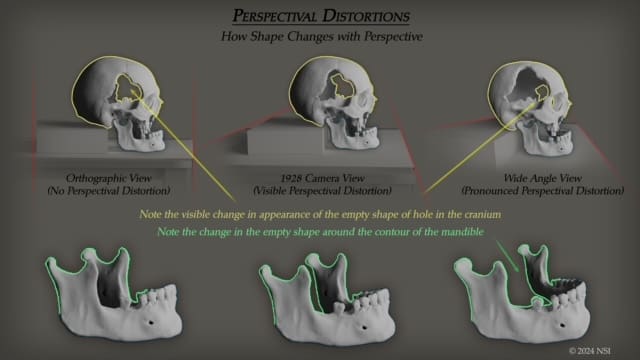
Understanding the vantage point of the camera enables us to identify distortions of perspective in the photographs
Forensic Sciography: How Rays of Sight and Rays of Light Help Reconstruct the Prophet’s Skull
In the forensic reconstruction of three-dimensional reality from a photograph, rays of light provide an evidentiary “second witness” to the witness provided by lines of sight. These evidentiary “witnesses” will enable us to reconstruct the Prophet Joseph’s skull in three dimensions from the photographic evidence.
We have noted that, using perspective, the point of view of a camera can be reconstructed from the photograph it produced. And the idea that a camera has such a point of view, like the human eye does, is a familiar one. Yet every photograph is actually created by the interplay of two vantage points–that of a camera lens and that of a source (or sources) of light. Just as the camera lens has a “point of view” at which it receives light, a light source has its own “point of view” from which it transmits light. And just as the point of view of the camera can be reconstructed from a photograph, so too can the point of view of the light source. The light’s vantage point, or angle on the photographic scene, can be reconstructed from the lights, shadows, and shades within the photograph. Where the light shines from its source directly onto the subject of the photograph, without obstruction, the subject will be fully lit. Where some edge of the subject turns away from the light it falls into shade. And where it is shielded from the light’s “gaze” by another object, it lies hidden in shadow. So, what the light source illuminated, or might have “seen,” from its angle or point of view is revealed by the play of light and dark within the photograph.
The silhouette of a visible form is a contour revealed by rays of sight from our own eye. In contrast, the shapes of shadows we see are the contours revealed by rays of light from another perspective. Those shadow shapes can thus delineate forms that are not directly in our point of view.
Because the respective points of view of the light source and camera lens can each be reconstructed, and each stand at a different angle to the subject of the photograph, combining their respective effects enables us to even more fully reconstruct the 3-dimensional reality behind a 2-dimensional photograph–just as the different angles of the eyes provide depth perception in stereoscopic vision. Using sciography as the “second witness” provided by rays of light can thus combine with perspective to reconstruct the reality and depth of a past scene from the 2D record provided by a photograph.
Fortunately, we can reconstruct the skulls of the martyred witnesses Joseph and Hyrum by applying perspective and sciography to the photographs of their skulls. Perspective offers us a first witness to this 3-dimensional reality, enabling us to begin reconstructing the skulls. And the shadows in those photographs offer a second witness. The first enables us to reconstruct the position of the camera relative to the skull, the second the position of the light source relative to the skull, steps that assist in calculating the three-dimensional shapes of objects within the photographs. Perspective allows us to understand where one visible part of the skull stands relative to another. And because even parts of the skull we cannot directly see cast shadows that we can see, sciography enables us to understand the position and shape of parts of the skull we cannot see.
So, using sciography we can reconstruct the side of the skull that was turned, not toward the camera, but toward the light, as shown in the image below.
[Sciographic construction of Anterior Photo of Skull #1]
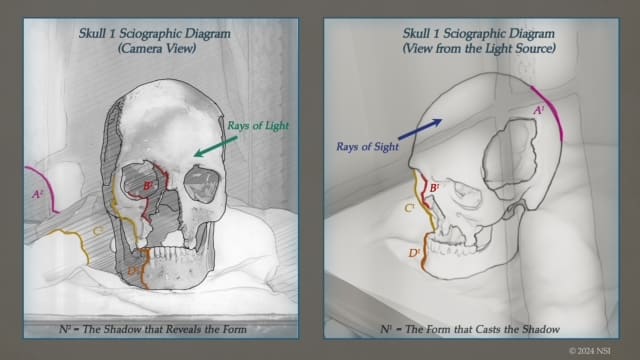
Sciographic reconstruction of the vantage point of the light source on Skull#1
Together, perspective and sciography empower us to reconstruct in three dimensions both what the camera could and could not see. Having used these methods to reconstruct Joseph and Hyrum’s skulls in three dimensional reality, we can compare the skulls to their three-dimensional death masks, definitively identifying which skull is which.

Additional angles of Skull #1 that can be reconstructed using perspective and sciography
Identifying the Skulls
With 3D models of the skulls in place, we will use two main methods for testing which was Joseph’s and which was Hyrum’s. First, we will compare the skulls to Joseph’s and Hyrum’s known facial structure, particularly as revealed by their death masks. Second, we will compare the skulls to what is known of how Joseph and Hyrum died.
Matching Skull to Death Mask
Forensic reconstruction of Joseph Smith’s physical form can work in two directions: from the outside in, and from the inside out. From the outside in, forensics can analyze the death mask made from the Prophet’s face to reconstruct the bone structure under that face–his skull. From the inside out, forensics can reconstruct Joseph’s face from the surviving skull. Together, the death mask and the skull provide an opportunity to do forensics in either direction. Working inward from Joseph’s death mask enables us to match the death mask to the correct skull. And working outward from the skull enables us to match the skull to the correct death mask.
Joseph’s and Hyrum’s death masks can be matched to their corresponding skulls by reconstructing what men with those skulls would have looked like in life. Such facial approximation can be done by creating models of the skulls’ faces using the known average depths of soft tissues for Caucasian men in their age ranges. Digitally restoring flesh to their dry bones yields faces that can then be compared with the death masks, to identify which death mask matches which skull.
[Tissue Depths with Skull #1 {Pointillistic Face}]

Skull #1 & Joseph’s death mask with tissue depths
When tissue depths are taken into account, the skulls align with the death masks, Skull #1 matching Joseph’s death mask, and Skull #2 aligning with Hyrum’s.
The mandible (jaw) of Skull #1 and the brow structure of both skulls further demonstrate which skull is Hyrum’s and which is Joseph’s.
The 1928 photographs all place the mandible with the cranium in a way that they can rest together conveniently for photographing them, varying slightly in relation to each other with each photo. Because of this, none of the photos show the mandible placed in the anatomically correct position relative to the cranium.
When we look at 1928 placement from a reconstructed view at another angle, their misalignment becomes more apparent, and we see the incorrect relationship in which they have been placed to each other. This is critical in understanding them three-dimensionally and knowing how to reposition the mandible to the anatomically correct position.
[Mandible Placement from 1928 Photograph]

The mandible of Skull #1 was positioned in the 1928 photograph at a misaligned angle to the cranium and placed in an anatomically impossible position
The only way to position the mandible correctly is to do it three dimensionally. Repositioning the mandible by photo editing will not solve the issue, because its perspectival shape is only true to its perspectival position. In other words, its apparent shape only fits that particular angle of view. Therefore, to simply cut and paste in Photoshop cannot represent a true alignment in physical space, as illustrated below.
[Perspectival Perils of Photoshopping]

Skull #1’s mandible can only be properly placed when the skull is modeled in three dimensions
Once the mandible is correctly positioned anatomically, it is immediately obvious that it cannot be matched to Hyrum’s death mask, eliminating Hyrum as the skull’s possessor.[iv]
 The wide, square brow of Joseph Smith (left) matches that of Skull #1

The narrower, rounded, more prominent brow of Hyrum Smith (right) matches Skull #2
Skull #1 can also be matched to Joseph’s death mask, and Skull #2 to Hyrum’s death mask, using brow structure. Skull #1 has Joseph’s distinctive brow structure, distinguishing it from Hyrum. This is indicated by expert opinion solicited by Community of Christ historians Ronald E. Romig and Lachlan Mackay: Dr. Jane Buikstra, founder of the discipline of bioarchaeology, opined that, “Brows on Hyrum’s death mask [are] much more like the middle burial”–Skull #2–an assessment shared by Thomas A. Andrew, MD, formerly Chief Medical Examiner for the State of New Hampshire.[v] The alignments in brow structure noted by these experts are clear enough that they can be confirmed by the reader through visual inspection. Hyrum’s death mask shows his brow was more prominent, narrower, and rounder, receding more abruptly–visibly matching the rounded brow structure of Skull #2. Joseph’s death mask shows that his brow was wider and more square, receding gradually–visibly matching the brow structure of Skull #1.
[Alignment of Joseph’s Death Mask with Skull #1]
Alignment of Joseph Smith’s Death Mask with Skull #1
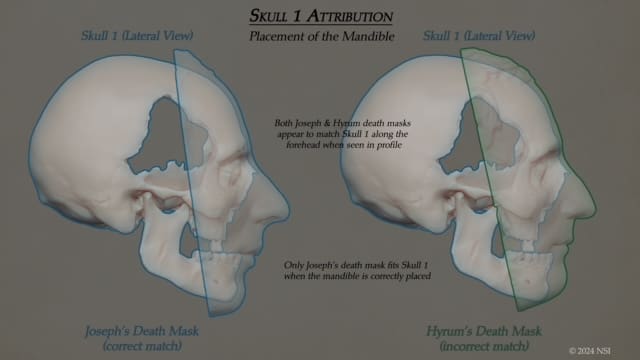
Alignment of Hyrum’s Death Mask with Skull #2

Further Evidence Matching Skull #1 to Joseph
Multiple further lines of evidence also attest that Skull #1 is that of Joseph Smith.
For instance, measurements were made of Joseph’s head during his lifetime. And with one exception where the measurement points used are uncertain, these measurements match Skull #1.
Another significant attestation that Skull #1 is that of Joseph Smith may be found by examining the skeleton associated with Skull #1. Famously, Joseph Smith had an intense osteomyelitis infection as a child, and a brutal surgery to remove infected pieces of bone from his left leg. After examining the 1928 photographs of both skeletons, Dr. Jane Buikstra and her team unanimously judged that the skeleton on the right, of which Skull #1 is a part, was the one that showed signs of this infection and its associated trauma. Thus, Skull #1 can be identified as Joseph’s even apart from comparison with his death mask.[vi]
Forensic Pathology: The Martyrs’ Voice from the Grave
The final, and definitive, line of evidence identifying Joseph’s and Hyrum’s correct skulls is that of forensic pathology. While Joseph and Hyrum both died from bullet wounds at Carthage Jail, the bullets that killed them struck different parts of the body. Hyrum, unlike Joseph, took a bullet to the face. Hyrum’s wound to the left side of the face is clearly visible on his death mask, just to the left of where his beaked nose curves downward. It is thus clear that the bullet struck Hyrum’s left-side facial bones, which would have shattered them. That Hyrum’s facial bones were, indeed, shattered is demonstrated by the death mask. Comparison of the right and left sides of the face in the mask show that relative to the right side of the face, the left side of the face is sunken between the eye socket and the mandible. This is the precise area where the bone is missing on Skull #2; yet the corresponding bone on Skull #1 is intact, demonstrating that it is Skull #1 that is Joseph’s and Skull #2 that is Hyrum’s.
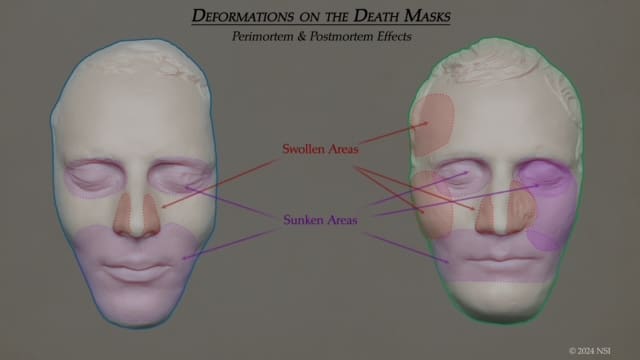
Hyrum’s Forensic Analysis: Bullet Trajectory; Sunken Left Side of Face

Hyrum Smith’s death mask with bullet trajectory and sunken left side of face

Overlay of Hyrum’s death mask to Skull #1, showing that the ball that struck him would have shattered bone that is still intact in this skull
Speaking of the effects of the bullet to Hyrum’s face, forensic pathologist Thomas A. Andrew described it as, “inconceivable to me that the ball did not completely penetrate the soft tissues of 3966/3968 [images of Hyrum’s death mask] to damage the facial bones of the skull, consistent with what is seen in image 3971 [an image of Skull #2].”[vii]

Hyrum Smith’s death mask, judged to be consistent with Skull #2 by forensic pathologist Thomas A. Andrew
The absence of such damage to the left-side facial bones of Skull #1 thus rules out this skull being Hyrum’s.
The testimony of the various lines of evidence is consistent. Skull #1, as indicated by its measurements, by its distinctive jaw and brow structure, by the signs of trauma on its associated left leg, and by its intact left-side facial bones, is the skull of the Prophet Joseph Smith.
Having correctly identified the Prophet’s skull, we can begin the work of reconstructing his appearance. The skull provides data points that can, for instance, help correct distortions in his death mask, to reverse engineer from it a “life mask.”
While Joseph’s death mask provides significant information about his face, changes that naturally occur after death distort its appearance, as does the weight of the plaster mold on his soft tissues during the creation of the death mask. When these effects are taken into account, the death mask image can be modified to reverse them–e.g., by making the eyes less sunken, the lips less pressed down, removing swelling and sinking of parts of the face due to injuries, etc. Reversing these effects shows us more of what Joseph and Hyrum looked like in life.
[Joseph’s Death Mask and Joseph’s Life Mask]

Joseph Smith’s death mask (gray) at various angles, and his reconstructed life mask (white) at the same angles
[Hyrum’s Death Mask and Hyrum’s Life Mask]

Hyrum Smith’s death mask (gray) at various angles, and his reconstructed life mask (white) at the same angles
The data points of the Prophet’s correctly identified skull that can be used to recreate his appearance can also be used to verify proposed photographs of the man, most significantly the newly discovered Larsen daguerreotype, which we will analyze and seek to forensically authenticate in our next article.
In a prophecy of the biblical Ezekiel, God speaks to dry bones promising, “I will bring flesh upon you, and cover you with skin . . . and ye shall live” (Ezekiel 37:5-6). While the ultimate fulfillment of such promises awaits the resurrection, for the Prophet Joseph Smith we can already begin putting flesh onto dry bones, and put a face on the man who spoke with God face to face to inaugurate the Restoration.
©2024 NSI
Notes:
[i] Robin G. Collingwood, The Idea of History, 247.
[ii] “Before I had left Independence, President [Frederick M.] Smith had indicated by placing his finger upon the side of his face, just below his right eye, and had told me that . . . I should find the place where the bullet that killed Hyrum had entered his face . . . I found the hole where the bullet had gone through, so clearly defined as to make identification positive and complete.” W. O. Hands to the Officers of the Reorganized Church of Jesus Christ of Latter Day Saints, undated, P19f81, as cited by Ronald E. Romig and Lachlan Mackay, “Hidden Things Shall Come to Light: The Visual Image of Joseph Smith Jr.,” presentation at the John Whitmer Historical Association annual conference, September 17, 2022.
[iii] The ruler that appears in one of the photographs of the skulls enables us to determine the width of the lace that appears in all of the photographs. The lace thus serves as a reference point for measuring objects in each photograph.
[iv] A further complexity that must be taken into account in comparing Joseph’s death mask with the skulls is that the death mask shows Joseph’s upper lip protruding unnaturally, and his chin recessed, indicative of a broken maxilla. This aligns with the description that after Joseph fell from the window of Carthage Jail, members of the mob that killed him hit him in the face, perhaps with the butts of their guns: “The mob was not satisfied with this, but some struck him on his face, damning him, cursing and swearing him after he was dead.” Jennetta Richards to “My dearly beloved Parents, Sister and Brother,” July 8, 1844, L. Tom Perry Special Collections, Harold B. Lee Library, Brigham Young University.
[v] Romig and Mackay, “Hidden Things Shall Come to Light: The Visual Image of Joseph Smith Jr.”
[vi] Romig and Mackay, “Hidden Things Shall Come to Light: The Visual Image of Joseph Smith Jr.”
[vii] This information and the associated images are from Romig and Mackay, “Hidden Things Shall Come to Light: The Visual Image of Joseph Smith Jr.”
FEATURES