




The Heartland Versus Mesoamerica Part 4: Directions and the East and West Seas

The following comes from The Interpreter Foundation.
Sorenson’s Map and Non-Cardinal Directions
A very common assumption modern readers bring to the Book of Mormon is that most of the English words in the text mean precisely what we assume they do. Royal Skousen and others have examined the words in our English text and found that there are many which represent a more archaic meaning than the one we would typically ascribe to them. These are only a few of those Skousen discusses, but they are representative of the issue of assumed meaning:
But ‘unless’
“I greatly fear lest my case shall be awful but I confess unto God” (Jacob 7:19)
Call ‘need’
“thus we see the great call of the diligence of men to labor in the vineyards of the Lord” (Alma 28:14)
Consigned ‘assigned’
“I am consigned that these are my days” (Helaman 7:9)
Course ‘direction’
“in the course of the land of Nephi, we saw a numerous host of the Lamanites” (Alma 2:24)
Cross ‘to contradict’
“that thereby they might make him cross his words” (Alma 10:16)
Depart ‘to divide’
“the waters of the Red Sea . . . departed hither and thither” (Helaman 8:11)
Depressed ‘rendered weaker’
“and they were depressed in body as well as in spirit” (Alma 56:16)[1]
The concept that there are words in the text that might have a different meaning than what we expect becomes important when the seemingly obvious words for directions appear in the text. We know what north, south, east, and west mean. Obviously.
There is no aspect of Sorenson’s map that has come under greater scrutiny than his use of directions. Where the internal models discussed in the first post in this series (Heartland vs Mesoamerican—Foundational Issues) show a very north/south orientation, Sorenson’s model appears to lay that model on its side. This places his sea east to the north!
Sorenson’s explanation begins with the fact that concepts of directions are culturally dependent.
The Israelites of Palestine, in their most common mental framework, derived directions as though standing with backs to the sea, facing the desert. Yam (“sea”) then meant west,” for the Mediterranean lay in that direction, while qedem (“fore”) stood for “east.” Then yamin (“right hand”) meant “south,” while shemol(“left hand”) denoted “north.”[2]
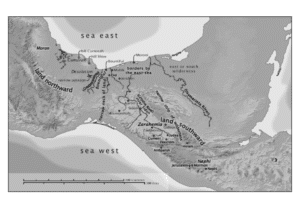
I have reexamined the issue of directions in the Mesoamerican model. Rather than basing the meaning on Hebrew, I use concepts of directions from Mesoamerica. Mesoamerican directional systems have some linguistic diversity, but the majority are based upon the path of the sun, with some variation of the phrase “from the east to the west” appearing multiple times in the text. In Mesoamerican systems, east and west were defined by the sun, and north and south would be “on the left” or “on the right.” Different languages might flip the meanings based on whether they assume that directions came from facing the sun or having one’s back to the sun. Because the sun’s rising changes along the horizon through the year, the Mesoamerican concept of north was not the vertical line we assume, but rather a pie wedge where what is north sweeps an area because the beginning of the sun’s path changes throughout the year.
Combined with the understanding that directions are relevant to the focal point from which they are given, what is north and south are slightly different in the Book of Mormon when the directions are given from the city of Nephi or later from the city of Bountiful. Thus, I modeled that directional concept on Sorenson’s map and that way, it yields a more explicable understanding of how the Mesoamerican orientation fits into the directional explanations.
Of course, the argument for understanding directions in this way is much more extensive than the summary offered here. I refer readers to the published article for the full details.[3]
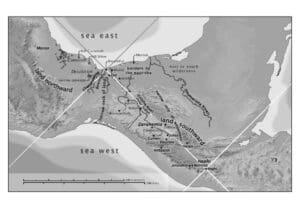
In the concept depicted above, it is easy to see a sea west of the land of Nephi. It is perhaps less so when seen from Bountiful. However, this issue of a continuous sea that is both west and south may help explain an interesting verse in Alma: “And now it came to pass that the armies of the Lamanites, on the west sea, south. . .” (Alma 53:8). If tradition beginning in the land of Nephi used “west sea” as a name as much as a directional description, then there is a reason to see the Lamanites on the West Sea, south.
Neville’s Heartland Map and the East and West Seas
Neville’s map uses cardinal directions and therefore neither he nor other Heartland modelers need to nuance our expectations of what directional terms mean. Nevertheless, the geography that he proposes requires some explanation of what a sea is, and therefore what a sea east and a sea west might mean.
Neville does not argue a specific east sea, apparently accepting the Atlantic Ocean. He never discusses how the distance from the Heartland to this east sea may be accounted for. As I noted in the post on “Up, Down and Distance,” there is a serious problem with how far away his east sea is from the Zarahemla heartland.
Where Neville has a real problem is with the west sea. The Atlantic is far away, but he apparently understands that the Pacific is simply too far away to be seen as the west sea. Neville suggests “it is possible that were multiple seas; i.e., the “sea west” could refer to one body of water in one passage and a different body of water in another passage.”[4] This is similar to his suggestion that the River Sidon is sometimes the Mississippi and sometimes the Tennessee River.[5]
While this is possible in theory, the issue is whether the text supports the idea or whether the hypothesis is simply necessary to make the text fit into the selected real-world geography. This underscores the problem of beginning with a fixed pin in mind. Neville’s pins commit him to a geography and therefore he must fit the text to the geography rather than the geography to the text. Neville does not attempt to show how the text uses the west sea differently. He simply asserts that it could be and therefore is.
Neville’s solution depends upon one of the meanings associated with the Hebrew word, yam, typically referencing, seas. He indicates that it could mean a “mighty river.” That meaning allows him to suggest that the Mississippi could be seen as the west sea.[6] The argument that the Book of Mormon peoples continued to use Hebrew has been asserted by multiple defenders of multiple geographies, including the various Mesoamerican models. Although I have personal disagreements with the use of Hebrew as a default language for the Book of Mormon, it is widely enough used that Neville’s suggestion cannot be dismissed outright.
The next problem Neville’s west sea imposes is that he has the Mississippi as the Sidon River as well as the west sea. His solution is to suggest that the Mississippi becomes the west sea only farther south after tributaries have swollen the size of the river.[7] Interestingly, he admits “that doesn’t solve all the issues with seas in the Book of Mormon. It doesn’t even solve all of Alma 22.”[8] Solving Alma 22 requires Neville to posit a difference between the west sea and the sea West. This is where the idea of more than one sea can come in, where the west sea is only the lower Mississippi and the sea west is another body of water, which he suggests is Lake Michigan.[9] As with the Sidon River that becomes the west sea, the idea that there are multiple west seas (or a real distinction between a sea west and a west sea, which he never demonstrates from the text) is a requirement of the desired geography dictating the interpretation. As I noted concerning river travel, the need to adapt the text to fit the desired geography required Neville to invent unnamed and unreferenced rivers, and now to posit multiple west seas (also without textual support), one of which is the Mississippi River which all modern maps rather clearly understand as the same river even though it is fed from multiple tributaries.
Comparison of the Mesoamerican and Heartland Seas
Neither the Mesoamerican nor the Heartland models survive a simplistic reading of east and west. For the Sorenson model, I believe the orientation of the model is explained by using the directional system that was native to the cultures that lived in the model’s geography. For Neville, there is no need to alter the concepts of directions, but he must alter the definitions of bodies of water. In order to fit the text, he must redefine river as sea, but only when it is south of Zarahemla. Then he must create a second west sea after the Nephites have moved north. He asserts, without analysis, that west sea and sea west are fundamentally different rather than different ways of representing the same concept.
While both models have their issues, the Mesoamerican model can be explained with a culturally appropriate understanding. The Heartland model requires having the Sidon become a sea south of Zarahemla (which is nowhere attested in the text), and then have Lake Michigan become the west sea later in the text. Neville never addresses the problem of the distance from the Heartland to the east sea, which is the Atlantic. The Mesoamerican model requires resetting expectations, but the result is a culturally appropriate definition. The Heartland model requires inventing multiple seas as well as a distinction in the upper and lower Mississippi. Parsimony sides with the Mesoamerican model.
[1] Royal Skousen, “The Language of the Original Text of the Book of Mormon,” BYU Studies Quarterly 57, no. 3 (2018): 88.
[2] John L. Sorenson, An Ancient American Setting for the Book of Mormon (Salt Lake City and Provo: Deseret Book and the Foundation for Ancient Research and Mormon Studies, 1985), 38-39.
[3] Brant A. Gardner, “From the East to the West: The Problem of Directions in the Book of Mormon,” Interpreter: A Journal of Latter-day Saint Faith and Scholarship 3 (2013), 119-153. https://journal.interpreterfoundation.org/from-the-east-to-the-west-the-problem-of-directions-in-the-book-of-mormon/.
[4] Jonathan Neville, Moroni’s America. The North American Setting for the Book of Mormon, (Digital Legend, 2016), 33.
[5] Neville, 98.
[6] Neville, 34.
[7] Neville, 34.
[8] Neville, 35.
[9] Neville, 37.
The Heartland Versus Mesoamerica Part 2: The Heartland “Pins” in the Map

The following comes from The Interpreter Foundation.
As part of the Gospel Topics essay in Book of Mormon geography, it is declared:
The Book of Mormon includes a history of an ancient people who migrated from the Near East to the Americas. This history contains information about the places they lived, including descriptions of landforms, natural features, and the distances and cardinal directions between important points. The internal consistency of these descriptions is one of the striking features of the Book of Mormon.[1]
Although there is no official Church position on the Book of Mormon,[2] there is an understanding that because we believe the Book of Mormon to represent an ancient people, the descriptions of “landforms, natural features, and the distances” might be subject to investigation.
There is more than one suggestion for the way the Heartland model maps the Book of Mormon to the real world. This analysis will use the geography Jonathan Neville has proposed.[3] There are two geographical correlations that Jonathan Neville suggests are pins in the map that will assist in the discovery of all other locations. The first is the New York hill that has come to be called Cumorah. Jonathan Neville understands that:
No two people can independently develop an identical map merely from reading the text. Matching such maps to real-world locations is just as problematic. What we need is a solid starting point—a reliable pin in the map. That’s why we need modern revelation.[4]
Neville is suggesting that there is revelation that provides the starting point for interpreting Book of Mormon geography. Were that true, it would indeed be a firm foundation.[5]
One confirming revelation is Doctrine and Covenants 128:20. “And again, what do we hear? Glad tidings from Cumorah! Moroni, an angel from heaven, declaring the fulfilment of the prophets—the book to be revealed.” The revelation declares that we have “glad tidings” [the Book of Mormon] from Cumorah [thus linking the Book of Mormon name with the location where the plates were found]. This gives Neville a revealed location and therefore a pin in the map. As I discussed in the post initiating this series, this is the same beginning point that Ed Goble used to create what has become the Heartland model.[6]
How firm is this pin? From tradition, it is solid. It has long been accepted and taught that the New York hill is the very Hill Cumorah mentioned in the Book of Mormon. When we examine that actual text of the Book of Mormon, however, the pin is less than firm.
The latter part of Mormon 6:6 reads:
I made this record out of the plates of Nephi, and hid up in the hill Cumorah all the records which had been entrusted to me by the hand of the Lord, save it were these few plates which I gave unto my son Moroni.
The plates given to Moroni were the ones recovered in New York. Nevertheless, according to the only statement we have about records in the hill Cumorah, the plates Joseph received were not among those buried in the hill Cumorah. Although Joseph Smith retrieved plates from a hill, according to Mormon, those specific plates were never in the Book of Mormon Hill Cumorah – they were given to Moroni, in contrast to those that were “hid up.” From the text alone, we cannot say that the New York hill was the Book of Mormon Hill Cumorah.
The Church-sanctioned publication of Saints does not use the name Cumorah for the New York hill. The omission of Cumorah has resulted in some controversy, which Jed Woodworth and Matth Grow specifically address:
The word “Cumorah” does not appear in Saints. This omission has led some to believe that we left out that word in order to speak against a “heartland” model. We assure you that this is simply not the case. We have worked on Saints for many years, Matt as a general editor of Saints and Jed as a review editor of Volume 1. In those capacities, we have read all the draft chapters and editorial comments accompanying these drafts. No one under our observation—writers, editors, external reviewers, General Authority reviewers—has expressed any concern about the word “Cumorah” or articulated any need to expunge it from the record. To our knowledge, there have been no discussions about the need to put down one theory of Book of Mormon geography in order to promote another.[7]
To read the full article on The Interpreter Foundation, CLICK HERE.
The Heartland Versus Mesoamerica Part 1: A Foundation for Comparison

The following comes from the Interpreter Foundation.
This post begins a series of blog posts in which I will compare two proposed locations for the Book of Mormon. An important caveat is that I have published on the Mesoamerican model and prefer it. Having stated that I do begin with bias, I will nevertheless attempt to deal with evidence more than prejudice. I will attempt to represent comparable aspects of both the Heartland and Mesoamerican models. Also important is the declaration that I present this information as my own studied opinion and intend no implication that my ideas represent The Interpreter Foundation or the Interpreter journal.
The very first point of comparison is that it is going to be difficult to make the comparison. The reason is that the two geographic models are built on completely different concepts of how one should arrive at a solution to the question of where the Book of Mormon took place. Although both models produce maps that reflect the locations of Book of Mormon named places, there is an extreme difference in how the models are created.
John L. Sorenson highlights what he considers the foundation for searching for a real-world location of the Book of Mormon:
The first place to seek for knowledge of the Book of Mormon context is in the book itself. Going back to the original is the basis of sound scholarship whenever anyone works with an ancient text. . . .
Building an internally consistent map is but the first step. Next we must match up Book of Mormon lands and rivers and mountains with actual places, location for location, as scholars have done for much of the information in the Bible.[1]
Although Sorenson’s model has become the most widely accepted of the Mesoamerican models for the Book of Mormon, Sorenson was not the only one who created an internal model. Some of those who created internal models never attempted the elaboration of attempting to place that model on a real-world location. The variation in the internal maps echoes the wide variation of the real-world models that have been proposed (covering, apart from the Heartland or Mesoamerican models, a Great Lakes Model, a Delmarva Peninsula model, a Baja model, South American models, and Hemispheric models).
The following are different models created to demonstrate the relationships of Book of Mormon internal locations:

Two more modern examples:

There are others, but these four are representative. Notice that while different, they all propose general similarities. Although the one published in the Improvement Era does not have the overall hourglass shape of the other three, it nevertheless places a narrow neck on the northern end of the Nephite lands.[2]
Note how different the shape of the map becomes when the conceptual map, based on the Book of Mormon text, is compared to the two Heartland maps:

To read the full post on the Interpreter Foundation, CLICK HERE.
Hidden Poetic Architecture of the Book of Mormon

Not just pieces of the Book of Mormon. Not just chapters or series of chapters. Apparently, the entire Book of Mormon is designed as a chiasm, a divine architecture reflecting not only ancient Hebrew poetry, but the Lord’s signature upon it.
Opening the Book of Mormon is like crossing the threshold of the temple. I look about myself in anticipation, wondering what new concepts will be shared today. Who will be my teachers? Like the temple, the Book of Mormon has many rooms all dedicated to teaching the principles of life and of the gospel in a myriad of wonderful ways.
I turn and enter one room. Instead of seeing the baptismal font on the backs of twelve oxen—that dozen representing the covenant tribes of the House of Israel—I see a clear pool of water and hear its fountain of flowing pure water. I watch Helam depart the group waiting on the bank and descend down into the waters of Mormon where Alma waits.
Passing deeper into the book’s corridors, I realize a need to better understand a particular aspect in the doctrine of Christ. A doorway is open and I enter a room where a loving father explains repentance, redemption, restoration and resurrection to a wayward son. What a delight to sit near Alma and listen to his careful discourse to Corianton about rising above the follies of youth, the easy transgressions of mankind.
Yesterday I decided to spend some time in the Celestial Room. I passed through its doorway and entered the splendor and enchantment of light and space accorded Christ’s visit among the Nephites, his blessing of the little children. There, in that holy place I watch him gather them in and kneel in their midst glowing in his love for them, for all of us—his little children. And I feel the power of his blessings upon them, upon us.
Not too long ago I was depressed. Things were not going as I wanted. Opening the book, I carefully searched through its sacred chambers eventually stopping at a room named “Enos.” I opened the door and saw a young man kneeling in the forest pleading that his transgressions might be rectified. When he received his response from God he did not get up and go bouncing off down the mountain and through the brush notching an arrow and looking for deer. No, he knelt down again and sought the welfare of his brethren.
After receiving that particular confirmation concerning the welfare of the people he loved, he stayed on his knees and pleaded for his enemies. He desired that they too would be remembered by the Lord. Watching Enos receive his final confirmation from a loving God brought again my remembrance of my pressing problems, but my depression was gone. In that special room, surrounded by the flowers, mountains and wilderness of an ancient time, Enos taught me that caring more for the needs of others than for my own worries brings the peace, reassurance and capacity to face my own personal doubts and fears.
I wander the corridors of this temple of paper and ink. Now I am passing a room where Mormon himself presides. Stopping here I watch this man cope with his terrible realities, this man who knows that soon everything that he knows and loves will be gone. Yet he does not rail out in anger or protest. Rather he teaches us about commitment and never fearing. When he kneels imploring the Lord that his son, Moroni, might be spared to continue his mission with the records, I have seen enough. I quietly leave that sacred place.
Over across the way there is the room where Nephi the ship builder, the hunter, the invincible, opens his heart to his God, being deeply grieved because of the hatred and open hostility of his family members. I feel his anguish. I am comforted. My family members are challenged in various aspects but they are neither a threat nor an encumbrance.
Across the corridor is a place where one can silently sit and carefully hear and observe the righteous expressions of an ancient prophet as he addresses a weak and wicked king and a room filled with apostate priesthood. I hear Abinadi’s warning, his teaching of the commandments of God and his final testimony of the Savior. I search the faces of that angry, unrepentant crowd and would that I could step forth—a specter from the far future— to help him, to add my warnings to his. I start to leave the room when his execution by fire begins. But something makes me look again in his direction and I see his specter, finally released from the flames and the smoke, ascend with joy into a greater glory.
The Deep Order of the Book of Mormon
Today I enter this book, this temple, with the continuing hope that I can absorb the structure of order that exists within its pages. We are told that the House of the Lord is a house of order. Craving the capacity to excel in orderliness of thought, word and action, I open these paper temple doors to learn how those ancient prophets understand and created order.
I turn to a different room, one I have not yet fully explored. Entering, I immediately know that this is the place where I will find and hopefully assimilate order because the writing on the wall reads: Order comes from Truth—Truth comes from a precise understanding of Context. Studying this new statement, I hesitate, thinking to myself: “I am 76 years old; surely by now I understand the meanings of Truth, Understanding, Precision, and Context; they all are elements of order.” Taking a seat, I assume that I am ready, finally, to learn ORDER.
My attention is drawn to Mormon, the great teacher and warrior prophet. “Of course,” I suddenly realize, “who else can address the subject of ORDER in this special temple than its architect; and of course, Mormon will use his own writings to teach me on that subject.” Mormon takes his seat at a table laden with manuscripts and metal plates. He pauses and then begins to press a stylus to the gold. He presses down and I watch his efforts release a thin sliver of metal which peels away from the plate. And I know that he is now about to erect a literary temple.
I study the layout that his efforts slowly reveal, the careful phrases, words and drawings that he is using to erect this holy temple. He lets me read the title: The Architecture of God’s Dealings with His Children, the Nephites.
All Pointing to the Center
He waves his hand to look again and I see an array of ancient prophets on the right and a separate array on the left. They are all pointing to the center, a place between the two groups. As I watch the center, the scene gradually fills with the vision of the Christ’s birth and life and death and returning. The final part of that scene shows our resurrected Savior kneeling and praying among the Nephite children.
“Of course,” I now realize, “the Christ’s atoning work and His subsequent mission among the Nephites would form the center of this literary temple—the center of any temple whether made of paper, wood or stone.”
The scene shifts. Its center featuring the Christ remains the focus but the two ends have transformed; those places to the far right and the far left of the Christ have changed. What do I see there? I see Moroni praying to the Lord and placing his life in the Lord’s hands. I shift across the scene to the opposite frame where Lehi is also praying to the Lord and is also placing his life in the Savior’s hands. Like bookends on a shelf, these two ancient prophets are alone but unified in their commitment: with single intent they place their lives in the Lord’s keeping.
The scene shifts again. Lehi and Moroni still retain their beginning and ending places but there are two new additions toward the center. On the left Lehi leads his family toward the Lord but in doing so he takes them into the wilderness seeking safety from the brutality of his culture. And in this journey towards the center, he carries with him his writings and his prophecies while moving the group in slow but steady progress toward the Savior who still waits in the center. I look to the opposite side. Here too, Moroni is alone. He too carries his writings and the prophecies of others as he steadily progresses into the wilderness and toward his waiting Savior. He too is fleeing the awful depravity that has engulfed his culture.
Sequences Emerge
As the next change occurs in the architecture of Mormon’s temple, a temple built from words and thoughts, I realize that I am actually standing within a chiasmus, a poem that Mormon is fashioning before my eyes to demonstrate the sacredness of his temple. Mormon is taking the history of his people, the Nephites, and is preparing it in three parts using the architecture of his careful poetry. In true chiastic form he places the Savior’s mission to the Nephites within the center portion. Then he establishes the Nephite history from Lehi to Christ within the first third of the chiasmus, on the far left. Finally, he places the Nephite history from the Christ’s departure to the final days of Moroni within the final third, to the far right.
A new addition to the structure is exposed. Now I see Lehi and other prophets, still moving toward the center and the waiting Christ, but now prophesying about the forthcoming destruction of Jerusalem and the scattering of the covenant children of Abraham, Isaac, and Jacob.
What do I see on the opposite side of the scene? In true chiastic form I see Mormon and Moroni, still moving toward the center and the waiting Christ, but their foreseeing our day, my time on earth, and prophesying about the great gathering of the House of Israel that is now taking place within the latter-days.
The next sequence emerges. Facing the central figure, the Savior, Nephi retrieves the brass plates containing the ancient prophecies given as a witness of the Being and atoning mission of the Christ. I look to the right and see the contrasting end of Mormon’s great architectural scene now features a demonstration of Moroni, who also faces the center. What is Moroni doing? He too is receiving ancient sacred records. He is receiving from his father, Mormon, that prophet’s writings, his testimony and his abridged history of his people.
Further ahead to the left in the scene I see the Israelites destroyed as a nation, Jerusalem sacked. Death and bondage are occurring according to the warnings of the ancient prophets. Prophets who now all turn toward the center pointing toward the great Jehovah/Christ and His requirements for order and righteousness among a wicked covenant-breaking people. And, on the right, the opposite portion of the scene what do I behold? I witness the Nephites’ terrible demise at Cumorah, a destruction long foretold by the many who foresaw the destruction of that covenant-breaking people.
Mormon continues engraving, making changes within this vast scene. Two ends of his careful literature always orient toward the center, always steadily moving towards the Christ and His central mission. Two different progressions of history and prophecy are evident in the Book of Mormon—one from the beginning and one from the end–two different progressions whose individual elements are always complementary as they progress steadily toward that sacred center.
Now understanding that I am witnessing just a few repetitive elements within a chiastic format, the literary layout of the Book, I finally lift my pen and begin recording this framework—Mormon’s poetic architecture for his literary temple: the Book of Mormon.
I finally understand the meaning of the words written on the wall above Mormon’s table and stack of manuscripts: Order comes from Truth—Truth comes from a precise understanding of Context. I understand that he relied on the order associated with poetic parallelism and its repetition of words and phrases to create the architectural framework for the historical narrative of his abridged Book of Mormon.
The actual text of the Book of Mormon was apparently recorded by Mormon and other Nephite prophets in two different manners: They generally wrote the historical narrative as plain unembellished text; however, to demonstrate sacred text and concepts, those authors also used poetic parallelisms of many different types of repetition of which chiasmus is but one example.[1] However, in my opinion, the poetic structure specific to chiasmus has generally been used in that book to set apart or define its most pertinent and sacred concepts.[2]

Geography Merits Special Treatment
For instance, after diagramming the book’s eight extended references to the geography described the Book of Mormon, I have discovered that the authors of that geography, Mormon and Moroni, used various forms of poetic parallelism to accentuate the sacredness of those geographical scriptural references. They used this literary technique so that those scriptures pertaining to their geography might stand apart from the historical narrative in the text. “Why,” I asked myself, “Why, would geography merit such special treatment?”
One response to that question is that these various statements concerning geography were flagged using chiastic formats as a signal that we are dealing with very special information. These statements of geography appear to be those authors’ perceptions of their sacred Promised Land, or the covenant territory that the Lord promised Lehi and gave to Nephi and to Lehi’s descendants for all time. What better way than to use poetic expressions to accentuate the sacredness of their covenant land!
There is a second reason for identifying the text’s geography using poetic parallelisms: repetition is a great agent for clarification and establishing the truthful understanding of a concept. Using chiastic and other parallelisms to explain the sacred geography of the Promised Land, the authors give us no room for divergent interpretations as to the meaning of any given word. Truly, when complex information is framed within repetitive phrases and especially when it is framed within chiastic architecture, Order does come from Truth—Truth does come from a precise understanding of Context.
Why the Asymetry?
When studying the overall chiasmus of the Book of Mormon, as shown above, one might ask, “Why is this chiasmus asymmetric and not balanced? Why is there more information in the upper third preceding Christ’s entrance compared to the lower third that is shown after that central or turning point?”
The answer to this pertinent question comes from a comparison of the structure of the book itself. Most of the Nephite history takes place during the +/- 250 year span from the beginning reign of Mosiah I until the Savior’s arrival at the temple in the land Bountiful. This +/-250 year span is documented in approximately 283 pages extending from Omni 1:12 to 3 Nephi 9:1. In comparison, the 250 years of Nephite history that follows Christ’s visit among the Nephites is confined within just seven pages. Those pages extend between 3 Nephi 28:13 and 4 Nephi 1:41. For some reason known only to Mormon and the Lord, Mormon did not provide in detail the significant religious experiences that occurred during that latter period; had he done so, the book that we now have would be huge. What could he have omitted concerning those wonderful years of peace and cultural development? This is the reason a chiasmus of what we now have as the Book of Mormon is somewhat lopsided or top heavy.[3]
Many readers of the Book of Mormon have felt this chiasmus throbbing in its architecture; they have realized a certain underlying dynamic order of repetition that even when presented in our modern narrative format can be felt in our bones like some faraway beating of a drum.
Readers frequently state this perception when they ask questions like, “Why do the Nephites keep repeating the process of prosperity, wickedness, prophets crying repentance followed by war and destruction. Then the cycle concludes with the Nephites repenting and, finally, a return to prosperity. Over and over again this pattern occurs, why?” I suppose that Mormon uses this chiastic order, this repetitious throbbing like a heart beating in our chest, to help us identify similar cycles in our own lives. His purpose is not only to demonstrate the centrality of the Christ, but to make us all aware, all of us in these the latter-days, of similar cycles impacting our own lives. He uses the music of his poetry to make us aware of where we can find release from the baseness, the wickedness contained within such a cycle.
The Book of Mormon, like a standing temple, is a house of order, a document of order. Order was used by Mormon in his abridgment of Nephite historical records to identify and highlight truths concerning the Savior, His doctrine, and even the geography of His Promised Land. As we sincerely search and study the messages contained in its many special corridors and chambers we can learn to appreciate two simple facts: The spiritual truths of the Book of Mormon are always revealed through the Holy Ghost. And finally, all of the remaining linguistic, historical and geographical truths buried within the book can only be discovered through a precise understanding of its diverse contexts as revealed through Mormon’s poetry.
[1] To examine the variety of parallelisms and repetitions existing in the Book of Mormon see Donald W. Parry’s Poetic Parallelisms in the Book of Mormon, The Complete Text Reformatted (Provo, Ut.: Maxwell Institute for Religious Scholarship, Brigham Young University, 2007). Other publications relating to parallelisms in the book are also available including John Welch’s Chiasmus in Antiquity (Hildesheim: Gerstenberg Verlag, 1981) which contains examples of chiasmi that have been recently discovered within the religious passages of the book.
[2] For information pertaining to the structural integrity of the more exclusive chiastic formats see John W. Welch’s Criteria for Identifying and Evaluating the Presence of Chiasmus, in Journal of the Book of Mormon and other Restoration Scripture, Vol. 4, Issue: 2 (Provo, Ut.: FARMS, 1995).
[3] The chiasmus shown in this article has been extracted from an extended chiasmus of The Book of Mormon previously diagrammed by the author. That larger, more complete chiasmus occupies several pages in length and is even more asymmetrical than the shortened model provided in this article. Materials found within the extended format but not included in this reduced format include multiple repetitions of the 7, 8, 9 and 10 lines that are shown in this, the shorter version, with the exception that those repetitions always feature different prophets and wars than those included in this limited version of Mormon’s chiasmus.
FEATURES