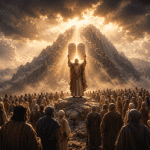





“My Presence Shall Go With Thee”– Come, Follow Me: Exodus 19-20 24; 31-34

Cover image via Gospel Media Library.
There are two kinds of people: Those who repent, and those who refuse to repent.
“What about the righteous? Aren’t they a third kind?”
No, to be righteous is to be repentant. When we take upon ourselves the name of Christ, we enter into a covenant with Him that we are “willing” to keep His commandments. But to be “willing” to do a thing and to actually do it are not always the same. That’s why when we take the sacrament, we are also promising to repent when our willingness fails us.
Then, when we are in the process of repentance, the Lord promises “my presence shall go with thee” (Exod. 33:14). President Russell M. Nelson has said:
“Too many people consider repentance as punishment—something to be avoided except in the most serious circumstances. But this feeling of being penalized is engendered by Satan. He tries to block us from looking to Jesus Christ, who stands with open arms, hoping and willing to heal, forgive, cleanse, strengthen, purify, and sanctify us” (“We Can Do Better and Be Better,” April 2019 General Conference).
When we are repentant, therefore, we are in the healing, cleansing, sanctifying presence of the Savior.
Every covenant consists of an oath and a blessing for keeping the oath; a penalty for breaking the oath; and a sign or token to symbolize the oath.
For example, the Sabbath is a sign of the covenant. “My sabbaths ye shall keep,” the Lord says, “for it is a sign between me and you throughout your generations; that ye may know that I am the Lord that doth sanctify you” (Exod. 31:13). When asked why I keep the Sabbath, I reply that it is a token of the covenant I have made with my Heavenly Father. It is a symbol of my commitment to honor Him and to keep my covenant. It is a sign of my love for Him. Of course, Sabbath-keeping blesses me with peace of the spirit and a closer relationship with Him.
President Nelson says, “In my much younger years, I studied the work of others who had compiled lists of things to do and things not to do on the Sabbath. It wasn’t until later that I learned from the scriptures that my conduct and my attitude on the Sabbath constituted a sign between me and my Heavenly Father. With that understanding, I no longer needed lists of dos and don’ts. When I had to make a decision whether or not an activity was appropriate for the Sabbath, I simply asked myself, ‘What sign do I want to give to God?’ That question made my choices about the Sabbath day crystal clear” (“The Sabbath Is a Delight,” Ensign, May 2015, 130).
The Lord also defined the penalty for breaking the Sabbath covenant: “Every one that defileth it shall surely be put to death: for whosoever doeth any work therein, that soul shall be cut off from among the people” (Exod. 31:14). This penalty is harsh, and it is still in effect. Unless they repent, those who persistently desecrate the holy Sabbath will die the “second death”—which is to be cut off from the presence of the Lord (see Alma 12:16).
The Israelites in the wilderness caught a man gathering wood on the Sabbath. Unsure of what to do with him, they brought him to Moses, who inquired of the Lord: “And the Lord said unto Moses, The man shall be surely put to death: all the congregation shall stone him with stones without the camp” (Num. 15:35).
But centuries later, when the hungry disciples of Jesus walked through a wheat field on the way to the synagogue on the Sabbath, they “plucked the ears” and ate them. The Pharisees were watching and asked, “Why do they do on the sabbath day that which is not lawful?” The Savior replied, “The sabbath was made for man, and not man for the sabbath” (Mk. 2:23-27). In other words, the Lord intended the Sabbath as a blessing of rest and recommitment, not as a “list of dos and don’ts.”
Why, then, the difference between the responses of Moses and Jesus to these situations?
Obviously, there must have been a crucial distinction between the motives of the wood gatherer and the disciples of Christ. The wood gatherer seems to be flaunting his indifference to the Lord’s commandment by doing what should have been done beforehand. He exemplifies the “stiffneckedness” of the house of Israel (Exod. 33:3); thus, his punishment served as an example to the people of the death that awaits the proud and the hard of heart.
A key purpose of the law of Moses was to soften the hearts and necks of Israel. “The Lord God saw that his people were a stiffnecked people, and he appointed unto them a law, even the law of Moses” (Mosiah 3:14). Although we don’t know, we might assume from his act of open defiance that the wood gatherer was unrepentant, and “if a man repenteth not . . . mercy hath no claim on that man” (Mosiah 2:38-39). His fate is a caution to those who break their covenants through pride or indifference.
By contrast, the disciples of Christ were going about the Lord’s work, on their way to worship in the synagogue. They were hungry, and the law of Moses specifically permitted them to take a handful of grain as they went (see Deut. 23:25). Necessary work is lawful on the Sabbath, such as “preparing food with singleness of heart” (Matt. 12:11; D&C 59:13). So the intent of the heart matters in questions of justice and mercy.
Now, as we read the Old Testament, we might ask, “Why were the penalties for breaking the covenant so harsh?”
Moses set down this law: “Thou shalt give life for life, eye for eye, tooth for tooth, hand for hand, foot for foot, burning for burning, wound for wound, stripe for stripe” (Exod. 21:23-25). The law of justice requires exact compensation for damage—not retaliation but perfect restoration of that which was lost or hurt. “The work of justice cannot be destroyed,” says Alma, “or God would cease to be God” (Alma 42:13). So, the strict work of justice was encoded in the law of Moses.
In practice, however, the penalties were probably not implemented very often, according to historians: “In fact, there is little evidence that many of these sanctions were ever actually carried out in ancient Israel. Only in the case of premeditated murder was there the added stricture of ‘Do not accept a ransom [satisfaction] for the life of the murderer who deserves to die’ (Num. 35:31)” (Walter Kaiser, Jr., Peter H. Davids, F.F. Bruce, and Manfred T. Brauch, Hard Sayings of the Bible, Downers Grove IL: IVP Academic, 1996, 162).
The law required death for some twenty offenses, but in nearly every case offenders could offer a “ransom”—money or other property in restitution—to save their lives. The exception: Because a murderer could not restore life, his or her life must be taken. The word “ransom” means “redemption.” The Hebrew word in Numbers 35:31, kopher, is related to the word kippur, meaning “covering” or “atonement.” In other words, repentant persons should make what restitution they can as a token of their repentance, while the Atonement of Christ “answers the ends of the law unto all those who have a broken heart and a contrite spirit” (2 Ne. 2:7).
On the other hand, those who refuse to repent out of pride or a hard heart face the full penalty of the law on their own. The Lord does everything possible to convince the unrepentant to change. He pleads with them through the prophets, He shows them the consequences of their actions through plague and warfare, He “suffers long” with them because His essence is charity. But when their “iniquity is full,” the flood of consequences cannot be held back. “In that day that they are fully ripe in iniquity they shall perish” (2 Ne. 28:16): The law of justice requires it.
For this reason, Israel was commanded to destroy whole peoples, including the Amalekites and the Amorites (Canaanites). Centuries before, the Lord had told Abraham that his descendants would suffer “in a land that is not theirs” (Egypt) for four hundred years—“until the iniquity of the Amorites is full” (Gen. 15:13-16). Not until the totally degraded peoples occupying Canaan were doing their worst—among other things, burning their own children as an offering to their gods—did the Lord let the armies of Israel loose upon them.
Of course, the Lord took no pleasure in their destruction and no doubt wept over them: “Wherefore should not the heavens weep, seeing these shall suffer?” (Moses 7:37).
One reason the Lord wanted repugnant practices swept from the Promised Land was to protect the covenant people from their influence. Unfortunately, that influence was strong. When Moses went up Mt. Sinai for forty days to receive the law of the Lord, the Israelites backslid into idolatry: “When the people saw that Moses delayed to come down out of the mount, the people gathered themselves together unto Aaron, and said unto him, Up, make us gods, which shall go before us; for as for this Moses, the man that brought us up out of the land of Egypt, we wot not what is become of him” (Exod. 32:1). So they made a golden calf, threw a party, and got drunk.
We see this pattern too often in the Old Testament whenever Israel is put to the test. “Our fathers dealt proudly, and hardened their necks,” says the prophet Nehemiah,” and hearkened not to [the Lord’s] commandments” (Neh. 9:16). We see it today among those who say in their hearts, “The Lord delayeth his coming . . . [they] eat and drink with the drunken” (Matt. 24:48-49).
Fortunately, after Moses chastised them, the Israelites repented: “They mourned: and no man did put on him his ornaments. . . . all the people rose up and worshipped, every man in his tent door” (Exod. 33:4, 10). Although guilty of gross violation of their covenants, they humbled themselves and the Lord forgave them.
Years later, Nehemiah praised the Lord for the mercy shown to repentant Israel: “When they had made them a molten calf, and said, This is thy God that brought thee up out of Egypt, and had wrought great provocations; yet thou in thy manifold mercies forsookest them not in the wilderness: the pillar of the cloud departed not from them by day, to lead them in the way; neither the pillar of fire by night, to shew them light, and the way wherein they should go” (Neh. 9:18-19). Like the Israelites in the desert, we need that light to guide us through our mortal journey.
Like the Israelites, we too often wander from the path and need to repent. And if we are repentant, “His presence will go with us.” As President Nelson says, “Whether you are diligently moving along the covenant path, have slipped or stepped from the covenant path, or can’t even see the path from where you are now, I plead with you to repent. Experience the strengthening power of daily repentance—of doing and being a little better each day.”
When the Earth Was Filled with Violence — and What Noah Teaches Us Now

Cover image: Illustration of Noah leaving the ark, by Sam Lawlor.
We can learn from the story of Noah how to save ourselves and our families even in a time of turmoil and wickedness: By obedience to the gospel of Jesus Christ.
“As the days of Noah were,” says the Lord, “so shall also the coming of the Son of man be” (Matt. 24:37). We live in those latter days when the Lord will come again, and the world we live in has embraced much of the wickedness Noah saw in his time.
It was a culture driven by ambition and violence. “In those days Satan had great dominion among men, and raged in their hearts; and from thenceforth came wars and bloodshed; and a man’s hand was against his own brother, in administering death, because of secret works, seeking for power” (Moses 6:15).
In his heart, every individual had nothing but enmity for his neighbor. “Every imagination of the thoughts of his heart was only evil continually” (Moses 8:22). The Hebrew word translated as “imagination” is yetser: “goal, aim, purpose, intent.” This enmity grew out of deep-rooted covetousness, for their governing goal was to “murder and get gain,” in the tradition of Cain, who slew Abel for his flocks (Moses 5:31).
This kind of wickedness led to genocidal wars and the environmental degradation of Noah’s world. For example, the powerful nation of Canaan utterly destroyed the people of Shum in order to take their land. Such great wars left the earth “barren and unfruitful,” cursed with “much heat,” and its “barrenness went forth forever.” Deadly famine blighted the land. According to an intriguing Middle Eastern legend, no children were allowed to be born in the forty years before the Flood (Etan Kohlberg, “Some Shī’ī Views of the Antediluvian World.” Studia Islamica, no. 52, 1980, 51).
The wickedness of Noah’s people took the form of organized crime. “For, from the days of Cain, there was a secret combination, and their works were in the dark. . . . all of them covenanted with Satan . . . their works were abominations, and began to spread among all the sons of men” (Moses 5:51-52). Jewish legend affirms these things: “The end of the dwellers upon the earth was near because they had learned the secrets of the angels, the misdeeds of Satan, and all the mysteries of the world which should have been hidden from them” (“Noah,” Jewish Encyclopedia). Their rites perverted the temple ordinances as they made covenants with Satan. In summary, “the earth was corrupt before God, and it was filled with violence” (Moses 7:7-8; 8:4, 28).
Knowing the calamity that was coming, the Lord called Noah, ordained him to the priesthood, and sent him to preach repentance to the people (Moses 8:19). We hear that “Noah was a just man and perfect in his generations, and Noah walked with God” (Gen. 6:9). The Hebrew word translated as “perfect” means “complete, full, sincere, sound, and undefiled.” Another possible translation is “whole-hearted” (NIV Gen. 6:9), meaning that his heart was wholly dedicated to serving the Lord. Thus, he “found grace” or favor in the eyes of the Lord.
“He continuously warned the people of the painful doom that was coming, and that nobody but God could save them. He said that the time of the deluge was appointed and could not be delayed, and that the people had to submit to God. As he was building the Ark, the chieftains passed by and mocked him” (“Islamic View of Noah,” Religion Wiki, religion.fandom.com).
They responded with apathy: “Are we not eating and drinking, and marrying and giving in marriage? And our wives bear unto us children, and the same are mighty men, which are like unto men of old, men of great renown” (Moses 8:21). In other words, “Everything’s fine. Our prospects look good. The markets are thriving. All our children are gifted. Why are you so gloomy?”
But according to Middle Eastern lore, they did much more than joke around with Noah. The scripture says, “They hearkened not unto the words of Noah.” The legends give more detail: “The people heeded not his words, they mocked at him, and used vile language; and Noah suffered violent persecution at their hands” (“Noah,” Jewish Encyclopedia). “Noah was constantly beaten by those to whom he preached. . . . He would remain unconscious for days at a time, blood flowing from his ears.”
The Quran says that the poor and powerless minority supported Noah at first, but “when it came to the ultimate crucial test of loyalty and belief, they too failed to rise to the occasion.” Noah complained, “They follow those whose wealth will hasten their perdition” (“Noah,” The Koran, Penguin Classics, 1990, 407). In the end, all people were either apostates or hypocrites. “Those who were destroyed had either called Noah a liar or had failed to oppose those who thus labeled him. . . . Neutrality in the face of injustice is the mark of the hypocrite” (Kohlberg, 49, 51, 52).
One of the striking things about Moses 8 is the close correspondence between its account of Noah and accounts from Middle Eastern sources that do not appear in the Bible. External accounts back up the Joseph Smith translation of Noah’s words below:
Believe and repent of your sins and be baptized in the name of Jesus Christ, the Son of God, even as our fathers, and ye shall receive the Holy Ghost, that ye may have all things made manifest; and if ye do not this, the floods will come in upon you; nevertheless they hearkened not (Moses 8:24).
There is not a word in the Bible about Noah’s missionary work among his people, yet the Book of Moses and extra-biblical sources tell the story in roughly the same way.
As in the time of Noah, our world is facing its last days. We too have seen titanic wars and genocides, and we will likely see more. As class and race distinctions harden, people divide into hostile tribes just as they did in Noah’s day and Mormon’s (see 4 Ne. 1:35, 40-41). Increasing political contention and the constant threat of warfare plague our lives, too.
In Noah’s day, bloodthirsty “men of renown” “began to sin against birds, wild beasts, reptiles, and fish. And their flesh was devoured the one by the other, and they drank blood. And then the earth brought an accusation against the oppressors.” The archangel Michael saw “much blood being shed upon the earth” (1 Enoch, 7: 5,6; 9:1). “The greatest acts of the mighty men . . . have been at the expense of the lives of the innocent—the blood of the oppressed,” wrote Joseph Smith. “Before them, the earth was a paradise, and behind them a desolate wilderness” (“The Government of God,” Times and Seasons 15 July 1842,” 855, The Joseph Smith Papers). The wicked were “de-creating” the beautiful world God created.
We too face climate upheavals and deteriorating biodiversity—scientists predict that human activity will extinguish more than a million species in the coming decades (“Species Extinction Rates Accelerating,” UN Report, May 6, 2019). In saving the animals, Noah preserved the biodiversity that was threatened by the “men of renown” who died in the flood. Thirst for blood among the wicked might have brought an end to all flesh human and animal even without the flood, but Noah prevented that destruction. How to forestall today’s “Noah’s Ark Problem” is an open question.
Like the people of Noah’s time, our civilization responds with apathy to these threats. Jesus foretold that the day of His coming will be as “the days that were before the flood” when “they were eating and drinking, marrying and giving in marriage, until the day that Noe entered into the ark” (Matt 24:38). And so it is. Regardless of great commotion in the world, so many remain indifferent to the calamity that will overtake them if they do not repent.
For Noah’s world, that calamity came in the form of a great flood. Elder John A. Widtsoe said, “The exact nature of the flood is not known” (Evidences and Reconciliations, Bookcraft, 1943, 110). “The waters prevailed, and were increased greatly upon the earth” (Gen. 7:18). The Hebrew word translated as “earth” (eretz) could mean the entire globe or a portion of it. In vision, Moses “beheld many lands; and each land was called earth [eretz]” (Moses 1:29), and the land of Israel is known as an eretz. So, we know that the water covered the “earth“ or “the land.”
Intriguingly, cultures around the world retain memories of a great flood. The man who survived the flood is known by many names: Sumerian Ziusudra (“Long Lived One”), Babylonian Utnapishtim (“Preserver of Life”), Indian Manu (“First Man”), Greek Deucalion (“Sweet Sailor”), and Maya Balam Quitze (the “Smiling Jaguar God” ). In each case, the “Survivor” we call Noah signifies the originator of a better world.
A puzzling structure, the ark of Noah was a large rectangular box with no means of propulsion. The Hebrew word tevah, “ark,” means a box, not a ship, and later refers to the Ark of the Covenant in the tabernacle of Moses. Both arks are plain symbols of the Atonement of Christ. One commentator notes that Noah’s ark “was designed as a temple. The ark’s three decks suggest both the three divisions of the tabernacle and the threefold layout of the Garden of Eden. Indeed, each of the three decks of Noah’s ark was exactly ‘the same height as the Tabernacle and three times the area of the Tabernacle court’” (Jeffrey M. Bradshaw, “The Ark and the Tent: Temple Symbolism in the Story of Noah,” in Temple Insights, Eborn Books, 2014, 25).
The ark’s design suggests a holy sanctuary, and so it was. A great symbol of the power of the Atonement of Christ, the ark carried its precious cargo of life safely through the thundering flood, which represented chaos to the minds of the ancients. In an analogy to baptism, the flood symbolizes cleansing of sin from the earth. It also marks a re-creation of the world after the wicked have “de-created” so much of it.
When the ark lands, Noah carries out his priestly duty of sacrifice on an altar. This ordinance included the making of a covenant. The Lord said to Noah, “I will establish my covenant with you, which I made unto your father Enoch, concerning your seed after you” (JST Gen. 9:15). This covenant encompassed more than simply a promise not to flood the earth again: it was much more far-reaching than that. The covenant of Enoch was the promise of eternal life through the Savior: “Blessed is he through whose seed Messiah shall come; for he saith—I am Messiah, the King of Zion, the Rock of Heaven, which is broad as eternity; whoso cometh in at the gate and climbeth up by me shall never fall” (Moses 7:52).
A token accompanies every covenant, and the token of the covenant of Enoch and Noah is the rainbow. Obviously associated with rain, the “bow in the cloud” symbolizes God’s promise never to flood the earth again. But the rainbow represents much more than that.
In Ezekiel’s vision of the heavenly temple, he sees the Lord’s throne encircled by “the bow that is in the cloud of the day of rain, so was the appearance of the brightness round about. This was the appearance of the likeness of the glory of the Lord” (Ezek. 1:29). Likewise in John’s vision in the book of Revelation, he sees a “rainbow round about the throne” of God (Rev. 4:3). The bow in the heavenly temple could signify the “eternal round” of the cosmos, in the center of which God sits enthroned. Perhaps the rainbow of Enoch and Noah symbolizes the promise of exaltation and eternal life as well as the promise of temporal salvation.
What lessons do we learn from the story of Noah? I see at least three insights.
First, we learn to obey the Lord promptly. Noah wasted no time in carrying out the Lord’s very detailed instructions on what to preach and how to save his family. If we want salvation for our families, we can see in the experience of Noah that exact obedience to the words of Christ is the only safe route through the storms of life.
Second, we learn to stay on the path set out by the Lord’s prophet. There would have been space in the ark for everyone who chose to seek safety; instead, people mocked or looked on with indifference. Some may have believed at first, but gradually lost faith and stopped listening.
President Henry B. Eyring has said, “The failure to take prophetic counsel lessens our power to take inspired counsel in the future. The best time to have decided to help Noah build the ark was the first time he asked. Each time he asked after that, each failure to respond would have lessened sensitivity to the Spirit. And so each time his request would have seemed more foolish, until the rain came. And then it was too late” (“Finding Safety in Counsel,” Ensign, May 1997, 25).
Third, we learn that we receive great blessings for keeping our covenants. We can journey securely through the harsh conditions of this life if we do what the Lord asks. The ark symbolizes the hand of the Savior. We are not the pilot or the oarsmen of our own ship. We build, we gather our families around us, we serve faithfully in our stewardships at His command; but He holds us firmly on course. And at the end, we receive all that His throne rainbow promises: peace in this life and eternal life in the world to come.
When Spouses Make Each Other Crazy


People are as different as foods on a buffet. For example, I am an extrovert. I do my thinking on the outside. I think out loud. Nancy is an introvert. She likes to think before she talks (in spite of my consistent example to the contrary).
Sometimes it makes me crazy when I ask Nancy a question and she goes into a trance. I want to know what she’s thinking; I want to participate in the process. She, however, likes to mull ideas over before she offers a considered opinion—after several minutes. In the meantime, I tap my toe impatiently.
Of course, I have a talent for making her crazy (thankfully she is amazingly patient and forgiving!). When I am playing with an idea, I talk about it from different angles. Each time I talk about it, I make small refinements. But, to the untrained ear, it sounds like I’m saying the same thing over and over. It could make anyone crazy!
That is an enduring difference between us. Unfortunately there have been times when I have gotten impatient and pushed her to talk. I’m sure there are times when she wondered if I would quit talking.
Differences can irritate and grow. They can become defining issues. After all, the natural man is an enemy to his spouse. And always has been. And always will be.
There simply is no hope we will get along unless we can change the way we feel about our differences—“unless [we] yield to the enticings of the Holy Spirit, and putteth off the natural man and becometh a saint through the atonement of Christ the Lord” (Mosiah 3:19). Even then we will still be different. But the differences won’t bother us like they do when our fallenness is talking.
Daniel B. Wile, the insightful marriage therapist, observed:
There is value, when choosing a long-term partner, in realizing that you will inevitably be choosing a particular set of unresolvable problems that you’ll be grappling with for the next ten, twenty, or fifty years. (p. 13, After the Honeymoon)
Wile notes that we can get disgusted and leave our marriages. We can find new partners. And it will take a few years before we discover our unresolvable differences with our new partners. At that point we can leave those marriages and find new partners again. And thus we have the great American marriage pattern, serial monogamy. We stay frustrated and keep looking for the partner who is the perfect match, the one who completes us.
Or we can subscribe to God’s purposes in marriage. We can turn our discontents into humility and openness. We can try to understand and appreciate someone else’s perspective. We can seek to learn from each other.
If you have been paying attention, you have discovered the unresolvable differences in your relationship. You may have also discovered that they are not resolved as the result of candid discussion. Nope. Often they get worse. We get entrenched in our way of thinking and feeling.
There really is only one solution: heart-changing humility. When we become truly humble, we seek to understand our partners. We appreciate their uniqueness. We adapt to their ways. We even learn to appreciate them.
After all, God does not intend that we spend our lives coasting along in easy happiness. He intends to provoke us toward charity. Sure, God intends that we have times of peace and contentment. He also intends that we ascend the mountains of godliness. That will require real climbing—spiritual transformation. We “pray unto the Father with all the energy of heart, that ye may be filled with this love . . . that we may be purified even as he is pure” (Moroni 7:47).
Of course we must cooperate with God. When we feel ourselves getting irritated we must do more than wait for Him to patch our souls. We must actively call on Him as Alma did: “O Jesus, thou Son of God, have mercy on me, who am in the gall of bitterness, and am encircled about by the everlasting chains of death.”
Will the differences go away? Nope. God wants us to get disgusted enough with our grumbling and complaining that we beg Him for the mighty change that brings us charity.
The leading relationship scholar, John Gottman, has recommended that we start a dialogue with our unresolvable differences. Whether our differences are about relatives, money, sexuality, housework, or parenting, we can set aside our demands and seek to truly understand what matters to our partners.
We can stop thinking of differences as problems to be fixed and embrace them as opportunities for appreciation. We can stop holding up our own preferences as the standard of rightness. We can become “as a child, submissive, meek, humble, patient, full of love, willing to submit to all things which the Lord seeth fit to inflict upon him, even as a child doth submit to his father” (Mosiah 3:19).
As we learn to appreciate our differences, we become more like our perfect Father.
Invitation:
Think about the things that irritate you most often in your marriage. How would you feel about those things if/when you were filled with the Spirit of God? How can you turn irritations into appreciations?
Recommendations:
For more about coping with our differences, read Gottman’s The 7 Principles for Making Marriage Work.
For more about cultivating charity in marriage, read my Drawing Heaven into Your Marriage.
A Great Question: What DO We Believe? The Articles of Faith and Official Declarations 1 and 2

Scot
We know that the Prophet Joseph Smith wrote the Articles of Faith as part of a larger request from Mr. John Wentworth, editor and proprietor of the Chicago Democrat, a brand-new newspaper in the young, bustling city of Chicago. The Democrat would be published for just seven years, from 1842 to 1849. Mr. Wentworth wanted a concise history of the fledgling Church of Jesus Christ of Latter-day Saints and he wanted it written by its founder, Joseph Smith. The piece was also to be a part of the history of New Hampshire, being compiled by a Mr. George Barstow, a friend of John Wentworth. Joseph agreed to write the piece with this agreement: “As Mr. Barstow has taken the proper steps to obtain correct information, all that I shall ask at his hands is that he publish the account entire, ungarnished, and without misrepresentation.” Joseph carefully compiled the letter but it was never published in the newspaper or any history of New Hampshire. But this letter has become one of the great treasures of Church History.
Maurine
Welcome to Meridian Magazine’s Come Follow Me Podcast. We are Scot and Maurine Proctor and we are delighted to be with you again this week. We’ve entitled this lesson: A Great Question: What DO we believe? and this covers the Articles of Faith and Official Declarations 1 and 2.
One of the ways we support this podcast is through the yearly sale of Come Follow Me calendars. They are simply beautiful and the one for this coming Old Testament year truly sends you back to that ancient world where the Old Testament happens. These feature Scot’s remarkable photography with the Come Follow Me lessons for each week listed so you can help yourself keep track. They are a great gift for all those many people you’d like to give a meaningful gift to, but you don’t know what to do. Order as many as you’d like at flat rate shipping. Now that’s a deal. Go to latterdaysaintmag.com/2026. That’s latterdaysaintmag.com/2026.
Scot
I’ve always loved the Articles of Faith. Haven’t you? Those of you who grew up in the Church, didn’t you memorize all 13 of them in primary? I had the wonderful privilege of having my angel mother, Martha Proctor, teach me these amazing lines of doctrinal teaching. I want us to explore a little background about the Articles of Faith and then talk about some of the doctrines they underline. I remember once, Maurine, when some of my classmates in Rolla, Missouri, during lunch time, questioned what I believed as a Mormon (as we called ourselves in those bygone days). You have to understand that in our little town of 11,320 people, there were fifty-four different religious denominations. Four or five of my evangelical friends asked me what we really believed—but it wasn’t in a “I’d really like to understand you and your religion better” kind of way. It was like, “You are bizarre and freaky and who are you anyway” sort of way—a complete view of ignorance. I said, “Well, first of all, We believe in God the Eternal Father, and in His Son, Jesus Christ, and in the Holy Ghost.” That kind of got their attention. They said, “Yeah, well we believe in them too.” I said, “I know you do and We believe that men will be punished for their own sins, and not for Adam’s transgression.” They started staring at me, a little dumbfounded. I don’t think they really expected me to actually answer the question they had posed. They just wanted to create some contention. I continued, “We believe that through the Atonement of Christ, all mankind may be saved, by obedience to the laws and ordinances of the Gospel.” Okay, they stopped questioning me and made body language like they were done. I caught them in their motions to move and said, “We also believe that the first principles and ordinances of the Gospel are: first, Faith in the Lord Jesus Christ; second, Repentance; third, Baptism by immersion for the remission of sins; fourth, Laying on of hands for the gift of the Holy Ghost.” I wish you could have seen their faces at this point. I understood for the first time what the words confounded and dumbfounded meant. They were speechless and started to leave, I told them I had plenty more to tell them, but they said, “thanks, but we understand now,” and they left. And they never questioned me again. These statements of pure truth and doctrine are powerful.
Maurine
I love that story because these truly are salient, concise, perfect truths combined into powerful sentences and statements that teach our doctrines perfectly. And, if you look carefully at these 13 Articles of Faith, we see that Joseph covered these doctrines and teachings:
- The Godhead
- The Fall
- The Atonement
- The Saving Ordinances
- Priesthood Authority
- The Divine Organization of the Church
- Spiritual Gifts
- The Holy Canon of Scripture
- Continuing Revelation
- The Covenants made with Israel
- Religious Freedom
- Submission to Law
- The Godly Attributes
This is a lot of heavy material to put in just 411 words! And I think it’s interesting to understand that some articles of faith had been worked on and compiled by other leaders of the Church for eight years before Joseph published his. Oliver Cowdery made an attempt in 1834 and published them in the Messenger and Advocate. Oliver was known for his beautiful prose and eloquent language. Listen to Oliver’s approach to the doctrine of the Godhead:
“[1] We believe in God, and his Son Jesus Christ. We believe that God, from the beginning, revealed himself to man; and that whenever he has had a people on earth, he always has revealed himself to them by the Holy Ghost, the ministering of angels, or his own voice.
Of course, all of that is true and beautiful. But when Joseph was asked to give a short history of The Church of Jesus Christ of Latter-day Saints and to talk about its beliefs, he had to be more concise and right to the point in all areas.
Scot
Well, and Maurine, that point is well taken when we read Orson Pratt’s article of faith on the Atonement in 1840. Listen to this and think about Primary children memorizing this one:
“[3] We believe, that through the sufferings, death, and atonement of Jesus Christ, all mankind, without one exception, are to be completely, and fully redeemed, both body and spirit from the endless banishment and curse, to which they were consigned, by Adam’s transgression. … After this full, complete, and universal redemption, restoration, and salvation of the whole of Adam’s race, through the atonement of Jesus Christ, without faith, repentance, baptism, or any other works, then, all and every one of them, will enjoy eternal life and happiness, never more to be banished from the presence of God, if they themselves have committed no sin. …” (Orson Pratt, Interesting Account of Several Remarkable Visions and of the Late Discovery of Ancient American Record, 1840) Try putting that one to primary music! Of course, if Janice Kapp Perry is listening, knowing her, I’m sure she could and it would become a favorite.
I think Elder B.H. Roberts (by the way, B.H. stands for Brigham Henry) summed it up wonderfully when he wrote about the Prophet Joseph’s Wentworth letter, of which the Articles of Faith were the final words: “The letter is one of the choicest documents in our church literature; as also it is the earliest published document by the Prophet personally, making any pretension to consecutive narrative of those events in which the great Latter-day work had its origin. … For combining conciseness of statement with comprehensiveness of treatment of the subject with which it deals, it has few equals among historical documents, and certainly none that excel it in our church literature.” (History of the Church, 4:535–41)
Maurine
Elder Dallin H. Oaks, then of the Quorum of the Twelve, spoke at the Harvard Law School on February 26, 2010, said that “our Articles of Faith,” found at the end of the Wentworth Letter, remain today as “our only formal declaration of belief.”
“The impact of this sacred document lingers today.”
“President Thomas S. Monson wrote in the June 2011 Friend magazine about a man named Sharman Hummel, whom he worked with in the printing business.
“Mr. Hummel learned of the Church when he sat next to a girl on a bus and posed the question “What do you Mormons believe?” The girl recited the Articles of Faith.
“Mr. Hummel got off the bus, looked up the Church, and requested the missionaries come and teach him more. He joined the Church and now claims a large posterity of Latter-day Saints (Monson, Thomas S., “All Because a Child Knew the Articles of Faith,” The Friend, June 2011.)
Elder L. Tom Perry taught in his April 1998 general conference address that if members will use the Articles of Faith as a guide to direct their studies of the Savior’s doctrine, they will find themselves prepared to declare their witness of the restored, true Church of the Lord.
“The Articles of Faith were not the work of a team of scholars but were authored by a single, inspired man who declared comprehensively and concisely the essential doctrines of the gospel of Jesus Christ,” Elder Perry said. “They contain direct and simple statements of the principles of our religion, and they constitute strong evidence of the divine inspiration that rested upon the Prophet Joseph Smith.
“I encourage each of you to study the Articles of Faith and the doctrines they teach. … If you will use them as a guide to direct your studies of the Savior’s doctrine, you will find yourselves prepared to declare your witness of the restored, true church of the Lord. You will be able to declare with conviction: ‘We believe these things’” (Perry, L. Tom, “The Articles of Faith,” General Conference, April 1998).
Scot
I just have to say one other thing about these amazing Articles of Faith. Over the years I interviewed hundreds of BYU kids for their Ecclesiastical Endorsement to be at BYU. The interview had a number of questions and was committing the students to live and act in exacting ways. Of course, I agreed with everything in the BYU Code of Honor. As I very prayerfully considered how I was to interview those precious students I received a wonderful answer. And this is how I did it:
I would first ask a little bit about them and about their background and a little bit about their family if I didn’t yet know them well. And then I said, “Could you please recite for me the 13th Article of Faith?” “The 13th?”, they would ask. “Yes, it starts with ‘We believe…” They would laugh nervously and then would say. “That’s the long one, right? I think I can. Let’s see, “We believe in being honest, true, chaste, benevolent, virtuous, and in doing good to all men;” then they would usually pause here and say, “Uhhh, indeed, we may say that we follow the admonition of Paul—We believe all things, we hope all things, we have endured many things, and hope to be able to endure all things. If there is anything virtuous, lovely, or of good report (and I usually had to prompt them to remember this last thing) or praiseworthy, we seek after these things.” I would say, “Well done! Now, do you believe what you have just recited?” “Yes, I do.” “If you will live your life based on what you have just recited, this amazing 13th Article of Faith, I have no need to ask any more questions.” They would say, “I will.” And that was the interview. And we always felt the Spirit confirming this meeting. And you know, in all the years I did that I only had two students who needed help because they were converts in their late teens and didn’t memorize the Articles of Faith in their primary years. This was so inspiring to me!
Maurine
We could certainly gladly talk about the Articles of Faith all day, but let’s use the 9th Article of Faith as a seg way into the next section of this podcast: “We believe all that God has revealed, all that He does now reveal, and we believe that He will yet reveal many great and important things pertaining to the Kingdom of God.” This is the definition of what President Russell M. Nelson calls “the ongoing Restoration.” Remember what President Nelson said, ““We’re witnesses to a process of restoration. If you think the Church has been fully restored, you’re just seeing the beginning. There is much more to come. … Wait till next year. And then the next year. Eat your vitamin pills. Get your rest. It’s going to be exciting.” I remember standing outside the White House with President Gordon B. Hinckley when he received the Medal of Freedom from then President George W. Bush. He was asked by the press something like, “Is this a great day for the Church, is this a pinnacle of achievement?” And he said, “Oh, we have only just begun to scratch the surface of this great work.”
Scot
Which reminds me of the context of the placement of the Articles of Faith in the Wentworth Letter, by the way. Do you want to know what comes immediately before the Articles of Faith? Listen:
“[T]he Standard of Truth has been erected; no unhallowed hand can stop the work from progressing; persecutions may rage, mobs may combine, armies may assemble, calumny may defame, but the truth of God will go forth boldly, nobly, and independent, till it has penetrated every continent, visited every clime, swept every country, and sounded in every ear; till the purposes of God shall be accomplished, and the Great Jehovah shall say the work is done.” (Wentworth Letter, March 1, 1842, Times and Seasons, Nauvoo) And then the next sentence is:
We believe in God the Eternal Father, and in His Son Jesus Christ, and in the Holy Ghost!
That is so great to see that placement and to think about the ongoing and unfolding Restoration. If you are a little rusty on the Articles of Faith from Primary days, or you have never memorized them, well, take it upon yourself to memorize all 13 of them, a total of 411 words. It will bless your life forever, I promise. I have a personal witness of the power of the Articles of Faith.
Maurine
So, in the process of ongoing revelation let’s go back to the mid 1800’s and explore ever so briefly the growing Church in Utah in those early days and the importance of continuing revelation. Plural marriage was in full bloom. Many of the sisters and brethren in the Church were living “the principle.” One of them that we all know well, and whom Scot and I know especially well, was Parley Parker Pratt. Parley had 11 wives, ten of whom were living. Parley fathered 31 children. Now, all of us take a little Nephite pride in the number of our grandchildren, right? We see it all the time on the Church History tour. It’s kind of a badge of honor or something—at least it feels that way. We are swamped all the time by people who say they have 47 grandchildren and one recently said to us, “My mother had 11 children just like you guys and she had 78 grandchildren.” Sheesh. Well, sit down for a moment, because Parley P. Pratt had 264 grandchildren. And he was martyred before he even got to meet the very first one! That’s a lot of posterity! AND a tremendous loss for him to not get to know his grandchildren on this side of the veil.
Scot
It certainly is! And there were many others, George Q. Cannon had 43 children. Heber C. Kimball had 66 children. Brigham Young had 57. Wilford Woodruff had 34. Joseph F. Smith had 48. John Taylor 34. My own 2nd Great Grandfather, George Facer, had six wives and 29 children (and two of his wives bore no children!). This all makes sense from the Book of Mormon where the Lord said, “For if I will, saith the Lord of Hosts, raise up seed unto me, I will command my people; otherwise they shall hearken unto these things.” (Jacob 2:30) And the antecedent to “these things” is one man with one wife. (See Jacob 2:25-30)
Now, the Saints had been practicing plural marriage for almost 50 years. They were fairly isolated from the rest of the country as they lived in the Great Basin amongst the Rocky Mountains. And remember Deseret or Utah was a territory and had not obtained statehood yet. The Church of Jesus Christ was gaining converts and was growing in numbers and gaining national attention.
Maurine
And in the meantime, laws were being enacted in the United States, including the Edmunds Anti-Polygamy Act of 1882. Signed into law on March 23, 1882 by President Chester A. Arthur, the law declared polygamy a felony in all the federal territories of the United States, which included the Utah Territory. Enforcement of the act started as early as 1882 and in all, more than 1,300 men in Utah were imprisoned, including George Q. Cannon of the First Presidency and apostles Lorenzo Snow and Rudger Clawson. Elected officials in Utah vacated their offices because of their declared belief in polygamy.
In 1887 an amendment was passed, unsigned by the President, to the Edmunds Act to form the Edmunds-Tucker Act, specifically aimed at The Church of Jesus Christ of Latter-day Saints.
Scot
The act:
- Disincorporated The Church of Jesus Christ of Latter-day Saints and the Perpetual Emigrating Fund Company, with assets to be used for public schools in the Territory.
- Required an anti-polygamy oath for prospective voters, jurors and public officials.
- Annulled territorial laws allowing illegitimate children to inherit.
- Required civil marriage licenses (to aid in the prosecution of polygamy).
- Abrogated the common law spousal privilege for polygamists, thus requiring wives to testify against their husbands.
- The act disenfranchised women (who had been enfranchised by the Territorial legislature in 1870), and also a number of other things.
This, of course, caused Church President Wilford Woodruff to be extremely prayerful about what to do. Would the Lord require the dismantling of the Kingdom by continuing to live plural marriage? President Woodruff issued the Official Manifesto in General Conference, read by President Lorenzo Snow, on September 24th, 1890. Polygamy, or plural marriage, by revelation, officially came to an end.
President Woodruff later stated in November 1891:
The question is this: Which is the wisest course for the Latter-day Saints to pursue—to continue to attempt to practice plural marriage, with the laws of the nation against it and the opposition of sixty millions of people, and at the cost of the confiscation and loss of all the Temples, and the stopping of all the ordinances therein, both for the living and the dead, and the imprisonment of the First Presidency and Twelve and the heads of families in the Church, and the confiscation of personal property of the people (all of which of themselves would stop the practice); or, after doing and suffering what we have through our adherence to this principle to cease the practice and submit to the law, and through doing so leave the Prophets, Apostles and fathers at home, so that they can instruct the people and attend to the duties of the Church, and also leave the Temples in the hands of the Saints, so that they can attend to the ordinances of the Gospel, both for the living and the dead?
Maurine
President Woodruff continued:
“The Lord showed me by vision and revelation exactly what would take place if we did not stop this practice. If we had not stopped it, you would have had no use for … any of the men in this temple at Logan; for all ordinances would be stopped throughout the land of Zion. Confusion would reign throughout Israel, and many men would be made prisoners. This trouble would have come upon the whole Church, and we should have been compelled to stop the practice. Now, the question is, whether it should be stopped in this manner, or in the way the Lord has manifested to us, and leave our Prophets and Apostles and fathers free men, and the temples in the hands of the people, so that the dead may be redeemed. A large number has already been delivered from the prison house in the spirit world by this people, and shall the work go on or stop? This is the question I lay before the Latter-day Saints. You have to judge for yourselves. I want you to answer it for yourselves. I shall not answer it; but I say to you that that is exactly the condition we as a people would have been in had we not taken the course we have.
“… I saw exactly what would come to pass if there was not something done. I have had this spirit upon me for a long time. But I want to say this: I should have let all the temples go out of our hands; I should have gone to prison myself, and let every other man go there, had not the God of heaven commanded me to do what I did do; and when the hour came that I was commanded to do that, it was all clear to me. I went before the Lord, and I wrote what the Lord told me to write. …
“I leave this with you, for you to contemplate and consider. The Lord is at work with us. (Cache Stake Conference, Logan, Utah, Sunday, November 1, 1891. Reported in Deseret Weekly, November 14, 1891.)
Scot
And Maurine, this law that had been introduced quietly in Nauvoo in the early 1840’s and then publicly in Utah in 1850, was extremely hard to live, but the people had been living it for 50 years. These were husbands and wives and children who loved each other and were striving to keep the Lord’s commandments. And in those days, because this practice was in place, the Spirit of the Lord would testify to anyone who was asked to live it, that the practice was true and sanctioned by the God of Heaven. But when the Manifesto was issued in that fall General Conference of 1890, many of the Saints openly wept at this change. They loved their families. This would be a hard change for everyone and yet, it was what the Lord now required of His people. This is the Kingdom of God on the earth and there is continual and continuing revelation. The Lord had spoken and His people obeyed.
Maurine
Now, let’s talk about how Official Declaration number 2 came about. This change brought universal joy and happiness in the Church. But it was slow, by our standards, in coming. We want to talk about it in some detail, mainly so you can see the careful process of revelation to the Prophet of God.
If you had already been born and were a member of the Church, June 9, 1978, you remember in vivid detail exactly where you were the minute you heard that President Spencer W. Kimball had received a revelation extending the priesthood to all worthy males.
Elder Marion D. Hanks, an emeritus General Authority who was there said, “Hallelujah. I thank God I lived long enough to see this day.”
Scot
Church historian, Leonard Arrington, said that within five minutes “my son Carl Wayne telephoned from New York City to say he had heard the news. I was in the midst of sobbing with gratitude for this answer to our prayers and could hardly speak with him. I was thrilled and electrified. I felt like the Prophet Joseph Smith said we should feel about the gospel: “A voice of gladness! A voice of mercy from heaven; and a voice of truth out of the earth; glad tidings for the dead; a voice of gladness for the living and the dead; glad tidings of great joy.” (Doctrine and Covenants 128:19)
Rarely has news of an event spread faster than this one, taken the breath away of a people, most of whom had been long pained by the denial of the priesthood to those of African descent.
Maurine
Newspapers delayed their editions to add the announcement. Time and Newsweek stopped their presses on their weekend editions. The New York Times made it a front-page story, and newspapers that had been neutral or hostile to the Church carried laudatory editorials. U.S. President Jimmy Carter commended President Spencer W. Kimball for “compassionate prayerfulness and courage.”
“All of us had the sense of discomfort at the continuing policy that kept good and honorable people from the blessings of their possibilities,” said Elder Hanks. “For 39 years I was a General Authority and had to find ways to respond to what was a troubling reality that there were those worthy and wonderful people who were not yet permitted to hold the priesthood. You can’t respond to questions about this for years, and know that the Lord tells us that he “esteemeth all flesh in one” (1 Nephi 17:35) and not look forward to a change.”
He remembers being on the top of a hill in Vietnam, long before the revelation, talking to a young black member of the Church who had just had his legs blown off, holding his hand and weeping. “All I could say to him is that one day there will be additional information on this subject, and when that happens the Lord will give it to the president of the Church.”
Scot
President Kimball had long been sensitive to this issue. For instance, in March 1976, he was present for the laying of the cornerstone of the Sao Paulo, Brazil temple and met Ruda and Helvecio Martins, devoted black members, converted in 1972. They had donated money and time to the temple, knowing full well that as things stood, they would not be receiving its blessings. The bank account, which they had carefully saved for their son’s mission, went to another young man who would be able to serve. Seeing their devotion–and many others like them–moved and grieved President Kimball.
President Kimball wasn’t the first prophet to ponder and pray over the exclusion policy of the priesthood. Other prophets had made pronouncements to the effect that someday the priesthood would be made available to all worthy male members.
President Kimball had a long record of reaching out to people of many ethnicities. In his early years as an apostle, his assignment had been to the Indian nations, adding to his sensitivity.
Maurine
Beginning in 1976 as the prophet, he began a systematic routine of praying, fasting and supplicating the Lord on this matter.
It was, then, with both keen desire, and awe and reverence for God, that he began his heart-felt petitions, not believing for a moment that the matter was merely in his hands to make a change.
Scot
The spring of 1978 found the First Presidency and the Twelve discussing the subject often in the upper rooms of the temple at their Thursday meetings.
According to Joseph Fielding McConkie, “President Kimball did not act in isolation on the matter. He freely sought the feelings of his counselors and the Quorum of the Twelve. In March of 1978 he invited any of the Twelve who desired to do so to make any expressions they desired to him in writing so that he could carefully consider them. Three members of that Quorum responded to this invitation, Elders Monson, Packer, and McConkie. Elder McConkie’s memo centered on the doctrinal basis for conferring the Melchizedek Priesthood on the Blacks. After the revelation was received, he freely shared with his family the scriptural chain of thought that he had suggested to President Kimball. The power of it was in its simplicity. He simply saw things in passages of scriptures that the rest of us had conditioned ourselves not to see.
Maurine
Joseph McConkie continued: “Dad reasoned that inherent in any passage of scripture that promised that the gospel would go to all mankind was the promise that it–with all its blessings-must go to the Blacks. The Third Article of Faith, for instance, states that we believe that through the atonement of Christ ‘all mankind may be saved, by obedience to the laws and ordinances of the Gospel’ (italics added.) The word saved as used in this text, he said, meant to be exalted or obtain all the blessings of the celestial kingdom. To illustrate this point he quoted D&C 6:13, ‘If thou wilt do good, yea, and hold out faithful to the end, thou shalt be saved in the kingdom of God, which is the greatest of all the gifts of God; for there is no gift greater than the gift of salvation,’ and Joseph Smith’s statement that ‘Salvation consists in the glory, authority, majesty power and dominion which Jehovah possesses and in nothing else.’ (Lectures on Faith, 7:9; Italics added.)
“He also reminded us that all those who accept the gospel become the seed of the family of Abraham and are entitled to all of the blessings of the gospel. Jehovah told Abraham that his seed would take the gospel and the ‘Priesthood unto all nations,’ and that ‘as many as receive this Gospel shall be called after thy name, and shall be accounted thy seed, and shall rise up and bless thee, as their father.’ This, of course, is the matter of being adopted into the house of Israel.
“Jehovah also promised Abraham that when his literal seed took the message of salvation to ‘all nations,’ that then ‘shall all the families of the earth be blessed, even with the blessings of the Gospel, which are the blessings of salvation, even of life eternal.’ (Abraham. 2:9-11.)
“In his funeral address for Elder McConkie, Elder Packer observed that ‘President Kimball has spoken in public of his gratitude to Elder McConkie for some special support he received in the days leading up to the revelation on the Priesthood.’ It would be hard to suppose that that ‘special help’ did not include the assurance of his gospel understanding as found in the doctrinal analysis just reviewed.
Scot
“President Kimball described his own process of seeking revelation this way: “I remember very vividly that day after day I walked to the temple and ascended to the fourth floor where we have our solemn assemblies and where we have our meetings of the Twelve and the First Presidency. After everybody had gone out of the temple, I knelt and prayed. I prayed with much fervency. I knew that something was before us that was extremely important to many of the children of God. I knew that we could receive the revelations of the Lord only by being worthy and ready for them and ready to accept them and put them into place. Day after day I went alone and with great solemnity and seriousness in the upper rooms of the temple, and there I offered my soul and offered my efforts to go forward with the program. I wanted to do what he wanted. I talked about it to him and said, “Lord, I want only what is right. We are not making any plans to be spectacularly moving. We want only the thing that thou dost want, and we want it when you want it and not until.”
President Gordon B. Hinckley said in an October 1988 Ensign, “I was not present when John the Baptist conferred the Aaronic Priesthood. I was not present when Peter, James, and John conferred the Melchizedek Priesthood. But I was present and was a participant and a witness to what occurred on Thursday, June 1, 1978. My memory is clear concerning the events of that day.
“Each first Thursday of the month is a day for fasting and the bearing of testimony by the General Authorities of the Church. So many of the Brethren are absent from home on the first Sunday of the month because of assignments to stake conferences that we hold our monthly testimony meeting in an upper room of the Salt Lake Temple the first Thursday of the month. The Thursday of which I speak was June 1, 1978. We heard testimonies from some of the brethren, and we partook of the sacrament of the Lord’s Supper.
“It was a wonderfully spiritual meeting, as are all such meetings in these holy precincts and under these circumstances. Then the members of the First Quorum of the Seventy and the Presiding Bishopric were excused, while there remained the president of the Church, his two Counselors, and ten members of the Council of the Twelve-two being absent, one in South America and the other in the hospital.
Maurine
President Hinckley continued: “The question of extending the blessings of the priesthood to blacks had been on the minds of many of the Brethren over a period of years. It had repeatedly been brought up by Presidents of the Church. It had become a matter of particular concern to President Spencer W. Kimball.
“Over a considerable period of time he had prayed concerning this serious and difficult question. He had spent many hours in that upper room in the temple by himself in prayer and meditation.
“On this occasion he raised the question before his Brethren—his Counselors and the Apostles. Following this discussion, we joined in prayer in the most sacred of circumstances. President Kimball himself was voice in that prayer. I do not recall the exact words that he spoke. But I do recall my own feelings and the nature of the expressions of my Brethren. There was a hallowed and sanctified atmosphere in the room. For me, it felt as if a conduit opened between the heavenly throne and the kneeling, pleading prophet of God who was joined by his Brethren. The Spirit of God was there. And by the power of the Holy Ghost there came to that prophet an assurance that the thing for which he prayed was right, that the time had come, and that now the wondrous blessings of the priesthood should be extended to worthy men everywhere regardless of lineage.
Scot
“Every man in that circle, by the power of the Holy Ghost, knew the same thing.
“It was a quiet and sublime occasion.
“There was not the sound “as of a rushing mighty wind,” there were not “cloven tongues like as of fire” (Acts 2:2-3) as there had been on the Day of Pentecost. But there was a Pentecostal spirit, for the Holy Ghost was there.
“No voice audible to our physical ears was heard. But the voice of the Spirit whispered with certainty into our minds and our very souls.
“It was for us, at least for me personally, as I imagine it was with Enos, who said concerning his remarkable experience, “And while I was thus struggling in the spirit, behold, the voice of the Lord came into my mind.” (Enos 1:10.)
“So it was on that memorable June 1, 1978. We left that meeting subdued and reverent and joyful. Not one of us who was present on that occasion was ever quite the same after that. Nor has the Church been quite the same.”
Leonard Arrington, who interviewed many of those present said, “At the end of the heavenly manifestation [President] Kimball, weeping for joy, confronted the church members, many of them also sobbing, and asked if they sustained this heavenly instruction. Embracing, all nodded vigorously and jubilantly their sanction. There had been a startling and commanding revelation from God-an ineffable experience.”
Maurine
Those Arrington interviewed said, “the gathering, incredible and without compare, was the greatest singular event of their lives. Those I talked with wept as they spoke of it. All were certain they had witnessed a revelation from God.”
An official announcement of the revelation, dated June 8, 1978, was announced to the press the next day, on June 9. Arrington wrote, “Here was indisputable evidence of God’s presence and direction in these latter days-divine reaffirmation of the faith and values of our church.” It read:
To all general and local priesthood officers of The Church of Jesus Christ of Latter-day Saints throughout the world:
As we have witnessed the expansion of the work of the Lord over the earth, we have been grateful that people of many nations have responded to the message of the restored gospel, and have joined the Church in ever-increasing numbers. This, in turn, has inspired us with a desire to extend to every worthy member of the Church all of the privileges and blessings which the gospel affords.
Aware of the promises made by the prophets and presidents of the Church who have preceded us that at some time, in God’s eternal plan, all of our brethren who are worthy may receive the priesthood, and witnessing the faithfulness of those from whom the priesthood has been withheld, we have pleaded long and earnestly in behalf of these, our faithful brethren, spending many hours in the Upper Room of the Temple supplicating the Lord for divine guidance.
Scot
He has heard our prayers, and by revelation has confirmed that the long-promised day has come when every faithful, worthy man in the Church may receive the holy priesthood, with power to exercise its divine authority, and enjoy with his loved ones every blessing that flows therefrom, including the blessings of the temple. Accordingly, all worthy male members of the Church may be ordained to the priesthood without regard for race or color. Priesthood leaders are instructed to follow the policy of carefully interviewing all candidates for ordination to either the Aaronic or the Melchizedek Priesthood to ensure that they meet the established standards for worthiness.
We declare with soberness that the Lord has now made known his will for the blessing of all his children throughout the earth who will hearken to the voice of his authorized servants, and prepare themselves to receive every blessing of the gospel.
Sincerely yours,
Spencer W. Kimball
N. Eldon Tanner
Marion G. Romney
The First Presidency
Maurine
In an interesting note, Scot, when I interviewed Camilla Kimball for a video on her life, as you know, she explained her experience of the event. She said she had known that Spencer had been troubled and concerned for some time over a matter that absorbed him. She remembered that one day as they were returning from the Salt Lake airport, he had asked to be let off at the temple because he wanted to spend some time in meditation and prayer. She did not know about the revelation on the priesthood until after her daughter, who had heard the announcement on television, called her on the morning of June 9. President Kimball was a man who could keep confidences.
Scot
I love this intimate view of the process of revelation in the Church at the highest level. Now, I remember when we interviewed William (Billy) Johnson in Ghana, a man who heard about the Church in 1964 and had 10 congregations of faithful Ghanaians ready for baptism as soon as they could get missionaries. He told us, “We used to sing Come, Come Ye Saints in our meetings and with tears in our eyes we would cry, “When will our brothers from the West come for us?” They finally did come!
These congregations and others have grown exponentially. Ghana now has 113,470 members in 387 congregations in 31 stakes. Nigeria has 250,341 members in 840 congregations in 80 stakes. The Democratic Republic of the Congo has 102,862 members in 269 congregations in 42 stakes. The list goes on and on—and this is just the growth since the Church officially came into West Africa in late 1978!
Maurine
When I stood next to William (Billy) Johnson going into the Temple dedication in Accra, he told me he had spent all night prostrate upon the floor in a prayer of gratitude to the Lord for bringing the Temple to them. What faith and humility and gratitude! But even more impressive was when I walked out of the Temple with Brother Johnson, one of the most amazing people we have ever met in all the world, he told me that during the singing of The Spirit of God he was given to see a vision of the hosts of the Ghanaian dead. “They were all there, led by their tribal chiefs in all their full royal dress and they had come to have their work done for them!”
This is the faith of a people who had waited so long to have the full blessings of the Gospel and now these blessings are freely extended to all on both sides of the veil.
Scot
That’s all for today. These are marvelous truths and a perfect view of continuing revelation in this, The Church of Jesus Christ. We’ve loved being with you. Next week our lesson will be on: The Family: A Proclamation to the World. We’re grateful to Jenny Oaks Baker for the music and to our daughter, Michaela Proctor Hutchins for producing this show. Have a wonderful, joyous week and see you next time.
“Come, Thou Fount of Every Blessing” Performed by Jenny Oaks Baker. Used with permission © 2003 Shadow Mountain Records
Come, Follow Me for Individuals and Families: “By Faith All Things Are Fulfilled”, Ether 12-15
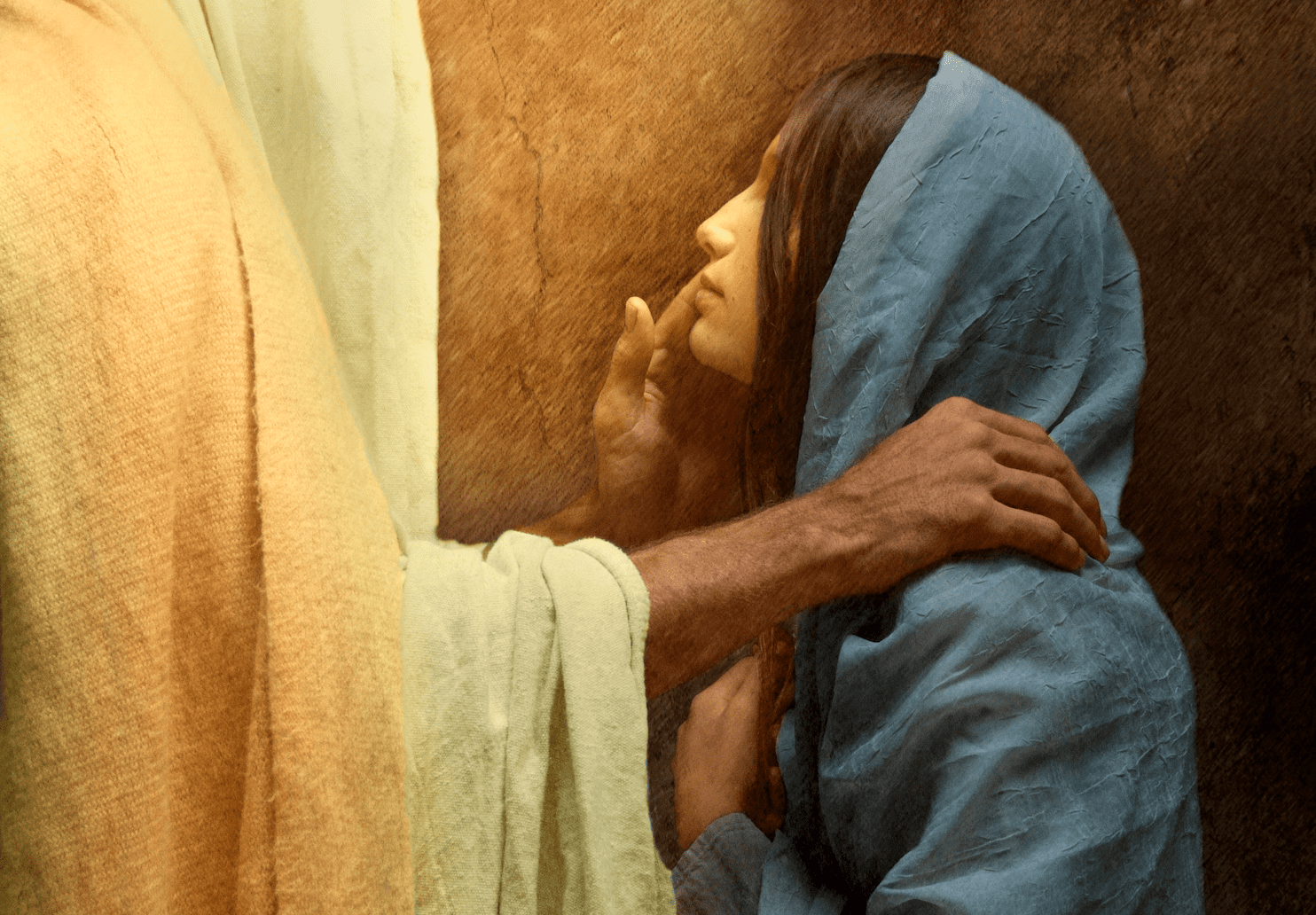
This week we arrive at the account of Ether the prophet and are privileged to receive some of the most remarkable passages of scripture in our canon.
Moroni, who abridged this portion of the account, notes that he could not write even the hundredth part even of Ether’s account, but that which he shares with us of Ether’s words, his prophecies and his own commentary provides a wonderful illumination into the nature of God and Godliness.
I Give Unto Men Weakness
Even as Moroni documents this incredible account he laments the awkwardness of his ability to write those things he feels and his weakness in performing the work God has asked him to perform.
The dialog between Moroni and God about the nature of human weakness is absolutely wonderful, as we read:
“And if men come unto me I will show unto them their weakness. I give unto men weakness that they may be humble.” (Ether 12:27)
Wow. This means that drawing nearer to God will mean having our weaknesses pointed out by Him. He isn’t going to sugarcoat, ignore or gloss over our shortcomings, but highlight them for us.
Not only that but those weaknesses He points out were a gift He himself provided.
We are certainly not naturally inclined to look at our shortcomings as gifts and yet that is their purpose, to provide the means for us to develop humility and trust, to appreciate more fully the role of Christ in God’s great plan of redemption, His goodness and His grace.
Ultimately, allowing ourselves to acknowledge His hand and power alongside our need provides the spark which ignites the fires of faith in our lives.
Q: How might your weaknesses become a gift in your life to help you draw closer to the Savior?
Seeing With an Eye of Faith

Much of Ether 12 revolves around the nature of faith in God, believing in that which we cannot see.
And yet Moroni also speaks of those things we see with an “eye of faith”.
As we discussed this together, it became apparent that faith is very much about where we look and how we envision God in our lives.
Throughout the scriptures we find many instances of individuals looking with an eye of faith including:
- Those Israelites willing to look upon the brazen serpent and be healed
- Peter walking on water as he looked to Christ
- Nephi after being bound upon the ship, noting that he looked unto God
- Looking upon the Liahona to read the Lord’s direction after repenting
- In Lehi’s vision, those willing to look upon the tree of life without paying heed to the derision of those in the great and spacious building
- The Lamananites in prison with Nephi and Lehi turning towards the light
- The condemned Nephites looking forward to Christ’s coming
- The Nephites at the Temple looking towards the voice at Christs coming
- The brother of Jared looking to Christ to touch the stones he had brought

Where we focus our spiritual sight means a great deal.
- Are we finding ways to un-distract our minds such that we can look and consistently see God’s hand and goodness in our lives each day?
- Do we see ourselves as children of loving Heavenly Parents who desire our joy with an intensity and longing we can scarcely fathom?
- Do we look to Christ with the trust to allow His atoning power to help us change and become more like him, as we face our mortal weakness?
- When we close our natural vision in prayer, how wide do we seek to open our spiritual apertures to the Savior’s light to envision His love and sacrifice and to trust in the promises and covenants God has made?
With each of these exercises in faith, in looking, feeling and drawing nearer to God bit by bit we find that His power in our lives is strengthened and grows.
As we begin to taste of the fruits of faith we find ourselves filled with the joy and light described by Lehi partaking of the fruit of the tree.
Hope as an Anchor

This sensation of goodness, edification, knowing that we can find redemption and purpose in God’s light is what fills us with hope.
We come to understand that whatever difficulty we may encounter or darkness we may be called upon to confront, nothing can take away the power and promises of Christ’s coming and the fulfillment of His mission on our behalf.
This is what Job described as he claimed that even in death, he knew he would rise and see his Redeemer again. (Job 19:25-27)
It’s what Paul described when we wrote that nothing we could suffer would be able to separate us from the love of God which is in Christ Jesus our Lord (Romans 8:35-39)
No wonder Ether wrote: “…hope cometh of faith, maketh an anchor to the souls of men, which would make them sure and steadfast, always abounding in good works, being led to glorify God.”
When our minds our truly focused on the hope of salvation, there is little that can distract or derail our determination to exult in God’s goodness even as we continue to pursue that course which will bring us to the greater light and truth of a life focused on Christ.
That they Might Have Charity
Christ instructed Moroni that “faith, hope and charity bringeth unto me–the fountain of all righteousness.” (Ether 12:28)
Having experienced the joy of redemption and hope in Christ we find ourselves desirous to share it so that others might come and partake. This unconditional love we come to feel comes to us and through us from Christ himself.
One of the most telling scriptures in this section is in verse 35-36 where Moroni worries that because of their (the Nephites’) weakness in preparing these words, we (The Gentiles) might not have charity and would in turn lose the blessings and gifts that come of living with Christ’s perfect love. So He prays for God to lend us grace that we might have charity.
The Lord’s reply was that, as wonderful as Moroni’s heartfelt prayers on our behalf were, it is up to us to learn, find and develop this greatest of gifts in our lives, our homes, our communities and our nations.

The Land of Promise
The remainder of the record contains two stories revolving around the covenants associated with the land of promise.
In Ether 13:2 we learn that the land which the Jaredites, Nephites and Gentiles inhabited was dedicated as a choice land from creation and that all who dwell there should serve Him.
The first story plays out in the remainder of the Book of Ether as we read of the destruction of a people who would not learn faith to repentance, hope in redemption nor charity for their brothers and sisters. Hatred and despair, revenge and hopelessness feed on themselves in a vortex that leaves nothingness in its wake.
The second story is that of a New Jerusalem to be established among a Zion people who are one in heart in the land of promised. We read that this would be built in fulfillment of the Lord’s covenants with the remnant of the seed of Joseph who would be preserved.
In our nations and the world over this kind of unity may feel like a distant dream at times, but let us take hope in this wonderful prophecy of Ether.
“And then cometh the New Jerusalem; and blessed are they who dwell therein, for it is they whose garments are white through the blood of the Lamb; and they are they who are numbered among the remnant of the seed of Joseph, who were of the house of Israel.
And then also cometh the Jerusalem of old; and the inhabitants thereof, blessed are they, for they have been washed in the blood of the Lamb; and they are they who were scattered and gathered in from the four quarters of the earth, and from the north coutries, and are partakers of the fulfilling of the covenant which God made with their father, Abraham.”
(Ether 13:12-13)
This is ultimate promise of redemption, the fulfillment of our labors to gather Israel from every part of the earth and the hope we share that we might become one in Him.
As people who have embarked on this covenant journey, we have a ways to go and work still to do.
Yet pursued each day with an eye of faith and hope in all of God’s wonderful promises the day will arrive where we shall know as we are known and see eye to eye with hearts brim and overflowing with a charity that will endure through prayer and never fail.
The Brother of Jared’s Prayer Teaches Us to Access Divine Power

Cover image via Gospel Media Library.
There are unnumbered treasures in the Book of Mormon! In 2005, I published a series of thirteen articles about the ways that great book of scripture acts as a latter-day corrective—from teaching us about such subjects as personal revelation and caring for the poor as well as keeping records and avoiding contention. The book is a priceless latter-day blessing! I cherish the book for all the ways it blesses us.
Yet there is one reason above all others that the Book of Mormon is priceless gift: It gives us a front-row seat on the process of redemption! It allows us to see transformation and it teaches us the process for transformation. And it describes the process enough times to make it perfectly clear. If we apply the book’s lessons in our lives, we will find ourselves growing closer and closer to God.
King Benjamin was the first Book of Mormon prophet who launched my understanding of the process of transformation.
And they had viewed themselves in their own carnal state, even less than the dust of the earth. And they all cried aloud with one voice, saying: O have mercy, and apply the atoning blood of Christ that we may receive forgiveness of our sins, and our hearts may be purified; for we believe in Jesus Christ, the Son of God, who created heaven and earth, and all things; who shall come down among the children of men. (Mosiah 4:2)
Benjamin defines what we must do. When we recognize our dependence on God and call on Him for mercy, the process of redemption begins in earnest. Even before I fully understood the doctrine, I felt that Benjamin’s magnificent speech was a master class in spiritual transformation.
But it is one thing to know the doctrine; it is quite another to fully apply it. Somewhere in my mid-forties, I found myself disgusted with my failure to make spiritual progress. I had tried all the things I could think of to be a better person but I kept being stupid! And I hated it! So, in desperation, I decided to follow Alma’s example at a time of spiritual failure. I found a quiet place, laid on the floor, and cried out,
O Jesus, thou Son of God, have mercy on me, who am in the gall of bitterness, and am encircled about by the everlasting chains of death. (Alma 36:18)
And God shocked me! I thought He would whisper, “Look Wally, you’re a mess. But I love you and if you try harder than ever, I will eventually embrace you.”
That’s NOT what He said or did! No! To my astonishment, as soon as I said Alma’s words, I felt engulfed in His love! I was overwhelmed by His grace. My mind protested, “You can’t do that! You must make me prove my faithfulness before you can embrace me!”
It seemed foolish to tell God how to do His work. And with reflection, I came to understand Alma’s pattern. He went from being the vilest of sinners to feeling the presence of God (Alma 36:22). When we empty ourselves of ourselves and throw ourselves on the merits, mercy, and grace of Jesus, He cleans us. And when we are humble and clean, He comes in and abides with us.
Alma’s story of conversion is an incredible gift to us! This late-in-life description of his transformation encapsulates the wisdom of his lifetime of spiritual tutoring from God. And as if that were not enough, the Book of Mormon provides Alma the father’s account of his son’s transformation (Mosiah 27) so that we can see conversion from the inside and the outside.
Later, I was surprised to see the same pattern with Nephi. We usually think of Nephi as squeaky clean. But Nephi was burdened by his failings—even his sins!
Nevertheless, notwithstanding the great goodness of the Lord, in showing me his great and marvelous works, my heart exclaimeth: O wretched man that I am! Yea, my heart sorroweth because of my flesh; my soul grieveth because of mine iniquities.
I am encompassed about, because of the temptations and the sins which do so easily beset me. And when I desire to rejoice, my heart groaneth because of my sins; (2 Nephi 4:17-19)
But one phrase changed everything for Nephi: “Nevertheless, I know in whom I have trusted” (2 Nephi 4:19). Trusting Jesus changes everything!
Nephi rejoices when he turns his hopes to Jesus rather than himself. The Book of Mormon teaches us clearly and repeatedly that spiritual self-reliance is folly. We must throw ourselves on the merits, mercy, and grace of Him who is mighty to save.
Wherefore, how great the importance to make these things known unto the inhabitants of the earth, that they may know that there is no flesh that can dwell in the presence of God, save it be through the merits, and mercy, and grace of the Holy Messiah. (2 Nephi 2:8)
Along my life journey, A. Theodore Tuttle’s family shared his talk to the brethren about the atonement. I was inspired by his talk! I was amazed! When I reread it, I realized that the great insights he shared were almost entirely passages from the Book of Mormon. As part of his talk, he lists some of the great atonement chapters in scripture. In his accounting, seven out of nine of the great scriptural atonement chapters are in the Book of Mormon.
Line upon line, I kept understanding the Lord’s doctrine of redemption more fully. For example, I rejoice in Ammon’s remarkable statement of the joy we feel when we are partnered with God.
I do not boast in my own strength, nor in my own wisdom; but behold, my joy is full, yea, my heart is brim with joy, and I will rejoice in my God.
Yea, I know that I am nothing; as to my strength I am weak; therefore I will not boast of myself, but I will boast of my God, for in his strength I can do all things; yea, behold, many mighty miracles we have wrought in this land, for which we will praise his name forever. (Alma 26:11-12)
Ammon is a great model of something far better than self-confidence: God confidence!
There are so many other teachings and examples of redemption in the Book of Mormon! In my view, the central message of the Book of Mormon is that we must look to Jesus for redemption.
The Book of Mormon prophet who continues to stretch my understanding of how to draw heavenly power into my life is the brother of Jared.
His story is unique in sacred history. He went from a three-hour chastening from the Lord “because he remembered not to call upon the name of the Lord” to entering the divine presence (Ether 2:14) in unprecedented ways (Ether 3:15). What happened between the chastening and the heavenly encounter? That’s an important question! What happened can teach us essential principles for approaching God.
I have studied his prayer in Ether 3:2-5 with great interest. I think I see a pattern that can guide us in special prayers.
Context:
O Lord, thou hast said that we must be encompassed about by the floods. (v. 2)
Behold, O Lord, thou hast smitten us because of our iniquity, and hast driven us forth, and for these many years we have been in the wilderness; (v. 3)
Approach:
thou art holy and dwellest in the heavens (v. 2)
O Lord, that thou hast all power, and can do whatsoever thou wilt for the benefit of man; (v. 4)
Declaration:
O Lord, and do not be angry with thy servant because of his weakness before thee; for we know that, and that we are unworthy before thee; because of the fall our natures have become evil continually; (v. 2)
Cry for Mercy:
O Lord, look upon me in pity, and turn away thine anger from this thy people, (v. 3)
Plea for Divine Help:
O Lord, thou hast given us a commandment that we must call upon thee, that from thee we may receive according to our desires. (v. 2)
thou hast been merciful unto us. (v. 3)
Behold, O Lord, thou canst do this. We know that thou art able to show forth great power, which looks small unto the understanding of men. (v. 5)
I have tried to tidy the brother of Jared’s prayer and have added my own rejoicing. The result is something like this:
- Father, Thou art holy and dwellest in the heavens. Thou art glorious beyond description and gracious beyond comprehension. I stand in awe of Thy goodness. I am immeasurably grateful that Thou hast revealed Thyself to us.
- Because of the fall my nature has become evil continually. I am a mess and I know I am. I make no pretense of deservingness. I come to Thee in desperation.
- Look upon me in pity. Turn away Thy wrath. Oh, Lord, have mercy on me! I am desperate for Thy heavenly gift.
- Grant according to my righteous desires.
The brother of Jared’s pattern is especially useful for turning crisis into revelation. I think I discern a strong correspondence between these four elements and the advanced form of prayer taught in sacred places. In fact, I suspect that God chided the Brother of Jared for not praying, not because he neglected prayer altogether, but because, in a time of great need, he had failed to use what God had taught him about powerful prayer in his endowment.
I should acknowledge that the brother of Jared’s prayer may not be appropriate for opening sacrament meetings. But it is appropriate for opening the heavens. It is the way I begin every day. It is also the prayer with which I approach Him when I make special requests of heaven.
The core doctrine of the Book of Mormon is:
He doeth not anything save it be for the benefit of the world; for he loveth the world, even that he layeth down his own life that he may draw all men unto him. Wherefore, he commandeth none that they shall not partake of his salvation. (2 Nephi 26:24)
What a reassuring message! What a powerful invitation! We are not beyond His reach! We are not alone in a challenge course that demands more than we can give. Rather than despair at our weakness and fallenness, we should embrace the Book of Mormon pattern to come to Him relying wholly on His merits. That choice will offer the priceless gifts of transformation, redemption, and an enduring relationship with God.
Invitation to Share Gratitude!
This season, build the spirit of gratitude in your family and among your friends by sharing an extraordinary book. God’s Trophies is a heartwarming children’s tale about Rupert learning gratitude for all of God’s creations. Rupert’s whimsical adventure also teaches children that they are each God’s most beloved creation. Wonderful illustrations accompany the clever story. This book would make an excellent holiday gift for special people in your life. For the holiday season, I am offering five copies of God’s Trophies—a $67.50 value—for $25 with free shipping in the US.
To get this special offer, CLICK HERE
Thanks to Barbara Keil for her valuable refinements of this article.
The Brother of Jared portion of this article is adapted from my article Higher Forms of Prayer, previously published by Meridian Magazine.
A Letter To My Fellow Perfectionists

The following first appeared on Public Square Magazine.
I was sitting in the temple not too long ago, feeling overcome with the stresses of life, wondering if I would ever be “good enough.” As I went through an endowment session that day, I learned a valuable lesson—we’re not “good enough,” and that’s kind of the point.
Now, before you come at me with your metaphorical pitchforks, let me elaborate on what exactly I mean.
Too often, we conflate being “good enough” with “doing enough.” The reality is that we will never be able to do enough to save ourselves and return back to the presence of God. As Heavenly Father conveyed to Adam and Eve after they partook of the fruit, “dust thou art, and unto dust thou shalt return.” Additionally, King Benjamin told his people, “I say, if ye should serve him [God] with your whole souls, yet ye would be unprofitable servants.”
Maybe we understand on a conceptual level that we will never achieve the highest degree of glory without the grace of Jesus Christ. However, knowing something cognitively is different than truly feeling something within your soul.
Knowing something cognitively is different than truly feeling something.
I know better than to speak for all perfectionists. Truthfully, I can only speak to my own experience. I know that God does not expect perfection of me. However, too often, I have found myself still functioning as if I am playing catch-up against a never-ending deficit. Then I wonder why I feel as though I am constantly failing, why the to-do lists are stacking up higher, and why I will never feel “good enough.”
Unbeknownst to me in those times, I am unintentionally trying to earn my way to heaven. God has not expected perfection of me, but in a very real way, I have expected it of myself. The irony of expecting more of myself than God does is not lost on me here.
Perhaps this is why it can feel like I am anxiously running a race against a clock that is not actually there. In a BYU devotional, Brad Wilcox made the comment:
Too many are giving up on the Church because they are tired of constantly feeling like they are falling short. They have tried in the past, but they always feel like they are just not good enough. They don’t understand grace.
He continues later in the talk,
… Grace is not a booster engine that kicks in once our fuel supply is exhausted. Rather, it is our constant energy source. It is not the light at the end of the tunnel but the light that moves us through the tunnel. Grace is not achieved somewhere down the road. It is received right here and right now.
As I have been thinking about grace and my own misunderstanding of it, scrolling on Instagram one day, I saw a particular message, and it stayed with me as I reflected on my own relationship with Christ. The prompt goes something like this: Do you need to be clean to get in the shower?
The perfectionist might answer “no” almost immediately, but upon further reflection, may recognize their own propensity to shuck off as much mud and gunk as they can before they (metaphorically) get in the shower. The perfectionist’s thought can go something like this: “I know that I need to come to Christ, but before I do that, lemme do this one thing first, and then I’ll go to Him. Maybe I won’t even need to bother Him because I already figured it out.”
What I have personally failed to acknowledge is that if I would just get in the shower, if I would just allow myself to experience, to feel in my soul, the Atonement of Jesus Christ, I would become the person that I am capable of being. Christ does not need me to ‘get clean’ before I approach Him, that is the very purpose He is there.
But shame is the power by which perfectionism is run, and it is not so easy to let go of, even if I know it is actually quite ineffective in motivating people. It can feel shameful to rely on other people, even Christ. Even though I know it is not true, it often feels like I should be able to do it by myself, and I’m a burden if I cannot.
However, we can develop the ability to recognize that we do not need shame to approach Christ in our imperfections. In the beginning, we were provided with a Savior because Heavenly Father knew that we would fall short, not because He wanted us to live in the shadow of an impossible standard. As Elder Holland has said:
… except for Jesus, there have been no flawless performances on this earthly journey we are pursuing, so while in mortality, let’s strive for steady improvement without obsessing over what behavioral scientists call “toxic perfectionism.”
While I can appreciate the succinct way in which Elder Holland dismantled “perfectionism” in this conference address, shame is a difficult beast to shuck.
As a sort of antithesis to shame, faith may become something helpful to cling to. I do not refer to ‘faith’ here as a throw-away answer like “just have more faith” or “pray it away.” This is not helpful discourse.
I am referring to faith here as trust and, by extension, genuine vulnerability before Christ. When we talk about putting something on the altar, we talk of surrendering ourselves to Him. The act of surrendering is the ultimate act of faith.
Shame is the power by which perfectionism is run.
While it is not easy to give of ourselves, our talents, and our time, I would postulate that it can be easier to give of those ‘positive’ things than to surrender the ‘ugly’ parts. I have probably clung more fervently to my own experience of anxiety because it feels like an unworthy thing to offer up to Christ. Certainly, I am more willing to surrender other attributes or talents that feel better to put on display or give over.
So, what does it mean for us to offer our shame, our pride, our guilt, our anxiety, and our depression to Christ? What does it mean to feel like you have no worthy gift to give and yet give it to Him anyway? What does it mean to surrender all upon His altar?
In Luke, we read the story of the widow’s mite:
And he looked up and saw the rich men casting their gifts into the treasury. And he saw also a certain poor widow casting in thither two mites. And he said, Of a truth I say unto you, that this poor widow hath cast in more than they all: For all these have of their abundance cast in unto the offerings of God: but she of her penury hath cast in all the living that she had [emphasis added].
Christ will not turn us away in our penury or in our brokenness. In fact, He wants us to approach Him in our weakness. He says, “Come unto me, all ye that labor and are heavy leaden, and I will give you rest,” and further states, “My grace is sufficient for all men that humble themselves before me; for if they humble themselves before me, and have faith in me, then will I make weak things become strong unto them.” Our Savior does not look at our comparatively ‘meager’ offerings, like the widow’s mite, and tell us we are not enough. He takes our offerings, whatever they may be, and He calls us His.
In a recent conference address, Elder Kearon added further to this idea. He said,
… our Father’s beautiful plan … is designed to bring you home, not keep you out. No one has built a roadblock and stationed someone there to turn you around and send you away. In fact, it is the exact opposite. God is in relentless pursuit of you [emphasis in original].
He continues,
If you are prone to worry that you will never measure up or that the loving reach of Christ’s infinite Atonement mercifully covers everyone else but not you, then you misunderstand. Infinite means infinite. Infinite covers you and those you love [emphasis in original].
The fact is we are not meant to do this life alone. We are not meant to be “good enough,” and we quite literally cannot “do enough.” We are meant to rely on the strengthening power of the Atonement of Jesus Christ. We are meant to turn to Christ and be perfected in Him. I can admit that it feels hard to wait on the Lord, to be patient in becoming whole. However, as Brad Wilcox once said at a devotional: “Time is the medium through which the Atonement of Jesus Christ is made manifest in our lives.” So be patient, let go of your shame and perfectionism, offer the things that feel unworthy, get in the dang shower, and let Christ help you become whole. Know that I am attempting to do the same. It may take time, but we have the assurance that it is worth it.
FEATURES