










Season 5 of “The Chosen” called “Last Supper” will begin streaming on Prime Video on June 15, 2025. Released in three parts over three weeks, they will become available June 15, then June 22 and finally on June 29th. Season 6 is being filmed in large part in Utah.
It is not often that you can say that a film has changed the world, but “The Chosen”, a historical drama based on the life of Christ and the followers who knew him, has found 280 million viewers across the world, many who say their lives have been transformed because they saw the show. The goal is to reach a billion viewers, which is lofty and possible.
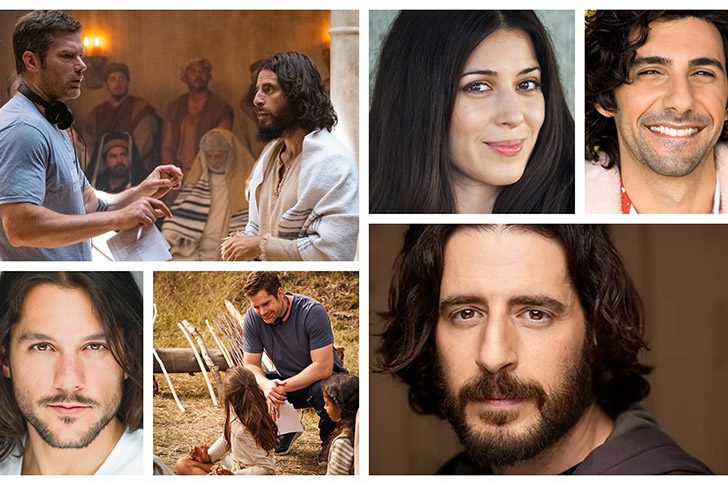 People are ignited about Jesus and they don’t just love the show, they are full-blown supporters who put their money where their hearts are, so that the project is crowd-funded.
Of course, the show has every element of great story-telling as it draws the image of a world oppressed by Romans where Jesus, the Messiah, has come to create a whole new world and a kingdom nobody expected.
Filmed in Utah
For thirty days, this spring, season 6 of this blockbuster is being filmed on the massive Jerusalem set in Goshen, Utah, designed and built by The Church of Jesus Christ of Latter-day Saints. Drive down a two-lane road, in an area largely uninhabited, and then this set that seems like a vision of antiquity arises out of nowhere.
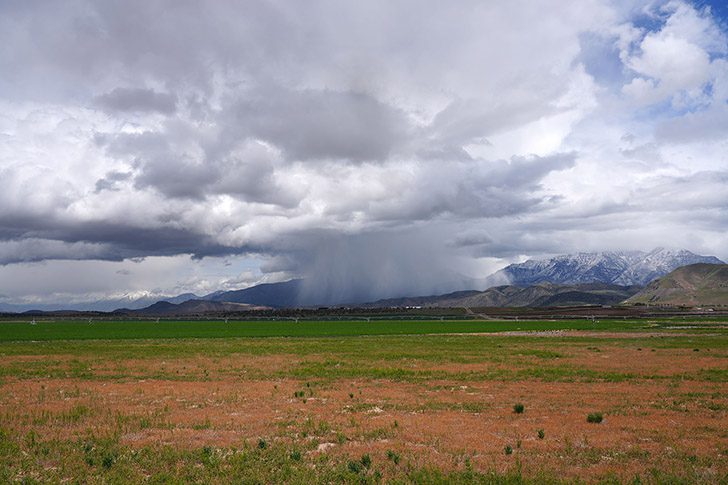
It was a chilly, blustery day when we arrived on set to do a story. We had arrived the day that a scene was being filmed where Christ was carrying his cross, and, under the weight of the agonizing burden he had already carried, stumbles up a set of stairs.
Though most films have little time for rehearsals while a big, expensive crew waits, this crucial scene had been rehearsed and carefully choreographed the day before.
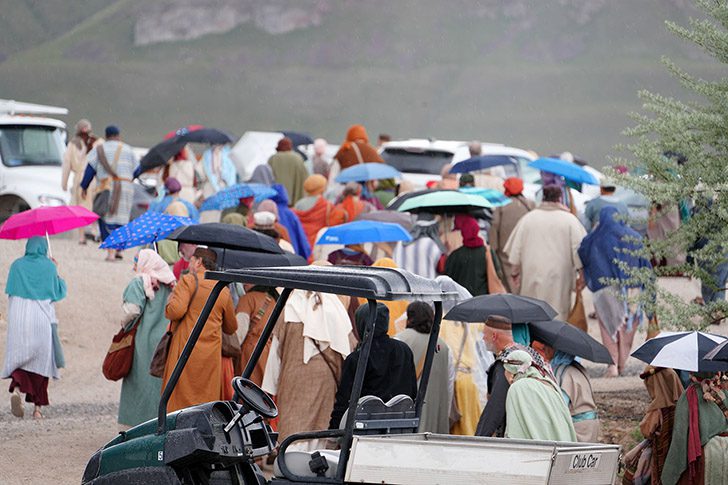
Six hundred extras were on set to play their part as members of the watching crowd. We walked into a tent provided for their meals, where many were sheltering, waiting for their call, and the mood was joyous, full of chatter and good will.
The costumes for this crowd, a normally big expense on a movie set, was provided by themselves and they freely gave their time and paid their own way, some from very far destinations, for the privilege of joining the cast on set, even for a day.

Before they came, they had received a booklet telling them how to costume themselves and what colors would not have been available in the first century. For the filming they took off their watches, left their devices behind, and emerged on the set, thinking all the trouble was worth it to be a part of sending this story to the world.
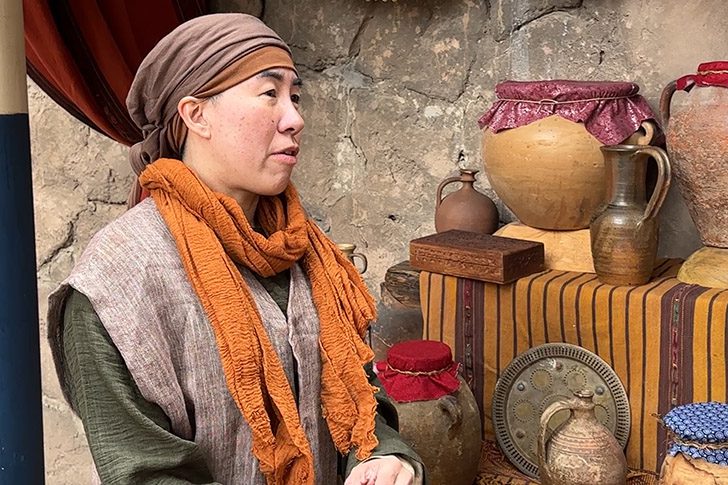
Hannah Teoh came 17 hours from Singapore for her chance to be an extra. “This morning we filmed the scene leading up to the crucifixion,” she said. “It’s a heavy scene where we see Jesus and the two thieves carrying the cross across the town. It was difficult to watch to be really honest. But I think that what I read in scripture is coming to life in a most powerful way. I think about it like yes, these scenes are going to make my heart really heavy and race, but I am seeing victory personified, and that’s exciting to me.”
Hannah began watching the show during COVID and, at first, she was a little resistant to watch. “I said, every faith-based show I’ve ever seen is a little cheesy. I’m not going to watch anything faith-based, but I was bored, so I watched it and it blew my mind. The story telling was refreshing. It reaffirmed so much of my faith that was important to me, and I said to myself, if this is crowd-funded, I am going to back them for sure.
“And I told myself, if ever the opportunity comes up to be an extra, sign me up. I am so glad I get to do this and to open eyes to what a story like this can do on screen. I get to meet people of different faith traditions, but all still part of a big faith family.”
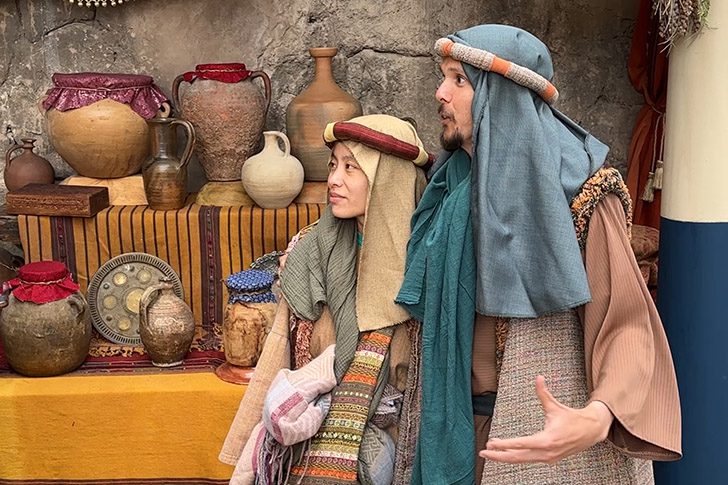
Lucy and Brandon are from Jacksonville, Florida, and they came despite the pressures of getting married soon.
“We are getting married in 11 days,” Brandon said. “We’re super excited about it. The wedding is in Florida. When they heard we were leaving just a few days before the wedding to be in the show, our parents, our vendors, our wedding coordinators are saying where are you going the week before the wedding?” Also, he acknowledged that “my phone has been blowing up all day with the birthday texts. It’s also my birthday.”
Why, then celebrate on the set of “The Chosen” in the occasional rain storm? He said, “I always kind of believed in God, but I didn’t love the religion element of it, so watching “The Chosen” and seeing what we are supposed to do with our lives and how to live and focus on that relationship, that’s what got me really super excited and motivated to read the Bible for the first time, find a local church and become super involved.
“For me, we watched the first episode and I didn’t know who these characters were because I hadn’t read the Bible, so I wasn’t really hooked until episode three—Jesus with the little children. That is what really moved me to want to continue watching, and then it was hard not to binge and stay up super late.”
Why the Success?
Why has “The Chosen” struck such a deep chord with so many? Of course, those who love Jesus are always wanting more. Certainly, in this visual age, where film combines music, scenes well designed like paintings, and the power of storytelling and movement, what may have been a static idea for some suddenly bursts into life and is more accessible on screen.

What works so incisively for “The Chosen” is it helps viewers, through the power of imagination, to visualize scenes and people that we have let stay on the page. Ideally, the historical drama turns people back to the scriptures to understand them again, to probe with more power.
When you think about it, what Dallas Jenkins did, who is the director, creator and co-writer of the show, is an act of creative courage. He took iconic figures like the apostles that we know and love, and then dared to fill in details of their characters and lives with his own imagination. He gave them personalities and back stories, hesitations and imperfections to trip on. He let us see that they have their own fears and that they are given assignments and roles that are much bigger than they originally are.
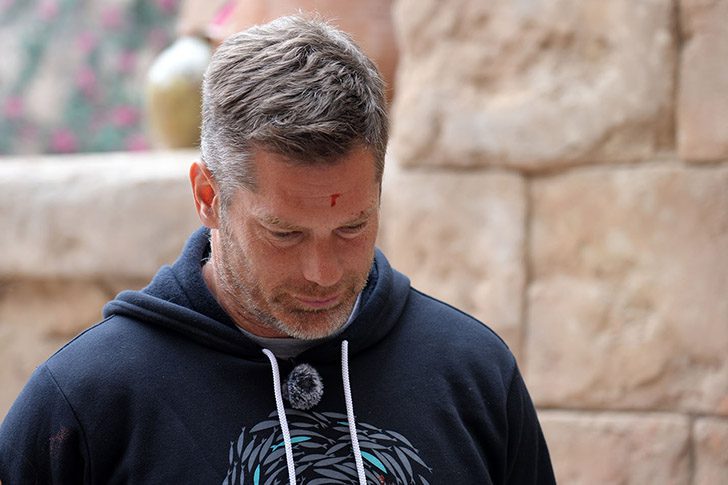
One has the sense that Dallas wasn’t just wondering what Peter or John might have said or done in those biblical events as he wrote the script, but what we as humans, who share characteristics with people in all times, might do or say. Even though the Lord sees them clearly in all their flawed sensibilities and awkward humanness, he loves the men and women who surround him, and teaches them patiently—and sometimes even with a little humor to become more than then ever imagined.
As viewers, we see ourselves there, personally being taught and loved by Jesus. We feel surrounded by the Savior’s love. We want to see more.
There is a moment in one episode, for instance, that stands out to us. Matthew is autistic, talented, and awkward with people, but his skill with numbers has landed him the job of tax collector. This makes him well-off, but despised by his own people, the Jews.
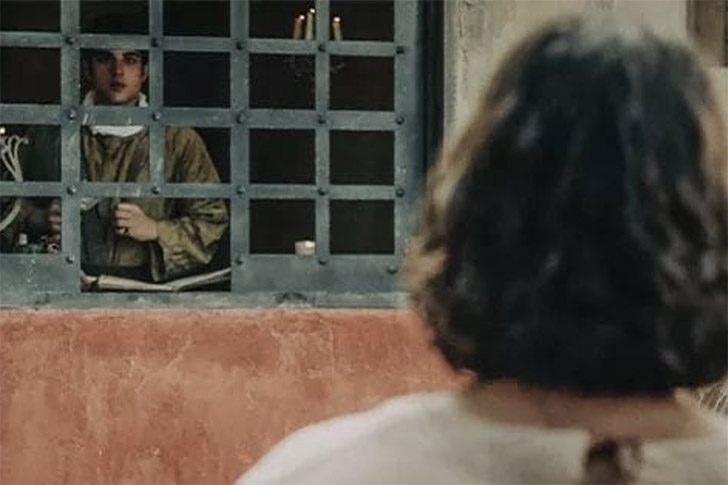
He is standing at his window collecting taxes when he sees that Jesus is on the road, across the way, looking at him with a love that continues for a long time. Matthew can’t believe that Jesus would be looking at him, but in that instant the viewers know that Jesus sees something in Matthew that nobody else can see. Even Matthew can’t see it in himself and looks quizzical like, “Do you mean me?”
The viewer, knowing well how rejected and alone Matthew has been, cannot help but be touched at that moment. We are reminded that the Lord sees us too.
Dallas Jenkins Addresses the Question
So, is it ok to take some of our scriptural heroes and create them into characters? Isn’t it just too much to give Jesus new dialogue?
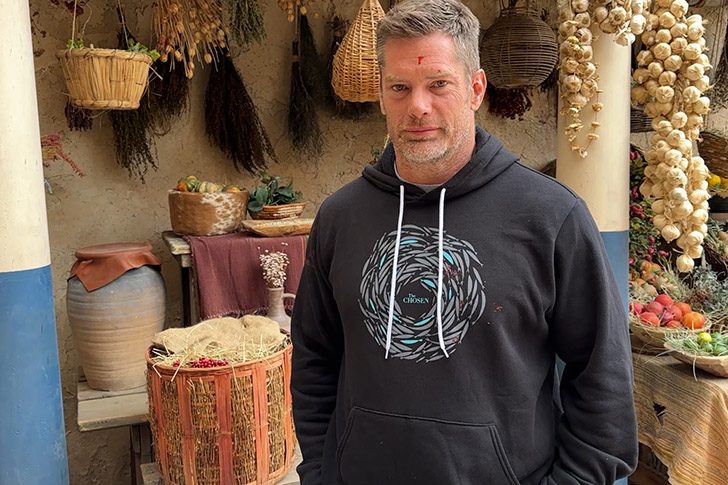
Dallas said, “Throughout history, there have been movies and television shows about historical figures, and I don’t believe that just because the Bible is the current written form of what took place in the first century, it means that we can’t then portray anything else from the first century.
“In this show, we start with the Bible as our primary source of truth and inspiration. We start with the stories of the Bible as our benchmarks for what we are going to be telling, but then we work our way backwards. The gospels weren’t intended to be a record of everything Jesus said or did. The gospel never shows Jesus saying hello, but we know that he must have, though we don’t see it in the Bible.

“We use cultural context such as life would have been like back then. We use historical context—what they would have done at key events like a wedding or a funeral, or a crucifixion even, and then we use human imagination and we recognize the truth that these were human beings, 2000 years ago, and humanity has been the same for 2,000 years as it has been today.
“I think what has resonated with people about the show is that we that we are not treating these people as just words on the page, like just stained-glass windows or paintings. They were human beings and we are bringing them to life.”
Are Some Scenes More Difficult to Create?
Still, season six includes the crucifixion. Isn’t this an extremely sacred matter to portray?
Dallas said, “I think people would assume that this season 6, currently being filmed, has more responsibility because it is the crucifixion season, but we think every aspect of Jesus’s life is important to get right. We have taken seriously and felt a weight and responsibility since season 1.
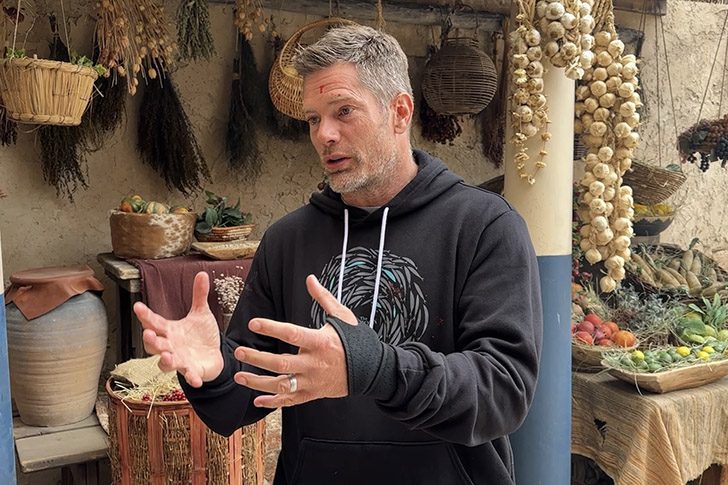
“What’s challenging about this season is that it has a lot of logistics. I mean it is the longest season we’ve ever filmed because we have so many night shoots. We are covering the 24 hours after Jesus’ arrest which takes place at night. Even at the crucifixion, there is darkness for several hours. This season is almost 20 days longer than any season that we’ve ever filmed. It is weighty not just in terms of the emotion, but also in the logistics. It’s going to take some time, but I know that viewers are going to give us a little bit of grace in recognizing that it is important to get it right.”
The Magic of the Jerusalem Set at Goshen
B.J. Forman, the art department coordinator of “The Chosen”, said that the first time he saw the Jerusalem set in Goshen, “it was overwhelming compared to the postage stamp set where we had shot season one.
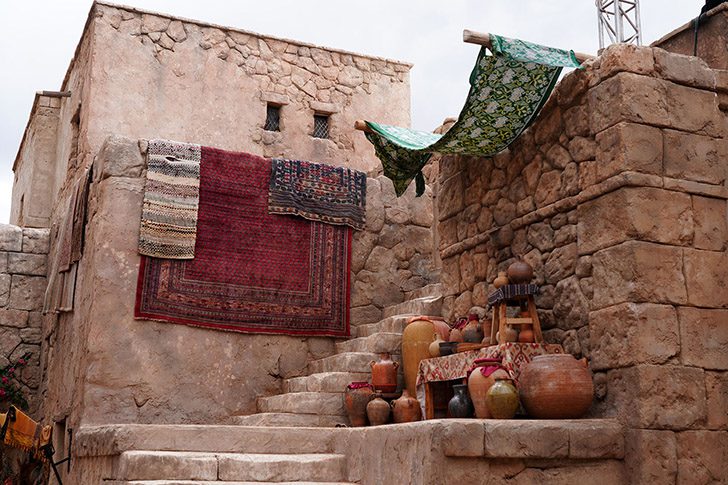
Yet, as gorgeous as it was, it was still a blank canvas, and it was our job to bring it to life. The people from the facility here said, no one has ever used it the way we’ve used it. No one has ever added this much color and texture and life.”
For the Via Dolorosa, those scenes where Jesus is carrying his cross, three locations will be used for six scenes and then stitched together to look like they are seamlessly in one place. Two of them will be shot at the Goshen set, one in Texas and three in Italy.
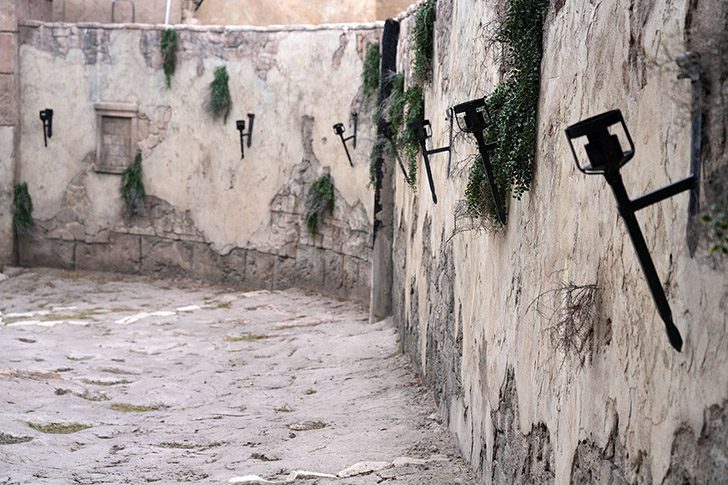
Forman said, “We have actually taken reference photos in Italy and replicated a lot of those elements right here so that the physical vocabulary that we are walking through is the same. Our set back in Texas is the village of Capernaum, so it is much smaller, it has a different color palette, it looks and feels different, so when we shoot these scenes there, we will have to rescale our city to look like a section of Jerusalem.”
Any set has only so much space. Using it well is an art born of necessity. “We have only so many square feet of space and we have to be creative to think about what we are going to use this neutral space for. We actually used a lot of the same sets over and over again for some pretty pivotal moments, but because the camera has a relationship with each set, and you put the focal point in a different spot, the audience doesn’t realize you are standing in the same piece of real estate.
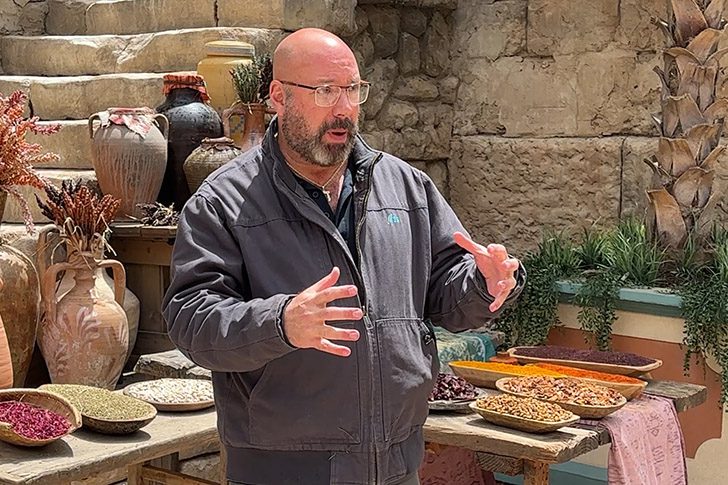
“In season one,” Forman said, “Mary’s bedroom where it was ransacked, Matthew’s bedroom where it was stunning and Shimei’s office were all the same room.”
Forman said, “The way our team works is fascinating. From start to finish everything is inspired by the text, what the writers envision, whether it is based on fact, whether it is based on fiction, if it is just an idea, we’ll go in and start to find, did these places really exist? What was the landscape? What did it look like? What did it feel like? What color was it?
“Whatever we can find from ruins or whatever information James Cunningham, our Production Designer can find, he compiles into his own paper work, in his notes, and then he begins to describe it. In our office we have a concept artist who will take those words that are coming to him and start to sketch the actual space. Sometimes it’s based on a real piece of real estate and we’ll take that as the base and then build our show on top of that, but sometimes we are creating from scratch.”

Yet, for any historical drama, a question lingers and we asked Forman, “How do you know you are capturing what Jerusalem and other places in Jesus’s life really looked like?
He admits, “We don’t. People say to me ‘Oh, you’re working on that Christian show.’ And I say, ‘No, I am actually working on a Jewish show and we have no records of what anything looked like. There were no idols, there were no paintings, there were no physical representation of what the world looked like back then. It’s all the written word. We are just doing our best to create a world that both fits the needs of the script and doesn’t make any historian, get upset and write us a nasty email.
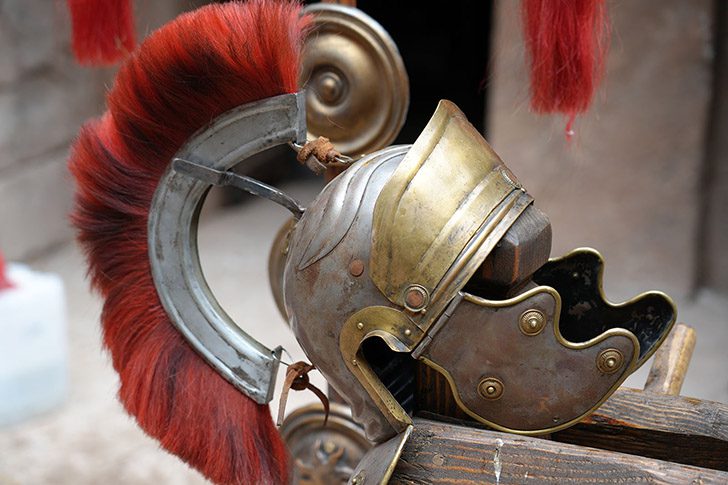
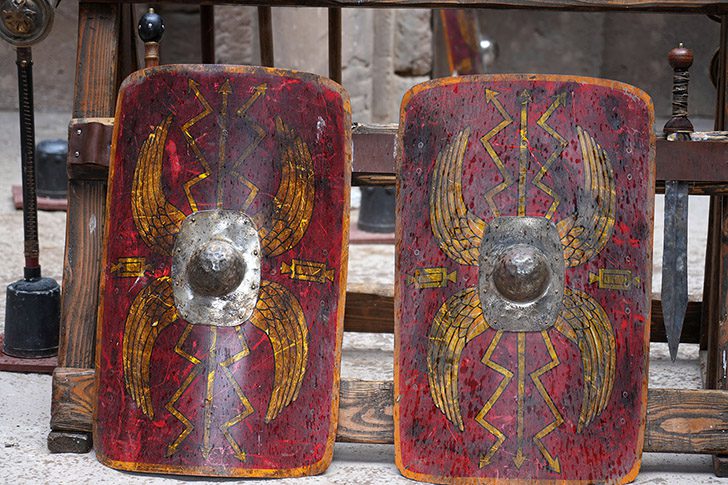
“The Romans had a more visual history. In one of our sets, there is a neighborhood with actual Roman grafitti copied from that time period. The Roman paraphernalia is all based on ruins we’ve actually found. We do as much research as we can to reflect the time period and color palette. It is great to come here to Goshen and have this amazing stone work on the walls to work with.”
To illustrate how tricky it is to get the background as accurate as possible, Forman said, “Think of the Last Supper. Immediately what comes to mind is DaVinci’s painting, so that’s what we think it looks like. If you look at the texts, however, it doesn’t look quite like that. To give the viewers an idea about how people might have sat around a table, we actually set up a similar banquet two episodes before the Last Supper. It was a three-sided table called a triclinium. In actuality, they were probably reclining at the last supper, but to lie down for a week’s filming would really be painful.”
The art department for “The Chosen” is very particular about the look they finally get and Forman said that when they look at the monitor and see the footage, it is the most rewarding moment when they say, “that’s it.”
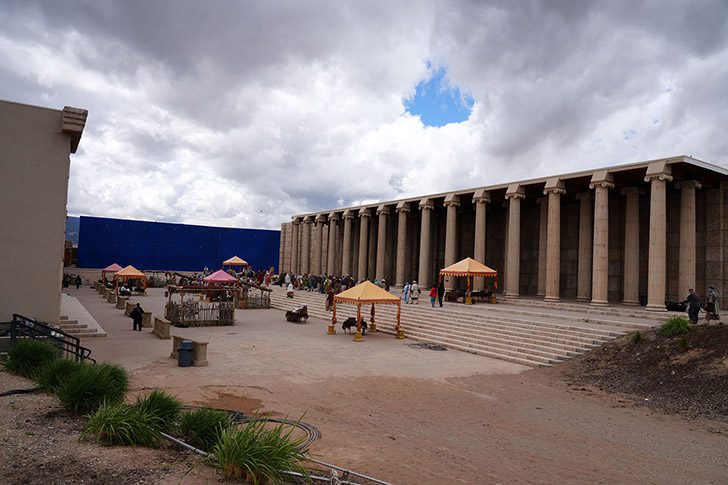
We would have loved to stay basking in the goodwill of the people behind this production on our day on set, but suddenly a promising break occurred in the wind, and the extras were hurried on to the set. They walked quickly, almost running, to their positions where they were about to become the audience for a re-creation of the most pivotal moment in history—Christ on his way to Calvary.

For all of us millions who weren’t there so long ago, we still have a front-row seat through the power of film of the magnificent gift that Christ gave us.



Traci WalkerJune 3, 2025
Oh Scot and Maurine, Thanks for taking us along with your pictures and words! They provide a precious new angle on this much-loved series about Jesus. Who knew that our church would be providing exactly the realism that was need on the Jerusalem set? He did! Continuing revelation is such a gift.
Judith La MontagneMay 30, 2025
I very much appreciate the great importance you have shown in "getting it right" in your series. This series will be undying. Our family here in Iowa are some of your biggest fans. We belong to the Church of Jesus Christ of Latter-day Saints and very much appreciate your outstanding efforts to "get it right." It was obviously no accident that our Church built this Jerusalem set several years ago! Thank you so much for the tremendous detail work you have put into this series!