





During his ministry, Jesus Christ fed 5,000 people with five loaves and two fishes. The food He provided filled them physically, shortly after He had filled them spiritually. On July 13, 2025, another group gathered together to experience a spiritual feast, one 5,000 performances in the making.
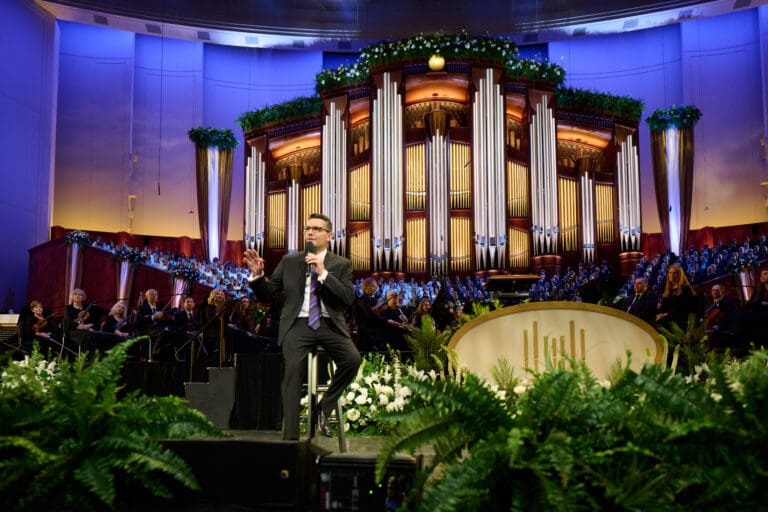
The Tabernacle Choir at Temple Square performed their 5,000th uninterrupted broadcast yesterday on July 13, 2025, almost 96 years to the day from their first ever broadcast on July 15, 1929. The first broadcast required a young announcer, Ted Kimball, to climb to the top of a ladder with a microphone, allowing the audio broadcast to be heard across the airwaves of the state. Since then, technology has improved exponentially, allowing more than 6 million viewers the opportunity to watch the broadcast live through television and online streaming.
The choir was originally formed to sing at a conference in the Salt Lake Valley on August 22, 1847, 29 days after the pioneers first arrived. Brigham Young requested John Parry, a pioneer from Wales, to prepare a choir for the conference. Parry organized a small group of singers into the choir, a decision that would lead to more than 170 years of music and nearly 96 years of broadcasting. Originally known as the Mormon Tabernacle Choir, the choir changed their name to The Tabernacle Choir at Temple Square to better align with its sponsoring organization, The Church of Jesus Christ of Latter-day Saints.
The choir performed religiously every week, singing throughout The Great Depression and World War Two. They helped the United States heal following the 9/11 terrorist attack and brought hope during the COVID-19 pandemic through their voices and message. They have performed for presidential inaugurations in the United States and royalty in foreign nations, all while sharing a message of peace, hope, and love of God.
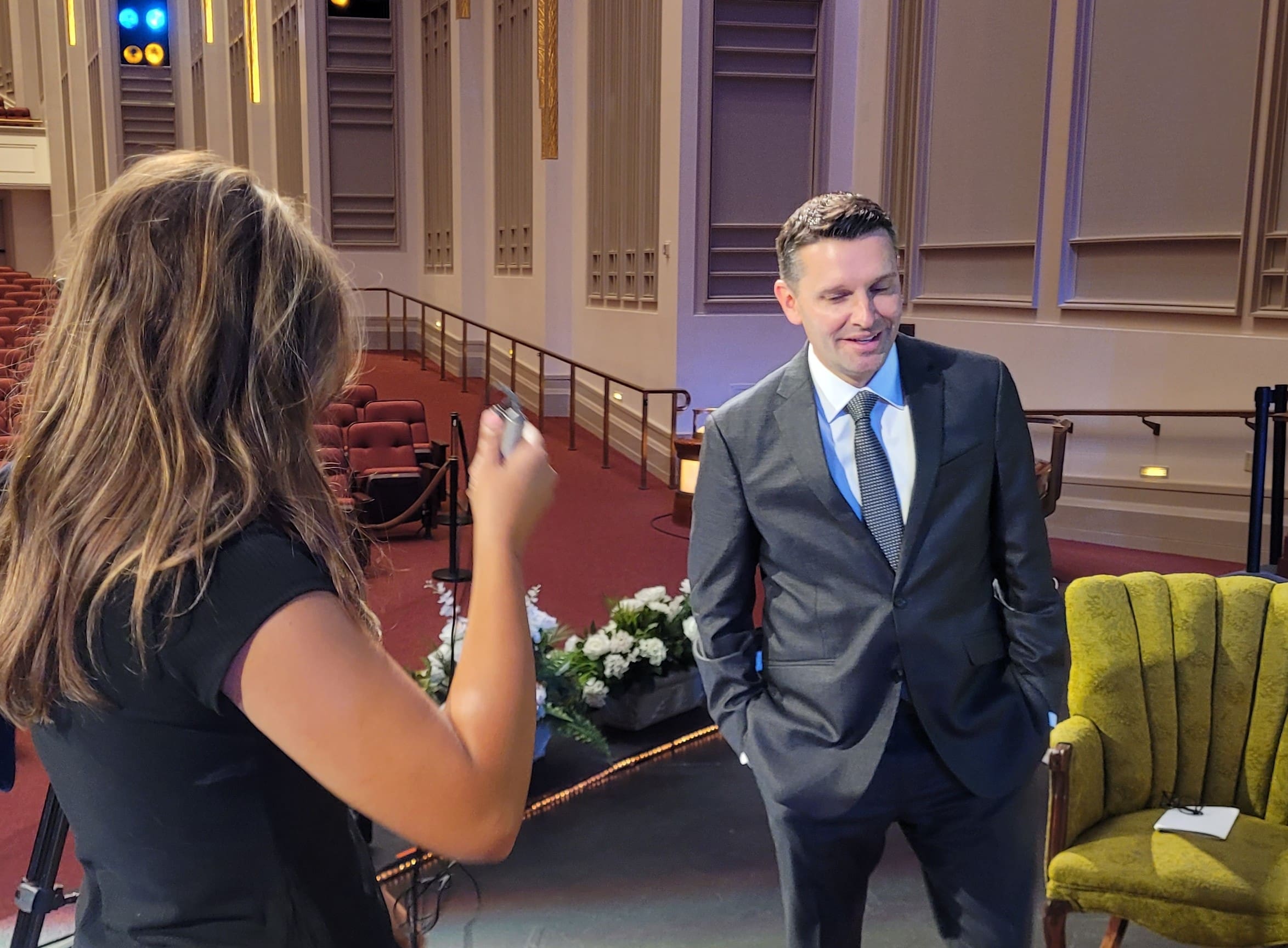
Derrick Porter, executive producer and current host of Music and The Spoken Word, shared the experience of someone who remembered the first ever broadcast when she was a little girl. “My aunt sat me down with my sisters and said ‘Something special was about to happen,’” Porter shared. “And then she added, ‘And I still watch today.’”
Audiences have tuned into the performances from around the world. One listener who was stationed at the South Pole in Antarctica during a research trip many years ago connected with the producers of Music and The Spoken Word, requesting that they would begin broadcasting there. Another listener heard songs from the choir as he mounted Mt. Everest.
These and more than a thousand other listeners sent in stories and personal experiences that they had while listening to Music and The Spoken Word.
“When you read them, they read as a book detailing out again the impact that this program has made the world over,” Porter explained.
Mack Wilberg, Music Director for The Tabernacle Choir at Temple Square, has been with the choir since 2008, conducting more than 1600 broadcasts. “It never gets old from week to week,” he shared. “I’m always excited about what’s coming… it’s a great joy and again, a blessing to be involved.”
Michael O. Leavitt, President of The Tabernacle Choir at Temple Square, grew up listening to the choir when he was a young boy in Cedar City. “Part of our Sunday morning ritual was to have Music and The Spoken Word on,” Leavitt shared. He had never expected to be a part of the choir, but reflected that several unique parts of his own personal experiences helped shape him to bring something to help support the choir.
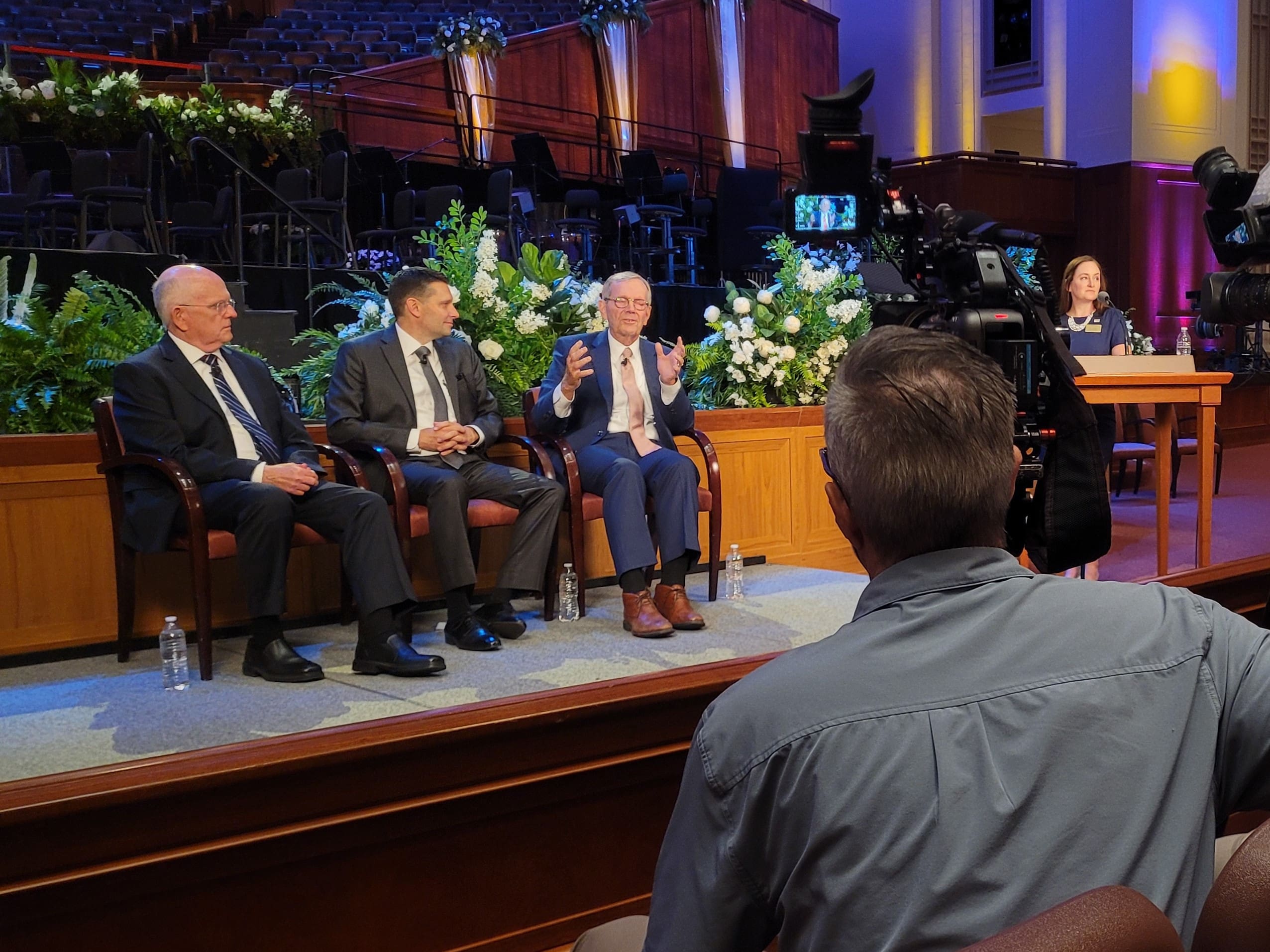 One major point shared by the three was the fact that the performances and broadcasts were not about them. Despite their very visible positions with the choir and key roles in the broadcast, they all highlighted that this production was bigger than themselves.
“My job is nothing more than to translate feelings and impressions that come from heaven into words that can be of benefit to any who might hear or read or watch our broadcast,” Porter said.
“It would be impossible to duplicate 360 voices and 80-90 in the orchestra from week to week,” Wilberg said. “The only way you can do that is with everybody coming together and bringing their time and their talents. It’s really a collective effort.”
“I think at this point where we’re spending out time is building the audience and improving the quality going forward,” Leavitt said. “We want people to hear [Music and the Spoken Word] and be able to relate to it in their own time. We want to expand the number of ways in which they receive it.”
These expansions have allowed more and more people to participate in the spiritual messages and the music. Traditionally, the host would share spiritual thoughts in English, while translators would dub over the host. In 2023, new hosts began sharing messages in Spanish, allowing more listeners to connect with the spiritual messages in their own language.
At the same time, The Tabernacle Choir at Temple Square launched a new initiative to allow singers to apply to sing with the choir for General Conference. More than 70 participants are currently working remotely with the choir to perform during the twice yearly conference of The Church of Jesus Christ of Latter-day Saints.
Before the broadcast, a special pre-show celebration was held at the conference center, highlighting the stories of the orchestra and choir members that performed in the broadcast itself. Following the broadcast, a post-show celebration highlighted many of the stories submitted by listeners, along with sound clips from the first ever recorded broadcast of Music and the Spoken Word, which occurred in 1933.
“There is a treasure trove of history that is being unrolled as we remember where we’ve been, as we recognize where we are, and as we now focus and look to where we hope to go,” Porter said.
During the broadcast, the first song, The Morning Breaks, was chosen in part to mirror the first ever broadcast. “The arrangement we’re doing, it’s not the same arrangement from 1929, but the hymn is nonetheless the same.” Wilberg said. “And the rest of the music is also reinforcing our celebration. We’re singing with our music. God is glorified. There’s not a better message than that.”
During the final song, Wilberg was able to use the baton originally used during the first ever broadcast of Music and the Spoken Word by conductor Anthony Lund. “The family assures us that that was the baton that he used for that first broadcast,” Wilberg explained.
The choir and orchestra practiced together only once before the 5,000th broadcast, three days before the performance. Their regular practice schedule has been more than enough to prepare their voices and song for the world to hear. “That’s one of the reasons why we have to have very proficient musicians who can produce at a very high level,” Wilberg said.
While Porter stressed that the broadcast was not about him, he did have this to share about his emotions during this momentous occasion. “Here on this 5000 week, I think on behalf of the entire Tabernacle Choir and Orchestra at Temple Square and all of those who are associated with us, I stand all amazed. We stand all amazed.”