











When I travel to a new country, I like to study the language before I go. Last year it was Turkish. The year before that, Spanish. Now, I’ve taken up Hebrew. In the process, I’ve become increasingly fascinated by how much theological and symbolic meaning a single word can hold, and sometimes even a single letter.
As I’ve been contemplating Easter while studying Hebrew, I stumbled upon one small connection that struck me with unexpected power: The blood on the doorposts in Exodus 12 and the Hebrew letter ḥet (ח). Together, they point toward Christ, new life, grace, and covenant.
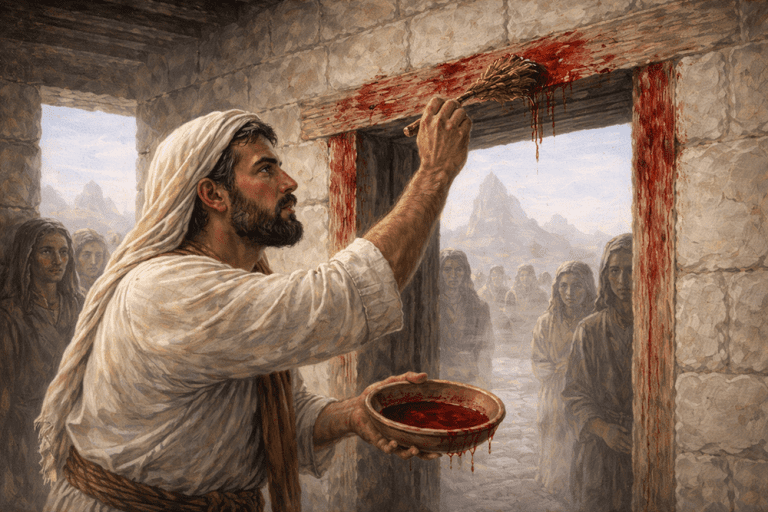
In Exodus 12:7, the Lord instructed the Israelites to apply the lamb’s blood to the two side posts and the upper lintel of their doorframes. That night, when the Destroyer passed, the blood formed a visible sign that marked the household as protected. The pattern–two vertical lines and one horizontal line above–visually resembles the shape of what is now the Hebrew letter ḥet (ח), the eighth letter of the alphabet. In Hebrew numerology, ḥet also stands for the number 8.
It is worth remembering that in Moses’ day the Israelites would not yet have known the Hebrew writing system as we now see it. The script of that period belonged to an earlier Northwest Semitic tradition, often called Proto-Sinaitic or Proto-Canaanite, from which later Hebrew, Phoenician, and Aramaic alphabets developed. In that early script, the ancestor of ḥet resembled a simple fence or wall: two uprights joined by one, two, or three horizontal bars, symbolizing a protected or enclosed space.
Sometime after the Babylonian exile, this letter evolved into the current design of the Hebrew letter ḥet (ח), which, as in its previous form, carries the numeric value 8. Anciently, as now, the letter het was associated with “life,” since it is the first letter of the Hebrew word haim (חיים), meaning “life.” It is also linked with “grace,” because it begins the word hen (חֵן), meaning “favor” or “grace.”
In that sense, the blood-marked doorway in Exodus 12 forms the same basic frame, two sides and a top, that later generations would see encoded in the letter ḥet. The shape of the letter evolved from a letter resembling a protective barrier or wall to one that more closely resembles a doorway. But the sound and the symbolic pairing of life and grace remained, allowing later readers to see the Exodus story through that same lens.
The number eight carries its own scriptural weight. A boy is circumcised on the eighth day, marking his formal entry into the Abrahamic covenant. Eight souls–Noah and his family–were preserved through the flood, symbolizing a new beginning after judgment. Commenting on this, Peter wrote, “The like figure [the number eight] whereunto even baptism doth also now save us” (1 Peter 3:20–21). Since the Lord created the world in seven days, the number eight can be seen as a symbol of transcending the natural order.
Given all this, it is perhaps not coincidental that Christ arose on the first day after the seventh day, or the eighth day. As Paul wrote, Christ is the “firstfruits of them that slept” (1 Corinthians 15:20), the firstborn from the dead, inaugurating a new creation. Seen this way, the Resurrection is both a supernatural event and the fulfillment of an ancient pattern of salvation that reaches back through the promises made to Noah, the covenant with Abraham, and the blood of the paschal lamb.
Although the Israelites did not repeat the daubing of blood on the doorposts in later years (that was a one-time command tied specifically to the night of the Exodus), the symbolism of that blood endures: it marked a protected space where God’s presence and purpose reigned. As the letter ḥet changed form from having one to three cross bars to only having one line at the top, it remained, anciently as now, the first letter in the words for “life” and “grace”.
When we picture that blood on the sides and top of the doorframe, resembling the ḥet of life and grace, we may also think of Christ’s own blood shed for us. Just as the destroying angel passed over the ancient Israelites because of the blood on the door, the faithful are saved by the blood of the Lamb of God. As Jesus said, “I am the door…. I am come that they might have life” (John 10:9–10).
This Easter, as we meditate on the blood of the Lamb, we can also see the shape of God’s grace in the doorway of our lives–the ancient wall of protection and the later doorway of life. The letter ḥet invites us to remain faithful to our covenants, to receive the grace Christ offers, and to walk in the favor of the One who has risen on the eighth day–not only to break the power of death, but also to open a new and eternal door for all who will come to Him.






Chuck PlaudisApril 2, 2026
Thank you for another connection to Christ from the Old Testament.
Joni HiltonMarch 31, 2026
I love learning about cool connections like this! Thank you.