



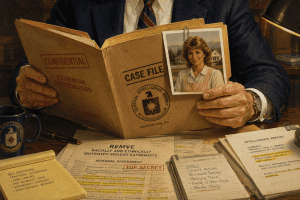








We often begin family history by looking backward—names, dates, places, and stories of those who came before us. We search for our ancestors with reverence, curiosity, and hope. Yet there comes a sacred moment when the lens quietly turns. We realize that one day we will be the ancestors. Our posterity will look for us, wonder about us, and try to understand who we were and what mattered most.
“And you have to understand: What you do really matters.”1
-Margit Meissner
Before going further, I want to pause and clarify what I mean by posterity. In this article, posterity refers not only to our direct descendants, but to all future generations of people. If you have ever read a life story that captured your heart—even though the person was not related to you in any way—then you already understand this truth: every story matters.
When our stories are preserved, they become a gift for those who come after us. The experiences we record, the choices we describe, the faith we wrestle with, and the lessons we learn may one day speak directly to someone we will never meet. It is entirely possible that something from your life—an insight, a moment of courage, even a quiet act of faith—could hold the answer another soul is searching for.
This shift—from progenitors to posterity—invites a deeper kind of stewardship. It calls us to live and to record our lives with holy intentionality.
Thanking Posterity, Remembering the Holocaust, and Choosing Action
Margit, a dear friend of mine, fled Europe with her mother in 1940. They arrived in the United States as Jewish refugees carrying little more than hope, faith, and the fragile gift of survival. In time, Margit would come to understand herself as what the world now calls a Holocaust survivor—though she wore that title with quiet humility for much of her life.
Later, she served as a docent at the Holocaust Museum in Washington, DC, guiding visitors through one of history’s darkest chapters. Margit passed away in July of 2019, but the quiet power of her story continues to speak.2
For many years, Margit did not intend to write her story. It was her family—children, nieces, and nephews—who lovingly insisted. They knew the story mattered. They understood that memory is a sacred inheritance. Because of their persistence, her memoir, Margit’s Story,3 came to be.
She opens the introduction with these heartfelt words:
“I HAVE TO THANK my children and my nieces and nephews for having urged me, then pleaded with me, to write our family’s story. They nudged me for years about sorting out the boxes with family letters… organizing and annotating the many photographs that cluttered my closet. I am now grateful for their insistence. Though writing this tome has been difficult, completing it has been a satisfying labor of love.”
Her words feel both humble and prophetic. How often do we need the gentle pressure of those who come after us to recognize that what we call clutter is, in truth, consecrated memory?
Margit understood that memory must be tended carefully. In one interview 4, Margit was asked how the story of the Holocaust might change when there are no surviving witnesses left to tell it. Her answer was sobering. She worried that, for younger generations, the Holocaust might one day feel as distant as the Punic Wars. Her hope was simple yet urgent: preserve the stories, make them accessible, and teach them in ways rising generations can truly receive.
History, when untended, grows quiet.
Memory, when unshared, fades at the edges.
We are approaching that moment quickly. History, when untended, grows quiet. Memory, when unshared, fades at the edges.
One moment from Margit’s life especially pierced her heart. After a museum talk, a young boy turned to and asked: “Mrs. Meissner, what do you really regret in your life?”
Margit was taken aback. After a moment’s thought, she answered honestly. One regret, she said, was never fully learning Russian, though she had tried several times throughout her life. So she did something remarkable. Margit began again—at age ninety.
What a holy pattern for the rest of us. A life of courage does not end with survival; it continues with humility, curiosity, and the willingness to begin again.
Stories are meant to steady our courage.
Margit often said one of her deepest hopes was that young people who heard her story would choose not to be bystanders when they witnessed persecution, scapegoating, or discrimination. She understood something eternal: memory is meant to move us. Stories are meant to steady our courage. Even regret—when humbly received—can become a quiet summons to action.
Having Our Say!
Another witness to the sacred power of memory comes from Bessie and Sadie Delany, the beloved Delany sisters, whose joyful declaration still rings: “Some people grieve to remember, but we celebrate!”
Their lives, beautifully preserved in Having Our Say: The Delany Sisters’ First 100 Years 5, offer another gentle but powerful witness.
When writer Amy Hill Hearth6 first approached the sisters, who were 101 and 103 years old, they hesitated. The Delany sisters didn’t know this writer, nor did see themselves as particularly important. Hearth later reflected that she had to persuade them that their experiences mattered—that their lives were part of history itself.
“At first, they weren’t sure they wanted to be interviewed because they didn’t see themselves as important,” Amy Hearth noted. “I had to persuade them that of course they were important, that their life experiences should be told and shared for the sake of history.”
Eventually, the sisters came to see what so many of us must also learn: recording our stories is part of an ancient and sacred tradition—the passing of knowledge and experience from one generation to the next.
As Hearth wrote in the preface, the project became deeply empowering for the sisters. The very title came from Bessie’s delighted refrain during the interviews: “This is fun! We’re having our say!”
The Delany sisters were also clear about something that still feels instructive today: their story was not meant to be boxed into “black history” or “women’s history,” but understood for what it truly is—American history. It belongs to all of us. 7
Actress Ruby Dee captured their impact beautifully when she observed that the sisters gave history a depth and significance beyond any textbook, standing in the long storytelling tradition of the African griot.
“The Delany sisters give our history a depth and significance that exceeds any history lesson…They have glorified the spaces and times in which I and my family lived [and] they are storytellers in the tradition of the African griot.” – Ruby Dee
Margit knew it.
The Delany sisters lived it.
And perhaps our posterity is quietly hoping we will learn it.
What we preserve today becomes courage for tomorrow.
Spiritually Tangible Memories
“We renew our appeal for the keeping of individual histories and accounts of sacred experiences.” – Spencer W. Kimball
As I have reflected on my own family history journey, I have come to understand something deeply personal:
“Through these precious keepsakes and the spiritually tangible memories, I have discovered my progenitors stories and examples of faith, fortitude, and endurance. I have chosen to build upon those tales of triumph and loss as I have captured, collected, and passed down these treasures to my posterity. I have chosen to teach my descendants those things that matter most, such as their true identity and purpose; for they are sons and daughters of God who belong to the House of Israel, which is a heritage filled with glorious, eternal promises and blessings as well as great and wonderful responsibilities.” 8
To know who we are changes how we live. But knowledge alone is not enough.
It must be lived.
It must be preserved.
It must be shared.
“What Do You Do With All That Knowledge?”
My daughter Sam once observed something that has lingered in my heart:
“It wasn’t until I left home that I realized that many people don’t have that knowledge of where they came from. I’ve always known, thanks to my parents for keeping the stories and traditions alive. My question is, what do you do with all that knowledge, and how do you pass it down?”
Her question lingers still.
As I reflect on my mother’s efforts to pass down our heritage and who she was, I use Sam’s words. She noted, “As Mother’s Day approaches, I find myself in quiet awe of my own mother—her strength, her spirituality, her steady foresight in preserving the tangible reminders of who we are, both in this life and in eternity. She showed me how to mother without a handbook. She gave me the priceless gift of example.”
Sam’s question and thoughts converge into one clear answer:
We live the stories forward.
We preserve them.
We teach them.
We embody them.
We make intentional choices so our descendants inherit not only photographs and journals, but faith and identity.
PattieMarch, a reader of Meridian Magazine once commented:
“Everyone’s history is one that needs to be written–our thoughts, our actions, our deeds so we may help future generations understand that our lives matter and so do theirs. We all have a story to tell. Let it be told.” (See PattieMarch 11, 2020 – Meridian Magazine)
Yes. Let it be told.
Lehi’s Story: Living for Posterity
The Book of Mormon prophet Lehi embodies this forward-looking stewardship more fully than most.
He did not journey into the wilderness toward the land of promise for himself. Lehi left Jerusalem knowing destruction loomed. He bore testimony of the greatness of God even when it placed his life in danger. He knew the value of obedience to God’s guidance and commandments, passing it forward by example. Lehi endured the long and uncertain pilgrimage because he saw beyond his own lifetime.
He moved forward for his posterity.
Lehi did not enjoy the land of promise for long; he died shortly after arriving. I believe as Lehi journeyed toward the land of promise he knew his time there would be short, yet he pressed forward in faith because he knew the blessings would flow forward to those who would come after him.
Lehi understood something eternal: sometimes we labor for blessings we may never personally enjoy. The land of promise may be meant for our children—and our eternal place will be to dwell with our family in the eternities.
Writing the Things of God
The pattern of record keeping runs throughout the Book of Mormon.9 From Nephi to Moroni, prophets treated writing as sacred work. Consider what Nephi wrote about his purpose for the small plates of Nephi, and the commandment he gives to his posterity: “I desire the room that I may write of the things of God. For the fulness of mine intent is that I may persuade men to come unto God . . . Wherefore, the things which are pleasing unto the world I do not write, but the things which are pleasing unto God and unto those who are not of the world. . . I shall give commandment unto my seed, that they shall not occupy these plates with things which are not of worth unto the children of men.” (2 Nephi 6:3-6)
Most of the Book of Mormon follows this pattern, yet somewhere between Enos and Amaleki the record wanes a bit and mentions the purpose is “to preserve our genealogy.” Yet, at the end of The Book of Omni, Amaleki gives a brief history of what has taken place and gives a firm testimony of the Savior, the Holy one of Israel.
The lesson is gentle but clear.
Genealogy alone is not enough.
Names matter—but so do testimonies.
Dates matter—but so do divine encounters.
President Spencer W. Kimball renewed the appeal for individuals to keep personal histories and sacred experiences.10 President Gordon B. Hinckley likewise urged the young women of the Church to write and keep journals, promising that such writing would bless generations yet unborn.
As we write, something sacred happens within us.
Our faith clarifies.
Our gratitude deepens.
Our spiritual anchors strengthen—for storms we have not yet seen.
A Sacred Continuum
As we approach the sunset of our lives, the greatest legacy we can leave to our posterity is a life full of example that will stand as a beacon of goodness for generations to come. Unknown
Family history is not only about sealing generations backward. It is about strengthening generations forward.
As Margit searched through preserved boxes, she discovered letters her mother had carefully kept for decades—letters between engaged parents, letters from children scattered by war, letters that stopped abruptly when loved ones were taken to Auschwitz.
These were not merely papers.
They were witnesses.
They were voices.
They were love that outlived tragedy.
They awakened in Margit a deeper devotion to remembering.
We honor our ancestors by remembering them.
We honor our posterity by leaving a record worthy of remembrance.
Looking Back with Gratitude, Looking Forward with Purpose
Nephi taught that the Lord “knoweth all things from the beginning; wherefore, he prepareth a way” (1 Nephi 9:6). Part of that way includes us—our voices, our witness, our willingness to be known.
My own life is now a quiet shaping influence my posterity will one day seek. They will not search for perfection. They will search for meaning. They will want to know:
What did she believe?
What sacrifices did she make?
Did she trust God when it was hard?
May our descendants find in us not flawlessness, but faith.
Not convenience, but covenant.
Not silence, but testimony.
The shift from progenitors to posterity changes everything. It transforms family history from a hobby or genealogy chart into a holy responsibility. It invites us to live intentionally, record faithfully, and testify boldly.
For one day, our names will be the ones searched.
Our journals will be the ones opened.
Our stories will be the ones longed for.
Let them find that God was with us—
and that He will be with them.




Kay Wiemer GerkeMarch 12, 2026
So beautifully written! This is the most effective message I have ever read to motivate others to write and record things that matter about our life experiences. Thank you, Tanya.
Terry DickensMarch 12, 2026
I just read this article, and it truly resonated with me. I recently completed a book of my life experiences—about 80 short chapters reflecting on family, faith, and many meaningful moments from more than 80 years. It is not a chronological history, but a collection of stories that offer small glimpses into the life I have been blessed to live. My hope is that articles like this will encourage others to record their own experiences and insights to bless their children, grandchildren, and generations yet to come.