




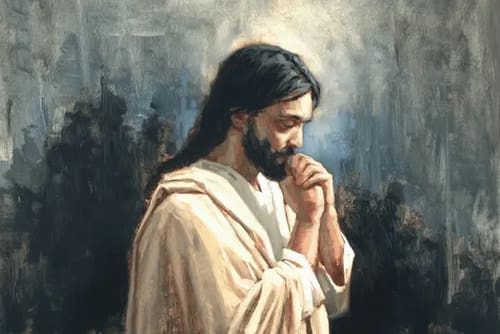


A Temple Pattern in the Life of Christ
Most biographies begin with ancestry and end with accomplishment. The Savior’s life begins and ends with a word. And that word is Father. Other lives are measured by what they achieve; His is measured by Whom He loves.
In the premortal council, the Beloved Son steps forward and speaks: “Father, thy will be done, and the glory be thine forever” (Moses 4:2). The first recorded utterance we hear from Him is not self-regarding. It is filial, worshipful, turned wholly toward Another. He introduces Himself to the universe by looking away from Himself. The first movement of divinity is deference. In Abraham’s account of that same council, His voice is equally ready: “Here am I, send me” (Abraham 3:27).
And if the Joseph Smith Translation preserves for us His final words upon the cross, “Father, into thy hands I commend my Spirit; thy will is done” (JST, Matthew 27:54), then the whole of His mortal ministry is framed in the same orientation. His first word is Father. His last word is Father. Between those two invocations stands everything He came to do. All else is stone and timber raised between those pillars. The miracles are masonry; the obedience is architecture. The Messianic Psalm had already anticipated this interior order: “I delight to do thy will, O my God: yea, thy law is within my heart” (Psalm 40:8).
The will of the Father is not a cage but a country, and the Son moves through it with the joy of a man who has come home.
Notice the verb. Delight. Not endure, not tolerate, not grimly execute. The Son delights in the Father’s will the way a master cellist delights in Bach; the constraint of the score is precisely what sets the music free. This is the paradox that governs everything that follows: the will of the Father is not a cage but a country, and the Son moves through it with the joy of a man who has come home.
The Architecture of Filial Fidelity
If one listens carefully, that phrase, the will of the Father, resounds through every room of His ministry. “I came down from heaven,” He declared, “not to do mine own will, but the will of him that sent me” (John 6:38). It shapes how He understands His gospel, how He eats, how He prays, how He defines family, how He describes the kingdom, how He endures agony, and how He introduces Himself in resurrected glory. The pattern never wavers. He does not drift from it by a single degree. If there is a straight line in history, it is the line of the Son toward the Father. The rest of us move in zig-zags, loops, and the occasional confident shortcut that turns out to be a swamp. He is the only one who walked as though He actually knew where the front door was — and never once checked the map, because He had written it.
The risen Lord has already given His Nephite disciples hours of theology. Then comes the question: what is your gospel? One might expect a summary, a creed, a careful distillation of the preceding hours. Instead, He offers a sentence about a Son and a Father: “I came into the world to do the will of my Father, because my Father sent me” (3 Nephi 27:13). The lecture collapses into a relationship. He came because He was sent, and He went because He loved the One who sent Him — which turns out to be the whole of it. President Russell M. Nelson has taught that “our Father knows that when we are surrounded by uncertainty and fear, what will help us the very most is to hear His Son,”1 and that invitation directs us again to the only place where the theology becomes a Person.
Mortality is not accidental. We are here on assignment. The endowment quietly requires that we remember why we came. Christ never forgot.
In Latter-day Saint temples, we learn that mortality is not accidental. We are here on assignment. The endowment quietly requires that we remember why we came. Christ never forgot.
Sustenance in the Disputed Territory
In the first-century Holy Land, there existed what might be called an unpleasant arithmetic: Jew plus Samaritan equaled defilement. Hatred, having failed to destroy its rival, had contented itself with drawing maps. When men cannot conquer, they redraw the borders — and then, in time, mistake the map for the truth.
Yet John tells us that “he must needs go through Samaria” (John 4:4). The phrase is curious. From a purely geographical standpoint, He did not need to. There are necessities that do not appear on maps, roads drawn not by terrain but by obedience. Christ walked straight through disputed territory because obedience makes a straighter road than fear. He had a habit of ignoring the “No Trespassing” signs erected by human spite. To the Pharisees, Samaria was a spiritual landfill; to Jesus, it was simply a place where a woman was thirsty. He did not need a passport to enter a country His Father had already made.
At Jacob’s well He meets a Samaritan woman, and the conversation that follows has nourished readers for two thousand years. When the disciples return with food and urge Him, “Master, eat” (John 4:31), He replies with a sentence that startles them: “I have meat to eat that ye know not of” (v. 32). This hidden sustenance is nothing less than the “will of him that sent me” (v. 34). While the disciples were haggling over the price of barley—preoccupied with the perishable manna of the marketplace—He had been feasting on something the world cannot bake. He stood by the well looking like a man who had just finished a seven-course meal, while holding nothing but a conversation. We suspect obedience is a fast; Christ reveals it is a banquet where the Father picks up the tab.
We suspect obedience is a fast; Christ reveals it is a banquet where the Father picks up the tab.
Here is the paradox the world misses entirely. The world suspects obedience of being a starvation diet for the soul. Christ reveals the opposite. Alignment with the Father is sustenance. The One who had fasted forty days in the wilderness speaks here as a man well-fed, because He is. As Elder D. Todd Christofferson has observed, the Savior’s “moral discipline was rooted in His discipleship to the Father,”2 a discipleship so complete that doing the Father’s work became His literal nourishment. Heaven’s bread is heavier than it looks.
The Lord’s Prayer: Tutoring the Human Heart
This same orientation shapes the prayer He gives to His disciples. In what we call the Lord’s Prayer, the petition rises early: “Thy will be done in earth, as it is in heaven” (Matthew 6:10).
Heaven, in that brief phrase, is described without ornament: it is the place where no one argues with love. Hell begins wherever love is treated as a suggestion. Earth is invited to learn the same music. The discord is ours; the melody is already written. The prayer is not a list of demands left on a divine doorstep; it is a tuning fork. We do not say “Thy will be done” to inform God of His duties, but to remind ourselves of our own. We are asking to be bent into harmony, which is often a painful process for those of us who prefer our own off-key solos.
The Father’s will is not an inscrutable decree imposed from above. It is the eternal order of love, the grain of reality as it truly runs. King Benjamin invited his people to “consider on the blessed and happy state of those that keep the commandments of God,” who are “blessed in all things” and “received into heaven” (Mosiah 2:41). To pray “Thy will be done” is not to ask for domination. It is to ask that our lives be brought into alignment with what is ultimately life-giving. In the temple, the structure and sequence of ordinances tutor us in what it means to live that prayer. There the Lord has promised that “my glory shall rest upon it; yea, and my presence shall be there” (D&C 97:15–16). Christ does not merely instruct us to pray this way. He embodies the prayer from Bethlehem to Calvary.
The Covenant Circle and the Household of Faith
His devotion redefines even the most intimate human bonds. In Matthew 12, when told that His mother and brethren stand without, Jesus stretches forth His hand toward His disciples and declares, “Whosoever shall do the will of my Father which is in heaven, the same is my brother, and sister, and mother” (Matthew 12:50).
There is nothing dismissive in this gesture. It is an enlargement of the hearth. The circle widens beyond bloodline into the vastness of covenant, a widening that makes room for the whole worn, wandering human family. You are His brother when you face the same way He faces. Kinship is not first a matter of blood but of direction. We belong most truly to those toward whom we are walking.
There is a world of difference between a man who can recite the recipe and a man who has flour on his hands.
The same principle governs the gates of His kingdom. “Not every one that saith unto me, Lord, Lord, shall enter into the kingdom of heaven,” He warns, “but he that doeth the will of my Father which is in heaven” (Matthew 7:21). The repetition of “Lord” suggests a sincerity that remains perched upon the lips, like a bird that will not come indoors. The Kingdom requires a devotion that has moved in, rearranged the furniture, and refuses to leave. There is a world of difference between a man who can recite the recipe and a man who has flour on his hands. President Dallin H. Oaks teaches that “the gospel of Jesus Christ is not a checklist of things to do; rather, it is a plan that shows us how to become something.”3 We obey to become the kind of children who are finally at home in the Father’s presence — not guests who have memorized the house rules, but heirs who have learned to love the house.
The Gethsemane “Nevertheless”: Consecration on the Altar
If this theme sounds serene in Galilee, it becomes something else entirely in Gethsemane. Under the weight of approaching agony, the Savior prays, “O my Father, if it be possible, let this cup pass from me” (Matthew 26:39). The plea is honest. There is no theatrical stoicism here. The cup is bitter — not metaphorically bitter, the way we call a Monday bitter, but bitter the way blood is bitter when you taste it in your own mouth. Luke tells us that His sweat became as great drops of blood (Luke 22:44). President Russell M. Nelson has testified that “in the Garden of Gethsemane, our Savior took upon Himself every pain, every sin, and all of the anguish and suffering ever experienced by you and me.”4 The agony was not performative. The cup could be refused; every bitter drop was visible to Him. Love did not remove the choice. It made the choice radiant.
And then comes the word that steadies the cosmos: “Nevertheless not as I will, but as thou wilt.”
That nevertheless holds within it the redemption of worlds. History turns upon that hinge. A single surrendered will outweighed all the empires of self. It signals neither reluctance nor resignation, but consecration. The human will of Jesus Christ is not merely offered; it is laid upon the altar of the Father’s love. Whether in the simple bread and water of the sacrament or the sacred altars of the temple, the pattern is the same: we bring our nevertheless to the Father, discovering that the altar is not a place of loss but the site where our will is sanctified and returned to us, enlarged.
What temples teach in symbol, He enacts in blood. Abinadi foresaw this moment when he taught that the Redeemer would be “led, crucified, and slain, the flesh becoming subject even unto death, the will of the Son being swallowed up in the will of the Father” (Mosiah 15:7). His will is not coerced into harmony. It is freely one with the Father’s. What appears as surrender is, in truth, the revelation of who He eternally is.
On the cross, the pattern remains unbroken. “Father, forgive them,” He prays (Luke 23:34). And at last, according to the inspired rendering preserved by Joseph Smith, “Father, it is finished; thy will is done” (JST, Matthew 27:54; cf. Matthew 27:50–54).
The shift in tense is as quiet as it is consequential. In the premortal council: “Father, thy will be done.” Upon the cross: “Father… thy will is done.” The space between those two verbs, between the be and the is, is the space of a human life. It is the distance between a promise made in heaven and a promise kept in blood. The Savior’s final breath was not a sigh of relief that the pain was over. It was a final report of mission accomplished to the One who sent Him.
Resurrection Light and the Final Accounting
One might imagine that after resurrection the emphasis would shift. Yet when He appears among the Nephites in Bountiful, His introduction resounds with the same devotion: “Behold, I am Jesus Christ… and I have drunk out of that bitter cup which the Father hath given me, and have glorified the Father… in the which I have suffered the will of the Father in all things from the beginning” (3 Nephi 11:10–11).
From the beginning. The phrase gathers premortal council, mortal ministry, Gethsemane, and Calvary into a single, seamless obedience. Resurrection does not eclipse submission; it reveals its glory the way morning light reveals the builder’s work.
Justice, in such hands, is mercy with a backbone—the kind of love that refuses to call a lie a truth for the sake of keeping the peace.
Even His role as Judge is cast in these terms. “I can of mine own self do nothing,” He declared. “As I hear, I judge: and my judgment is just; because I seek not mine own will, but the will of the Father which hath sent me” (John 5:30; see also D&C 19:2). We often picture judgment as a cold accounting, as if God were a celestial actuary with a green eyeshade. But in the Son’s hands, judgment is the fierce protection of a Home. He is not looking for a reason to lock the door; He is looking for children who actually want to live in the house. Justice, in such hands, is mercy with a backbone—the kind of love that refuses to call a lie a truth for the sake of keeping the peace.
The Holy House
The foundation is laid in heaven: “Father, thy will be done.” The walls rise through mortal ministry, each stone set in obedience. The altar stands in Gethsemane. The veil trembles at Calvary. Glory crowns the structure in resurrection light.
For those who worship in temples today, the invitation is both sobering and sweet. In a world that prizes self-assertion, we kneel in a quiet room and practice the ancient art of facing the right direction. President Russell M. Nelson has declared that “the covenant path is the only path that leads to exaltation and eternal life.”5 Elder Neal A. Maxwell taught that “the submission of one’s will is really the only uniquely personal thing we have to place on God’s altar. The many other things we ‘give’ are actually the things He has already given or loaned to us. However, when you and I finally submit ourselves, by letting our individual wills be swallowed up in God’s will, then we are really giving something to Him. It is the only possession which is truly ours to give!”6
The first word of the Son was Father. The last word was Father. Eternity opens and closes with that address. To follow Christ is to enter the same temple of obedience, until our own lives, however humbly, echo His: Thy will is done. And in that echo, we find at last that the will of the Father is not the loss of ourselves but the finding of our true name. For the only self worth keeping is the one given back to us by God.
Footnotes
1 Russell M. Nelson, “Hear Him,” Ensign or Liahona, May 2020, 88–92.
2 Todd Christofferson, “Moral Discipline,” Ensign or Liahona, November 2009, 105–8.
3 Dallin H. Oaks, “The Challenge to Become,” Ensign, November 2000, 32–34; see also “Kingdoms of Glory,” General Conference, October 2023.
4 Russell M. Nelson, “The Correct Name of the Church,” Ensign or Liahona, November 2018, 87–90.
5 Russell M. Nelson, “The Temple and Your Spiritual Foundation,” Liahona, November 2021, 93–96.
6 Neal A. Maxwell, “Swallowed Up in the Will of the Father,” in Ensign, November 1995, 22–24.



Donna PenningtonMarch 18, 2026
Wow! Beautiful piece such depth and talent t allowed me to savor what our Savior did for us!! Thank you!
Glenda PeckhamMarch 16, 2026
This is one of the most beautiful articles I have ever read. It opens a new perspective on following our Father's will and not ours. It truly adds insight on the need to follow our Father as our Savior has done. Thank you!