







View the original post on Scripture Central.
The prophet Lehi, in his last recorded discourse before his death, urged his children to keep the Lord’s commandments: “Awake! And rise from the dust, and hear the words of a trembling parent, whose limbs ye must soon lay down in the cold and silent grave, from whence no traveler can return; a few more days and I go the way of all the earth” (2 Nephi 1:14). Some have suggested this language would have been out of place for an ancient prophet like Lehi and was simply lifted from William Shakespeare’s play Hamlet, in which the young prince describes death as “the undiscovered country from whose bourn [i.e., boundary or limit] no traveler returns.” 1
First it should be noted that, although quite similar, this is not a verbatim quotation. As can be seen below, only some of the key words in the most similar phrase are shared (bolded for emphasis):
- from whence no traveler can return (2 Nephi 1:14)
- from whose bourn no traveler returns (Hamlet, 3.1.79–80)
In addition, Hugh Nibley and Robert F. Smith have shown that this same core idea is expressed in writings from the ancient Near East including the Bible.2 In fact, when one examines Lehi’s words from this passage in their entirety, it is clear that they significantly overlap with language and themes in biblical literature, much of which would have presumably been available on the plates of brass (1 Nephi 13:23; 19:22–23). These writings may have influenced Lehi’s own prophetic voice as he taught his children the ways of God.
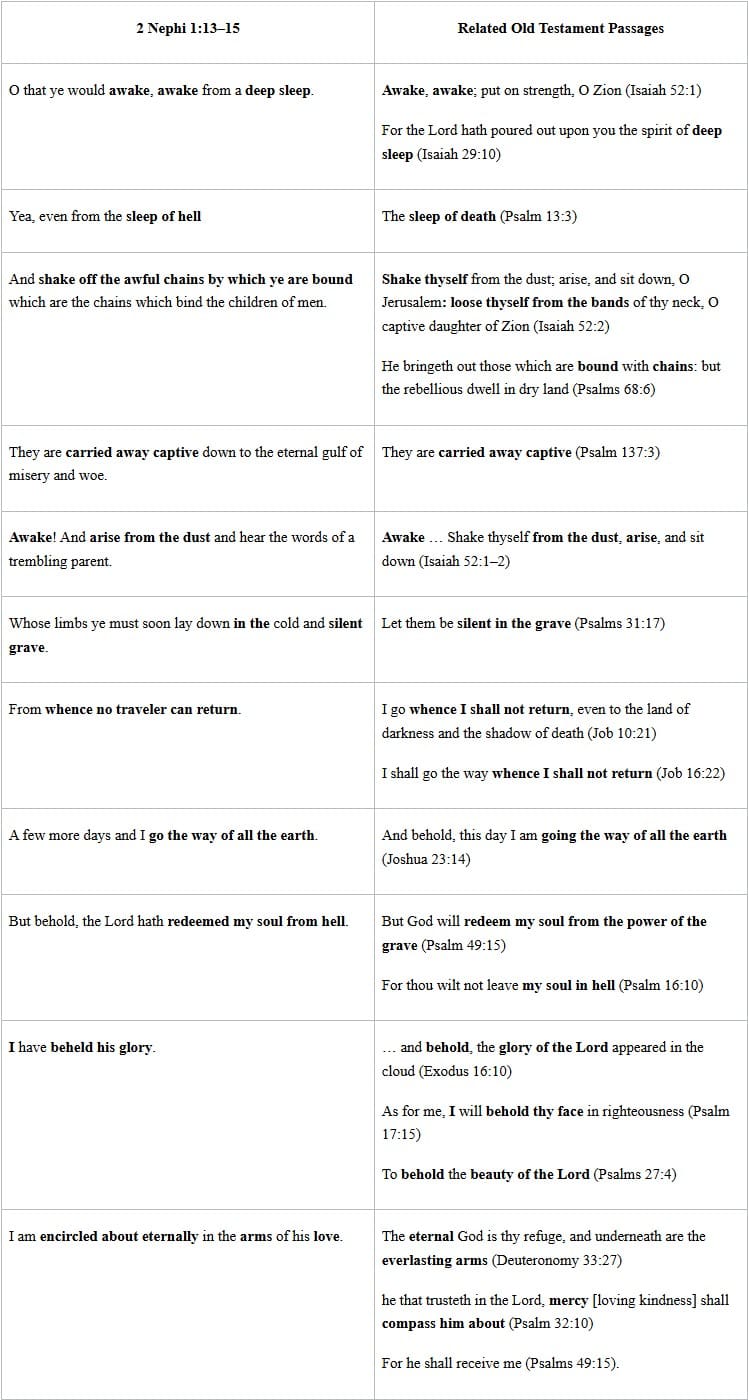
This chart compares Lehi’s words in 2 Nephi 1:13–15 with Old Testament passages, highlighting shared language and imagery. These parallels support the ancient Near Eastern context of the Book of Mormon and show that Shakespeare was not the only source of similar expressions.
Robert Smith, drawing upon a study by Jan Zandee, observes that “the constellation of ideas and expressions found there (and in parallel texts) were available throughout the ancient Near East in Lehi’s own time.” 3 Zandee shows that similar ideas and phraseology are found in ancient Mesopotamian and Egyptian texts. He notes that the “Babylonians call the netherworld irṣit la tāri, land without return … ‘where dust is their nourishment and mud their food.’”4 The Descent of Ishtar, which describes the descent of the goddess into the underworld, repeatedly refers to the world of death as “the Land of no Return.”5 Utnapishtim, the Noah figure in the Epic of Gilgamesh, likewise tells the hero in the story that “no one returns from death. And who can know when the last of his days will come?”6
Egyptian texts also sometimes “express themselves ‘in a Babylonian way,’ when the realm of the dead is mentioned as a place where one arrives, but from where one does not return.”7 For example:
- “May you not go on the roads of the western ones, who go on them, they do not return” (Pyramid Text, 697).8
- “There is nobody who returns from there” (P. Harris, 500, VI/8).9
- “Behold, there is nobody who has gone, who has returned” (P. Harris 500, VII/2-3).10
- “Lo, none who departs comes back again!” (Song of King Antef).11
Lehi also spoke of the “cold and silent grave” (2 Nephi 1:14). Zandee notes this as another feature of some Egyptian texts: “In the realm of the dead there is silence. It is the domain of silence. Silence is one of the phenomena which occur when death has set in and in that case it stands as pars pro toto for being dead.”12
As another point of resemblance, Egyptian texts share the theme found in Lehi’s words (as well as in the writings of Isaiah) of rising from death and shaking off the dust with which the individual was once surrounded:
- “You have shaken off your dust. You have loosened your bonds” (Pyramid Text, 2008. a.b.; 2009. a.).13
- “Rise, shake off your dust, remove the dirt which is on your face” (Coffin Texts 71ab I 297).14
- “Rise, receive your head, assemble your bones, collect the parts of your body, shake off the dust of the earth which is on your flesh” (Pyramid Texts 654. a-d.).15
- “He has chased away his dust” (Coffin Texts VI. 223. i.).16
Since Lehi and Nephi apparently had training in the Egyptian language, it isn’t improbable that they had at some point encountered such sentiments in their ancient literary culture and environment (1 Nephi 1:2).17
Conclusion
These examples from biblical passages, as well as from sources within the broader ancient Near Eastern world in which Lehi lived, demonstrate that Shakespeare is hardly the only source from which the wording and ideas of 2 Nephi 1:14 could derive. Indeed, when one looks at the entirety of Lehi’s statements, it would appear that an ancient Near Eastern context can account not only for the wording similar to Shakespeare’s Hamlet but for nearly every other concept and turn of phrase as well.
As Nibley concluded, “The ideas to which [Lehi] here gives such familiar and conventional expression are actually not his own ideas about life after death—nor Nephi’s nor Joseph Smith’s, for that matter, but they are ideas which any eloquent man of Lehi’s day, with a sound literary education such as Lehi had, would be expected and required to use.”18
References
1. Shakespeare, Hamlet, 3.1.78–80. Alexander Campbell, “Delusions,” Millennial Harbinger 2, no. 2 (February 7, 1831): 94; M. T. Lamb, The Golden Bible (Ward & Drummond, 1887), 236–237.
2. See Hugh Nibley, An Approach to the Book of Mormon (Deseret Book and FARMS, 1988), 275–277; Robert F. Smith, “Evaluating the Sources of 2 Nephi 1:13–15: Shakespeare and the Book of Mormon,” Journal of Book of Mormon Studies 22, no. 2 (2013): 98–103.
3. Smith, “Evaluating the Sources of 2 Nephi 1:13–15,” 100.
4. J. Zandee, Death as an Enemy (Brill, 1960), 7.
5. James B. Pritchard, The Ancient Near East: An Anthology of Texts and Pictures, 2 vols. (Princeton University Press, 1973), 1:80–84.
6. Stephen Mitchell, Gilgamesh: A New English Version (Free Press, 2004), 179.
7. Zandee, Death as an Enemy, 55.
8. Zandee, Death as an Enemy, 10.
9. Zandee, Death as an Enemy, 55.
10. Zandee, Death as an Enemy, 55.
11. Miriam Lichtheim, Ancient Egyptian Literature, Volume 1: The Old and Middle Kingdoms (University of California Press, 2006), 197.
12. Zandee, Death as an Enemy, 93.
13. Zandee, Death as an Enemy, 104.
14. Zandee, Death as an Enemy, 104–105.
15. Zandee, Death as an Enemy, 105.
16. Zandee, Death as an Enemy, 105.
17. See Scripture Central, “Book of Mormon Evidence: Egyptian Writing,” Evidence 33 (September 19, 2020).
18. Nibley, An Approach to the Book of Mormon, 277. It should also be noted that even if the text of the Book of Mormon were to contain phrases which drew upon English sources familiar to 19th century audiences, that wouldn’t, in and of itself, necessitate plagiarism. It could, instead, be viewed as a natural choice for an English translator, especially if genuinely similar language was present in the ancient source.