








About 25 years ago, I learned a new stitching skill in what was then Relief Society Homemaking meeting. Even though my grandmother had taught me how to do simple embroidery when I was five years old and I had done my fair share of dishtowels and pillowcases as a preteen, I wasn’t very interested in stitchery. But when a mini-class was offered in counted cross-stitch, I picked up my needle and thread and began stitching missionary and birth samplers. Little did I know that once I made a sampler for the first missionary and for the first grandchild, a tradition was born. Now five missionaries and fifteen grandchildren later, I have learned an important lesson in this process.
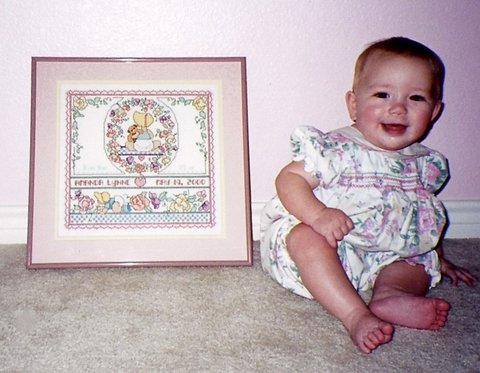 Embroidery is much easier than counted cross-stitch as it usually has the pattern stamped or drawn on a piece of fabric, making it easy to follow. Counted cross-stitch requires one to actually count little squares and then transfer the design stitch by stitch. That’s what makes it challenging and satisfying—yet frustrating at times. I’m not one to sit down and just cross-stitch. I do this time-consuming craft while watching television, riding in a car or an airplane, or talking on the phone. I learned that miscounting just one stitch can throw the whole project askew. There are two choices once I discover the mistake: 1) keep going, try to adjust each segment of the design, and be unhappy with the out-of-kilter pattern; 2) stop, unpick, correct the mistake, and be happy with the end result.
Getting off-course for a pilot can have a more significant effect. “While traveling, I have had the opportunity of visiting with many airline pilots,” said Elder L. Tom Perry of the Quorum of the Twelve Apostles, “and I am always amazed, as I look into the cockpit, at how many switches, lights, displays, and controls are necessary to fly the plane. I entered into a discussion with one pilot regarding what could happen if he deviated from his flight plan. I proposed deviating just one degree from the charted course. His reply astonished me.
“He said that for every one-degree variance from the plan, you would miss your charted destination by one mile for every 60 miles you were flying. This means that in a flight from Salt Lake to Denver, you would land in downtown Denver rather than at the airport. On a flight from Salt Lake to Chicago, you would miss the airport and land in Lake Michigan. Going from Salt Lake to New York, you would miss Kennedy Airport and land in the Hudson River. Going to London, you wouldn’t even make England-you would land somewhere in France.
“A deviation from a flight plan of several degrees would take you totally off course. The pilot explained to me that, obviously, the faster the error is discovered, the easier it is to return to the flight plan. If the correction is delayed for a long time, it is very difficult to find the way back because of flight traffic, poor weather conditions, decreased visibility, and other limiting factors. The charted course would be so far away that it might be almost impossible to reach the intended destination. My visit with the pilot gave me no comfort, but it did cause me to think of how a flight plan parallels the direction we chart for our life’s experience.”[i]
Passengers who schedule a flight to England, for example, would not be happy to land in France, which would necessitate a change of plans and time and effort expended to arrive at their intended destination. Getting off-course with choices in our lives, however, can have eternal consequences.
We are instructed that “strait is the gate, and narrow is the way, which leadeth unto life, and few there be that find it” (Matthew 7:14). Through the scriptures, the words of prophets and other Church leaders, lesson manuals, Church magazines, and inspired counsel from family and friends, we do know what is right, what is expected of us, and what kinds of choices in life will bring us eternal happiness.
However, because we are mortal and this life is a test, we sometimes make mistakes, commit offenses, and wrong choices, and thus we get off course by one stitch or one degree. When we recognize our errors, we fortunately can make corrections by repenting. Anne C. Pingree, who served as a counselor in the general Relief Society presidency, stated: “Sometimes a personal course correction is as immediate as retracing our hurried steps toward the exit after Church meetings and instead crossing the foyer to greet a lonely sister who we know will talk long. Often it will be as long-term as regularly rising above feelings of resentment for family members who treat us thoughtlessly-all while we are trying to build positive relationships. Regularly, these individual course corrections, which are crucial instances of repentance, yield the peaceable fruit of righteousness.'”[ii]
The longer we delay rectifying our mistakes, the more repenting we will need to do. Since “way leads on to way” as the poet Robert Frost said in “The Road Not Taken,” one choice leads to other choices and that can make “all the difference” in our lives, now and eternally. The wage-earner who stops paying tithing one month may find it easier to skip the next month. The teenager who accepts the first drink or recreational drug may take just one more, then another and another. The young woman who dresses immodestly may find herself later in compromising situations.
President Dieter F. Uchtdorf, Second Counselor in the First Presidency, recounted the tragedy of a jet taking 257 passengers on a sightseeing flight to Antarctica. Because the flight coordinates had been modified by only two degrees, which the pilots didn’t know, the plane crashed into Mt. Erebus.
President Uchtdorf said: “Small errors and minor drifts away from the doctrine of the gospel of Jesus Christ can bring sorrowful consequences into our lives. It is therefore of critical importance that we become self-disciplined enough to make early and decisive corrections to get back on the right track and not wait. The longer we delay corrective action, the larger the needed changes become, and the longer it takes to get back on the correct course-even to the point where a disaster might be looming.”[iii]
Through the Atonement of Jesus Christ and the process of repentance, we can have the righteous patterns of our lives and the gospel course we follow lead us to ultimate happiness: “And if you keep my commandments and endure to the end you shall have eternal life, which is the greatest of all the gifts of God” (D&C 14:7).
_________________________________________
[i] L. Tom Perry, “Learning to Serve,” Ensign, Aug. 1996, lds.org.
[ii] Anne C. Pingree, “To Look, Reach, and Come unto Christ,” Ensign, lds.org, Nov. 2006.
[iii] Dieter F. Uchtdorf, “A Matter of A Few Degrees,” Ensign, lds.org, May 2008.