







Is Psalm 18 the “Book of Mormon Psalm”?
by Geoffrey Biddulph
Did Israeli King David see a vision of future events as recorded in the Book of Mormon when he wrote Psalm 18? Was the king inspired by the Holy Ghost to place references to the acts of the prophets Lehi and Nephi in this psalm?
This article will argue that just as other psalms have references to future events, such as the crucifixion of the savior, Psalm 18 has several references to the Book of Mormon. Are they coincidental?
First, a note of caution. I am something of an amateur scholar on the scriptures. I have read literally hundreds of books and articles on the scriptures, but I would never claim to be an expert along the lines of scholars at BYU and other universities. I am simply a faithful Latter-day Saint, business executive and former journalist. I like to write in my spare time and listen to the scriptures in my car while driving home from work. And one day recently I was listening to the psalms and I heard, “He teaches my hands to war, so that a bow of steel is broken by mine arms.” (Psalm 18:34).
Wait a minute, a bow of steel? Didn’t Nephi have a bow of steel (see 1 Nephi 16:18)? Bows of steel could not have been that common when David wrote the Psalms (about 1050 BC). Most bows were made of wood or other material. Forging a bow of steel would have been extremely difficult and extremely rare. Yet here was a reference to a bow of steel in the psalms and in the Book of Mormon. Strange.
And then I listened to the psalm again. There were many other references that could apply to the Book of Mormon. Is it possible?
First, a word about the psalms. As far as scholars can judge, the psalms are something akin to the hymns of today. David wrote most of them, and the faithful would chant the psalms, sometimes to music, sometimes alone. The psalms were meant to be memorized and repeated.
Many of the psalms have clear Messianic references. Read Psalm 22, which starts out with “My God, my God, why hast thou forsaken me?” This is what Jesus says on the cross, according to Matthew 27:46. It seems clear that most of the psalm is a reference to the Atonement. Let’s take a look.
Psalm 22:4: “Our fathers trusted in thee: they trusted, and thou didst deliver them.” Isn’t it true that the House of Israel trusted in the Lord for deliverance? Didn’t the faithful know a Messiah would come?
Psalm 22:7-8: “All they that see me laugh to scorn; they shoot out the lip, they shake their head, saying, he trust on the Lord that he would deliver him; let him deliver him, seeing he delighted in him.” This is exactly the scene described in Matthew, chapter 27, especially verse 43.
Psalm 22:10: “Thou art my God from my mother’s belly.” This is a clear reference to the virgin birth (remember that Jesus was from David’s lineage).
Psalm 22:16: “The assembly of the wicked have enclosed me; they pierced my hands and my feet.” This is a clear reference to the crucifixion.
Psalm 22:17: “They look and stare upon me. They part my garments among them, and cast lots upon my vesture.” The gospels confirm this happened during the crucifixion.
Psalm 22:23-31: “Ye that fear the Lord, praise him; all ye seed of Jacob, glorify him; and fear him, all ye the seed of Israel.for he hath not despised nor abhorred the affliction of the afflicted.the meek shall eat and be satisfied: they shall praise the Lord that seek him: your heart shall live forever.all the ends of the world shall remember and turn unto the Lord: and all the kindreds of the nations shall worship before thee.all they that go down to the dust shall bow before him: and none shall keep alive his own soul.a seed shall serve him.they shall come and declare his righteousness unto a people that shall be born.” These verses contain clear references to the gathering of Israel, the resurrection, the restoration of the Lord’s true church and the Second Coming of the savior. I see undeniable parallels to the work being done in the latter days (is it an accident that Alma 32 compares faith to a seed?)
The psalm has a few key characteristics:
1) The events are not necessarily chronological. The piercing of the feet and hands came chronologically before Jesus said “why has thou forsaken me” in real time, yet the psalm has it afterwards. This is common in the scriptures. Just look at Isaiah for hundreds of instances of events being written about apparently out of order.
2) Not everything in the psalm actually happened, according to what we know. There are references to the savior being “compassed” by “many bulls” (Psalm 22:12-13) and “dogs” (Psalm 22:16), but as far as we know this did not happen. Of course, these references could be metaphorical.
3) The psalm seems clearly intended to remind people in later days about the suffering of the savior. We are intended to think about how David could have known about these future events. Was he given a vision of the future? Did the Holy Ghost inspire him to write these things?
4) Like many of the prophets who write in the Old Testament, David was clearly concerned about the future of his seed. He had observed the people quickly turn against the Lord, and the Psalms are intended to remind the people to get back on the right path.
Now let’s look at Psalm 18. The psalm is also recorded in 2 Samuel 22. It is difficult to know exactly when the psalm was written. The notes on Psalm 18 said it was recorded on “the day that the Lord delivered him from the hand of all his enemies, and from the hand of Saul.” It’s possible the psalm was written when David was young, but it is more likely it was written near the end of David’s life. The events that take place near 2 Samuel 22 in the Bible all happen in the later part of David’s life. Like many psalms, it is a song of thanksgiving to the Lord. It also appears to have some references to the Book of Mormon.
Psalm 18:5-6: “The sorrows of hell compassed me about: the snares of death prevented me.in my distress I called upon the Lord, and cried unto my God: he heard my voice out of his temple, and my cry came before him, even into his ears.” How did we get the Book of Mormon? It was translated by Joseph Smith year after the First Vision. And how does Joseph Smith describe the First Vision? “I was seized upon by some power which entirely overcame me.thick darkness gathered around me, and it seemed to me for a time as if I were doomed to sudden destruction.But, exerting all my powers to call upon God to deliver me out of the power of this enemy which has seized me, and at the very moment when I was ready to sink into despair and abandon myself to destruction.I saw a pillar of light exactly over my head.” (Joseph Smith-History 1:15-16) It sounds like David and Joseph Smith are describing the same event.
Psalm 18:12: “At the brightness that was before him his thick clouds passed, hail stones and coals of fire.” This could be both a description of Joseph Smith’s “pillar of light” and the pillar of fire that Lehi sees in 1 Nephi 1:6.
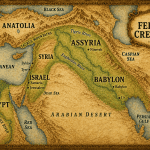
Psalm 18:15-17: “Then the channels of waters were seen, and the foundations of the world were discovered.He sent me from above, he took me, he drew me out of many waters.He delivered me from my strong enemy.” When David uses the term “me” he could be referring to himself or his people, the House of Israel. In the case of Psalm 18, I believe he is referring to both. How did the family of Lehi make it from Arabia all the way to the Americas on the other side of the world? The only way was through “channels of water.” Traveling across “many waters” is an especially apt description of the journey of the Book of Mormon people. Of course, the Book of Mormon people were delivered from a strong enemy, Babylon, when they left Jerusalem around 600 B.C.
Psalm 18:19: “He brought me forth also into a large place; he delivered me, because he delighted in me.” From the perspective of David, what better description for the Americas than a “large place.” As mentioned above, the reference to “me” could be personal or a reference to David’s future people. It is certainly true that the Lord delighted in Lehi, Nephi and Sam and their families, who were obedient in following extremely difficult commandments from the Lord.
Psalm 18:22: “For I have kept the ways of the Lord, and have not wickedly departed from my God.” Given David’s adultery with Bathsheba, and David’s obvious guilt about this act, are we to believe that David really believed near the end of his life that he had “kept the ways of the Lord?” Is it possible he was writing about another righteous people, led by the righteous prophets Lehi and Nephi, and celebrating their future acts?
Psalm 18:34: “He teacheth my hands to war, so that a bow of steel is broken by mine arms.” The Standard Works make only four references to a “bow of steel:” 1 Nephi, Psalm 18, 2 Samuel 22 (a repeat of Psalm 18) and Job 20:24. The reference in Job is different than the other three in that it does not imply the bow of steel is broken. Is it pure coincidence that in both Psalm 18 and 1 Nephi, the bow of steel is broken? Is this meant to be a reference to the Book of Mormon? Was David shown a vision of Nephi breaking the bow, just as he was shown a vision of the events surrounding the crucifixion? There are many things you can do with a bow: you can shoot it, you can pick it up, you can lift it in victory, and you can use it for target practice. Breaking a bow of steel is certainly something of a non sequitur: it’s not the first thing that would come to mind if you are trying to give the image of winning in battle. However, if the incident is intended to be a reference to Nephi’s future breaking of the bow of steel, it falls right into place.
Psalm 18:39-40: “Thou has subdued under me those that rose up against me.Thou hast also given me the necks of mine enemies; that I might destroy them that hate me.” Nephi was certainly given the neck of his enemy, Laban, when he was ordered to cut off his head. But before that, David cut off the head of one of Israel’s most fearsome enemies, Goliath (see 1 Samuel 17:51). Is David’s slaying of Goliath meant to be a type for Nephi’s decapitation of Laban? Is one event intended to remind us of the other?
Psalm 18:41-42: “They cried, but there was none to save them: even unto the Lord, but he answered them not. Then did I beat them small as dust before the wind.” Is this a reference to the Nephites? Before you scoff, look at Isaiah chapter 29. References to dust are often associated in the scriptures with the Nephites, who recorded the Book of Mormon and whose “speech shall be low out of the dust.” (Isaiah 29:4).
Psalm 18:43-49: “Thou has made me the head of the heathen: a people whom I have not known shall serve me.the strangers shall submit themselves to me.thou has delivered me from the violent man.Therefore, I will give thanks unto the, O Lord, among the heathen.” Conventional wisdom has seen this as a reference to David’s reign over the many heathen nations around Israel. But could it also be a reference to the seed of the House of Israel, which is taken “out of many waters” to a “large place?” Did David foresee that a righteous branch of the House of Israel would be taken from the land of Jerusalem to a distant land and there mix with “strangers” and “heathens?” It’s worth noting that David did not end up living among the heathen in Jerusalem, while the Book of Mormon people certainly did in the Americas.
How does psalm 18 compare to psalm 22?
1) Just as in psalm 22, the events are not strictly chronological. The cutting of the neck of Laban comes before Nephi broke the steel bow in the Book of Mormon, but, again, this is common in the scriptures.
2) There are some references in psalm 18 that did not happen historically, as far as we know.
3)I cannot help but wonder if David was shown a vision of the events involving the Book of Mormon and was inspired to place them in the psalm.
4) The psalm also seems to have some references to the future of the seed of the House of Israel.
It would be interesting for a scholar who reads Hebrew to look at the original language of the psalm and see if my comparisons between Psalm 18 and the Book of Mormon hold up. It’s possible that in Hebrew many of the similarities are simply not there. Or it’s possible there are even more similarities.
A more detailed analysis by an LDS biblical scholar may also show that my analysis is overdrawn. And I’ll be the first to agree, if the evidence is convincing. But until then, I will always think of the Psalm 18 as the “Book of Mormon Psalm.”
2002Meridian Magazine. All Rights Reserved.