






Author’s note: The following article is not your typical Meridian fare. It will be much darker than what you are used to reading here. In fact, if you aren’t disturbed at the end of this article, then I didn’t do my job right. The language used herein will be graphic and to the point. When discussing poverty and sex trafficking there is no point to using more polite or gentle language. The language used will be exact and to the point. You may notice that my grammar is not at its best, and will switch from past to present tense without warning. I struggled with whether or not to correct it after I caught what I had written. In the end, I chose to leave it as is, feeling that it best explains the moments I am sucked back into the events, and not just recounting a story for you.
While volunteering in Cambodia I saw things I never imagined existed. I thought I had seen poverty and despair, but nothing prepared me for what I witnessed on my “advocacy walk,” hosted by Riverkids Foundation.
The advocacy walk was set up for me as a tour through the slums of Phnom Penh. Even after having spent the last few weeks reading about the slums, street children, and sex workers, I was still shocked and brought to tears over the conditions of the families in the slums.
On many levels Phnom Penh is a major capital city, where you can see massive shiny banks, motorcades from visiting dignitaries, traffic, and large shopping areas. You can get nearly anything you might want if you know where to look. But right next to the all of the commerce and tourists is despair. And I mean total despair.
On my advocacy walk I followed a young street boy. He was 14 years old and something about him reminded me of my nephew. He had a thin, lithe frame, with a quick smile, and while he was shy at first, refusing to make eye contact with me, once I started asking him about his favorite superheroes, he opened right up.
My translator guide and I stayed a safe distance behind him, as he made his route through various neighborhoods picking up trash off the street and filling his empty rice sack. He wandered major highways, in and out of industrial areas, picking through the debris outside of bars, looking for glass and plastic to put in his bag. Beer bottles outside of bars and discarded water bottles are his main target. I quickly finished off my water bottle, just to give it to him.

At first it was shocking to see such a young boy wandering the streets alone. He gets up at 5 am every day to be the first one on the streets.
Having traveled to developing countries before where I have witnessed a great deal of criminal activity, I asked about turf wars and if the trash kids ever get ripped off. I was shocked that there aren’t really turf wars among the street kids. Mostly the kids are limited to the area they can walk to, and as a result they don’t really stumble into other kids’ areas.
Surprisingly, they don’t get ripped off because so many people have to collect trash that the price per kilo is well-known in the community. This is something I have learned over and over about Phnom Penh — with the exception of a few places ripping off tourists, the people are fairly honest here. I haven’t heard talk of any sort of mafia, or gang leaders around that bring about cheating or dishonesty. The people here want to earn their wages, and aren’t looking to rip anyone off to take a shortcut. This is a huge change from what I have witnessed in other developing countries, and something I have really come to admire about the Cambodian people. They want to learn and work, and they will make great sacrifices in order to do it.
We took the young boy to breakfast. He waited for us outside of the cafe, but wouldn’t walk in. He didn’t feel worthy. We had to walk in and convince him it was okay to sit with us. I watched his face as he ate. He didn’t drop a piece of rice, or miss a tiny piece of meat on the bone. He was glued to a TV show, and for a minute looked like a normal teenage boy.
As we got up to leave he looked back longingly at the table, unsure of something. He was looking at the bottles we had been served our beverages in. He wasn’t sure if it would be appropriate to take them out with us. I didn’t care if someone else would be comfortable with it. I grabbed the bottles and walked outside to put them in his sack (that he left hidden outside). The look on his face made it clear he thought I was crazy — a foreign, white woman helping a trash, street boy.
Over breakfast and through the translator, I asked him about school and his ambitions. He would like to go to school, but it is important for him to work to help support his family. Through the translator I asked him what he wants to be when he grows up. The look on his face was complete confusion. The translator struggled with him for a minute.
After several exchanges with him she tells me that he doesn’t know what that means. The concept of wanting to be something “when he grows up” is lost on him. Living in a slum and picking up trash off the ground is the only life he knows. He can’t conceive of having further ambitions. His parents are also street trash collectors, and that is what he will do. Without aid or assistance, it is what his own children will do, too. The generational cycle of poverty is difficult to break.
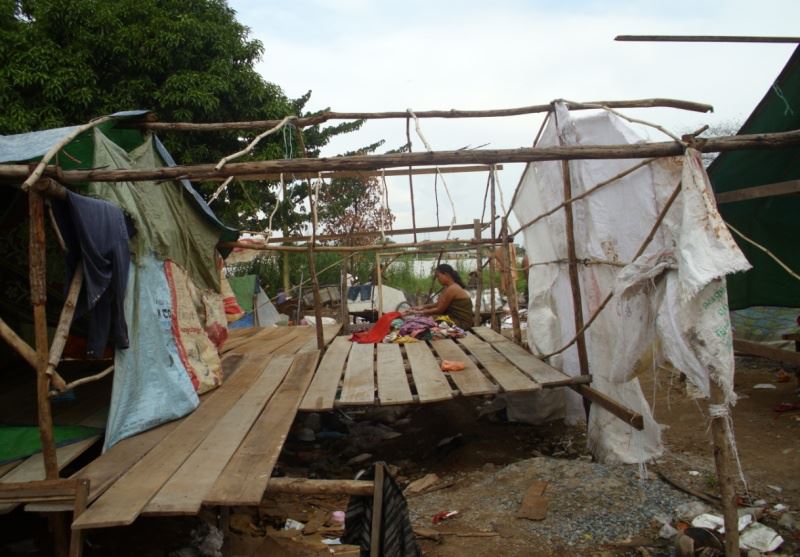
Next, we followed him to a slum where the trash is weighed and he gets paid. I had never before imagined something so awful. The trash is collected in a shack that is lined up just like the other shack homes. It is possible that this shack used to be a home itself.
I chose not to mentally assess the area enough to determine if it is still a home. The shacks had been built on dry ground originally, but the river has come up and eroded the area. The water came closer and now covers the floors of many “homes.” It covers the rotting wood planks and there are children and babies walking through waist high dirty, filthy, nasty water.
The flooding in Southeast Asia is at record levels right now, and the governments are not equipped to handle the situation. No place is this more obvious than in the slums, where the families are living in the flooded, dirty waters with no escape.
In one home I look inside and see that the floor is completely covered in 3-4 inches of water.
The shack has a corrugated tin roof, with wires running in through the entry (there are no doors anywhere in this slum, just openings).
The wires used to bring in electricity, but there hasn’t been electricity in this place in a while. There isn’t running water or toilets, just holes in the floor where they go — dropping their waste right into the water below them.
A few feet away I see two women working side by side. The rotting wood walkway disappears under the water. The women work at the water’s edge. One is washing her dishes, the other her laundry. Another woman is squatting in her doorway nearby, filling up her pot with water to make rice.
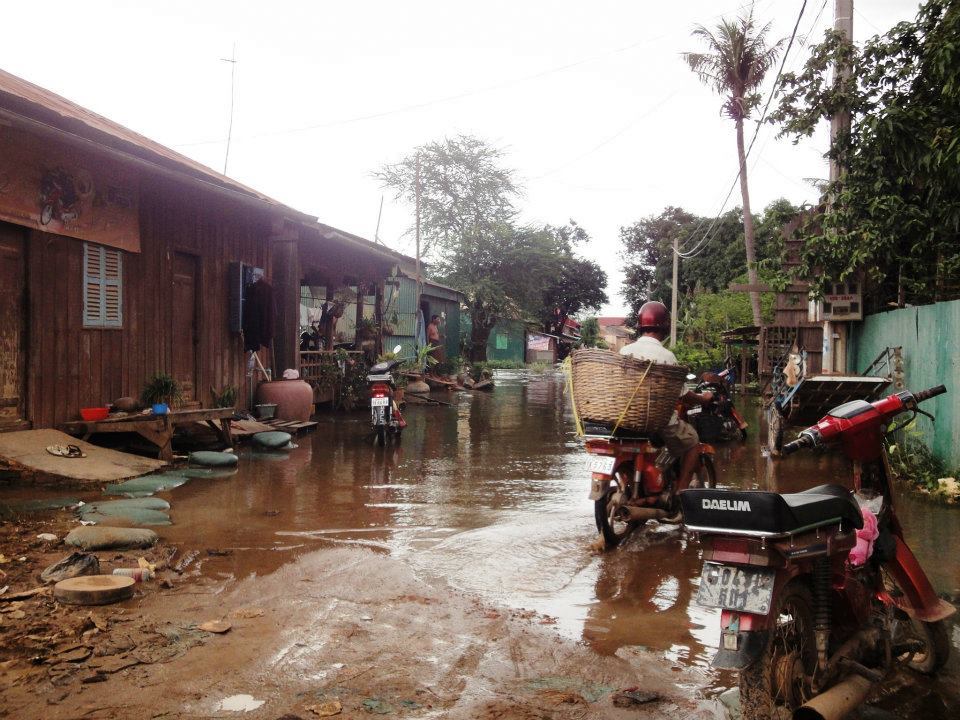 This photo and the next image are by Seang Kim. The other photos in this essay are by Erin Ann McBride. The cover photo is by Riverkids.
I’m on the verge of gagging and crying. The smells are overwhelming, the scenes around me depressing. We choose not to walk through the knee-deep water, but I watch as a young boy crosses through it to go in another apartment.
We turn down a different walkway/alley, and I see a cute, little, naked boy. He runs up to me, squealing happily as he does. When he gets closer I realize how deformed his little body is. His legs are twisted, his eyes slightly crossed. His arms are too skinny, and I can see his ribs. His head bobs too much and I can tell he isn’t focusing his eyes. I’d bet my right foot that he has cerebral palsy from a birth defect and malnutrition. I look at the elderly woman providing for him and realize explaining these things to her won’t help anyone.
Everything is covered in trash. It’s disgusting. Trash and debris just floating in the water, and the water is in their homes, covering the paths they can’t avoid. We walk over to the room where the trash gets weighed. John has made $1 today, but normally he makes $2.50 each day. (He was also compensated by us for his time, and given breakfast.) The trash shack is overwhelming with horrible smells and debris everywhere, and I hate seeing a young boy standing in there.

I’ve seen enough. The water, the trash, the sickly people — it’s too much and I am ready to leave. My emotions are running high. It physically hurts to see any human being living in these conditions. Thinking of the foreigners- friendly restaurant I ate at the night before just five minutes away drives a knife into my heart. The disparity between the haves and have-nots is too much to digest.
As we walk out I see the thing that sends me over the edge. I’ve seen many dogs in this town. Most look healthy and cared for. People here take them in as pets. But a little dog is following us out of the slum. Her white coat is covered in tiny black bugs. Her eyes are oozing and red, and I suspect she’s mostly blind. There are sores all over her. Her teats are uneven, swollen, and even from a distance I can see they are infected. Her bones protrude everywhere. I have never seen so much disease, sickness, and filth on one living thing. I began to cry, and had to disappear around a corner to hide my emotions.
I quickly rummaged through my purse, desperate to find something to kill this dog. It was so sick that killing it was the only humane thing to do. I couldn’t find anything, and looked on the ground around me — a big rock, anything. I have to put this poor dog out of its misery. I have never felt like this before in my life, and it makes me cry harder.
My tour guide had mysteriously disappeared as well, just to come around the corner with tears streaming down her face. I told her what I was thinking. She didn’t look shocked or upset. She nods at me, and understood what I meant to do. She walked over to a street vendor to buy some meat for the dog. For a moment I stood at the edge of the busy road, wondering if I could throw the dog into the road where someone could hit it. Not only does my own thought sound perverse to me, but I’m more upset by the next thought that crossed my mind — I can’t throw it into the road without touching it, and I can’t bring myself to touch it. I find myself caught between being too selfish and too caring at the same time, and break down crying.
It was not just the dog. The dog was the worst of it, and that pushed me over the edge. But this little dog is indicative of the slum as a whole. Disease and filth everywhere, and people (and dogs) who know nothing different. The people who live here don’t know how to leave — it’s all they know.
We leave John and the watery slums behind and continued our tour of the side of life most people prefer to believe doesn’t exist. Except I was being forced into accepting its existence in a very real way. We worked our way over to a different neighborhood not even two minutes away by car. Our “tuk-tuk” driver dropped us off in the middle of the neighborhood at the Riverkids school. Instantly a chorus of “Hello! Hello!” started up.
Every little kid in the slum knows that the white people at the Riverkids school speak English, and many of them have been taught English by a white person at this very school. If nothing else, they all seemed to know how to say “Hello!” I couldn’t walk past two doors without a small child come running out to scream “HELLO!” at me. And because I am a sucker for cute kids in every country, I had to yell “HELLO!” back each time.
At first I was easily mesmerized and fooled by the cute army of children following us around, yelling greetings every few seconds. It was all so sweet and fun. I felt like I had my own merry band of paparazzi for a few minutes. But slowly but surely I started to notice the details behind the children. One child with an infected sore, another covered in bites, teeth rotting, bellies protruding, and the general look of neglect you see in the slums.
We passed from house to house, shack to shack, in a dirty, dingy neighborhood. At first it didn’t feel all that bad, but something wasn’t sitting quite right. And then it hit me. Doors. No one had a door. I looked in past the doorways and realized how few of the homes had anything in them. Most homes had nothing more than a few large bowls, and a mat on the floor. No chairs, no shelves, nothing. Just a few bowls for cooking and doing laundry in, and a mat on the floor.
We turned at the end of a street, up over a small grassy area, leaving the greetings paparazzi behind, and found ourselves by the railroad tracks.
I already knew what this meant.I had visited one of the railroad communities earlier in the week.
In Cambodia the train system is nearly obsolete. The tracks are still in place, and trains still run. But they do not run on time, if and when they even bother to run.
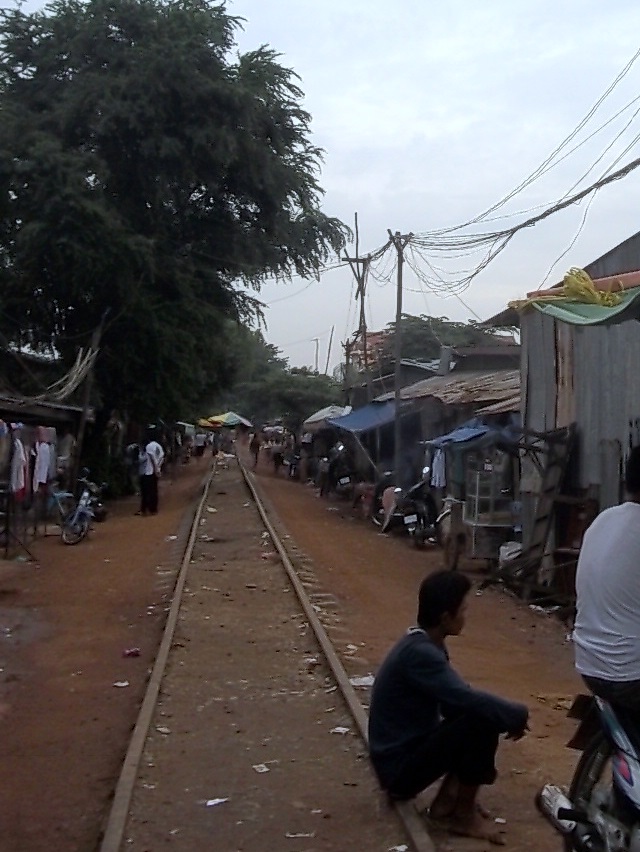 The slum communities that are, at best, very industrious and ingenious in their ways of making the most out of nothing, have moved in around the tracks. The tracks serve multiple purposes — a sidewalk, something to sit on, a great way to spread out anything that needs to be dried, and of course, a trash can. Just eight feet away on either side of the tracks, people have built their humble shacks.
These slums make the neighborhood we just left look downright ritzy in comparison. These homes are built out of scrap wood, sheets, and junk. Everything looks like it never gets quite dry. I stumble along the train tracks to an on-going chorus of “hellos,” from a new band of paparazzi. Riverkids has a school in this slum as well. A few of the women come out of their homes and excitedly wave and smile at me, recognizing me from my previous visit.
Along the train tracks I step over litter, discarded food (never wasted food, but food that has gone bad, or the bones, or peels), coconut husks, little children, clothing, and all the other detritus of life. I notice a little cubicle held up by sticks and old shirts (by slum standards), and see a little boy run in and out of it. It’s the toilet for the neighborhood.
Intermittently throughout the slum I still see shops selling food, meat, and hygiene products. I stop and briefly look at the products of one store, painfully aware of the large audience I attract by doing so. There are strips of meat placed neatly around a plate, covered in flies, and sitting out in the blazing sun. There is a large bowl of fish.
A woman comes up to buy a fish, and the shopkeeper reaches in, pulls out a fish, and whacks it over the head to kill it. I do my very best to not look completely stunned. The “fresh” meat is threatening to make me gag. I can see little tiny worms moving on it.
I turn towards the other products in the “store.” I use “store” loosely. It is still nothing more than a shack, but it has a table out front, and an umbrella over the top. The products are all displayed across the table, or are hanging from the umbrella. I look closer at the umbrella at the little tiny packets of glittering foil you see so often around Phnom Penh. There is soap, shampoo, and condoms. There are always condoms. Why? Because so many of the women in the slums are sex workers, and they need to buy them for work.
We continue our walk along the railroad. I do see the efforts of other NGO’s in the slum. Someone has built a “women’s center” where the women can go in and take showers, see a nurse, and get help if they have been abused. I’m not sure, but it also looks like the center offers cleaner toilets than the tiny cubicle I saw earlier.
We stop in at the Riverkids school for a few minutes. The main room is also the classroom. It is about 20×30 feet wide, with a large section of the ceiling missing. The roof leaked and the roof and ceiling had to be repaired. Classes for the children have to be canceled when it rains.
In this room about 40 children go to school. Half of the children face one wall, and the other half face the other. This is the kindergarten and first grade. It can get very noisy and loud in there! There are a few plastic chairs around, but the children sit on mats on the floor.
To a Westerner, this may sound like the school is no better than the rest of the slums. But this building is far nicer than what the children have at their homes. Riverkids helps families and fights child trafficking by keeping children in their neighborhoods. The children in this slum cannot afford to attend state school (which is not free).
Some would solve this problem and “help” these children by taking them out of the slum and and away from their families by sending the children to an orphanage. More children in Cambodian orphanages have parents than do not. Riverkids believes educating the children in their homes, where their skills and knowledge can benefit their communities, is best. These children have the chance to set an example in their communities, be leaders, and help others escape the generational cycle of poverty.
Again I feel like I have seen enough of the slums. They have no privacy and no protection there. Before we leave the train comes through. It goes very slowly and screams its whistle as it passes by. Nobody really cares or changes their activities for the train, except one mother I see go out and pick up her naked toddler off the tracks. She doesn’t rush or seem alarmed. This is just life in this slum, where a train passing within inches of a toddler by is a momentary inconvenience, and not a life-threatening event.
I glance at my watch. We are only three hours into my nine-hour tour. The rest of my story will wait for another day.
Southeast Asia has been suffering from unprecedented flooding over the past few weeks. Many of the slums, which reside next to the rivers, are receiving the worst of it. The government has little resources or assistance to provide. Some neighborhoods have been relocated out into the countryside. Families are picked up in buses, taken out to a new community, and offered a small remuneration, and left. On the one hand, the families are out of danger. On the other hand, without jobs, improvements, and access to new opportunities they are only being left to start a new slum.
Different charities, such as Riverkids, have stepped in to help the families suffering from the flooding. The government, with its limited means, is doing what it can. (Although there are many who feel the government could do more, but they are plagued by their own selfishness and corruption.) I am left to wonder why some people must suffer at the hands of others. Would I survive if I had to live in a slum? Why I was given so much more than my brother? What will I do to help ease the suffering?
Erin Ann McBride is a writer, dreamer, blogger, and service volunteer. Equal parts Mary Poppins, Carrie Bradshaw, and Mother Theresa, she goes where the wind blows, writes about single life, and is devoted to helping others. You can read more about what defines her and her travels in Cambodia at the Story of a Nice Mormon Girl.
Send a message to future friends and family that you care about the gospel and Latter-day Saints in today’s world by becoming a fan of <a href="https://www.
<hr class=’system-pagebreak’ ></a><hr class=’system-pagebreak’ ></a><hr class=’system-pagebreak’ ></a><hr class=’system-pagebreak’ ></a><hr class=’system-pagebreak’ ></a>facebook.com/LDSmag”>Meridian Magazine on Facebook!