If you have not yet received it, there is a treat coming to your mailbox. The October issue of the Ensign is entirely devoted to The Book of Mormon, and it provides a timely introduction to the scripture that the whole Church will be studying in Gospel Doctrine next year. This special issue features the testimonies of apostles and prophets, as well as the experiences of ordinary Latter-day Saints from around the world, all bearing witness of the significance and power of the Nephite record.
There are articles about the coming forth of the Book of Mormon, apostolic essays about its key themes and teachings, and a reprint of one of President Benson’s most memorable conference addresses: “The Book of Mormon: Keystone of our Religion.”
As is usually the case with The Book of Mormon, there is still so much more that could be said about its message, its miraculous origins, and its worldwide impact. There are hints in the Ensign of additional information and insights, but the constraints of space and an international audience limited what could be included. On p. 78, a bulletpoint notes, “For more information, articles, and explanations, see lds.org/study/topics/book-of-mormon?lang=eng.”
The resources there — consisting entirely of articles from Church magazine and manuals —are helpful, but for Meridian readers with access to the Internet and English-language books, it is possible to identify some additional reliable resources, written and published by faithful Latter-day Saints, including several that have appeared only in the last few years.
Female Witnesses of the Golden Plates
On p. 77, in answer to the question “Who else saw the golden plates?”, the editors state, “In addition to Joseph Smith, several other men and women saw the plates and testified of their existence.” They go on to briefly describe the Three Witnesses and the Eight Witnesses, but readers might reasonably ask, “Can you tell us a little more about the women who saw the plates?”
Although I’m not exactly sure who the editors had in mind when they wrote their answer, we know of several women who saw or even held the Nephite record wrapped in cloth. Joseph’s younger sister Katherine reported that when he first brought home the golden plates, after being attacked by several unknown assailants on the way, she took the package containing the plates from him and laid it on a table until he could catch his breath again.
His wife Emma, in an interview with their son Joseph III in 1879, described her own experiences with the plates as follows:
Q. Are you sure that [Joseph] had the plates at the time you were writing for him?
A. The plates often lay on the table without any attempt at concealment, wrapped in a small linen table cloth, which I had given him to fold them in. I once felt the plates, as they thus lay on the table, tracing their outline and shape. They seemed to be pliable like thick paper, and would rustle with a metallic sound when the edged were moved by the thumb, as one does sometime thumb the edges of a book. [Another except from this same interview appears in the October Ensign, pp. 8-9.]
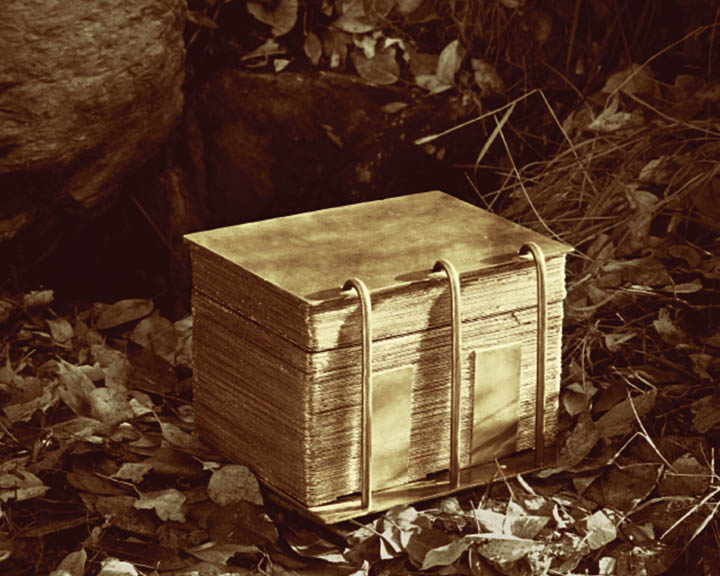
In 1842, a visitor to Nauvoo wrote about a conversation with Joseph’s mother, Lucy Mack Smith, in which she affirmed: “I have myself seen and handled the golden plates; they are about eight inches long, and six wide; some of them are sealed together and are not to be opened and some of them are loose. They are all connected by a ring which passes through a hole at the end of each plate, and are covered with letters beautifully engraved.”
We are not sure whether he was embellishing a bit (he goes on to say that Lucy had also seen the breastplate with the interpreters, when we know by her own first-hand account that she had only felt them through the cloth that covered them), or perhaps Lucy was referring to an otherwise unknown event, but in any case there a report of another woman who definitely saw the plates directly.
When Joseph, Emma, and Oliver moved in with the Whitmer family to finish the translation, the mother there, Mary Musselman Whitmer, found that her workload had significantly increased. Her grandson told the story this way:
My grandmother in having so many extra persons to care for, besides her own large household, was often overloaded with work to such an extent that she felt it to be quite a burden. One evening, when (after having done her usual day’s work in the house) she went to the barn to milk the cows, she met a stranger [identified in another version as Moroni] carrying something on his back that looked like knapsack. At first she was a little afraid of him, but when he spoke to her in a kind, friendly tone, and began to explain to her the nature of the work which was going on in her house, she was filled with inexpressible joy and satisfaction. He then untied his knapsack and showed her a bundle of plates, which in size and appearance corresponded with the description subsequently given by the witness to the Book of Mormon. This strange person turned the leaves of the book of plates over, leaf after leaf, and also showed her the engravings upon them; after which he told her to be patient and faithful in bearing her burden a little longer, promising that if she would do so, she should be blessed; and her reward would be sure, if she proved faithful to the end. The personage then suddenly vanished with the plates, and where he went, she could not tell. From that moment my grandmother was enabled to perform her household duties with comparative ease, and she felt no more inclination to murmur because her lot was hard.
I quite like the striking contrast between Mary Whitmer’s miraculous account and Emma Smith’s matter-of-fact reporting (at another time Emma said that she used to lift and move the covered plates while she was dusting). Both are impressive testimonies in their own way, much like the contrast between the Three Witnesses who saw an angel show them the plates, and the Eight Witnesses who handled and turned the pages themselves, with no divine intervention at all.
Most of the accounts above can be found in John W. Welch, ed., Opening the Heavens: Accounts of Divine Manifestations, 1820-1844 (Provo: Brigham Young University Press, 2005), which can be purchased here, or you can simply download the chapter on the Book of Mormon translation here for $2 and it will be sent to your computer within minutes. The story of Mary Whitmer is a little harder to find (it appears in my Reader’s Edition of the Book of Mormon on pp. 639-640), but it was originally published in official Church publications in the 1880s and then was made into a BYU movie titled The Fourth Witness: The Mary Whitmer Story in 1997.
Textual Issues
One of the most exciting developments in the study of The Book of Mormon over the past couple of decades is Royal Skousen’s Critical Text Project, which analyzes all the changes that have occurred from the original manuscript through the current official edition (1981), and which also offers a scholarly reconstruction of the text as it was first dictated by Joseph Smith to his scribes.
So when the question is posed in the October Ensign at p. 79, “I have heard that changes have been made to The Book of Mormon since it was first published. What was changed and why?”, we have more evidence than ever before to answer this clearly and comprehensively.
The Ensign, limited by space and audience, gives a few good examples of inadvertent copying errors that were subsequently corrected in later editions, but this doesn’t really get at the heart of the issue, which concerns deliberate changes to the text. There have been several thousand of these since 1830, almost all of which are grammatical revisions such as which to who, or was to were.
Very, very few of these affect the meaning at all, and there has been no reworking of the Book of Mormon’s complicated narratives or extensive sermons. In fact, there are only eleven instances where Joseph Smith added or changed a few words to clarify doctrine or a name.[1]
I do not know why the Lord saw fit to reveal The Book of Mormon in a non-standard grammatical form, but that’s what happened, and Joseph Smith himself smoothed out much of the language in the 1837 and 1840 editions (he even deleted 46 instances of “it came to pass”!). Thanks to Skousen’s work, The Book of Mormon is probably the most thoroughly documented scriptural text in history, meaning that we can track its progress from its first written form to the present official version in minute detail.
Consequently, we can be sure that The Book of Mormon as we have it today is virtually the same text that Joseph first dictated to his scribes, aside from grammatical updating. If you are interested, here is a photographic reprint of the 1830 edition that you can read online, and Skousen’s Book of Mormon: The Earliest Text (published by Yale University Press in 2009) gets us as close as humanly possible to the original moment of revelation. For more on Skousen’s work, you can check out a four-part series that ends here here and then follow the links at the bottom to the earlier installments.
And this webpage at the Foundation for Apologetic Information & Research (FAIR) has links to several great articles on the subject of changes in The Book of Mormon, all instantly available at the click of a mouse.
The October Ensign (p. 79) reminds us that the present chapters and verses were added later in the history of the text (in 1879 to be exact; Joseph Smith only read The Book of Mormon in paragraphs).
It is also worth noting that the punctuation was introduced by John Gilbert, the non-Mormon typesetter for the 1830 edition. This means that the divisions into clauses and sentences were not part of the original revelation.
Sometimes this can make a difference in how we read. For example, Elder Andersen observes on p. 43 that in The Book of Mormon, “the specific roles of women and daughters are to some extent unmentioned,” which is why we treasure those few verses where they are highlighted, and why the praise of the young stripling warriors for their mothers is quoted not once, but twice in the special issue (pp. 45 and 46): “”We do not doubt our mothers knew it” (Alma 56:47).
This is intelligible — it indicates that the young men were sure that their mothers had testimonies — but Royal Skousen has argued that it would make more sense if there was some sort of punctuation break between the words doubt and our: “We do not doubt; our mothers knew it.” Or, in other words, “We do not doubt [that God will deliver us; after all,] our mothers knew it” — a sentiment that fits the context a little better (and still honors mothers). Ultimately, their faith was in God, not in their mothers, but the two elements were certainly closely related. See Royal Skousen, Analysis of Textual Variants of the Book of Mormon, Part 5 (Provo: FARMS, 2008), 2745-2746 or this essay in Insights, where I made a similar suggestion independently.
Look for Part 2 of this article to appear in a couple days in Meridian.
Grant Hardy is the editor of The Book of Mormon: A Reader’s Edition (University of Illinois Press, 2003) and the author of Understanding the Book of Mormon: A Reader’s Guide (Oxford University Press, 2010). His most recent publications include the Oxford History of Historical Writing, Vol. 1 and Great Minds of the Eastern Intellectual Tradition, a 36-lecture cd/dvd course produced by the Great Courses. Hardy is a professor of History and Religious Studies at the University of North Carolina, Asheville.
[1] 1 Ne. 11:18, 21, 32, 12:18, 13:40; 20:1, 2 Ne. 30:6, Mosiah 21:28, Alma 5:48, 13:9, Ether 4:1. The exact changes are specified in appendices in both my Reader’s Edition and in Skousen’s Earliest Text.