







This summer I fulfilled a long-time dream and spent a week studying at Oxford University. It was an amazing experience.
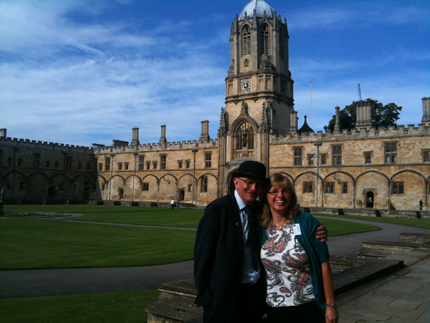
I lived in the dorms at Christ Church, built over 500 years ago by Cardinal Wolsey. My room was up six flights of stairs!
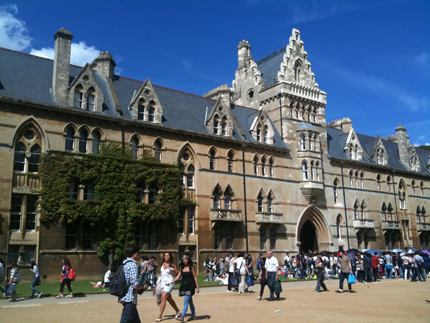
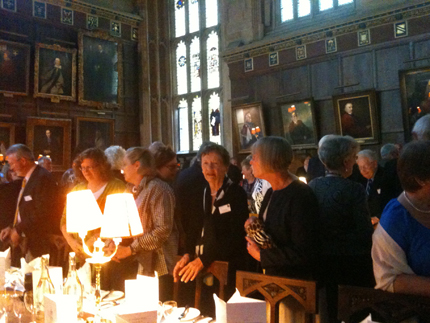
I ate my meals in the Great Hall that appears in the Harry Potter movies – it was hard not to expect owls to swoop in, and a few ghosts, but I didn’t see any. These are members of my class standing, as we did each evening, until the Dean enters and says Grace in Latin.
Each morning I attended my seminar on the Bronte sisters and their novels, studying with an Oxford Professor, called a Tutor, in her wood-paneled office.
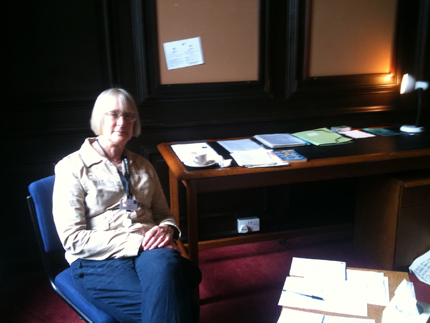
I spent many happy hours with twelve fascinating women discussing Jane Eyre and her remarkable creator, Charlotte Bronte. Here are some highlights of our discussions (just to save you the plane fare.)
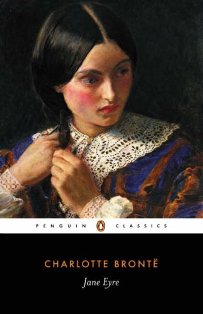
Jane Eyre: The Dangerous Life of a Good Person
G.K. Chesterton described Jane Eyre as the story of “the dangerous life of a good person.” Chesterton (author of the Father Brown Stories, among other wonderful books) was a devout Christian, a mentor to C.S. Lewis and a shrewd literary critic. I love to read what he has to say about my favorite books. He did not buy into the idea that evil is interesting and good is boring, but, on the contrary, believed that really good fiction ought to deal with really good people. And Jane Eyre does. Trying to be good in a wicked world can be dangerous, and it nearly kills Jane! But she triumphs, and it’s a wonderful journey. One reader described Jane as a “spitfire” of a kid, and Joyce Carol Oates speaks of Bronte’s “barely suppressed rage.” She has so much anger there that she must learn to assimilate into her nature and use in a positive way. So must we all.
The twelve members of our class each found something different to admire in the novel. Ita, an Irish clinical psychologist, saw the eternal struggle of the id versus the ego – the mad woman in the attic versus the controlled, restrained governess Jane. Her daughter Olga, a teacher at an inner city school in London and a 32-year-old career woman, saw how no matter what women achieve, they really long for a man and children! Anne, the refined art historian from Boston, saw the eternal struggle of the woman to find self-worth, and Jane’s need to control. (She ends up in total control of Rochester’s life.) Helen, the high school teacher from Northern England, noticed all the patterns and pairings: Rochester and Rivers, Jane and Bertha, the Rivers sisters and the Reed sisters and the Bronte sisters! And on it went. Each was touched in a different way.
I think Jane Eyre is a great example of why we read. We read for the story of course, and to be lifted out of our lives into a fantasy world, and all of the gothic and romantic elements in this novel give us that kind of fun release. But this would not be a great book unless there was more, and there is. While offering a fanciful, fictional story, it also offers us a true and believable character. Tiney, determined Jane is someone we want to know, and want to go on knowing throughout our lives. When we come back to the novel after a decade or so, our lives inform the reading and the reading informs our lives. A great book grows with you and you grow with it; there is always something more there to find. Above all, it offers you some wisdom about your own life that is useful. So here, in tribute to Jane, are a few of her greatest moments:
“It is in vain to say human beings ought to be satisfied with tranquility: they must have action; and they will make it if they cannot find it. Millions are condemned to a stiller doom than mine, and millions are in silent revolt against their lot. Nobody knows how many rebellions besides political rebellions ferment in the masses of life which people earth. Women are supposed to be very calm generally: but women feel just as men feel; they need exercise for their faculties, and a field for their efforts, as much as their brothers do; they suffer from too rigid a restraint, too absolute a stagnation, precisely as men would suffer; and it is narrow-minded in their more privileged fellow-creatures to say that they ought to confine themselves to making puddings and knitting stockings, to playing on the piano and embroidering bags. It is thoughtless to condemn them, or laugh at them, if they seek to do more or learn more than custom has pronounced necessary for their sex.”
“I care for myself. The more solitary, the more friendless, the more unsustained I am, the more I will respect myself. I will keep the law given by God, sanctioned by man, I will hold to the principles received by me when I was sane, and not mad- as I am now. Laws and principles are not for the times when there is not temptation: they are for such moments as this, when body and soul rise in mutiny against their rigour; stringent are they; inviolate they shall be. If at my individual inconvenience I might break them, what would be their worth? They have a worth, so I have always believed, and if I cannot believe it now, it is because I am insane – quite insane with my veins running fire; and my heart beating faster than I can count its throbs. Preconceived opinions, foregone determinations, are all I have at this hour to stand by: there I plant my foot.”
“I am no bird and no net ensnares me. I am a free human being with an independent will.”
You go, girlfriend.
And, in case you’ve just read Jane Eyre, here is a companion novel from a different generation:
Jane Eyre’s Younger Sister: Rebecca, by Daphne du Maurier
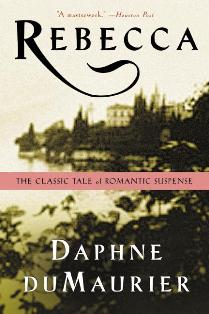
“Sometimes it’s a sort of indulgence to think the worst of ourselves. We say, ‘Now I have reached the bottom of the pit, now I can fall no further,’ and it is almost a pleasure to wallow in the darkness. The trouble is, it’s not true. There is no end to the evil in ourselves, just as there is no end to the good. It’s a matter of choice. We struggle to climb, or we struggle to fall. The thing is to discover which way we’re going.”
This brief quote by Daphne du Maurier encapsulates, for me, her allure as a writer. It’s hard to find an actual villain in a du Maurier novel. Even when the “villain” is revealed, the reader has been forced to question the motives and actions of everyone in the story. We are tempted to say, with Pogo, “we have met the enemy, and he is us.
” In her stories Du Maurier created an amalgem of mystery, thriller and horror, with a dash of the paranormal thrown in, that is always unsettling. Hitchcock filmed three of her works: “The Birds,” Jamaica Inn and her most famous novel, Rebecca, which won the Oscar for Best Picture in 1941.
If you haven’t read Rebecca (or if, like me, you haven’t read it for a couple of decades and can’t remember it!) you must start there. It is her masterpiece, and begins with the haunting first line, “Last night I dreamt I went to Manderley again.” This line, set in iambic hexameter (that is six heartbeats: pa pum pa pum pa pum pa pum pa pum pa pum) alerts us to the musical nature of du Maurier’s prose. She is a gorgeous writer. Set in a lonely West Country Estate, it takes place at this very time of year, the end of summer. The story bears a resemblance to Jane Eyre, (a first wife that haunts the scene, the powerful husband, the blazing finale) and shares the same point of view: first-person narrator telling the events from a distant perspective, after all the excitement is over. As in Jane Eyre, we experience the maturation process of a remarkable woman as she moves from a position of innocence and subservience to one of wisdom and, ultimately, control.
I was curious to read more of Du Maurier’s work, and just finished The Flight of the Falcon. Set in Italy, it is the only book I’ve ever read that features a tour guide as its protagonist. (I once worked as a tour guide, so I found that interesting.) It’s a curious story about, among other things. family bonds and the many ways war wounds its survivors. Though it does not reach the level of Rebecca or My Cousin Rachel, I enjoyed it, and if you are desperate for a dash of du Maurier’s magic, ’twill serve.
Daphne du Maurier, born in 1907 in England, was reared in a family of creative people. Her parents were actors, her uncle and grandfather were artists, and her cousins were the boys on whom J. M Barrie based his play, Peter Pan. She began writing stories at a very young age, and in 1938 Rebecca made her a celebrity. In her later life she wrote biographies and more “serious” works, but for many decades her strange, romantic novels topped the “most borrowed” lists in libraries here and abroad.
So my first recommendation for a great end-of-summer read: take Jane Eyre off the shelf and read one of the greatest books ever written. Then watch the latest film adaptation (just out on DVD) and write me a review – what do you think? Then, when you’re finished with Bronte, you might want to take a dip into the swirling pool of human possibilities, both for good and evil, stirred up by Daphne du Maurier. By the way, both Jane Eyre and Rebecca are great books to share with a teenager too – an inter-generational bonding experience! Enjoy, and share your reactions on my blog at www.backtothebestbooks.com.