




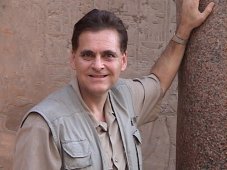


George Potter has lived in Arabia for twelve years. During the last eight years he has explored Lehi’s trail and has co-authored a new book, Lehi in the Wilderness. More information can be found at www.nephiproject.com.
Part Two: Read Part One Here
Before setting off into the ‘out back’ of Arabia, on what was to be my first expedition in this vast desert, I studied the account of the children of Israel in the books of Exodus and Deuteronomy. Only then did I agree to join Craig Thorsted and Tom Culler in their hunt for the mountain of Moses. In the previous article I described finding the mountain, and explained why we believe it is the real mount Sinai. But the question remained, how did the children of Israel reach the mountain? We may have discovered the route of the Exodus.
Our journey of discovery started in the city of Tabuk on 9 May 1995. Tom Culler had arranged to meet at our hotel a Saudi who was a friend of a friend of a friend of his, and obviously an Arab none of us had ever met before. Tom was told that the man we were to meet knew Bedouins nomads who could show us the mountain of Moses.
Our first surprise came when the man actually showed up. After a brief meeting, he excused himself stating that he needed to talk to a friend about getting us to mountain. As it turned out, our guide-to-be was a city Arab who had no idea where the mountain was. However, he hunted in the mountains and had befriended Bedouins. A half hour later, the man returned with a noble looking young Bedouin. This nomad spoke not a word of English, so our city Arab became a God-sent interpreter, and now we had a way of unlocking the secrets of the nomads who lived near the mountains.
The Bedu brought to the expedition a beefed up desert-ready Land Cruiser. Now we were ready to head northwest toward the area where allegedly Mount Sinai was located. We followed the Bedu’s Land Cruiser for an hour, until they suddenly pulled off the road just short of the tiny village of Zehar. “Leave your jeep here”, the city Arab said. “We want to show you something.” Craig Thorsted, Tom Culler and I climbed into the back of their short-bed cruiser, and off we went across very soft sands and up a wadi to the north. The engine roared as the Land Cruiser struggled in the soft sand. No wonder they wanted us to leave our 4 by 4 — it would have never made it through the soft sand.
Water in the Desert
 The wadi was a beautiful canyon, with sand stone cliffs rising a thousand feet tall on both sides. Roughly two miles up the wadi the Bedu headed the Land Cruiser toward the west side of the canyon. I knew something unusual must be there, for I saw a half dozen fig trees growing next to the edge of the cliff. In my 12 years in Arabia, that is the only time I’ve seen fig trees growing in the wild. My first thought was that there must be a spring giving life to the figs.
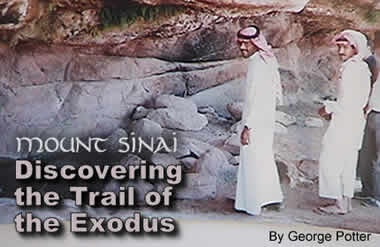
However, that wasn’t what we saw. Instead, at several places along the bottom of the cliff were overhangs where water was literally dripping out of pure stone. Below the overhangs, pools of pure water accumulated. The Bedu said something in Arabic, and our city Arab translated what he said. “Here is where Prophet Musa (Moses) struck the stone and water came out of the rock”.
If so, this wadi was a campsite of the children of Israel. And whether this was where the miracle took place or not, Moses would have known about the various water resources in these mountains of Midian. For years, he watched Jethro’s flocks in the valleys of Midian (Qur’an 28:27-20). Exodus tells us that Moses kept Jethro’s flocks on the “backside” of the desert. Since the ruins of the town of Midian, where Jethro lived, was southwest side of these mountains, the northeast side, where we were standing beside the pools of water, must have been on the backside (Exodus 3:1). On returning from Egypt, Moses would have taken the children of Israel to where he knew he could find water, perhaps even to a site were water was stored in sand stone cliffs.
Water dripping from sand stone cliffs is rare, but not unheard of. An example of such a phenomenon is found in Zion’s Canyon National Park. Of course, what would have been unique is if this oral tradition of the Bedouins is true; that is, the water started flowing from the rock face when Moses struck it with his staff.
Beyond the Guarded Gates
We returned to the highway and again headed west. In five minutes we came to a fenced compound that consisted of a gasoline station, a police post and a heath clinic. This was Zehar. This would be our last chance to gas up before heading deep into the wilderness. While we filled our thirsty tanks we noticed our Arab travel mates talking with another Bedu who joined our party by jumping in their Land Cruiser. We were told that this newest member of the tour could get us permission to enter the guard gates to the road that led up Jabel al-Lawz, the mountain that was alleged to be mount Sinai.
This was important, for during the previous two years, the US government was building for the Saudis a huge radar and communications facility on the very top of the Jabel al-Lawz. What bad luck! Here we were trying to find the artifacts of mount Sinai and the top of the mountain was being transformed into a $700 million military facility. Without a way past the gates guards, our expedition would be short lived. So now we had a translator, a Bedu with a Land Cruiser who knew the Mosaic folklore of Midian, and now someone who claimed he could get us through the gates. Who else was needed? We soon found out.
We rejoined the highway for a few miles, but then turned south onto a dirt road. A few miles along the road, the Land Cruiser stopped, and the city Arab walked back to our truck. He told us we had to wait there while his Bedouin friends went a short distance up a wadi to the camp of the gate buster’s father. If we followed them into the camp, we might accidentally see the women of the camp without their veils and shrouds. He said they needed to get a rifle in case they saw rabbits or wolves.both game the Bedouins hunt for food. Now things were getting interesting. We were miles off the nearest highway, in an area known to harbor anti-American sentiments, with Bedouins we hadn’t met until that morning, and now they were getting guns!
Soon they returned, but now there was not one, but two Land Cruisers. The one with our guides came first, turning back onto the dirt road and then heading on in the direction of the tallest mountain in the area, Jabel al-Lawz. Following them in his truck was a noble old Bedouin, slim, muscular and beared. Joining the old man in his truck was another long-beard, a goat staring at us through the back of his Land Cruiser. We followed the old Bedu’s Land Cruiser and the goat up the foothills of Jabel al-Lawz. Through the dust, we could see that the goat had that worried look, meaning he would soon be our lunch.
Roaring up Jabel al-Lawz
We roared at high speed up the hills toward the Jabel al-Lawz military project. Long whirl winds of dust trailed each vehicle. Craig and Tom had tried on an earlier expedition to get permission to enter the military zone, but were refused. The radar installation was no common installation, from the top of Jabel al-Lawz, at 7,890 feet, the radar system would be able to scan deep into Israel, Egypt or Jordan to give the Saudis an early warning on any unwelcome aircraft.
As we came to the gate, the young Bedouin from the gasoline station walked to the guard house. After a minute or so, he left the guard house, spoke a few words to the guards at the gate itself, and waved us forward. Like magic the guards opened the gate. All we could figure was that we were granted permission into the area because the Bedouins had grazing rights to the land, and could enter the area whenever they needed.
Beyond the gate was a wide two lane gravel road, which led directly up the mountain. The grade of the road was incredibly steep, probably to leave a minimum aerial foot print to give away the radar facility to an enemy. At one point we came upon a mangled Mercedes semi truck and trailer lying in ruins next to the road. It must have lost its brakes, and tumbled down the mountain until it smashed directly into a cliff face. The cabin was crunched into half its former size, and was torn completely free from the truck’s frame. A few years away from found the front axle. The city Arab simply said, “one man lost. “
 The sight of the accident didn’t slow down the Bedouins. Like mad men the Bedouins continued up the mountain as fast as their trucks could climb. I was driving my truck and tried as best I could to keep up, and stay on the road despite all the dust. It reminded me of a race up Pikes Peak in Colorado, but we were losing the race to an old man and his goat.
After twenty minutes we finally came to the top of the mountain. The entire summit, perhaps two acres in all, was covered with a thick layer of cement. When we stopped, we were parked upon a huge bunker. We looked down a vent hole and saw that the bunker had several stories inside. This we realized would be for foundation for the large radar tower. How ironic we thought! If this was once a sacred mountain, it was now a sophisticated weapon of war.
View from the Summit
From the summit we beheld a marvelous view. Looking south we could see a granite saddleback and other large mountains that were nearly as high as Jabel al-Lawz. To the east, were the rugged hills in a barren desert. To the north, we could see into Jordan and Israel. To the west, we could see as far as the Gulf of Aqaba of the Red Sea. We could even see to the southwest the southern tip of the gulf, Ra’s Ash Shaykh Hamayd (Straits of Tiran), a possible site for the crossing of the Red Sea by the children of Irsael. The older Bedouin pointed out to us the location of his tent in a wadi off to the east. It was obvious that these mountain valleys were laden with enough good pastures that they could have supported the great herds of cattle, goats, sheep and camels of the children of Israel.
The old Bedouin said something in Arabic, which we were told was his declaration that this was the mountain of Moses. However, we left the mountain believing that if it was Sinai, there were no artifacts to that effect, and now that its summit had been desecrated we would probably never be able to find them even if they had existed at one time. We descended the mountain at an even greater speed than we climbed it. A few miles before the gate our small convoy suddenly stopped. Our city Saudi informed us that the old Bedouin wanted to invite us to lunch. Good news for us, bad news for the goat.
Considering that our new friends had obtained permission for us to go to the top of Jabel al-Lawz, we could not refuse the old man’s offer. Besides even though we were pressed for time, it would have been a great loss of face for the old man if we refused his hospitality in front of his son and his friends. We accepted the offer, and consoled ourselves to the fact that our exploring was over for the day.
Unforgettable Meal
We followed the old Bedouin’s Land Crusier into a side wadi, and finally stopped at a seasonal stream that had been dammed into small ponds. Next to one pool, we parked our trucks in a meadow of natural spearmint. The mint smelled refreshing after our dusty race up and down the mountain. Before we knew it, our guest, the old Bedouin, had the goat out of the back of his truck. He said, the traditional prayer of thanks and blessing to Allah, and performed the required Islamic slaughter, cutting the goat’s throat and holding the animal until all the blood was free from the body. Our host then left the goat with his son, while he built a shallow earth pit about three feet in radius and 6 inches in depth. In the meantime, the other Arabs had gathered branches from dead bushes and placed them in the pit. With some dry grass for kindling, the old Bedouin started a fire.
His son hung the dead goat roof rack on the back of the Land Cruiser, then skinned and butchered the animal. The head was removed and later buried. The stomach and pancreas were removed and left for wild animals. The remaining organs and meat were put into a large Kapsa pan – a two and a half foot wide pan with a depth of four inches. It reminded me of a giant pie tin.
 While the fire was reducing to coals, one of the Bedouin young men placed a teapot in the coals, to prepare traditional ‘gie’, the Arabic word for yellow tea. To not offend, we quickly lit a camp stove and heated water, claiming we wanted to try some wild mint for tea. They seemed glad to hear this, and advised us that the natural spearmint was very healthy to drink.
When our old Bedouin host stopped gathering wood, and started grinding rock salt. He seemed to have endless energy. As he worked, we talked to him through our translator. We learned that his name was Ibrahim and that he had four wives and twenty-five children.
As we enjoyed the spearmint tea, our guest’s son brought his father the meat, now cut into small pieces. The host turned his focus to the fire. It was now reduced to coals which he spread into a small circle. The fire had been built from small branches, not large pieces of wood, so the coals had a low temperature. Ibrahim rubbed each piece of meat in the ground salt then place it directly on the coals. After all the meat had been placed on the coals, the Bedouin turned the kapsa pan upside down and placed it over the meat. The pan was then covered with earth. Next, the Bedouin placed more branches on the mound of dirt that now covered the kapsa pan and started the branches on fire.
During this time, one of the Bedouins sounded the traditional Muslim call to prayer, and was quickly joined by the other Saudis in our company. The young Saudi then lead the pray, with the men forming a single line facing Mecca. The holy city was just six hundred miles to our south and that very week over two million Muslims had gathered from around the world to perform the “Hajj”, the Islamic pilgrimage.
 After the prayer, our high energy host built a second pit somewhat smaller than the first. A fire was started in that pit as well. As most of us were enjoying each others company, Ibrahim took a smaller kapsa pan and started mixing a bread batter consisting of white flour, salt and water. He worked the dough until it formed what look like an inch thick pizza crust. When the flames died low, he placed the bread directly on the coals, and covered the sides and top of the dough with coals from the fire.
Thoughts of Elijah
Witnessing this sight, Tom Culler reminded us that Elijah was fed this very bread as he journeyed to mount Sinai. Seemingly exhausted and hungry, the prophet “sat down under a juniper tree: and requested for himself that he might die; and said, It is enough; now, O Lord, take away my life; for I am not better than my fathers” (1 Kings 19:4). And as he lay and slept under a juniper tree, behold, then an angel touched him, and said unto him, “Arise and eat. And he looked, and behold, there was a cake baken on the coals, and a cruse of water at his head” (1 Kings 19:5-6). The angel appears to have feed Elijah twice before the prophet continued on his way to Mount Horeb (Mount Sinai) (1 Kings 19:8).
The feeding of Elijah in the wilderness is just another example of how the Bible has been misinterpreted. Over the centuries there have been hundreds of transmissions and transcriptions of the Bible, resulting in numerous errors. In 1 Kings 17:4 the text states that ravens feed the prophet Elijah. This is difficult to understand. Would the Lord have birds bring food to a prophet while he was traveling in a land where people lived? The fact that the Arabic word for “raven” is similar to “Arab”, has led some Bible scholars to conclude that the 1st Kings’ text should read “I have commanded the Arabs to feed thee there”. [i]
Elijah was provided another miraculous dinner. Fleeing the wrath of Jezebel, Elijah went into the wilderness where the Bible states that an angel fed him a loaf of bread that was bake on coals. Hugh Nibley tells us that wilderness usually meant desert in the Bible [ii] We know that Lehi’s and Moses’ wilderness meant Arabia.
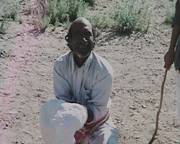 To me it makes no sense that an angel would appear from heaven, and then perform the chores of a Bedouin house wife of making a fire, mixing dough and baking a loaf on coals. I wonder if that the angel who baked bread for Elijah was a very real human angel who, acting on command from the Lord, provided food for his servant. Perhaps he/she was the ancestors of these Bedouins who to this day live near mount Sinai and still bake their bread in coals.
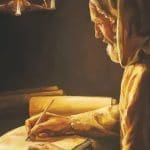
In reference to this Biblical event, the August 2002 edition of the Ensign Magazine shows a painting of bread being baked on coals [iii] . When I saw the painting, I immediately recognized this cooking technique, it was exactly the same used by Ibrahim the Bedouin.
As the flames subsided above the make-shift goat oven, Ibrahim recruited the others to help unearth the upside-down kapsa pan. Once exhumed, Ibrahim lifted away the pan to reveal steaming chunks of cooked meat still resting on the coals. As if oblivious to the heat of the sizzling meat, the old Bedouin flipped the pan over, and reached down and picked up the perfectly roasted chunks with his bare hands and sat them in the pan.
Next Ibrahim brushed away the coals from above and around the sides of the bread, then retrieved the flat loaf from its bed of blacken the coals. He then picked up a smooth rock and rubbed it over the bread removing the remaining black cinders. Once the primitive cleansing was finished, the loaf was placed on an empty flour bag and placed in the center of our circle where we were sitting and drinking our different teas. Sitting on the ground, with not a sign of utensils or other western eating formalities, I said a silent prayer we’d not get sick.
As I opened my eyes, I was wondering if the Lord had heard my prayer. In front of me Ibrahim had placed a tin of something foul looking. It was a mixture of full goat yogurt and goat fat all blended with a few goat hairs. The city Arab saw that we were perplexed as to what to do with the mixture so, he smiled, took a piece of bread and dipped in the tin. I followed suit, but didn’t smile, it tasted like Crisco, sour milk and cat’s whiskers.
Before I could force the bread down, one of the young Bedouins honored me by taking a choice piece of goat liver and threw it to me. Good choice, for there’s nothing like goat liver to keep the blood red. Even after the goat liver, my mouth tasted like I had brushed my teeth with a hairbrush and Brylcream.
Eventually, I was able to wash down most of the grim food by eating few pieces of pain bread. The cleansing was finished none too soon, for the Bedouins started passing around the goat meat as fast we could eat it.and we did eat fast for the meat had been cooked to perfection.
Memorable Conversation
Through our city Arab translator, I was able to carry on a conversation with Ibrahim. I found him an intelligent man despite his complete lack of schooling. We talked of religion, and laughed about the challenges and joys of being a father. Of course the demands of my ten children were no match to the responsibilities he faced being the father of twenty-five. Ibraham took a liking to me, and in jest, he offered to let me marry one of his daughters. The only conditions he placed on the transaction were that I’d have to convert to Islam and come and live with him in the desert. “Thanks, but no thanks” was my answer, “I am already married.” However, I pointed to Craig and passed the word through the translator that Craig was single and in need of a good wife. Apparently, Ibrahim had a daughter that was proving hard to place, for he made my friend a special offer. “You can have my daughter. You don’t have to convert, and you don’t even need to live in my tent. However, you must marry her our way. You cannot see her until the wedding night.” I knew Craig was a risk-taker, but the odds were just too high. He also had to forgo a chance of a lifetime.
For dessert we got some sodas from our cooler and passed them around. After dinner, the Bedouins demonstrated their marksmanship skills using an old Chinese rifle. Ibrahim placed a Pepsi can a hundred feet down the wadi against a stone cliff face. He aimed, pulled the trigger and bam – a direct hit, then “winng.” Next, one of the young Saudis shot the rifle, no hit, just the “winng,”
Craig said, “Let’s get out of here, they’re using tracer rounds which are bouncing straight back at us”. The “winngs” were the bullets passing our ears. We said some quick “good-byes” and offered to pay our guides for spending the entire day with us. In good Bedouin form, their honor prevented them from taking our money. These noble Bedouins had performed their services to uphold their famous tradition of hospitality. We might not have found Mount Sinai that day, but received instead the warm friendship of the Bedouins. It was a day I will never forget.
(Watch for the next part of “Discovering the Trail of the Exodus” tomorrow in Meridian.)
[i] A. Jeffery, “Arabians”, in Buttrick, et al., eds, The Interpreter’s Dictionary of the Bible. 1:182; John Gray, I and II Kings: A Commentary (Philadelphia: The Westminister Press, 1963), 338-39. Quoted by Daniel Peterson, Abraham Divided (Salt Lake City: Aspen Books, 1995) 55.
[ii] Nibley, Collected Works of Hugh Nibley, 135.
[iii] Ensign Magazine, 2002, back cover.