




Probably the last thing that Elder Michael Benning expected to see when a volunteer brought a document into the National Archives’ Digital Imaging Center was the signature of Brigham Young. His bold script was on the marriage certificate of Henry Jackson and Eliza Ann Dibble, one of 30 priceless documents in Eliza’s Civil War widow’s pension file.

Eliza, the daughter of early LDS Church leader Philo Dibble, had petitioned the U.S. Government to receive a widow’s pension after the death of her husband, Henry Jackson, a lieutenant in Company C, 1st Regiment, District of Columbia. Henry was shot through the left lung in battle and died on May 28, 1864, in the Chesapeake General Hospital, Ft. Monroe, Virginia. Eliza’s file bulges with official documentation and personal affidavits which attest to the births of her three children, her marriage, and other vital information about her life.

Eliza’s file is not only a national treasure, it is a personal treasure for her descendants. Buried for almost 150 years in the stacks of the National Archives in Washington, D.C., it – and millions of others – are now literally being brought into the light of the digital age by a corps of 75 NARA volunteers and a FamilySearch imaging team of LDS missionary couples. Among them are Michael and Reitha Benning from San Jose, California.

“Finding something from Utah is very rare because most of the Saints were living in Utah and not involved in the Civil War,” Elder Benning explained. He and Sister Benning immediately digitized Eliza’s file and transmitted it to the Church History Department. They have also received a request from the Joseph Smith Papers Project for the digital images.
As one of the volunteers on the Civil War Widow’s pension project, I am well aware that the work of the FamilySearch team is highly regarded among Archives staff. “We were invited on a special tour to view some historical documents,” Sister Benning related. “Knowing our interest in Mormon history and culture, the staff pulled out some Mormon-related items.”
Having the opportunity to view and photograph these historical treasures was a once-in-a-lifetime experience. Among the documents were the 1843 Memorial of the Constituted Authorities of the City of Nauvoo in Illinois Praying to be Allowed a Territorial Form of Government (part of the Mormon Redress Petitions). This included the Charter of the City of Nauvoo, a certification signed by Stephen A. Douglas as to the accuracy of the Charter, and a petition to Congress that Joseph Smith be empowered “to call to his aid a sufficient number of United States forces, in connection with the Nauvoo Legion, to repel the invasion of mobs, keep the public peace, and protect the innocent from the unhallowed ravages of lawless banditti that escape justice on the Western Frontier….”

Note the signatures on the second page: Joseph Smith, Mayor; Willard Richards, Recorder, John P. Green, Marshall; along with George Albert Smith, Hyrum Smith, John Taylor, Orson Pratt, Heber C. Kimball, Brigham Young and others.

The historical significance of these documents is inestimable. In addition, they give a fascinating glimpse into the contemplative deliberations of the persecuted Latter-day Saints of that time:
“Under the proposal, the mayor of Nauvoo would be empowered to call upon United States forces to join with the Nauvoo Legion in defending the Saints. The unusual ordinance made it mandatory for the United States Army to comply with such an order. It authorized federal pay for the Nauvoo Legion when it was involved in quelling mobs. It anticipated the possibility that other local militias might turn against the Latter-day Saint community or that vigilantes might masquerade as a militia. It was yet another action by Saints desperate to protect their rights and those of the Prophet Joseph Smith.”1
Another document viewed was the Appointment of Brigham Young as Governor of Utah, signed by then-President Millard Fillmore on September 26, 1850.
And the Constitution of the State of Deseret, signed by Church leaders.
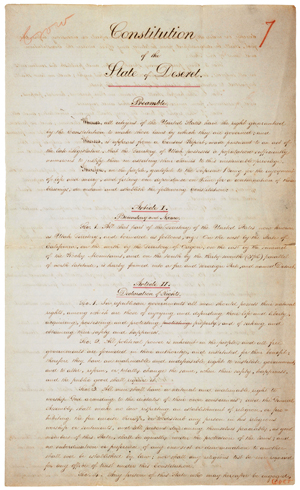
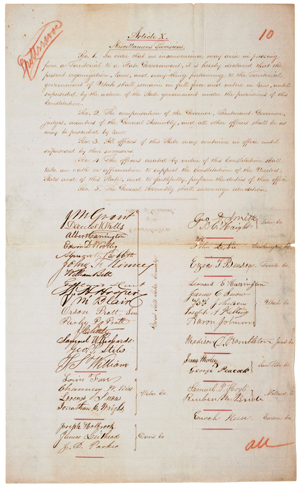
The FamilySearch team was thrilled to be able to view a number of the foremost documents in U.S. history:
- George Washington’s first inaugural address
- Abraham Lincoln’s appointment of Ulysses S. Grant as commander of the Union Army
- Andrew Johnson’s impeachment papers
- Franklin Delano Roosevelt’s “Day of Infamy Speech” after the attack on Pearl Harbor
- Thomas Jefferson’s memo reporting his purchase of the Louisiana territories
“This was a special bonus,” Sister Benning related. “It gives us a link with the past to see something written by someone who was a great historical figure,” Elder Benning added.
As the Bennings’ mission draws to a close in March, a new couple will step into their place. Little do they know what amazing treasures will be within their reach! “It’s been a wonderful experience,” commented Sister Benning about their unique missionary assignment.
“It connects us more when you see and hold these letters and documents,” Elder Benning emphasized. “You realize that anyone who has ever touched the file you are now handling is dead, but they’re not. You’ve got a piece of paper signed in 1850 that has been sitting in a folder since then. You’re the next and maybe the last person ever to touch it.”
What treasures wait to be found in your family’s history? Has an ancestor of yours signed a historic document , witnessed a national event, fought in a war, collected a government pension? With the tidal wave of digitization surging through the internet, surely there is something that relates to your ancestors – a personal treasure waiting for your discovery. Contemplated Elder Benning,“These were real people and you feel that you know them. They want to be found.”
Carol Kostakos Petranek is one of the Directors of the Washington DC Family History Center and a Volunteer at the National Archives in Washington, D.C.
1 Clark V. Johnson, ed., The Mormon Redress Petitions: Documents of the 1833-1838 Missouri Conflict, p. 565-569