






The following is an excerpt from “Back to the Best Books,” a new guide featuring 36 classics, old and new. It’s full of great selections for ward book groups or casual readers that are ready to take it up a notch! To join the discussion, go to www.backtothebestbooks.com. This article is taken from Chapter Two: Growing Pains.
It happens this way: you’re young, in love, and you cannot listen to your better judgment telling you that you are making a mistake. Against the advice of everyone who knows better, you marry that charming man with a weak character. Each passing year shows you the folly of your choice, yet you make the best of it and build a life together.
Or perhaps it happens this way: you are a parent, and you have a child who is the special treasure of your heart, yet she chooses to marry a man whom you cannot respect. Later, when you are older and your grandchildren come for a visit they are unruly, as ill mannered as their father, and hard to enjoy, yet you watch their faces as they sleep and revel in their perfect beauty.
Then again, perhaps it happens this way: you have a spouse you love dearly, yet between you there are long-standing resentments that are hard to get past. On some days however, the two of you feel so much joy and fulfillment in the children you have raised and the life you have built together that you wonder why those tense times must plague your relationship.
As you grow older your faith in God grows, but your faith in mankind suffers. Or vice versa. Finally you lay dying, and all of the trials, resentments, fears and challenges seem as nothing to you. There is only your faith, the love between you and your spouse, and your quiet joy in the lives of your children and their children.
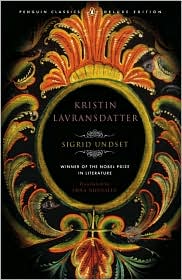
I could be talking about moments in your life or the lives of those close to you. In reality, I am recounting scenes from a remarkable trilogy of novels titled Kristin Lavransdatter, by Sigrid Undset. In an epic narrative tracing the life of one fourteenth century Norwegian woman, Undset holds a mirror up to life that reflects the timeless nature of the trials, joys and fears we all face. Sigrid Undset was the first woman to win the Nobel Prize for Literature, awarded to her in 1928 for this remarkable trilogy. Some critics hailed her heroine, Kristin Lavransdatter, as the first “real woman” in literature, and she emerges from these pages as a fully realized human being, with a noble heart and many flaws.
Synopsis
We first meet Kristin as the young, slightly spoiled daughter of a Norwegian nobleman who refuses her father’s choice of a husband and instead marries a weak, moody man. We follow her progress through her long, difficult marriage, the joys and sorrows of raising seven sons, the onset of old age, and to the close of her life. Along the way we are introduced to an unforgettable cast of supporting characters.
As does any good historical novel, Kristin Lavransdatter immerses us in the details of life in another age. We know what’s for dinner, how it is eaten and what the room looks like where it is served. We come to understand the church, and the strange combination of pagan superstition and Christian faith that guided the people of that day. Kristin’s weaknesses, joys and sorrows are so deftly shown through dialogue and inner monologue that we begin to feel that we know her intimately, and cannot help but love her as others do. The narrative shifts effortlessly from political intrigues to the most mundane details of rural life, from deep spiritual insights to moments of selfishness and stress. In other words, we are given a whole life, not the varnished version of a life presented with a hidden agenda.
What Makes it Great?
One of the characteristics of this great book is the way it combines historical accuracy with emotional veracity. Many works of “historical fiction” give us a picture of life in another age; yet offer us only cardboard cut-outs for characters. Undset, a diligent student of history, definitely has her facts right, but her writing soars as well. As Kristin’s life unfolds we are drawn both into her family and into her time, as the world of medieval Norway becomes as familiar to us as our own. Few historical novels accomplish this with such grace; we are scarcely aware of the transformation, but we begin thinking and reacting like Norwegians in that distant age. The character of Kristin is multi-faceted. We are never sure what she is going to do or say but we never tire of finding out. Her insatiable love of life sees her through one trial after another, and fuels the lifelong passion in her relationship with her husband, Erlend. Much like Tolstoy, Undset has a gift for bringing us in the side door of a family and finding us a spot at the dinner table. We are privy to the thoughts and emotions of each family member, yet always our main focus is on Kristin and her stormy past.
Juxtaposed against the ongoing battleground of Kristin’s marriage is the steady relationship of her father and mother. Undset beautifully contrasts their insurmountable difficulties with the deep joys of the long, faithful partnership between Lavrans and his wife. When, after thirty-four years of marriage, Lavrans becomes ill and knows he must die, these two stoic souls are finally able to communicate without barriers (yet still with a dignified restraint) in one of the most beautiful exchanges I have ever read. Its spare beauty reminds me of the last sweet exchange between Cordelia and King Lear. In a quiet moment together, Lavrans places on her finger his own ring, one that he had requested never to be taken from his finger. Ragnfrid gazes down at her betrothal ring, her wedding ring, and now this last, which she realizes is to be worn after his death.
“She felt it – with this last ring he had wedded her again. When in a little while, she sat over his lifeless body, he willed she should know that with this ring he had espoused to her the strong and living force that had dwelt in that dust and ashes…Through the pitchy darkness that was coming she saw the glimmer of another, milder sun, she smelt the scent of the herbs in the garden at the world’s end…”
Lavrans laid his wife’s hand back in her lap, and sat down on the bench, a little way from her, with his back to the board, and one arm upon it. He looked not at her, but gazed into the hearth-fire.
When she spoke again, her voice was calm and quiet:
“I had not thought, my husband, that I had been so dear to you.”
“Aye, but you were”; he spoke as evenly as she.” (505)
Here is a sample of a more recent translation, showing Tiina Nunnally’s skillful use of alliteration and poetic imagery.
Here, news spreads of the death of Arne, Kristin’s first love:
“It was a biting, cold night, the snow creaked underfoot, and the stars glittered, as dense as frost, in the black sky. After they had gone a short distance, they heard shouts and howls and furious hoof beats south of the meadows. A little farther along the road the whole pack of riders came storming up behind them and then raced on past… a few of them understood the news that Halvdan had yelled after them; they dropped away from the group, fell silent, and joined Lavran’s party…the dark houses looked as if they were streaked with blood…One of Arne’s little sisters was standing outside, stamping her feet, with her arms crossed under her cloak. Kristin kissed the tear-stained face of the freezing child. Her heart was as heavy as stone, and she felt as if there was lead in her limbs as she climbed the stairs to the loft where they had laid him out.” (86)
Finding Ourselves in Kristin’s World
Kristin Lavransdatter is a work that invites you into another world, yet leaves you with many insights about your own. I don’t know anyone who hasn’t loved this book (I speak of it as one book because my old hardbound version has all three novels bound together) and I have recommended it to many. One critic called it “the finest historical novel our 20th century has yet produced,” and another claimed, “As a novel it must be ranked with the greatest the world knows today.”
As we look to the classics for wisdom about our own lives, Kristin’s experiences can be illuminating. Most marriages are more like Kristin’s than those portrayed in romance novels. Both partners struggle with personal weaknesses that undermine the success of the union, and those struggles can stretch through generations. There are no really evil characters in this novel; no villain is threatening the happiness of Kristin’s home. As Pogo so eloquently said; “We have met the enemy, and he is us.” Recognizing that fact can make us more compassionate toward those we love, and who struggle to love us.
About the Author: Sigrid Undset
Sigrid Undset was born in Kalundborg, Denmark in 1882, but her family moved to Norway when she was two years old. Her father was an archeologist and her mother served as his illustrator and secretary, and Sigrid grew up among the artifacts of her native land. Since her father was Norwegian and her mother was Danish, she was comfortable in both societies.
Her best-known work is Kristin Lavransdatter, a trilogy about life in Scandinavia in the Middle Ages. The book was published from 1920 to 1922 in three volumes, and portrays the life of one woman from birth until death. For this and other work, Undset was the first woman to be awarded the Nobel Prize in Literature in 1928.
In the face of the Nazi invasion Undset fled Norway for the United States in 1940 but returned after World War II ended in 1945. She donated all of her Nobel Prize money to charity, and even sold her Nobel medal to raise money for Finnish children in distress after the war. She was married twice, raised three children, one of them severely retarded, and late in life converted from Lutheranism to Catholicism. She died in Norway in 1949, at the age of sixty-seven.
(Kristin Lavransdatter, Introduction, and Wikipedia)