







The Ancient America Foundation (AAF) is pleased to present AAF Notes: a series of research articles by scholars of Book of Mormon culture and history and reviewed by AAF editors. Visit our website at https://www.ancientamerica.org.
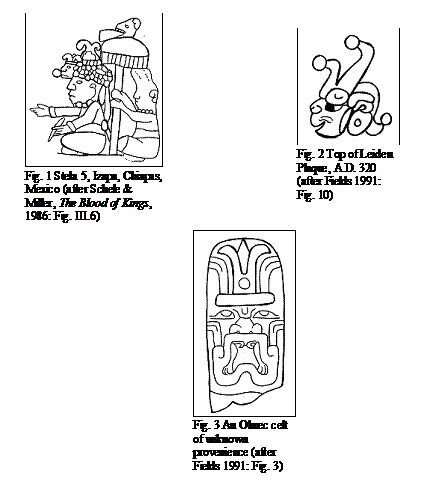
As early as 1958, Wells Jakeman identified the figure he considered to be Nephi on Stela 5, Izapa, Chiapas, Mexico, as wearing a symbol of grain (attached to the front of his headdress atop a small head) that Jakeman believed verified the name of Nephi at this site (Fig. 1).
He postulated that the Egyptian Grain God, Nepri (also spelled Nepi, Nepr, or Nepra), may be the origin of the name Nephi.[1] Today we know that it was very astute of Jakeman to identify this particular headdress being related to grain, and in the case of Mesoamerica a headdress of maize/corn, and that the personage was a king.
Hundreds of years later during the Classic era of the Maya at Tikal, a ruler on Stela 2 wears almost the same identical Maize God on his headdress as that worn on Stela 5 at Izapa. This shows the timeless nature and importance of this motif.[2]
There is a headband worn by the Maya called the Jester God headband (Fig. 2). This name was applied to it because of its three points comparable to a medieval court jester’s hat. This headband started in use during the Late Pre-Classic around the last century B.C. It wasn’t until the late 1980’s that the Jester God motif was identified as to its meaning.[3] This headband was worn by Maya kings and served as a crown.
It has been determined that the so-called Jester God headband derived and evolved from the Olmec Maize God,[4] the Olmec being the great formative culture that Latter-day Saints associate with the Jaredites (Fig. 3).
According to Virginia Fields, “The primary icon of Maya rulership [is] the Jester God. The importance of the symbol lies both in its meaning as related to maize and in its power as an object to express royal authority.”
Fields has identified the Jester God headband of rulership being worn by the figure that many in the Church identify with Nephi. She believes this royal emblem along with the jaguar head on the parasol held by an attendant, probably signifies that this individual was a ruler[5] (see Fig. 1)
In front of the face of the Jester God on Stela 5 there is a small round object (see Fig. 1). There are two possibilities in identifying this object: a breath bead or a piece of fruit from the Tree of Life. As we will see, either supports life after death, i.e., resurrection.
A breath bead is very common among portraits of the Maya and signifies the captured last expired breath of the deceased, or if living, his life force. The breath bead is considered to be made of green jade, and of course, green is the color of vegetation and “the essence of the life spirit.”[6]
Like green maize that lives, the deceased will live again. The living look forward to being born again in resurrection after their death. This is a very firm belief of all those who lived in ancient Mesoamerica.
On the other hand, if this round object is a fruit of the Tree of Life, we know from 1 Nephi 16:36 that its fruit is the most precious above all other fruits and is the greatest of all the gifts of God, i.e., eternal life with God.
Turning our attention to the name of Nephi, we have the Egyptian Grain God called Nepri or other similar spellings. In Egypt, Nepri was the personification of corn and was an aspect of the god Osiris, the ultimate Grain God who died and was resurrected.
One may ask, “Why did Wells Jakeman choose the Egyptian Grain God? What did Lehi’s people have to do with Egypt?” The mere fact that the records of Lehi’s descendants wrote in a script called “Reformed Egyptian” (1 Nephi 1:2; Mormon 9:32-34) is a good clue that Lehi’s family had dealings with the Egyptians, perhaps as merchants of their metalwork as suggested by John Tvedtnes.[7]
In Mesoamerica among the Maya, rulers wore emblems of their name on their headdress. For example, the founder of Copan in Honduras has a quetzal bird and a macaw on his headdress. His name is Yax (First or Green) Kuk (quetzal) Mo (macaw). This reasoning could lead to the name of Stela 5’s ruler. It is also interesting to note that the Egyptian name of Nfr was a male authentic name.
John Gee, a BYU Egyptologist, wrote: “Nephi is an attested Syro-Palestinian Semitic [Npy] form of an attested Egyptian name [Nfr] dating from the Late Period in Egypt. It is the proper form of a proper name from the proper place and proper time to appear in First Nephi.”[8]
Whether or not Nephi’s name is derived from the Egyptian Corn God, we cannot say. However, it is impressive that Wells Jakeman identified this figure on Stela 5 has having a vegetal motif on his headdress and that he was of royal lineage. Today scholars have verified this perspective.
Editorial note by Garth Norman: According to Sjodahl (1927:227) nephi is the Hebrew nevi (navi, nebhi) meaning prophet. The prophet was the official title of one authorized to speak for God, the words of life. Priest kings like Moses and Nephi were also prophets. Although Jakeman did not identify all the details, current research has determined that what he had identified was still there.
With this in mind, the question arises that since the Book of Mormon was recorded in reformed Egyptian, can we track Nephi from Hebrew nevi to Egyptian nepri or nepi with equivalent meaning? Is it essentially the same? And what would be the motivation for using the Egyptian version over the Hebrew, if that is the case? For instance, was it fashionable to use foreign word names to convey meaning inappropriate in the mother tongue? Could not the Hebrew word for “prophet” be used as his name?
This is an open question. Feedback is invited.
Notes
[1] M. Wells Jakeman, “Stela 5, Izapa, Chiapas, Mexico,” University Archaeological Society (Provo, Utah: Brigham Young University), 1958.
[2] David Freidel and Linda Schele, “Symbol and Power: A History of the Lowland Maya Cosmogram,” in Maya Iconography, ed. By Elizabeth P. Benson and Gillett G. Griffin (Princeton: Princeton University Press), 1988: 44-93.
[4] Virginia M. Fields, “The Iconographic Heritage of the Maya Jester God,” in Sixth Palenque Round Table, 1986, Merle Greene Robertson, Gen. Ed., Virginia M. Fields, Vol. Ed. (Norman: University of Oklahoma Press), 1991: 167-174.
[6] Karl A. Taube, “The Symbolism of Jade in Classic Maya Religion,” in Ancient Mesoamerica 16 (Cambridge: Cambridge University Press), 2005: 23-50.
[7] John Tvedtnes, The Most Correct Book (Salt Lake City: Cornerstone Publishing) 1999.
[8] John Gee, “A Note on the Name Nephi,” in F.A.R.M.S. Update, Insights: An Ancient Window (Provo: The Foundation for Ancient Research & Mormon Studies): November 1992.
Copyright © 1999-2002 Ancient America Foundation. This message may be forwarded with identifying information. For more information or to subscribe or unsubscribe to AAF Notes or utilize the AAF order form, visit https://www.
ancientamerica.org and click “Contact us”. Refer, by e-mail,comments or questions to [email protected].