





Click here to sign up for Meridian’s FREE email updates

I leaned over the large oak table at a carrel in the Maryland Archives, curious as to what the clerk had brought me. When I opened the first of ten large manila folders, I drew in a sharp breath. My heart started pounding and I felt almost dizzy. Before me were original documents dating to the mid 1700’s: wills, land records, court proceedings. A chapter from the lives of our Cook and McKisson families was laid out before me!
The papers were brittle and ever-so fragile. Some were encased in plastic but most were not. I put on white gloves to handle them gently, yet tiny flecks crumbled at the edges.

I carefully turned over each sheet of yellowed paper, my brain stretching to decipher the 18 th century handwriting. I was eager for any scrap of information that would verify spouses, children, dates and property ownership of my husband, Gary’s, 5th great-grandfather, Samuel McKisson. Through our research, we learned that there were three Samuel McKissons who lived in Harford County during the late 1700’s – early 1800’s. Our trips to libraries and courthouses revealed that one or more:
- was fined for operating a ferry without a license
- had posted bond for an unwed mother who was his sister-in-law
- had served as a constable in Broad Creek Hundred and was fined for dereliction of his duties
- was married to Esther Cook and listed in her father’s will
- was accused of horse stealing in York County , Pennsylvania and ordered to leave the state
So many fascinating glimpses into a life-but which Samuel’s life? The Archive documents spread before me verified that a Samuel was, indeed, married to Esther Cook. Her family owned parcels of land on the Susquehanna River known as ” Paradise ” and “Maiden’s Mount,” which included the Bald Friar Ferry. Other vital facts were confirmed; relationships were established; hardships were uncovered. These court documents provided many-but not all-of the answers I was seeking to break through this brick wall.
It was time to find out more about these owners of Maiden’s Mount and the ferry. When I hit a brick wall, I hit the road! Although internet searches are yielding increasing amounts of online data, I have learned that personal visits to courthouses, libraries and archives can uncover information that has not-and may not-make it into cyberspace. I now know that taking multiple trips to the same locale invariably yields new information or additional research clues.
We headed to the Susquehanna River area. After praying for guidance, Gary and I met a property law attorney at the Harford County courthouse who had drawn a map of that area as it existed in the 1700’s. He taught us how land boundaries were determined, explained the meaning behind unusual property names (such as McKisson’s Neglect) and gave us hints for finding the Cook/McKisson properties. At the Cecil County Historical Society, we found articles on the Bald Friar Ferry and learned that it was used by Comte de Rochambeau’s troops during the Revolutionary War because it was the only ferry strong enough to carry military equipment. We were thrilled to find a sketch of a late 1700’s ferry that showed us what Samuel McKisson had operated.

On a subsequent research trip to the same area, Gary prayed “that we would come to know more about our ancestors and something about their lives.” This prayer was answered in an unexpected way when he pulled out his GPS to find a detour to traffic-clogged Interstate 95 north. Veering off the main highway we drove over back roads, which turned into unpaved roads, which turned into narrow horse trails that wound through deep woods. Several times I shouted, “Stop! This is dangerous! You’re going the wrong way!” but he persisted. All around us were thick woods and fallow fields, untouched by development. We were enveloped in an almost reverent silence when we realized that this was the countryside that his Cook/McKisson ancestors could well have traveled, as it was adjacent to the area where they owned property.
Eventually, the ancient horse trail led to a main road and we proceeded over the Conowingo Bridge that spans the Susquehanna River, dividing Maryland from Pennsylvania . Gary pointed to a water tower towards the northwest and, after examining early maps, determined that Maiden’s Mount and the Bald Friar Ferry were somewhere in that vicinity. After crossing the bridge, he decided to take a secondary road following the river on the chance that it might yield clues to the exact location of the property.
As we came to a fork in the road, Gary pointed out a road that led down to the river. Looking up, I was speechless when we saw a sign that said ” Bald Friar Road .” That was it – the road that led to the ferry landing!
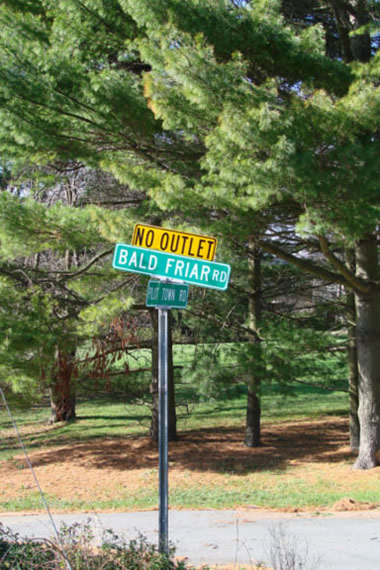
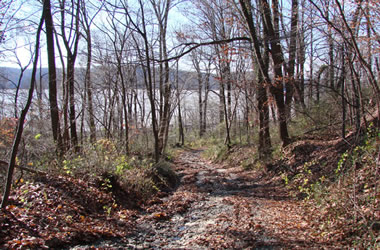
With great anticipation, we started driving until the paved road ended and we were at the crest of an extraordinarily steep, rocky and rutted path that led down to the river. When we could go no further, we left the car and started walking.
It had rained hard the day before, and rivulets of water swirled around our feet as we carefully picked our way over slippery leaves, logs and rocks. We made it to the bottom where the land flattened into a wide landing at the edge of the river. We saw that railroad tracks had been built parallel to the river; obviously trains had come long after the Cooks/McKissons sold their land in 1805.
We looked across the river and saw a corresponding flat stretch of land on the other side-the ideal setting for a ferry landing! We knew then, without a doubt, that this was the location of the Bald Friar Ferry. We wondered how difficult it was for our Samuel to navigate a ferry across the wide and dangerous river. We marveled that horses (and people!) carried wagonloads and carts filled with goods up and down the steep, rocky road that we had just descended.
At that moment, the McKisson and Cook families became very real to us. We walked their land, saw their river, and felt their spirits.
Although we cannot yet untangle the mystery of the three Samuel McKissons, we got a glimpse of the life that one of them led. We received a reaffirmation of the inestimable value of going “on sight” to look for records. I was comforted in knowing that we can prove these people did exist. We can put approximate dates on timelines, and we have sufficient data to submit names for ordinances. It is not necessary to wait until everything is figured out before we proceed with temple work. Our responsibility is to do whatever we can with the information we have.
Standing on the bank of the Susquehanna River , we were thrilled beyond words as we felt history come alive. But this wasn’t just history-it was our history-part of Gary ‘s family legacy! After 250 years, McKisson descendants were once again on the land where their ancestors had toiled and tread.

Family history is a journey that takes us to places near and far, and connects us to individuals who share our genes and our dreams. How has your heart been turned? What words of encouragement or stories of inspiration can you share with our readers? Please consider sharing your comments and stories by submitting them to: [email protected].
Click here to sign up for Meridian’s FREE email updates