





By Page Johnson
Many convert black families come from strong Christian homes where generations of members have been in the ministry, where music has been a powerful influence, and where the women have been a dynamic motivating force. At baptism, they bring this legacy of faith and commitment, service, and patient long-suffering to the Church body, but their home wards should be prepared to sustain them with continued encouragement and understanding as each member transitions to what is often a very different way of life.
The Revelation of 1978
The revelation of 1978 gave full fellowship to all worthy black male members by allowing them to hold the priesthood. It helped heal the wounds of many who had felt excluded and denied, and it opened the doors to new missionary efforts among blacks in all countries.
Still, black members often struggle with assimilating their heritage and culture into their lives as Latter-day Saints. Two families, one in Georgia and one in Virginia, have not only made it work, but are also able to offer insight to other members, both black and white, on how to focus on what is really important.
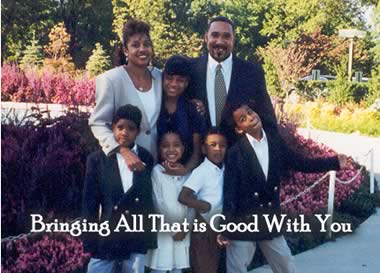
The Womble Family of Atlanta, GeorgiaWhen Brother Nathaniel Womble of the Glenridge Ward in Atlanta, Georgia, thinks of the priesthood, he does not focus on the revelation of 1978, but rather on the restoration of the priesthood to Joseph Smith in 1829.
“That’s the day I commemorate,” he says, “because that’s the day the Lord restored the priesthood to the earth. He meant for me to have it, too, but the time had to be right. Like so many other things that I’ve encountered in my life, I’ve had to be realistic. We all do.”
Among his favorite scriptures is 2 Nephi 26:28: “Behold, hath the Lord commanded any that they should not partake of his goodness? Behold I say unto you, Nay; but all men are privileged the one like unto the other, and none are forbidden.” He adds, “I have never felt denied in this church.”
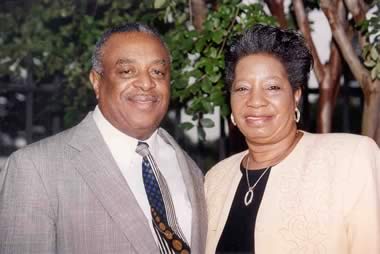
Brother Womble’s first experience with the LDS Church was in May 1978, one month before the revelation on the priesthood was announced. Two sister missionaries stopped to get gas at his filling station in Atlanta and when he noticed their Utah license plates, he asked the two young women why they were so far away from home. At the time, he had not even heard about the Church.
When they told him they were missionaries sent to preach the Gospel, he immediately responded, “Well, come on and teach me!” Instead, they thanked him, explained they had other appointments that day, and drove off. “But they kept coming back because I had the only 25-cent sodas around,” he laughs. “I kept asking them to teach me, but they always seemed to have other people to visit.” By the time the sisters called him back to set up an appointment, the new priesthood revelation had been announced.
Brother Womble thought he was prepared to discuss religion with these young missionaries because he came from a family of Baptist preachers and had been one himself. His spiritual search began as a youngster when he used to sneak into the adult Bible study in his home on Wednesday nights. He remembers discussions on the prophet Moses and learning that “when you meet a prophet you will know what to do.” Later in Vietnam, he promised to serve God if his life were spared. Upon his return, he says he wanted-and expected-God to do something for him, to direct his life.
So he became a preacher, thinking that would help him discover his spiritual purpose, but he remained unfulfilled. After four years, he realized that he was set on a path of his own making, not God’s.
“I stood up before my congregation and explained that I had not really received the call to serve from God. I was listening only to myself. By finally admitting that, I felt a great burden lift from me.”
Disillusioned with religion, but still searching for a purpose to his life, he moved to Florida for several years where he entertained as a pianist in a nightclub. But that too did not satisfy him and he finally returned to his home in North Georgia. There his mother prayed for him and encouraged him to go to church, but he only agreed so he could play the piano for the local Baptist church choir. It was there that he met his future wife, Ruby Jett.
Slowly, Brother Womble began to realize that he was only seeking God through others. “I could see that I had asked everybody but God to help me,” he points out, “and I had to learn to pray and really talk to God. I kept thinking of the atonement and how Jesus Christ must have loved me personally to do that for me. I knew in my heart that God would send someone to help me, and that I would recognize him. I just hadn’t met that person yet.”
Now he believes that the messenger he was looking for was actually two messengers wearing name tags that said Sister. “I have never been able to find the words to express what it was like when those two sisters entered my home,” Brother Womble reflects. “Wherever they stood, the immediate area surrounding them seemed to be distinctly clear and clean, while the rest of the room seemed dark, almost smoky-as if someone had just squeegeed a section of a dirty window, right where they were standing. I could hardly talk. And when they showed me the picture of Joseph Smith in the grove, I felt enveloped right into that scene as if I were there.”
A few weeks later, Brother and Sister Womble were married. On July 15, 1978, Brother Womble was baptized and then on August 5, he baptized his wife. They now have five children and 21 grandchildren.
Brother Womble does not think of himself as a black man who is a Mormon but simply as a man of God. “I may have a cultural background, a black heritage, but don’t look at me as only a part of a culture, look at me as a man,” he says. “When the Lord made me a man, he said it was good. So God was pleased with me even before I became a Latter-day Saint. Now what I need to do is find out what God wants me to incorporate into my life to make me a better man, a spiritual man, one who lives like he is His son.”
But the Wombles have known other black families in the Church who struggle to fuse their black heritage with that of a predominantly white pioneer heritage. He tries to get them to see that when people come into the Church they are “reborn spiritually and become one culture together–with the opportunity to build up the kingdom together. It is not our job to force the church to make changes to fit us and what we want the culture to be.” He says that if people feel out of place, they need to look within themselves to see if they are the ones who need to change.
According to Womble, one of the most difficult adjustments for some black members is LDS music. “They miss Gospel music. But I would say that if you want to hear Gospel music, you can listen to recordings, go listen to Gospel choirs, or work with the Activities Committee to put on a program that utilizes the musical heritage of black members. The music at Sacrament meeting, however, is not meant to entertain but to instill a spirit of reverence and to remind us that we are reborn spiritually as we take the Sacrament. We start to see the purpose of the Church through the music.”
Womble also says that he has seen black members become discouraged because they don’t feel that they fit. “But no one can pull you higher than you want to go,” he says. “The Church is not a social club. In order to receive the blessings, you have to serve and feel the spirit. And I’ve learned that it is not the calling or position that counts, but how you magnify your priesthood in that calling.” As for feeling welcomed and accepted, he encourages black members to “make a place for yourself in the church. Don’t wait to be fellowshipped, go out and fellowship someone else.”
Both Brother and Sister Womble feel there is no difference between the way they were treated when they joined the church twenty-five years ago from the way they are treated now.
“The Gospel is meant to bring people together,” affirms Brother Womble.
“Joseph Smith spoke out for the rights of every man, and he gave us the Lord’s doctrine in the Doctrine and Covenants 101:79, which says, ‘Therefore, it is not right that any man should be in bondage one to another.'”
Sister Womble agrees. She loves Relief Society because it brings the sisters together in an atmosphere of unconditional love and acceptance. “It’s a place that helps me become a better woman, wife, and mother,” she emphasizes.
“And I come because I know that God loves me,” adds Brother Womble.
“God has a plan, and I am part of that plan. More than that, I personally have something to contribute to that plan.”
The Charles Family of McLean, Virginia
Before they even joined the Church, the Charles family of Vienna, Virginia, had their own form of Family Home Evening. Chad, an electrician, and Jueletta, a police dispatcher, tried to spend at least one night a week doing something with their five children, even if it was just having a water fight. So when sister missionaries knocked on their door over seven years ago, the couple was curious about a religion that emphasized the importance of family. But after a few lessons and even a visit from the ward mission leader of the Fair Oaks Ward, Brother Dave Tenny, it became clear that the family wasn’t ready to commit to baptism.
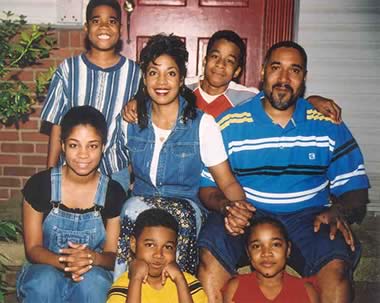
Over the next two and one-half years, however, Brother Charles said that he became so discontented with some of the policies and practices of his own church that he vowed “never to set foot in another church again.” Yet Jueletta kept praying for a church in which to raise her children: Jessica (now 16), Darren (13), Don (11), Asia (9), and Casel (8).
One evening as she prayed, the image of the Washington D.C. Temple “passed in front of her face,” remembers Brother Charles. They had all seen this familiar landmark in Washington many times as they drove around the beltway, but they could not explain what Jueletta had experienced. Just 30 minutes later, however, two sister missionaries knocked on their door and said that although they had been tracting in another neighborhood, they had a strong feeling they should come to the Charles’ home.
This time the family was ready for their message. “When they told me that the Father, Son, and Holy Spirit were three distinct beings, I realized that I had always believed that,” says Brother Charles. “I also believed there could be modern-day prophets.” He recalls the day the family attended Sacrament meeting for the first time and Brother Tenny, then a counselor in the Bishopric, welcomed them by saying joyfully, “I knew you’d come!” Over the next weeks, everyone on the ward council and each auxiliary worked to make the new family welcome.
At the time, the children ranged in age from three to twelve years, but they had never been in a comprehensive church youth program before. Brother Charles was impressed by how much the kids enjoyed going to Primary and participating in the Boy Scout program, Achievement Days, and the Young Women. Jessica Charles had just turned 12, and she couldn’t believe there was a church program just for girls. ” I was learning new ideas and what it means to be a daughter of God that I had never learned before,” she says.
Soon everyone except Brother Charles was ready for baptism. “The Word of Wisdom was hard for me,” he admits, “because I liked to drink beer and watch football games with my friends. To help me change my habits, the sister missionaries left root beer at my house every Saturday night. Then one evening, they brought over baptismal clothes for my family to try on, and I just put one on because everyone else was. But I had a great feeling.”
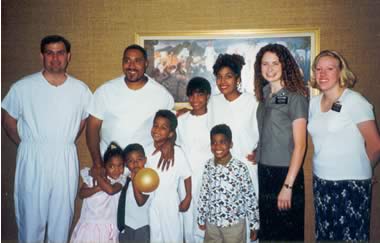
So Brother Charles changed his habits and the family was baptized on September 28, 1997, in the Fair Oaks Ward. Jessica remembers the “spiritual moment of being there across the altar and looking at my family in the mirrors.” According to Brother Tenny, it was also a happy celebration for all the ward members because they had participated so fully in the conversion of this family: “What a great ward experience to see a whole family embrace the Gospel and go on to be sealed in the temple.” The Bishop at the time, Ralph Johnson, remembers what outstanding parents Chad and Jueletta were, how they had taught a lesson on family unity, and how Brother Dick Robinson, one of the full-time missionaries, had called them “pure and honest people.”
But the family’s transition from baptism to temple sealing wasn’t completely smooth, at least for Jueletta. As she learned more about Church history, Jueletta began to have concerns about the status of black members within the Church, now and in the past. She had had similar worries even before they were baptized and she needed confirmation that families, regardless of race or origin, had full fellowship and acceptance in the Church. In particular, she was troubled by various passages in the Book of Mormon and the fact that it took a revelation in 1978 to give the priesthood to all worthy males, regardless of race.
Bishop Johnson and Brother Tenny counseled with the couple to help them understand the extent of God’s love. “I told them that Heavenly Father loves each of his children without regard to race or sex,” stresses Brother Johnson. As Jueletta began to pray and study about it, she came to believe that the early years of the Church were a critical period of growth.
“It (not giving the priesthood to black males) was a situation that had to exist in order for the Church to be established at that time, and also be able to survive,” she says. “But now it’s such a blessing to see my husband hold the priesthood and baptize members of our family. And I’m so thankful to have the priesthood in my home so Charles can give priesthood blessings. Just before his aunt died a few year ago, she asked him for a blessing, even though she was not a member of our Church. That’s how powerful the priesthood is in our home.”
Her son Darren, who received the Aaronic Priesthood a year ago, adds,
“It felt really good because now I can pass the Sacrament.” He also likes going to church as a family and hopes to become an Eagle Scout.
Likewise, Brother Charles feels peace about the priesthood issue because he believes strongly that “This is the true gospel of Jesus Christ. From the first time we stepped into this church, we felt welcome. Now we are closer than ever as a family and it’s easier to raise our children because the morals we already believed in are taught here.” So careful are the Charles about the environment they want for their children, that they have home schooled each of them at various times.
They recently moved to be closer to their places of work and are now members of the McLean Second Ward.
Despite so many positive changes in their lives, however, Brother Charles notes that these changes have been hard for their friends to accept. “I don’t allow smoking, or swearing in my house, and that makes many of my friends uncomfortable. Unfortunately, some just stopped coming around.”
Now a Laurel in Young Women, Jessica says she also deals with the challenge of living up to church standards in high school. “Sometimes I have to stay away from parties and just hang out with my friends. And it’s so hard when people are rude or mean. But my Mom tells me to be an influence on my friends, and to act more Christ-like. Sometimes, you just have to walk away.”
Yet each member of the family continues to believe strongly in the power of example to influence their friends and relatives. Although they have only been members for five years, Brother Charles has now baptized two of his nephews, Christian Charles and John Smith, and he is planning to baptize his mother, Anita Charles, in June.
“I’m influenced, too, by my friends in the church,” notes Jessica. “When I listen to people bear their testimony, it makes me want to find out the same thing for myself.”
2003 Meridian Magazine. All Rights Reserved.