





by Kelly L. Martinez
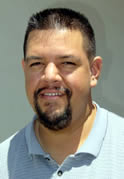
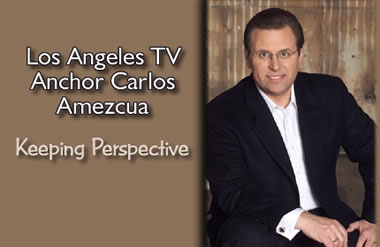
In a career that has covered over a quarter of a century, Carlos Amezcua, co-anchor of the Los Angeles WB affiliate’s “KTLA Morning News,” has seen the world from the best seats.
He has anchored and reported television news in Denver, San Diego, and New York. He has been on CNN, “CBS Evening News” with Walter Cronkite, “NBC Nightly News” with Tom Brokaw, and HBO’s “America Undercover.” His work has earned him six Emmy and two Golden Mike awards. With these credentials and honors, it would be easy to assume that Amezcua comes from a privileged background that has provided him with valuable contacts and connections as he’s climbed the broadcasting ladder.
Not so.
A first-generation Mexican-American, Amezcua saw his father and grandfather work as field laborers in southern California. After a long day working in the fields, his father, who loved to play music performed in a mariachi band at night. With this influence, young Amezcua learned to play the guitar and became good enough to join his father on his nighttime musical excursions. He was also very talented at oil painting.
When he was a child, Amezcua’s mother required him to read aloud from newspapers to her every day. Until he was 14, his English was very poor and his mother hoped to improve his diction and comprehension of English by doing the daily readings. It was an act of love that would pay off as he matured into his present career.
Early Influences
While growing up in San Diego, Amezcua and his brother Oscar were encouraged by their parents to join the Boy Scouts. The local Catholic parish didn’t have a troop but the local LDS ward did, and they joined. Though the Amezcuas were the only non-LDS in the troop, they felt welcomed and Carlos made an LDS friend, Steve Fitch, who would prove to play an instrumental part his life.
“The influence the Church had on me through scouting was profound,” said Amezcua, who eventually became involved in other Church programs as well. The bishop required him to attend one Sunday School meeting a month in order to play on the ward’s basketball team.
What started as a one-Sunday-a-month requirement soon became a weekly-event-of-choice for Amezcua as he grew to enjoy the meetings and loved associating with the youth in the ward. On Sundays he would show up at church with a surfboard on top of his car with the intent of heading to the beach as soon as Sunday School was over. “I actually talked Steve into going surfing with me one Sunday,” Amezcua recalled. “He got sunburned very badly that day. I’ll never forget when we got back to his house; his mom told him that the sun burns a lot stronger on Sunday.”
About-faces
Thanks to his friendship with Steve, Amezcua decide to attend BYU after graduating from high school, enrollingas a Fine Art major with the intent of becoming the next Pablo Picasso. However, at the encouragement of a cousin, Kent Dana (who is currently a TV anchorman in Phoenix), Amezcua sought out Tom Griffiths, a communications professor at BYU, about pursuing a career in broadcasting. Griffiths handed Amezcua news copy and told him to go into the broadcasting booth to read into a microphone.
“I read the wire copy and (Griffiths) said, ‘That’s good. You sound good. You’re a natural. You start Monday,'” recalled Amezcua. “I told him that I hadn’t taken any (broadcasting) classes and he said, ‘It doesn’t matter. You know what you’re doing, just do it.’ That following Monday morning, I started doing news on KBYU-FM.”
This was the same semester he was taught by the missionaries and baptized a member of the Church. “I made it through a whole semester as a Catholic at BYU,” he said.
Two years later, Carlos accepted the call to serve as a full-time missionary in the Guatemala/El Salvador Mission where he labored from 1973-75. After his mission, he returned to Provo to pursue his broadcasting degree. To help finance his schooling, he worked at a cowboy clothing store in Provo where he met his wife, Mary.
The Road to Los Angeles
Amezcua’s first job in broadcasting was at KSL-TV in Salt Lake where he was assistant to the assignment desk assistant. His job duties included answering phones, vacuuming the newsroom, running to get burgers, and picking up (current KSL-TV anchorman) Dick Nourse’s dry cleaning. About eight months later, he landed a reporting job at KOOL-TV in Phoenix.
Assignments in Phoenix, San Diego, Salt Lake, and Denver led to his current assignment, where he’s been since June 1991, as the morning anchor for “KTLA Morning News.” It was the first local morning TV news program in Los Angeles and Amezcua has been instrumental in helping the upstart program gain a massive following. In the nearly 13 years since its inception, the morning program has won all but two ratings sweeps while Amezcua, in a viewer poll, has been recognized as the most-watched and admired television anchor in Los Angeles.
In the past, Amezcua did correspondent work for Family Times, an LDS-themed TV show that has ceased production but still runs on KBYU-TV and BYU-TV. The show was co-hosted by (Salt Lake’s current FOX-13 news anchor) Bob Evans and Kim Gunnel and focused many of its segments on arts and crafts, family relations, and other fun topics. Amezcua and Evans are currently working on a TV show together, being produced by the Church, which will have a serious tone to it and address subjects like politics and other topical issues. Six episodes have been filmed and it’s hoped that the show will be picked up in syndication by the mass market.
Perspective
During his career, Amezcua has covered tragic news stories including the 1994 Northridge earthquake, the 1984 McDonalds Massacre in San Ysidro, Calif., and the 1992 Los Angeles Riots. He was also on the air September 11, 2001, when the terrorist attacks in New York and Washington D.C. began to unfold.
Keeping a sober perspective in the face of such horrifying occurrences has earned Amezcua a reputation for keeping viewers calm in the face of tragedy. “People don’t want a hysterical anchorman who’s shouting at them and trying to hype the story,” he said. “Those awful things and the pictures speak for themselves. All I, as a broadcaster, can hope to do is to add some perspective and have a calming effect on the audience.
“The gospel really helps me with that sober approach. I think, more than anything else, understanding the plan of salvation and thinking of the covenants I’ve made and the way that I live gives me a perspective that other newscasters don’t have.”
Because of his perspective on life and broadcasting, Amezcua draws the line on what he will and won’t report. In a recent broadcast, he substituted the term ‘adult magazine’ for ‘Playboy,’ as it was written in the script. “There are things I simply will not participate in or promote,” he said. “I won’t promote the trash that everyone else promotes. It’s promoted enough already. In a sense, it’s my small contribution to keeping common decency on the airwaves.”
LDS in the L.A. viewing area will, on occasion, hear Amezcua utter “Mormonisms” on the air. On July 24th, he wishes viewers a Happy Pioneer Day. During the Los Angeles Lakers’ NBA Championship run in 2002, he encouraged viewers to watch that evening’s game (which was on a Monday) as part of their Family Home Evening. Fast Sunday has also been referenced on the air. Though much of the audience has no idea what Amezcua’s referring to, it’s fun and creates opportunities for him to explain to others what he’s talking about.
“I’m not shy about what I believe,” Amezcua stated. “I’m not shy about proclaiming who I am, what my faith is and what I stand for. The way I see it, I never really got released from my mission. It’s my responsibility to preach the gospel in word and deed every single day of my life. I just happen to have five million people a day to preach to.”
Production Efforts
In addition to his broadcasting endeavors, Amezcua has produced several programs. Comady Compadres was a show that showcased Latino comedians and was instrumental in launching the careers of big-name comedians like George Lopez and John Mendoza. Currently, he and “KTLA Morning News” weatherman, Mark Kriski, are marketing a radio talk show that features comedic banter and discussion on serious issues. “The Carlos and Mark Show,” if all goes as planned, may be coming to the radio airwaves in your city or town soon.
Jon, Carlos’ son, came across some of his dad’s old oil paintings a couple of years ago. Amazed at their quality, Jon bought his dad canvases, brushes, and paints and encouraged him to pursue his love of painting again. Carlos has returned to painting and has produced some wonderfully painted pictures. With the help of his children, Carlos has started selling some of his paintings on his website.
“I’m hoping the website will become my retirement some day,” Carlos joked.
Sage Advice
LDS that are considering careers in broadcasting, Carlos advises, need to understand how competitive it is to break into the business these days. Early on, it is extremely easy to become disillusioned and discouraged.
“My advice would be to persevere and don’t give up,” Carlos advised. “There will be those that believe that a person of faith can’t be a news anchor or can’t possibly know what the world is about. But we can and we do and we can make a difference. People that get discouraged and walk away from the opportunity that broadcasting brings are really cheating the public of the perspective that we, as LDS, bring. It’s a perspective that is critical to the balance of information that gets disseminated throughout the world. There can be too much information on one side and nothing to balance it out. Those of us that fight the fight every day need to be reinforced by good people that will likewise fight the fight. I don’t believe at all in being a passive member of the Church. I’m so vigorous in that belief that I think people wish I would keep my mouth closed.”
2004 Meridian Magazine. All Rights Reserved.