








The gospel doctrine teacher in our ward introduced the lesson on Joshua by asking a group of young women to recite the 2010 Mutual theme. Without hesitation and with conviction in their voices, the girls said in unison: “Be strong and of a good courage; be not afraid, neither be thou dismayed: for the Lord thy God is with thee whithersoever thou goest” (Joshua 1:9).
Although it was only May and the Young Women will be reciting this scripture many more times this year, I believe that this verse is already firmly planted into their minds and hearts and will surely guide them “whithersoever” they go – to their schools, activities, “hanging out” with friends, to dating in a few years, and to the many other venues of their lives.
These “Young Women of Zion” are blessed, as are a half million other Latter-day Saint teens, to belong to the greatest (and likely the largest) organization for adolescent girls in the world. Young women today, like their predecessors, are much blessed by this auxiliary of The Church of Jesus Christ of Latter-day Saints. The organization’s name has changed several times over the years:
The Young Gentlemen and Ladies’ Relief Society of Nauvoo (1843)
The Young Ladies’ Department of the Cooperative Retrenchment Association (Young
Ladies’ Retrenchment Association) (1869)
Young Ladies’ National Mutual Improvement Association (1877)
Young Ladies’ Mutual Improvement Association (1904)
Young Women’s Mutual Improvement Association (YWMIA) (1934)
Aaronic Priesthood MIA, Young Women (1972)
Young Women (1974)
Yet the purposes – to help young women improve themselves, develop their talents, serve others, and strengthen their testimonies of Jesus Christ – have not.
Many years ago, Marba C. Josephson, then editor of the Improvement Era and a YWMIA general board member, described the young women’s organization as “aiding the LDS girl to gain a testimony of the gospel through wholesome lesson work and spiritualized recreation.”
Church leaders have long recognized the vital role that this auxiliary fills in helping adolescent girls develop testimonies of the Savior and to become faithful, covenant-keeping women. The guidance and strength available through the “Lord’s organization for [young] women” today is more needed, more vital than ever before.
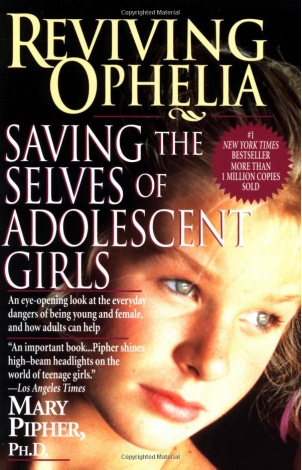
When I was serving as stake Young Women president in the early 1990s, my husband gave me a book titled Reviving Ophelia: Saving the Selves of Adolescent Girls by Mary Pipher, Ph.D., a clinical psychologist, whose practice focused on teenage girls. She said, “This book is an attempt to share my thinking with parents, educators … and anyone else who works for and with girls.” (She is also the author The Shelter of Each Other: Rebuilding Our Families.)
My husband thought the book would help me to better understand the world of young women. At the time our only daughter was serving a mission, we had four of our five sons at home, and my only other calling in Young Women had been assistant camp director one summer. I did need to become better acquainted with the environment of the young women I would be serving; this book would be one avenue to explore.
As I read about the moral challenges and lack of family structure and involvement described by Dr. Pipher, I was astonished – yet even more committed to help the young women in my stake navigate the challenges of the 1990s. Although Pipher’s studies did not involve Latter-day Saints, unfortunately, in many areas of social behavior, the percent of the Church population following national trends is fairly high (i.e., divorce, blended families, teen pregnancy, drug use, and other challenges). And young women are not isolated from the world at large.
Since the book’s publication sixteen years ago, the general moral climate and the status of marriage and the family as an institution has deteriorated at an alarming and accelerating rate. Add to the mix the technological temptations, and one wonders how a young woman could possibly survive to adulthood, let alone to become a virtuous woman, prepared “to make and keep sacred covenants,” and to become a righteous and loving wife and mother.
Mary Pipher noted that adolescent girls need mentors and role models, good friends, meaningful activities, leadership opportunities, and to be emotionally connected to a whole.
Regarding mentors, she observed: “In the past, many young women were saved by conversations and support from a beloved neighbor, a kindhearted aunt or a nearby grandmother. Many women report that when they were in adolescence, they had someone they could really talk to, who encouraged them to stay true to who they really were.
Now, in our more chaotic, fragmented world, fewer girls have the option available … In the 1990s therapists often play this role. They are calm outsiders who can be trusted.” Further, “Girls can be saved by … a good teacher.”
She suggested that girls need good role models: “We need more stories of women who are strong” and that girls see primarily in their mothers, but also in other adults, women who model “respect” and “wholeness” and who “find pleasure in the right things.”
Pipher wrote that “positive peer relations … cannot be overemphasized. One of the best things that can happen to a girl is that she have well-adjusted friends.” In addition, meaningful activities and leadership opportunities through “school, clubs, and groups,” help adolescents develop abilities and experience the “limelight” in healthy ways. She said, “They need to feel that they are part of something larger than their own lives and that they are emotionally connected to a whole.”
What the girls that Pipher described in her book are lacking and what she suggests they really need is what is available in every ward and branch throughout the Church: the Young Women program! There youth are provided mentors, good role models, develop positive friendships, experience meaningful activities, have leadership opportunities, are part of something larger than their own lives, and are emotionally connected to a significant whole.
Spiritually mature sisters are called to serve as Young Women leaders and advisors. They genuinely love the girls whom they are called to serve and not only teach lessons in a classroom setting, but they also mingle with the young women in a myriad of ways, including girls’ camp, ball games, youth conferences, weekly Mutual activities, service projects, baptismal sessions at the temple. They have fun and laugh together; they sometimes cry together; they share their lives, their challenges, and their testimonies.
Beyond the home environment, the young women learn from their adult leaders how to be “righteous, problem-solving women of faith” as they see earnest, though not perfect, sisters in the gospel who have traveled more of life’s paths than they.
The girls see that problems come to every woman and that it is through these challenges that faith is tested and grows. They see that real happiness – not what is touted in the media and by the glorified pop icons – comes from keeping God’s commandments and serving others. They see that the family is of utmost importance and that they can help strengthen their own families now and prepare for their future homes and families.
 As 12- to 18-year-olds gather, often several times a week, during their Young Women years and learn, serve, and have fun together, positive peer relations are fostered and loving friendships are developed. The younger girls look up to and learn from the older ones, and the older girls not only help the younger ones, they also serve as another set of positive role models.
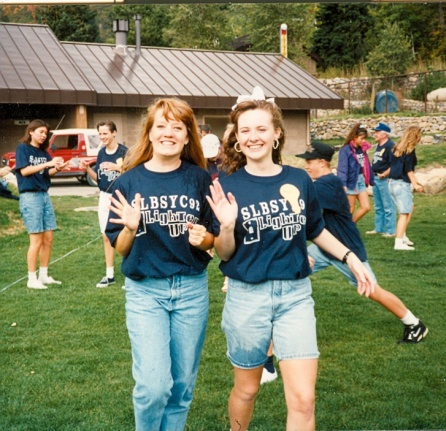
Meaningful activities define the Young Women program, whether it’s Sunday lessons, service projects, the Personal Progress program, weekly Mutual events, camp, youth conferences – to name a few. Activities are planned with the guideline of “What do we want to have happen?” rather than, “What do we want to do?” The gospel of Jesus Christ frames, infuses, and gives significant meaning to Young Women activities.
Leadership opportunities come to young women as they serve in class presidencies and on ward and stake youth councils. Through these experiences, girls not only learn to plan and carry out events and conduct meetings, they also serve and seek to meet the needs of their peers.
 Girls, both young and old, love to be together, to feel like they belong to a group. Witness how girls group together at school, at outings and activities, in hanging out at the mall or elsewhere. However, sometimes such groups are exclusionary: the groups require certain skills or clothes or status to belong. Sometimes the groups are negative or destructive.
Each girl can know that by belonging to The Church of Jesus Christ of Latter-day Saints, she is part of “something larger than her own life,” a church that is global in reach, eternal in nature, and true in doctrine.
All young women are part of a wonderful, worldwide whole. Each time I hear a group recite the Young Women theme, I am moved not only by the principles espoused but also by the unity of spirit expressed as they stand together.
Each 12-to 18-year-old girl can feel that she rightfully belongs not only as a member of her Beehive, Mia Maid, or Laurel class, but to the ward and stake organization as well as to the entire Church organization of Young Women.
How reinforcing and strengthening it is for them to gather for the annual general Young Women’s Meeting in the Conference Center or their stake centers, then to sing together and hear counsel from the members of the First Presidency and the general Young Women presidency. This and other periodic occasions make the idea of belonging to a multi-national organization, now a half-million strong, real.
When our daughter, Stephanie, was in Young Women, she and I attended the first Worldwide Celebration, the Rising Generation, in 1986. Prior to the celebration, Stephanie and the other young women in our stake wrote their testimonies on small pieces of paper that were put inside balloons. We felt such sisterhood among the young women and mothers in our stake as we met together to watch a satellite broadcast. Then as part of the celebration, we moved outside and watched in awe as the young women released hundreds of colorful balloons into the October sky, knowing that similar launchings were taking place in thousands of locations.
 Ardeth G. Kapp, general Young Women president, later said, “What we wanted to have happen was to establish a worldwide sisterhood. That happened. It was an incredible thing with young women all over the world a part of it, sending their testimonies to the world.”
Over the history of this auxiliary, inspiration has directed changes in the programs and procedures to meet the needs of an ever-growing Church population and to help young women face the challenges of their particular eras. The Young Women program today is in many respects quite different than when I participated in the early 1960s, when we didn’t have Sunday lessons (because the Church was not on the block meeting schedule yet), when we earned Individual Awards each year, wore blue felt bandlos, and attended “Swarms of the Hive.”
(Requirements for the Individual Award included attending 75% of Church meetings, giving a 2_ minute talk in sacrament meeting, participating in a welfare project, paying tithing, and being morally clean.)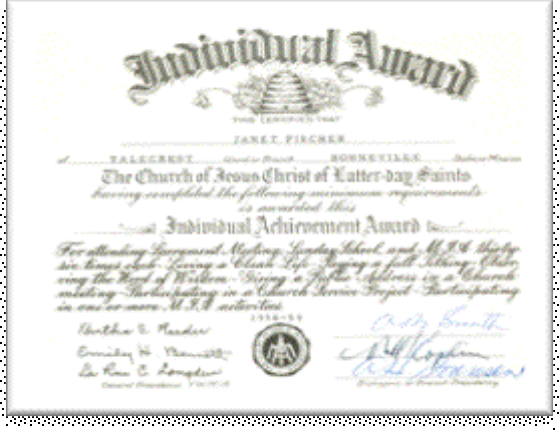
YWMIA was the right program for this era. It helped me to gain a sure testimony of the gospel and to experience “wholesome lesson work and spiritualized recreation” and did so for thousands of other young women throughout the-then-much-smaller Church. I knew that my leaders, Maxine Sutton, Lovinia Harmsen, and Beth Stewart, loved me and were concerned about my life, especially my spiritual development. I was one of those for whom the ward organization made a huge difference since my family was not the traditional Mormon family.
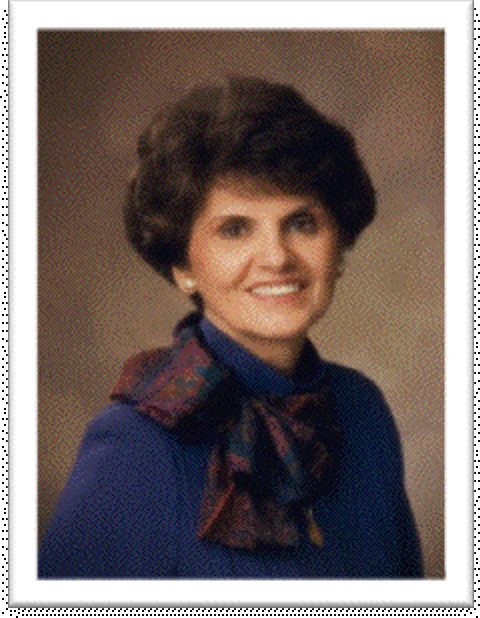 Twenty years later, when Ardeth G. Kapp was called as the general president of the Young Women, she and her counselors and general board discussed the needs of young women in the 1980s and addressed the questions of identity, direction, and purpose.
Ardeth said, “”We went through a rather lengthy and soul-searching process, seeking to know what would be best for young women today. From that process, the Young Women Values – faith, divine nature, individual worth, knowledge, choice and accountability, good works, and integrity – were developed. The vision we had was that every young woman should be prepared to make and keep sacred covenants and to receive the ordinances of the temple.”
The following year the Young Women theme was introduced, and a new Personal Progress book outlined opportunities for deeper spiritual development of participants.
As the 21st century opened and the assaults on the institution of the family increased, the words strengthen home and family were added to the Young Women Theme. The revised theme supports the Proclamation on the Family and encourages young women to recognize their active role in helping their own families.
Commenting on the contemporary view of marriage, Angela Kays-Burden wrote in the Christian Science Monitor: “The purveyors of our pop culture often portray marriage itself as an arcane institution that our progressive society should move beyond.
“In recent years, television shows and Hollywood movies have promoted our acceptance of – and even our appetite for – infidelity. Major networks are complicit in helping to erode the significance of lifelong commitments and loving relationships between husbands and wives.”
Today’s young women are faced with greater moral challenges than any generation in Church history.
(See Boyd K. Packer, “The One Pure Defense,” address to CES Educators, February 6, 2004, 4.) They are bombarded with immoral behaviors and icons through the media, the Internet, and text messages. As the new general president in 2008, Elaine S. Dalton called for a return to virtue and for young women to lead “virtuous and exemplary lives in order to influence the world for good.”
On the 139th anniversary of Young Women, the First Presidency approved Virtue as a new value.
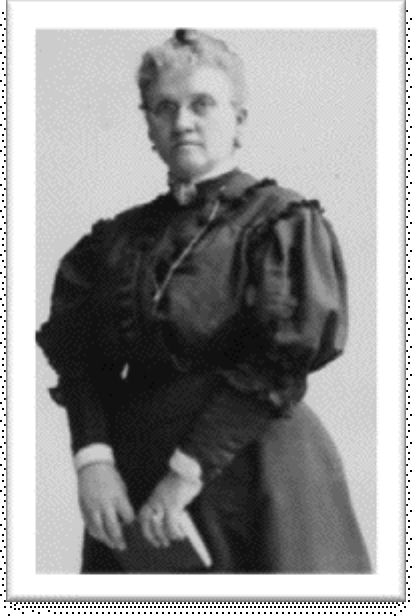 From its inception, this auxiliary has striven to help young women mature in the gospel, gain testimonies of the Savior, prepare for the temple and for their later roles as wives, mothers, and Church leaders. Susa Young Gates, daughter of President Brigham Young and founder of the Young Woman’s Journal, stated, “Mortality has no scales with which to weigh, no rule by which to measure, the value of the Mutual Improvement work to the young women of Zion!”
How true in Susa’s time, how true in my era, and how true today.