






How Far We’ve Come
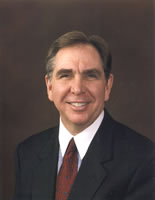
by Michael K. Young
Something remarkable happened in America’s history.

In June, our 15th prophet and President of the Church of Jesus Christ of Latter-Day Saints, Gordon B. Hinckley, stood before an assembled crowd of thousands and dedicated, or, one might say more correctly, rededicated, a temple in the small town of Nauvoo, Illinois. This event might go deservedly unremarked by much of the world, except for the unique place that Nauvoo and we, the Mormons, have in the history of religious persecution in the United States. This story is worth highlighting, not only for what it tells us about America’s history, but also for what it teaches the rest of the world about how a country can learn to provide genuine religious liberty as that country grows and matures.
President Hinckley’s visit to Nauvoo was preceded exactly 158 years to the day by a much bleaker event in the history of the United States. As we all know, on June 27, 1844, in the hardscrabble town of Carthage, Illinois, Joseph Smith, Jr., the founder of our Church, and his brother, Hyrum, were brutally murdered by a mob that desired nothing more than to be rid of the hated Mormons.
The Mormons had recently settled in large numbers on nearby farms and had even built a city, Nauvoo, the City Beautiful, in the forlorn hope that they might finally find refuge from persecution somewhere in this land supposedly founded on the principal of religious freedom. But the mob had other ideas. Kill the shepherd and the sheep will scatter, they reasoned in the twisted logic that has motivated religious bigots for millennia.
But even assassinations were not enough, the mob soon discovered. So, over the next two years, they drove outlying Mormon settlers off their farms and into the town where an estimated 17,000 people were soon suffering for want of food and supplies. Finally, in the hopes of finding the peace they thought was their birthright, in February 1846, in the bitter cold of an Illinois winter, Brigham Young began directing the mass exodus across the frozen Mississippi and toward the west, where those who survived the 1300-mile journey would establish Salt Lake City a year and a half later.
Illinois was at least the third state we had been forced to abandon. And the last glimpse of Nauvoo and the state of Illinois most of them ever had was the lone spire of their temple piercing the bitter Midwestern sky.
And a magnificent spire it was, sitting atop the extraordinary carved-stone edifice that dominated the Nauvoo landscape. The temple that was now receding in the distance had cost the Saints perhaps as much as a million dollars, an extraordinary sum for a group of persecuted farmers and merchants to raise in 1844, and had taken over five years of mostly volunteer labor to complete. But complete it they did, and their temple, though it stood only briefly, served as a symbol of their unswerving devotion to their God and their religion. But even this symbol of religious commitment did not survive the wrath of the mob and was put to the torch in 1848.
This story of religious persecution is not terribly well known, even in the United States, and might surprise many who are only familiar with the impressive recent growth of our Church and the reputation of our many members for patriotism and good citizenship. It might also surprise those who are not so familiar with the persecution that many religious groups faced in the early history of our country.
But it would be a familiar, indeed, almost commonplace tale even today to many who live outside the United States. Indeed, for as many as two-thirds of the world’s population, religious tolerance is the exception, not the rule, and the only unusual thing about the story of the early Mormons is that they were not all massacred in their sleep. That they were allowed to escape at all would be a wonder to many who live in a state of oppression that we in the United States can only imagine in our worst nightmares.
The list of oppressed is heartbreakingly long. It includes North Koreans, who cannot practice any form of unauthorized religion, Sudanese Christians and animists, who are the subject of relentless military attacks by their own government, Indian Muslims in Gujarat, who were murdered by the hundreds in communal riots by Hindus, a Jewish reporter beheaded in Pakistan once he confessed his faith, and a hundred thousand Muslims – mostly women and children – murdered by the terrorist Armed Islamic Group in Algeria. The list goes on and on, but the theme is the same. Religious liberties and religious tolerance are in very short supply around the world.
But that is precisely why the story of the Mormons is both so heartbreaking and so hopeful. It is true that our leaders were assassinated and their followers hounded to the edge and beyond of the United States.
But when, President Hinckley stood before an audience of thousands and rededicated the very temple that had been burned to the ground in 1848, he did so not with an occupying army protecting him, but rather after a leisurely (and unprotected) stroll down the very street from which our spiritual ancestors had been driven by torch and bullet. President Hinckley came not under cover of stealth, but rather as a man fully free to profess and practice his beliefs, beliefs that had earned his predecessor a death sentence at the hands of a mob exactly 158 years earlier. The mob was now gone, replaced by the welcoming embrace of the local citizens.
Indeed, I have no doubt the leaders of that Carthage mob would have been stunned to hear Mary Jo Scheetz of the Nauvoo Planning Commission give this assessment: “I think the temple rebuilding . is uniting us. We don’t want it to be city against church and I don’t think it is that way. … We’ve made very good friends. We couldn’t have asked for anything better historically … we’re just more than thrilled.” And Katherine Walker of the Macomb Area Convention and Visitors Bureau followed in the same vein, writing in a guest editorial this spring in The Macomb Journal that, It’s not only a historical rebirth for the temple and Nauvoo, but it’s a cooperative effort between the LDS Church, regional tourism and many local officials.
One hundred and fifty years after they were hounded out of Nauvoo, the Mormons came back, by the thousands, but not for revenge and not to a hostile reception. Rather, the Mormons returned to rebuild in the community that had been one of their earliest homes and again to become peaceful and gracious neighbors. The town, in turn, welcomed them with open arms.
This is not to say, of course, that some did not raise voices of alarm, though the number who objected in this day of protest as parlor game was remarkably small. Nor is it to say that everyone embraced the doctrines of the LDS Church with equal equanimity. Indeed, in even further tribute to the tolerance now practiced in America, evangelical Christians passed out tracts and otherwise tried to button-hole anyone who would listen as they attempted to explain their theological differences with the Mormons. But the most important point in all this is that everyone was peaceful and respectful of each other and even some of those who disagree most strongly with the Mormons took advantage of the free tours that were offered of the newly constructed Nauvoo Temple. And they, in turn, were warmly welcomed.
When President Hinckley announced in April of 1999, that the Church of Jesus Christ of Latter-Day Saints was returning to Nauvoo to build its temple, it brought gasps from his audience. I know, I was there.
But, to the great credit of the United States and its political growth and maturity, the announcement did not bring out armed mobs to oppose. Whatever disagreements that surfaced regarding the return of the Mormons were fought out in the meetings of local city councils and zoning commissions, not in the streets and most certainly not with guns and knives or tar and feathers.
The lesson of the Mormon return to Nauvoo should not be lost on any government or peoples around the world. Even the most free country in the world may have a history of which it is not particularly proud. But, more importantly, a country grows in strength and power precisely to the degree it honors the dignity of every individual and allows each to choose in freedom and safety the God he or she will worship and the religion he or she will practice.
Considering its history, the story of little Nauvoo on the banks of the Mississippi speaks volumes about how far American society has come in 150 years. It also should serve as a beacon of hope and faith for millions of others around the world who have not yet had an opportunity to reconcile with their neighbors or to rebuild their own religious lives in peace and dignity. The Nauvoo temple should become a landmark of understanding for all of us.
2002Meridian Magazine. All Rights Reserved.