









By Professor Richard G. Wilkins
Crossing a Moral Divide
Make no mistake about it. With the 6-3 decision by the U.S. Supreme Court last week overturning Texas’ sodomy law, we have crossed a major legal as well as moral divide, one from which there may be no return.
In the Lawrence case, a majority of the justices determined that there is a constitutional right to engage in a certain type of sexual behavior between consenting adults in private. Think about that for a minute. The highest court in the land was able to find in the U.S. Constitution a requirement that a particular type of sexual behavior is constitutionally protected. That constitutional right, the court said, outweighs the right of the citizens of a state such as Texas to decide what sexual conduct is legal. As I will explain shortly, and whatever one thinks about sodomy, this decision may soon have serious consequences for the nation – and in particular the nation’s children.
Like most other court watchers, I was not surprised that the court overturned the Texas law. When the court agreed to hear the case, it seemed likely that this would be the result. The only question was on what grounds the majority would base its ruling.
Justice Anthony Kennedy, who wrote the majority opinion, cites the “due process” clause, which the majority claims gives homosexuals “the full right to engage in private conduct without government intrusion.” The majority also held that the two homosexual defendants in the case “are entitled to respect for their private lives” and that “the state cannot demean their existence or control their destiny by making their private sexual conduct a crime.”
Justice Anthony Scalia, who wrote the opinion for the three dissenting justices, put precisely into perspective what this decision means both to the law and to society. Taking the unusual step of reading part of his opinion from the bench as a way of emphasizing how strongly he dissented, Justice Scalia characterized the decision as a “massive disruption of the current social order” and charged that “the court has taken sides in the culture war.” The opinion, he said, “is the product of a court, which is the product of a law-profession culture, that has largely signed on to the so-called homosexual agenda, by which I mean the agenda promoted by some homosexual activists directed at eliminating the moral opprobrium that has traditionally attached to homosexual conduct.”
While I was not surprised by this decision, I am saddened. And alarmed-as should everyone be who is concerned about basic morality and about traditional marriage and the natural family. In terms of its negative impact on the future of our society and on the basic moral and cultural values that are so essential to our future, this decision is at least on a par with Roe v. Wade, the 1972 case in which a majority of the court “found” a basic constitutional right to abort unborn children. It has a range of other broad implications as well for the federal-state relationship, the separation of powers between legislatures and courts and the basic rights of citizens.
Legislating from the Bench
As a constitutional scholar, I can argue with the dissenters that the majority is on shaky legal ground in rendering this decision. There is no mention of sexual behavior in the Constitution, just as there is no mention of abortion. To “find” one requires the kind of stretch of logic and the law that characterizes the very worst of the activist judges who increasingly are legislating from the bench. It is clear that a majority of this court clearly knew where it wanted to go and then manufactured a constitutional way to get there. It was, as Justice Scalia said in his dissent, a “result-oriented” decision.
In fact, I find this to be one of the most disturbing things about this decision. It shows that a majority of the current court is now comfortable going far beyond interpreting the Constitution. Interpreting the Constitution and laws has long been accepted as the proper and necessary role of the courts under our system of government. As former Chief Justice Charles Evans Hughes once observed, “The Constitution is what the justices say it is.” In this decision, however, the majority of the court joins an increasing number of judges at lower levels who are handing down decisions based – not on what the Constitution or laws say or don’t say – but on what the judges think they should say.
In succumbing to this temptation, the majority has usurped a role in our system that must be left to the elected representatives of the people, and more specifically to elected representatives at the state level. The regulation of sexual behavior is one of the many areas that are rightly within the purview of the states. If a majority of the citizens of Texas or another state want to discourage homosexual behavior, or even make it illegal, that should be their prerogative and an honest and strict interpretation of the constitution would uphold that right. Federal judges are not elected and therefore are not answerable to the people for how they rule. When they try to assume what are rightly legislative powers that should be controlled by the voters, they are corroding the very foundation of our form of government.
The Dire Implications
There are a number of immediate implications from this decision. One is its general impact on many other laws that govern other sexual activities such as prostitution and incest carried on in private between consenting adults. Based on the majority’s finding that homosexuals practicing one such behavior, sodomy, have “the full right to engage in private conduct without government intrusion,” there is a good chance that the majority would also find that states could not proscribe any of these other behaviors.
And, I fear, long-standing state protection of children from sexual predation by adults is not far behind. There is already a strong debate within the American Psychiatric Association regarding whether pedophilia is a “disorder.” The ever-increasing view is that “inter-generational sexual relations” (as pedophilia is now so delicately relabeled) is not always harmful and may even be beneficial for those who engage in it. Will this be the next sexual “right” that will be “entitled to respect” so long as the child and adult “consent” and act “in private”?
The implications of this decision for legalizing same sex marriage are even more disturbing. It now appears that the majority could easily apply the same reasoning and find that there is a constitutional right to same-sex marriage. While Justice Kennedy maintains that the decision did not promote same sex marriage, the reality clearly is otherwise. As Justice Scalia concluded in his dissent, this decision “leaves on pretty shaky grounds state laws limiting marriage to opposite sex couples.” Indeed, in the wake of the decision, homosexual activists made it clear that they would be using the momentum they have gained to push for same sex marriage.
A Wake Up Call
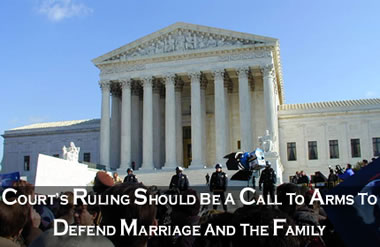
Those of us who are determined to protect marriage and the natural family must understand that we have probably already lost the war unless we view this decision as both a wake up call and a call to arms and react accordingly.
For one thing, it is now even more essential to rally the support necessary to pass a constitutional amendment to protect marriage. Before this decision, it had appeared that application of the Constitution’s Full Faith and Credit Clause (which requires all states to recognize contracts legal in any one of them) would be the most likely way in which all states would be forced to recognize same sex marriage if any one of the states legalized it, as Massachusetts appears to be on the verge of doing. Now, however, in light of the reasoning applied by the majority in this case, it is not outside the realm of possibility that they could also “find” some other constitutional basis for legalizing same sex marriage in the due process or some other clause.
This decision also underscores, if more evidence were needed, the critical importance to our future of making certain that those who fill future vacancies on the court are individuals of integrity who will interpret, not rewrite, the constitution. If just two of the liberals in the majority on this decision had instead shared the same philosophy as the three justices who dissented, we would have had a 5-4 victory instead of a 6-3 defeat. One or two vacancies are possible within a year and will likely occur because of the retirement of a couple of the court’s more traditional justices.
We must realize, however, that even filling future vacancies with the right people will not likely turn this defeat into a clear-cut future victory. The Supreme Court seldom does a complete turn about and directly reverses a previous decision, (although it did just that in overturning the previous sodomy decision in a case out of Georgia that it decided in 1986). Rather, it tends to expand or contract the scope of precedents set in previous decisions, sometimes significantly, sometimes only subtly. That means that even with good people on the bench, the best we can likely hope for is that this decision will be narrowed in its scope and new decisions which might expand it will be less likely.
Finally, this decision dramatically underscores the need to warn and educate our fellow citizens about the dangers that lie along the path on which the majority is taking the country. It has been observed that even judges who try to interpret the constitution and the laws strictly also read the newspapers. The majority in this case clearly wanted to issue a decision that would promote the agenda of a small but vocal minority, thinking that their agenda was where the country should be heading.
Justice Kennedy says that the majority claims that it based its decision on a perception of a “living constitution” that can be interpreted in light of changing societal values and priorities. He claims that had the framers of the Constitution, or those who supported previous amendments to it, “known the components of liberty in its manifold possibilities they might have been more specific” in enumerating just what they were attempting to protect. Instead, he claims, “They knew times can blind us to certain truths and later generations can see that laws once thought necessary and proper in fact serve only to oppress. As the Constitution endures, persons in every generation can invoke its principles in their own search for greater freedom.”
One does not need to be a legal scholar to see that he is advocating a legal version of situational ethics and attempting to justify ignoring or rewriting basic constitutional principles to serve societal needs that are perceived – correctly or incorrectly – by the justices. Adopting his rational will only accelerate the present situation in which we find our selves trapped, spiraling ever-downwards towards the lowest common moral denominator in our society.
There are several ways to prevent this philosophy from doing additional damage. They include getting better people on the bench. But one of those is something each of us can and must do. We must educate and warn our neighbors about what is happening. We must organize to be more effective and we must support, with our time, talents and resources, those groups that will spearhead this fight. We must try to avoid discouragement and, above all, we must never give up.
It has been said that “forewarned is forearmed.”
With this decision, we have truly been forewarned.
(For more information on this issue, as well as to sign up for periodic updates on this serious threat to marriage and the family, please go to www.defendmarriage.org. This is the Web site of Defend Marriage, an organization I started specifically to defend marriage and the natural family in the political arena.)
2003 Meridian Magazine. All Rights Reserved.