






All Rights Reserved
Editor’s Note: Suspected serial bomber, Eric Rudolph, who may have walked into a crowded and noisy park during the Atlanta Olympics, leaving behind a bomb, was arrested recently after being on the FBI’s Most Wanted List for five years. The man who found his bomb was a Latter-day Saint.
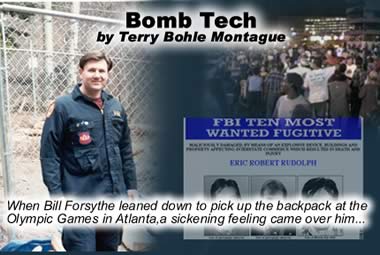
When Bill Forsythe leaned down to pick up the backpack at the Olympic Games in Atlanta, a sickening feeling came over him.
I will be on your right hand and on your left, and my Spirit shall be in your hearts, and mine angels round about you, to bear you up. D&C 84:88
When Bill Forsythe received his patriarchal blessing as a teenager, he was told there would be times when his life would be in danger and hang in the balance. He was also told angels were called to protect him and buffer him from harm.
At the time, Bill thought he would have some perilous experiences as a missionary and his life would be in danger then. His mission came and went uneventfully and, other than riding with a companion or two, he never felt as if he had any dangerous experiences.
But, on a hot, summer night in Atlanta, Georgia, in 1996, Bill bent over the ticking contents of an abandoned backpack and realized his life, in that very moment, hung in the balance.
At 31, after working several years in law enforcement and security, Bill was recruited into the Federal Bureau of Investigation. From the Denver, Colorado, FBI office, Bill was assigned to San Francisco, California. He was trained as a forensic specialist and assigned to the FBI’s newly-formed Evidence Response Team that became involved in the Polly Klaas kidnaping and murder. Because of the team’s processing of the evidence in that crime, the prosecution had a successful case, and Bill’s team became visible “on the FBI radar screen.”
Bill said, “We were assigned to work in Oklahoma City, the World Trade Center 1 in 1993, and other major bombings in San Francisco, Los Angeles, and stuff going on in South America.”
One day Bill was called into the office and told, “Since you’ve worked a number of bomb crime scenes, we’d like you to consider being trained as a bomb technician.”
“I’m not real keen on bombs,” he said. “What exactly will this entail?”
“As a bomb technician, you’ll be taught bomb triggering systems. You’ll understand bomb components. Also, you’ll be assigned to work special events all over the U.S. and abroad. You’d be an evaluator, doing assessments on unattended packages. Don’t worry. You’ll never have to deal with a live, ticking bomb.”
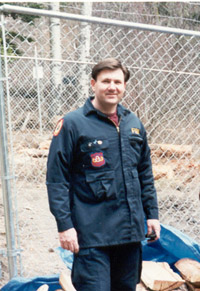
When Bill talked it over with his wife, Leslie, she wanted to know how dangerous it was going to be.
He said, “There is always a chance to be hurt, but I’m not going to do anything that I don’t feel safe and comfortable in doing.”
Bill received his Bomb Technician Certification after six weeks in the National Training Academy at Redstone Arsenal in Huntsville, Alabama.
In 1996, the Atlanta Olympics were coming up, and Bill was detached from San Francisco to work as part of an assessment team during the Games.
“Our director, Louis Freeh, didn’t like having agents work on live bombs. He thought it was too dangerous. The FBI had spent so much time and money training agents, he didn’t want to lose all that expertise if someone was having a bad day and cut the wrong wire. Instead, he preferred FBI Bomb Techs work in a support role for the local Bomb Squads and Technicians. “We were basically to look at packs and bags and boxes and see if there was anything about them that would cause us to be suspicious. And if we saw something that was weird or ticking or if there was a note attached or it was accompanied by a bomb threat, then we would start an evacuation and call in an area bomb squad, and they’d go down and look at it with a robot.”
On the evening of July 27, Bill and his partner were assigned to Centennial Olympic Park where a rock concert was scheduled to be held.
Centennial Park was a manufactured, fenced, 21-acre park situated two miles from the Olympic Stadium. The night was very warm and between 50,000 and 70,000 people crowded into the park to enjoy one of the nightly concerts.
A little before 1:00 a.m., Georgia Bureau of Investigation agent, Tom Davis, and Olympic security guard, Richard Jewell, noticed a group of young men with shaved heads and black clothing at the bottom of the NBC Sound Tower. They were behaving boisterously, as if they might be intoxicated. The officers watched them for a minute and then turned away. When they turned back, the young men were gone, but the officers saw a green, military-style backpack, commonly called an Alice pack, on the ground beneath a bench where the young men had been.
The officers looked around for the young men, assuming they might be the owners of the pack, but when they couldn’t find them, decided to treat the pack as suspicious. They called Special Agent Bomb Technician Bill Forsythe.
“I got a call on the radio to meet a couple of guys (Davis and Jewell) about an unattended backpack. This was just like a 120 previous incidents. There was nothing at all that was alarming to us or concerned us. So we made our way through the crowd.
“Because I had, 100 times before, found somebody’s lunch or gym clothes, I started to reach down to the pack and was going to pick it up. As I was bending over, I got a very strong feeling. I don’t know quite how to explain it. A sickening feeling. I started to get a little bit of apprehension. A little bit of warning started to come. The thought came to me, ‘You weren’t trained this way.’
“Without a doubt it was the Holy Ghost talking to me. “I said to myself, ‘That’s right, I wasn’t trained to deal with packages like this.’
“My job wasn’t to do a render-safe, but I started to do some diagnostics on the backpack. The thing that struck me as odd was that the pack was very, very full. It was packed full. You can tell if a pack is half full, but this was completely full.
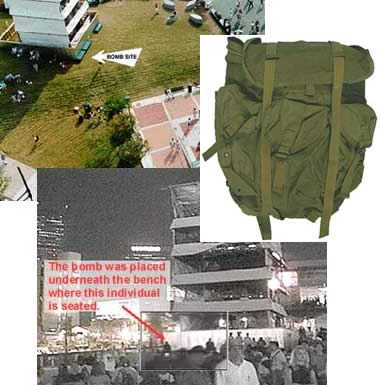
Photos courtesy of the FBI
“I tried to feel the side of the pack, if it was spongy or there might be clothes in it or something. It definitely was not clothes. It felt like it was very, very hard. The caution level went up.
“I couldn’t hear anything because the band was playing so loud and there were so many people around talking. I really could not hear anything.
“There were some modifications made to the pack. It was like a bolo tie kind of clasp on the top of the pack. It was a plastic thing that slid up and down. I loosened that and peeled, about halfway back, the flap on the backpack.
“As I did, I looked down into a bag that contained three large pipes, about 14 inches long and two and a half inches wide with end caps. I saw the wires. I saw what looked like a box, like a plastic sandwich container. I could see the side of a Big Ben clock.
“Now, I understand this is a live, ticking bomb and I don’t know how much time I have because I can’t see the face of the clock.
“I didn’t want to move the device in the pack because it may have had an anti-tampering switch in it, which would cause the bomb to go off if it was moved. There were a lot of things that could be funky on this thing.
“A lot of things raced through my mind. How much time do I have? Is there something I can do quickly?
“I had people walking around who were almost tripping over my legs as I was bent over this thing. How can I either diffuse this thing or minimize the blast without hurting myself and everyone around here?
“Inside of me, I was scared. I was trying to think about what I should do. The two of us can’t get thousands of people out of there. Should I have somebody run to the stage and make an announcement for everybody to get out?
“How much time do I have? Is there something I can do?
“My partner had a cell phone. I said, ‘Go off, get to a quiet place, call for help, get the bomb squad to come over here and help us.’
“I went back to (Tom) Davis and (Richard) Jewell and told them what was happening. Jewell was in disbelief. I was still in disbelief. I told Davis, ‘Get on the radio and call for as many police officers as there are in the park area. We’re going to start moving people back as far as we can.’
“In the process of doing that, approximately eight minutes after we got up off the pack, the thing goes.”
Other witnesses at the site described a bright, orange flash, a tremendous, ground-shaking boom, and smoke. The air filled with flying debris of twisted metal and shards.
Bill said, “I just remember that there was a horrendous force. I remember seeing a policeman on the side of me that literally did a flip onto the ground. All of sudden, I was down on all fours on the ground and I rolled.”
Some witnesses talked about being thrown into the air and others about being knocked down. As the smoke billowed above the 40-foot sound tower, many began to run and scream. The wounded lay sprawled on the ground. One witness said, “There were rivers of blood.”
“It wasn’t until everyone started screaming that it hit me that the thing went off. I looked at my partner and said, ‘Are you okay? Are you okay?’
“He said, ‘I don’t know.’
“I said, ‘Turn over, because if we’re hurt, we would have taken it some place in the back.'”
Bill had been standing down the slope from the sound tower, 42 feet from the position of the Alice pack under the bench. The blast would have occurred at about Bill’s shoulder level. He said the debris from the pack blew into the back of his arms and legs. The metal bits that struck the back of his shirt did not, however, penetrate to his skin.
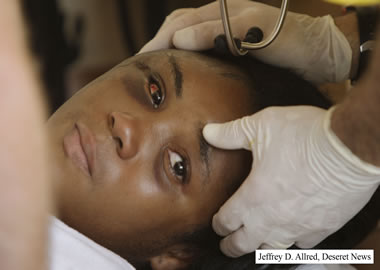
Bill’s partner suffered from some hearing loss and a few of the policemen around them “caught a nail or two. People were screaming and calling for first aid. I walked over to where all the commotion was and saw Alice Hawthorne and her daughter who was crying and screaming and trying to comfort her mother.”
Woody Enderson, Inspector in charge of the Southeast Bomb Task Force described the scenes in the park just after the explosion. “A husband holding his wife as he searched for her injuries, a young girl on the ground with several puncture wounds in her legs, law enforcement officers bleeding and stunned after they had tried to clear the area near where the bomb had been found before it detonated.”
Bill worked all that night and until two o’clock the following afternoon, controlling the crime scene and processing evidence from it. His findings were that the bomb contained, “three large pipe bombs, approximately 24 pounds of explosives and additionally nails and other shrapnel.
“The bomb had a half-inch (thick) piece of steel underneath it. It was designed to force the fragments up and away so as little as possible would be absorbed into the ground. The kill zone around this thing was easily 2,000 feet. Alice Hawthorne, the lady who was killed that night, was about 70 feet down and to the left of where I was standing.
“I’ve investigated and processed a lot of crimes and crime scenes. Shootings, stabbings, kidnappings and bombings. I pulled people out of Oklahoma City. But I guess what reminds me of my mortality and what keeps me awake, sometimes even now is, in my mind, I’m going back to the park and I’m going back to the pack and I’m picking it up.
“That was what I was going to do and I’m convinced that if I had, I wouldn’t be here today.
“If I had been eight minutes later getting to the pack, it could have gone off just as I was opening it. If we hadn’t had that eight minutes to get people away, there would have been many, many more deaths.
“At the time, I was Bishop in my ward in California (Rohnert Park 2nd). There were a lot of people in my ward who were praying for me. I know my wife and family were praying for me and I have no doubt that at 1:23 a.m., that morning, that those prayers were answered.”
One hundred and eleven people were injured in the blast, many severely, and two died. Alice Hawthorne died of massive head injuries and a Turkish cameraman died as a result of a heart attack.
The young men in black whose behavior drew attention to the abandoned backpack were located and cleared as suspects.
No one has been convicted of the Centennial Olympic Park bombing, but in October 1998, Federal authorities charged Eric Robert Rudolf with that bombing as well as several others. Rudolf has never been captured and the case is still open.

For an exceptional courage and actions taken on the night of July 27, 1996, Bill Forsythe was awarded the Medal of Bravery, the second highest citation awarded by the FBI. Bill was one of only 42 recipients of the medal in the history of the FBI.
Bill is quick to note, however, “There were a lot of people who did what was beyond normal that night. A lot of people who did a lot of brave things.”
Another time Bill held a live bomb was only a few months earlier, April of 1996, in Ted Kacyzinski’s 10 foot-by-10 foot cabin in the mountains near Lincoln, Montana.

“We heard, going in, there was probably going to be bombs, booby-traps, and explosive material, so we were going very, very slowly.
“There were lots and lots of things in there. A lot of stuff. That’s why it took ten days to process that small cabin. I was to testify to nearly 300 pieces of evidence seized in the search of Kacyzinski’s cabin.
“As is often the case in a major crime scene, you get people who want to see what’s going on in field operations. We had a person who was helping with evidence, he was a typewriter specialist. He was the one who was going to make (identify) the typewriter Kacyzinski used to type the letters to the Washington Post and the New York Times. He was supposed to have stayed outside the cabin and wait for my partner, Dave Alford, or myself to bring the typewriter out to him.
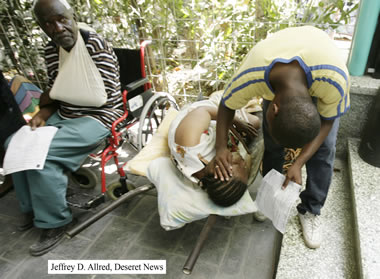
“We found something underneath Ted’s bed and it looked like it could be a block of cheese. It was wrapped in tin foil. Square. The guy picks it up and shakes it.
“It was just one of those feelings that came over me. A very sickening kind of thing. What could I say? ‘Put the thing down.’
“We x-rayed it and, sure enough, that was device number 18.”
In 2000, Bill was transferred from San Francisco, California, to Salt Lake City, Utah, to be the FBI Coordinator and later Chairman of the EOD (Explosive Ordnance Disposal) Planning Committee for the 2002 Winter Games. His committee was responsible for dealing with, rendering safe, and disposing of all hazardous devices that may have been brought into any of the Olympic areas from January 14 until March 16, 2002. His assignment was not limited to explosive material and devices, but included chemical, biological, radiological, nuclear, and incendiary devices.
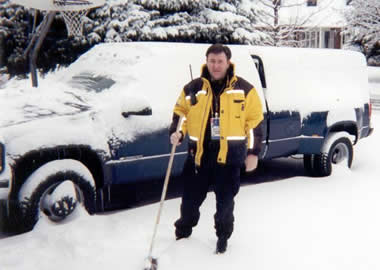
Now that the Olympic Games are over, Bill is being transferred to FBI headquarters in Washington D.C. where he will be part of an anti-terrorism division. His assignment is help develop counter-measures for weapons of mass destruction.
“As a policeman and an FBI agent, I felt it a number of times that the angels have been there to watch out for me,” he said. “It’s felt like a protective bubble.”
Bill has a favorite scripture. “It’s one I used in my son’s mission farewell,” he said. “It’s in Doctrine and Covenants Section 84.”
Verse 88 reads;
“Whoso receiveth you, there will I be also, for I will go before your face. I will be on your right hand and on your left, and my Spirit shall be in your hearts, and mine angels round about you, to bear you up.” D&C 84:88
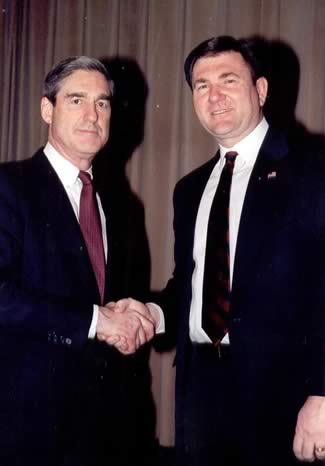
Sources:
Interviews: Bill Forsythe, 14 August and 5 September 2002; Letter, 12 September 2002
2003 Meridian Magazine. All Rights Reserved.