






By Sunny McClellan Morton
It sounds like something out of Peter Pan: a remote mountain village populated almost entirely by orphan boys. [1] But this group of “lost boys” is no fairy tale. The boys of Flor Azul live on a rocky mountain hillside above Tegucigalpa, Honduras. There they scrape out a meager existence, raising crops, livestock, and each other.
But survival is only part of their story. As small groups of international volunteers arrive to help or teach these boys, they are finding that the boys have much to teach them about hard work, hope and a sense of community.
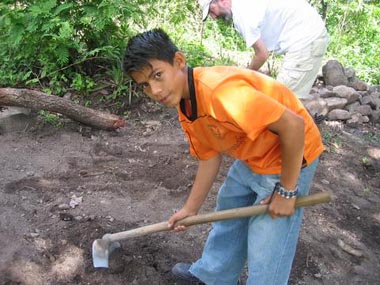
The residents of Flor Azul work hard for their own maintenance. They help build their own buildings and cultivate their own food.
“The community of Flor Azul is only two and a half years old,” explains Karen Godt, who runs Hope for Honduran Children Foundation, a charity in the United States that has helped build Flor Azul. [2] “Two destitute boys traveled clear across Honduras – on foot – to find Sister Maria Rosa Loggol, who was known for helping abandoned children.”
Sister Maria didn’t have a home for the boys. Instead she took them far into the mountains to an abandoned building owned by her charity, Sociedad Amigos de los Nios. The two boys began homesteading the rocky hillside.
“More boys began to gather,” continues Karen. “In the blink of an eye there were twenty-four boys, then eighty.” Now Flor Azul is home to 100 Honduran boys, all victims of abandonment, neglect or abuse.
Poverty in Honduras
“The ones who make it to Flor Azul are the lucky ones.” Karen describes the dire situation in Honduras, the second poorest country in the western hemisphere. “The lack of government assistance, sanitation, and heath care programs is astounding. Education is scarce and job opportunities are non-existent.” UNICEF reports that 68% of Honduran families are poor, with higher poverty in rural areas. An estimated 180,000 children are orphaned. [3] These are often left to fend for themselves, sleeping in cardboard boxes and picking rotten food from dumpsters. They frequently gravitate toward cities, where violence, disease and gang problems add to their misery.
Flor Azul
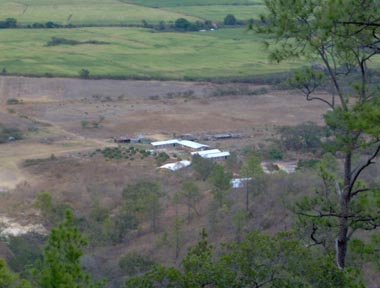
An aerial view of Flor Azul, high on a Honduran mountainside.
Flor Azul is one answer to Honduras’ enduring child poverty. Three concrete dormitories, a one-room school and a dining hall shelter the boys. A well provides running water. Fields that were cleared with machetes by the first boys in residence now grow corn and fruit trees. Chickens roam among the buildings, pecking at the rocky soil, and ragged sheep wander the hillside. Thin cows stand along the rutted dirt road that leads back down the mountains. There is no electricity. But even this bare existence is a paradise to the boys – a rescue from exploitation, starvation and exposure.
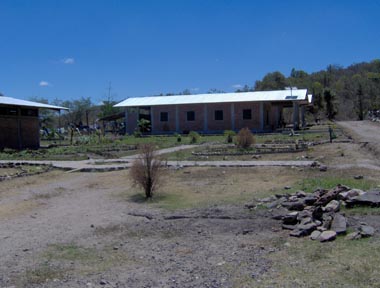
A concrete dormitory at Flor Azul. The laundry hangs to dry in the breeze.
Six days a week the boys of Flor Azul rise with the sun to care for their crops and animals. They aren’t just subsistance farmers, however. “Our ultimate goal is to provide the necessary tools and instill the desire for these children to become self-sufficient, caring and responsible adults,” says Karen.
The boys attend school, learning not just mathematics and English but also career skills in fields like business, farm management, and carpentry. When older boys with no schooling arrive at the home, they start in the first grade and work their way forward with the younger students. “We won’t send someone away until he has an education and a job.” This means that older boys might be around for awhile (the oldest there right now is 22). Meanwhile they help care for the younger boys and run the orphanage.
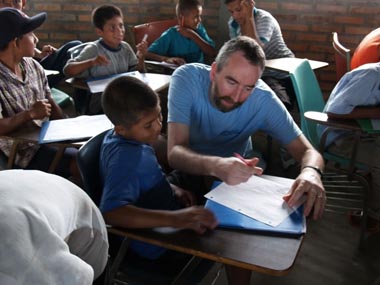
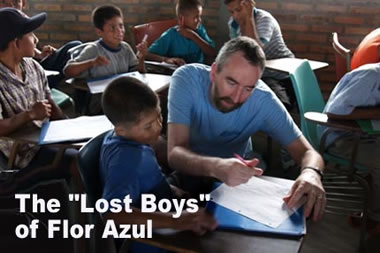
The boys study with visiting instructor Matthew McCue, a teacher from University School in Shaker Heights, Ohio.
Who Runs the Orphanage?
A few adults shoulder the enormous daily responsibilities of running Flor Azul. Executive Director Geovany Herrera grew up in an orphanage run by Sociedad Amigos de Nios. “He commutes daily in his pick-up truck from Tegucigalpa where he lives with his wife and son and attends the university,” says Karen. “He is always working – advocating for the boys in every corner of the country.”
The boys’ schoolteacher, known to all only as Gustavo, lives a two-hour walk down the mountain with his own family of six children. He rises before dawn to be at Flor Azul when the boys get up, and he is often there past dark. “He is such a Renaissance man,” Karen says as she shakes her head in amazement. “This man lives in a humble two-room adobe home and reads Socrates, Plato, and anything else he can get his hands on. I don’t know where he gets all his energy. He teaches the boys everything, from math to manners.”
A young family and an older man actually live at Flor Azul with the boys. Anival, his wife, and their two-year old son “work 24/7” for this little village, says Karen. Anival grew up in an orphanage as well. “He guides the boys with a very strict discipline but amazing grace, dignity and love.”
The boys’ other resident companion is Don Beto, known simply as “abuelo” (“grandfather”). A former resident from a neighboring community, he now commits all his time and 80-year old energy to his “grandsons.”
International Visitors Include an LDS Youth
Inevitably, word of Flor Azul has spread beyond Honduras. Karen, who lives in Cleveland, Ohio, first visited the place as a medical translation volunteer. “They had just started Flor Azul. It was literally a shack and a field.” So she and her husband started Hope for Honduran Children, a nonprofit organization that works to provide a nurturing environment and hopeful future for children in Honduran orphanages. Their focus is on food, clothing, shelter, medical care, education, and life and career skills that will lead to a happier future. She regularly leads civic, school or church groups from the United States on humanitarian service trips to Flor Azul and neighboring orphanages.
One of Karen’s student workers is Brandon Jackson, a Latter-day Saint youth who lives in University Heights, Ohio. She recalls meeting him after delivering a speech about Hope for Honduran Children at his school. “As I left the stage, one young man stood apart from the crowd and said to his friends, ‘These boys are our brothers – we must do something to help them.’ It was Brandon Jackson, and it was an encounter I will remember forever.”
Since then, fifteen-year old Brandon has helped raise more than $10,000 for Honduran orphanages and has visited there twice. (And he’s not even old enough to date yet!) In March he traveled to Flor Azul to help build a tilapia farm. This project was planned by a hatchery specialist to improve the boys’ diet and teach them career skills.

“Teach them to fish”: a tilapia farm under construction at Flor Azul.
“If it’s successful, they’ll be able to eat fresh fish every day,” explains Brandon enthusiastically. “The kids are really excited. We moved about 1000 bricks the first day into the pit, which is about six feet deep. We mixed cement and helped build part of the foundation. They had a wall done by the time we left.”[4]
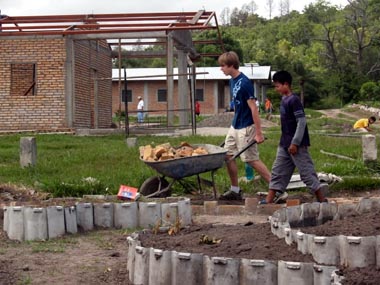
Brandon Jackson hauls bricks with a resident of Flor Azul.
What about the language barrier? “A lot of people think you have to speak Spanish – it was not completely true,” explains Brandon. “Even with the language barrier, just being there and caring enough makes them extremely happy. Although you can’t speak to them, you can still communicate.” He admits his own Spanish is poor and he was “just getting the hang of it” when he had to leave Honduras for the second time.
Karen has been so impressed with Brandon that she appointed him to her foundation’s board as a youth advisor. “I am inspired and motivated every day by Brandon’s sense of determination, commitment and energy,” she says. “He has been a huge motivator at University School – creating excitement, awareness, and recruiting more and more students to become part of our immersion travel groups. He has spearheaded fundraisers and clothing drives. While in Honduras he has connected with each and every young man at Flor Azul. They know he sincerely cares about them and they appreciate his gift of ‘hope.'”
“Enter to Serve, Go Forth Having Learned”
Working with Hope for Honduran Children is like no other service project Brandon has ever participated in. “My parents always taught me about tolerance and about knowing more about the world than just what America is,” he says. “But I don’t think anything can prepare you for the experience of going there.”
Arriving at the airport gave Brandon his first hint of the new perspective that awaited him. “You see hundreds of Honduran people standing there, and it’s really sad. You can already see the troubles on their faces. You have to pass all them with your fancy luggage and your nice clothes. And you see them wearing their nicest clothes and it’s something you would throw away. It’s pretty depressing at first but then you see that they still have hope and it gives you really mixed emotions.”
He continues, “You watch the news. You see people who are suffering, but you can change the channel to your favorite sitcom and forget about it.” Not in Honduras. There, “it is so humbling to see that lifestyle. It makes you think about who you are, whether you’re doing the right things. Down there the kitchen people would work in the hot kitchens for twelve hours to feed the Americans and the medical brigade. And they are starving. You’d get mad at yourself for being full. It was just really hard. [Now] I try not to waste things. I felt so guilty when I came back, I couldn’t finish my dinner so I left it out all night so I would finish it in the morning.”
Great lessons about hope and community are taught by the boys of Flor Azul. “They’re really happy. All they really have is each other, the school, and God. And it’s enough,” Brandon marvels. “They have a profound and family-like atmosphere. They’re all working hard so they’ll have a better life later on. There’s an atmosphere of hope.”
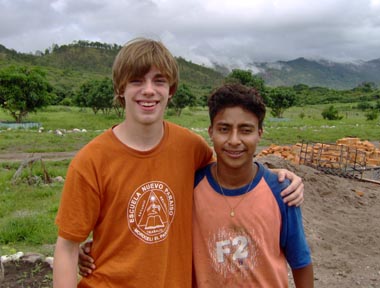
Brandon Jackson and Justiano, who became instant friends.
Another student watched the distribution of a bag of hand-me-down clothing at Flor Azul. “I remember seeing boys running around, holding up shirts, and asking what they could and could not take. Not a bit of greed came across their faces. The older kids would stay back and let the younger boys get their first pick [of] the newer or nicer things. This just shows the brotherhood that is in their community. These boys are a family to each other.” [5]
“They are hungry, but they are not desperate,” writes Karen in her book A Pocket of Heaven. [6] “They are proud of their achievements. They are strong, bright, beautiful and wonderfully happy. We ask them about their dreams. They tell us – food and shoes.”
Making a Difference One Life at a Time
Karen and Brandon easily admit that the scope of child poverty at Flor Azul and throughout the world is staggering. But they also each stress that one person’s efforts are not lost in a sea of need. “To the world you might be one person, but to one person, you might just be the world,” writes Karen.
Brandon put it a little differently. “While we were down there I came to the conclusion that the entire world would never able to be ‘saved.’ So you have to choose where you want to serve.” He pauses. “I love it there. This is what I will do with my time, with my hobbies, and if I am financially successful, my money.”
How Can Others Help?
“Financial support is the greatest and most overwhelming challenge,” says Karen. The most immediate needs are food, clothing, and shelter. “A dollar a day will do that. So if you just make a five-dollar donation, you have just taken care of a child for five days.”
Her organization’s website www.HopeforHonduranChildren.org accepts online donations in any amount. A donor can sponsor a child ($30 a month); pay the teacher’s salary for a month ($50); feed the entire orphanage for a day ($100), or contribute to building, hospital, micro-enterprise (small business), scholarship or emergency funds. Karen’s book A Pocket of Heaven is also available at the website (proceeds benefit the children).
There are other ways to help. “Hosting an event (a concert, bake sale, party, or other fundraiser) to create awareness and solicit donations for our children” is a great way for families or individuals to contribute. Another suggestion is to arrange for a presentation by the Hope for Honduran Foundation at a school or community function. That’s how Brandon got involved – and it’s been worth more than $10,000 to the orphanages (and lots of Brandon’s hard work!).
Karen also invites adults and older youth to join one of her travel groups to visit the children in Honduras. “It costs about $800 and the price of a plane ticket for a one-week stay,” she says.
Any of these things will help the children in Honduras. As young Anne Frank – herself a victim of the horrors of war – wrote more than half a century ago, “How wonderful it is that nobody need wait a single moment before starting to improve the world.” [7]
[1] Mark Krieger. “Honduras Trip, July 2006.” Electronic diary. In possession of Karen Godt, Hope for Honduran Children. www.HopeforHonduranChildren.org.
[2] Interviews by Author with Karen Godt, March – April 2007. Telephone, email, and face-to-face meetings. Notes in possession of the Author.
[3] UNICEF. At a Glance: Honduras. https://www.unicef.org/infobycountry/honduras_2026.html.
[4] Telephone interviews by Author with Brandon Jackson, March – April 2007. Notes in possession of the Author.
[5] Brittany Byrd. “Reflection. March 2007.” Electronic diary. In possession of Karen Godt, Hope for Honduran Children. www.HopeforHonduranChildren.org.
[6] Karen Donovan Godt and John Ransom Godt. A Pocket of Heaven. Copyright 2005 by the Authors. Cleveland, OH, USA, page 32.
[7] Quoted in A Pocket of Heaven, p.68.
2007 Meridian Magazine. All Rights Reserved.