






Michael K. Winder is the author of Presidents and Prophets, The Story of America’s Presidents and the LDS Church.
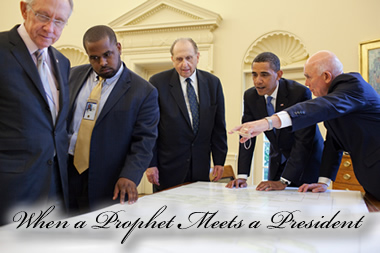
On July 20, 2009 when President Thomas S. Monson met with President Barack Obama, it marked only the fourteenth time when an LDS Church president had a meeting in the White House with the President. The first meeting was in 1839 when Joseph Smith called on Martin Van Buren to plead the cause of the persecuted Saints in Missouri. That meeting didn’t go so well, and Joseph Smith was famously rebuffed with “Your cause is just, but I can do nothing for you.”
Typically the President and the Prophet meet for one of three reasons:
1) To explain specific Church programs and enlist the partnership of the federal government. This was the case when George Albert Smith called on Harry S Truman in 1945 to explain the Church’s desire to provide welfare help to the people of war-torn Europe. This was also the case when Ezra Taft Benson met with Ronald Reagan in 1986 to discuss the famine in Africa, and to explain about the Church’s special fast that raised $10 million for relief aid.
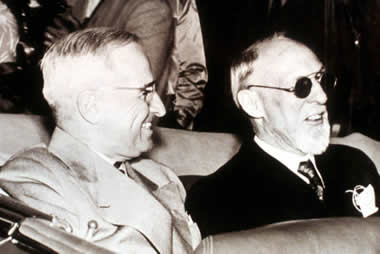
Harry S. Truman, president of the United States, and President George Albert Smith. This visit together prepared the way for an important visit to Washington, D.C., fifteen months later, when President Smith asked permission to send supplies to European Saints who had endured the bitter fighting of World War II.
2) When a President wants to seek solace and advice from a religious leader. We saw this in 1964, when just a couple months after the Kennedy assassination, Lyndon B. Johnson reached out to David O. McKay. This sort of visit occurred again after 9/11 when George W. Bush invited Gordon B. Hinckley back to the White House along with other religious leaders.
3) Finally, there are many visits that are simply get-to-know-you courtesy visits, where a wide variety of topics are discussed. An example of this is the 1977 visit to Jimmy Carter made by Spencer W. Kimball, where they discussed Latin American affairs, the Peace Corps, the LDS missionary program, the Family Home Evening program, and how to strengthen the family.
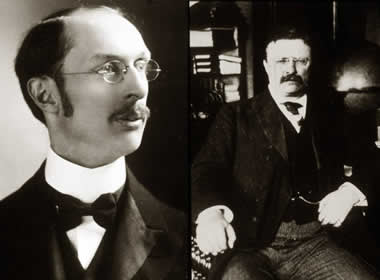
George Albert Smith and President Theodore Roosevelt in his White House Office. George Albert Smith had a natural, unaffected gift for making genuine, lasting friends of national and world leaders. He had contact with nine presidents of the United States, including Theodore Roosevelt. Roosevelt is quoted as saying to Smith””I never want you to come to Washington while I am President of the United States without coming to see me.”
Congressmen are often involved in arranging these visits. Even Joseph Smith was introduced to Martin Van Buren by Illinois Congressman John Reynolds, a non-Mormon. Later introductions were made by LDS members of Congress, such as when Senator Reed Smoot introduced Joseph F. Smith to William Howard Taft in the White House in 1911. The 2009 visit of Presidents Monson and Obama was assisted by Senator Harry Reid (D-NV), who also attended the meeting.
Often the Church president is accompanied by a member of the Quorum of the Twelve; such as when Neal A. Maxwell (in his capacity as chair of the Church Public Relations Committee) joined Gordon B. Hinckley in his 1995 visit to Bill Clinton. In the visit of President Monson to President Obama, he was accompanied by Dallin H. Oaks, who, as a former state Supreme Court justice and attorney, enjoyed discussing law with the former head of the Harvard Law Review-turned Commander in Chief.
Gifts of family history have been a tradition since the Jimmy Carter years. Ronald Reagan was so pleased with his because he found an ancestor he didn’t know about who had fought in the Civil War. Bill Clinton was also appreciative, and promised to hold a Family Home Evening with Hillary and Chelsea at Camp David during the upcoming Thanksgiving holiday to go through it. In this tradition, President Obama was also grateful for the family history and said he looks forward to sharing it with his daughters.
These visits of a Prophet with a President are important. They build ties between the Church and America’s chief, demonstrating the Mormon willingness to be good citizens and active in American life.