
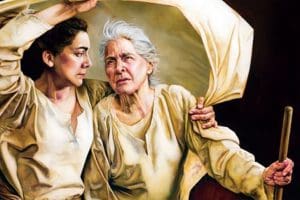




Faith in the Service: Inspirational Stories from LDS Servicemen and Servicewomen
By Chad S. Hawkins

Editor’s Note: These excerpts are from Faith in the Service, a new book compiled and illustrated by Chad S. Hawkins, who conducted many on-site personal interviews with those serving in the armed forces. Serving in the most harsh and difficult circumstances imaginable – in armed combat, air rescue missions, support assignments, and hospital settings – these courageous and dedicated men and women describe their feelings, tell of the much-needed help and support received by their families and loved ones at home, and testify that the Lord does watch over and protect his children during troubled times, often in miraculous ways. Used by permission of Deseret Book.
“Blankets Warm Victims”
Major Michael Burton Howard
U.S. Air Force
Iraq, April-September 2007

Major Howard and Buriyar, a nine-year-old boy who was grateful for a gift of a soccer ball. His family expressed gratitude to all Coalition Forces for freeing them from Saddam.
With less than one month left in my deployment, my aunt and her daughter-in-law organized a girls’ camp project to make twelve blankets for people in need. These large, soft fleece blankets were handmade with loving care and sent to me for distribution.
As I thought about who should receive the blankets, I remembered a recent car bombing in downtown Kirkuk. I thought it would be meaningful if we could find victims of the attack and let them know that Americans care and were thinking of them. A friend of mine who served as the provincial police chief went to work and identified several families directly affected by the attack.
The location of the families posed a real and dangerous threat. Kirkuk can be an unpredictable, menacing city. This mission was unique because my team was going to rely on the police chief to guide and escort our convoy without us knowing beforehand exactly where our route would take us. We had to trust him.
Most of my men were uneasy about not being in complete control and not inclined to trust any Iraqi official completely. As we gathered and prepared to leave the base, I had to make a judgment call. I was in command, and it was up to me to decide whether to proceed or not. I relied on inspiration from the Holy Ghost, and I believed we were going to be fine. I felt we were going to return safely and that we needed to accomplish this mission.
I went from Humvee to Humvee and said, “Guys, I know you are uncomfortable, but we are going to be fine on this mission. Trust me on this one. We are going to be safe.” The Holy Ghost’s comfort enabled me to gain the confidence of these tremendous men.
The mission took us through the narrow city streets, around piles of rubble, and under drooping telephone wires strung like spaghetti between the old buildings. We knocked on the dwelling doors and were introduced through our Iraqi linguists as “Americans who would like to provide your family with comfort.” We proceeded to give those blankets of love to families who had lost a loved one in the attacks.
If there were children in the home, we also gave them backpacks filled with school supplies, soccer balls, and stuffed animals. I would take as many as I could by the hand, look at them, and say, “May God bless and protect you.” It was my way to exercise my priesthood and bless them in a small way. Frequently, other children would swarm us, and so we were prepared to share the supplies, Beanie Babies, and soccer balls with them, too.
I have always trusted the Lord and learned to rely on the Holy Ghost, especially as a young missionary in Italy. Now, like then, the reassurance of the Spirit came to me. I was able to safely lead my men while serving the people of Kirkuk.
To end my deployment on such a high note, with a humanitarian mission, was very special. We were doing what we could to give hope and comfort to these children of our Heavenly Father who were so tragically deprived of their husbands, brothers, and fathers in this war. I will never forget their tears and their gratitude and encouragement to us. They pleaded with us to keep on fighting for their freedom and give them hope that their country would someday be like America.
“I Ran for Them!”
Sergeant Jill Stevens
Utah Army National Guard
Afghanistan, 2004

Sergeant Jill Stevens with an Afghan woman. In many cases, Afghan women will not allow their photo to be taken unless they are completely covered with their burqa.
My Utah National Guard unit was deployed with an infantry division from Hawaii. A few of the soldiers from Hawaii run in the world-famous Honolulu Marathon every year. Even though they were in Afghanistan, they thought it would be great for morale to create the inaugural Afghanistan Marathon sponsored by the Honolulu Marathon. The details were worked out and equipment, time clocks, and even banners were sent. The banner over the start/finish line stated boldly, “Honolulu Marathon.”
We arrived at the marathon course in Chinook helicopters two hours before the race began. We were reminded that although security was provided, the area was still a combat zone. A quick-reaction force was on hand to respond should an attack occur. A team of armored Humvees was ready to roll out of the gate on a moment’s notice.
Some of the guard towers doubled as water and aid stations. There were even holes dug along the course so runners had somewhere to flee if rockets or mortars were fired in their direction. Military participants had the option to run with their weapons. During the security briefing, I looked around at all the runners still wearing full body armor and thought, “What am I doing, running a marathon during a war?”
With as many as 187 troops and civilians from around the country participating, we ran about five laps for a full 26.2 mile marathon. The course was a dirt-and-rock trail. The first three laps, I had energy and felt great. On the fourth lap my legs started to burn, and during the fifth lap I had nothing left. It was too hard.
Then it occurred to me what I was really doing. I thought that I was probably among the first group of women ever to run a marathon in Afghanistan. I was a woman running in a country where women are defiled and have no rights.
As I ran, I began to focus on how Afghan women are treated. Feelings of anger and frustration came over me. The feelings that followed were centered on pride - pride not only to be in the military, but also to be a woman in the military fighting for the women of Afghanistan.
From then on, every step I took I was thinking and running for them. This race is for them! I was the first female to cross the finish line (3:45:18). I won the race for them!
“The Fog of War”
Captain Tom Beckstrand
U.S. Army Special Forces Afghanistan, 2004

Captain Tom Beckstrand in the desolate Afghan wilderness
During one of the earlier elections for the transitional government of Afghanistan, I was serving as the team leader of a special forces detachment in the Oruzgan Province. Our time in the country had gone much like other deployments I had been on and would go on in the future: 90 percent boredom and 10 percent hysterics.
The team’s specialty was unconventional warfare. In essence, that meant that a handful of Americans would work with local forces to find and combat the Taliban. Our mission was simple: destroy any Taliban in the province in an effort to provide a stable environment in which the fledgling government could establish itself.
The Oruzgan Province is located in south-central Afghanistan at the base of the Hindu Kush Mountains; it is a remote province devoid of any substantial infrastructure and makes rural West Virginia look cosmopolitan. (I mean no offense to West Virginia.) It also happens to be the birthplace of the Taliban’s leader, Mullah Omar, and the birthplace of the Taliban movement itself.
The valley has always been sacred ground for the Taliban and the place where the Taliban flags began to fly once again just a couple years after they were toppled in 2001. The Taliban frequently claimed that they still controlled the valley.
Our team was about two-thirds of the way through our deployment and looking forward to a strong finish and being home for the holidays when our headquarters began planning how to best support the elections and ensure their success. Our recommendation was to place our team in the Cahar Cineh Valley shortly before the elections in an effort to engage Taliban forces and deny them the ability to interfere with the elections.
In the weeks prior, the local government had had its own forces ambushed multiple times in the valley, and they were apprehensive about what the actual election would bring. Likewise, a conventional United States unit (as opposed to a special forces unit) that had recently located at the north end of the valley had experienced substantial casualties since they had moved in just two weeks earlier, all from bombs placed in the road or ambush. Our proposal to move into the valley was accepted and incorporated into the master plan.
This was my team’s second deployment to the same area in Afghanistan, and we were familiar with the terrain and obstacles that it presented. We had made many trips into the Cahar Cineh Valley and knew that if you took a substantial force, the Taliban wouldn’t fight. They’d simply pick up shovels and look like farmers. The only risk would be from bombs buried in the road - a tactic employed with increasing frequency and effectiveness. It is also a tactic that’s extremely difficult to avoid.
Our plan was to take a force small enough to avoid detection and target a couple of key areas that our informants had indicated were Taliban hotbeds. We took a ten-man special-forces team and about thirty of our best Afghan militia. We would move during the night and hide during the day; our targets would be a couple of compounds located at the southern end of the valley.
During the first night of the operation, we covered the distance from our firebase through the narrow pass at the southern end of the valley. As day broke, we moved into a narrow draw off the valley and hid from the other traffic using the road. Throughout the day, we contacted our informants in the area to ascertain the location of a Taliban leader known to be in the valley; one informant agreed to meet up with us and to take us to him.
We moved in the late afternoon, our plan being to attack his compound and then leave as it got dark. We would then move through the night and be at our next target before the sun rose. As we crested the hill and moved down to surround the Taliban leader’s compound, we began to notice a lot of movement in the village around us. The recently vacated target compound showed signs of use as a barracks; large quantities of food and bedding were present.
After we had surrounded the structure and team members began to search it, I noticed two Taliban fleeing the area. As one team member pinned them down with a machine gun, three of us moved forward to engage them. In the ensuing gunfight, one died and the other was wounded.
As I was returning to the initial target, the senior enlisted man on the team, Mark, asked me to come back to my truck. When I got there, the interpreter came over and told me that he was listening to the Taliban plan their counterattack on his radio. Here’s what he heard:
“Get my AK-47; I will need it for the attack tonight.”
“And tell the others to get their RPGs [rocket-propelled grenades] and machine guns and come down here.”
“The wind and dust are too strong; they will have no help coming.”
That last remark held my attention. He was right; there was a dust storm at the time that was strong enough to prevent helicopters from flying. We would have no reinforcements and no way to evacuate any casualties.
I looked around through the dust and once again noticed a substantial amount of movement occurring all around us. Five guys on a tractor, two on a motorcycle, several on foot, all converging on an outdoor market about a half mile west of us. Mark then posed a simple but very difficult question. “So, what are we doing?”
Responsibility can be daunting. In a situation where there appears to be no right answer and no source of guidance, being the one charged with making the decisions can be intimidating. What if you’re wrong? What if someone for whom you’re responsible gets killed? Contrary to what’s in the movies, there’s no voice from the past with all the answers and no guarantee of a happy ending. Just, “So what are we doing?”
I looked towards the setting sun and told Mark that we were staying put. I figured it was better to defend from a place with which I was familiar than stumble around in the dark into an ambush trying to find someplace better.
I asked Mark and Tom, the two most senior guys on the team, to establish a defensive perimeter and made some suggestions as to how I thought it should look. I then took a moment to try to figure out how the Taliban would attack and what the outcome might be. As I looked through my binoculars at the orange “fog” that was the dust storm towards the market, my entire field of view was filled with men – men just milling about, waiting. I estimated I could see well over one hundred.
Most worrisome was a series of ditches that ran from the market to the compound we had just searched, which was sixty feet away from us. I realized that men could crawl down the ditches and emerge on the other side of the compound and we wouldn’t know it. It would then be possible to fire several RPGs in unison from the doors and windows of the compound, initiating an attack with little or no warning. It’s how I would have done it.
As I thought through how the attack might happen and what we could do to defeat it, I realized that unless our situation changed we wouldn’t all survive the night. I got on the radio and contacted our headquarters element in Kandahar. I was describing to them our situation on the ground when the satellite phone in my truck started to ring. I answered the phone and was greeted by my battalion commander. He told me that we had a satellite overhead that was seeing “some interesting things happening all around you.” There was also a “high probability that the men you’re looking at are the same ones we’ve been sent to find.”
He offered some encouraging words, wished me luck, and then said good-bye. He was a good man, a great commander, and I admired him. But as I put the phone down, I had never felt more alone in my entire life.
Sometimes it seems as though it’s easier to deal with adversity if it’s consistently difficult. The more arduous the situation, the more focused and driven one may become until resolution of the crisis is all that occupies one’s mind. This was one of those times for me. But when my commander offered encouragement, I was reminded of how much I missed my home and family and how badly I wanted to return to them.
After receiving that kindness, the impending sense of doom I felt was all the more pronounced. I thought of my home on the other side of the world and wondered if I would ever see it again. I had a memory of placing my bare feet on our carpet and wiggling my toes, and I remembered how good it felt. I wanted to call my mom and tell her that I loved her.
The recognition of the finite nature of mortality brought with it the remembrance of things we often easily forget. I remembered how comforting it was to hold a temple recommend and to know that should this be the end, I wasn’t worried about my standing with the Lord. I was thankful for the opportunity to have served a mission and the testimony that can come only through service to others; it was as a missionary that I decided that I would devote my life to service. And it was my time as a missionary that placed me on the path to military special forces and my service there.
As I was standing alone with my thoughts, looking toward the men amassing to our west, Tom came and stood next to me. Tom was in his late forties and had seen action in just about every conflict our military has participated in since the 1980s; he is also a close friend and confidant. I knew he recognized our situation for what it was: dire. When I looked over at him, he just cocked an eyebrow and shrugged. “Yeah, I know,” was all I could think to say in response.
With our defense in place, we waited for the attack to begin. Not long after it got dark, a teammate on the eastern side of our perimeter spotted through a thermal sight a truck with no headlights coming toward our position. It stopped about a half mile away, and nine armed men got out and started making their way toward us.
Previously, while we were waiting for the attack to begin, we had called for fixed-wing aircraft to loiter above our location in anticipation of the oncoming hostilities. They could fly above the storm. I now contacted one of those aircraft and asked him to make a strafing pass to target the nine men and the vehicle. I also asked my teammate to use our .50-caliber machine gun to ensure that both the men and the vehicle didn’t get away. The aircraft and machine gun struck at the same time, destroying the target.
A moment later, our interpreter got very excited and told us that we had hit some of the men he had been listening to on the radio. He also said that the Taliban were now moving inside the surrounding buildings to avoid detection.
As we thought of how to target the men hiding in the buildings without harming any civilians, we realized that one of our aircraft had a smaller 40mm cannon and a larger 105mm howitzer available for use. We came up with a plan whereby we would use the 40mm cannon to shoot the buildings we suspected the Taliban were using. It was too small to penetrate the thick mud roofs and do any damage. But it also provoked chatter on the radio when we hit one of the right buildings. Slowly and methodically, we worked our way through the market and surrounding buildings. When we identified a hiding place with the smaller cannon, we then used the larger one to destroy the building. This went on for several hours.
After listening to the Taliban plan to attack after the aircraft left, I asked the aircraft to move far enough away that it couldn’t be heard on the ground. My plan was to draw the Taliban out into the open and then bring the aircraft back to target them. Just as our gunship got out of earshot, he came back on the radio to inform us that he had a malfunction and really did have to leave. Ten minutes later a B-1 bomber checked in; it flew high enough not to be heard on the ground.
The Taliban’s plan called for all their remaining men to mass in the market and in some compounds 500 meters north of us. My plan was to give them thirty minutes to get there and then drop three 2000-pound bombs at those locations. I conveyed my plan back to headquarters and got a phone call shortly thereafter.
“Tom, this is the battalion operations officer.”
“Yes, sir.”
“The ordnance you’re planning on dropping is substantial.”
“Yes, sir.”
“Okay. Well, we’ve plotted your location on our map and where you intend to drop, and we want you to know that you’ll be in range of your own ordnance.”
“Yes, sir.” (Minimum safe distance for the ordnance I wanted to drop was 750 meters. With us only 500 meters away from where it would hit, all of the manuals said I could expect 10 percent casualties with my own men. As much as I wished the situation could have been different, it was what it was.)
“Well, okay. Good luck.”
“Thank you, sir.”
Thirty minutes later the bombs hit. All of us knew what was coming. With only ten Americans on the ground, it was easy to pass along information as it came available. The Afghans with us knew to stay close to their American counterparts and to do as we did.
Most of the debris from the blast passed over our heads; however, Tom sustained a slight shrapnel wound to his face. He stayed with us through the night and rode out with us just before daybreak. After our return to our firebase, he was flown down to Kandahar, where he underwent some minor surgery and fully recovered.
After the attack, we left before sunrise, taking a road south from our location and traveling out through the desert and arrived safely back at our base.
In the days after the attack, we learned from our informants in that area that between two hundred and three hundred men had gathered to attack us that night. Most were killed; this included a few notable ones that had specialized skills in explosives and communications, men we knew by name.
We also learned that both of the roads we had initially planned on taking north and west had been mined and had men in ambush waiting for us. This was also true of the road we came in on. The seemingly random decision to set off to the south out through the desert took us on the only unguarded route out. Tom would later comment to me, “Someone up there does like us.”
In the weeks that followed I received many congratulations for the work that my team had done. I’ll always remember the battalion sergeant major’s remark: “All of that activity and none of you got killed. Nice work.” I felt like I was taking credit for something I didn’t do.
This event was one of a series that caused the Taliban’s leadership to call in from Pakistan and offer a $200,000 reward or bounty for the man who could kill me. As far as anyone in my battalion knew, it was the first time that that had happened since the war began in Afghanistan.
I know that much of what happens on the battlefield can be attributed to the “fog of war.” There are countless, seemingly random events that occur, and we have little to no ability to influence their outcome. However, unlike many of the men with whom I served, I have a testimony of the gospel and an understanding of the plan of salvation. I do not believe in coincidence or good luck.
It is true that accidents happen, sometimes to good people. But oftentimes the Lord, unnoticed, intervenes on behalf of one of his children. In my case this has happened many times. There have been times in the past when I’ve put on a strong performance because I prepared and worked hard to ensure my success. This was not one of those times.
During this event I was at the mercy of limited information and great uncertainty. This was a time where all of the odds indicated that my team should have paid dearly for being in the wrong place at the wrong time. That we not only made it away safely but also were tremendously successful demonstrates to me that Heavenly Father is mindful of his children and their needs, even when they’re far from home.
I think back often to times when I have witnessed the Lord’s intervention not only on my behalf, but on behalf of the men for whom I was responsible. I feel especially indebted to the Lord for his protection of my men, men who didn’t know him. While it is natural to expect the Lord’s protection for obeying his commands, seeing his protection of others because it was important to me has helped me to understand his tremendous love for all of his children, as well as our responsibility for them.
My time in the service has given me an unshakable testimony, a testimony that has come with a price but one that I willingly paid. Besides, how do you put a price on a relationship with the Lord? The risks or hardship required to come to know the Savior seem insignificant compared to the knowledge and the happiness that I’ve received in return. My hope is that I’ll use what I’ve been given in a manner that is pleasing to him.
“Delivering Joy in a Blackhawk”
Chief Warrant Officer 2 Jared Kimber
U.S. Army, Blackhawk Pilot Iraq, three deployments

Iraqi Children wearing new clothes and holding their precious toys.
While serving in Kirkuk, Iraq, my living quarters were on the edge of our base. I lived so close to the perimeter that I could see through the wire and watch the Iraqi children on the outside. The children frequently occupied their time by playing games. These kids did not have anything. I never saw them play with any kind of toy. Yet they were able to find joy by playing tag or games of soccer in their bare feet using an old can instead of a ball.
My flying partner had children back home, so he was very sensitive to the needs of these kids. Together we watched the children make the best of their situation.
One day as the children played, my partner and I walked over to the fence and threw a few toys over the tall barrier. The kids were very excited for the gifts and amazed that anyone would give them toys.
We shared with our friends on base what we had done, along with the touching reaction of the children. The word of our experience began to spread. It was not long before we were approached by authorities in the air force. They explained that the military had been working to improve U.S. relations with a strategic small town. The military had gone to great lengths to foster and maintain a high level of public support among those living in the village. We were asked to assist with this objective by gathering and delivering toys in our Blackhawk to the children living there.
I loved the idea because I knew it would bless and bring joy to the lives of children living in desperate circumstances. We gathered toys by spreading word of our project on base and also back home. Our families back in the States collected toys in creative ways and then sent them to us.
After only a few weeks we were ready to go on our first “toy bombing” mission. A team of special forces was first sent to secure a location in the town. A translator was among the first on the scene to inform locals what was about to transpire. We circled up above until everyone on the ground was in position and we were cleared to land. I then landed my helicopter into the secured zone.
It was wonderful to watch the children’s expressions as I unloaded the cargo with my crew.
We had every kind of toy you could imagine – Frisbees, stuffed animals, soccer balls, and footballs – along with some clothes and shoes. We were allowed to play with the kids for about thirty minutes. They knew what to do with soccer balls, but we had to show them how to catch and throw the footballs. The best part of our mission was taking a few minutes to play with them. The kids had a great time. The parents told us through translators how much they appreciated us thinking of their children.
This first “toy drop” was a huge success, and we continued to get shipments of toys from back home. I guess word spread, and loving people back in the States continued to send us toys. Shipments came in “from sea to shining sea.” The toys filled our building and hallways. It seemed that we could not deliver them fast enough to keep up with the toys coming in.
Depending on our mission, we would sometimes fly low and drop the toys without landing. We were able to do this in several villages throughout Iraq. It was not long before we noticed a difference. Before, when we had flown over towns, people would run indoors and hide. Now, however, the villagers would come out and greet us with waves, even when we did not have anything to give. I know we made a difference in building trusting relationships.
It was a great feeling to give something to children who actually appreciated the gift. Kids back home have so much that many of them do not appreciate what they have. As a father of a one-year-old girl, I am grateful beyond belief that I can provide for her when so many children go without.
“Don’t Go Back with Them”
Henry Zander
Civilian Contractor
Iraq and Afghanistan, 2006-

Henry Zander: “Don’t go back with them.”
My first assignment in Iraq was my first experience in a combat zone. It was a daily occurrence on the base where I was staying, Balad Air Base, to have rocket or mortar attacks.
One day in May 2004, I had worked the previous day, through the night, and into the next day. It was approaching lunch time, and I was ready for bed. A few of my friends wanted me to go to lunch with them. Despite how tired I was, they persuaded me to go with them. The base was huge, so we drove a mile in our HMMWV, or Humvee. After lunch, we left the building and were walking back to our vehicle.
As we approached the vehicle, I had a very strong impression. Actually, it was more than an impression. I recognized it as the Spirit saying, “Don’t go back with them.” The message was clear. So I stopped and said, “Hey, I am not going to go back with you guys.”
My friends replied, “But you’re tired and you want to go to bed. We will get you back in just a few minutes.”
I thanked them but told them that I would find another way back. I ended up locating my vehicle, which another contractor had been borrowing, and drove it back to a location near my sleeping quarters.
My friends arrived at their building and parked the vehicle. Ten seconds after they parked their vehicle, a 127mm rocket flew over their heads and blew up the chaplain’s Humvee, which was parked two spaces over. The rocket pierced the soft skin of the Humvee body just behind the front left wheel and exploded directly beneath the engine. The vehicle actually capped much of the shrapnel and prevented collateral damage. My friends ran into an adjacent building, and one collapsed with exhaustion from the event.
We had multiple attacks throughout the day, which kept me up the rest of the day. It was late that night before I finally got to bed. Then I finally had time to reflect on the day’s events. Only then did I realize that if I had ridden back with them, I would have exited the Humvee from the rear and walked directly to my quarters, which were exactly in line with the explosion.
Considering the time it would have taken me to get out of the vehicle and head back to my room, I would have been at the direct point of impact. I then recalled the prompting I had received earlier that day that told me not to go back with my co-workers.
I know Heavenly Father is very aware of all of us. I knew that prior to this experience, but this just reinforced that knowledge. He lives; he absolutely lives. Being spared from the rocket explosion only confirmed what I already knew to be true.