








The Art of the Entry into Canaan
By Bonnie Lach Oswald, BFA, MA
Art done by the Israelites during their travels in the wilderness, and entry into Canaan, no longer exists. The golden calf, the Ark of the Covenant, and the Tabernacle have disappeared. I have checked my basement, which seems to hold an accumulation of just about everything, but they are not there, so we can assume they are gone for good. Moses destroyed the calf.
We can speculate on how art from the Canaan period might have looked, based on Bible descriptions, and the art of cultures surrounding the Israelites that they might have used as models. The famous medical symbol, the caduceus, is modeled after Moses’ staff, which he held aloft with 2 snakes coiled around it. People who had been bitten by snakes would but look at this staff, and be healed if they had faith.

Artist’s rendering of the Tabernacle, with the Holy of Holies enclosed in the tent-like area.

One of the features of the Tabernacle was the Menorah, the distinctive 7 branched candlestick. it would not have held candles, but small lamps for oil on the top of the branches.
The Bible tells us in great detail the plan and decorative elements of the tabernacle (a portable temple that would become a plan for Solomon’s temple), and the Ark of the Covenant. The Ark, built to hold the Ten Commandment tablets, featured two cherubim on top with their wings extending towards each other. Every artist’s rendering that I have seen of the Ark looks like the art of the time of the artist who did the rendering. My guess would be that the sculpted figures would have appeared more in an Egyptian tradition. Winged figures were a common Egyptian artistic device.
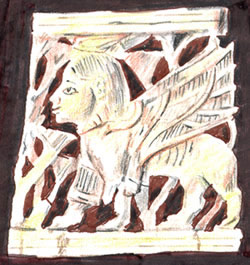
Striding sphinx, ivory, 3 3/8″ tall, Egyptian style, found in the ruins in Samaria of Ahab’s Ivory House.
The art created by the Philistines and Phoenicians was wonderful. This art will be presented in the next article in this series, on the art from the period of judges. Israelites entering Canaan would have encountered a rich artistic tradition. However, the Israelites, with their new ban on graven images, were not encouraged in artistic expression, and showed little skill in design and craftsmanship based on the art we find that is attributable to them. Art was NOT encouraged.
The Israelites lived a simpler life than the Canaanites. Trade items and imports of lovely pottery, jewelry and other artistic objects ceased under the Israelites. Unfortunately they were attracted to the fertility gods and other idols of the Canaanites, and these idols can be found in many Israelite areas, attesting to the necessity of prophets’ warnings to desist from idol worship.
The Israelites entered Canaan from the east at a time that Canaan was weak militarily. Egypt had withdrawn its support as the Egyptians were involved in a tremendous series of battles against the Sea Peoples, a huge warrior group from the Aegean. These Viking-like raiders, driven from the Aegean by fierce battles in Greece, advanced by ship first farther north, and decimated the Hittites. Then they moved south towards Egypt. They fought Egypt almost to a draw, and were at last repelled in the delta after a massive and expensive effort by the Egyptians. Egypt, admiring their fighting skills and superior weapons, then employed many of them as mercenaries, settling them along the coast of Canaan in fortresses. They came originally from the Aegean Isles, and were known by names of the islands – but we came to know them as the Philistines.
The Pelestra (Philistines) became the dominant group, and the many tribes became known by this name. The Philistines were distinctively dressed with a short kiltlike skirt and feathered (or possibly horsehair) headdress. We can be grateful to the Egyptian, those consummate record keepers, for vivid pictures in the tombs and monuments of Egypt of the Philistines and Canaanites.
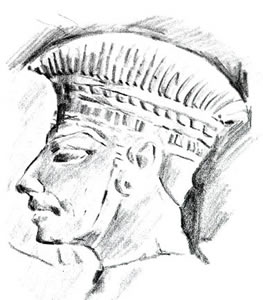
Bas relief of Philistine, Medinet Habu, Egypt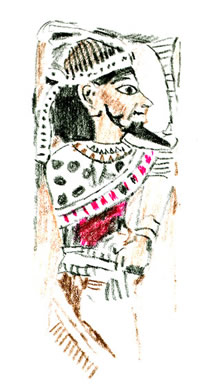
A Canaanite warrior captive, Medinet Habu, Glazed tile.
At first, the Israelites settled in the sparely settled eastern highlands, away from the coast, gradually spreading into the lower areas. The Bible gives the impression that the conquest of the area was a lightening blitz, but archaeological evidence and a careful reading of the Bible shows a much slower advance.
Canaan consisted of many diverse groups, loosely connected. There were large city states, and small satellite towns, each governed by a strong chieftain or king, and no central government.
The defensive structures of each city were different. Some had defensive walls of massive size, with steep inclines, moats, and massive gates with successive defensive layers through which those entering would have to pass. Some even had water sources inside the city walls, making them safe in times of siege. Other areas were small, unfortified villages.
Many of the conquered cities mentioned in the Bible have not yet been identified. Archaeological evidence shows that at this time, the end of the Bronze Age, many of these cities were burned, or destroyed, while others remained untouched. Perhaps some of these towns surrendered without a fight, perhaps joining the Israelite in rebellion against a difficult local leader.
Hazor and Jericho, which were larger and well fortified, put up a fight. There is evidence of great destruction in both cities. In fact, it can be seen that they were destroyed many times, in different wars against different peoples.
Jericho is particularly interesting. It is one of the oldest continuously inhabited cities in the world, and is still occupied. Archaeologists have searched the ruins areas for evidence of the walls tumbling at Joshua’s advance, but there are so many layers of walls, built upon other walls over the centuries, that it is difficult to identify any particular destruction and credit it to Joshua. Many areas had fallen walls, with the fall occurring over centuries. We also know that they didn’t fall completely all around the city, as Rahab’s house was still standing. Presumably her house was built into a casement wall. Casement walls are double walls, several yards apart, with rooms or
storage areas sandwiched into the space between. This gives the walls extra strength. Masada had casement walls. Jericho in also in an area prone to earthquakes.
However, it is obvious that a new culture moved into Canaan toward the end of the Bronze Age, with different structures and household objects. Storage vessels are found in abundance, for storage of grains and other farm products, indicating a simpler agrarian lifestyle. Some Canaanite cities were never defeated, remaining as pockets of idol worship that caused problems for the Israelites.
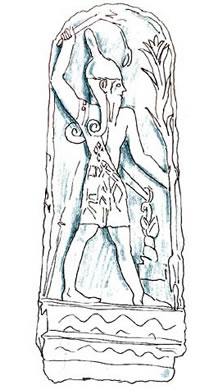
Stele showing Baal, the Canaanite god, ready to hurl a thunder bolt. Louvre
Over the years the Israelites came into contact with the Philistines who were expanding from their main five cities towards the inland. They were the major enemy during the period of the Judges, and were not defeated until the time of Saul and David – and even then not completely eradicated.
Israelite settlements are identifiable by their distinctive architecture. They built a structure known as the four-room house. There was a single room along the back, usually used for storage, and three parallel rooms extending from the front to the back storage room. The entry to the street was in the front, usually in the center of the three rooms. None of these buildings has been found remaining with walls higher than a meter or so, but the thickness of some of these walls indicates that there was probably a second story.
The central room was probably a courtyard with enclosed rooms with doors or openings at either side. This basic plan is followed with many variations of size and wall arrangements.
Why no documents have been found explaining why this design was so popular, one theory is that with a central room or courtyard that can access every other room, the home would have been convenient for the monthly time when the wife was considered unclean. She could have stayed inside the house, continued her work, but remained isolated from the men in the family by staying in the part of the house set aside for her. Men could access every other room without coming in contact with her. Finding a four-room house in any settlement identifies it as an Israelite area. No other cultures used this plan. In other cultures, you would have to go through one room to another to enter all the rooms. The roof would also have been usable, cool for sleeping in the hot times of year. Animals might have been kept in an area on the ground floor, and cooking could have been done in the central courtyard to keep the rest of the house cool.

An artist’s rendering of a typical Israelite four-room house.
2006 Meridian Magazine. All Rights Reserved.