







The Russian Church in Village Angelova
By Marvin R. VanDam
Editor’s note: This is the conclusion of a three-part series on Eastern Orthodox Christianity. To read “Baptism for the Dead in Ancient Ukraine,” click here. To read “Vestiges of Original Christianity in the Russian Orthodox Church,” click here.
On Moscow ‘s Fringe
Moscow is Europe ‘s largest city – and the world’s most expensive! It’s not known how many people live there – perhaps 14 million. Most residents are jammed into massive, dreary, Soviet-era apartment blocks, although costly penthouses in the centrum house oil-rich multi-millionaires and billionaires.
Newly-built dachas (country homes) house others of great wealth who, in the free-for-all when the Soviet Union disintegrated in 1991, took advantage of the collapse of Russia ‘s government and economy.
Moscow ‘s centrum, which straddles the winding Moskwa River , is dominated by the Kremlin (meaning “fortress”), the seat of Russia ‘s federal government. Communist dictator Joseph Stalin destroyed most church buildings throughout Russia , but you can still see the onion domes of the Russian Orthodox churches that survived as monuments.

The gold-leafed domes of one of several Russian Orthodox churches inside the Kremlin’s walls. All photos by Marvin R. VanDam.
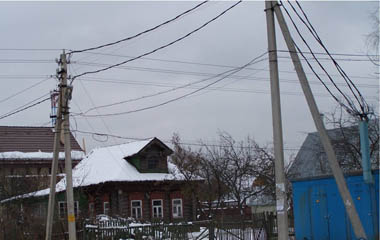
Crowded, cosmopolitan Moscow is, however, not representative of Russia generally. For the most part, Russia was – and still is – a peasant society. This is typified by the quiet little Village Angelova, which lies just beyond the northwest edge of Moscow . Angelova is typical Russia , with bric-a-brac-adorned wooden houses built generations ago, most of which are in various states of disrepair and clutter.
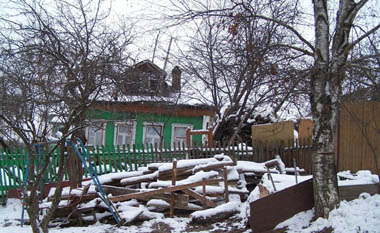
A typical Russian home in Village Angelova.
Some residents keep their houses up, repainting them and their gingerbread trim in traditional blues, greens, reds, yellows, whites, and other bright colors.
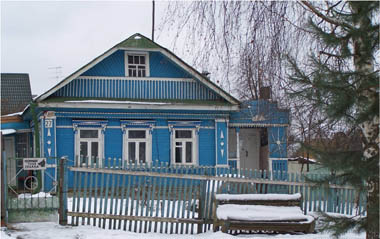
A well maintained bric-a-brac wooden home in Village Angelova.
Angelova’s meager population is beginning to grow as the wealthy in Moscow build homes in the villages and country surrounding the city.
The Church in Village Angelova
Through the rear windows of our modest (by American standards) townhouse in the expatriates housing community of Rosinka, which lies adjacent to Village Angelova, we had a good view of the onion domes of the Russian Orthodox church in the village. The church’s exterior is plain and simple. It’s interior, however, is not, being filled with much gold and silver, icons, carved woodwork, and other finery.

The Russian Orthodox church in Village Angelova, on the edge of Moscow.
A Snowy Sunday Morning
On a snowy and cold (below zero) Sunday morning early in 2006, my wife, Sandy, and I entered Village Angelova’s small church through its arched wooden doors. Its interior floor is of plain beige ceramic tile except for a decorative aisle of tiles running to the front of the sanctuary.
The church has a complex footprint – basically a compressed Greek cross, approximately 60 feet long and 40 feet wide. The walls are bordered by gold-framed columns and for the rest are mostly covered with icons (worship paintings on wood) of Christ, Mary and Christ, the Saints, and scenes from biblical stories. A major painting, filling a half-rounded archway, is of Jesus entering Jerusalem at Passover.
The interior of the church’s dome is painted in delicate patterns. Beneath it hangs a large gilded chandelier. Under that, beside candle stands, are two wooden stands with fresh flowers. To either side of the worshipers’ sanctuary are five tall, clear-glass windows for natural light, which are protected by decorative iron gratings on the outside. On the window sills are potted plants. At the rear and to either side of the worship nave are booths where candles, small icon reproductions, pamphlets, books, and various religious trinkets are sold.
Prominent inside the church, in front of the raised and screened holy sanctuary (which forms the upper member of the cross), are nine gilded candle stands, and eight wooden lecterns of carved wood that are draped with decorative cloths and topped with vertically affixed icons.
Much in the church is covered with pure gold leaf (as is the gilding that covers the golden church onion domes that remain here and there throughout Russia ). Gold, diamonds and other precious substances were mined in the eastern Urals, the ancient low range of mountains that officially divides Europe from Asia .
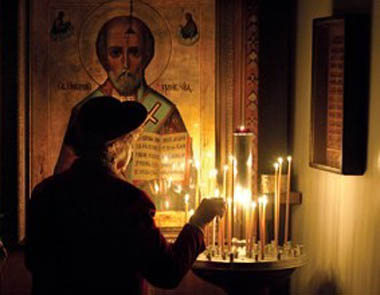
One of the many candle stands in an orthodox church. Russian babushkas (elderly grandmothers) tend to them throughout the day, snuffing and removing spent candles, rearranging the remaining ones, and cleaning and polishing the candle stands.
The attendees at the mass purchase tall, thin yellowish-brown candle tapers (4 lengths, 4 prices), which they light from the already-burning candles on the stands. Two older women in bandana scarves ( babushkas – the venerable Russian grandmothers) keep busy throughout the day snuffing spent candles, removing the stubs, rearranging the lit ones, and cleaning and polishing the candle stands.
Conspicuous by their absence are chairs for worshipers to sit on. All stand and kneel throughout the extended church service, which lasts several hours.
The Priest
During much of the service one hears the chantings of the bearded, gold-berobed priest. He spends much time behind the richly gilded and decorated screen of panelings and doors that separate the congregational sanctuary from the holy sanctuary and its altar, which is two steps up from the former.
A portion of the priest’s time is also spent with the congregation in the lower sanctuary.
During portions of the service one also hears the co-chantings, in musical harmony, of a trio of two women and one man (and later an additional woman) in a small balcony to the rear.
In attendance at the beginning of the service were seven women worshippers, one man, and one small child (a family), all standing, mostly with heads bowed and making the sign of the cross from time to time.
Much of Ceremony
At one point the priest came out of the sanctuary, bearing a large Bible in a beautifully carved and gilded wooden frame. Later he came forward, blessing many items in the church with incense from the golden burner he waved ceremoniously to the background of the chantings of the quartet in the loft. During this ceremony, the worshippers knelt, crossing themselves repeatedly and bending forward to place their faces on the floor for several minutes. The priest then read out loud from books on the lecterns.
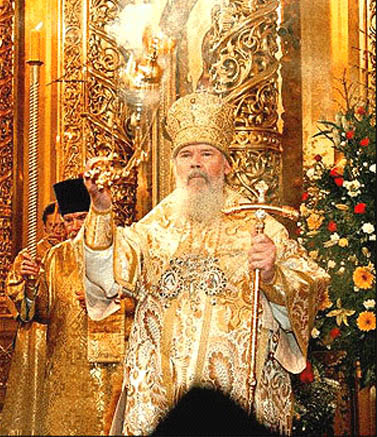
A gold robed Orthodox priest performing the incense ceremony.
As the priest finally read from the front-left lectern while standing on a special rug, the worshippers lined up behind him for individual confessions and blessings. A young child came forward first. The priest spoke with him but didn’t appear to take a confession. He then pulled the child into his bosom, laid his hands on the child’s head, and pronounced a blessing. The child, in turn, kissed the priest’s book and golden crucifix.
During the confessions the babushkas watered the plants with a decorative ceramic pitcher, tended to the candles, and cleaned up generally.
After the children came the adults, who bowed their heads before the priest, and who, with his hands on their heads, conversed with him. After also kissing his book and crucifix, they laid paper money on a small stand beside the lectern. The singers in the loft continued their musical chantings.
By this time, several other worshippers had come in from outside, where it continued to snow heavily. Several women wore ankle-length furs coats. By the end of the service there were fifteen women, two men, and five children worshipers, including the singers but not ourselves.
The tinny-sounding bells in the tower began to ring as the priest finally came forward through the double-arched golden doors bearing the chalice of sacramental substance that he had blessed, and which was covered with a crimson cloth. He spooned a little into each person’s mouth, the children first (who had their arms tightly folded), each recipient kissing the priest’s crucifix and hand.
The priest then spoke to the congregation – and his robed assistant walked out of the side door of the upper sanctuary talking on his cell phone.
Tea Time
Following the sacrament service, all of the participants, including the assistant to the priest who had been a visible part of much that transpired, went to the center windows on the right for hot tea and cookies – and fruit and sweets for the children. (The babushkas had brought the tea service in during the sacrament.) The babushkas then cleaned everything up, including vigorously polishing every element on the candle stands, and put all away. The quartet sang, the priest joining in, and he then performed a final round of incense.
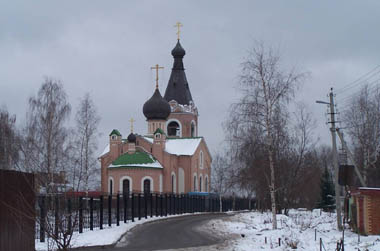
The traditional Russian Orthodox Church in Village Angelova.
Outside, amongst the old cottages and ubiquitous eastern European white birches, the snow kept falling. Nearly three hours after the service began, people began to leave the village church. Several were friendly to us, having invited us forward for confession and sacrament. We declined by saying we only speak “par Angleeskee” (“after the manner of the English”).
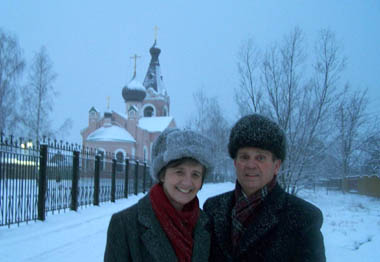
Marv and Sandy VanDam near Village Angelova’s church on a less snowy day
(though still very cold).
Easter in Traditional Russia
In traditional Russia , Easter was for many centuries the highest holy day of the year. In fact, the Russian word for Sunday continues to be “Vaskreshyenya” – literally, “the Resurrection.” Although few Russians go to church any more, many still attend midnight mass on the eve of Easter.
The Russian folk custom used to be that children, on Easter Sunday, would go to the doors of nearby relatives and friends exclaiming: “Jesus was resurrected!” The hearer would in turn respond, “Truly He was!” – and would give the little bearer of the glad resurrection tiding a muffin or piece of candy.
Many generations of Russian children have grown up in quiet Village Angelova.